

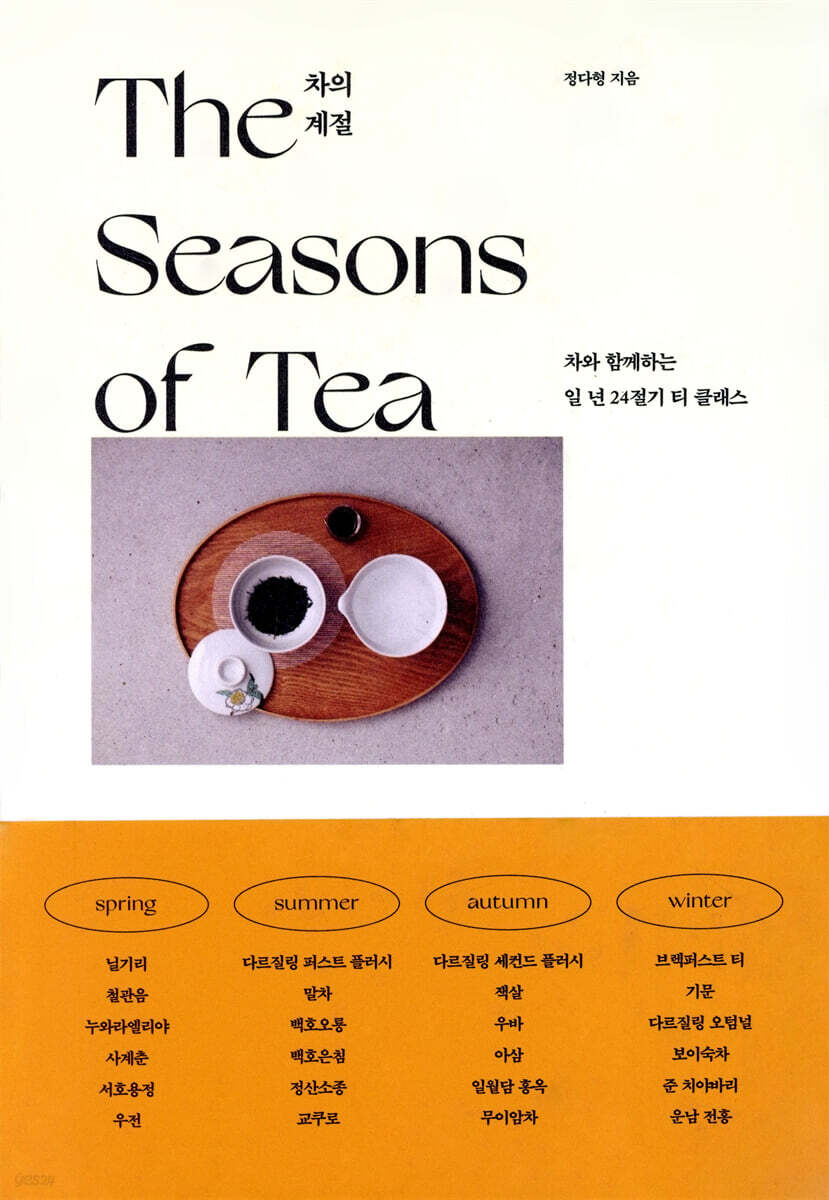
The Seasons of Tea
 |
Description
Book Introduction
The 24 solar terms of the year, the flow of seasons,
Everything about tea that we meet together
Green tea, black tea, white tea, green tea, breakfast tea...
For those who love and enjoy tea
A practical and beautiful guidebook for tea life!
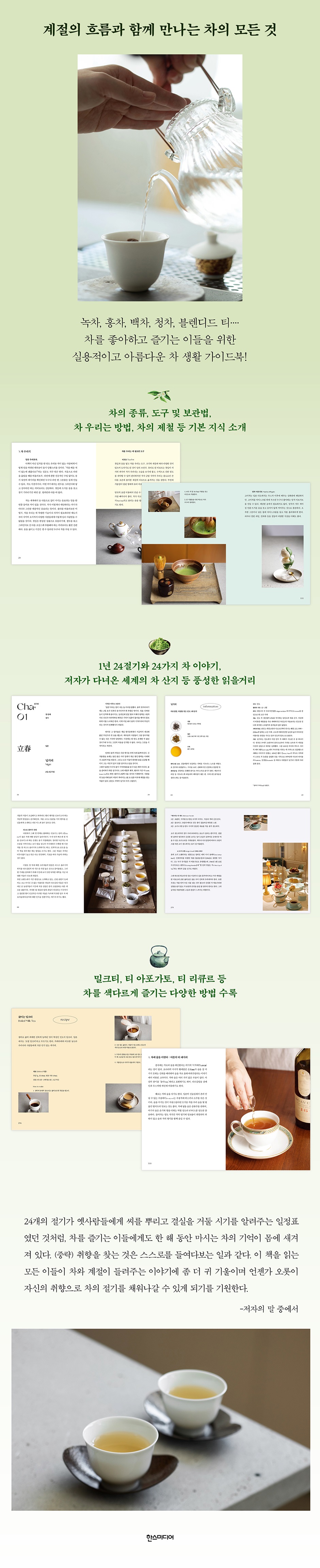
Discover the 24 solar terms that perfectly capture the seasons and passage of time throughout the year, along with fragrant teas that suit each season.
We have introduced the customs of each season, such as the beginning of spring, the beginning of autumn, the beginning of winter, the winter solstice, etc., which served as milestones in life for people in the past, along with major teas from around the world that go well with them.
The author, a professional tea director with extensive experience studying tea, introduces basic knowledge about tea, including types of tea, tea brewing methods, and tea seasons, in an easy-to-understand format.
In addition, we have included various ways to enjoy tea in a unique way, such as milk tea, iced tea, fruit tea, and tea liqueur recipes for tea lovers.
Discover the beautiful tea time flowing with the seasons of nature through this book.
Everything about tea that we meet together
Green tea, black tea, white tea, green tea, breakfast tea...
For those who love and enjoy tea
A practical and beautiful guidebook for tea life!
Discover the 24 solar terms that perfectly capture the seasons and passage of time throughout the year, along with fragrant teas that suit each season.
We have introduced the customs of each season, such as the beginning of spring, the beginning of autumn, the beginning of winter, the winter solstice, etc., which served as milestones in life for people in the past, along with major teas from around the world that go well with them.
The author, a professional tea director with extensive experience studying tea, introduces basic knowledge about tea, including types of tea, tea brewing methods, and tea seasons, in an easy-to-understand format.
In addition, we have included various ways to enjoy tea in a unique way, such as milk tea, iced tea, fruit tea, and tea liqueur recipes for tea lovers.
Discover the beautiful tea time flowing with the seasons of nature through this book.
- You can preview some of the book's contents.
Preview
index
Entering
Chapter 1: The First Encounter with a Car
1.
Types of tea
2.
How to store tea
3.
Tea ceremony
Tools we need to make tea
Our teapot
Our flag with a dog
4.
Tea season
Chapter 2 Seasons and Tea
spring
Ipchun / Nilgiri: One of India's three major mountain ranges, following Darjeeling and Assam.
Excellent / Tieguanyin: The most popular green tea in China
Kyeongchip / Nuwara Eliya: The Champagne of Ceylon Tea
Vernal Equinox / Four Seasons Spring: Spring all year round
Qingming / Xihu Longjing: China's Most Beloved Green Tea
Grain Rain / Ujeon: The first tea of the year
summer
Arrival / Darjeeling First Flush: Darjeeling tea harvested in spring
lesson Darjeeling story
Soman / Matcha: The original form of tea that has been passed down since the Song Dynasty
lesson Matcha We are the law
Mangjong / Baekho Oryong: The Oriental Beauty Who Captivated the West
Haji / Baekho Silver Needle: The King of White Tea, Embracing Nature
Soseo / Jeongsansojong: The world's first black tea
lesson Jeongsansojong and Lapsangsouchong
Daeseo / Gyokuro: A strange yet familiar umami flavor
lesson Gyokuro we are the law
autumn
Ipchu / Darjeeling Second Flush: The Champagne of Black Tea
lesson Muscatel flavor
Cheoseo / Jacksal: Our fermented tea that resembles a sparrow's tongue
White Heron / Uva: Menthol brought by the monsoon wind
lesson Explore Sri Lanka
Equinox / Assam: The Origins of British Black Tea
lesson Indian Chai culture
Hanro / Ilwoldam Hongok: A New Black Tea Beyond East and West
Sanggang / Muiamcha: Green tea with a strong rock-bone fragrance
lesson Representative varieties of Mui Amcha
winter
Ipdong / Breakfast Tea: All the Mornings of the World
lesson scones and black tea, cream tea
Lesson: Making Your Own Breakfast Tea: Tea Blending Basics
Novel / Essay: Black tea resembling Burgundy wine
Heavy Snow / Darjeeling Autumn: Sweet and Deep Darjeeling
Dongji / Boisukcha: A post-fermented tea as black as night
Sohan / Jun Chiyabari: The Future of Tea Plantations
lesson Is Nepalese tea a Darjeeling knockoff?
Daehan / Yunnan Jeonhong: Black tea from the home of the tea tree
lesson The land of tea, England
Chapter 3: A Different Way of Seeing Tea
1.
Add ice to tea: iced tea
Rapid-frozen iced tea
Cold brew iced tea
2.
Add milk to tea: milk tea
Basic milk tea
Boiling milk tea
Masala Chai
Microwave milk tea
iced milk tea
Cold brewed milk tea
3.
Add fruit to tea
Lemon tea
Russian tea
4.
Adding Alcohol to Tea: Adult Tea Recipes
Hot Toddy
Matcha beer
tea liqueur
Tea Table with Three Scenes
British tea time on Sunday afternoon
A seasonal tea ceremony filled with seasonal delights
A cozy tea table with family
Learn more
1.
Tea and six kinds of tea
2.
Tea tasting
Tea Tasting Process
Tea Tasting Terminology
Tea Flavor Wheel
3.
Grades of black tea
Chapter 1: The First Encounter with a Car
1.
Types of tea
2.
How to store tea
3.
Tea ceremony
Tools we need to make tea
Our teapot
Our flag with a dog
4.
Tea season
Chapter 2 Seasons and Tea
spring
Ipchun / Nilgiri: One of India's three major mountain ranges, following Darjeeling and Assam.
Excellent / Tieguanyin: The most popular green tea in China
Kyeongchip / Nuwara Eliya: The Champagne of Ceylon Tea
Vernal Equinox / Four Seasons Spring: Spring all year round
Qingming / Xihu Longjing: China's Most Beloved Green Tea
Grain Rain / Ujeon: The first tea of the year
summer
Arrival / Darjeeling First Flush: Darjeeling tea harvested in spring
lesson Darjeeling story
Soman / Matcha: The original form of tea that has been passed down since the Song Dynasty
lesson Matcha We are the law
Mangjong / Baekho Oryong: The Oriental Beauty Who Captivated the West
Haji / Baekho Silver Needle: The King of White Tea, Embracing Nature
Soseo / Jeongsansojong: The world's first black tea
lesson Jeongsansojong and Lapsangsouchong
Daeseo / Gyokuro: A strange yet familiar umami flavor
lesson Gyokuro we are the law
autumn
Ipchu / Darjeeling Second Flush: The Champagne of Black Tea
lesson Muscatel flavor
Cheoseo / Jacksal: Our fermented tea that resembles a sparrow's tongue
White Heron / Uva: Menthol brought by the monsoon wind
lesson Explore Sri Lanka
Equinox / Assam: The Origins of British Black Tea
lesson Indian Chai culture
Hanro / Ilwoldam Hongok: A New Black Tea Beyond East and West
Sanggang / Muiamcha: Green tea with a strong rock-bone fragrance
lesson Representative varieties of Mui Amcha
winter
Ipdong / Breakfast Tea: All the Mornings of the World
lesson scones and black tea, cream tea
Lesson: Making Your Own Breakfast Tea: Tea Blending Basics
Novel / Essay: Black tea resembling Burgundy wine
Heavy Snow / Darjeeling Autumn: Sweet and Deep Darjeeling
Dongji / Boisukcha: A post-fermented tea as black as night
Sohan / Jun Chiyabari: The Future of Tea Plantations
lesson Is Nepalese tea a Darjeeling knockoff?
Daehan / Yunnan Jeonhong: Black tea from the home of the tea tree
lesson The land of tea, England
Chapter 3: A Different Way of Seeing Tea
1.
Add ice to tea: iced tea
Rapid-frozen iced tea
Cold brew iced tea
2.
Add milk to tea: milk tea
Basic milk tea
Boiling milk tea
Masala Chai
Microwave milk tea
iced milk tea
Cold brewed milk tea
3.
Add fruit to tea
Lemon tea
Russian tea
4.
Adding Alcohol to Tea: Adult Tea Recipes
Hot Toddy
Matcha beer
tea liqueur
Tea Table with Three Scenes
British tea time on Sunday afternoon
A seasonal tea ceremony filled with seasonal delights
A cozy tea table with family
Learn more
1.
Tea and six kinds of tea
2.
Tea tasting
Tea Tasting Process
Tea Tasting Terminology
Tea Flavor Wheel
3.
Grades of black tea
Detailed image
Into the book
Like all crops, tea has its season.
It sprouts in spring, grows luxuriantly in summer, blooms and bears fruit in fall, and hibernates in winter.
Due to the nature of tea trees growing in subtropical to tropical climates, there are places where harvesting is possible all year round, but among them, there is a season when the quality is the best.
This is called the season, or 'Quality Season'.
--- p.
30
The beginning of spring is not a time when everyone can tell that spring has begun, but rather a time to prepare for spring.
When we talk about seasonal teas and quality seasonal teas, we usually expect them to be available around March or April, but there are some teas that are in season at the beginning of February, when the seeds of spring are sown, avoiding people's eyes.
Like Nilgiri tea from South India.
--- p.
39
It is often said that among all car technicians, the carbon technician is the most highly regarded, as the carbonization process is very difficult and demanding.
To make traditional Tieguanyin, charcoal made from fruit trees such as longan is burned, a bamboo bowl filled with tea is placed on top, and the tea leaves are gently cooked at a low temperature to prevent them from burning.
In addition, in order to evenly distribute the tea, the branches must first be removed, and during the process of applying heat, the volume and weight of the tea are naturally greatly reduced.
--- p.
50
The sight of flat, pressed tea leaves slowly rising and unfolding as they absorb water is as enchanting as a flower blooming.
The tea is so thin that it makes you wonder if too few leaves were added or if it was steeped too short, but the fresh and savory scent of steamed vegetables fills your nose, and a clear spring field unfolds above it.
It has a simple charm that comes from the subtle sweetness of fresh tea leaves.
--- p.
71
The scent of Jeongsansojong, which is imbued with the smoke from burning Mami pine trees that grow widely in the Muui Mountain and Dongmokchon areas, may feel somewhat strong at first.
But even that is as secretive and alluring as the smell of a poem in broad daylight.
The use of local fuel to infuse the aroma brings to mind the whisky from the Scottish island of Islay, which is distilled by burning peat with a hint of the sea.
However, the aroma is still too foreign to be called tea, so you might not be able to reach for a cup. However, if you muster up the courage to take a sip, you will be surprised by the gentle sweetness that gently coats your mouth.
--- p.
133
In Korea, where the first tea of the year is considered important, many people tend to think that the first flush is the most outstanding, but the season when Darjeeling tea's identity is most clearly revealed is the second flush season in summer.
After the first flush harvest and in May, Darjeeling enters a short rest period of about ten to fifteen days.
Then, the second flush season begins again, and the period before the rainy season arrives.
--- p.
157
Black tea or not, Jacksall is a lovely tea.
The faint scent of azalea lingers above the refreshing scent of barley fruit warmed by the late summer sun.
It has a deep sweetness like a ripe daebongsi or sun-dried tomato, and its taste is round without any sharp corners, making it good to keep on hand and drink often. It does not become bitter even if you boil it roughly in a kettle.
--- p.
172
It is the name of the world's most common black tea that can be found anywhere, but each company makes it with a different recipe, so master tea blenders pour their heart and soul into making it by incorporating their own philosophy on tea.
If you want to know right away what kind of thoughts the company has when selecting and blending tea when you first encounter a tea brand, choose Breakfast Tea.
Because the Breakfast Blend is the heart and identity of the tea brand itself.
It sprouts in spring, grows luxuriantly in summer, blooms and bears fruit in fall, and hibernates in winter.
Due to the nature of tea trees growing in subtropical to tropical climates, there are places where harvesting is possible all year round, but among them, there is a season when the quality is the best.
This is called the season, or 'Quality Season'.
--- p.
30
The beginning of spring is not a time when everyone can tell that spring has begun, but rather a time to prepare for spring.
When we talk about seasonal teas and quality seasonal teas, we usually expect them to be available around March or April, but there are some teas that are in season at the beginning of February, when the seeds of spring are sown, avoiding people's eyes.
Like Nilgiri tea from South India.
--- p.
39
It is often said that among all car technicians, the carbon technician is the most highly regarded, as the carbonization process is very difficult and demanding.
To make traditional Tieguanyin, charcoal made from fruit trees such as longan is burned, a bamboo bowl filled with tea is placed on top, and the tea leaves are gently cooked at a low temperature to prevent them from burning.
In addition, in order to evenly distribute the tea, the branches must first be removed, and during the process of applying heat, the volume and weight of the tea are naturally greatly reduced.
--- p.
50
The sight of flat, pressed tea leaves slowly rising and unfolding as they absorb water is as enchanting as a flower blooming.
The tea is so thin that it makes you wonder if too few leaves were added or if it was steeped too short, but the fresh and savory scent of steamed vegetables fills your nose, and a clear spring field unfolds above it.
It has a simple charm that comes from the subtle sweetness of fresh tea leaves.
--- p.
71
The scent of Jeongsansojong, which is imbued with the smoke from burning Mami pine trees that grow widely in the Muui Mountain and Dongmokchon areas, may feel somewhat strong at first.
But even that is as secretive and alluring as the smell of a poem in broad daylight.
The use of local fuel to infuse the aroma brings to mind the whisky from the Scottish island of Islay, which is distilled by burning peat with a hint of the sea.
However, the aroma is still too foreign to be called tea, so you might not be able to reach for a cup. However, if you muster up the courage to take a sip, you will be surprised by the gentle sweetness that gently coats your mouth.
--- p.
133
In Korea, where the first tea of the year is considered important, many people tend to think that the first flush is the most outstanding, but the season when Darjeeling tea's identity is most clearly revealed is the second flush season in summer.
After the first flush harvest and in May, Darjeeling enters a short rest period of about ten to fifteen days.
Then, the second flush season begins again, and the period before the rainy season arrives.
--- p.
157
Black tea or not, Jacksall is a lovely tea.
The faint scent of azalea lingers above the refreshing scent of barley fruit warmed by the late summer sun.
It has a deep sweetness like a ripe daebongsi or sun-dried tomato, and its taste is round without any sharp corners, making it good to keep on hand and drink often. It does not become bitter even if you boil it roughly in a kettle.
--- p.
172
It is the name of the world's most common black tea that can be found anywhere, but each company makes it with a different recipe, so master tea blenders pour their heart and soul into making it by incorporating their own philosophy on tea.
If you want to know right away what kind of thoughts the company has when selecting and blending tea when you first encounter a tea brand, choose Breakfast Tea.
Because the Breakfast Blend is the heart and identity of the tea brand itself.
--- p.
218
218
Publisher's Review
24 seasons of the year x 24 tea stories
A rich and interesting read about seasons and tea.
The four seasons of the year, the twenty-four solar terms naturally learned by the ancient sages as they sowed seeds, grew crops, and harvested them, are like a map of the time we live in.
As the time of tea also flows with the seasons, this book introduces teas from around the world that match the 24 solar terms.
Comprised of 23 single-origin teas and one blended tea, the encounter between tea and season tells an intriguing journey from the distant mountains where the teas were born and grown to their fragrant flavor in our teacups.
This book vividly introduces the colorful stories of tea, culture, and time spanning centuries, including spring Nilgiri tea from India's 'Blue Mountains', China's West Lake Longjing that brings to mind gentle love songs, Darjeeling, the three stories of Darjeeling created in the British Empire's dreamy land of black tea, Matcha and Gyokuro with their deep green flavors, Taiwan's White Tiger Oolong where a bug-inspired flaw was reborn with a beautiful fragrance, our warm and cozy teas Wuchen and Jacksall, and Assam and British tea culture that became the beginning of British black tea.
In addition, you can also hear the author's unique stories from his travels to various tea producing regions, including India, Sri Lanka, China, Taiwan, Japan, Korea, and the UK.
From basic knowledge for tea beginners to in-depth information for enthusiasts.
Contains practical information and know-how for enjoying tea in everyday life.
This book is also packed with colorful and practical information for both beginners and tea enthusiasts.
The book provides detailed explanations with photos on the types of tea, basic tools and tea storage methods, and how to brew various types of tea deliciously. It also organizes the 'tea seasons (quality seasons)' in which tea is produced in the world's major tea-producing regions, such as India, Sri Lanka, China, Japan, Korea, and Taiwan, in easy-to-understand text and tables.
In addition to straight tea, we also introduced ways to enjoy tea in a more delicious and unique way by adding various ingredients such as milk tea, iced tea, fruit tea, and tea liqueur.
The milk tea section provides detailed guidance on how to enjoy the taste of milk tea in six different ways, and also includes the author's own tea pairing tips for various flavors of tea and fruit, tea and alcohol, and other ingredients.
In addition, it contains a variety of in-depth knowledge and practical information about tea, including tea table settings, tea tasting terms and methods, the tea flavor wheel, and grades of black tea.
This book contains beautiful and fascinating stories about tea and the seasons, as well as a wealth of knowledge and information needed to enjoy tea in your daily life.
“Just as the 24 solar terms served as a calendar for ancient people, indicating the time to sow and harvest, so too do tea lovers have memories of the tea they drink throughout the year engraved in their bodies.
(Omitted) Finding your taste is like looking into yourself.
I hope that everyone who reads this book will listen more attentively to the stories that tea and the seasons tell, and that one day they will be able to fill the tea season with their own unique tastes.”
- From the "Prologue"
A rich and interesting read about seasons and tea.
The four seasons of the year, the twenty-four solar terms naturally learned by the ancient sages as they sowed seeds, grew crops, and harvested them, are like a map of the time we live in.
As the time of tea also flows with the seasons, this book introduces teas from around the world that match the 24 solar terms.
Comprised of 23 single-origin teas and one blended tea, the encounter between tea and season tells an intriguing journey from the distant mountains where the teas were born and grown to their fragrant flavor in our teacups.
This book vividly introduces the colorful stories of tea, culture, and time spanning centuries, including spring Nilgiri tea from India's 'Blue Mountains', China's West Lake Longjing that brings to mind gentle love songs, Darjeeling, the three stories of Darjeeling created in the British Empire's dreamy land of black tea, Matcha and Gyokuro with their deep green flavors, Taiwan's White Tiger Oolong where a bug-inspired flaw was reborn with a beautiful fragrance, our warm and cozy teas Wuchen and Jacksall, and Assam and British tea culture that became the beginning of British black tea.
In addition, you can also hear the author's unique stories from his travels to various tea producing regions, including India, Sri Lanka, China, Taiwan, Japan, Korea, and the UK.
From basic knowledge for tea beginners to in-depth information for enthusiasts.
Contains practical information and know-how for enjoying tea in everyday life.
This book is also packed with colorful and practical information for both beginners and tea enthusiasts.
The book provides detailed explanations with photos on the types of tea, basic tools and tea storage methods, and how to brew various types of tea deliciously. It also organizes the 'tea seasons (quality seasons)' in which tea is produced in the world's major tea-producing regions, such as India, Sri Lanka, China, Japan, Korea, and Taiwan, in easy-to-understand text and tables.
In addition to straight tea, we also introduced ways to enjoy tea in a more delicious and unique way by adding various ingredients such as milk tea, iced tea, fruit tea, and tea liqueur.
The milk tea section provides detailed guidance on how to enjoy the taste of milk tea in six different ways, and also includes the author's own tea pairing tips for various flavors of tea and fruit, tea and alcohol, and other ingredients.
In addition, it contains a variety of in-depth knowledge and practical information about tea, including tea table settings, tea tasting terms and methods, the tea flavor wheel, and grades of black tea.
This book contains beautiful and fascinating stories about tea and the seasons, as well as a wealth of knowledge and information needed to enjoy tea in your daily life.
“Just as the 24 solar terms served as a calendar for ancient people, indicating the time to sow and harvest, so too do tea lovers have memories of the tea they drink throughout the year engraved in their bodies.
(Omitted) Finding your taste is like looking into yourself.
I hope that everyone who reads this book will listen more attentively to the stories that tea and the seasons tell, and that one day they will be able to fill the tea season with their own unique tastes.”
- From the "Prologue"
GOODS SPECIFICS
- Date of issue: January 13, 2022
- Format: Hardcover book binding method guide
- Page count, weight, size: 356 pages | 796g | 152*218*30mm
- ISBN13: 9791160077704
- ISBN10: 1160077703
You may also like
카테고리
korean


korean

![GQ KOREA Mark (Monthly): December [2025]](http://librairie.coreenne.fr/cdn/shop/files/8ef265dbbfbf186523ed75ba7319009d.jpg?v=1765340328&width=3840)


