

Impostor
 |
Description
Book Introduction
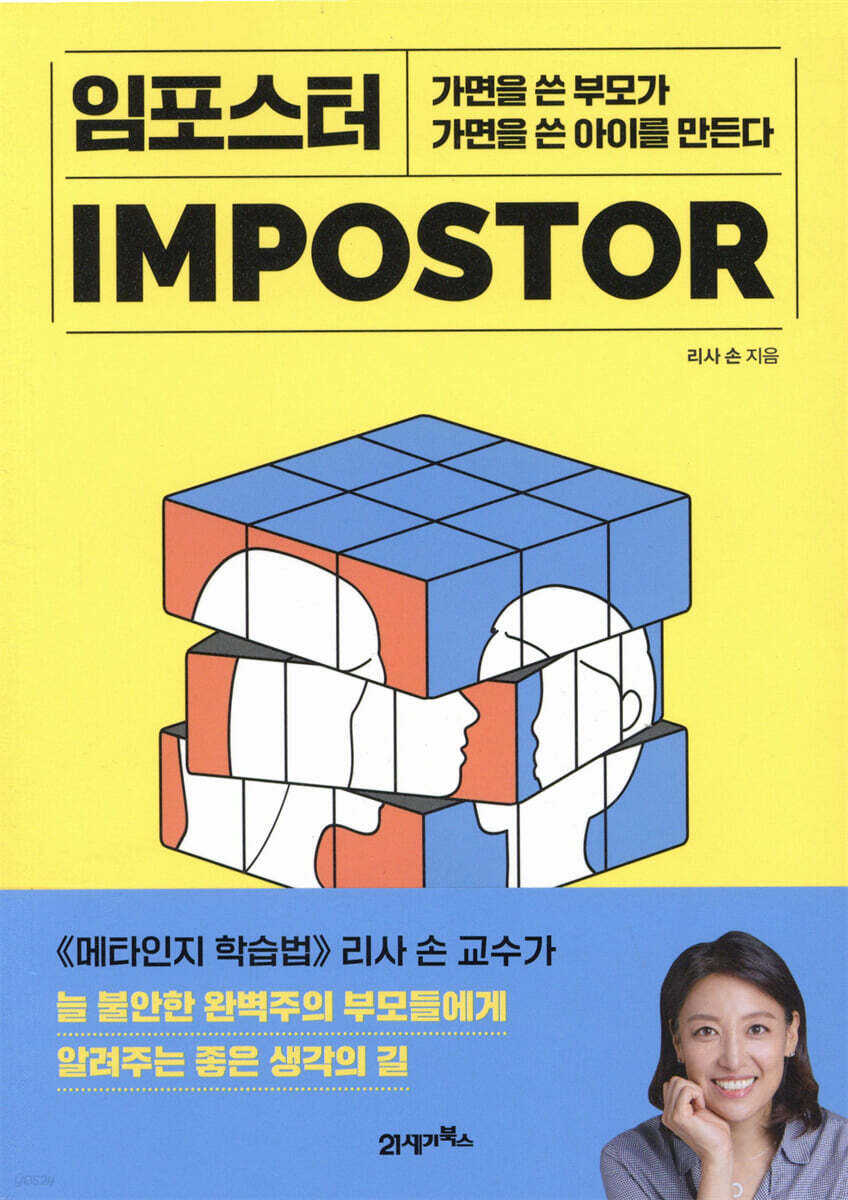
“Parents, let your children know that you are a complete being even when you take off your mask.” Professor Lisa Son's book, Metacognitive Learning Methods A good way to think for parents who live with masks on. “You always have to be perfect,” “You have to do it right from the start,” “You can’t act like you’re smart”… … From childhood, we wear the masks that come with these thoughts. A mask that looks perfect, a genius mask, a good kid mask. Especially in our country, where studying and learning are considered top priorities, children grow up taking wearing masks for granted. There are so many Koreans who grow up to be 'Impostors' (meaning people who impersonate others, con artists) who suffer from imposter syndrome, a phenomenon in which they lose themselves and suffer from anxiety while wearing a mask. Even as adults, they have a hard time letting go of this anxiety, and they often pass the same mask on to their children. Professor Lisa Son, an expert in metacognitive psychology, confesses that she, too, lived wearing masks as a good daughter and a good student during her childhood, and as an adult, as a perfect mother and a great professor. Professor Son was able to discover his true self only through studying metacognition, and to help parents and children who, like him, are struggling with learning and growing, he included metacognitive practices that can free them from their masks in his new book, "Imposter." |
- You can preview some of the book's contents.
Preview
index
Prologue: “Mom, I have so many thoughts in my head!”
Introduction: Impostors begin in childhood.
Chapter 1.
The first metacognitive thinking method to take off the mask,
The road to happiness is bumpy.
People who believe their success is fake
Why Honest and Academicly Achievable Students Feel Anxious
The easiest mask to wear, test scores
What's Hidden Behind Perfect Results
The 'Path of Thought' Necessary for Everyone's Growth
Everyone has a different way of reaching their goals.
The stereotype that 'a mature person is an old person'
Why Masks Are Dangerous
How to Praise Without Fear of Success
Let go of the idea that you have to do as much as others
What's more important than comparison is doing my best.
The moment you reveal your imperfect self, metacognition begins.
“We will continue to learn and learn more in the future.”
[Summary] Metacognitive Practices for True Happiness
Chapter 2.
Second metacognitive thinking method for removing the mask,
Every child goes through a period of uncertainty.
The mindset of parents who believe their children are originally good
The Risk of Imposter Parents Raising Imposter Children
The ability to step out of the present and think about the future
What you learn today you may forget tomorrow.
The mistake of erasing past trials and errors from memory
Impostor who fears feedback
When 'giving up' is necessary from a metacognitive perspective
If you don't want to pass down the mask...
Why Freshmen Are at High Risk for Becoming Imposters
The idea that you already know everything is a mistake.
A word of advice for a child who matures early
A child who wears the good daughter mask becomes a perfectionist mother.
Think about why it's wrong rather than why it's right
We must shake off the anxiety that "I'm the only one who doesn't know."
[Summary] Metacognitive Practices to Overcome Hindsight Bias
Chapter 3.
The third metacognitive thinking method for taking off the mask,
True humility is knowing how to ask for help.
The moment when the virtue of humility becomes a mask
“Why are you acting so smart?”
Emphasizing your flaws isn't metacognition.
Why can't I trust that my child has studied enough?
It's not humility that motivates, it's interest
The expectation that if you unconditionally agree, you will like me
The problem with focusing only on what's lacking
The psychology of wanting to do well but fearing rewards
Is it a good thing to take responsibility for everything alone?
Practice looking at yourself objectively first
Children also develop their parents' metacognition.
It's not humility that kills a child's spirit.
We can be good teachers to each other.
Who can set the most accurate standards?
Metacognitive humility that recognizes my strengths
[Summary] Metacognitive Practices for Healthy Humility
Chapter 4.
'Caught Learning' for Parents and Children
Can you live your whole life wearing a mask?
Getting caught also requires learning.
Children who abandon metacognition for fear of disappointing their parents
Prerequisites for implementing detection learning
With the mindset of 'let's do a little more'
The moment you take off your mask is optional.
How to Make Healthy Mask Play Possible
The coolest mask is myself
Epilogue: A Thoughtful Path for Parents Still Living as Imposters
Acknowledgements
Acknowledgement
References
Introduction: Impostors begin in childhood.
Chapter 1.
The first metacognitive thinking method to take off the mask,
The road to happiness is bumpy.
People who believe their success is fake
Why Honest and Academicly Achievable Students Feel Anxious
The easiest mask to wear, test scores
What's Hidden Behind Perfect Results
The 'Path of Thought' Necessary for Everyone's Growth
Everyone has a different way of reaching their goals.
The stereotype that 'a mature person is an old person'
Why Masks Are Dangerous
How to Praise Without Fear of Success
Let go of the idea that you have to do as much as others
What's more important than comparison is doing my best.
The moment you reveal your imperfect self, metacognition begins.
“We will continue to learn and learn more in the future.”
[Summary] Metacognitive Practices for True Happiness
Chapter 2.
Second metacognitive thinking method for removing the mask,
Every child goes through a period of uncertainty.
The mindset of parents who believe their children are originally good
The Risk of Imposter Parents Raising Imposter Children
The ability to step out of the present and think about the future
What you learn today you may forget tomorrow.
The mistake of erasing past trials and errors from memory
Impostor who fears feedback
When 'giving up' is necessary from a metacognitive perspective
If you don't want to pass down the mask...
Why Freshmen Are at High Risk for Becoming Imposters
The idea that you already know everything is a mistake.
A word of advice for a child who matures early
A child who wears the good daughter mask becomes a perfectionist mother.
Think about why it's wrong rather than why it's right
We must shake off the anxiety that "I'm the only one who doesn't know."
[Summary] Metacognitive Practices to Overcome Hindsight Bias
Chapter 3.
The third metacognitive thinking method for taking off the mask,
True humility is knowing how to ask for help.
The moment when the virtue of humility becomes a mask
“Why are you acting so smart?”
Emphasizing your flaws isn't metacognition.
Why can't I trust that my child has studied enough?
It's not humility that motivates, it's interest
The expectation that if you unconditionally agree, you will like me
The problem with focusing only on what's lacking
The psychology of wanting to do well but fearing rewards
Is it a good thing to take responsibility for everything alone?
Practice looking at yourself objectively first
Children also develop their parents' metacognition.
It's not humility that kills a child's spirit.
We can be good teachers to each other.
Who can set the most accurate standards?
Metacognitive humility that recognizes my strengths
[Summary] Metacognitive Practices for Healthy Humility
Chapter 4.
'Caught Learning' for Parents and Children
Can you live your whole life wearing a mask?
Getting caught also requires learning.
Children who abandon metacognition for fear of disappointing their parents
Prerequisites for implementing detection learning
With the mindset of 'let's do a little more'
The moment you take off your mask is optional.
How to Make Healthy Mask Play Possible
The coolest mask is myself
Epilogue: A Thoughtful Path for Parents Still Living as Imposters
Acknowledgements
Acknowledgement
References
Detailed image
.jpg)
Into the book
The first reason I wrote this book was to share the transformation process of how I, who had lived wearing a mask as an imposter, found my true self.
But there is another reason.
This is because I wanted to teach Korean readers who are accustomed to masks and have difficulty revealing and expressing themselves how to use metacognition to meet their true selves.
As I was organizing psychological experiments related to imposterism, I thought it was worth considering why people wear imposter masks, and why they maintain or remove them.
--- From "Introductory Remarks"
Children first learn to express their emotions through their parents.
Just because a child learns to express his or her emotions doesn't mean he or she will start to express all of his or her thoughts on his or her own.
Metacognition is the hidden thoughts within, and it is entirely up to the child to decide which of them to express and which to keep inside.
While it is important to respect a child's choices, parents must also guide their children well to avoid falling into imposterism.
First of all, it is good to allow the child to cry when he wants to cry, get angry when he wants to get angry, and get irritated when he wants to get annoyed.
When children are able to express their feelings, they can face and encounter their true selves.
--- From "Why Masks Become Dangerous"
Parents who only care about test scores put a huge burden on their children.
Even if your child gets a perfect score, it's a good idea to ask them again, "How was the test? Were there any questions that confused you? Which question was the most difficult?"
It is also important to encourage them that they do not need to feel psychologically burdened as if their entire life depends on one test.
For a child who's been getting good grades, instead of saying, "That's enough! My kid is really smart!", asking, "Good job! But what do you want to learn next?" will be more helpful for their development.
This is also in line with metacognitive learning methods.
When children are guided to monitor and control their future learning direction rather than being obsessed with past test scores, they can be freed from the burden of learning.
--- From "Let go of the idea that you have to do as much as others"
Since becoming an adult, I've always worn a mask because I thought, 'I wasn't particularly good at anything since I was young, I was just lucky and things worked out well for me.'
So I was always anxious.
But as I watched my children overcome their shortcomings through hard work, I was reminded of my own past.
Watching my children make mistakes and overcome them made me realize that I didn't get here just by luck.
I realized that I was able to get to this point by practicing metacognitive monitoring and controlling myself through my mistakes.
Seeing children learn through trial and error gave me the courage to take off my mask.
But there is another reason.
This is because I wanted to teach Korean readers who are accustomed to masks and have difficulty revealing and expressing themselves how to use metacognition to meet their true selves.
As I was organizing psychological experiments related to imposterism, I thought it was worth considering why people wear imposter masks, and why they maintain or remove them.
--- From "Introductory Remarks"
Children first learn to express their emotions through their parents.
Just because a child learns to express his or her emotions doesn't mean he or she will start to express all of his or her thoughts on his or her own.
Metacognition is the hidden thoughts within, and it is entirely up to the child to decide which of them to express and which to keep inside.
While it is important to respect a child's choices, parents must also guide their children well to avoid falling into imposterism.
First of all, it is good to allow the child to cry when he wants to cry, get angry when he wants to get angry, and get irritated when he wants to get annoyed.
When children are able to express their feelings, they can face and encounter their true selves.
--- From "Why Masks Become Dangerous"
Parents who only care about test scores put a huge burden on their children.
Even if your child gets a perfect score, it's a good idea to ask them again, "How was the test? Were there any questions that confused you? Which question was the most difficult?"
It is also important to encourage them that they do not need to feel psychologically burdened as if their entire life depends on one test.
For a child who's been getting good grades, instead of saying, "That's enough! My kid is really smart!", asking, "Good job! But what do you want to learn next?" will be more helpful for their development.
This is also in line with metacognitive learning methods.
When children are guided to monitor and control their future learning direction rather than being obsessed with past test scores, they can be freed from the burden of learning.
--- From "Let go of the idea that you have to do as much as others"
Since becoming an adult, I've always worn a mask because I thought, 'I wasn't particularly good at anything since I was young, I was just lucky and things worked out well for me.'
So I was always anxious.
But as I watched my children overcome their shortcomings through hard work, I was reminded of my own past.
Watching my children make mistakes and overcome them made me realize that I didn't get here just by luck.
I realized that I was able to get to this point by practicing metacognitive monitoring and controlling myself through my mistakes.
Seeing children learn through trial and error gave me the courage to take off my mask.
--- From "A Child Wearing a Good Daughter Mask Becomes a Perfectionist Mother"
Publisher's Review
Why does Professor Lisa Son focus on imposters?
Because imposters start from childhood!
Anyone can become an imposter.
Even when things go as planned, don't we often experience in our daily lives the feeling that we are deceiving others and that it is due to luck rather than ability?
In fact, the imposter phenomenon is also well known as imposter syndrome, but it is so common that it is said to be experienced by 70% of the entire American population, so the academic world classifies it as an experience or phenomenon rather than a disease.
The problem is that this phenomenon, so common that people don't take it seriously, interferes with our happiness.
Professor Lisa Son speculates that Korean children in particular may experience the pain caused by the imposter phenomenon more frequently.
In Korea, where high goals and grades are the only things that matter most, young students are at high risk of becoming imposters.
“Students who study hard or get good grades may appear happy on the outside, but they may be very anxious on the inside,” says Professor Son.
Students with imposter tendencies believe they are less capable than other students, but in reality, they study hard and get excellent grades.
However, since parents and teachers only see students with excellent grades, they have no way of knowing the inner feelings of anxious students.
Eventually, they are more likely to feel depressed or give up as they struggle alone to show only the perfect image.
Through this book, Professor Son explains to Korean parents and children what imposters are and how they can recognize and overcome them from a young age. He also teaches those who are already living as imposters, who have become so accustomed to masks that they have difficulty revealing and expressing themselves, how to use metacognition to meet their true selves.
A child who enjoys making mistakes, and a parent who doesn't care about the results.
Metacognitive Practices
The biggest reason we wear masks is to show a side of ourselves that pleases others.
Children, in particular, often begin to wear masks to hide their mistakes and failures, out of a fear of disappointing their parents.
Even if you succeed in achieving good results, the fear of having to present a perfect image in the future makes the mask thicker and stronger.
In this book, Professor Lisa Son once again emphasizes metacognition as a way to understand and resolve the psychology behind a child's mask.
We need to break away from the misconception that learning 'quickly, easily, and without mistakes' is good learning, and provide an education that frees children from the pressure to make mistakes and succeed.
Metacognition involves monitoring how much I know and controlling to select good learning strategies to learn more about what I need to know in the future. This process can be a solution to 'discovering' the existence of the mask.
Throughout the book, Professor Lisa Son introduces metacognitive practices to free ourselves from the mask.
For example, when a child gets a good grade, instead of praising them by saying things like, “My child must be a genius!” or “My child knows everything!” to complete their learning, you should praise them by saying things like, “What was difficult about this test?” or “What are you most curious about here?” to encourage new learning.
Also, rather than giving up right away because your child doesn't know how to do something and thinking, "My child doesn't have the talent to study," I recommend that you change your thinking and have the courage to wait for your child after thinking, "Let's try a little more."
Although it may not be visible to the parents, countless thoughts are clearly occurring in the child's head.
For learning to occur, you must spend time thinking on your own and wait until you can express it yourself.
Professor Son emphasizes that by practicing metacognition in everyday life, parents and children can grow into parents who are not afraid of mistakes, are not obsessed with the results, and can achieve learning effects on their own.
The path of thought that is not visible due to goals and grades,
Find the story of the learning curve
This book introduces metacognitive thinking techniques that overcome three common thinking errors among perfectionist parents.
It explains typical ways of thinking that make us wear masks, such as 'The condition for happiness is perfectionism', 'Our child must do well at everything from the beginning', and 'You must be humble unconditionally to be recognized', and how parents' incorrect child-rearing methods can be changed through metacognition, along with interesting psychological experiments.
At the same time, it emphasizes that children each find their own path to learning in different ways, and that the value of this path cannot be evaluated solely by visible achievements like test scores.
Professor Son argues that only adults who are free from masks can help children develop self-confidence and follow their own path.
The visualization of the process of reaching a learning goal in an actual learning situation is called a 'learning curve'.
The shape of the learning curve varies depending on what and how you learn. Some curves rise steeply from the beginning, while others show a gradual rise in the beginning and then surge later.
This learning curve is formed differently for each child, and because it is not determined from the beginning, its shape also varies greatly.
The biggest problem Korean parents have is the illusion that everyone should have the same learning curve.
Metacognitive research suggests that learning that is slow, difficult, and error-prone is better than learning that is based on one's own learning curve. However, focusing solely on the goal of test scores runs the risk of making children lose themselves within the framework of average and success.
This is not just a problem for children.
If parents don't understand that their children have their own learning curves, they may never be able to break free from the mask.
Professor Lisa Son says this at the end of the book:
“I believe that adults who are free from masks can instill healthy faith in children’s hearts.
“I believe that even though I may be slow and make mistakes like a turtle now, I will eventually find my own way to success.”
Professor Son, who has returned with his new book, "Imposter," after three years, goes beyond simple learning methods and shares stories essential for the growth of both children and adults.
As we live, it is impossible to completely throw away the mask, and there are times when a mask is necessary.
But the important thing is to remember that the most wonderful mask is 'myself'.
Above all, the author's greatest message in this book is the comforting words, "It's okay to be just the way you are," to parents and children who are having a hard time because of masks.
The moment you turn the last page, readers will find the courage to take off their masks and find their own path to growth.
Because imposters start from childhood!
Anyone can become an imposter.
Even when things go as planned, don't we often experience in our daily lives the feeling that we are deceiving others and that it is due to luck rather than ability?
In fact, the imposter phenomenon is also well known as imposter syndrome, but it is so common that it is said to be experienced by 70% of the entire American population, so the academic world classifies it as an experience or phenomenon rather than a disease.
The problem is that this phenomenon, so common that people don't take it seriously, interferes with our happiness.
Professor Lisa Son speculates that Korean children in particular may experience the pain caused by the imposter phenomenon more frequently.
In Korea, where high goals and grades are the only things that matter most, young students are at high risk of becoming imposters.
“Students who study hard or get good grades may appear happy on the outside, but they may be very anxious on the inside,” says Professor Son.
Students with imposter tendencies believe they are less capable than other students, but in reality, they study hard and get excellent grades.
However, since parents and teachers only see students with excellent grades, they have no way of knowing the inner feelings of anxious students.
Eventually, they are more likely to feel depressed or give up as they struggle alone to show only the perfect image.
Through this book, Professor Son explains to Korean parents and children what imposters are and how they can recognize and overcome them from a young age. He also teaches those who are already living as imposters, who have become so accustomed to masks that they have difficulty revealing and expressing themselves, how to use metacognition to meet their true selves.
A child who enjoys making mistakes, and a parent who doesn't care about the results.
Metacognitive Practices
The biggest reason we wear masks is to show a side of ourselves that pleases others.
Children, in particular, often begin to wear masks to hide their mistakes and failures, out of a fear of disappointing their parents.
Even if you succeed in achieving good results, the fear of having to present a perfect image in the future makes the mask thicker and stronger.
In this book, Professor Lisa Son once again emphasizes metacognition as a way to understand and resolve the psychology behind a child's mask.
We need to break away from the misconception that learning 'quickly, easily, and without mistakes' is good learning, and provide an education that frees children from the pressure to make mistakes and succeed.
Metacognition involves monitoring how much I know and controlling to select good learning strategies to learn more about what I need to know in the future. This process can be a solution to 'discovering' the existence of the mask.
Throughout the book, Professor Lisa Son introduces metacognitive practices to free ourselves from the mask.
For example, when a child gets a good grade, instead of praising them by saying things like, “My child must be a genius!” or “My child knows everything!” to complete their learning, you should praise them by saying things like, “What was difficult about this test?” or “What are you most curious about here?” to encourage new learning.
Also, rather than giving up right away because your child doesn't know how to do something and thinking, "My child doesn't have the talent to study," I recommend that you change your thinking and have the courage to wait for your child after thinking, "Let's try a little more."
Although it may not be visible to the parents, countless thoughts are clearly occurring in the child's head.
For learning to occur, you must spend time thinking on your own and wait until you can express it yourself.
Professor Son emphasizes that by practicing metacognition in everyday life, parents and children can grow into parents who are not afraid of mistakes, are not obsessed with the results, and can achieve learning effects on their own.
The path of thought that is not visible due to goals and grades,
Find the story of the learning curve
This book introduces metacognitive thinking techniques that overcome three common thinking errors among perfectionist parents.
It explains typical ways of thinking that make us wear masks, such as 'The condition for happiness is perfectionism', 'Our child must do well at everything from the beginning', and 'You must be humble unconditionally to be recognized', and how parents' incorrect child-rearing methods can be changed through metacognition, along with interesting psychological experiments.
At the same time, it emphasizes that children each find their own path to learning in different ways, and that the value of this path cannot be evaluated solely by visible achievements like test scores.
Professor Son argues that only adults who are free from masks can help children develop self-confidence and follow their own path.
The visualization of the process of reaching a learning goal in an actual learning situation is called a 'learning curve'.
The shape of the learning curve varies depending on what and how you learn. Some curves rise steeply from the beginning, while others show a gradual rise in the beginning and then surge later.
This learning curve is formed differently for each child, and because it is not determined from the beginning, its shape also varies greatly.
The biggest problem Korean parents have is the illusion that everyone should have the same learning curve.
Metacognitive research suggests that learning that is slow, difficult, and error-prone is better than learning that is based on one's own learning curve. However, focusing solely on the goal of test scores runs the risk of making children lose themselves within the framework of average and success.
This is not just a problem for children.
If parents don't understand that their children have their own learning curves, they may never be able to break free from the mask.
Professor Lisa Son says this at the end of the book:
“I believe that adults who are free from masks can instill healthy faith in children’s hearts.
“I believe that even though I may be slow and make mistakes like a turtle now, I will eventually find my own way to success.”
Professor Son, who has returned with his new book, "Imposter," after three years, goes beyond simple learning methods and shares stories essential for the growth of both children and adults.
As we live, it is impossible to completely throw away the mask, and there are times when a mask is necessary.
But the important thing is to remember that the most wonderful mask is 'myself'.
Above all, the author's greatest message in this book is the comforting words, "It's okay to be just the way you are," to parents and children who are having a hard time because of masks.
The moment you turn the last page, readers will find the courage to take off their masks and find their own path to growth.
GOODS SPECIFICS
- Date of issue: January 5, 2022
- Page count, weight, size: 312 pages | 438g | 148*210*21mm
- ISBN13: 9788950998769
- ISBN10: 8950998769
You may also like
카테고리
korean


korean

![GQ KOREA Mark (Monthly): December [2025]](http://librairie.coreenne.fr/cdn/shop/files/8ef265dbbfbf186523ed75ba7319009d.jpg?v=1765340328&width=3840)


