

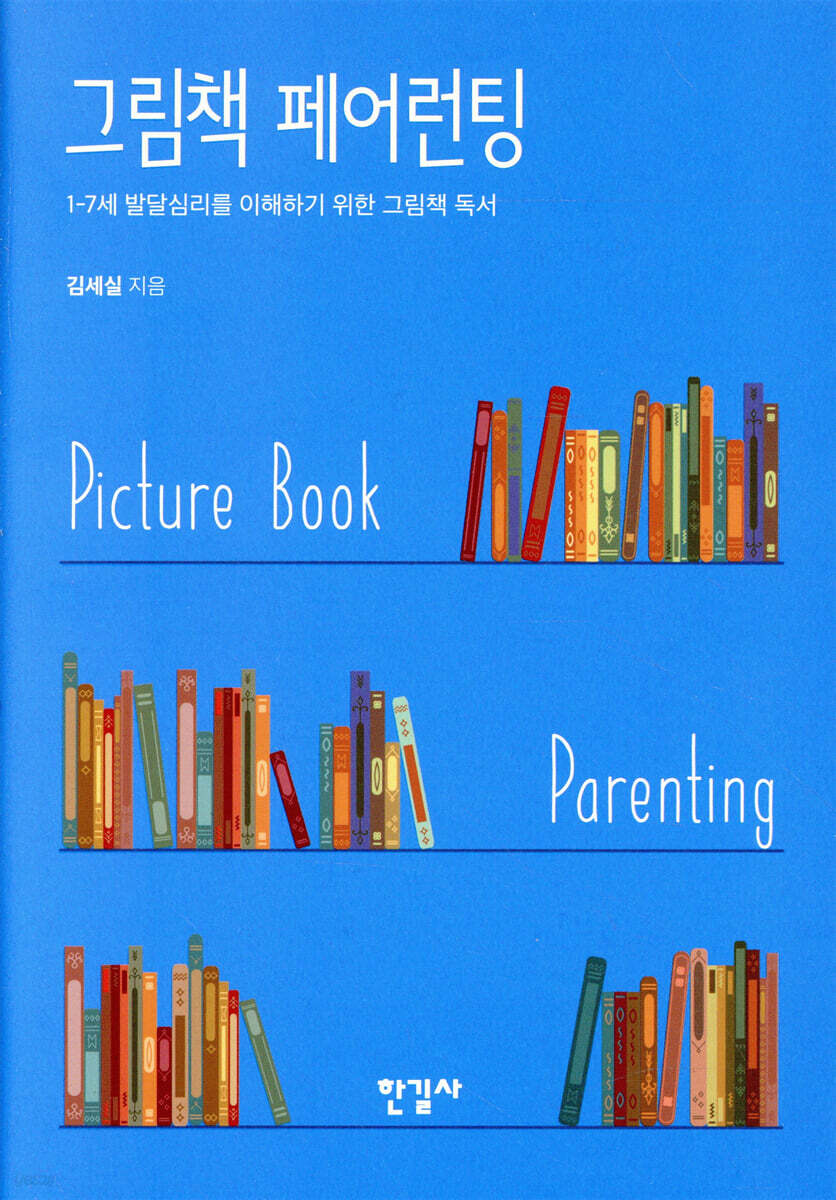
Picture book parenting
 |
Description
Book Introduction
110+ picture books that will help you kill two birds with one stone: developmental psychology and picture book parenting for children ages 1-7.
This is a full-fledged developmental psychology parenting book written by Sesil Kim, who has worked as a child psychologist, picture book therapist, writer, translator, and planner for 26 years, and has accumulated her expertise.
Among the major developmental issues of infants and toddlers aged 1-7, this book introduces meaningful theories and research related to picture books in an easy-to-understand manner, and explains them with examples of approximately 110 colorful picture books related to them.
Each chapter is categorized into developmental areas such as senses, language, cognition, emotion, and self, and provides specific information on how to raise children with picture books.
In particular, in the areas of attachment, family environment, and play, we will consider how to share true love among family members, how to create a healthy family environment in situations of socioeconomic stress on parents or conflict between couples, and how to be good playmates for children who have lost their playgrounds in the COVID-19 era.
This is the easiest 'developmental psychology theory book' for novice parents to get started with, and it is also a 'book about picture books' that will help children grow while also comforting the child within parents.
This is a full-fledged developmental psychology parenting book written by Sesil Kim, who has worked as a child psychologist, picture book therapist, writer, translator, and planner for 26 years, and has accumulated her expertise.
Among the major developmental issues of infants and toddlers aged 1-7, this book introduces meaningful theories and research related to picture books in an easy-to-understand manner, and explains them with examples of approximately 110 colorful picture books related to them.
Each chapter is categorized into developmental areas such as senses, language, cognition, emotion, and self, and provides specific information on how to raise children with picture books.
In particular, in the areas of attachment, family environment, and play, we will consider how to share true love among family members, how to create a healthy family environment in situations of socioeconomic stress on parents or conflict between couples, and how to be good playmates for children who have lost their playgrounds in the COVID-19 era.
This is the easiest 'developmental psychology theory book' for novice parents to get started with, and it is also a 'book about picture books' that will help children grow while also comforting the child within parents.
- You can preview some of the book's contents.
Preview
index
Growing Up with Picture Books Today│Prologue
1.
Discover the World of Picture Books: Sensory Development
2.
Learning to Love for the First Time in Life: Attachment
3.
Connecting with the Wider World: Language Development
4.
Framing Your Mind: Cognitive Development
5.
Speaking to the Heart: Emotional Intelligence
6.
Discovering Myself: Self-Development
7.
Meeting Light and Shadow: Family Environment
8.
Containing Others Within Me: Theory of Mind
9.
Finding the Path to Growth: Play
References
1.
Discover the World of Picture Books: Sensory Development
2.
Learning to Love for the First Time in Life: Attachment
3.
Connecting with the Wider World: Language Development
4.
Framing Your Mind: Cognitive Development
5.
Speaking to the Heart: Emotional Intelligence
6.
Discovering Myself: Self-Development
7.
Meeting Light and Shadow: Family Environment
8.
Containing Others Within Me: Theory of Mind
9.
Finding the Path to Growth: Play
References
Into the book
If you give a picture book to a baby, he or she will probably suck it, chew it, and drool as he or she devours it with gusto.
That is the expression of a baby's interest in the world, his exploration and learning.
So, who do you think learned more today, the baby or the parent? Whose eyes sparkle with curiosity and wonder about the world? The baby, of course! Therefore, infancy is a crucial time to begin a "life of reading."
--- p.16
Healthy separation from attachment figures is a challenge for both the child and the mother.
Because attachment is a reciprocal state, the experience of separation is not only difficult for the child.
Mothers suffer from separation anxiety just like their children.
In fact, many cases of school refusal and school fear are said to be due to the mother's separation anxiety being passed on to the child.
Moreover, if the mother herself grew up with insecure attachment issues or emotional trauma as a child, the child will likely mirror the mother's anxiety.
--- p.59
Children in the digital age seem to see and know more, but the reason they fail to accumulate knowledge is because they don't have time to think and process the vast amount of information.
Digital media, which presents new stimuli at a rapid pace, only urges children to move on to the next thing.
Any stimulus that is not repeated enough will soon simply disappear.
This is where the 'pruning' of the snaps takes place.
--- p.126
Most adults have negative stereotypes about crying, such as that grown children shouldn't cry, that men shouldn't cry, and that crying means being weak.
In fact, crying is not an emotion, but an act of expressing emotion.
A child's cries contain real emotions such as anger, sadness, fear, shame, and resentment. If parents respond unsupportively by suppressing the crying, they are denying and ignoring the emotions contained within.
If you discourage a child from expressing their emotions in this way, they will begin to view the emotion itself as bad, uncomfortable, or threatening, and will avoid opportunities to explore it.
--- p.147
There is no relationship in the world without conflict.
What matters is how you solve it.
After a fight between spouses, be sure to explain to your child.
Mom and Dad fought because they had different opinions, but they said it doesn't mean they hate each other.
And please make it clear that it has nothing to do with you and that it is not because of you.
Seeing parents reconcile and resolve their issues amicably can help children regain emotional peace, and it can also be an opportunity to learn conflict resolution skills.
--- p.201-202
Through this picture book, we can clearly tell children that it is unfair and wrong to bully and ostracize peers just because they are different.
It also conveys a message of hope that if someone bullies and ostracizes me, they can never be my friend, and that there are true friends out there who will welcome me.
That is the expression of a baby's interest in the world, his exploration and learning.
So, who do you think learned more today, the baby or the parent? Whose eyes sparkle with curiosity and wonder about the world? The baby, of course! Therefore, infancy is a crucial time to begin a "life of reading."
--- p.16
Healthy separation from attachment figures is a challenge for both the child and the mother.
Because attachment is a reciprocal state, the experience of separation is not only difficult for the child.
Mothers suffer from separation anxiety just like their children.
In fact, many cases of school refusal and school fear are said to be due to the mother's separation anxiety being passed on to the child.
Moreover, if the mother herself grew up with insecure attachment issues or emotional trauma as a child, the child will likely mirror the mother's anxiety.
--- p.59
Children in the digital age seem to see and know more, but the reason they fail to accumulate knowledge is because they don't have time to think and process the vast amount of information.
Digital media, which presents new stimuli at a rapid pace, only urges children to move on to the next thing.
Any stimulus that is not repeated enough will soon simply disappear.
This is where the 'pruning' of the snaps takes place.
--- p.126
Most adults have negative stereotypes about crying, such as that grown children shouldn't cry, that men shouldn't cry, and that crying means being weak.
In fact, crying is not an emotion, but an act of expressing emotion.
A child's cries contain real emotions such as anger, sadness, fear, shame, and resentment. If parents respond unsupportively by suppressing the crying, they are denying and ignoring the emotions contained within.
If you discourage a child from expressing their emotions in this way, they will begin to view the emotion itself as bad, uncomfortable, or threatening, and will avoid opportunities to explore it.
--- p.147
There is no relationship in the world without conflict.
What matters is how you solve it.
After a fight between spouses, be sure to explain to your child.
Mom and Dad fought because they had different opinions, but they said it doesn't mean they hate each other.
And please make it clear that it has nothing to do with you and that it is not because of you.
Seeing parents reconcile and resolve their issues amicably can help children regain emotional peace, and it can also be an opportunity to learn conflict resolution skills.
--- p.201-202
Through this picture book, we can clearly tell children that it is unfair and wrong to bully and ostracize peers just because they are different.
It also conveys a message of hope that if someone bullies and ostracizes me, they can never be my friend, and that there are true friends out there who will welcome me.
--- p.247
Publisher's Review
Basic sensory development in newborns
Am I really a good parent?
How to love, how to be loved
Parenting is a comprehensive term that refers to the behaviors, skills, and responsibilities that parents need to raise their children and help them develop.
It is a broader concept than the term 'picture book parenting' which involves reading more picture books to children and providing them with various post-reading activities.
The author's intention for picture book parenting is "to help caregivers qualitatively understand their child's development and picture books, and based on that, to help children successfully achieve developmental tasks and grow together with picture books."
The author says that picture books are a 'necessary and sufficient condition' for a child's development.
Chapter 1, “Meeting the World of Picture Books,” and Chapter 2, “Learning to Love for the First Time in Life,” examine developmental psychology theories on the development of basic senses in infancy and the formation of attachment between caregivers and children, and provide a picture book reading guide for new parents (page 31).
Several studies have shown that babies remember the auditory information they hear while in the womb, and after birth, they show a clear preference for their mother's voice.
If the mother reads picture books to the baby during prenatal education, the baby will remember and distinguish the pitch, rhythm, and patterns of the books when reading.
The various onomatopoeia and mimetic words used in picture books provide enjoyment to babies and help with auditory development.
Because vision develops more slowly than other senses, it needs to be provided with richer experiences and stimulation.
Even at this time, we can benefit from the rich colors and shapes contained in picture books.
Attachment is a strong emotional bond that makes you feel deeply connected to someone.
A child who has formed a secure attachment can begin to explore the wider world using the caregiver as a safe base.
The author suggests specific ways to read picture books that increase 'physical contact', the key to attachment, and convey love.
The valuable experience of receiving unconditional love helps us grow into loving adults.
Perhaps humans learn 'how to love' before they learn 'how to live' after being born into this world._Page 42
It also clearly answers questions from caregivers, such as whether insecure attachment cannot be recovered, whether it is difficult to form an attachment with parents if institutional care is started early, and whether parental attitudes that are sensitive to the baby's needs spoil the child (p. 52).
Above all, author Kim Se-sil emphasizes to readers who are wondering, "Am I really a good parent?" that it is important to care for the emotional wounds and anxieties of caregivers, and that healthy separation is just as necessary as stable attachment.
The rapidly changing digital age
What is the value of picture books?
Chapter 3, “Communicating with the Wider World,” and Chapter 4, “Formulating Thoughts,” discuss language and cognitive development, respectively.
Ironically, language development progresses rapidly during infancy, before children can even speak, so that by toddlerhood, children have almost completely mastered their native language.
Author Kim Se-sil says that for language development during this crucial period, “everyday language stimulation alone is not enough; through picture books, children can acquire correct grammar and a refined literary sensibility of their native language.”
It teaches the skills of reading for language development, and provides specific examples of how to elicit a child's language response through various 'questions' while reading picture books (pp. 94-95).
Ages 3-7 are a time of intense curiosity as the frontal lobe develops intensively.
The author advises that parents should not panic when faced with children suffering from 'why disease' and diligently read high-quality 'informational picture books'.
“At a time when every paradigm that has defined our lives for so long is rapidly shifting, there are no longer any ‘right answers’ that parents can give their children.
Rather, it would be most important to provide a richer experience, to allow for leisurely trial and error, and to encourage curiosity to learn.”_pp. 128-129
It also provides answers to digital media.
The authors warn that the more children are exposed to digital media, the more intense the stimulation they seek in a short period of time, and the less they can stay focused and think as they do when reading a book.
Because if information is not stored in long-term memory, it cannot become knowledge.
However, most children these days experience smartphones before the age of three.
There were also positive effects of digital media experienced in non-face-to-face education during the COVID-19 pandemic.
So, an unconditional ban cannot be an alternative.
The author suggests that to wisely navigate the digital age, parents need to move beyond vague anxieties and worries and actively engage with the digital environment surrounding their children. He also suggests ways to flexibly navigate the analog and digital worlds.
Become your true self
coexist with others
Children with high emotional intelligence are relatively good at coping with stress and have high self-esteem.
This also has a major impact on academic ability and peer relationships.
Chapter 5, "Speaking to the Heart," Chapter 6, "Discovering Myself," and Chapter 8, "Containing Others Within Me," connect emotional intelligence, self-development, and moral development.
As children begin to experience peer conflict and bullying as they enter society, we introduce picture books that can provide desirable problem-solving methods, and also suggest disciplinary and communication methods that can help with character development.
In particular, in order for children to grow up with a rich and beautiful emotional dictionary in their hearts, it is necessary to respond appropriately to their emotions, so it is said that parents should look deeply into their own 'meta-emotions' (emotions about emotions).
Reading picture books about emotions to children can naturally bring back memories of your own childhood and help you explore unresolved emotions.
At that moment, the readers of the picture book become both the child and the parent.
Healthy 'family dynamics' and
Conditions for a decent life
Chapter 7 of this book, “Light and Shadow,” talks about the “family environment,” which has a huge impact on a child’s development.
This picture book, which features siblings, often likened to "life's first rivals," shows the subtle psychology between siblings and helps them realize how precious they are to each other.
Also, the picture book, which depicts young protagonists wisely and cheerfully coping with situations such as frequent quarrels between couples due to economic reasons, stress from balancing childcare and work, and divorce, helps readers understand what 'family dynamics' (complex emotional exchanges and interactions that occur within a family) are based on flexible 'separation', strong 'connection', and strong 'resilience' among family members.
The final chapter, Chapter 9, “Finding the Path to Growth,” focuses on the theme of “play.”
Through play, children freely express themselves, experience life in miniature, and learn skills for coexistence.
In particular, the author says that play is a "condition for a childlike life" in that it gives children confidence and control, reduces their fear of the world, and allows them to freely express their emotions.
Remember that parents are the most desirable playmates for children, and suggest ways to become good playmates for children.
Am I really a good parent?
How to love, how to be loved
Parenting is a comprehensive term that refers to the behaviors, skills, and responsibilities that parents need to raise their children and help them develop.
It is a broader concept than the term 'picture book parenting' which involves reading more picture books to children and providing them with various post-reading activities.
The author's intention for picture book parenting is "to help caregivers qualitatively understand their child's development and picture books, and based on that, to help children successfully achieve developmental tasks and grow together with picture books."
The author says that picture books are a 'necessary and sufficient condition' for a child's development.
Chapter 1, “Meeting the World of Picture Books,” and Chapter 2, “Learning to Love for the First Time in Life,” examine developmental psychology theories on the development of basic senses in infancy and the formation of attachment between caregivers and children, and provide a picture book reading guide for new parents (page 31).
Several studies have shown that babies remember the auditory information they hear while in the womb, and after birth, they show a clear preference for their mother's voice.
If the mother reads picture books to the baby during prenatal education, the baby will remember and distinguish the pitch, rhythm, and patterns of the books when reading.
The various onomatopoeia and mimetic words used in picture books provide enjoyment to babies and help with auditory development.
Because vision develops more slowly than other senses, it needs to be provided with richer experiences and stimulation.
Even at this time, we can benefit from the rich colors and shapes contained in picture books.
Attachment is a strong emotional bond that makes you feel deeply connected to someone.
A child who has formed a secure attachment can begin to explore the wider world using the caregiver as a safe base.
The author suggests specific ways to read picture books that increase 'physical contact', the key to attachment, and convey love.
The valuable experience of receiving unconditional love helps us grow into loving adults.
Perhaps humans learn 'how to love' before they learn 'how to live' after being born into this world._Page 42
It also clearly answers questions from caregivers, such as whether insecure attachment cannot be recovered, whether it is difficult to form an attachment with parents if institutional care is started early, and whether parental attitudes that are sensitive to the baby's needs spoil the child (p. 52).
Above all, author Kim Se-sil emphasizes to readers who are wondering, "Am I really a good parent?" that it is important to care for the emotional wounds and anxieties of caregivers, and that healthy separation is just as necessary as stable attachment.
The rapidly changing digital age
What is the value of picture books?
Chapter 3, “Communicating with the Wider World,” and Chapter 4, “Formulating Thoughts,” discuss language and cognitive development, respectively.
Ironically, language development progresses rapidly during infancy, before children can even speak, so that by toddlerhood, children have almost completely mastered their native language.
Author Kim Se-sil says that for language development during this crucial period, “everyday language stimulation alone is not enough; through picture books, children can acquire correct grammar and a refined literary sensibility of their native language.”
It teaches the skills of reading for language development, and provides specific examples of how to elicit a child's language response through various 'questions' while reading picture books (pp. 94-95).
Ages 3-7 are a time of intense curiosity as the frontal lobe develops intensively.
The author advises that parents should not panic when faced with children suffering from 'why disease' and diligently read high-quality 'informational picture books'.
“At a time when every paradigm that has defined our lives for so long is rapidly shifting, there are no longer any ‘right answers’ that parents can give their children.
Rather, it would be most important to provide a richer experience, to allow for leisurely trial and error, and to encourage curiosity to learn.”_pp. 128-129
It also provides answers to digital media.
The authors warn that the more children are exposed to digital media, the more intense the stimulation they seek in a short period of time, and the less they can stay focused and think as they do when reading a book.
Because if information is not stored in long-term memory, it cannot become knowledge.
However, most children these days experience smartphones before the age of three.
There were also positive effects of digital media experienced in non-face-to-face education during the COVID-19 pandemic.
So, an unconditional ban cannot be an alternative.
The author suggests that to wisely navigate the digital age, parents need to move beyond vague anxieties and worries and actively engage with the digital environment surrounding their children. He also suggests ways to flexibly navigate the analog and digital worlds.
Become your true self
coexist with others
Children with high emotional intelligence are relatively good at coping with stress and have high self-esteem.
This also has a major impact on academic ability and peer relationships.
Chapter 5, "Speaking to the Heart," Chapter 6, "Discovering Myself," and Chapter 8, "Containing Others Within Me," connect emotional intelligence, self-development, and moral development.
As children begin to experience peer conflict and bullying as they enter society, we introduce picture books that can provide desirable problem-solving methods, and also suggest disciplinary and communication methods that can help with character development.
In particular, in order for children to grow up with a rich and beautiful emotional dictionary in their hearts, it is necessary to respond appropriately to their emotions, so it is said that parents should look deeply into their own 'meta-emotions' (emotions about emotions).
Reading picture books about emotions to children can naturally bring back memories of your own childhood and help you explore unresolved emotions.
At that moment, the readers of the picture book become both the child and the parent.
Healthy 'family dynamics' and
Conditions for a decent life
Chapter 7 of this book, “Light and Shadow,” talks about the “family environment,” which has a huge impact on a child’s development.
This picture book, which features siblings, often likened to "life's first rivals," shows the subtle psychology between siblings and helps them realize how precious they are to each other.
Also, the picture book, which depicts young protagonists wisely and cheerfully coping with situations such as frequent quarrels between couples due to economic reasons, stress from balancing childcare and work, and divorce, helps readers understand what 'family dynamics' (complex emotional exchanges and interactions that occur within a family) are based on flexible 'separation', strong 'connection', and strong 'resilience' among family members.
The final chapter, Chapter 9, “Finding the Path to Growth,” focuses on the theme of “play.”
Through play, children freely express themselves, experience life in miniature, and learn skills for coexistence.
In particular, the author says that play is a "condition for a childlike life" in that it gives children confidence and control, reduces their fear of the world, and allows them to freely express their emotions.
Remember that parents are the most desirable playmates for children, and suggest ways to become good playmates for children.
GOODS SPECIFICS
- Publication date: December 17, 2021
- Format: Hardcover book binding method guide
- Page count, weight, size: 312 pages | 600g | 148*210*23mm
- ISBN13: 9788935668861
- ISBN10: 8935668869
You may also like
카테고리
korean


korean

![GQ KOREA Mark (Monthly): December [2025]](http://librairie.coreenne.fr/cdn/shop/files/8ef265dbbfbf186523ed75ba7319009d.jpg?v=1765340328&width=3840)


