

literacy classes
 |
Description
Book Introduction
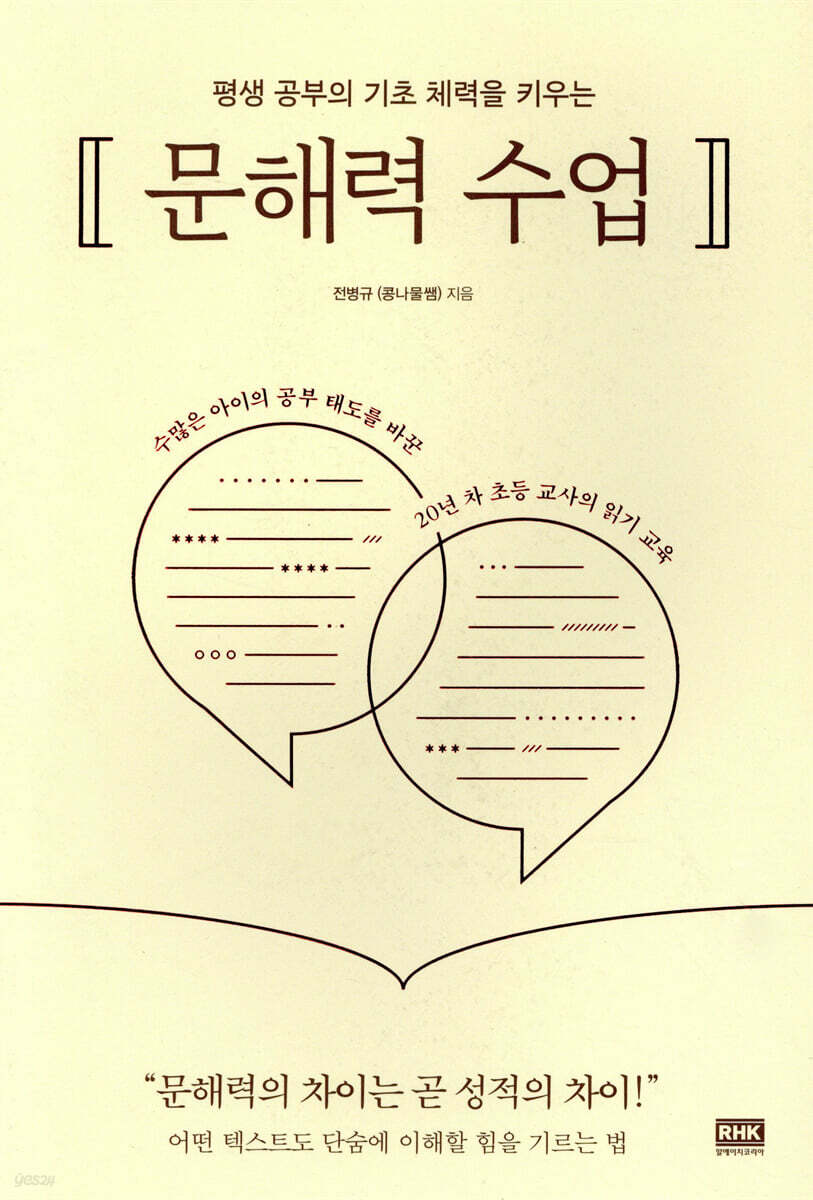
A new work by YouTuber 'Kongnamul Teacher' with 1.5 million total views “Differences in literacy are equal to differences in grades!” How to develop the ability to understand any text in one sitting Author Jeon Byeong-gyu, a father of two and an elementary school teacher with 20 years of experience, and well-known as the YouTuber “Kongnamul Teacher,” has published “Literacy Class.” From the beginning of my teaching career, I saw children who did not change no matter how hard I taught them, and I realized that this was not simply a problem with studying. After discovering that literacy was a very important cause, we made a great effort to improve literacy by changing the entire classroom and replacing the "non-reading" children with "reading" children. This book is filled with vivid examples of children who have changed, why literacy affects grades, and how to develop literacy skills. Starting with strengthening the roots of literacy, we help anyone develop the ability to properly ‘read’ by accompanying them through the process of literacy growth from reading aloud → reading with meaning → reading with interpretation. The author emphasizes: What we should pass on to our children should be ‘literacy’ rather than money and knowledge. A child who is literate can study any subject without difficulty throughout his or her life and can always acquire up-to-date knowledge quickly and accurately. Even if you graduate from a prestigious university and get a good job, if you lack literacy skills, your knowledge will not be updated and you will soon fall behind. Literacy is the foundation for lifelong learning and a weapon that guarantees competitiveness. All humans are born illiterate and must go through the process of developing literacy. Written with a deep understanding and insight into reading, along with extensive field experience, "Literacy Class" will be the optimal bible to help you navigate the jungle of illiteracy and settle into a literate city. |
- You can preview some of the book's contents.
Preview
index
Preface: Passing Literacy on to Your Children
Part 1
Literacy, the foundation for lifelong learning
Chapter 1: Literacy in Crisis
▶ Reading that cannot be called reading
Traditional Illiteracy and Functional Illiteracy | Who Spent All That High Literacy? | Three Misconceptions About Reading | Faulty Reading Education: A Complicity in the Literacy Crisis
▶ Why literacy alone can predict grades
What's the Difference Between Lower, Middle, and Higher Levels? | As Literacy Improves, Study Attitudes Change | There Is No Complete and Permanent "Reading Independence" | How to Achieve the Most Dramatic Progress
▶ Classes alone are not enough
The Gap Between Knowing and Doing | The Difference Between Reading Classes and Guided Reading | Guided Reading: Reducing Trial and Error
Chapter 2: How Literacy Improves Grades
▶ What's eating away at your grades?
The Cost of Distraction | Why Games Can't Improve Focus | Passive vs. Active Focus
▶ Language skills increase your study speed.
Why Vocabulary Is Directly Related to Grades | Reading Enhances Expressive Power | Reading Enhances Listening and Speaking Skills | Reading Enhances Reading and Writing Skills | Reading Enhances Foreign Language Skills
▶ How reading changes intelligence
It's not just about increasing your knowledge | Reading is the most profoundly transformative thing for the brain.
▶ Literacy determines lifelong learning.
Reading Transforms Schools | From "Learning to Read" to "Learning by Reading" | Improving Literacy Leads to Better Grades
Chapter 3: The Process of Literacy Development
▶ Reading is done with the brain, not the eyes.
Reading Process 1: Seeing Letters: Light into Letters | Reading Process 2: Reading Sounds: Letters into Sounds | Reading Process 3: Reading Meaning: Sound into Meaning | Reading Process 4: Reading Interpretation: Meaning into Thoughts and Feelings | A Trained Brain Reads Easier
▶ What process does literacy development go through?
The Four Stages of Literacy Development: Akin to the "Reading Process" | From Illiteracy to Literacy | Literacy: Growing Like a Tree
Part 2
How to improve literacy?
Chapter 4: Developing Literacy through Guided Reading
▶Reading preparation doesn't happen automatically.
To firmly establish the "roots of literacy" | Teaching the Roots of Literacy 1: The Development of Spoken Language | Teaching the Roots of Literacy 2: The Encounter with Reading
▶ The starting point for reading fluency: reading aloud
The Power of Reading Smoothly and Naturally | At What Age Should You Start Teaching Korean? | Reading Phonetics Teaching Method 1: Becoming Familiar with Sounds | Reading Phonetics Teaching Method 2: Learning Korean | Reading Phonetics Teaching Method 3: Using Various Reading Methods | Reading Phonetics Teaching Method 4: Utilizing Fluency Development Programs
▶ If you don't understand the meaning, it's not reading.
Reading and understanding the content | 'Vocabulary' has an absolute impact on overall study | Vocabulary must be 'acquired', not learned | Vocabulary alone is not enough, content comprehension | Teaching reading for meaning 1: Building a wide and deep vocabulary | Teaching reading for meaning 2: Building background knowledge | Teaching reading for meaning 3: Using comprehension strategies
▶ Reading that completes the process of adding thoughts and emotions, interpretive reading
For the reading effect to truly shine | Interpretive reading guidance method 1: Slow reading | Interpretive reading guidance method 2: Observational reading | Interpretive reading guidance method 3: Havruta reading
Chapter 5: Building Literacy by Reading
▶ The amount of reading parents do is a measure of literacy.
How to Read to Your Child | How Long Should You Read to Your Child? | Check Your Child's Literacy While Reading
▶ How reading develops literacy skills
Children Transformed by Daily Picture Book Reading | How Does Reading Aloud Affect 'Reading by Sound'? | How Does Reading Aloud Affect 'Reading by Meaning'? | How Does Reading Aloud Affect 'Reading by Interpretation'?
▶ Havruta-style reading to boost hidden literacy
The Secret to the Fastest Literacy Growth | Havruta Reading 1: Before Reading | Havruta Reading 2: During Reading | Havruta Reading 3: After Reading | What Questions Should You Ask Before, During, and After Reading?
Chapter 6: Developing Literacy Through Independent Reading
▶ Developing a desire to read on your own
Three Key Motivations for Reading | How to Love Reading | To Experience Complete Enjoyment | To Feel A Sense of Achievement and Competence | To Gain Motivation for Reading
▶ How to choose a good book
Buy or Rent? | Principles of Book Purchase | Recommended Books by Age | Award-Winning Books | How to Use Recommended Books | Is It Okay to Read Only One Category? | Are Educational Comics Good? | Are E-Books Good?
▶ Make time to read
Limit media use | Reduce private education | Set aside a daily reading time | Read one book a day | Study through reading
▶ Create a space to read
Creating a Reading Spot | The 3 Bs of Expanding Your Reading Space | Visiting a Library | Carrying Books
Conclusion: All change begins with literacy.
Part 1
Literacy, the foundation for lifelong learning
Chapter 1: Literacy in Crisis
▶ Reading that cannot be called reading
Traditional Illiteracy and Functional Illiteracy | Who Spent All That High Literacy? | Three Misconceptions About Reading | Faulty Reading Education: A Complicity in the Literacy Crisis
▶ Why literacy alone can predict grades
What's the Difference Between Lower, Middle, and Higher Levels? | As Literacy Improves, Study Attitudes Change | There Is No Complete and Permanent "Reading Independence" | How to Achieve the Most Dramatic Progress
▶ Classes alone are not enough
The Gap Between Knowing and Doing | The Difference Between Reading Classes and Guided Reading | Guided Reading: Reducing Trial and Error
Chapter 2: How Literacy Improves Grades
▶ What's eating away at your grades?
The Cost of Distraction | Why Games Can't Improve Focus | Passive vs. Active Focus
▶ Language skills increase your study speed.
Why Vocabulary Is Directly Related to Grades | Reading Enhances Expressive Power | Reading Enhances Listening and Speaking Skills | Reading Enhances Reading and Writing Skills | Reading Enhances Foreign Language Skills
▶ How reading changes intelligence
It's not just about increasing your knowledge | Reading is the most profoundly transformative thing for the brain.
▶ Literacy determines lifelong learning.
Reading Transforms Schools | From "Learning to Read" to "Learning by Reading" | Improving Literacy Leads to Better Grades
Chapter 3: The Process of Literacy Development
▶ Reading is done with the brain, not the eyes.
Reading Process 1: Seeing Letters: Light into Letters | Reading Process 2: Reading Sounds: Letters into Sounds | Reading Process 3: Reading Meaning: Sound into Meaning | Reading Process 4: Reading Interpretation: Meaning into Thoughts and Feelings | A Trained Brain Reads Easier
▶ What process does literacy development go through?
The Four Stages of Literacy Development: Akin to the "Reading Process" | From Illiteracy to Literacy | Literacy: Growing Like a Tree
Part 2
How to improve literacy?
Chapter 4: Developing Literacy through Guided Reading
▶Reading preparation doesn't happen automatically.
To firmly establish the "roots of literacy" | Teaching the Roots of Literacy 1: The Development of Spoken Language | Teaching the Roots of Literacy 2: The Encounter with Reading
▶ The starting point for reading fluency: reading aloud
The Power of Reading Smoothly and Naturally | At What Age Should You Start Teaching Korean? | Reading Phonetics Teaching Method 1: Becoming Familiar with Sounds | Reading Phonetics Teaching Method 2: Learning Korean | Reading Phonetics Teaching Method 3: Using Various Reading Methods | Reading Phonetics Teaching Method 4: Utilizing Fluency Development Programs
▶ If you don't understand the meaning, it's not reading.
Reading and understanding the content | 'Vocabulary' has an absolute impact on overall study | Vocabulary must be 'acquired', not learned | Vocabulary alone is not enough, content comprehension | Teaching reading for meaning 1: Building a wide and deep vocabulary | Teaching reading for meaning 2: Building background knowledge | Teaching reading for meaning 3: Using comprehension strategies
▶ Reading that completes the process of adding thoughts and emotions, interpretive reading
For the reading effect to truly shine | Interpretive reading guidance method 1: Slow reading | Interpretive reading guidance method 2: Observational reading | Interpretive reading guidance method 3: Havruta reading
Chapter 5: Building Literacy by Reading
▶ The amount of reading parents do is a measure of literacy.
How to Read to Your Child | How Long Should You Read to Your Child? | Check Your Child's Literacy While Reading
▶ How reading develops literacy skills
Children Transformed by Daily Picture Book Reading | How Does Reading Aloud Affect 'Reading by Sound'? | How Does Reading Aloud Affect 'Reading by Meaning'? | How Does Reading Aloud Affect 'Reading by Interpretation'?
▶ Havruta-style reading to boost hidden literacy
The Secret to the Fastest Literacy Growth | Havruta Reading 1: Before Reading | Havruta Reading 2: During Reading | Havruta Reading 3: After Reading | What Questions Should You Ask Before, During, and After Reading?
Chapter 6: Developing Literacy Through Independent Reading
▶ Developing a desire to read on your own
Three Key Motivations for Reading | How to Love Reading | To Experience Complete Enjoyment | To Feel A Sense of Achievement and Competence | To Gain Motivation for Reading
▶ How to choose a good book
Buy or Rent? | Principles of Book Purchase | Recommended Books by Age | Award-Winning Books | How to Use Recommended Books | Is It Okay to Read Only One Category? | Are Educational Comics Good? | Are E-Books Good?
▶ Make time to read
Limit media use | Reduce private education | Set aside a daily reading time | Read one book a day | Study through reading
▶ Create a space to read
Creating a Reading Spot | The 3 Bs of Expanding Your Reading Space | Visiting a Library | Carrying Books
Conclusion: All change begins with literacy.
Detailed image

Into the book
Children who barely manage to maintain their upper-middle class status while spending their days filled with private education and pressure from their parents to study.
However, children who have low literacy skills because reading is put on the back burner and thus rely even more on listening classes.
As these children advance in grade level, their underlying strengths become apparent and their grades gradually decline.
Because they don't have the strength to understand the more complex texts they have to read and the more complex stories they have to hear as they enter upper elementary, middle, and high school.
If your child studies hard and attends many academies, but their grades continue to drop as they advance in grade level, this is why you need to focus on literacy first.
--- From "Why literacy alone can predict grades"
Parents often have a hard time understanding why their children can't grasp even simple things if they don't understand the content of the book.
Then, we will explain the contents of the book directly.
It doesn't lead you to understand and think about the content of the text, but rather explains the plot of the book you just read.
But the problem isn't that the child doesn't understand what he's reading.
The real problem is a fundamental lack of literacy to understand the content of the book.
If you lack literacy, no matter how well you explain the contents of a particular book, it will not help you understand the contents of other books.
Because the contents of this book and that book are different.
The important thing is not to know the contents of a single book, but to develop the literacy to read any book.
--- From "Reading That Cannot Be Called Reading"
Literacy is a lifelong learning skill, but the period in which reading is learned in school is limited to the first and second grades of elementary school.
After the third grade, education is conducted on the assumption that students can read.
However, the reading that can be learned in the first and second grades of elementary school is only the 'minimum of reading'.
In terms of a baby's development, it's like the baby is just starting to walk.
If we assume that children who can barely walk can run, how can we possibly teach them effectively? Knowledge in each subject advances at breakneck speed, but if a child's literacy skills are weak and they're still toddling, how can they possibly learn effectively?
--- From "Literacy Determines Lifelong Learning"
How well you learn and know academic vocabulary is directly related to your academic performance.
Because vocabulary is both concept and knowledge.
Simply put, studying is the act of collecting and understanding academic vocabulary.
Physics is about understanding words like motion, speed, velocity, acceleration, mass, and tension, and the relationships between them, while world history is about knowing words like civilization, empire, Hellenism, feudalism, religious reform, and monarchy, and their examples.
--- From "Language skills increase study speed"
If the 'beginner reading brain' is the brain of a worker who has to do the arduous and difficult process himself, the 'skilled reading brain' is like the brain of a boss who just gives orders and rests during the entire process.
But since it's not a business, there's no need to worry about it failing, and it's easy and convenient.
So, without exception, children who love books are children who have reached a level of reading proficiency.
If you can't reach this level, it's hard to enjoy reading.
Who enjoys a tedious and arduous process? So, to enjoy reading, it's crucial to first "automate" a significant portion of the reading process.
Reading becomes fun when your eyes just walk over the letters and the sounds and meanings come to greet you.
--- From "Reading is done with the 'brain', not the 'eyes'"
Learning to read independently means that you are just beginning to learn to read aloud.
If you stop reading to your child when he or she can read aloud, your child's literacy development will be halted too early.
It is said that the ability to read and understand becomes similar to the ability to listen and understand around the second year of middle school.
It means that until they reach the second year of middle school, they will understand even things they don't understand if you tell them about them.
So, it is helpful for parents to read to their children until this point.
--- From "The amount of reading parents do is a measure of literacy"
Traditional reading classes are like a written driver's license test.
It's something you need to know, but knowing it doesn't make you a good driver.
Even if you start out not knowing much, there are aspects you will come to know as you go along.
There is a huge gap between knowing and doing.
So, while you may take traditional reading classes that focus on what you "know" and do well on written tests, it's not easy to "do" actual reading well.
To actually read well, it is important to read often.
It's not about acquiring reading knowledge.
In the written driver's license test, they tell you to look ahead and look left and right.
But how can you keep your eyes focused forward while also looking left and right? It may seem counterintuitive, but in real life, you need to keep your eyes focused forward while also looking left and right.
You have to make the knowledge you don't understand just by hearing it your own by actually trying it out.
--- From "Classes alone are not enough"
The important point is that there is no such thing as complete and permanent reading independence, as reading level must be judged individually for each text.
Reading independence means being able to read 'a specific text' on your own, not 'all texts' on your own.
For example, even if a second grader becomes independent readers of picture books and short stories, he or she may be at a guided reading level for some other books and at a frustrated reading level for others.
It's not that it can't be, it's just that it has to be.
Even if a second grader is a good reader, he or she will not be able to read Dostoevsky's "Crime and Punishment" or Yuval Harari's "Sapiens" with ease.
What this means is that no human, including adults, can attain a perfect level of reading independence.
However, children who have low literacy skills because reading is put on the back burner and thus rely even more on listening classes.
As these children advance in grade level, their underlying strengths become apparent and their grades gradually decline.
Because they don't have the strength to understand the more complex texts they have to read and the more complex stories they have to hear as they enter upper elementary, middle, and high school.
If your child studies hard and attends many academies, but their grades continue to drop as they advance in grade level, this is why you need to focus on literacy first.
--- From "Why literacy alone can predict grades"
Parents often have a hard time understanding why their children can't grasp even simple things if they don't understand the content of the book.
Then, we will explain the contents of the book directly.
It doesn't lead you to understand and think about the content of the text, but rather explains the plot of the book you just read.
But the problem isn't that the child doesn't understand what he's reading.
The real problem is a fundamental lack of literacy to understand the content of the book.
If you lack literacy, no matter how well you explain the contents of a particular book, it will not help you understand the contents of other books.
Because the contents of this book and that book are different.
The important thing is not to know the contents of a single book, but to develop the literacy to read any book.
--- From "Reading That Cannot Be Called Reading"
Literacy is a lifelong learning skill, but the period in which reading is learned in school is limited to the first and second grades of elementary school.
After the third grade, education is conducted on the assumption that students can read.
However, the reading that can be learned in the first and second grades of elementary school is only the 'minimum of reading'.
In terms of a baby's development, it's like the baby is just starting to walk.
If we assume that children who can barely walk can run, how can we possibly teach them effectively? Knowledge in each subject advances at breakneck speed, but if a child's literacy skills are weak and they're still toddling, how can they possibly learn effectively?
--- From "Literacy Determines Lifelong Learning"
How well you learn and know academic vocabulary is directly related to your academic performance.
Because vocabulary is both concept and knowledge.
Simply put, studying is the act of collecting and understanding academic vocabulary.
Physics is about understanding words like motion, speed, velocity, acceleration, mass, and tension, and the relationships between them, while world history is about knowing words like civilization, empire, Hellenism, feudalism, religious reform, and monarchy, and their examples.
--- From "Language skills increase study speed"
If the 'beginner reading brain' is the brain of a worker who has to do the arduous and difficult process himself, the 'skilled reading brain' is like the brain of a boss who just gives orders and rests during the entire process.
But since it's not a business, there's no need to worry about it failing, and it's easy and convenient.
So, without exception, children who love books are children who have reached a level of reading proficiency.
If you can't reach this level, it's hard to enjoy reading.
Who enjoys a tedious and arduous process? So, to enjoy reading, it's crucial to first "automate" a significant portion of the reading process.
Reading becomes fun when your eyes just walk over the letters and the sounds and meanings come to greet you.
--- From "Reading is done with the 'brain', not the 'eyes'"
Learning to read independently means that you are just beginning to learn to read aloud.
If you stop reading to your child when he or she can read aloud, your child's literacy development will be halted too early.
It is said that the ability to read and understand becomes similar to the ability to listen and understand around the second year of middle school.
It means that until they reach the second year of middle school, they will understand even things they don't understand if you tell them about them.
So, it is helpful for parents to read to their children until this point.
--- From "The amount of reading parents do is a measure of literacy"
Traditional reading classes are like a written driver's license test.
It's something you need to know, but knowing it doesn't make you a good driver.
Even if you start out not knowing much, there are aspects you will come to know as you go along.
There is a huge gap between knowing and doing.
So, while you may take traditional reading classes that focus on what you "know" and do well on written tests, it's not easy to "do" actual reading well.
To actually read well, it is important to read often.
It's not about acquiring reading knowledge.
In the written driver's license test, they tell you to look ahead and look left and right.
But how can you keep your eyes focused forward while also looking left and right? It may seem counterintuitive, but in real life, you need to keep your eyes focused forward while also looking left and right.
You have to make the knowledge you don't understand just by hearing it your own by actually trying it out.
--- From "Classes alone are not enough"
The important point is that there is no such thing as complete and permanent reading independence, as reading level must be judged individually for each text.
Reading independence means being able to read 'a specific text' on your own, not 'all texts' on your own.
For example, even if a second grader becomes independent readers of picture books and short stories, he or she may be at a guided reading level for some other books and at a frustrated reading level for others.
It's not that it can't be, it's just that it has to be.
Even if a second grader is a good reader, he or she will not be able to read Dostoevsky's "Crime and Punishment" or Yuval Harari's "Sapiens" with ease.
What this means is that no human, including adults, can attain a perfect level of reading independence.
--- From "Why literacy alone can predict grades"
Publisher's Review
“I don’t know what you’re talking about!” → “I’m going to start studying too!”
Reading education from an elementary school teacher with 20 years of experience that changed countless children's attitudes toward studying.
Here are two best friends in fifth grade who can't focus in class and are only interested in their appearance and makeup.
These two were struggling academically, having difficulty reading their Korean textbooks word by word and having difficulty with the multiplication tables.
But one day, these two people showed up at school wearing matching glasses and said this.
“I’m going to try studying now too.”
“In the past, when I tried to attend classes, I couldn’t understand what was being said, but now I can understand a little bit!”
What was the reason for this dramatic change in the two children's attitudes toward studying? It was a teacher's efforts that improved their literacy skills.
As literacy improved, class content became easier to understand, and class attitudes changed to become more proactive.
My grades naturally improved.
The author of this book is an elementary school teacher with 20 years of experience who led this amazing change.
From the early days of his teaching career until now, he has observed that children do not always understand what they read.
In addition, I learned that 'children who do not understand writing well do not understand classes well and do not study well.'
Since then, literacy has been a major concern for him.
By adding related research and field experience, we have achieved miraculous changes in the classroom by replacing the regular reading class with a 'literacy class'.
His literacy classes have been very popular with students and parents year after year.
Letters poured in saying, “My child changed after meeting the teacher,” and there was even a grandmother who went up to the fourth floor classroom where her grandson’s homeroom teacher was, carried on her son’s back, to express her gratitude.
In the teacher evaluation, there were also parents who strongly requested, “Please change the Korean curriculum with literacy classes.”
The Roots of Literacy → Reading Sounds → Reading Meaning → Reading Interpretation
A 4-Step Reading Education Bible to Help Develop Literacy Skills
How did "literacy classes" develop children's literacy skills? To understand this, we need to understand the process of literacy development.
Literacy development goes through four stages: root of literacy → reading sounds → reading meaning → reading interpretation.
As spoken language develops and meets reading, letters must be transformed into sounds, sounds into meaning, and finally meaning into feelings and thoughts.
If you have poor literacy skills, you are having difficulty with at least one of these four steps.
If your child is having trouble passing through these four gates, this book will help you understand which process is causing the difficulty and provide solutions tailored to each stage.
Ultimately, developing literacy is about successfully completing these four steps.
Additionally, you can learn a balanced teaching method of ‘guided reading’ and ‘independent reading.’
Reading a book that you can digest on your own is called 'independent reading', and reading a book that is a bit difficult to digest on your own with the help of someone else is called 'guided reading'.
Low and high literacy are not simply differences in the amount of reading.
In between, a great river called ‘reading activity’ flows.
Only a select few children cross this river on their own.
Ultimately, someone has to help children cross the river through 'guided reading'.
A child's literacy skills can grow most efficiently and rapidly when they are encouraged to read independently and enjoyably books appropriate for their level while intentionally developing their literacy skills through guided reading.
“I go to school diligently, but why are my grades dropping?”
“Why do students lose interest in studying as they advance in grade level?”
Now, the mystery that has puzzled many parents will be solved.
If your child is having trouble with his or her studies, before increasing the number of academies he or she attends or scolding him or her, you should think about why he or she is not making progress despite studying.
Pulling on a child's head and legs does not make them grow taller.
To increase a child's height, sufficient nutrition, rest, and exercise are necessary, which are the foundations of growth.
If you develop strong literacy skills, your ability to study will naturally increase.
This is why we must first develop the literacy skills that determine grades rather than focusing on visible grades.
I can confidently say that reading is both the beginning of the problem and the solution.
Reading education from an elementary school teacher with 20 years of experience that changed countless children's attitudes toward studying.
Here are two best friends in fifth grade who can't focus in class and are only interested in their appearance and makeup.
These two were struggling academically, having difficulty reading their Korean textbooks word by word and having difficulty with the multiplication tables.
But one day, these two people showed up at school wearing matching glasses and said this.
“I’m going to try studying now too.”
“In the past, when I tried to attend classes, I couldn’t understand what was being said, but now I can understand a little bit!”
What was the reason for this dramatic change in the two children's attitudes toward studying? It was a teacher's efforts that improved their literacy skills.
As literacy improved, class content became easier to understand, and class attitudes changed to become more proactive.
My grades naturally improved.
The author of this book is an elementary school teacher with 20 years of experience who led this amazing change.
From the early days of his teaching career until now, he has observed that children do not always understand what they read.
In addition, I learned that 'children who do not understand writing well do not understand classes well and do not study well.'
Since then, literacy has been a major concern for him.
By adding related research and field experience, we have achieved miraculous changes in the classroom by replacing the regular reading class with a 'literacy class'.
His literacy classes have been very popular with students and parents year after year.
Letters poured in saying, “My child changed after meeting the teacher,” and there was even a grandmother who went up to the fourth floor classroom where her grandson’s homeroom teacher was, carried on her son’s back, to express her gratitude.
In the teacher evaluation, there were also parents who strongly requested, “Please change the Korean curriculum with literacy classes.”
The Roots of Literacy → Reading Sounds → Reading Meaning → Reading Interpretation
A 4-Step Reading Education Bible to Help Develop Literacy Skills
How did "literacy classes" develop children's literacy skills? To understand this, we need to understand the process of literacy development.
Literacy development goes through four stages: root of literacy → reading sounds → reading meaning → reading interpretation.
As spoken language develops and meets reading, letters must be transformed into sounds, sounds into meaning, and finally meaning into feelings and thoughts.
If you have poor literacy skills, you are having difficulty with at least one of these four steps.
If your child is having trouble passing through these four gates, this book will help you understand which process is causing the difficulty and provide solutions tailored to each stage.
Ultimately, developing literacy is about successfully completing these four steps.
Additionally, you can learn a balanced teaching method of ‘guided reading’ and ‘independent reading.’
Reading a book that you can digest on your own is called 'independent reading', and reading a book that is a bit difficult to digest on your own with the help of someone else is called 'guided reading'.
Low and high literacy are not simply differences in the amount of reading.
In between, a great river called ‘reading activity’ flows.
Only a select few children cross this river on their own.
Ultimately, someone has to help children cross the river through 'guided reading'.
A child's literacy skills can grow most efficiently and rapidly when they are encouraged to read independently and enjoyably books appropriate for their level while intentionally developing their literacy skills through guided reading.
“I go to school diligently, but why are my grades dropping?”
“Why do students lose interest in studying as they advance in grade level?”
Now, the mystery that has puzzled many parents will be solved.
If your child is having trouble with his or her studies, before increasing the number of academies he or she attends or scolding him or her, you should think about why he or she is not making progress despite studying.
Pulling on a child's head and legs does not make them grow taller.
To increase a child's height, sufficient nutrition, rest, and exercise are necessary, which are the foundations of growth.
If you develop strong literacy skills, your ability to study will naturally increase.
This is why we must first develop the literacy skills that determine grades rather than focusing on visible grades.
I can confidently say that reading is both the beginning of the problem and the solution.
GOODS SPECIFICS
- Publication date: July 23, 2021
- Page count, weight, size: 348 pages | 584g | 150*220*21mm
- ISBN13: 9788925579870
- ISBN10: 8925579871
You may also like
카테고리
korean


korean

![GQ KOREA Mark (Monthly): December [2025]](http://librairie.coreenne.fr/cdn/shop/files/8ef265dbbfbf186523ed75ba7319009d.jpg?v=1765340328&width=3840)


