

Bread tastes better when it's cooked.
 |
Description
Book Introduction
Eating the traditional way is best
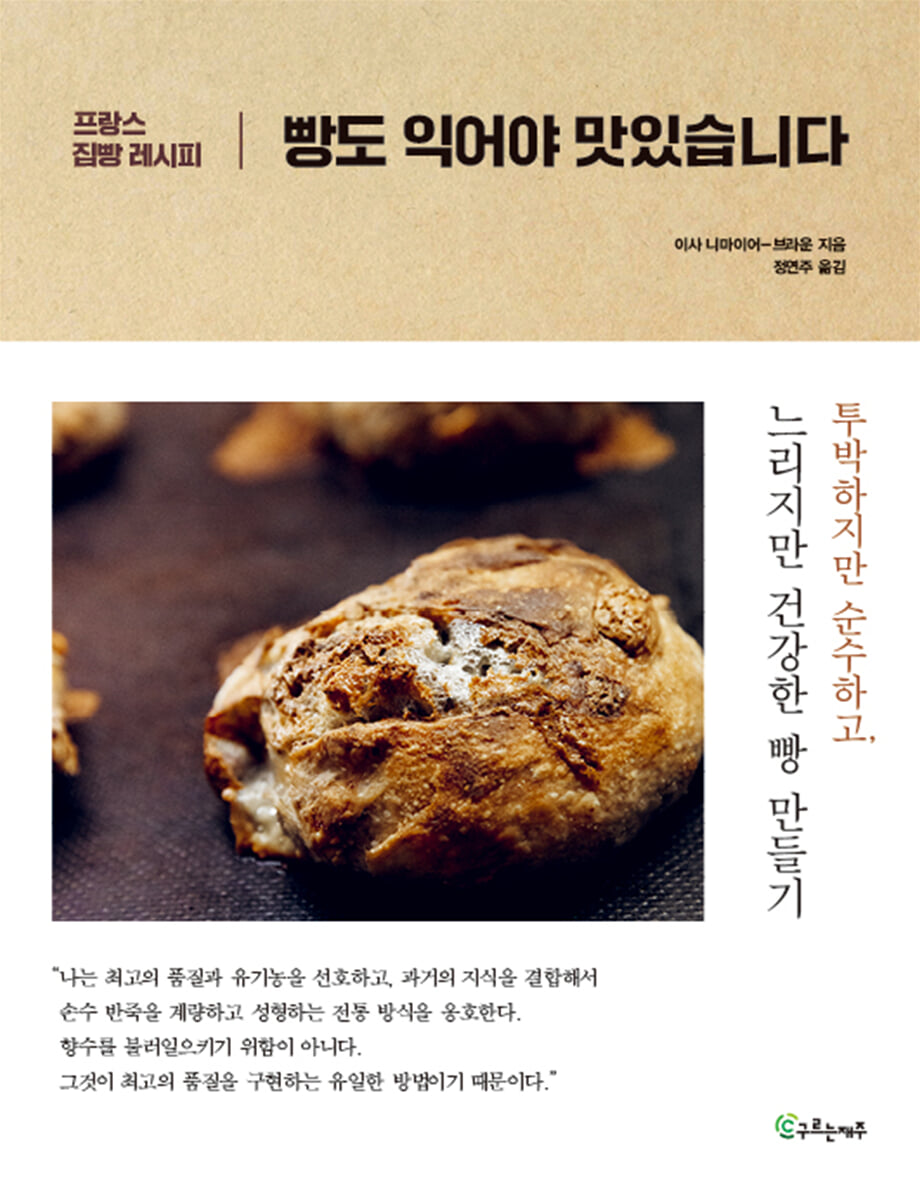
“I prefer the best quality and organic, and I advocate traditional methods of hand-measuring and shaping dough, combining knowledge from the past.
It's not meant to evoke nostalgia.
Because that is the only way to achieve the best quality.”
Recently, some people have even argued that it is better to avoid eating bread altogether.
This is a very reasonable idea, considering the factory-made bread commonly available in supermarkets.
For some people, bread is a difficult food to digest because it is made up of gluten and carbohydrates.
Plus, you're forced to eat unwanted artificial sweeteners and preservatives.
Such bread has little nutritional value other than carbohydrates.
But if you make dough with flour ground on a millstone according to the traditional European method, shape it with minimal force, and let it rise, you get a completely different bread.
The result is bread that is easy to digest and rich in minerals, vitamins, and protein.
It is a bread with a simple and pure taste and flavor that goes well with any Western dish.
This book contains the author's recipes for traditional French bread, combining traditional methods with modern baking techniques.
Instead of using machines to quickly knead and rise the dough, we knead with minimal force and develop the dough slowly through maturation.
So, the destruction of nutrients is minimized.
It also provides detailed instructions on how to make sourdough and starter the traditional way.
Learn how to make healthy and delicious bread with recipes from the author, recognized as one of the best bakers in the Netherlands.
“I prefer the best quality and organic, and I advocate traditional methods of hand-measuring and shaping dough, combining knowledge from the past.
It's not meant to evoke nostalgia.
Because that is the only way to achieve the best quality.”
Recently, some people have even argued that it is better to avoid eating bread altogether.
This is a very reasonable idea, considering the factory-made bread commonly available in supermarkets.
For some people, bread is a difficult food to digest because it is made up of gluten and carbohydrates.
Plus, you're forced to eat unwanted artificial sweeteners and preservatives.
Such bread has little nutritional value other than carbohydrates.
But if you make dough with flour ground on a millstone according to the traditional European method, shape it with minimal force, and let it rise, you get a completely different bread.
The result is bread that is easy to digest and rich in minerals, vitamins, and protein.
It is a bread with a simple and pure taste and flavor that goes well with any Western dish.
This book contains the author's recipes for traditional French bread, combining traditional methods with modern baking techniques.
Instead of using machines to quickly knead and rise the dough, we knead with minimal force and develop the dough slowly through maturation.
So, the destruction of nutrients is minimized.
It also provides detailed instructions on how to make sourdough and starter the traditional way.
Learn how to make healthy and delicious bread with recipes from the author, recognized as one of the best bakers in the Netherlands.
- You can preview some of the book's contents.
Preview
index
prolog
1. Starting
French Baking: A Reinvention of Tradition 30
As a baker, my pick 34
2 What is bread?
Material 38
Yeast and Sourdough 40
Whole wheat bread, multigrain bread, white bread 42
Is it good or bad for your health? 44
3. Practical Bread Baking
Choosing Flour, Salt, Yeast, and Water 48
Kneading and mixing, Autolyze 56
Resting the dough and folding the dough 64
72 Molding
Planning Downtime, Using Your Refrigerator 84
Baking 86
Making and Raising Sourdough Starters 92
Working with Yeast Starter Dough 100
Using Percentages 102
4 How to Use the Recipe
Material 106
Measuring Yeast and Salt 107
Mixing 107
Temperature 109
Resting / Developing the Dough 110
Dough Folding 111
Plastic Surgery 111
Baking 113
5 Recipes
Traditional Baguette 118
Baguette Blanche 122
Old Baguette 128
Pave 130
Petit Pain 136
Epi Baguette 138
sourdough
Sourdough Fire 142
Sourdough Batard 146
whole wheat
Whole Wheat Sourdough Boil 150
Yeast whole wheat flour 152g
154 rye bread
Pang O Nua
Walnut Bread / Walnut Fig Bread 160
Walnut Blue Cheese Roll 164
Pizza Bianca 168
Pizza 174
Fougas
Sourdough Fougasse 178
Yeast Fougasse with Olive Oil and Sage 182
Pangdeumi and Pangbri
Classic Pangdeumi 186
Pangdeumi 188 with extended fermentation time
Pangbri 190
Stollen 192
Brioche 200
Halla 206
6 Create your own recipe
To bake bread with a dense structure and irregular pores, 215
If you want to increase the volume of the bread, 215
To increase the strength of the dough and make it easier to shape, 215
216 How to make a beautiful green
216 to make a strong crust
To make a thin crust, 216
To make a thin but crispy crust, 216
To enrich the flavor 217
How to keep the meat fresh for a long time 217
217 to vary the level and type of acidity and flavor
Appendix 7
Baking Glossary 221
Technical characteristics of wheat flour 222
Indoor temperature and humidity 226
Water temperature and dough temperature 228
Using Canvas for Bakery 229
How to Make and Use a Dough Shovel 230
Greene, inserting a knife into the dough 233
Acknowledgments 236
Search 238
1. Starting
French Baking: A Reinvention of Tradition 30
As a baker, my pick 34
2 What is bread?
Material 38
Yeast and Sourdough 40
Whole wheat bread, multigrain bread, white bread 42
Is it good or bad for your health? 44
3. Practical Bread Baking
Choosing Flour, Salt, Yeast, and Water 48
Kneading and mixing, Autolyze 56
Resting the dough and folding the dough 64
72 Molding
Planning Downtime, Using Your Refrigerator 84
Baking 86
Making and Raising Sourdough Starters 92
Working with Yeast Starter Dough 100
Using Percentages 102
4 How to Use the Recipe
Material 106
Measuring Yeast and Salt 107
Mixing 107
Temperature 109
Resting / Developing the Dough 110
Dough Folding 111
Plastic Surgery 111
Baking 113
5 Recipes
Traditional Baguette 118
Baguette Blanche 122
Old Baguette 128
Pave 130
Petit Pain 136
Epi Baguette 138
sourdough
Sourdough Fire 142
Sourdough Batard 146
whole wheat
Whole Wheat Sourdough Boil 150
Yeast whole wheat flour 152g
154 rye bread
Pang O Nua
Walnut Bread / Walnut Fig Bread 160
Walnut Blue Cheese Roll 164
Pizza Bianca 168
Pizza 174
Fougas
Sourdough Fougasse 178
Yeast Fougasse with Olive Oil and Sage 182
Pangdeumi and Pangbri
Classic Pangdeumi 186
Pangdeumi 188 with extended fermentation time
Pangbri 190
Stollen 192
Brioche 200
Halla 206
6 Create your own recipe
To bake bread with a dense structure and irregular pores, 215
If you want to increase the volume of the bread, 215
To increase the strength of the dough and make it easier to shape, 215
216 How to make a beautiful green
216 to make a strong crust
To make a thin crust, 216
To make a thin but crispy crust, 216
To enrich the flavor 217
How to keep the meat fresh for a long time 217
217 to vary the level and type of acidity and flavor
Appendix 7
Baking Glossary 221
Technical characteristics of wheat flour 222
Indoor temperature and humidity 226
Water temperature and dough temperature 228
Using Canvas for Bakery 229
How to Make and Use a Dough Shovel 230
Greene, inserting a knife into the dough 233
Acknowledgments 236
Search 238
Detailed image
Into the book
Recently, some people have even argued that it is better to avoid eating bread altogether.
For some people, bread is a difficult food to digest because it is made up of gluten and carbohydrates.
This is a very reasonable idea, considering the factory-made bread commonly available in supermarkets.
Such bread has little nutritional value apart from carbohydrates, and because of the rapid fermentation process, it is almost 'indigestible' and settles heavily in the stomach.
Additionally, breads are often manipulated to contain more protein by adding less easily digestible additives, such as lactose or added gluten, which increases the gluten content.
But if you use stone-milled flour and let it ferment slowly, so that the acids produced in the dough break down the gluten and fully digest the flour, it's a different story.
When aged dough is shaped and baked with minimal force, the bread is not only easy to digest but also a nutritious source of minerals, vitamins, and protein.
---Page 44
The most basic way to make bread using an autolyze instead of a strong dough is as follows.
First, mix the flour and water until the flour is 'hydrated'.
That is, mix until all the flour has absorbed the water and there are no dry particles left.
This first step is simply a mixing process, so you should never knead vigorously and work with minimal hand contact.
Cover the mixed dough and leave it to rest.
In my experience, 30 minutes is usually sufficient (the ideal resting time will vary depending on the recipe and the quality of the flour; a good rule of thumb is between 20 minutes and 24 hours).
During these 30 minutes, several things happen inside the dough.
The flour grains continue to absorb moisture.
And wheat flour proteins form the gluten structure.
During this process, the amylase enzyme in the flour begins to convert starch into sugar.
This is the autolysis, or self-decomposition, stage.
---Page 60
When you fold the dough, the gluten strands stretch to their maximum extent possible.
And when you let the dough rest again, the gluten relaxes.
The gluten strands slowly elongate again.
The next step, shaping, involves stretching the gluten again and aligning the protein strands all in the same direction.
However, immediately after folding, the dough does not stretch well and is elastic, so it tears easily and cannot be shaped.
It should usually be folded at least an hour before shaping.
Depending on the properties of the dough, especially the moisture content it has reached, even very moist doughs can be made strong enough by repeating the dough folding process several times (and then allowing a rest period between each).
---Page 71
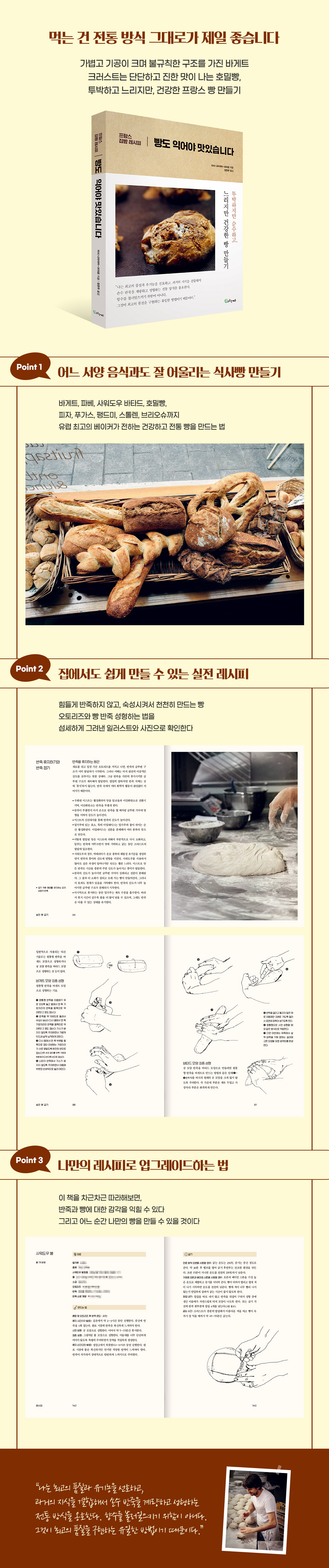
① Cut the dough into rectangles.
Take one piece of dough, hold it at the end away from you, and pull it all the way towards you, making sure the seam is under the edge that is closest to you.
② Use your thumb to push the seam downwards, but pull the dough without turning it over.
The top of the dough should remain facing upward throughout the entire process.
Let's think about pushing it down.
③ Place your hand flat on the edge farthest from your body, almost at the bottom, and pull the dough toward your body.
Your little finger should touch the dough and move across the work surface.
Repeat pulling or pushing the dough using the resistance of the surface until the dough surface reaches maximum tension.
Again, the top of the dough should still be facing upwards and the seam should remain underneath.
Be careful not to sprinkle too much flour, as this will cause the dough to slip and not have the resistance it needs to gain tension.
---Page 76
To make the flavor richer
· Knead as little as possible.
· The fermentation time is long, either before or after molding, or both, and some of it must be carried out at a relatively low temperature.
· Use only a very small amount of yeast or sourdough starter dough.
· The dough must be measured and shaped by hand, and care must be taken to prevent gas from escaping.
· Let the dough ferment sufficiently.
Pay special attention to the first fermentation before molding.
· When starting to bake, make sure the oven is sufficiently humid to allow the crust to develop, and let the finished bread cool sufficiently before cutting.
For some people, bread is a difficult food to digest because it is made up of gluten and carbohydrates.
This is a very reasonable idea, considering the factory-made bread commonly available in supermarkets.
Such bread has little nutritional value apart from carbohydrates, and because of the rapid fermentation process, it is almost 'indigestible' and settles heavily in the stomach.
Additionally, breads are often manipulated to contain more protein by adding less easily digestible additives, such as lactose or added gluten, which increases the gluten content.
But if you use stone-milled flour and let it ferment slowly, so that the acids produced in the dough break down the gluten and fully digest the flour, it's a different story.
When aged dough is shaped and baked with minimal force, the bread is not only easy to digest but also a nutritious source of minerals, vitamins, and protein.
---Page 44
The most basic way to make bread using an autolyze instead of a strong dough is as follows.
First, mix the flour and water until the flour is 'hydrated'.
That is, mix until all the flour has absorbed the water and there are no dry particles left.
This first step is simply a mixing process, so you should never knead vigorously and work with minimal hand contact.
Cover the mixed dough and leave it to rest.
In my experience, 30 minutes is usually sufficient (the ideal resting time will vary depending on the recipe and the quality of the flour; a good rule of thumb is between 20 minutes and 24 hours).
During these 30 minutes, several things happen inside the dough.
The flour grains continue to absorb moisture.
And wheat flour proteins form the gluten structure.
During this process, the amylase enzyme in the flour begins to convert starch into sugar.
This is the autolysis, or self-decomposition, stage.
---Page 60
When you fold the dough, the gluten strands stretch to their maximum extent possible.
And when you let the dough rest again, the gluten relaxes.
The gluten strands slowly elongate again.
The next step, shaping, involves stretching the gluten again and aligning the protein strands all in the same direction.
However, immediately after folding, the dough does not stretch well and is elastic, so it tears easily and cannot be shaped.
It should usually be folded at least an hour before shaping.
Depending on the properties of the dough, especially the moisture content it has reached, even very moist doughs can be made strong enough by repeating the dough folding process several times (and then allowing a rest period between each).
---Page 71
① Cut the dough into rectangles.
Take one piece of dough, hold it at the end away from you, and pull it all the way towards you, making sure the seam is under the edge that is closest to you.
② Use your thumb to push the seam downwards, but pull the dough without turning it over.
The top of the dough should remain facing upward throughout the entire process.
Let's think about pushing it down.
③ Place your hand flat on the edge farthest from your body, almost at the bottom, and pull the dough toward your body.
Your little finger should touch the dough and move across the work surface.
Repeat pulling or pushing the dough using the resistance of the surface until the dough surface reaches maximum tension.
Again, the top of the dough should still be facing upwards and the seam should remain underneath.
Be careful not to sprinkle too much flour, as this will cause the dough to slip and not have the resistance it needs to gain tension.
---Page 76
To make the flavor richer
· Knead as little as possible.
· The fermentation time is long, either before or after molding, or both, and some of it must be carried out at a relatively low temperature.
· Use only a very small amount of yeast or sourdough starter dough.
· The dough must be measured and shaped by hand, and care must be taken to prevent gas from escaping.
· Let the dough ferment sufficiently.
Pay special attention to the first fermentation before molding.
· When starting to bake, make sure the oven is sufficiently humid to allow the crust to develop, and let the finished bread cool sufficiently before cutting.
---Page 217
Publisher's Review
Recently, some people have even argued that it is better to avoid eating bread altogether.
This is a very reasonable idea, considering the factory-made bread commonly available in supermarkets.
For some people, bread is a difficult food to digest because it is made up of gluten and carbohydrates.
Plus, you're forced to eat unwanted artificial sweeteners and preservatives.
Such bread has little nutritional value other than carbohydrates.
But if you make dough with flour ground on a millstone according to the traditional European method, shape it with minimal force, and let it rise, you get a completely different bread.
The result is bread that is easy to digest and rich in minerals, vitamins, and protein.
It is a bread with a simple and pure taste and flavor that goes well with any Western dish.
This book contains the author's recipes for traditional French bread, combining traditional methods with modern baking techniques.
Instead of using machines to quickly knead and rise the dough, we knead with minimal force and develop the dough slowly through maturation.
So, the destruction of nutrients is minimized.
It also provides detailed instructions on how to make sourdough and starter the traditional way.
Learn how to make healthy and delicious bread with recipes from the author, recognized as one of the best bakers in the Netherlands.
A baker who bakes bread at home,
Becoming the best baker in the Netherlands
- Recreate the flavor of the bread you ate as a child
- Traveling through France, Italy, and Portugal in search of traditional breads
Author Isa Niemeyer-Braun, who studied sociology and philosophy at university and worked in reconstruction efforts in the Bosnian war zone, has been baking bread at home for fun since she was young.
Then, at some point, he changed the course of his life with the thought of wanting to recreate the bread he had tasted at his uncle's house in France as a child.
He travels through the countryside of France, Italy, and Portugal, learning ancient baking techniques there.
And finally, to overcome the limitations of an amateur, he formally learns baking skills at the Gosselin Bakery in France and finally becomes a professional.
Returning to Amsterdam, Issa Niemeyer-Braun opens Niemeyer Brothers Bakery with her brother, a chef.
Soon their bakery will take the industry by storm.
The author uses organic ingredients to minimize kneading and fermenting at low temperatures twice.
And then it is quickly shaped and baked.
The key is autolyzing, controlling the chemical reactions that occur in the dough so that the dough develops on its own instead of going through an intense kneading process.
This will drastically reduce the time and energy required to knead the dough.
In addition, it can preserve nutrients such as vitamins, minerals, and proteins that are destroyed during strong kneading.
However, no machines are used in this entire process.
Made by hand in the traditional way.
That's why we can easily follow the recipes made by him, a professional baker, at home.
Rustic but healthy
23 Traditional French Bread Recipes
- 23 Healthy Meal Bread Recipes
- Bread that goes well with all foods, like rice
《Bread Must Be Baked to Be Tasty》 is a book containing recipes for making bread that is served on the French dinner table.
Of course, it does not contain instructions for making desserts or sweet and fancy breads with various ingredients.
Instead, there is a way to make bread that can be eaten every day like rice, bread that goes well with any meal.
And it's completely different from existing books that just list recipes for making bread.
Each step before baking is devoted to as many pages as the recipe itself.
It explains the types and characteristics of flour, how to choose the right flour for your desired bread, the order in which water, salt, and yeast are added to the dough and why, what effect these have on the dough, and how they affect the bread when baked.
And it teaches you step-by-step how to make the best dough through emotional illustrations.
It focuses on teaching you the basics of making delicious, flavorful bread.
So the recipe feels rather simple.
But if you follow along step by step, you will learn how to make a variety of meal breads, from traditional baguettes to pavés, petit pains, chaudhé batards, rye bread, walnut bread, stollen, brioche, and challah.
The illustrations, which delicately depict the tools and process of bread-making with a pen, as well as vivid photographs of the bread-baking scene, will provide readers with a viewing pleasure.
This is a very reasonable idea, considering the factory-made bread commonly available in supermarkets.
For some people, bread is a difficult food to digest because it is made up of gluten and carbohydrates.
Plus, you're forced to eat unwanted artificial sweeteners and preservatives.
Such bread has little nutritional value other than carbohydrates.
But if you make dough with flour ground on a millstone according to the traditional European method, shape it with minimal force, and let it rise, you get a completely different bread.
The result is bread that is easy to digest and rich in minerals, vitamins, and protein.
It is a bread with a simple and pure taste and flavor that goes well with any Western dish.
This book contains the author's recipes for traditional French bread, combining traditional methods with modern baking techniques.
Instead of using machines to quickly knead and rise the dough, we knead with minimal force and develop the dough slowly through maturation.
So, the destruction of nutrients is minimized.
It also provides detailed instructions on how to make sourdough and starter the traditional way.
Learn how to make healthy and delicious bread with recipes from the author, recognized as one of the best bakers in the Netherlands.
A baker who bakes bread at home,
Becoming the best baker in the Netherlands
- Recreate the flavor of the bread you ate as a child
- Traveling through France, Italy, and Portugal in search of traditional breads
Author Isa Niemeyer-Braun, who studied sociology and philosophy at university and worked in reconstruction efforts in the Bosnian war zone, has been baking bread at home for fun since she was young.
Then, at some point, he changed the course of his life with the thought of wanting to recreate the bread he had tasted at his uncle's house in France as a child.
He travels through the countryside of France, Italy, and Portugal, learning ancient baking techniques there.
And finally, to overcome the limitations of an amateur, he formally learns baking skills at the Gosselin Bakery in France and finally becomes a professional.
Returning to Amsterdam, Issa Niemeyer-Braun opens Niemeyer Brothers Bakery with her brother, a chef.
Soon their bakery will take the industry by storm.
The author uses organic ingredients to minimize kneading and fermenting at low temperatures twice.
And then it is quickly shaped and baked.
The key is autolyzing, controlling the chemical reactions that occur in the dough so that the dough develops on its own instead of going through an intense kneading process.
This will drastically reduce the time and energy required to knead the dough.
In addition, it can preserve nutrients such as vitamins, minerals, and proteins that are destroyed during strong kneading.
However, no machines are used in this entire process.
Made by hand in the traditional way.
That's why we can easily follow the recipes made by him, a professional baker, at home.
Rustic but healthy
23 Traditional French Bread Recipes
- 23 Healthy Meal Bread Recipes
- Bread that goes well with all foods, like rice
《Bread Must Be Baked to Be Tasty》 is a book containing recipes for making bread that is served on the French dinner table.
Of course, it does not contain instructions for making desserts or sweet and fancy breads with various ingredients.
Instead, there is a way to make bread that can be eaten every day like rice, bread that goes well with any meal.
And it's completely different from existing books that just list recipes for making bread.
Each step before baking is devoted to as many pages as the recipe itself.
It explains the types and characteristics of flour, how to choose the right flour for your desired bread, the order in which water, salt, and yeast are added to the dough and why, what effect these have on the dough, and how they affect the bread when baked.
And it teaches you step-by-step how to make the best dough through emotional illustrations.
It focuses on teaching you the basics of making delicious, flavorful bread.
So the recipe feels rather simple.
But if you follow along step by step, you will learn how to make a variety of meal breads, from traditional baguettes to pavés, petit pains, chaudhé batards, rye bread, walnut bread, stollen, brioche, and challah.
The illustrations, which delicately depict the tools and process of bread-making with a pen, as well as vivid photographs of the bread-baking scene, will provide readers with a viewing pleasure.
GOODS SPECIFICS
- Publication date: June 10, 2021
- Page count, weight, size: 240 pages | 748g | 188*245*20mm
- ISBN13: 9791197355202
- ISBN10: 1197355200
You may also like
카테고리
korean


korean

![GQ KOREA Mark (Monthly): December [2025]](http://librairie.coreenne.fr/cdn/shop/files/8ef265dbbfbf186523ed75ba7319009d.jpg?v=1765340328&width=3840)


