

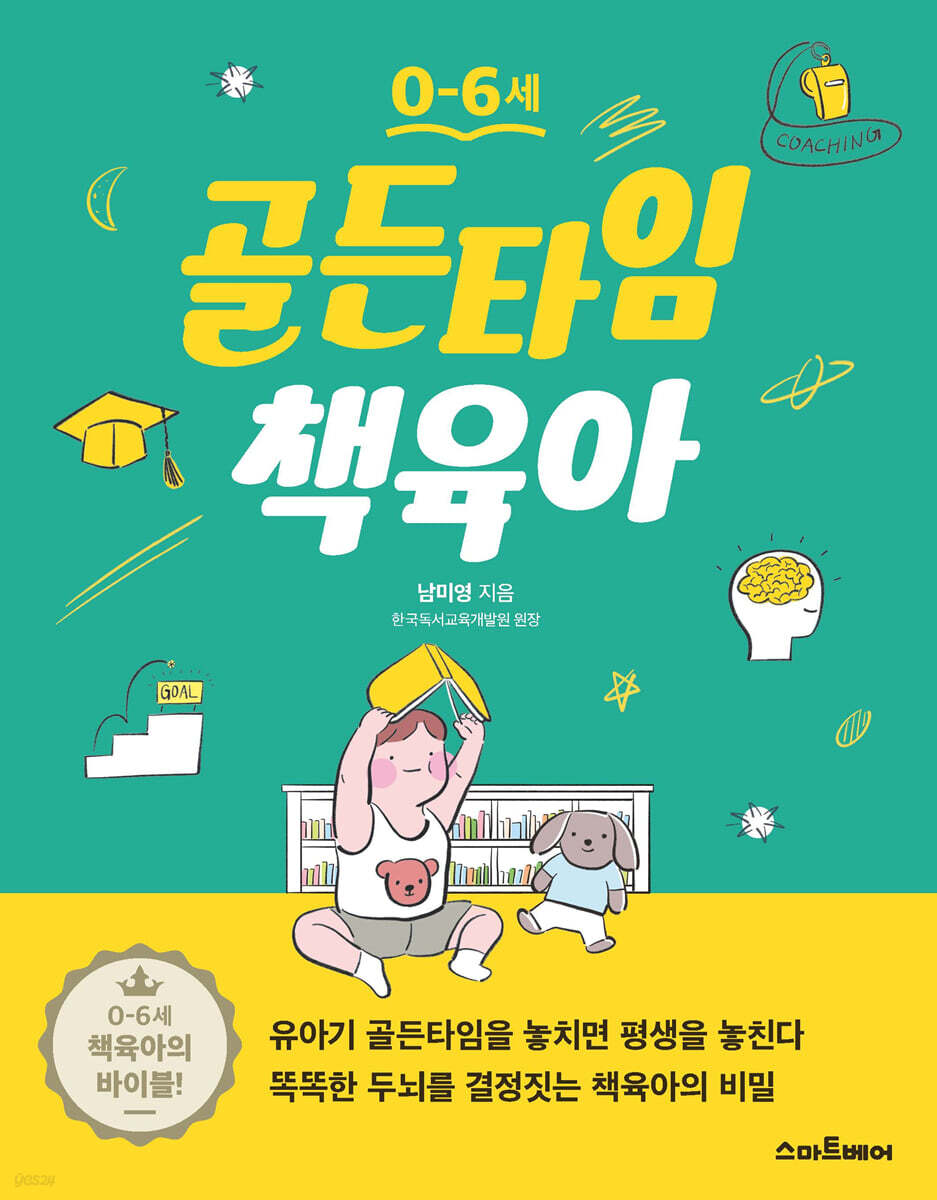
Golden Time Book Parenting for 0-6 Year Olds
 |
Description
Book Introduction
If you miss the golden time of infancy, you miss out on a lifetime.
The Secret of Book Parenting: Developing a Smart Brain
“What books should I read to my baby before he turns one?”
“When is a good time to start learning Korean?”
“What kind of books are helpful for sleeping?”
“Everyone else is learning foreign languages, so when should we start teaching them?”
“Is it okay to read e-books instead of paper books?”
“What should I do if my child has trouble concentrating on his/her book?”
Dr. Nam Mi-young, a national reading mentor, has received similar questions from all mothers at her over 100 reading lectures held annually.
Although their ages vary and their parenting environments vary greatly, they all share one goal: to raise their children to be smart.
All babies in the world, without exception, are born with the same number of developing brain nerve cells, or neurons.
However, there is a stark difference in brain development depending on the type of parenting that mothers do during the golden time of 0-6 years old.
You can be a smart kid that others envy, or you can be a kid that others envy.
Missing this time is like missing out on your whole life.
In "Golden Time Book Parenting for 0-6 Year Olds," we present the basic knowledge of book parenting that new mothers must know, as well as age-specific reading methods that develop the brain.
Let's discover the secrets of book parenting, which will make your child's brain smarter, a golden time in life that you shouldn't miss.
The Secret of Book Parenting: Developing a Smart Brain
“What books should I read to my baby before he turns one?”
“When is a good time to start learning Korean?”
“What kind of books are helpful for sleeping?”
“Everyone else is learning foreign languages, so when should we start teaching them?”
“Is it okay to read e-books instead of paper books?”
“What should I do if my child has trouble concentrating on his/her book?”
Dr. Nam Mi-young, a national reading mentor, has received similar questions from all mothers at her over 100 reading lectures held annually.
Although their ages vary and their parenting environments vary greatly, they all share one goal: to raise their children to be smart.
All babies in the world, without exception, are born with the same number of developing brain nerve cells, or neurons.
However, there is a stark difference in brain development depending on the type of parenting that mothers do during the golden time of 0-6 years old.
You can be a smart kid that others envy, or you can be a kid that others envy.
Missing this time is like missing out on your whole life.
In "Golden Time Book Parenting for 0-6 Year Olds," we present the basic knowledge of book parenting that new mothers must know, as well as age-specific reading methods that develop the brain.
Let's discover the secrets of book parenting, which will make your child's brain smarter, a golden time in life that you shouldn't miss.
- You can preview some of the book's contents.
Preview
index
12 Books for Moms Starting to Raise Children Between 0 and 6 Years Old
Chapter 1: Ages 0-6 Why should children become familiar with books?
1.
22. Parenting with books for children ages 0-6: Creating a happy brain
2.
The wealth gap begins with the book-raising of children ages 0-6. 28
3.
Book Parenting for Children Ages 0-6: The Key to Success (Part 34)
4.
Lifelong reading habits are formed between ages 0 and 6. 44
Chapter 2: The Age of Baby Stories for Children 0-1 Years Old
1.
Say 'I love you' 52
2.
59 Lullabies from Mom That Will Make Your Brain Happy
3.
Babbling: Babies' Conversation with the World 65
4.
Babies learn about the world through laughter 69
5.
Have romantic conversations with your baby for 30 minutes a day.
6.
Applause for the book-tearing baby! 79
7.
The Power of Children's Songs and Poetry in Your Arms 82
8.
Read difficult books to your baby before his or her first birthday. 86
9.
When you sit up, prepare a small picture book 90
10.
94 Reasons Why Dads Should Be Involved in Parenting
Chapter 3: The Age of Face-to-Face Stories for 1-2 Year Olds
1.
A First-Year-Old Baby's World Exploration 100
2.
Become a Chatty Mom 103
3.
Let's hear it, let's hear it! 109
4.
Please convert body language to spoken language 113
5.
Fill your vocabulary with good words 117
6.
If you are good at your native language, you can also speak a foreign language well. 122
7.
Picture Book: Talking to Your First-Year-Old Baby 126
8.
Picture Book, Please Read Slowly 130
9.
Teach me how to handle books 133
10.
Show me how to read a book 137
11.
Respected Dad, Dad Who Reads Books 142
12.
I prefer paper books over e-books 146
Chapter 4 Picture Story Ages 2-4
1.
Ugly Three-Year-Old, Pretty Four-Year-Old Stand at the Center of the World 152
2.
Mom, Mom! Listen to what I think. 155
3.
Let's listen, let's listen! 159
4.
162 Genius Questions That Annoy Mom
5.
A Three-Year-Old Talks to a Picture Book 166
6.
A three-year-old falls in love with a picture book about everyday life. 170
7.
173 Picture Books That Will Captivate Four-Year-Olds
8.
Nature is the world's greatest picture book 180
9.
The borrowed book is between men, my book is between us 184
10.
Why do people ask me to read the same book multiple times? 187
11.
Bedtime Stories: What and How Should I Read Them? 190
12.
Don't disturb me when I'm concentrating 194
13.
Children Whose Dads Read to Them Are Smarter 198
Chapter 5: The Age of Old Stories for 4-5 Years Old
1.
Declaration of Independence at the Age of Five 204
2.
The Power of a Beautiful "You Message" 207
3.
210 Rules of Life Learned from Fairy Tales by a Five-Year-Old
4.
Mom's Guide to Enjoying Traditional Fairy Tales 100%: 216 Questions
5.
Enjoying a Variety of Bedtime Stories 223
6.
Developing Imagination through Poetry and Fairy Tales 228
7.
How to Answer Various Questions 232
8.
Establishing a Strong Reading Habit 237
9.
A Good Mother Has the Art of Praise 241
10.
I'm afraid of losing you because of my smartphone 246
11.
Picture Book: The Most Powerful Sex Education Teacher 251
Chapter 6: Kindergarten Ages 5-6
1.
Learning, Thinking, and Relationships 258
2.
Please prepare a reading resume 263
3.
How would you rate your home's interior and reading environment? 267
4.
Passive Reader, Creative Reader 271
5.
When and how should letters be taught? 276
6.
Build Your Vocabulary Before You Get Hooked on Comics 282
7.
Get to the point! Develop your plot-finding skills 286
8.
Developing Concentration to Make Studying Fun 290
9.
Boost Your Memory and Make You a Knowledge Billionaire 294
10.
Why Reading Play Develops Logical Intelligence 298
11.
Why Reading Game 304: Developing Questioning Skills
12.
Role-playing games that enhance interpersonal intelligence 309
13.
Reading Play 313: Developing Moral Judgment
7 Things Moms Should Remember When Choosing Children's Books 318
Chapter 1: Ages 0-6 Why should children become familiar with books?
1.
22. Parenting with books for children ages 0-6: Creating a happy brain
2.
The wealth gap begins with the book-raising of children ages 0-6. 28
3.
Book Parenting for Children Ages 0-6: The Key to Success (Part 34)
4.
Lifelong reading habits are formed between ages 0 and 6. 44
Chapter 2: The Age of Baby Stories for Children 0-1 Years Old
1.
Say 'I love you' 52
2.
59 Lullabies from Mom That Will Make Your Brain Happy
3.
Babbling: Babies' Conversation with the World 65
4.
Babies learn about the world through laughter 69
5.
Have romantic conversations with your baby for 30 minutes a day.
6.
Applause for the book-tearing baby! 79
7.
The Power of Children's Songs and Poetry in Your Arms 82
8.
Read difficult books to your baby before his or her first birthday. 86
9.
When you sit up, prepare a small picture book 90
10.
94 Reasons Why Dads Should Be Involved in Parenting
Chapter 3: The Age of Face-to-Face Stories for 1-2 Year Olds
1.
A First-Year-Old Baby's World Exploration 100
2.
Become a Chatty Mom 103
3.
Let's hear it, let's hear it! 109
4.
Please convert body language to spoken language 113
5.
Fill your vocabulary with good words 117
6.
If you are good at your native language, you can also speak a foreign language well. 122
7.
Picture Book: Talking to Your First-Year-Old Baby 126
8.
Picture Book, Please Read Slowly 130
9.
Teach me how to handle books 133
10.
Show me how to read a book 137
11.
Respected Dad, Dad Who Reads Books 142
12.
I prefer paper books over e-books 146
Chapter 4 Picture Story Ages 2-4
1.
Ugly Three-Year-Old, Pretty Four-Year-Old Stand at the Center of the World 152
2.
Mom, Mom! Listen to what I think. 155
3.
Let's listen, let's listen! 159
4.
162 Genius Questions That Annoy Mom
5.
A Three-Year-Old Talks to a Picture Book 166
6.
A three-year-old falls in love with a picture book about everyday life. 170
7.
173 Picture Books That Will Captivate Four-Year-Olds
8.
Nature is the world's greatest picture book 180
9.
The borrowed book is between men, my book is between us 184
10.
Why do people ask me to read the same book multiple times? 187
11.
Bedtime Stories: What and How Should I Read Them? 190
12.
Don't disturb me when I'm concentrating 194
13.
Children Whose Dads Read to Them Are Smarter 198
Chapter 5: The Age of Old Stories for 4-5 Years Old
1.
Declaration of Independence at the Age of Five 204
2.
The Power of a Beautiful "You Message" 207
3.
210 Rules of Life Learned from Fairy Tales by a Five-Year-Old
4.
Mom's Guide to Enjoying Traditional Fairy Tales 100%: 216 Questions
5.
Enjoying a Variety of Bedtime Stories 223
6.
Developing Imagination through Poetry and Fairy Tales 228
7.
How to Answer Various Questions 232
8.
Establishing a Strong Reading Habit 237
9.
A Good Mother Has the Art of Praise 241
10.
I'm afraid of losing you because of my smartphone 246
11.
Picture Book: The Most Powerful Sex Education Teacher 251
Chapter 6: Kindergarten Ages 5-6
1.
Learning, Thinking, and Relationships 258
2.
Please prepare a reading resume 263
3.
How would you rate your home's interior and reading environment? 267
4.
Passive Reader, Creative Reader 271
5.
When and how should letters be taught? 276
6.
Build Your Vocabulary Before You Get Hooked on Comics 282
7.
Get to the point! Develop your plot-finding skills 286
8.
Developing Concentration to Make Studying Fun 290
9.
Boost Your Memory and Make You a Knowledge Billionaire 294
10.
Why Reading Play Develops Logical Intelligence 298
11.
Why Reading Game 304: Developing Questioning Skills
12.
Role-playing games that enhance interpersonal intelligence 309
13.
Reading Play 313: Developing Moral Judgment
7 Things Moms Should Remember When Choosing Children's Books 318
Detailed image

Into the book
There was news that when a private academy in Gangnam, Seoul, advertised that children could acquire 100 Seoul National University required reading books in advance while they were still in elementary school, hundreds of mothers flocked to the academy in just one day.
When a reporter asked a mother who had barely managed to get her child to enroll in the class why, she replied, “Because all the other mothers are doing it.”
The phenomenon of people following the mother next door and running around here and there is similar to the real estate speculation scene.
It's inevitable that you'll lose money if you speculate badly, but how sad would it be if you ruined the life of your child, the most precious person in the world?
--- From the prologue, “For mothers who are starting to raise children aged 0-6”
Babies are born with sensory abilities that are 50 times more powerful than those of adults.
And until the age of three, we read and learn about the world through this instinctive sense.
If you use your five senses evenly and frequently at this time, you can preserve them without being pruned.
However, by the law of pruning, unused senses are eliminated.
That's why parents should help their babies use the five senses they were born with until they are three years old.
---From "A happy brain is a brain with developed five senses"
It is up to the mother whether or not her newborn develops an attachment that is both trusting and happy about the world.
If a baby does not develop an optimistic self-confidence about the world before his or her first birthday, he or she will develop attachment problems and develop a pessimistic personality.
It may seem like life is all about sleeping, waking up, feeding, going to the toilet, and taking a bath, but it is around this time that babies learn about life through such an incredible sense.
----From “Attachment is a baby’s survival instinct”
Robert Morady, a psychiatry professor at the University of California, Los Angeles, studied the differences between children raised by their mothers and those raised by their fathers and found that children raised by their fathers were less shy and significantly less likely to cry when they saw strangers.
In other words, the conclusion is that children whose fathers actively participate in child-rearing are more active and have higher social adaptability.
---From "Babies who play with their fathers are more independent"
When we study children who stutter, we often find that mothers overreact when their children first stutter.
In times like these, try speaking for 30 minutes a day to increase your vocabulary.
If you talk to your mother regularly, your child's thoughts will become much deeper.
Investing 30 minutes a day will give you a huge vocabulary and will set you up for success when you enter school with a strong brain and high learning ability.
---From "It's okay to say it slowly and repeatedly"
Reading is a guessing game of language.
While looking at a picture book, children's brains begin a game of guessing what will happen next.
If your guess is correct, you will be happy, and if it is wrong, you will be encouraged.
The joy that arises at this time becomes the energy that makes you read a book to the end.
And every time you turn the page, your brain feels happy because you feel like you are evolving.
Children who have discovered this joy now fall in love with books.
---From “Picture books delight the brains of young children”
Whether the message is, "You're cool" or "You're lazy," the messages sent by older adults, especially moms and dads, are deeply ingrained in a child's subconscious.
If you were an elementary school student, you would think about this and that and say, 'Mom, you're not telling the truth right now.
You might think, 'He's just acting like that because he's angry,' but children under the age of six have limited reasoning skills and are vulnerable to such messages.
---From "Mom, What Kind of Child Am I?"
Mothers who see their children's speaking skills develop so rapidly think, "Shouldn't we start teaching them to read and write sooner?"
As I started to think about when and how to teach, I put up Hangul murals on the wall, bought Hangul magnets, and bought Hangul learning books.
Among the research partners of the Korea Reading Education Development Institute, more than 80% of mothers of five-year-olds were looking for answers to this question.
But there's no need to overthink it.
The best time to teach letters is when the child asks for the letters.
Of course, this period is different for each child.
---From "When? When the child asks, 'What letter is that?'"
Questions are an expression of curiosity and a sign that the brain is alive.
Children whose brains are asleep don't ask questions.
If you want to raise a child who studies well, becomes successful, and becomes a great person, you must first raise him or her to be a questioner.
When a reporter asked a mother who had barely managed to get her child to enroll in the class why, she replied, “Because all the other mothers are doing it.”
The phenomenon of people following the mother next door and running around here and there is similar to the real estate speculation scene.
It's inevitable that you'll lose money if you speculate badly, but how sad would it be if you ruined the life of your child, the most precious person in the world?
--- From the prologue, “For mothers who are starting to raise children aged 0-6”
Babies are born with sensory abilities that are 50 times more powerful than those of adults.
And until the age of three, we read and learn about the world through this instinctive sense.
If you use your five senses evenly and frequently at this time, you can preserve them without being pruned.
However, by the law of pruning, unused senses are eliminated.
That's why parents should help their babies use the five senses they were born with until they are three years old.
---From "A happy brain is a brain with developed five senses"
It is up to the mother whether or not her newborn develops an attachment that is both trusting and happy about the world.
If a baby does not develop an optimistic self-confidence about the world before his or her first birthday, he or she will develop attachment problems and develop a pessimistic personality.
It may seem like life is all about sleeping, waking up, feeding, going to the toilet, and taking a bath, but it is around this time that babies learn about life through such an incredible sense.
----From “Attachment is a baby’s survival instinct”
Robert Morady, a psychiatry professor at the University of California, Los Angeles, studied the differences between children raised by their mothers and those raised by their fathers and found that children raised by their fathers were less shy and significantly less likely to cry when they saw strangers.
In other words, the conclusion is that children whose fathers actively participate in child-rearing are more active and have higher social adaptability.
---From "Babies who play with their fathers are more independent"
When we study children who stutter, we often find that mothers overreact when their children first stutter.
In times like these, try speaking for 30 minutes a day to increase your vocabulary.
If you talk to your mother regularly, your child's thoughts will become much deeper.
Investing 30 minutes a day will give you a huge vocabulary and will set you up for success when you enter school with a strong brain and high learning ability.
---From "It's okay to say it slowly and repeatedly"
Reading is a guessing game of language.
While looking at a picture book, children's brains begin a game of guessing what will happen next.
If your guess is correct, you will be happy, and if it is wrong, you will be encouraged.
The joy that arises at this time becomes the energy that makes you read a book to the end.
And every time you turn the page, your brain feels happy because you feel like you are evolving.
Children who have discovered this joy now fall in love with books.
---From “Picture books delight the brains of young children”
Whether the message is, "You're cool" or "You're lazy," the messages sent by older adults, especially moms and dads, are deeply ingrained in a child's subconscious.
If you were an elementary school student, you would think about this and that and say, 'Mom, you're not telling the truth right now.
You might think, 'He's just acting like that because he's angry,' but children under the age of six have limited reasoning skills and are vulnerable to such messages.
---From "Mom, What Kind of Child Am I?"
Mothers who see their children's speaking skills develop so rapidly think, "Shouldn't we start teaching them to read and write sooner?"
As I started to think about when and how to teach, I put up Hangul murals on the wall, bought Hangul magnets, and bought Hangul learning books.
Among the research partners of the Korea Reading Education Development Institute, more than 80% of mothers of five-year-olds were looking for answers to this question.
But there's no need to overthink it.
The best time to teach letters is when the child asks for the letters.
Of course, this period is different for each child.
---From "When? When the child asks, 'What letter is that?'"
Questions are an expression of curiosity and a sign that the brain is alive.
Children whose brains are asleep don't ask questions.
If you want to raise a child who studies well, becomes successful, and becomes a great person, you must first raise him or her to be a questioner.
---From "A child who grows up being asked questions becomes good at asking questions"
Publisher's Review
A Methodology for Early Childhood Reading Education that Protects the Golden Time of Children Ages 0-6
Dr. Nam Mi-young, who has been researching Korean language education and reading education at the Korea Educational Development Institute (KEDI), the brains of the Ministry of Education and Human Resources Development, for 24 years, recalled the adage, “A child who has a good mother is already halfway to success in life,” and compiled her research into a book.
The core of early childhood reading education, as conveyed by Dr. Nam Mi-young, who has dedicated her life to reading education research, is not something grandiose.
This is a story about the 'right book' according to the child's developmental stage, the 'critical time' to read it, and the 'wise role of a mother.'
Many studies and experiments have shown that children who did not receive proper reading education in early childhood are less likely to benefit from any later education.
The reason there is a gap in learning ability between children who entered school at the same age of seven is because of differences in reading education during early childhood.
Dr. Nam Mi-young claims that the way to raise a child to be a 'smart child' is through book parenting.
Textbooks for elementary, middle, and high school are reviewed by the government to determine whether they pass or fail, but until they enter elementary school, mothers have no choice but to review and select the books that children read.
Mothers must personally select age-appropriate books for their babies and determine reading methods.
The problem is that for new mothers, this can be difficult and overwhelming.
The world is overflowing with picture books for children, and even if you choose a good one and buy it, you still have to worry about how to read it to your child.
This book provides step-by-step information on the basics of childcare that new mothers must know.
It also suggests age-specific reading methods that children should adapt to as they grow each year.
The gap between rich and poor begins with the reading of children aged 0-6.
“You can only get rich if you have books nearby.” This is what world-renowned stock market magnate Warren Buffett said, who has loved books since he was young.
If you talk to not only the world's wealthiest people, but also the so-called successful people around us, you will find that they have read a lot of books since childhood.
They were people who learned about the world through indirect experiences through books, developed empathy, and defined themselves to build self-esteem.
“Hey, it’s not too late to do it in elementary school.” If there’s anyone who says this, they should remember this proverb.
'Habits formed at age three last until age eighty.'
In fact, it is very easy to develop a reading habit until the age of three because everything is absorbed through the right brain.
Based on this scientific evidence, Dr. Nam Mi-young emphasizes that daily reading between the ages of 0 and 6 is daily brain training.
A brain trained through daily reading improves vocabulary, comprehension, imagination, critical thinking, reasoning, judgment, creativity, and problem-solving skills.
However, children who have not developed a reading habit by the age of six do not enjoy reading and make excuses for not wanting to read.
Also, because you study solely by memory, you are limited in what you learn from your teacher.
Reading books is the easiest and most certain way to make a child with a smart brain.
We need books that are appropriate for the developmental stage.
One year in infancy is equivalent to ten years in an adult, and a river that is difficult to cross flows in one year.
No matter how famous a children's book is, if it is not appropriate for a child's developmental stage, it becomes food that cannot be digested.
There is an 80% rule in reading.
This means that a book that a child can understand about 80% of is a book that is appropriate for that child's level.
If you can understand 100% of the book, it's too easy and boring, and if you can only understand 20-30%, it's demotivating to read.
The physical time of seven years for a child is not that long.
You don't have time to waste reading books that don't fit your level.
It would be nice if someone could handpick the books that children should read at that age, but each child has a different personality and interests, so no single list of recommendations can be the best for them.
Even if a list exists that is perfect for your child, it's not going to be extensive enough to last seven years.
Mothers shouldn't just expect someone to catch the fish for them.
You have to learn how to catch fish by casting your own net.
Fortunately, Dr. Nam Mi-young, who has dedicated her life to reading education research, presents the direction and methods of book parenting in “Golden Time Book Parenting for Children Ages 0-6.”
Mothers can put into practice book-based parenting without regrets by following the age-specific guide provided by Dr. Nam Mi-young.
Dr. Nam Mi-young, who has been researching Korean language education and reading education at the Korea Educational Development Institute (KEDI), the brains of the Ministry of Education and Human Resources Development, for 24 years, recalled the adage, “A child who has a good mother is already halfway to success in life,” and compiled her research into a book.
The core of early childhood reading education, as conveyed by Dr. Nam Mi-young, who has dedicated her life to reading education research, is not something grandiose.
This is a story about the 'right book' according to the child's developmental stage, the 'critical time' to read it, and the 'wise role of a mother.'
Many studies and experiments have shown that children who did not receive proper reading education in early childhood are less likely to benefit from any later education.
The reason there is a gap in learning ability between children who entered school at the same age of seven is because of differences in reading education during early childhood.
Dr. Nam Mi-young claims that the way to raise a child to be a 'smart child' is through book parenting.
Textbooks for elementary, middle, and high school are reviewed by the government to determine whether they pass or fail, but until they enter elementary school, mothers have no choice but to review and select the books that children read.
Mothers must personally select age-appropriate books for their babies and determine reading methods.
The problem is that for new mothers, this can be difficult and overwhelming.
The world is overflowing with picture books for children, and even if you choose a good one and buy it, you still have to worry about how to read it to your child.
This book provides step-by-step information on the basics of childcare that new mothers must know.
It also suggests age-specific reading methods that children should adapt to as they grow each year.
The gap between rich and poor begins with the reading of children aged 0-6.
“You can only get rich if you have books nearby.” This is what world-renowned stock market magnate Warren Buffett said, who has loved books since he was young.
If you talk to not only the world's wealthiest people, but also the so-called successful people around us, you will find that they have read a lot of books since childhood.
They were people who learned about the world through indirect experiences through books, developed empathy, and defined themselves to build self-esteem.
“Hey, it’s not too late to do it in elementary school.” If there’s anyone who says this, they should remember this proverb.
'Habits formed at age three last until age eighty.'
In fact, it is very easy to develop a reading habit until the age of three because everything is absorbed through the right brain.
Based on this scientific evidence, Dr. Nam Mi-young emphasizes that daily reading between the ages of 0 and 6 is daily brain training.
A brain trained through daily reading improves vocabulary, comprehension, imagination, critical thinking, reasoning, judgment, creativity, and problem-solving skills.
However, children who have not developed a reading habit by the age of six do not enjoy reading and make excuses for not wanting to read.
Also, because you study solely by memory, you are limited in what you learn from your teacher.
Reading books is the easiest and most certain way to make a child with a smart brain.
We need books that are appropriate for the developmental stage.
One year in infancy is equivalent to ten years in an adult, and a river that is difficult to cross flows in one year.
No matter how famous a children's book is, if it is not appropriate for a child's developmental stage, it becomes food that cannot be digested.
There is an 80% rule in reading.
This means that a book that a child can understand about 80% of is a book that is appropriate for that child's level.
If you can understand 100% of the book, it's too easy and boring, and if you can only understand 20-30%, it's demotivating to read.
The physical time of seven years for a child is not that long.
You don't have time to waste reading books that don't fit your level.
It would be nice if someone could handpick the books that children should read at that age, but each child has a different personality and interests, so no single list of recommendations can be the best for them.
Even if a list exists that is perfect for your child, it's not going to be extensive enough to last seven years.
Mothers shouldn't just expect someone to catch the fish for them.
You have to learn how to catch fish by casting your own net.
Fortunately, Dr. Nam Mi-young, who has dedicated her life to reading education research, presents the direction and methods of book parenting in “Golden Time Book Parenting for Children Ages 0-6.”
Mothers can put into practice book-based parenting without regrets by following the age-specific guide provided by Dr. Nam Mi-young.
GOODS SPECIFICS
- Date of issue: June 1, 2021
- Page count, weight, size: 320 pages | 718g | 180*230*20mm
- ISBN13: 9788930259064
- ISBN10: 8930259065
You may also like
카테고리
korean


korean

![GQ KOREA Mark (Monthly): December [2025]](http://librairie.coreenne.fr/cdn/shop/files/8ef265dbbfbf186523ed75ba7319009d.jpg?v=1765340328&width=3840)


