

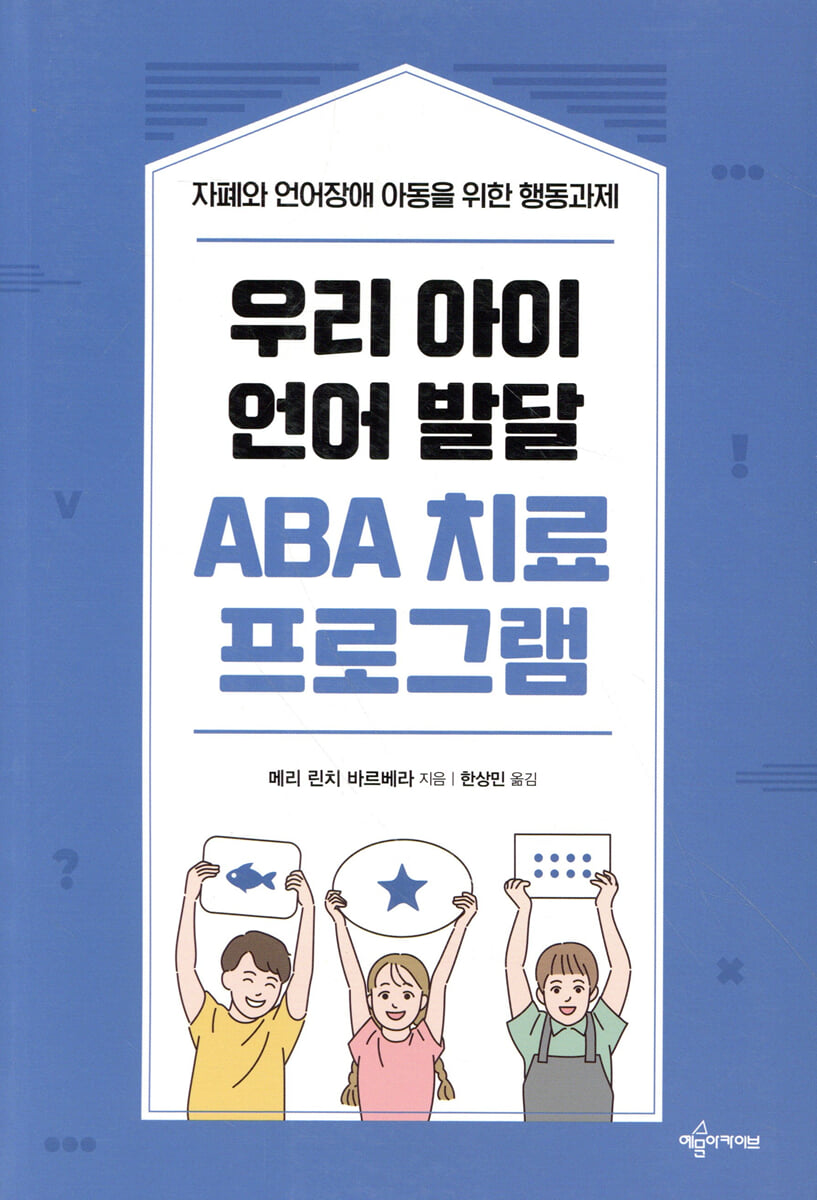
Our Child's Language Development ABA Therapy Program
 |
Description
Book Introduction
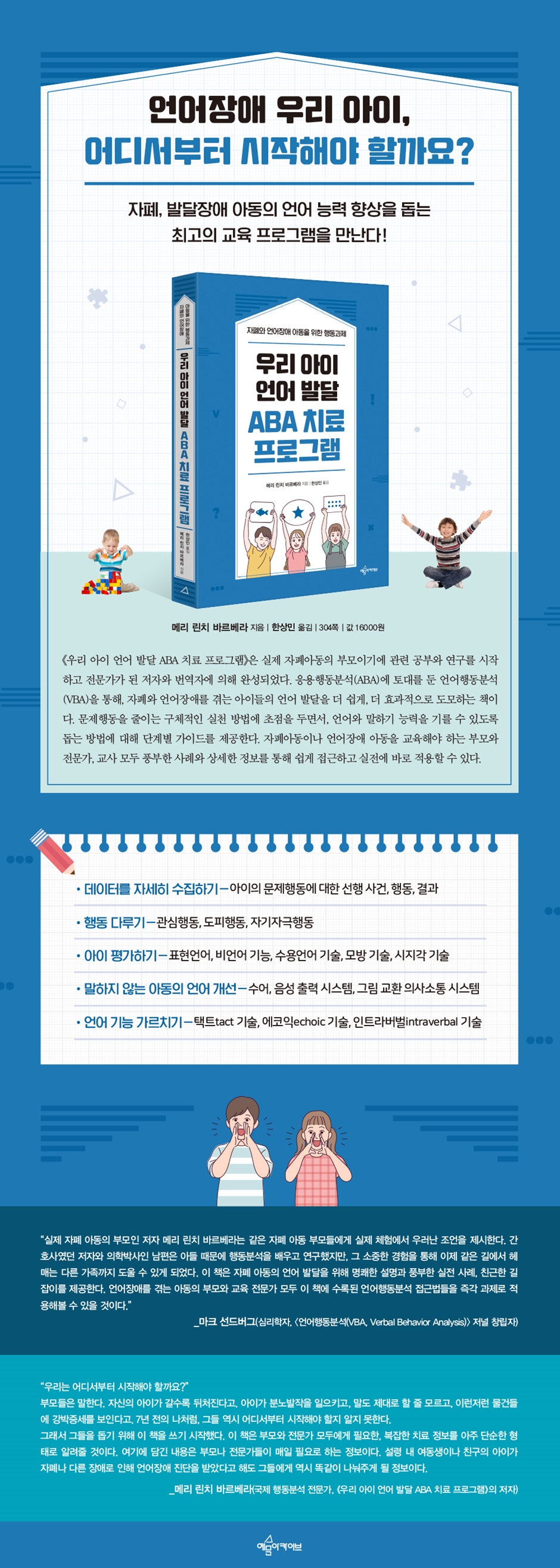
“Where does my child with language impairment start?
“Should we start?”
Helping improve language skills in children with autism and developmental disabilities
Discover the best educational programs!
Another essential educational resource for language development in children with autism and language impairments has been published.
"Our Child's Language Development ABA Therapy Program" is a book completed by the author and translator, who are parents of children with autism and have studied and researched the subject and become experts.
In the "Our Child's Language Development ABA Therapy Program," we promote language development in children with autism and language disorders more easily and effectively through Verbal Behavior Analysis (VBA), which is based on Applied Behavior Analysis (ABA).
It provides a step-by-step guide on how to help develop language and speaking skills, focusing on specific practices to reduce problem behaviors.
This is an educational method that is easily accessible and immediately applicable to real-world situations, with abundant examples and detailed information for parents, professionals, and teachers who need to educate children with autism or language disorders.
This book contains the principles and implementation methods of language behavior analysis, analysis and response methods for children's problem behavior, the principles and procedures of toilet training, and even my experiences as a parent of a child with autism.
Even in the United States, where the original work was published, it is considered one of the first books recommended to parents of children with autism and developmental disabilities, and is widely applied to children who have difficulties with language development, such as speech disorders, in addition to developmental disabilities.
“Should we start?”
Helping improve language skills in children with autism and developmental disabilities
Discover the best educational programs!
Another essential educational resource for language development in children with autism and language impairments has been published.
"Our Child's Language Development ABA Therapy Program" is a book completed by the author and translator, who are parents of children with autism and have studied and researched the subject and become experts.
In the "Our Child's Language Development ABA Therapy Program," we promote language development in children with autism and language disorders more easily and effectively through Verbal Behavior Analysis (VBA), which is based on Applied Behavior Analysis (ABA).
It provides a step-by-step guide on how to help develop language and speaking skills, focusing on specific practices to reduce problem behaviors.
This is an educational method that is easily accessible and immediately applicable to real-world situations, with abundant examples and detailed information for parents, professionals, and teachers who need to educate children with autism or language disorders.
This book contains the principles and implementation methods of language behavior analysis, analysis and response methods for children's problem behavior, the principles and procedures of toilet training, and even my experiences as a parent of a child with autism.
Even in the United States, where the original work was published, it is considered one of the first books recommended to parents of children with autism and developmental disabilities, and is widely applied to children who have difficulties with language development, such as speech disorders, in addition to developmental disabilities.
- You can preview some of the book's contents.
Preview
index
Acknowledgements
Recommendation
Header
Translator's Note: Understanding ABA and Language Behavior Analysis
Chapter 1: Getting Started with ABA
What is Verbal Behavior Analysis? / Improving Language and Reducing Problem Behaviors / Key Differences Between Verbal Behavior Analysis and the Robas ABA Program /
Why Use Language Behavior Analysis / Switching to Language Behavior Analysis
Chapter 2: The ABCs of ABA
Learning the ABCs / Collecting detailed data / Identifying the function of problem behavior / Developing a function-based intervention plan /
Handling behaviors of interest or acquisition function / Handling escape behavior / Handling self-stimulatory behavior /
Chapter 3: Evaluating Children
Evaluating Mand Technology / Evaluating Tact Technology / Evaluating Echoic Technology /
Assessing intraverbal skills / Assessing strengths and weaknesses of expressive language / Assessing nonverbal functions /
Assessing receptive language skills / Assessing imitation skills / Assessing visual perception skills
Chapter 4: Developing Reinforcements
Finding Powerful Reinforcers / Choosing Reinforcers / Using Videos or DVDs as Reinforcers /
Developing reinforcers for self-stimulation or problem behaviors / Completing a reinforcer assessment / Developing age-appropriate reinforcers /
Associating Learning Environments with Reinforcers / How to Associate Reinforcement / Relaxing Demands / Variable-Ratio Reinforcement Schedules
Chapter 5: Mand (Request)
Don't allow too many reinforcements
Chapter 6: Improving and Improving Language in Nonverbal Children
Sign Language or Augmentative and Alternative Communication System? / Voice Output System / Picture Exchange Communication System (PECS) /
Teaching Sign Language Skillfully / Teaching the First Five Words / Other Ways to Encourage Your Child to Speak /
Steps to improve articulation
Chapter 7: Using Errorless Learning and Transfer Procedures
Prompting / Hierarchy of Prompting / Utilization of Errorless Teaching and Transfer Procedures /
Error correction
Chapter 8: Teaching Receptive Language and Nonverbal Functions
Teaching Listening Skills (Receptive Language Skills) / Improving Receptive Language Skills in Real-World Settings /
Teaching Listening Skills / Teaching Imitation Skills / Using Intensive Teaching Sessions
Teaching visual perception and matching skills
Chapter 9: Teaching Language Skills
Teaching tact skills / teaching echoic skills / teaching intraverbal skills
Chapter 10_Summary
Implementing ABA/Verbal Behavior Analysis in a Natural Environment / Starting a Therapy Session / ITT Session / Starting an ITT Session /
Mix easy and difficult items / Mix and match language skills / Teach quickly
Chapter 11: Teaching Toileting and Self-Care Skills
Teaching Toilet Skills / Daytime Urine Training / Other Skills / Potty Training / Nighttime Training / Teaching How to Use the Toilet /
How to Deal with Toilet Accidents After Training / How Long Does It Take? / Teaching Self-Help Skills
Chapter 12 Conclusion
Accept your child's diagnosis as soon as possible / Define failure / Break free from the high-functioning/low-functioning trap / As soon as possible,
Try as many treatments as possible / Be an active advocate for your child / Try new treatments one at a time /
Learn everything about caring for your child / Take care of yourself.
And don't worry in advance / live positively
Glossary of Terms and Abbreviations
Language Behavior Assessment Form
Examples of gesture symbols
Learning Progress Chart
Weekly Pre-Assessment Form
Reinforcement Questionnaire
Useful websites
Recommendation
Header
Translator's Note: Understanding ABA and Language Behavior Analysis
Chapter 1: Getting Started with ABA
What is Verbal Behavior Analysis? / Improving Language and Reducing Problem Behaviors / Key Differences Between Verbal Behavior Analysis and the Robas ABA Program /
Why Use Language Behavior Analysis / Switching to Language Behavior Analysis
Chapter 2: The ABCs of ABA
Learning the ABCs / Collecting detailed data / Identifying the function of problem behavior / Developing a function-based intervention plan /
Handling behaviors of interest or acquisition function / Handling escape behavior / Handling self-stimulatory behavior /
Chapter 3: Evaluating Children
Evaluating Mand Technology / Evaluating Tact Technology / Evaluating Echoic Technology /
Assessing intraverbal skills / Assessing strengths and weaknesses of expressive language / Assessing nonverbal functions /
Assessing receptive language skills / Assessing imitation skills / Assessing visual perception skills
Chapter 4: Developing Reinforcements
Finding Powerful Reinforcers / Choosing Reinforcers / Using Videos or DVDs as Reinforcers /
Developing reinforcers for self-stimulation or problem behaviors / Completing a reinforcer assessment / Developing age-appropriate reinforcers /
Associating Learning Environments with Reinforcers / How to Associate Reinforcement / Relaxing Demands / Variable-Ratio Reinforcement Schedules
Chapter 5: Mand (Request)
Don't allow too many reinforcements
Chapter 6: Improving and Improving Language in Nonverbal Children
Sign Language or Augmentative and Alternative Communication System? / Voice Output System / Picture Exchange Communication System (PECS) /
Teaching Sign Language Skillfully / Teaching the First Five Words / Other Ways to Encourage Your Child to Speak /
Steps to improve articulation
Chapter 7: Using Errorless Learning and Transfer Procedures
Prompting / Hierarchy of Prompting / Utilization of Errorless Teaching and Transfer Procedures /
Error correction
Chapter 8: Teaching Receptive Language and Nonverbal Functions
Teaching Listening Skills (Receptive Language Skills) / Improving Receptive Language Skills in Real-World Settings /
Teaching Listening Skills / Teaching Imitation Skills / Using Intensive Teaching Sessions
Teaching visual perception and matching skills
Chapter 9: Teaching Language Skills
Teaching tact skills / teaching echoic skills / teaching intraverbal skills
Chapter 10_Summary
Implementing ABA/Verbal Behavior Analysis in a Natural Environment / Starting a Therapy Session / ITT Session / Starting an ITT Session /
Mix easy and difficult items / Mix and match language skills / Teach quickly
Chapter 11: Teaching Toileting and Self-Care Skills
Teaching Toilet Skills / Daytime Urine Training / Other Skills / Potty Training / Nighttime Training / Teaching How to Use the Toilet /
How to Deal with Toilet Accidents After Training / How Long Does It Take? / Teaching Self-Help Skills
Chapter 12 Conclusion
Accept your child's diagnosis as soon as possible / Define failure / Break free from the high-functioning/low-functioning trap / As soon as possible,
Try as many treatments as possible / Be an active advocate for your child / Try new treatments one at a time /
Learn everything about caring for your child / Take care of yourself.
And don't worry in advance / live positively
Glossary of Terms and Abbreviations
Language Behavior Assessment Form
Examples of gesture symbols
Learning Progress Chart
Weekly Pre-Assessment Form
Reinforcement Questionnaire
Useful websites
Detailed image
Into the book
Research on ABA now extends far beyond Robas's work. Over the past generation, hundreds of papers have been published demonstrating ABA as the ultimate tool for teaching children with autism.
In fact, no research-proven treatment for children with autism comes close to the success rate of ABA.
In a 1998 study, Jacobson, Mulick, and Green reported that although Robust ABA was expensive in the short term, it was actually cost-effective in the long term.
It has been shown that if ABA is used intensively during childhood, when cognition and personality are formed, the likelihood of needing treatment after school age and into adulthood may actually decrease.
---From "Getting Started with ABA"
Before asking something of a child, both the child and the adult must be able to have fun.
And at first, the request should be so small that you don't even realize it's a request.
A request can be as simple as putting away your shoes, getting into a car, or saying a sentence.
If a problem behavior occurs, you should step back for a moment and think about how to prevent this behavior from occurring again.
To summarize, to prevent problem behavior, you need to increase reinforcement and decrease demands.
---From "Getting Started with ABA"
It is impossible to force a voice, so urging them to speak is useless.
If you tell a child to say "cat," and the child doesn't respond, there's no way to force them to say the word by blowing air into their vocal cords.
However, you can help your child sign the word cat or point to a picture of a cat.
There are several effective strategies to increase the likelihood that a nonverbal child will speak.
These strategies will help your child communicate more clearly, so whatever spoken language your child has, his or her abilities will improve.
Speech strategies for nonverbal children have been a major area of interest for me since I became a BCBA in 2003.
I often take on children who are nonverbal, or who have been reported by parents or professionals to be nonverbal.
And within minutes, the kids were making word-like sounds!
---From "Improving and Improving Language in Non-Speechful Children"
Providing the right treatment for your child is not easy.
But that's the point.
Please do not take the expert's words at face value.
There was also a mother who said she had reduced her 30-month-old son's speech therapy to about an hour per month.
Even though it was clear that the child was still about a year behind.
The mother believed the therapist did so because the child was doing well.
What this mother needed was more objective data or standardized language test results, rather than expert opinion.
The reasons for stopping necessary treatment or reducing treatment time earlier than expected are often not because the child's learning has improved, but rather because of therapist availability or financial issues.
When in doubt, you should look for objective data to confirm the need for intensive care.
In fact, no research-proven treatment for children with autism comes close to the success rate of ABA.
In a 1998 study, Jacobson, Mulick, and Green reported that although Robust ABA was expensive in the short term, it was actually cost-effective in the long term.
It has been shown that if ABA is used intensively during childhood, when cognition and personality are formed, the likelihood of needing treatment after school age and into adulthood may actually decrease.
---From "Getting Started with ABA"
Before asking something of a child, both the child and the adult must be able to have fun.
And at first, the request should be so small that you don't even realize it's a request.
A request can be as simple as putting away your shoes, getting into a car, or saying a sentence.
If a problem behavior occurs, you should step back for a moment and think about how to prevent this behavior from occurring again.
To summarize, to prevent problem behavior, you need to increase reinforcement and decrease demands.
---From "Getting Started with ABA"
It is impossible to force a voice, so urging them to speak is useless.
If you tell a child to say "cat," and the child doesn't respond, there's no way to force them to say the word by blowing air into their vocal cords.
However, you can help your child sign the word cat or point to a picture of a cat.
There are several effective strategies to increase the likelihood that a nonverbal child will speak.
These strategies will help your child communicate more clearly, so whatever spoken language your child has, his or her abilities will improve.
Speech strategies for nonverbal children have been a major area of interest for me since I became a BCBA in 2003.
I often take on children who are nonverbal, or who have been reported by parents or professionals to be nonverbal.
And within minutes, the kids were making word-like sounds!
---From "Improving and Improving Language in Non-Speechful Children"
Providing the right treatment for your child is not easy.
But that's the point.
Please do not take the expert's words at face value.
There was also a mother who said she had reduced her 30-month-old son's speech therapy to about an hour per month.
Even though it was clear that the child was still about a year behind.
The mother believed the therapist did so because the child was doing well.
What this mother needed was more objective data or standardized language test results, rather than expert opinion.
The reasons for stopping necessary treatment or reducing treatment time earlier than expected are often not because the child's learning has improved, but rather because of therapist availability or financial issues.
When in doubt, you should look for objective data to confirm the need for intensive care.
---From "Treat as much as possible, as quickly as possible"
Publisher's Review
Helps with language development and language improvement
The best educational programs: ABA and Verbal Behavior Analysis (VBA)!
Introducing an ABA therapy program specialized in language improvement and language development.
Language impairment is a hallmark of autism and developmental disabilities.
Language is the most important form of communication in human behavior and has a significant impact on the acquisition of important skills such as intellectual ability and social skills.
Therefore, early development of effective communication skills is important in all intervention programs for children with autism.
However, with so many treatment programs and specialists to choose from, it can be difficult to find the right treatment for each child.
For parents and professionals living with children with autism or developmental disabilities, effective education and treatment programs are always in desperate need.
"Our Child's Language Development ABA Therapy Program," which contains solid concepts, abundant clinical experience, and even empathy as a parent of a child with autism, is a book that focuses on Verbal Behavior Analysis (VBA) based on Applied Behavior Analysis (ABA), a famous related treatment program, and is written so that it can be used in actual education.
With this approachable guide from the author, who is also the parent of a child with autism, parents and professionals can immediately implement a variety of behavioral tasks for their children in real life.
Language behavior analysis that simultaneously improves language and reduces problem behaviors
Verbal Behavior Analysis (VBA) is, simply put, a method that places particular emphasis on expressive language in the field of ABA therapy programs, which are already well-known in developmental disability education.
Even if you say the same word, its use and function can differ depending on the context.
If you have a language disorder, you may know what a 'candy' is, but you may not be able to express in words when you want to eat it.
While traditional ABA uses methods that reward (reinforce) children's desired behavior, verbal behavior analysis focuses more on creating an environment conducive to speaking, and helps children learn and use language more naturally in everyday life.
Language behavior analysis reduces temper tantrums and behavioral problems in almost all situations by first identifying and using the child's favorite objects or activities to motivate learning.
Once the reinforcer has been identified, the key issue is teaching the child to make specific demands.
This is called a “mand” (request), and “mand” is the most important thing when constructing a language behavior program.
A notable advantage of language behavior analysis is that it is child-centered.
When placing reinforcers that the child likes nearby, initially, the reinforcers should be given to the child 'for free' without the child asking for them.
That way, the child will see the teacher as someone who gives them good things, rather than someone who makes them do things they don't want to do.
A child who has acquired something will begin to ask for it, either verbally or through gestures, and as he progresses through the program, he may eventually reach the point where he asks for things that are not visible.
After that, as you gradually increase the learning progress, you can request other objects or activities.
Language behavior analysis requires relatively less documentation, allowing more time for the child and therefore more learning opportunities.
The most recommended book for parents of children with autism and developmental disabilities!
Author Mary Lynch Barbera, a former nurse, struggled with denial after her physician husband first suggested her 21-month-old son might have autism, but she eventually began studying verbal behavior analysis, determined to find the best treatment for her son.
After becoming a certified behavior analyst, I focused specifically on language behavior analysis, training numerous educational professionals and working with students and children with a variety of language challenges, from autism and Down syndrome to developmental disabilities and simple language delays.
"Our Child's Language Development ABA Therapy Program" is a book that compiles that experience and passion.
The author states that this is the answer to the question parents ask, “Where do I start?” after discovering that their child has an unusual disability.
The principles and implementation methods of language behavior analysis for language development, as well as the analysis and response methods for problem behaviors, and the principles and procedures of toilet training, can be applied to children with delayed language development as well as developmental disabilities.
Detailed analysis, evaluation, and supplementary methods for language development and improvement are provided.
Chapter 1 begins with a description of Applied Behavioral Analysis (ABA), the most widely trusted treatment and education program for children with autism. While ABA therapy has a proven success rate and is effective, its drawback is its high cost.
However, Verbal Behavior Analysis (VBA) differs from ABA in that it is based on ABA but focuses more on strengthening the child's everyday language skills.
Chapter 2 literally covers the ABCs, or foundations, of an ABA therapy program.
The basics here are not theory, but rather an easy-to-understand introduction to how to implement treatment and education in real-world settings, step by step, situation by situation, and with various examples.
The 'antecedent event' that occurred just before the action occurred is A, the 'action' that occurred after the antecedent event occurred is B, and the 'consequence' of that action is C. All actions can be divided into A, B, and C.
After collecting detailed data on these behaviors, the function of the problem behavior must be identified, and a strategy to intervene in the child's behavior based on that function must be developed.
"Our Child's Language Development ABA Therapy Program" analyzes various behaviors, including 'attention behaviors', 'escape behaviors', and 'self-stimulation problem behaviors' such as rocking, head banging, thumb sucking, nail biting, and moaning, and provides detailed information on how to deal with them.
Evaluation of children should also be conducted on various levels.
These four language behaviors, including the 'mand' skill, which is the skill of making requests; the 'tact' skill, which links language functions with the senses of seeing, hearing, smelling, tasting, and touching; the 'echoic' skill, which is the skill of repetition; and the 'intraverbal' skill, which is the ability to answer questions, constitute 'expressive language.'
Here, a detailed assessment of the child's current state, including nonverbal functions, receptive language skills such as following directions, imitation skills, and visual perceptual skills related to visual learning ability, can lead to more successful language development effects.
In order to improve the language skills of children who cannot or do not speak despite various procedures, sign language, which expresses language through gestures, a voice output system in which a machine speaks on behalf of the child when the child selects and presses a button, and a picture exchange communication system are used.
Supplementing practical materials relevant to our current situation in relation to language development education
"Our Child's Language Development ABA Therapy Program" offers practical information relevant to our current situation, particularly through detailed footnotes by the translator, who, like the author, entered the field of behavioral analysis research late in life after his child was diagnosed with autism and is actively working in the field.
The appendix also contains a variety of practical reference materials that will be helpful to parents and professionals who teach children with autism, language disorders, or developmental disabilities.
It provides explanations of terms and abbreviations that are essential to know when conducting related education, reading books, or studying, an assessment form designed to consistently record the child's usual language behavior, examples of various gesture symbols that express 'sign language', a behavioral language, a learning progress chart, a reinforcement questionnaire, and information on related websites that are constantly updated with useful information.
[Author's Note]
Parents always come up to me and ask me a simple question.
“Where should we begin?”
Parents say.
That my child is falling behind more and more.
The child has temper tantrums, can't speak properly, and shows obsessive-compulsive symptoms about various things.
Like me seven years ago, they don't know where to start.
So I started writing this book to help them.
"Our Child's Language Development ABA Therapy Program" will provide complex treatment information needed by both parents and professionals in a very simple form.
The information contained here is what parents and professionals need every day.
Even if my sister or my friend's child were diagnosed with a language disorder due to autism or another disability, this is the same information I would share with them.
As I guide you through this world of information, I'll share my perspective not only as a parent in the same situation, but also as an expert.
Mary Lynch Barbera (International Behavior Analyst)
The best educational programs: ABA and Verbal Behavior Analysis (VBA)!
Introducing an ABA therapy program specialized in language improvement and language development.
Language impairment is a hallmark of autism and developmental disabilities.
Language is the most important form of communication in human behavior and has a significant impact on the acquisition of important skills such as intellectual ability and social skills.
Therefore, early development of effective communication skills is important in all intervention programs for children with autism.
However, with so many treatment programs and specialists to choose from, it can be difficult to find the right treatment for each child.
For parents and professionals living with children with autism or developmental disabilities, effective education and treatment programs are always in desperate need.
"Our Child's Language Development ABA Therapy Program," which contains solid concepts, abundant clinical experience, and even empathy as a parent of a child with autism, is a book that focuses on Verbal Behavior Analysis (VBA) based on Applied Behavior Analysis (ABA), a famous related treatment program, and is written so that it can be used in actual education.
With this approachable guide from the author, who is also the parent of a child with autism, parents and professionals can immediately implement a variety of behavioral tasks for their children in real life.
Language behavior analysis that simultaneously improves language and reduces problem behaviors
Verbal Behavior Analysis (VBA) is, simply put, a method that places particular emphasis on expressive language in the field of ABA therapy programs, which are already well-known in developmental disability education.
Even if you say the same word, its use and function can differ depending on the context.
If you have a language disorder, you may know what a 'candy' is, but you may not be able to express in words when you want to eat it.
While traditional ABA uses methods that reward (reinforce) children's desired behavior, verbal behavior analysis focuses more on creating an environment conducive to speaking, and helps children learn and use language more naturally in everyday life.
Language behavior analysis reduces temper tantrums and behavioral problems in almost all situations by first identifying and using the child's favorite objects or activities to motivate learning.
Once the reinforcer has been identified, the key issue is teaching the child to make specific demands.
This is called a “mand” (request), and “mand” is the most important thing when constructing a language behavior program.
A notable advantage of language behavior analysis is that it is child-centered.
When placing reinforcers that the child likes nearby, initially, the reinforcers should be given to the child 'for free' without the child asking for them.
That way, the child will see the teacher as someone who gives them good things, rather than someone who makes them do things they don't want to do.
A child who has acquired something will begin to ask for it, either verbally or through gestures, and as he progresses through the program, he may eventually reach the point where he asks for things that are not visible.
After that, as you gradually increase the learning progress, you can request other objects or activities.
Language behavior analysis requires relatively less documentation, allowing more time for the child and therefore more learning opportunities.
The most recommended book for parents of children with autism and developmental disabilities!
Author Mary Lynch Barbera, a former nurse, struggled with denial after her physician husband first suggested her 21-month-old son might have autism, but she eventually began studying verbal behavior analysis, determined to find the best treatment for her son.
After becoming a certified behavior analyst, I focused specifically on language behavior analysis, training numerous educational professionals and working with students and children with a variety of language challenges, from autism and Down syndrome to developmental disabilities and simple language delays.
"Our Child's Language Development ABA Therapy Program" is a book that compiles that experience and passion.
The author states that this is the answer to the question parents ask, “Where do I start?” after discovering that their child has an unusual disability.
The principles and implementation methods of language behavior analysis for language development, as well as the analysis and response methods for problem behaviors, and the principles and procedures of toilet training, can be applied to children with delayed language development as well as developmental disabilities.
Detailed analysis, evaluation, and supplementary methods for language development and improvement are provided.
Chapter 1 begins with a description of Applied Behavioral Analysis (ABA), the most widely trusted treatment and education program for children with autism. While ABA therapy has a proven success rate and is effective, its drawback is its high cost.
However, Verbal Behavior Analysis (VBA) differs from ABA in that it is based on ABA but focuses more on strengthening the child's everyday language skills.
Chapter 2 literally covers the ABCs, or foundations, of an ABA therapy program.
The basics here are not theory, but rather an easy-to-understand introduction to how to implement treatment and education in real-world settings, step by step, situation by situation, and with various examples.
The 'antecedent event' that occurred just before the action occurred is A, the 'action' that occurred after the antecedent event occurred is B, and the 'consequence' of that action is C. All actions can be divided into A, B, and C.
After collecting detailed data on these behaviors, the function of the problem behavior must be identified, and a strategy to intervene in the child's behavior based on that function must be developed.
"Our Child's Language Development ABA Therapy Program" analyzes various behaviors, including 'attention behaviors', 'escape behaviors', and 'self-stimulation problem behaviors' such as rocking, head banging, thumb sucking, nail biting, and moaning, and provides detailed information on how to deal with them.
Evaluation of children should also be conducted on various levels.
These four language behaviors, including the 'mand' skill, which is the skill of making requests; the 'tact' skill, which links language functions with the senses of seeing, hearing, smelling, tasting, and touching; the 'echoic' skill, which is the skill of repetition; and the 'intraverbal' skill, which is the ability to answer questions, constitute 'expressive language.'
Here, a detailed assessment of the child's current state, including nonverbal functions, receptive language skills such as following directions, imitation skills, and visual perceptual skills related to visual learning ability, can lead to more successful language development effects.
In order to improve the language skills of children who cannot or do not speak despite various procedures, sign language, which expresses language through gestures, a voice output system in which a machine speaks on behalf of the child when the child selects and presses a button, and a picture exchange communication system are used.
Supplementing practical materials relevant to our current situation in relation to language development education
"Our Child's Language Development ABA Therapy Program" offers practical information relevant to our current situation, particularly through detailed footnotes by the translator, who, like the author, entered the field of behavioral analysis research late in life after his child was diagnosed with autism and is actively working in the field.
The appendix also contains a variety of practical reference materials that will be helpful to parents and professionals who teach children with autism, language disorders, or developmental disabilities.
It provides explanations of terms and abbreviations that are essential to know when conducting related education, reading books, or studying, an assessment form designed to consistently record the child's usual language behavior, examples of various gesture symbols that express 'sign language', a behavioral language, a learning progress chart, a reinforcement questionnaire, and information on related websites that are constantly updated with useful information.
[Author's Note]
Parents always come up to me and ask me a simple question.
“Where should we begin?”
Parents say.
That my child is falling behind more and more.
The child has temper tantrums, can't speak properly, and shows obsessive-compulsive symptoms about various things.
Like me seven years ago, they don't know where to start.
So I started writing this book to help them.
"Our Child's Language Development ABA Therapy Program" will provide complex treatment information needed by both parents and professionals in a very simple form.
The information contained here is what parents and professionals need every day.
Even if my sister or my friend's child were diagnosed with a language disorder due to autism or another disability, this is the same information I would share with them.
As I guide you through this world of information, I'll share my perspective not only as a parent in the same situation, but also as an expert.
Mary Lynch Barbera (International Behavior Analyst)
GOODS SPECIFICS
- Date of issue: May 29, 2020
- Page count, weight, size: 304 pages | 570g | 152*225*30mm
- ISBN13: 9791163860471
- ISBN10: 1163860476
You may also like
카테고리
korean


korean

![GQ KOREA Mark (Monthly): December [2025]](http://librairie.coreenne.fr/cdn/shop/files/8ef265dbbfbf186523ed75ba7319009d.jpg?v=1765340328&width=3840)


