

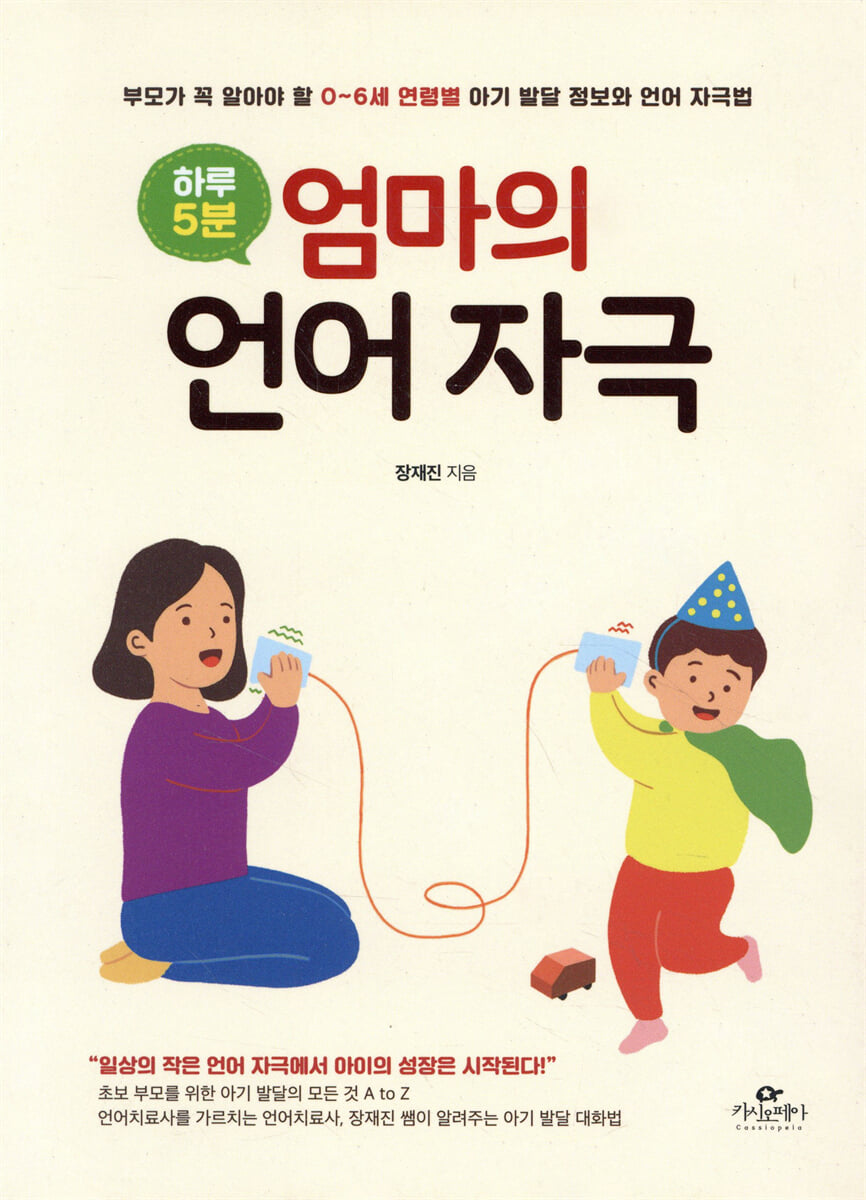
5 minutes a day, mother's language stimulation
 |
Description
Book Introduction
“5 minutes a day, a mother’s language stimulation leads to a child’s growth!”
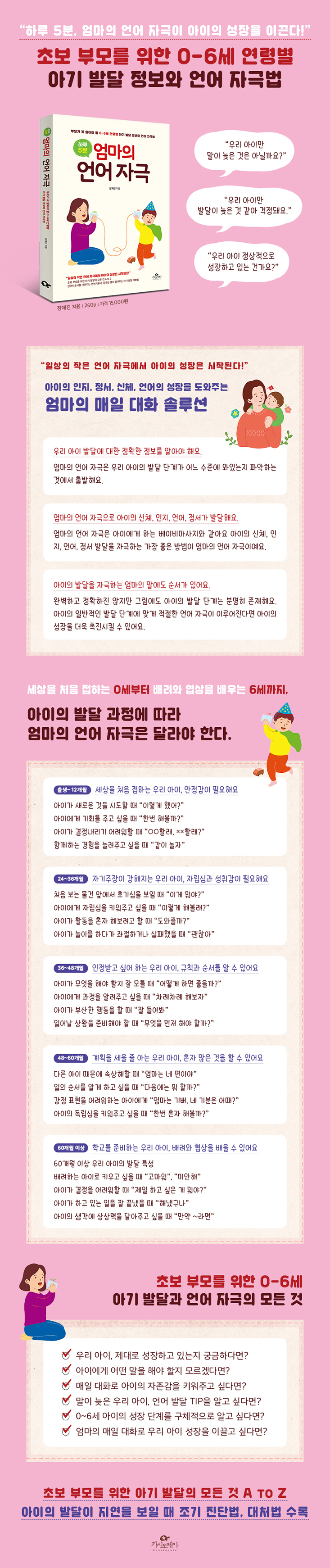
Baby Development and Language Stimulation for New Parents: Ages 0-6
"5 Minutes a Day, Mom's Language Stimulation" is a book that provides information on the development of children from 0 to 6 years old and mothers' language stimulation methods that are suitable for each child.
Children aged 0 to 6 experience rapid physical, language, cognitive, and emotional development all at once.
At this time, parents who are looking at their child are likely to worry that their child is just delayed and that their child is developing normally.
What is needed at this time is accurate information about the child's development and specific solutions accordingly.
This book provides detailed information on the stages of physical, cognitive, language, and emotional development of a child from 0 to 6 years old.
Among them, I have carefully selected the words of a mother who can help her child grow so that they can be used in specific situations.
This book is divided into chapters by age, from 0 to 6 years old.
Each chapter provides information on the characteristics of a child's physical, cognitive, language, and emotional development, as well as the mother's language stimulation methods that are essential for the child's growth during this period.
The author, a speech therapist, has included tips for your child's language development at the end of each chapter.
When a child's development is delayed, we provide proper treatment to parents who are concerned through early diagnosis and coping methods.
This book will answer all your questions about the development of babies aged 0 to 6, as well as provide parents with appropriate language stimulation methods for their children's growth and development.
Baby Development and Language Stimulation for New Parents: Ages 0-6
"5 Minutes a Day, Mom's Language Stimulation" is a book that provides information on the development of children from 0 to 6 years old and mothers' language stimulation methods that are suitable for each child.
Children aged 0 to 6 experience rapid physical, language, cognitive, and emotional development all at once.
At this time, parents who are looking at their child are likely to worry that their child is just delayed and that their child is developing normally.
What is needed at this time is accurate information about the child's development and specific solutions accordingly.
This book provides detailed information on the stages of physical, cognitive, language, and emotional development of a child from 0 to 6 years old.
Among them, I have carefully selected the words of a mother who can help her child grow so that they can be used in specific situations.
This book is divided into chapters by age, from 0 to 6 years old.
Each chapter provides information on the characteristics of a child's physical, cognitive, language, and emotional development, as well as the mother's language stimulation methods that are essential for the child's growth during this period.
The author, a speech therapist, has included tips for your child's language development at the end of each chapter.
When a child's development is delayed, we provide proper treatment to parents who are concerned through early diagnosis and coping methods.
This book will answer all your questions about the development of babies aged 0 to 6, as well as provide parents with appropriate language stimulation methods for their children's growth and development.
- You can preview some of the book's contents.
Preview
index
prolog.
A mother's verbal stimulation creates miracles.
CHAPTER 01
A mother's words should vary depending on the child's developmental stage.
What does a mother say that is appropriate for her child's developmental stage?
Body: Mom's words that guide physical development
Cognitive: Mom's Speech Stimulates Cognition
Language: Mom's Speech to Develop Communication Skills
Emotion: What Mom Says to Boost Self-Esteem
CHAPTER 02
From birth to 12 months, our babies are experiencing the world for the first time and need stability.
Developmental characteristics of our children from birth to 12 months
Holding the child in her arms, she said, “I am happy that you were born.”
When a child babbles happily, say, “I feel good.”
When a child whines and sucks his thumb, say, “I want to ~”
Language development tips from speech therapist Jang Jae-jin
CHAPTER 03
12-24 months: Our challenging children learn about the world through shared experiences.
Developmental characteristics of our children aged 12 to 24 months
When your child tries something new, ask, “Did you do it like this?”
When you want to give your child a chance, say, “Shall we give it a try?”
When a child has difficulty making a decision, say, “Do you want to do ○○ or ××?”
When you want to increase your shared experience, say “Let’s play together”
Language development tips from speech therapist Jang Jae-jin
CHAPTER 04
24-36 months: Our children are becoming more assertive and need independence and a sense of accomplishment.
Developmental characteristics of our children aged 24 to 36 months
When you show curiosity in front of something you see for the first time, ask, “What is this?”
When you want to help your child develop independence, ask, “Would you like to try this?”
When your child tries to do an activity on his or her own, ask, “Can I help you?”
When a child gets frustrated or fails while playing, say, “It’s okay.”
Language development tips from speech therapist Jang Jae-jin
CHAPTER 05
36-48 months: Our children want to be recognized and can learn rules and order.
Developmental characteristics of our children aged 36 to 48 months
When a child is unsure of what to do, ask, “What should I do?”
When you want to teach a child a process, “Let’s do it step by step”
When your child is acting up, say, “Listen carefully.”
When you need to prepare for a situation that might arise, “What should I do first?”
Language development tips from speech therapist Jang Jae-jin
CHAPTER 06
48-60 months: Our children know how to plan and can do many things on their own.
Developmental characteristics of our children aged 48 to 60 months
When you're upset because of another child, "Mom is on your side."
When you want to know the order of things, ask “What should I do next?”
For a child who has difficulty expressing his or her emotions, ask, “Mommy is happy, how are you feeling?”
When you want to foster your child's independence, ask, "Should I try it on my own?"
Language development tips from speech therapist Jang Jae-jin
CHAPTER 07
For children over 60 months old, preparing for school, we can teach them consideration and negotiation.
Developmental characteristics of our children over 60 months old
When you want to raise a considerate child, say "thank you" and "I'm sorry."
When your child is having trouble making a decision, ask, “What do you want to do most?”
When a child has successfully completed a task, say, "You did it!"
When you want to spark your child's imagination, use "what if"
Language development tips from speech therapist Jang Jae-jin
Epilogue.
The power of a mother's words
supplement.
Growth stages for children aged 0-6 at a glance
A mother's verbal stimulation creates miracles.
CHAPTER 01
A mother's words should vary depending on the child's developmental stage.
What does a mother say that is appropriate for her child's developmental stage?
Body: Mom's words that guide physical development
Cognitive: Mom's Speech Stimulates Cognition
Language: Mom's Speech to Develop Communication Skills
Emotion: What Mom Says to Boost Self-Esteem
CHAPTER 02
From birth to 12 months, our babies are experiencing the world for the first time and need stability.
Developmental characteristics of our children from birth to 12 months
Holding the child in her arms, she said, “I am happy that you were born.”
When a child babbles happily, say, “I feel good.”
When a child whines and sucks his thumb, say, “I want to ~”
Language development tips from speech therapist Jang Jae-jin
CHAPTER 03
12-24 months: Our challenging children learn about the world through shared experiences.
Developmental characteristics of our children aged 12 to 24 months
When your child tries something new, ask, “Did you do it like this?”
When you want to give your child a chance, say, “Shall we give it a try?”
When a child has difficulty making a decision, say, “Do you want to do ○○ or ××?”
When you want to increase your shared experience, say “Let’s play together”
Language development tips from speech therapist Jang Jae-jin
CHAPTER 04
24-36 months: Our children are becoming more assertive and need independence and a sense of accomplishment.
Developmental characteristics of our children aged 24 to 36 months
When you show curiosity in front of something you see for the first time, ask, “What is this?”
When you want to help your child develop independence, ask, “Would you like to try this?”
When your child tries to do an activity on his or her own, ask, “Can I help you?”
When a child gets frustrated or fails while playing, say, “It’s okay.”
Language development tips from speech therapist Jang Jae-jin
CHAPTER 05
36-48 months: Our children want to be recognized and can learn rules and order.
Developmental characteristics of our children aged 36 to 48 months
When a child is unsure of what to do, ask, “What should I do?”
When you want to teach a child a process, “Let’s do it step by step”
When your child is acting up, say, “Listen carefully.”
When you need to prepare for a situation that might arise, “What should I do first?”
Language development tips from speech therapist Jang Jae-jin
CHAPTER 06
48-60 months: Our children know how to plan and can do many things on their own.
Developmental characteristics of our children aged 48 to 60 months
When you're upset because of another child, "Mom is on your side."
When you want to know the order of things, ask “What should I do next?”
For a child who has difficulty expressing his or her emotions, ask, “Mommy is happy, how are you feeling?”
When you want to foster your child's independence, ask, "Should I try it on my own?"
Language development tips from speech therapist Jang Jae-jin
CHAPTER 07
For children over 60 months old, preparing for school, we can teach them consideration and negotiation.
Developmental characteristics of our children over 60 months old
When you want to raise a considerate child, say "thank you" and "I'm sorry."
When your child is having trouble making a decision, ask, “What do you want to do most?”
When a child has successfully completed a task, say, "You did it!"
When you want to spark your child's imagination, use "what if"
Language development tips from speech therapist Jang Jae-jin
Epilogue.
The power of a mother's words
supplement.
Growth stages for children aged 0-6 at a glance
Detailed image
Into the book
A parent's words are like a baby massage that stimulates the child's entire body.
When we do baby massage, we make eye contact with the baby, communicate their emotions, and have a conversation.
I hope to grow taller by doing 'Jjukjjuki', which stimulates the leg joints, and I hope to improve digestion and strengthen the intestines by doing a stomach massage.
Parents' words are a verbal baby massage that stimulates the child's development in various ways.
You need to pay attention and focus on your baby, just like you would when giving a baby massage.
If you can get into your child's mind, understand their thoughts, express them from their perspective, and learn more specific ways to encourage and praise them, your child will grow physically, cognitively, linguistically, and emotionally.
--- p..13, from “Mother’s verbal stimulation creates miracles”
The most important language skills for infants and toddlers aged 0 to 6 are ‘conversation’ and ‘communication.’
Communication problems arise when we don't understand what someone is saying, or when we want to ask for understanding but can't find the right words or expressions.
At times like this, some children become frustrated and throw a tantrum or say "yes, yes, yes" and point to the object they want with their fingers.
The same goes for cases where you speak properly but have trouble pronouncing it.
If the pronunciation is not correct, the other child may ask once or twice and then give up, or may say it several times and then close his/her mouth because he/she feels frustrated.
The goal of language development in early childhood should be to communicate with others.
In particular, being able to exchange ideas by listening to others' thoughts and telling your own story should be an important goal.
--- p..38, from “A mother’s speech that develops communication skills”
Even as parents, it is difficult to know the exact emotions of a child.
So, I'm just guessing, but it's confusing for parents to know if this can be considered a child's emotion.
But what is clear is that what a mother says about her child's feelings does not necessarily have to be the correct answer.
Just letting your child know that different emotions are expressed as "angry," "upset," "happy," and "fun" can be a good language stimulus.
Then the child says, 'I guess that's what it means to be happy when you feel this kind of emotion.
I'm learning that 'making this kind of expression makes you feel good.'
--- p..65, from “Birth to 12 months, our children who are experiencing the world for the first time need a sense of stability”
When teaching social rules, the parent's attitude is important.
As you accumulate experiences of getting angry or hurt because of your child, you will easily start yelling and talk to your child forcefully in emotionally charged situations.
However, children who are accustomed to this situation are only interested in escaping the moment, and do not actually put away their toys or tidy up their rooms.
It is not easy for such children to develop social rules or manners as a habit.
Also, when teaching a method, it is very important to convey it in a way that the child can easily understand.
If you need to wash your hands or brush your teeth, it's a good idea to ask your child:
“Okay, I’m home.
“What should I do first?” “You ate earlier, right? I need to sleep now. What should I do?”
--- p..161, from “36~48 months, our child wants to be recognized and can learn rules and order”
Self-esteem plays a very important role in a child's growth.
Self-esteem is feeling like you are a worthwhile person.
It is believing that your existence has meaning, and that you can achieve anything without being discouraged even if you fail.
When a child goes through difficult and challenging situations, it is of great help to the child's self-esteem when parents encourage and support them.
No matter how small the task, when a child is struggling and tired, a parent's words, "I'm on your side," can be a great source of strength for the child.
Children who grow up with emotional support are able to find strength and encourage themselves when faced with difficulties by thinking of those who believe in them.
One thing you shouldn't say in this situation is, "You're making a fuss over nothing," or "You did something wrong, didn't you?"
When we do baby massage, we make eye contact with the baby, communicate their emotions, and have a conversation.
I hope to grow taller by doing 'Jjukjjuki', which stimulates the leg joints, and I hope to improve digestion and strengthen the intestines by doing a stomach massage.
Parents' words are a verbal baby massage that stimulates the child's development in various ways.
You need to pay attention and focus on your baby, just like you would when giving a baby massage.
If you can get into your child's mind, understand their thoughts, express them from their perspective, and learn more specific ways to encourage and praise them, your child will grow physically, cognitively, linguistically, and emotionally.
--- p..13, from “Mother’s verbal stimulation creates miracles”
The most important language skills for infants and toddlers aged 0 to 6 are ‘conversation’ and ‘communication.’
Communication problems arise when we don't understand what someone is saying, or when we want to ask for understanding but can't find the right words or expressions.
At times like this, some children become frustrated and throw a tantrum or say "yes, yes, yes" and point to the object they want with their fingers.
The same goes for cases where you speak properly but have trouble pronouncing it.
If the pronunciation is not correct, the other child may ask once or twice and then give up, or may say it several times and then close his/her mouth because he/she feels frustrated.
The goal of language development in early childhood should be to communicate with others.
In particular, being able to exchange ideas by listening to others' thoughts and telling your own story should be an important goal.
--- p..38, from “A mother’s speech that develops communication skills”
Even as parents, it is difficult to know the exact emotions of a child.
So, I'm just guessing, but it's confusing for parents to know if this can be considered a child's emotion.
But what is clear is that what a mother says about her child's feelings does not necessarily have to be the correct answer.
Just letting your child know that different emotions are expressed as "angry," "upset," "happy," and "fun" can be a good language stimulus.
Then the child says, 'I guess that's what it means to be happy when you feel this kind of emotion.
I'm learning that 'making this kind of expression makes you feel good.'
--- p..65, from “Birth to 12 months, our children who are experiencing the world for the first time need a sense of stability”
When teaching social rules, the parent's attitude is important.
As you accumulate experiences of getting angry or hurt because of your child, you will easily start yelling and talk to your child forcefully in emotionally charged situations.
However, children who are accustomed to this situation are only interested in escaping the moment, and do not actually put away their toys or tidy up their rooms.
It is not easy for such children to develop social rules or manners as a habit.
Also, when teaching a method, it is very important to convey it in a way that the child can easily understand.
If you need to wash your hands or brush your teeth, it's a good idea to ask your child:
“Okay, I’m home.
“What should I do first?” “You ate earlier, right? I need to sleep now. What should I do?”
--- p..161, from “36~48 months, our child wants to be recognized and can learn rules and order”
Self-esteem plays a very important role in a child's growth.
Self-esteem is feeling like you are a worthwhile person.
It is believing that your existence has meaning, and that you can achieve anything without being discouraged even if you fail.
When a child goes through difficult and challenging situations, it is of great help to the child's self-esteem when parents encourage and support them.
No matter how small the task, when a child is struggling and tired, a parent's words, "I'm on your side," can be a great source of strength for the child.
Children who grow up with emotional support are able to find strength and encourage themselves when faced with difficulties by thinking of those who believe in them.
One thing you shouldn't say in this situation is, "You're making a fuss over nothing," or "You did something wrong, didn't you?"
--- p..188, "48~60 months, our children know how to plan and can do many things on their own."
Publisher's Review
“A child’s growth begins with small language stimulation in everyday life!”
A mother's daily conversation solution that supports her child's physical, cognitive, emotional, and language development.
Author Jang Jae-jin discovered that her first child could not hear when he was 10 months old.
Although the child successfully received cochlear implant surgery at 15 months of age, his physical development and language level were significantly behind those of other children.
The author begins to provide mother-style language stimulation just for her child to help him grow up with developmental delays.
During the first year of intensive language stimulation tailored to the child's developmental stage, the child followed the two-year mark of language development of other children.
The same thing happened the following year.
The child was eventually able to raise his language and developmental level to that of his peers before entering elementary school.
In the meantime, the author became a speech therapist who helps children develop and grow, and has made a living teaching parents who face the same concerns as he did a dozen years ago how to help their children at home.
This book meticulously and practically explains the author's know-how.
There is nothing more regrettable than not being able to foster a child's growth because you 'don't know' or 'don't know accurately' how the child's development process is or what the appropriate stimulation is.
However, there is no need to feel guilty or anxious about whether your child is not growing well because you did not provide proper language stimulation while raising him or her.
From now on, mothers can begin stimulating their children's language in accordance with their development.
This book will serve as an appropriate guide along the way.
Baby Development: A to Z for New Parents
Includes early diagnosis and coping methods when a child's development is delayed.
What's the first thing parents need to know to provide developmentally appropriate language stimulation? The first step is to determine your child's developmental stage.
Just as you wouldn't say long, difficult sentences to a toddler who hasn't even turned one, or routinely say "mama" or "peekaboo" to a six- or seven-year-old, stimulating a child's language appropriate to their developmental stage is essential to fostering their development.
Second, we must remember that a child's overall development is organically achieved through physical, cognitive, language, and emotional development.
It is very dangerous to look at a child's development based on only one area.
As children grow, their bodies and cognitive development progress.
Language develops accordingly, emotional and cognitive development is promoted, and social skills develop.
Therefore, checks on the child's development should be carried out in all areas.
Third, remember that there is an order to the mother's words that stimulate the child's development.
However, this does not mean that the order is exact or perfectly determined, such as 1, 2, 3.
But even so, there are clearly stages of a child's development.
If appropriate language stimulation is provided according to the child's general developmental stage, the child's growth can be further promoted.
A mother's daily conversation solution that supports her child's physical, cognitive, emotional, and language development.
Author Jang Jae-jin discovered that her first child could not hear when he was 10 months old.
Although the child successfully received cochlear implant surgery at 15 months of age, his physical development and language level were significantly behind those of other children.
The author begins to provide mother-style language stimulation just for her child to help him grow up with developmental delays.
During the first year of intensive language stimulation tailored to the child's developmental stage, the child followed the two-year mark of language development of other children.
The same thing happened the following year.
The child was eventually able to raise his language and developmental level to that of his peers before entering elementary school.
In the meantime, the author became a speech therapist who helps children develop and grow, and has made a living teaching parents who face the same concerns as he did a dozen years ago how to help their children at home.
This book meticulously and practically explains the author's know-how.
There is nothing more regrettable than not being able to foster a child's growth because you 'don't know' or 'don't know accurately' how the child's development process is or what the appropriate stimulation is.
However, there is no need to feel guilty or anxious about whether your child is not growing well because you did not provide proper language stimulation while raising him or her.
From now on, mothers can begin stimulating their children's language in accordance with their development.
This book will serve as an appropriate guide along the way.
Baby Development: A to Z for New Parents
Includes early diagnosis and coping methods when a child's development is delayed.
What's the first thing parents need to know to provide developmentally appropriate language stimulation? The first step is to determine your child's developmental stage.
Just as you wouldn't say long, difficult sentences to a toddler who hasn't even turned one, or routinely say "mama" or "peekaboo" to a six- or seven-year-old, stimulating a child's language appropriate to their developmental stage is essential to fostering their development.
Second, we must remember that a child's overall development is organically achieved through physical, cognitive, language, and emotional development.
It is very dangerous to look at a child's development based on only one area.
As children grow, their bodies and cognitive development progress.
Language develops accordingly, emotional and cognitive development is promoted, and social skills develop.
Therefore, checks on the child's development should be carried out in all areas.
Third, remember that there is an order to the mother's words that stimulate the child's development.
However, this does not mean that the order is exact or perfectly determined, such as 1, 2, 3.
But even so, there are clearly stages of a child's development.
If appropriate language stimulation is provided according to the child's general developmental stage, the child's growth can be further promoted.
GOODS SPECIFICS
- Date of issue: February 17, 2020
- Page count, weight, size: 260 pages | 422g | 152*210*20mm
- ISBN13: 9791188674817
- ISBN10: 1188674811
You may also like
카테고리
korean


korean

![GQ KOREA Mark (Monthly): December [2025]](http://librairie.coreenne.fr/cdn/shop/files/8ef265dbbfbf186523ed75ba7319009d.jpg?v=1765340328&width=3840)


