

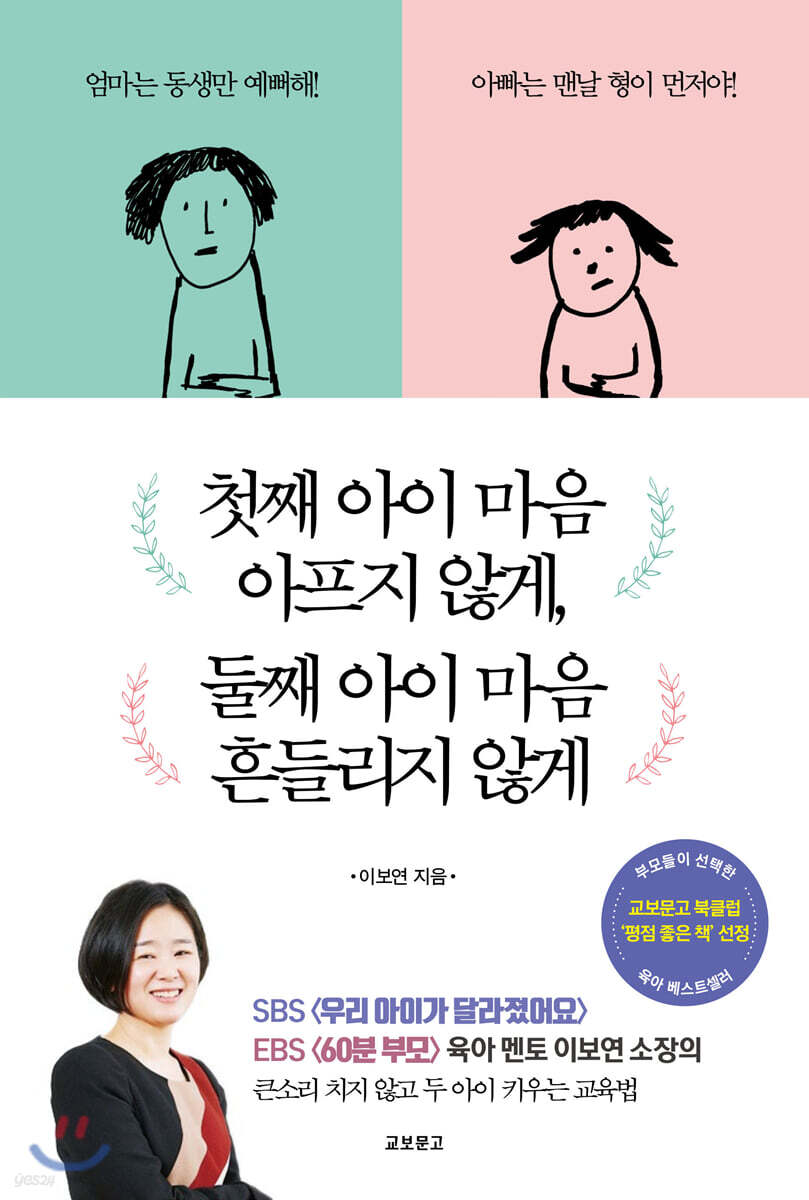
So that the first child's heart is not hurt, and the second child's heart is not shaken
 |
Description
Book Introduction
“Mom only likes my younger sibling!”
“Dad always puts my brother first!”
The Art of Parenting: Giving the Best Love Between Two Children
There is a saying that 'the appearance of a second child to the first child is like the feelings of a wife watching her husband bring in a lover out of nowhere and show off his affection.'
For a child who has been monopolizing his parents' love, the appearance of a younger sibling is a huge shock.
On the other hand, the situation of the second child, who has to compete with older siblings who are much more advanced than him from birth, is not easy.
Eventually, the older child becomes jealous of his younger sibling and starts to bully him, while the younger child cries out for attention and love.
The role of parents is to take responsibility for and guide the direction of their children's lives.
When you find a balance between the two children and show them love, the older child's heart will not be broken when he or she is robbed of his or her place by his or her younger sibling, and the younger child's heart will not be shaken when faced with the great obstacle of having an older sibling.
Siblings are the longest-lasting relationship in life.
As the two children grow up, they take on various roles such as friends, colleagues, competitors, and ideal types, developing social skills, interpersonal relationships, empathy, and adaptability.
But the reality is that we fight as soon as we open our eyes, shouting 'I first' and 'I do more'.
Raising two children with different personalities without raising their voices is never easy.
In this book, parenting mentor Director Lee Bo-yeon shares educational methods that provide the right amount of love for your first child and the attention your second child needs.
It also provides parenting techniques tailored to children who show different temperaments depending on their birth order.
Two children who feel loved enough by their parents in their respective positions will choose affection over fighting and will develop excellent social skills and self-esteem.
“Dad always puts my brother first!”
The Art of Parenting: Giving the Best Love Between Two Children
There is a saying that 'the appearance of a second child to the first child is like the feelings of a wife watching her husband bring in a lover out of nowhere and show off his affection.'
For a child who has been monopolizing his parents' love, the appearance of a younger sibling is a huge shock.
On the other hand, the situation of the second child, who has to compete with older siblings who are much more advanced than him from birth, is not easy.
Eventually, the older child becomes jealous of his younger sibling and starts to bully him, while the younger child cries out for attention and love.
The role of parents is to take responsibility for and guide the direction of their children's lives.
When you find a balance between the two children and show them love, the older child's heart will not be broken when he or she is robbed of his or her place by his or her younger sibling, and the younger child's heart will not be shaken when faced with the great obstacle of having an older sibling.
Siblings are the longest-lasting relationship in life.
As the two children grow up, they take on various roles such as friends, colleagues, competitors, and ideal types, developing social skills, interpersonal relationships, empathy, and adaptability.
But the reality is that we fight as soon as we open our eyes, shouting 'I first' and 'I do more'.
Raising two children with different personalities without raising their voices is never easy.
In this book, parenting mentor Director Lee Bo-yeon shares educational methods that provide the right amount of love for your first child and the attention your second child needs.
It also provides parenting techniques tailored to children who show different temperaments depending on their birth order.
Two children who feel loved enough by their parents in their respective positions will choose affection over fighting and will develop excellent social skills and self-esteem.
- You can preview some of the book's contents.
Preview
index
prolog
Part 1 - Between the First and the Second _ The closest and the farthest, the most intimate and the most difficult
1.
Why do we need brothers and sisters?
Sisters, Brothers, Older Sisters, Older Brothers, and Younger Brothers | Why I Want Siblings | Reality is Different
2.
The Truth About Sibling Relationships
Characteristics of Sibling Relationships | Developmental Changes in Sibling Relationships | The Influence of Siblings on Each Other
3.
Raise your children differently based on their birth order.
Firstborn, the dethroned king | Secondborn, the brilliant mediator | Middleborn, the resilient life force | Youngest child, the great achiever | Only child, the optimistic idealist | Twins and multiple children, the balance between individuality and connection
Part 2 - I've Got a Little Brother! _ Don't Let Your First Child Hurt
1.
The moment you have a younger sibling
When and how should I tell her I'm pregnant?
2.
Things to do before giving birth for your first child
Sharing Housework and Childcare | Bonding with a Secondary Caregiver | Establishing Stable Sleep Habits | Weaning from Nighttime Feeding | Preparing for Separation During Postpartum Care | Preparing for a Newborn
3.
First meeting with my younger brother
Meet your sibling as soon as possible | Focus on the child, not the baby | Exchange gifts | Hold the baby
4.
First life with my younger sibling
Have fun with your firstborn | Involve your firstborn in babysitting | Explain every little thing to them | Make your firstborn a star | Make sure they feel loved | Minimize changes | Monitor your child's needs | Bond with your sibling | Problems that may arise after the arrival of a sibling (Q&A)
5.
When my little brother started crawling
Protecting your oldest child's belongings | Not demanding that they play with their younger siblings | Responding enthusiastically when they are a positive influence on each other | Finding time for your oldest child | Not taking sides | Teaching them how to care for their wounds | Problems that can arise when your younger sibling starts crawling (Q&A)
Part 3 - My name is Dongsaeng _ Don't let your second child's heart waver
1.
The second one is always sad
Don't feel inferior | Don't lose your sense of identity | Don't feel alienated | Don't feel wronged
2.
Second, I want to win the competition.
Don't just try to satisfy your own needs | Be able to express your feelings | Problems that can arise when the second child recognizes the first (Q&A)
Part 4 - Children Who Grow Up While Fighting - You Can Grow Up Without Fighting
1.
What makes children fight?
Fights That Start in Love Triangles | Arguments Can Be Both "Healing" and "Poison" | Why Kids Fight | Are Children's Fights Competition or Abuse?
2.
Characteristics of families where children fight a lot
Parents who don't understand fighting | Parents who limit physical aggression | Parents who don't fully resolve conflict
Part 5 - Yesterday's Fight, Today's Fight - Parents' Attitudes to Dealing with Sibling Conflicts
1.
Principles parents should have between two children
Let go of comparisons and labels | Listen to your child | Show love | Don't use your child as a role model | Give individual attention | Acknowledge each child's needs | Set clear boundaries | Plan family activities | Be on the same side | Adjust daily routines | Establish house rules
2.
How to manage the sibling conflict?
Parental intervention is all about timing | Humor wins conflict | Fighting rules and timeouts | Fights are best broken up with a whisper | Time to calm down | What to do in these situations
Part 6 - How to Raise a Child Who Doesn't Fight with Siblings - Sibling Love Doesn't Come Naturally
1.
Increase emotional intelligence
Talking about emotions | Interpreting your child's feelings and needs | Skills for talking without blaming | Demonstrating prosocial behavior | Sometimes behavioral limits are necessary | Resolving negative emotions | Coaching each other to set limits | Teaching creative ways to express emotions
2.
Develop problem-solving skills
Show calm | Let them know there's a problem | Remove the source of the conflict | Don't judge your child's ideas | Prioritize family rules | Get your child's buy-in | Invite them into the problem-solving process | Write down solutions together | Evaluate solutions together | Monitor together | Establish new family rules | Practice sibling conflict resolution
3.
Learn negotiation skills
Trading | Sweet Deals | Taking Turns | Trading in Order | Sharing | Cooperating | Making Rules | Writing Agreements
4.
Reduce competition
Empathize with injustice; Don't be lured into comparison and competition; Buy things based on needs; Love unconditionally; Don't discriminate based on gender or age; Don't label others; Praise them individually; Discover cooperative games; Don't let your siblings feel superior when they fail; Provide personal space and time.
5.
Increase emotional bonding
Respect individuality | Acknowledge when children help each other | Team up children | Play games that require cooperation | Teach children to show interest
Part 1 - Between the First and the Second _ The closest and the farthest, the most intimate and the most difficult
1.
Why do we need brothers and sisters?
Sisters, Brothers, Older Sisters, Older Brothers, and Younger Brothers | Why I Want Siblings | Reality is Different
2.
The Truth About Sibling Relationships
Characteristics of Sibling Relationships | Developmental Changes in Sibling Relationships | The Influence of Siblings on Each Other
3.
Raise your children differently based on their birth order.
Firstborn, the dethroned king | Secondborn, the brilliant mediator | Middleborn, the resilient life force | Youngest child, the great achiever | Only child, the optimistic idealist | Twins and multiple children, the balance between individuality and connection
Part 2 - I've Got a Little Brother! _ Don't Let Your First Child Hurt
1.
The moment you have a younger sibling
When and how should I tell her I'm pregnant?
2.
Things to do before giving birth for your first child
Sharing Housework and Childcare | Bonding with a Secondary Caregiver | Establishing Stable Sleep Habits | Weaning from Nighttime Feeding | Preparing for Separation During Postpartum Care | Preparing for a Newborn
3.
First meeting with my younger brother
Meet your sibling as soon as possible | Focus on the child, not the baby | Exchange gifts | Hold the baby
4.
First life with my younger sibling
Have fun with your firstborn | Involve your firstborn in babysitting | Explain every little thing to them | Make your firstborn a star | Make sure they feel loved | Minimize changes | Monitor your child's needs | Bond with your sibling | Problems that may arise after the arrival of a sibling (Q&A)
5.
When my little brother started crawling
Protecting your oldest child's belongings | Not demanding that they play with their younger siblings | Responding enthusiastically when they are a positive influence on each other | Finding time for your oldest child | Not taking sides | Teaching them how to care for their wounds | Problems that can arise when your younger sibling starts crawling (Q&A)
Part 3 - My name is Dongsaeng _ Don't let your second child's heart waver
1.
The second one is always sad
Don't feel inferior | Don't lose your sense of identity | Don't feel alienated | Don't feel wronged
2.
Second, I want to win the competition.
Don't just try to satisfy your own needs | Be able to express your feelings | Problems that can arise when the second child recognizes the first (Q&A)
Part 4 - Children Who Grow Up While Fighting - You Can Grow Up Without Fighting
1.
What makes children fight?
Fights That Start in Love Triangles | Arguments Can Be Both "Healing" and "Poison" | Why Kids Fight | Are Children's Fights Competition or Abuse?
2.
Characteristics of families where children fight a lot
Parents who don't understand fighting | Parents who limit physical aggression | Parents who don't fully resolve conflict
Part 5 - Yesterday's Fight, Today's Fight - Parents' Attitudes to Dealing with Sibling Conflicts
1.
Principles parents should have between two children
Let go of comparisons and labels | Listen to your child | Show love | Don't use your child as a role model | Give individual attention | Acknowledge each child's needs | Set clear boundaries | Plan family activities | Be on the same side | Adjust daily routines | Establish house rules
2.
How to manage the sibling conflict?
Parental intervention is all about timing | Humor wins conflict | Fighting rules and timeouts | Fights are best broken up with a whisper | Time to calm down | What to do in these situations
Part 6 - How to Raise a Child Who Doesn't Fight with Siblings - Sibling Love Doesn't Come Naturally
1.
Increase emotional intelligence
Talking about emotions | Interpreting your child's feelings and needs | Skills for talking without blaming | Demonstrating prosocial behavior | Sometimes behavioral limits are necessary | Resolving negative emotions | Coaching each other to set limits | Teaching creative ways to express emotions
2.
Develop problem-solving skills
Show calm | Let them know there's a problem | Remove the source of the conflict | Don't judge your child's ideas | Prioritize family rules | Get your child's buy-in | Invite them into the problem-solving process | Write down solutions together | Evaluate solutions together | Monitor together | Establish new family rules | Practice sibling conflict resolution
3.
Learn negotiation skills
Trading | Sweet Deals | Taking Turns | Trading in Order | Sharing | Cooperating | Making Rules | Writing Agreements
4.
Reduce competition
Empathize with injustice; Don't be lured into comparison and competition; Buy things based on needs; Love unconditionally; Don't discriminate based on gender or age; Don't label others; Praise them individually; Discover cooperative games; Don't let your siblings feel superior when they fail; Provide personal space and time.
5.
Increase emotional bonding
Respect individuality | Acknowledge when children help each other | Team up children | Play games that require cooperation | Teach children to show interest
Detailed image

Into the book
The relationship between siblings is a love-hate relationship that is both close and distant, next only to that between parents and children.
Not only do we spend a lot of time together from birth, but we often resemble each other in appearance and personality.
However, it is also a complex and subtle relationship that cannot be said to be filled with warm brotherly love.
To put it bluntly, this means that siblings are not essential to a happy life.
But if you have siblings and don't take advantage of those bonds, you're missing out on the opportunity to develop smart, creative, and social skills.
--- From "The Truth About Sibling Relationships"
Many psychologists recommend a sibling age of three or more.
This is a calculation that takes into account the psychological development stages of children.
This is because children begin to form a psychologically independent self when they are at least three years old.
The ego plays a supporting role in coping with various stresses.
What if a child under the age of three, whose ego is still developing and unable to manage stress on their own, were to have a sibling? They would be completely dependent on their parents, and if their mother were unable to help them because she was busy caring for the sibling, they would inevitably become overwhelmed by stress.
--- From "The First Child, the Dethroned King"
In the movie [Thor], there is a scene where Loki, the younger brother, expresses his anger at himself for not being able to defeat his older brother.
Loki, who has a complex about not receiving his father's love, does not hesitate to indiscriminately attack his older brother Thor, who has been designated as his successor.
Excessive defense against competitors who threaten oneself and developing hostility and competitiveness toward one's closest blood relatives in order to secure more of one's parents' love.
In psychology, this is called the Cain complex.
It is named after Cain, the first murderer in human history and the man who killed his brother Abel.
Second children tend to have a strong Cain complex toward their eldest children.
--- From "The Second Child, the Excellent Mediator"
When the second child is born, let's make it possible for the first child to go see his mother and younger sibling as soon as possible.
It is time to reassure the child that his mother will definitely return and that he has not forgotten him.
At this time, it is best not to accept other visitors.
Let's make time for just the parents and the two children.
A child who witnesses a crowded room with everyone asking about his mother and younger siblings will feel a great sense of alienation and loss.
It is best not to have grandparents visit on the day your child first meets his or her younger sibling.
It should be spent as a time to strengthen the bond between parents and their children.
--- From "First Meeting with My Little Brother"
It's a blessing, not a nuisance, when your child shows interest in caring for his or her younger sibling.
Because it was an expression of affection, not jealousy or envy.
Besides, if the first child can take care of the second child skillfully, it will be of some help to the mother as well.
Just as no one is a parent from the beginning and only learns about childcare and parenting after the child is born, let's slowly and gradually teach our firstborn children how to take care of their younger siblings.
In this process, the child not only feels competent because he or she has something new to do within the family, but also gains a sense of security that he or she is not left out.
--- From "First Life with My Little Brother"
Parents should create peer friends just for their second child.
You need a friend who is not your first friend or your first friend's younger sibling, but your second friend's friend.
Children primarily develop relationships with their peers based on relationships within their families.
Through friends, we develop a perspective on others and are influenced by the formation of interpersonal relationships in society.
However, if the relationship after the family is connected to the first child, the second child's interpersonal relationships and sociality will inevitably continue to be influenced by the first child.
--- From "The Second One is Always Sad"
Noel Gallagher and Liam Gallagher, the two lead singers of the British rock band Oasis, are brothers.
According to Noel's older brother, the two have completely different temperaments, like a dog and a cat.
Noel has a quiet personality and likes to be alone. He has a calm disposition and plays guitar and listens to music at home.
On the other hand, his younger brother Liam always wanted people's attention.
He wanted to be the center of attention in any situation and liked a lively atmosphere.
These two brothers with such opposite personalities ended up working in the same band.
Although his younger brother Liam formed the band, the band revolved around Noel, who had a genius musicality.
It was an unbearable situation for Liam, who loved attention.
The brothers, who had deep conflicts due to their different temperaments, would slander each other whenever they had the chance, and the severe sibling conflict eventually led to the band's disbandment.
--- From "What Makes Children Fight"
There are parents who try to stop their children's fights unconditionally rather than understanding and resolving them.
A mother who approaches her children fighting over a toy and takes it away, a father who isolates children who are arguing or fighting in their own rooms, a parent who raises his hand and punishes the child whenever a fight starts. “I don’t know.
The family goes into their room, saying, “You guys figure it out!”
This kind of response is like being too eager to put out the urgent fire of a fight, while not even seeing the cause of the fight, which is the powerful spark hidden underneath.
Not only do we spend a lot of time together from birth, but we often resemble each other in appearance and personality.
However, it is also a complex and subtle relationship that cannot be said to be filled with warm brotherly love.
To put it bluntly, this means that siblings are not essential to a happy life.
But if you have siblings and don't take advantage of those bonds, you're missing out on the opportunity to develop smart, creative, and social skills.
--- From "The Truth About Sibling Relationships"
Many psychologists recommend a sibling age of three or more.
This is a calculation that takes into account the psychological development stages of children.
This is because children begin to form a psychologically independent self when they are at least three years old.
The ego plays a supporting role in coping with various stresses.
What if a child under the age of three, whose ego is still developing and unable to manage stress on their own, were to have a sibling? They would be completely dependent on their parents, and if their mother were unable to help them because she was busy caring for the sibling, they would inevitably become overwhelmed by stress.
--- From "The First Child, the Dethroned King"
In the movie [Thor], there is a scene where Loki, the younger brother, expresses his anger at himself for not being able to defeat his older brother.
Loki, who has a complex about not receiving his father's love, does not hesitate to indiscriminately attack his older brother Thor, who has been designated as his successor.
Excessive defense against competitors who threaten oneself and developing hostility and competitiveness toward one's closest blood relatives in order to secure more of one's parents' love.
In psychology, this is called the Cain complex.
It is named after Cain, the first murderer in human history and the man who killed his brother Abel.
Second children tend to have a strong Cain complex toward their eldest children.
--- From "The Second Child, the Excellent Mediator"
When the second child is born, let's make it possible for the first child to go see his mother and younger sibling as soon as possible.
It is time to reassure the child that his mother will definitely return and that he has not forgotten him.
At this time, it is best not to accept other visitors.
Let's make time for just the parents and the two children.
A child who witnesses a crowded room with everyone asking about his mother and younger siblings will feel a great sense of alienation and loss.
It is best not to have grandparents visit on the day your child first meets his or her younger sibling.
It should be spent as a time to strengthen the bond between parents and their children.
--- From "First Meeting with My Little Brother"
It's a blessing, not a nuisance, when your child shows interest in caring for his or her younger sibling.
Because it was an expression of affection, not jealousy or envy.
Besides, if the first child can take care of the second child skillfully, it will be of some help to the mother as well.
Just as no one is a parent from the beginning and only learns about childcare and parenting after the child is born, let's slowly and gradually teach our firstborn children how to take care of their younger siblings.
In this process, the child not only feels competent because he or she has something new to do within the family, but also gains a sense of security that he or she is not left out.
--- From "First Life with My Little Brother"
Parents should create peer friends just for their second child.
You need a friend who is not your first friend or your first friend's younger sibling, but your second friend's friend.
Children primarily develop relationships with their peers based on relationships within their families.
Through friends, we develop a perspective on others and are influenced by the formation of interpersonal relationships in society.
However, if the relationship after the family is connected to the first child, the second child's interpersonal relationships and sociality will inevitably continue to be influenced by the first child.
--- From "The Second One is Always Sad"
Noel Gallagher and Liam Gallagher, the two lead singers of the British rock band Oasis, are brothers.
According to Noel's older brother, the two have completely different temperaments, like a dog and a cat.
Noel has a quiet personality and likes to be alone. He has a calm disposition and plays guitar and listens to music at home.
On the other hand, his younger brother Liam always wanted people's attention.
He wanted to be the center of attention in any situation and liked a lively atmosphere.
These two brothers with such opposite personalities ended up working in the same band.
Although his younger brother Liam formed the band, the band revolved around Noel, who had a genius musicality.
It was an unbearable situation for Liam, who loved attention.
The brothers, who had deep conflicts due to their different temperaments, would slander each other whenever they had the chance, and the severe sibling conflict eventually led to the band's disbandment.
--- From "What Makes Children Fight"
There are parents who try to stop their children's fights unconditionally rather than understanding and resolving them.
A mother who approaches her children fighting over a toy and takes it away, a father who isolates children who are arguing or fighting in their own rooms, a parent who raises his hand and punishes the child whenever a fight starts. “I don’t know.
The family goes into their room, saying, “You guys figure it out!”
This kind of response is like being too eager to put out the urgent fire of a fight, while not even seeing the cause of the fight, which is the powerful spark hidden underneath.
--- From "Characteristics of Families Where Children Fight a Lot"
Publisher's Review
Children who grow up fighting?
You can grow as much as you want without fighting!
Many parents have a second child in the hopes that their most precious child in the world will have a best friend in life, feel a strong sense of brotherhood, and grow up without feeling lonely.
But contrary to expectations, the first child becomes jealous of the second child and harasses him, while the second child cries for attention and love.
Moreover, parents are exhausted from trying to stop the fights between two children who fight every time they open their eyes.
And before you know it, you forget your own role and become a parent who hurts both children.
For the eldest child who monopolized the love of his mother and father, the appearance of a younger sibling is the beginning of a crisis.
It is a huge shock to a child when his or her parents, who used to kiss him or her and love him or her the most, look at a stranger with love.
There is even a saying that “the appearance of a second child to a first child is similar to the feelings of a wife watching her husband suddenly bring his lover and show off his affection in front of her.”
The first child, unable to accept such a sudden change, begins to behave in unusual ways that they had never done before, and the parents, not knowing how to respond to such a child, just stamp their feet and end up becoming 'half-baked parents.'
When a second child is born, parents naturally pour their love and attention on the younger baby.
And the first one is always expected to take good care of his younger sibling and act well.
As a result, you may get angry or use physical punishment to control the behavior of your older child who is acting in a way that has never been done before.
But when a second child is born, the one who needs more attention is the first child.
First, you need to listen to the complex emotions your child may have toward his or her younger sibling, acknowledge the child's negative emotions, and help him or her resolve them.
At the same time, you need to make them feel that they are loved just like their younger sibling.
At the same time, we must understand and cherish the feelings of the second child who is hated by the first child for no reason from the moment he is born and lives a life of struggle invisibly.
What is needed is parental attention and a parenting style that acknowledges the child as the child he or she is, not just a 'younger sibling' within the family.
Only then will the two children accept each other not as competitors, but as life partners who share both sorrow and joy.
[My child has changed] [60 Minute Parent] Parenting mentor Director Lee Bo-yeon tells us
Raising two children without making a fuss
Parents are the ones who guide their children in the right direction so that they can live a happy life.
When you find a balance between the two children and show them love, the older child's heart will not be broken when he or she is robbed of his or her place by his or her younger sibling, and the younger child's heart will not be shaken when faced with the great obstacle of having an older sibling.
In this book, “Don’t let your first child’s heart hurt, and don’t let your second child’s heart waver,” parenting mentor Director Lee Bo-yeon shares educational methods that will give your first child the love he or she needs and the attention your second child needs.
Two children who feel loved enough in their respective positions will choose affection over fighting.
And it reveals the technique of how siblings who fight as soon as they open their eyes develop into friendly and understanding friends.
They say that children grow up fighting, but fights between siblings in childhood leave lifelong scars and hinder self-identity and self-esteem.
These experiences can have a negative impact on interpersonal relationships as adults.
Therefore, the more children grow up without fighting, the more they can develop their individuality and strengths and demonstrate social skills.
The book's comprehensive approach to dealing with children's fights, along with the various problem-solving techniques and examples for building sibling bonds, are so effective that they can be applied immediately when children start fighting.
As these techniques are repeated, parental intervention will decrease and children will learn to resolve conflicts amicably and transform their relationships into the best friends and comrades in the world.
Before you know it, the children's jealousy, envy, and fights will decrease, and the parents will be able to give their children the utmost love without raising their voices.
Raise your first and second children differently!
The Truth About Siblings Raised Differently Based on Birth Order
Alfred Adler, the founder of individual psychology, believed that birth order within a family had a significant impact on shaping an individual's lifestyle.
Generally, children born in a particular birth order have characteristics that correspond to that order.
Adler argued that the greatest psychological driving force that causes humans to behave in certain ways is 'inferiority complex'.
All humans have an inferiority complex, and the effort to overcome this and become superior has a great influence on human character and lifestyle.
And one of the factors that has a great influence on this inferiority complex is ‘birth order.’
Because the number of birth a child has has a decisive impact on his or her position.
Birth order is an indicator of differences in age, physique, strength, and status within the family.
It is not the birth order itself, but the variables that result from it, that influence a child's personality.
The first child is the object of envy during the time when he or she monopolizes all the love, but when a younger sibling is born, this child's situation and world view change dramatically.
Adler sometimes likened the first child to a "dethroned king," and said that this could be emotionally traumatic.
The first child, who has monopolized the attention and love of his parents, is likely to fall into shock and loss with the appearance of the second child.
Because of this, children who see their younger siblings may show signs of regression, such as wetting their clothes or a rapid decline in vocabulary, or may show aggressive behavior, such as hitting or pinching their younger siblings.
They may interfere with their parents' care for their younger siblings, or they may exhibit baby-like behaviors, such as trying to suckle from their mother or being unable to sleep alone.
For second-born children, they have to compete with older siblings who are much more advanced than them from birth.
It is about growing up in a world of stimulation and challenges to surpass the strengths of the first.
As a result, they develop a personality that is highly competitive and ambitious.
The second child, who strives hard to be the best, is sociable and loyal in relationships.
The second characteristic, which is his outstanding social life and his appearance as an 'excellent mediator', can be traced to this situation.
The relationship between siblings is the starting point for developing social skills by influencing each other.
As children grow up together, they take on various roles for each other, such as friends, colleagues, competitors, and ideal types.
Based on this, empathy, acceptance, and responsibility develop.
If parents do not understand the characteristics of siblings and show favoritism or do not keep the balance well, it can lead to negative consequences that hinder the development of various abilities of the child.
Sibling rivalry between two children can manifest itself in behaviors such as not wanting to share possessions with the sibling, displaying aggressive behavior and attitudes, or excessively criticizing the sibling for their mistakes.
This book talks about the different temperaments and personalities of children in different birth orders, from first and second children to middle and youngest children, only children, twins, and those with multiple children.
And by understanding and accepting these diverse temperaments and raising them, parents can help their children develop their innate strengths and reduce their weaknesses.
The most important thing when raising more than one child is to provide 'special parenting' that brings out the individual temperament and personality of each child.
Parents think it is right to treat all children equally, but it is wrong to treat children equally even though they have different appearances, thoughts, birth order, and personalities.
It is necessary to acknowledge the differences between the first and second children and provide parenting that is tailored to each child.
This book will be your guide.
You can grow as much as you want without fighting!
Many parents have a second child in the hopes that their most precious child in the world will have a best friend in life, feel a strong sense of brotherhood, and grow up without feeling lonely.
But contrary to expectations, the first child becomes jealous of the second child and harasses him, while the second child cries for attention and love.
Moreover, parents are exhausted from trying to stop the fights between two children who fight every time they open their eyes.
And before you know it, you forget your own role and become a parent who hurts both children.
For the eldest child who monopolized the love of his mother and father, the appearance of a younger sibling is the beginning of a crisis.
It is a huge shock to a child when his or her parents, who used to kiss him or her and love him or her the most, look at a stranger with love.
There is even a saying that “the appearance of a second child to a first child is similar to the feelings of a wife watching her husband suddenly bring his lover and show off his affection in front of her.”
The first child, unable to accept such a sudden change, begins to behave in unusual ways that they had never done before, and the parents, not knowing how to respond to such a child, just stamp their feet and end up becoming 'half-baked parents.'
When a second child is born, parents naturally pour their love and attention on the younger baby.
And the first one is always expected to take good care of his younger sibling and act well.
As a result, you may get angry or use physical punishment to control the behavior of your older child who is acting in a way that has never been done before.
But when a second child is born, the one who needs more attention is the first child.
First, you need to listen to the complex emotions your child may have toward his or her younger sibling, acknowledge the child's negative emotions, and help him or her resolve them.
At the same time, you need to make them feel that they are loved just like their younger sibling.
At the same time, we must understand and cherish the feelings of the second child who is hated by the first child for no reason from the moment he is born and lives a life of struggle invisibly.
What is needed is parental attention and a parenting style that acknowledges the child as the child he or she is, not just a 'younger sibling' within the family.
Only then will the two children accept each other not as competitors, but as life partners who share both sorrow and joy.
[My child has changed] [60 Minute Parent] Parenting mentor Director Lee Bo-yeon tells us
Raising two children without making a fuss
Parents are the ones who guide their children in the right direction so that they can live a happy life.
When you find a balance between the two children and show them love, the older child's heart will not be broken when he or she is robbed of his or her place by his or her younger sibling, and the younger child's heart will not be shaken when faced with the great obstacle of having an older sibling.
In this book, “Don’t let your first child’s heart hurt, and don’t let your second child’s heart waver,” parenting mentor Director Lee Bo-yeon shares educational methods that will give your first child the love he or she needs and the attention your second child needs.
Two children who feel loved enough in their respective positions will choose affection over fighting.
And it reveals the technique of how siblings who fight as soon as they open their eyes develop into friendly and understanding friends.
They say that children grow up fighting, but fights between siblings in childhood leave lifelong scars and hinder self-identity and self-esteem.
These experiences can have a negative impact on interpersonal relationships as adults.
Therefore, the more children grow up without fighting, the more they can develop their individuality and strengths and demonstrate social skills.
The book's comprehensive approach to dealing with children's fights, along with the various problem-solving techniques and examples for building sibling bonds, are so effective that they can be applied immediately when children start fighting.
As these techniques are repeated, parental intervention will decrease and children will learn to resolve conflicts amicably and transform their relationships into the best friends and comrades in the world.
Before you know it, the children's jealousy, envy, and fights will decrease, and the parents will be able to give their children the utmost love without raising their voices.
Raise your first and second children differently!
The Truth About Siblings Raised Differently Based on Birth Order
Alfred Adler, the founder of individual psychology, believed that birth order within a family had a significant impact on shaping an individual's lifestyle.
Generally, children born in a particular birth order have characteristics that correspond to that order.
Adler argued that the greatest psychological driving force that causes humans to behave in certain ways is 'inferiority complex'.
All humans have an inferiority complex, and the effort to overcome this and become superior has a great influence on human character and lifestyle.
And one of the factors that has a great influence on this inferiority complex is ‘birth order.’
Because the number of birth a child has has a decisive impact on his or her position.
Birth order is an indicator of differences in age, physique, strength, and status within the family.
It is not the birth order itself, but the variables that result from it, that influence a child's personality.
The first child is the object of envy during the time when he or she monopolizes all the love, but when a younger sibling is born, this child's situation and world view change dramatically.
Adler sometimes likened the first child to a "dethroned king," and said that this could be emotionally traumatic.
The first child, who has monopolized the attention and love of his parents, is likely to fall into shock and loss with the appearance of the second child.
Because of this, children who see their younger siblings may show signs of regression, such as wetting their clothes or a rapid decline in vocabulary, or may show aggressive behavior, such as hitting or pinching their younger siblings.
They may interfere with their parents' care for their younger siblings, or they may exhibit baby-like behaviors, such as trying to suckle from their mother or being unable to sleep alone.
For second-born children, they have to compete with older siblings who are much more advanced than them from birth.
It is about growing up in a world of stimulation and challenges to surpass the strengths of the first.
As a result, they develop a personality that is highly competitive and ambitious.
The second child, who strives hard to be the best, is sociable and loyal in relationships.
The second characteristic, which is his outstanding social life and his appearance as an 'excellent mediator', can be traced to this situation.
The relationship between siblings is the starting point for developing social skills by influencing each other.
As children grow up together, they take on various roles for each other, such as friends, colleagues, competitors, and ideal types.
Based on this, empathy, acceptance, and responsibility develop.
If parents do not understand the characteristics of siblings and show favoritism or do not keep the balance well, it can lead to negative consequences that hinder the development of various abilities of the child.
Sibling rivalry between two children can manifest itself in behaviors such as not wanting to share possessions with the sibling, displaying aggressive behavior and attitudes, or excessively criticizing the sibling for their mistakes.
This book talks about the different temperaments and personalities of children in different birth orders, from first and second children to middle and youngest children, only children, twins, and those with multiple children.
And by understanding and accepting these diverse temperaments and raising them, parents can help their children develop their innate strengths and reduce their weaknesses.
The most important thing when raising more than one child is to provide 'special parenting' that brings out the individual temperament and personality of each child.
Parents think it is right to treat all children equally, but it is wrong to treat children equally even though they have different appearances, thoughts, birth order, and personalities.
It is necessary to acknowledge the differences between the first and second children and provide parenting that is tailored to each child.
This book will be your guide.
GOODS SPECIFICS
- Publication date: November 22, 2018
- Page count, weight, size: 288 pages | 472g | 147*220*17mm
- ISBN13: 9791159099472
- ISBN10: 1159099472
You may also like
카테고리
korean


korean

![GQ KOREA Mark (Monthly): December [2025]](http://librairie.coreenne.fr/cdn/shop/files/8ef265dbbfbf186523ed75ba7319009d.jpg?v=1765340328&width=3840)


