

A child growing into puberty A child going astray into puberty
 |
Description
Book Introduction
Puberty is getting faster and faster,
Parents need to study!
『Children Growing into Puberty, Children Going Wrong in Puberty』 by CEO Kang Geum-ju, who has been counseling Korean teenagers and their parents for 35 years, has returned with an upgraded version.
At the time of its publication, this book was highly praised by parents and teachers as the "best book on raising teenagers" for its unprecedented insight into the thoughts and feelings of teenagers, as well as its understanding and advice on adolescent issues. It has been consistently loved ever since.
This revised and expanded edition includes supplements and additions based on the latest counseling cases and data, addressing the new characteristics, problems, and solutions of adolescents today, brought about by the popularization of smartphones.
Additionally, we have included ‘Words from a mother that move her child without hurting him’ so that you can use them right away in conflict situations with your child.
When a child reaches puberty, parents should not just stand by indifferently, but start studying puberty.
This is a must-read for parents who want their children to grow and change properly.
Parents need to study!
『Children Growing into Puberty, Children Going Wrong in Puberty』 by CEO Kang Geum-ju, who has been counseling Korean teenagers and their parents for 35 years, has returned with an upgraded version.
At the time of its publication, this book was highly praised by parents and teachers as the "best book on raising teenagers" for its unprecedented insight into the thoughts and feelings of teenagers, as well as its understanding and advice on adolescent issues. It has been consistently loved ever since.
This revised and expanded edition includes supplements and additions based on the latest counseling cases and data, addressing the new characteristics, problems, and solutions of adolescents today, brought about by the popularization of smartphones.
Additionally, we have included ‘Words from a mother that move her child without hurting him’ so that you can use them right away in conflict situations with your child.
When a child reaches puberty, parents should not just stand by indifferently, but start studying puberty.
This is a must-read for parents who want their children to grow and change properly.
- You can preview some of the book's contents.
Preview
index
Preface to the Revised and Expanded Edition
Preface to the first edition
Starting the book
Part 1 Puberty, He Has Arrived
Fourth grade in elementary school, the beginning of a child's puberty.
Problem child, problem child, non-problem child
Children's privacy on smartphones
Adult authority does not work
The basis for all choices is 'my feelings'
School violence where victims become perpetrators
Children who think it's too late to dream
“Is it hard? It’s okay.
“You’re doing great!”
A child doesn't become a monster overnight.
Part 2 Could it be that the parents are hurting their children?
Parents who evaluate their children solely on grades
Parents who criticize and judge their children
Parents who are overly strict and controlling
Parents who don't scold or teach their children
Parents who want their children to walk only on a flowery path
Parents who think their child has no problems
Parents who are harsh and violent
Rich kid, poor parents
Part 3: 10 Parent Coaching Tips for Proper Growth and Change in Children
Have a positive self-image
Listen to your child's little stories
Read the 'message' rather than the actions.
Celebrate your child's failures
Be a parent like Cox
Treat them with the eyes of a prosecutor and the mouth of a lawyer.
Don't give up on fighting your child's bad habits.
Appropriate punishment is stronger than forgiveness.
Sometimes, be an everyday secret royal inspector.
Accept that your child is at his best today.
Part 4 Things You Must Teach Your Child Before Puberty Ends
values
Learn to be grateful in any situation
There are things you must protect even if it means taking a loss.
A heart that does not turn a blind eye to the pain of others
family relationships
Parents need help too
Time to open our hearts to each other
Children must also strive to be loved.
Lifestyle habits
Correct speech and behavior are the foundation of everything.
Reading habits that allow you to read even thick books
School life
How to live and study regularly
The habit of speaking freely and asking questions
Don't give up easily if your grades don't improve
Friendship
Be a good friend to someone
It's best to postpone dating as much as possible.
Part 5 Children Can Change
A child who gets irritable and irritable easily
A child who never lets go of his smartphone
A child who says he will do it on his own but doesn't do it properly
A child who complains whenever he opens his mouth
A child who becomes silent as soon as he gets home
A child obsessed with celebrities
A child who lies for no reason
A child who hates going to school
A child who shows excessive interest in pornography
A child who swears too much
A child who is distracted and cannot concentrate on his studies
A child who lacks confidence in everything
A child addicted to computer games
A child who doesn't organize
A child who is overly obsessed with appearance
smoking child
In closing the book
Appendix: A mother's words on moving her child without hurting him
TIP.
Kang Geum-ju's Tips for Raising Teenagers
Signs that your child is entering puberty
Characteristics of today's teenagers
Bad Habits to Break Before Puberty
7 Things to Remember When You're Having a Hard Time Communicating with Your Child
Sexuality: The Essential Talk to Your Teenager
4 Steps to Changing Your Child's Behavior
Preface to the first edition
Starting the book
Part 1 Puberty, He Has Arrived
Fourth grade in elementary school, the beginning of a child's puberty.
Problem child, problem child, non-problem child
Children's privacy on smartphones
Adult authority does not work
The basis for all choices is 'my feelings'
School violence where victims become perpetrators
Children who think it's too late to dream
“Is it hard? It’s okay.
“You’re doing great!”
A child doesn't become a monster overnight.
Part 2 Could it be that the parents are hurting their children?
Parents who evaluate their children solely on grades
Parents who criticize and judge their children
Parents who are overly strict and controlling
Parents who don't scold or teach their children
Parents who want their children to walk only on a flowery path
Parents who think their child has no problems
Parents who are harsh and violent
Rich kid, poor parents
Part 3: 10 Parent Coaching Tips for Proper Growth and Change in Children
Have a positive self-image
Listen to your child's little stories
Read the 'message' rather than the actions.
Celebrate your child's failures
Be a parent like Cox
Treat them with the eyes of a prosecutor and the mouth of a lawyer.
Don't give up on fighting your child's bad habits.
Appropriate punishment is stronger than forgiveness.
Sometimes, be an everyday secret royal inspector.
Accept that your child is at his best today.
Part 4 Things You Must Teach Your Child Before Puberty Ends
values
Learn to be grateful in any situation
There are things you must protect even if it means taking a loss.
A heart that does not turn a blind eye to the pain of others
family relationships
Parents need help too
Time to open our hearts to each other
Children must also strive to be loved.
Lifestyle habits
Correct speech and behavior are the foundation of everything.
Reading habits that allow you to read even thick books
School life
How to live and study regularly
The habit of speaking freely and asking questions
Don't give up easily if your grades don't improve
Friendship
Be a good friend to someone
It's best to postpone dating as much as possible.
Part 5 Children Can Change
A child who gets irritable and irritable easily
A child who never lets go of his smartphone
A child who says he will do it on his own but doesn't do it properly
A child who complains whenever he opens his mouth
A child who becomes silent as soon as he gets home
A child obsessed with celebrities
A child who lies for no reason
A child who hates going to school
A child who shows excessive interest in pornography
A child who swears too much
A child who is distracted and cannot concentrate on his studies
A child who lacks confidence in everything
A child addicted to computer games
A child who doesn't organize
A child who is overly obsessed with appearance
smoking child
In closing the book
Appendix: A mother's words on moving her child without hurting him
TIP.
Kang Geum-ju's Tips for Raising Teenagers
Signs that your child is entering puberty
Characteristics of today's teenagers
Bad Habits to Break Before Puberty
7 Things to Remember When You're Having a Hard Time Communicating with Your Child
Sexuality: The Essential Talk to Your Teenager
4 Steps to Changing Your Child's Behavior
Detailed image
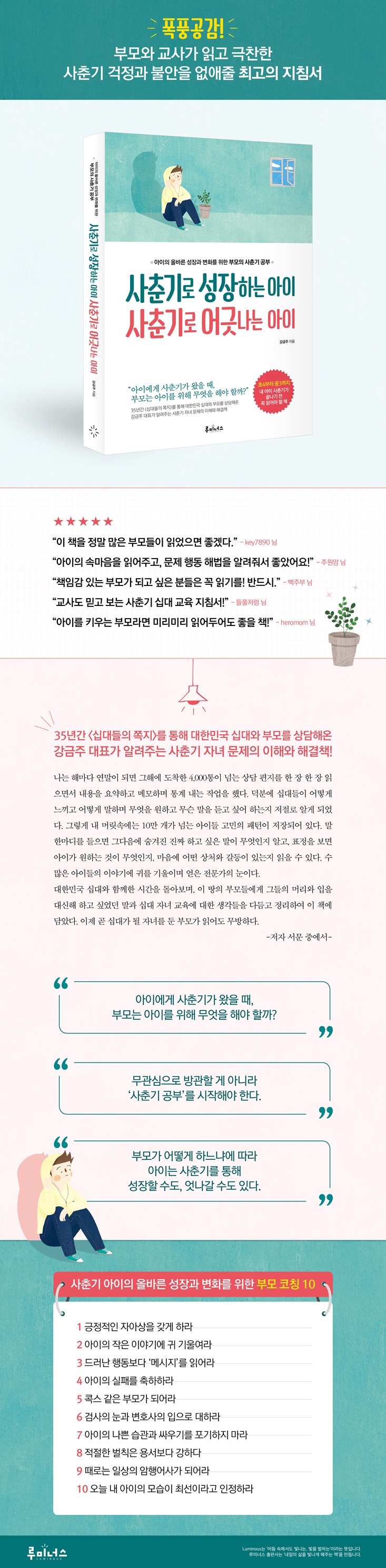
Into the book
The children have changed.
Puberty is starting earlier.
This is because the quantity and quality of external information that children are exposed to, as well as the speed of their development, have increased.
By the fourth grade of elementary school, symptoms of puberty are already appearing.
They start to respond harshly to their parents, get irritated, and act roughly.
Suddenly, they become overly concerned with their appearance and approach sexual information specifically.
--- p.
24
There are no set rules or answers when it comes to the problems of a teenager going through puberty.
Even if you solve it step by step according to certain rules like a math problem, you will not get the same answer.
Just as no matter how many numbers you add, multiply, subtract, or divide, if you multiply them by '0' at the end, they will all end up as 0, all your efforts can go down the drain in an instant, and sometimes, like an infinite decimal, the same symptoms repeat endlessly.
But there are common denominators that can help teens nonetheless.
It's the parents.
--- p.
15
These days, teenagers' standards of behavior are not 'things they have to do even if they don't want to do' or 'things that are right,' but 'things they want to do' and 'things that are fun.'
Your own feelings of like and dislike become the basis for your choices.
Even if it's something you shouldn't do or something wrong, if it's fun and you like it, just do it.
When you ask, “Why didn’t you do it?” even though you didn’t do something you absolutely had to do, you answer, “Because I didn’t want to do it.”
If you do something you absolutely should not do and say, “I just did it because it was fun,” that’s the end of it.
All criteria for selection are thoroughly tailored to one's own mood and emotions.
It doesn't matter what other people say.
Because they only care about themselves, they sometimes do things that are beyond common sense.
--- p.
43
Parents think that working late to pay for their children's private tutoring is a way to show love for their children.
So, only when the child has done something wrong do we have time to sit him down and scold him.
Parents think of it as a conversation, but from the child's perspective, it's frustrating because they don't say anything when they do well, but only get nagged when they do something wrong.
Even if children do something wrong, instead of scolding them, say, "Are you having a hard time? It's okay.
They want to hear words of recognition like, “You’re doing well now” or “You can do better in the future.”
They want to confirm their parents' love in their own way.
--- p.
63
The same goes for adolescent problems.
It may seem small at first, but if left to grow, it can lead to serious and irreversible consequences.
Even the first signals a child shows are often difficult to distinguish between good and bad, like the buds of a baobab tree and a rose.
There is only one way.
You should always pay attention to your child's speech and behavior, eye contact, smile, sitting posture, gait, emotional expression, and even sleeping behavior.
A child doesn't suddenly become a monster one day.
Puberty is starting earlier.
This is because the quantity and quality of external information that children are exposed to, as well as the speed of their development, have increased.
By the fourth grade of elementary school, symptoms of puberty are already appearing.
They start to respond harshly to their parents, get irritated, and act roughly.
Suddenly, they become overly concerned with their appearance and approach sexual information specifically.
--- p.
24
There are no set rules or answers when it comes to the problems of a teenager going through puberty.
Even if you solve it step by step according to certain rules like a math problem, you will not get the same answer.
Just as no matter how many numbers you add, multiply, subtract, or divide, if you multiply them by '0' at the end, they will all end up as 0, all your efforts can go down the drain in an instant, and sometimes, like an infinite decimal, the same symptoms repeat endlessly.
But there are common denominators that can help teens nonetheless.
It's the parents.
--- p.
15
These days, teenagers' standards of behavior are not 'things they have to do even if they don't want to do' or 'things that are right,' but 'things they want to do' and 'things that are fun.'
Your own feelings of like and dislike become the basis for your choices.
Even if it's something you shouldn't do or something wrong, if it's fun and you like it, just do it.
When you ask, “Why didn’t you do it?” even though you didn’t do something you absolutely had to do, you answer, “Because I didn’t want to do it.”
If you do something you absolutely should not do and say, “I just did it because it was fun,” that’s the end of it.
All criteria for selection are thoroughly tailored to one's own mood and emotions.
It doesn't matter what other people say.
Because they only care about themselves, they sometimes do things that are beyond common sense.
--- p.
43
Parents think that working late to pay for their children's private tutoring is a way to show love for their children.
So, only when the child has done something wrong do we have time to sit him down and scold him.
Parents think of it as a conversation, but from the child's perspective, it's frustrating because they don't say anything when they do well, but only get nagged when they do something wrong.
Even if children do something wrong, instead of scolding them, say, "Are you having a hard time? It's okay.
They want to hear words of recognition like, “You’re doing well now” or “You can do better in the future.”
They want to confirm their parents' love in their own way.
--- p.
63
The same goes for adolescent problems.
It may seem small at first, but if left to grow, it can lead to serious and irreversible consequences.
Even the first signals a child shows are often difficult to distinguish between good and bad, like the buds of a baobab tree and a rose.
There is only one way.
You should always pay attention to your child's speech and behavior, eye contact, smile, sitting posture, gait, emotional expression, and even sleeping behavior.
A child doesn't suddenly become a monster one day.
--- p.
73
73
Publisher's Review
A storm of empathy! Read and rave about by parents and teachers.
The Ultimate Guide to Eliminating Adolescent Worries and Anxiety
[Notes from Teenagers] 『Children Growing into Puberty, Children Going Wrong with Puberty』 by Geumju Kang, publisher and youth counselor, has been republished with an upgraded version.
The author, who worked as a middle and high school teacher in his younger days and later lived closely with the teenagers of this country, has refined and organized the words he wanted to speak for their minds and mouths, and his thoughts on educating teenagers, into this book.
In particular, this revised and expanded edition has been supplemented and added based on the latest counseling cases and data to address the new characteristics, problems, and solutions of adolescent children today due to the popularization of smartphones.
Additionally, it includes 'Words from a mother that move her child without hurting him' so that it can be used immediately in conflict situations with adolescent children.
The thoughts and inner feelings of teenagers, as well as stories about raising teenagers, that you've never heard before, provide a new barometer for parents of teenagers.
This is a must-read guide to parenting for parents of teenagers just entering the teenage years or those who will soon become teenagers.
When a child reaches puberty,
What should parents do for their children?
These days, children as early as the fourth grade of elementary school begin to show signs of puberty, such as calling themselves "teenagers" and responding harshly or rebelling against their parents.
The ever-changing external environment and rapid development are causing children to mature abnormally.
As early as the fourth grade, girls begin to bully others intellectually, and boys begin to show impulsive and violent tendencies.
In an age where every child is equally exposed to negative opportunities, we cannot be reassured that our child is okay.
How can I raise my child safely in this rapidly changing environment? What should parents do for their child as they enter puberty?
When a child enters puberty,
It means it's time to give new guidelines!
When a child talks back to others or acts rudely in a way they never did before, parents acknowledge and condone the child's rude and impolite behavior and speech, saying, "Now, my child has reached puberty."
This is because I believe that silently accepting puberty is what it means to be an educational parent who is sensitive to the child's changes and responds appropriately.
However, the author of this book says that accepting it that way is not the best way.
“Many parents attribute all their teenagers’ problems, which stem from untrained lifestyle habits, to ‘symptoms of puberty.’
I believe that if left alone, the symptoms of puberty will go away just like a cold.
However, if parents do not teach and correct it at this time, it will not go away.
“It just keeps changing shape and form and ruins the child even more.”
Based on 35 years of counseling and experience, the author advises parents on what they need to do right now to help their teenagers grow up properly.
It provides specific guidance on how to monitor your child, what must be taught, and how to change problem behaviors.
When a child goes through puberty, it doesn't mean you can let them go because they're all grown up.
It means it's time to give your child new guidelines.
Depending on how parents handle it, a child may either thrive or go astray through puberty.
For my child's proper growth and change
Parents' Adolescent Studies
Every child becomes a teenager.
And then you hit puberty.
Some children experience adolescence like a flowing river, while others experience it on the edge of a storm, swirling with emotions and impulses.
“Why? I’ll take care of it!”
When a child who used to follow their parents around saying, "Mom is the best," responds like this one day, the parents can't help but be at a loss, wondering, "Where did my beloved child go?"
But there is no need to be afraid and retreat in advance.
There is no need to turn a blind eye to it just because ‘that person has come.’
If you understand and guide your adolescent child's mind and behavior well, the child will soon grow up and return to his or her original position.
To achieve this, parents must put aside their impatience and their worries and anxieties about their children's future, and learn how to communicate and get along well with their children, even now.
If there is a problem, you must learn how to solve it.
We need to start studying 'puberty' before it's too late.
***** Praise for this book *****
This book is so honest and concrete that I think it will be very helpful to parents of adolescent children.
I really hope that many parents read this book.
It tells us about the terrifying reality of today and how we can protect our children from it and help them go through their 'growing adolescence'.
- key7890
I was frustrated and having a hard time dealing with my daughter who was moody and cranky about everything, but this book helped me a lot.
I liked that it read my child's inner thoughts and provided specific solutions to problem behaviors.
-Juwon's mom
I told my wife to read it first, and then I said I should read it, but after a few months, I finally got around to reading it.
I regret not reading it sooner.
I felt relieved that you explained in a logical and coherent way what I had been wanting to say.
A must-read for anyone who wants to be a responsible parent.
certainly.
-Mr. Baek Joo-bu
As a teacher, I read this book because I wanted to understand children better, and since it was written by someone who published [Notes from Teenagers], I have even more confidence in the content.
This is a guide to teenage education that you can trust and watch.
-Like wild grass
This is a good book to read in advance, not only for teenagers but also for parents raising children.
As parents and adults, it also makes us think about what kind of example we should show our children.
-heromom
The Ultimate Guide to Eliminating Adolescent Worries and Anxiety
[Notes from Teenagers] 『Children Growing into Puberty, Children Going Wrong with Puberty』 by Geumju Kang, publisher and youth counselor, has been republished with an upgraded version.
The author, who worked as a middle and high school teacher in his younger days and later lived closely with the teenagers of this country, has refined and organized the words he wanted to speak for their minds and mouths, and his thoughts on educating teenagers, into this book.
In particular, this revised and expanded edition has been supplemented and added based on the latest counseling cases and data to address the new characteristics, problems, and solutions of adolescent children today due to the popularization of smartphones.
Additionally, it includes 'Words from a mother that move her child without hurting him' so that it can be used immediately in conflict situations with adolescent children.
The thoughts and inner feelings of teenagers, as well as stories about raising teenagers, that you've never heard before, provide a new barometer for parents of teenagers.
This is a must-read guide to parenting for parents of teenagers just entering the teenage years or those who will soon become teenagers.
When a child reaches puberty,
What should parents do for their children?
These days, children as early as the fourth grade of elementary school begin to show signs of puberty, such as calling themselves "teenagers" and responding harshly or rebelling against their parents.
The ever-changing external environment and rapid development are causing children to mature abnormally.
As early as the fourth grade, girls begin to bully others intellectually, and boys begin to show impulsive and violent tendencies.
In an age where every child is equally exposed to negative opportunities, we cannot be reassured that our child is okay.
How can I raise my child safely in this rapidly changing environment? What should parents do for their child as they enter puberty?
When a child enters puberty,
It means it's time to give new guidelines!
When a child talks back to others or acts rudely in a way they never did before, parents acknowledge and condone the child's rude and impolite behavior and speech, saying, "Now, my child has reached puberty."
This is because I believe that silently accepting puberty is what it means to be an educational parent who is sensitive to the child's changes and responds appropriately.
However, the author of this book says that accepting it that way is not the best way.
“Many parents attribute all their teenagers’ problems, which stem from untrained lifestyle habits, to ‘symptoms of puberty.’
I believe that if left alone, the symptoms of puberty will go away just like a cold.
However, if parents do not teach and correct it at this time, it will not go away.
“It just keeps changing shape and form and ruins the child even more.”
Based on 35 years of counseling and experience, the author advises parents on what they need to do right now to help their teenagers grow up properly.
It provides specific guidance on how to monitor your child, what must be taught, and how to change problem behaviors.
When a child goes through puberty, it doesn't mean you can let them go because they're all grown up.
It means it's time to give your child new guidelines.
Depending on how parents handle it, a child may either thrive or go astray through puberty.
For my child's proper growth and change
Parents' Adolescent Studies
Every child becomes a teenager.
And then you hit puberty.
Some children experience adolescence like a flowing river, while others experience it on the edge of a storm, swirling with emotions and impulses.
“Why? I’ll take care of it!”
When a child who used to follow their parents around saying, "Mom is the best," responds like this one day, the parents can't help but be at a loss, wondering, "Where did my beloved child go?"
But there is no need to be afraid and retreat in advance.
There is no need to turn a blind eye to it just because ‘that person has come.’
If you understand and guide your adolescent child's mind and behavior well, the child will soon grow up and return to his or her original position.
To achieve this, parents must put aside their impatience and their worries and anxieties about their children's future, and learn how to communicate and get along well with their children, even now.
If there is a problem, you must learn how to solve it.
We need to start studying 'puberty' before it's too late.
***** Praise for this book *****
This book is so honest and concrete that I think it will be very helpful to parents of adolescent children.
I really hope that many parents read this book.
It tells us about the terrifying reality of today and how we can protect our children from it and help them go through their 'growing adolescence'.
- key7890
I was frustrated and having a hard time dealing with my daughter who was moody and cranky about everything, but this book helped me a lot.
I liked that it read my child's inner thoughts and provided specific solutions to problem behaviors.
-Juwon's mom
I told my wife to read it first, and then I said I should read it, but after a few months, I finally got around to reading it.
I regret not reading it sooner.
I felt relieved that you explained in a logical and coherent way what I had been wanting to say.
A must-read for anyone who wants to be a responsible parent.
certainly.
-Mr. Baek Joo-bu
As a teacher, I read this book because I wanted to understand children better, and since it was written by someone who published [Notes from Teenagers], I have even more confidence in the content.
This is a guide to teenage education that you can trust and watch.
-Like wild grass
This is a good book to read in advance, not only for teenagers but also for parents raising children.
As parents and adults, it also makes us think about what kind of example we should show our children.
-heromom
GOODS SPECIFICS
- Date of issue: October 30, 2018
- Page count, weight, size: 328 pages | 537g | 152*215*19mm
- ISBN13: 9791196334727
- ISBN10: 1196334722
You may also like
카테고리
korean


korean

![GQ KOREA Mark (Monthly): December [2025]](http://librairie.coreenne.fr/cdn/shop/files/8ef265dbbfbf186523ed75ba7319009d.jpg?v=1765340328&width=3840)


