

Residential Anatomy Atlas
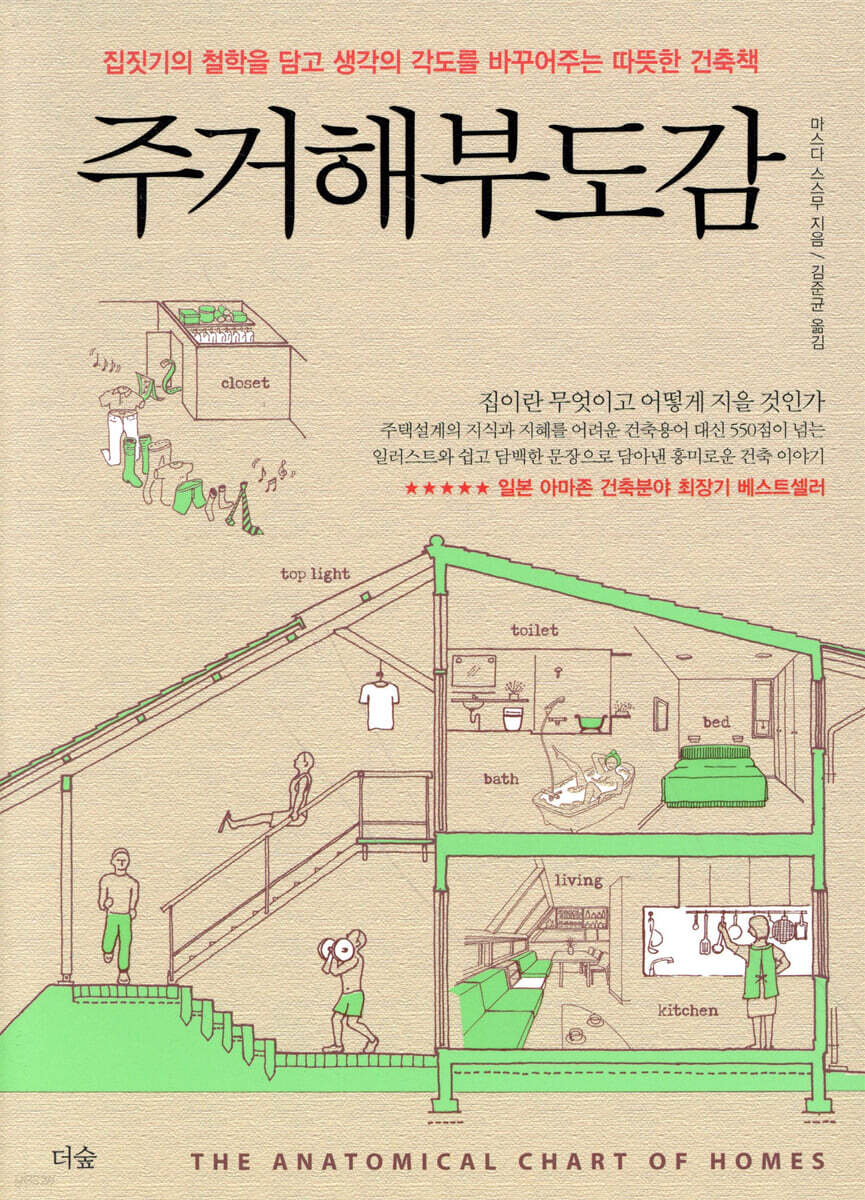 |
Description
Book Introduction
The #1 architecture bestseller on Amazon Japan for the longest time! The best architecture book, also exported to China, Taiwan, and other countries!
What is a home and how to build one?
It is natural that each country has different housing types and structures, just as each country has different cultures.
Architecture reflects and realizes our lifestyle, while also demonstrating creativity in areas where it is not yet available.
In this way, architectural design embodies our philosophies of life and reflections, continually creating new spaces. "Housing Anatomy" provides a detailed introduction to the structure and design of housing, while also seeking to challenge conventional perspectives on architecture.
Although it is written in the format of an illustrated guide and is mainly composed of knowledge about architecture, it is a book that is fun rather than boring thanks to its emotional illustrations and witty explanations.
Additionally, we aim to introduce basic concepts in an easy-to-understand manner, excluding difficult terms commonly used in the construction industry, and provide a flexible opportunity to understand our lives and architecture on the same level.
Therefore, even those who are new to architecture can easily understand the content, and it also provides useful information to homeowners who are building a house.
The author's unique perspective on the structure of a house is another interesting element of this book.
With more and more modern people dreaming of their own home and space, "Housing Anatomy Guide" will provide an important opportunity to lay the foundation for architecture and make their dreams a reality.
What is a home and how to build one?
It is natural that each country has different housing types and structures, just as each country has different cultures.
Architecture reflects and realizes our lifestyle, while also demonstrating creativity in areas where it is not yet available.
In this way, architectural design embodies our philosophies of life and reflections, continually creating new spaces. "Housing Anatomy" provides a detailed introduction to the structure and design of housing, while also seeking to challenge conventional perspectives on architecture.
Although it is written in the format of an illustrated guide and is mainly composed of knowledge about architecture, it is a book that is fun rather than boring thanks to its emotional illustrations and witty explanations.
Additionally, we aim to introduce basic concepts in an easy-to-understand manner, excluding difficult terms commonly used in the construction industry, and provide a flexible opportunity to understand our lives and architecture on the same level.
Therefore, even those who are new to architecture can easily understand the content, and it also provides useful information to homeowners who are building a house.
The author's unique perspective on the structure of a house is another interesting element of this book.
With more and more modern people dreaming of their own home and space, "Housing Anatomy Guide" will provide an important opportunity to lay the foundation for architecture and make their dreams a reality.
- You can preview some of the book's contents.
Preview
index
preface
Chapter 1: There's a reason why a home feels good.
Building a house is like designing a home, and packing a lunchbox is like packing a lunchbox.
A place to relax before opening the front door
Why do we take off our shoes at the entrance?
The narrow staircase room may be due to a failure in the staircase design.
People who open doors want to move around comfortably.
The door follows the heart of such a person.
The living room, a room where the whole family gathers
The dining room table is much larger than it appears.
Even for kitchen design experts, kitchen appliance placement isn't easy.
Kitchen + Dining Room (Flat) The refrigerator is a jack-of-all-trades.
Be loved and close to everyone
Kitchen + Dining Room (Cross-section) Achieving the perfect island kitchen isn't easy.
If you place your bed in the wrong position, you could end up diving in the middle of the night.
The storage items are alive.
They like to wander around and are nocturnal.
Column 1___ Building a home that flexibly adapts to your family's timetable
Washing your hands in the bathroom is done in the bathroom.
To soak in the bathroom bathtub or not
If you don't have a place for the washing machine, you can't decorate the washroom.
A water supply, hot water supply, and drainage system is a place where water constantly flows through.
Column 2___ Start with the ordinary
Chapter 2 The shape of the box has meaning
Roof and eaves On rainy days, it's like holding an umbrella, wearing a raincoat
It's not just noblewomen who appreciate the value of a parasol under the eaves.
What kind of hat should I put over the sunshade window?
Making a Wall and a Hole Should I Make a Hole in the Wall or Block the Hole with a Wall?
Why are windows, doors, and openings in buildings necessary?
Should insulation and ventilation be done or should it be stopped?
The air always hesitates
Are you planning to blow the wind out of the window with an air conditioner?
Absorb, block, or muffle sound
Column 3___ The concept appears only after the whole thing is completed.
The land and the road The land is hanging on the road
The direction of the land is determined by the road.
Two people in the building's layout 'Rubin's Jar'
Parking spaces Cars take up more space than they appear.
Column 4___ Is it not possible to use an ordinary sliding door?
Chapter 3: Just like people, measurements have habits.
You can cross the branches by using both hands without having to come down from the tree every time.
column 5___ Topology of the plane
Sharing and exclusive use of space (privacy) You, your family, many of you
Sharing and exclusive use of equipment: what's mine is mine, what's everyone's is mine
Why does the Chuck and Ping method still persist?
The simpler the rules of grid and module puzzles, the better.
A house with walls that are not thick enough to support the base line and the wall thickness cannot stand.
A hamburger without bread is tasteless.
Column 6___ There is also a purpose called purposelessness.
Conclusion
Chapter 1: There's a reason why a home feels good.
Building a house is like designing a home, and packing a lunchbox is like packing a lunchbox.
A place to relax before opening the front door
Why do we take off our shoes at the entrance?
The narrow staircase room may be due to a failure in the staircase design.
People who open doors want to move around comfortably.
The door follows the heart of such a person.
The living room, a room where the whole family gathers
The dining room table is much larger than it appears.
Even for kitchen design experts, kitchen appliance placement isn't easy.
Kitchen + Dining Room (Flat) The refrigerator is a jack-of-all-trades.
Be loved and close to everyone
Kitchen + Dining Room (Cross-section) Achieving the perfect island kitchen isn't easy.
If you place your bed in the wrong position, you could end up diving in the middle of the night.
The storage items are alive.
They like to wander around and are nocturnal.
Column 1___ Building a home that flexibly adapts to your family's timetable
Washing your hands in the bathroom is done in the bathroom.
To soak in the bathroom bathtub or not
If you don't have a place for the washing machine, you can't decorate the washroom.
A water supply, hot water supply, and drainage system is a place where water constantly flows through.
Column 2___ Start with the ordinary
Chapter 2 The shape of the box has meaning
Roof and eaves On rainy days, it's like holding an umbrella, wearing a raincoat
It's not just noblewomen who appreciate the value of a parasol under the eaves.
What kind of hat should I put over the sunshade window?
Making a Wall and a Hole Should I Make a Hole in the Wall or Block the Hole with a Wall?
Why are windows, doors, and openings in buildings necessary?
Should insulation and ventilation be done or should it be stopped?
The air always hesitates
Are you planning to blow the wind out of the window with an air conditioner?
Absorb, block, or muffle sound
Column 3___ The concept appears only after the whole thing is completed.
The land and the road The land is hanging on the road
The direction of the land is determined by the road.
Two people in the building's layout 'Rubin's Jar'
Parking spaces Cars take up more space than they appear.
Column 4___ Is it not possible to use an ordinary sliding door?
Chapter 3: Just like people, measurements have habits.
You can cross the branches by using both hands without having to come down from the tree every time.
column 5___ Topology of the plane
Sharing and exclusive use of space (privacy) You, your family, many of you
Sharing and exclusive use of equipment: what's mine is mine, what's everyone's is mine
Why does the Chuck and Ping method still persist?
The simpler the rules of grid and module puzzles, the better.
A house with walls that are not thick enough to support the base line and the wall thickness cannot stand.
A hamburger without bread is tasteless.
Column 6___ There is also a purpose called purposelessness.
Conclusion
Detailed image

Into the book
This book is for those who are so absorbed in design that they reach a dead end or become confused by overcomplicating the problem, and recommend that they go back to the basics.
First, it is a suggestion to stand at the starting point and once again look back at the meaning of the space and device you are aiming for.
Housing, in particular, has so many different purposes and uses that it can be difficult to prioritize the numerous factors.
Inevitably, the design becomes more complex, and when you suddenly come to your senses, you often find yourself just patching up the design drawings in front of you, turning them into rags, rather than solving the original problem.
Even the most experienced veteran designer can't guarantee that something like this won't happen.
However, veterans have crisis management skills that are unique to them.
It is the ability to instinctively recognize whether the path you are currently taking is the right one or not, or how far you are off the original path, and to immediately take out the compass and correct your course.
The difference between a professional and an amateur, not just in home design but in any field, is the time it takes to get to your destination.
The difference comes not from how fast you walk, but from how appropriate the path (process) you choose.
What matters is how efficiently you can follow a route that you deem appropriate, and the compass that a veteran holds in his hand is not a particularly good item.
You are just using an extremely ordinary tool in a natural way.
This book is a guide that doesn't provide a single final destination, but rather offers many starting points.
---From the "Preface"
An airplane needs a runway to fly.
We gradually increase our speed on the long runway and finally take off.
Concert halls need a lobby and a foyer (a meeting room for theater staff or a break room during intermission).
It serves as a place to wait for friends, and also plays a big role as a space to gradually raise the mood in preparation for the fun that is about to begin.
The same goes for housing.
Whether it's your own home, a friend's home, or the home of a business partner you're visiting for the first time, you need a little 'room' before opening the front door.
When you enter 'right from the main road to the front door', you can't prepare yourself mentally.
The space for this is the porch.
On rainy days, you can feel the gratitude of the pouch when opening or closing the umbrella.
Just as we have an aperitif before dinner and coffee afterward, our homes also need something to lift our spirits.
---From "Porch: A place to relax before opening the front door"
It was my third year in the office when I was first assigned to design a mountain lodge.
The teacher looked at the layout of the bathroom and asked, “Doesn’t this window open?”
“It looks like a built-in window, but it actually opens when you push on one corner!” he replied proudly (a skill he had only recently learned).
Then the teacher smiled and said, “But it’s a bathroom, right? And the view isn’t that great… Can’t a regular sliding door do?”
I couldn't say anything.
It wasn't a disappointment.
It felt like something written on me was falling away.
Sometimes, when you work on design projects, it's so fun that you forget about erosion.
That's why, if you're not careful, it's easy to fall into 'design for design's sake' or 'detail for detail's sake'.
To avoid that, you have to turn yourself back from 'bloodshot eyes' to 'normal eyes', but that's not an easy task.
This is because the aftereffects of the trial and error that continued until then still remain.
Of course, there are many ideas and techniques that are born from racking one's brains during the detailed design of a house.
But just as important, ‘ordinary skills’ are also valuable.
What I admire about Mr. Yoshimura is not only his many unique ideas and techniques, but also his ability to see, think, and speak with ordinary eyes.
After starting to do my part as a designer, it might be better to start by looking down at my feet rather than looking far ahead.
First, it is a suggestion to stand at the starting point and once again look back at the meaning of the space and device you are aiming for.
Housing, in particular, has so many different purposes and uses that it can be difficult to prioritize the numerous factors.
Inevitably, the design becomes more complex, and when you suddenly come to your senses, you often find yourself just patching up the design drawings in front of you, turning them into rags, rather than solving the original problem.
Even the most experienced veteran designer can't guarantee that something like this won't happen.
However, veterans have crisis management skills that are unique to them.
It is the ability to instinctively recognize whether the path you are currently taking is the right one or not, or how far you are off the original path, and to immediately take out the compass and correct your course.
The difference between a professional and an amateur, not just in home design but in any field, is the time it takes to get to your destination.
The difference comes not from how fast you walk, but from how appropriate the path (process) you choose.
What matters is how efficiently you can follow a route that you deem appropriate, and the compass that a veteran holds in his hand is not a particularly good item.
You are just using an extremely ordinary tool in a natural way.
This book is a guide that doesn't provide a single final destination, but rather offers many starting points.
---From the "Preface"
An airplane needs a runway to fly.
We gradually increase our speed on the long runway and finally take off.
Concert halls need a lobby and a foyer (a meeting room for theater staff or a break room during intermission).
It serves as a place to wait for friends, and also plays a big role as a space to gradually raise the mood in preparation for the fun that is about to begin.
The same goes for housing.
Whether it's your own home, a friend's home, or the home of a business partner you're visiting for the first time, you need a little 'room' before opening the front door.
When you enter 'right from the main road to the front door', you can't prepare yourself mentally.
The space for this is the porch.
On rainy days, you can feel the gratitude of the pouch when opening or closing the umbrella.
Just as we have an aperitif before dinner and coffee afterward, our homes also need something to lift our spirits.
---From "Porch: A place to relax before opening the front door"
It was my third year in the office when I was first assigned to design a mountain lodge.
The teacher looked at the layout of the bathroom and asked, “Doesn’t this window open?”
“It looks like a built-in window, but it actually opens when you push on one corner!” he replied proudly (a skill he had only recently learned).
Then the teacher smiled and said, “But it’s a bathroom, right? And the view isn’t that great… Can’t a regular sliding door do?”
I couldn't say anything.
It wasn't a disappointment.
It felt like something written on me was falling away.
Sometimes, when you work on design projects, it's so fun that you forget about erosion.
That's why, if you're not careful, it's easy to fall into 'design for design's sake' or 'detail for detail's sake'.
To avoid that, you have to turn yourself back from 'bloodshot eyes' to 'normal eyes', but that's not an easy task.
This is because the aftereffects of the trial and error that continued until then still remain.
Of course, there are many ideas and techniques that are born from racking one's brains during the detailed design of a house.
But just as important, ‘ordinary skills’ are also valuable.
What I admire about Mr. Yoshimura is not only his many unique ideas and techniques, but also his ability to see, think, and speak with ordinary eyes.
After starting to do my part as a designer, it might be better to start by looking down at my feet rather than looking far ahead.
---From "Column 4: Is it okay to use an ordinary sliding door?"
Publisher's Review
The knowledge and wisdom of home design are replaced with difficult architectural terms, with over 550 points.
An interesting architectural story told with illustrations and simple, straightforward sentences.
Why should bathroom doors open outward rather than inward? What is the relationship between a toilet and the bathroom entrance? Unlike Westerners who remove their shoes only after entering their own rooms, why do we remove them at the entrance? In what order should kitchen appliances—represented by the refrigerator, range, cutting board, and sink—be arranged? What kind of storage design should we employ to organize all the objects floating around? … In this way, architectural design is the work of fully embodying the deeply ingrained traces of our lifestyles and thinking while adding creative newness to them.
The recently published 『Housing Anatomy Guide』 is a unique architectural book that contains philosophical reflections on the structure and design of houses, and through these, changes the perspectives we have. Since its publication in November 2009, it has maintained the number one spot in the architecture category of Amazon Japan and has been a long-term bestseller.
And, as a rare architectural book, it is one whose copyrights have been exported to several countries, including China and Taiwan.
This book has a big difference from other architecture books.
The biggest difference is that, despite being in the form of an illustrated guide, it doesn't simply contain practical knowledge about housing design. Instead, it faithfully explains the fundamentals of architecture through the author's signature, entertaining analogies and explanations, providing us with an opportunity to gain a new perspective on life and architecture.
Furthermore, instead of using difficult architectural terms, we used over 550 small, warm illustrations and simple sentences to make it easier for the general public to understand and enjoy architecture.
The author says this about the significance of publishing this book:
“This book is for those who are so absorbed in design that they reach a dead end or get confused by overcomplicating the problem, and recommend that they go back to basics.
“This is a suggestion to first stand at the starting point and once again reflect on the meaning of the space and device you are aiming for.”
Although architecture is our specialty, we will encounter a warm and refreshing book on architecture that is full of philosophy.
Every space and layout in a home has its own fundamental reason!
A New Perspective on Home Building for Architects, Building Owners, and Architecture Students
As you read the book, you will discover the author's unique perspective on the design and structure of a house.
But it is not so much the author's unique perspective as an awakening to a fundamental idea that we have forgotten.
For example, why do bathroom doors open outward instead of inward? While doors are supposed to open inward, this can lead to situations where the person inside the door cannot move.
Bathrooms and warehouses are representative examples.
In the case of the front door, it is ideal for it to open inward from the perspective of welcoming guests, but if the floor of the front door is not wide enough, shoes may get caught on the door when opening it, so this principle cannot always be applied.
In the West, front doors open inward, which is possible because in these countries people do not wear shoes.
Let's take another example.
When placing a double bed in a bedroom, it is often placed against the wall.
But in this case, the author says, if the person using the outer side falls asleep first, the co-sleeper will have to dive towards the pillow.
When lying down in bed, the rule is to get up from the side.
Additionally, to make the bed well, you need to consider the space in three directions: both sides and underneath.
Therefore, unlike other furniture, bedroom furniture should not be placed wherever and however you want in the room, but rather, other design elements such as the location of windows, outlets, and lighting fixtures should be considered along with its location.
Ultimately, it is not design for design's sake, but design that is centered on humans.
The stories about design and structure discussed in this book are not limited to architects.
It also provides a new perspective on many aspects for the general public, including homeowners who are planning to build a house.
You will encounter a textbook on architecture and a guide to life from an architect who has been teaching housing design at a university for over 20 years while designing in actual fields.
What we need more than 'bloodshot eyes' that seek out novel ideas is 'ordinary eyes' that look at the fundamentals!
The book contains over 550 engaging illustrations and the author's unique metaphors and explanations.
The use of space in a house can be likened to various lunch boxes; the word 'organizing' does not mean the same as 'stow'; the room called 'child's room' does not have a child in it forever, so the composition of space must be planned so that it can flexibly respond to changes in the family at any time; the awning above the window can be likened to a hat; when we put on our shoes at the front door, we unconsciously make a new resolution for what we have to do outside, and when we take our shoes off, we let our minds go; etc. The author's explanatory style completely eliminates the feeling of a stiff technical book and easily and faithfully conveys expert content to general readers.
As the general public's interest in housing construction grows, dreaming of one day escaping from apartments, this book will establish itself as a solid foundation for building a truly beautiful "place to live"—one that teaches us that architecture isn't just a trend, nor is it simply a yearning for flashy buildings.
An interesting architectural story told with illustrations and simple, straightforward sentences.
Why should bathroom doors open outward rather than inward? What is the relationship between a toilet and the bathroom entrance? Unlike Westerners who remove their shoes only after entering their own rooms, why do we remove them at the entrance? In what order should kitchen appliances—represented by the refrigerator, range, cutting board, and sink—be arranged? What kind of storage design should we employ to organize all the objects floating around? … In this way, architectural design is the work of fully embodying the deeply ingrained traces of our lifestyles and thinking while adding creative newness to them.
The recently published 『Housing Anatomy Guide』 is a unique architectural book that contains philosophical reflections on the structure and design of houses, and through these, changes the perspectives we have. Since its publication in November 2009, it has maintained the number one spot in the architecture category of Amazon Japan and has been a long-term bestseller.
And, as a rare architectural book, it is one whose copyrights have been exported to several countries, including China and Taiwan.
This book has a big difference from other architecture books.
The biggest difference is that, despite being in the form of an illustrated guide, it doesn't simply contain practical knowledge about housing design. Instead, it faithfully explains the fundamentals of architecture through the author's signature, entertaining analogies and explanations, providing us with an opportunity to gain a new perspective on life and architecture.
Furthermore, instead of using difficult architectural terms, we used over 550 small, warm illustrations and simple sentences to make it easier for the general public to understand and enjoy architecture.
The author says this about the significance of publishing this book:
“This book is for those who are so absorbed in design that they reach a dead end or get confused by overcomplicating the problem, and recommend that they go back to basics.
“This is a suggestion to first stand at the starting point and once again reflect on the meaning of the space and device you are aiming for.”
Although architecture is our specialty, we will encounter a warm and refreshing book on architecture that is full of philosophy.
Every space and layout in a home has its own fundamental reason!
A New Perspective on Home Building for Architects, Building Owners, and Architecture Students
As you read the book, you will discover the author's unique perspective on the design and structure of a house.
But it is not so much the author's unique perspective as an awakening to a fundamental idea that we have forgotten.
For example, why do bathroom doors open outward instead of inward? While doors are supposed to open inward, this can lead to situations where the person inside the door cannot move.
Bathrooms and warehouses are representative examples.
In the case of the front door, it is ideal for it to open inward from the perspective of welcoming guests, but if the floor of the front door is not wide enough, shoes may get caught on the door when opening it, so this principle cannot always be applied.
In the West, front doors open inward, which is possible because in these countries people do not wear shoes.
Let's take another example.
When placing a double bed in a bedroom, it is often placed against the wall.
But in this case, the author says, if the person using the outer side falls asleep first, the co-sleeper will have to dive towards the pillow.
When lying down in bed, the rule is to get up from the side.
Additionally, to make the bed well, you need to consider the space in three directions: both sides and underneath.
Therefore, unlike other furniture, bedroom furniture should not be placed wherever and however you want in the room, but rather, other design elements such as the location of windows, outlets, and lighting fixtures should be considered along with its location.
Ultimately, it is not design for design's sake, but design that is centered on humans.
The stories about design and structure discussed in this book are not limited to architects.
It also provides a new perspective on many aspects for the general public, including homeowners who are planning to build a house.
You will encounter a textbook on architecture and a guide to life from an architect who has been teaching housing design at a university for over 20 years while designing in actual fields.
What we need more than 'bloodshot eyes' that seek out novel ideas is 'ordinary eyes' that look at the fundamentals!
The book contains over 550 engaging illustrations and the author's unique metaphors and explanations.
The use of space in a house can be likened to various lunch boxes; the word 'organizing' does not mean the same as 'stow'; the room called 'child's room' does not have a child in it forever, so the composition of space must be planned so that it can flexibly respond to changes in the family at any time; the awning above the window can be likened to a hat; when we put on our shoes at the front door, we unconsciously make a new resolution for what we have to do outside, and when we take our shoes off, we let our minds go; etc. The author's explanatory style completely eliminates the feeling of a stiff technical book and easily and faithfully conveys expert content to general readers.
As the general public's interest in housing construction grows, dreaming of one day escaping from apartments, this book will establish itself as a solid foundation for building a truly beautiful "place to live"—one that teaches us that architecture isn't just a trend, nor is it simply a yearning for flashy buildings.
GOODS SPECIFICS
- Date of publication: December 5, 2012
- Page count, weight, size: 204 pages | 290g | 152*209*20mm
- ISBN13: 9788994418483
- ISBN10: 8994418482
You may also like
카테고리
korean


korean

![GQ KOREA Mark (Monthly): December [2025]](http://librairie.coreenne.fr/cdn/shop/files/8ef265dbbfbf186523ed75ba7319009d.jpg?v=1765340328&width=3840)


