

Reconnecting the Brain, Awakening Joy
 |
Description
Book Introduction
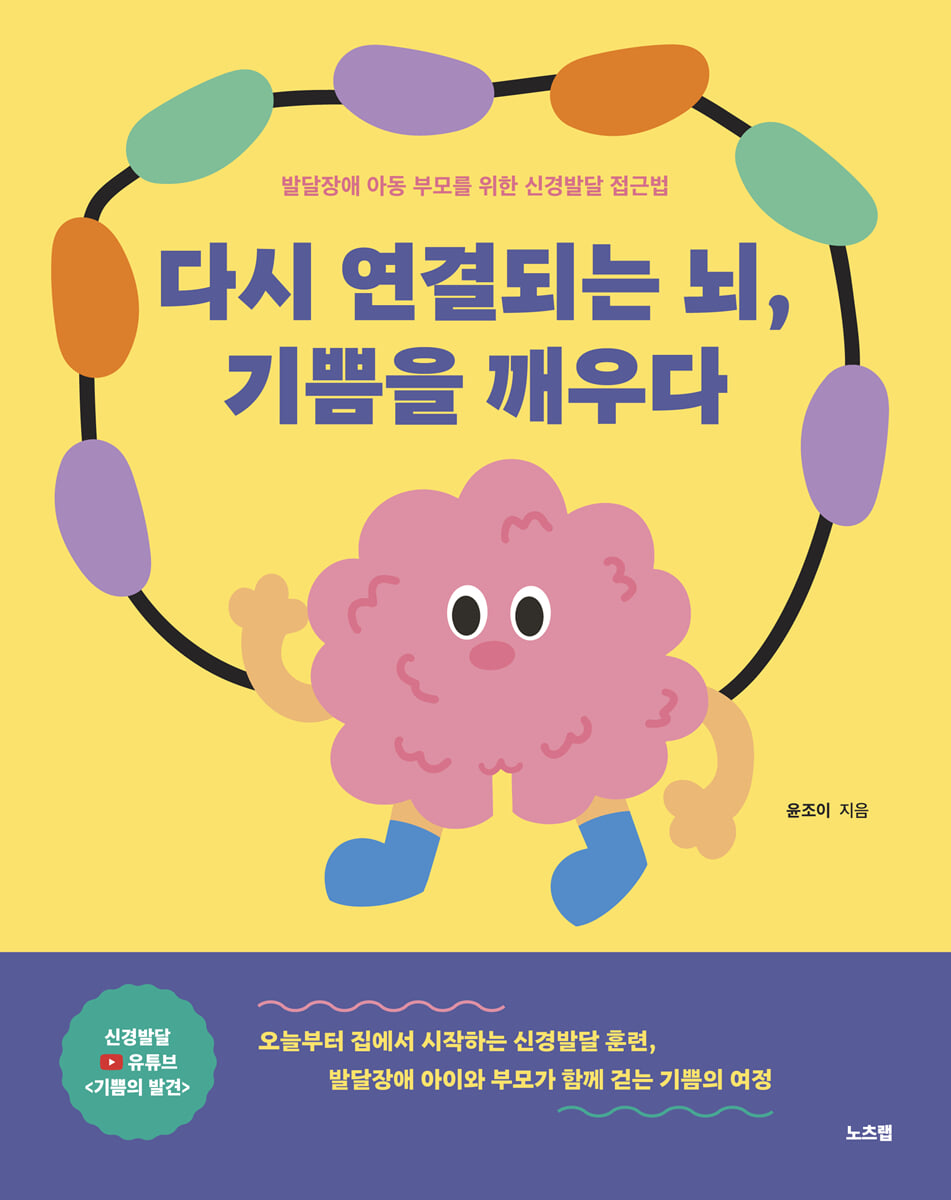
"Reconnecting the Brain, Awakening Joy" is a book that shows a new path for parents of children with developmental disabilities.
The author uses scientific evidence and vivid examples to demonstrate that children's brains can still change and grow.
It makes us see developmental disabilities not as a 'finished story', but as a process that can be reconnected and recovered.
The greatest strength of this book is that it provides specific guidance so that parents can learn the neurodevelopmental approach themselves and put it into practice with their children.
There is no need for complex specialized equipment or a large treatment space.
Even a small space at home and a parent's touch can stimulate a child's brain and help with development.
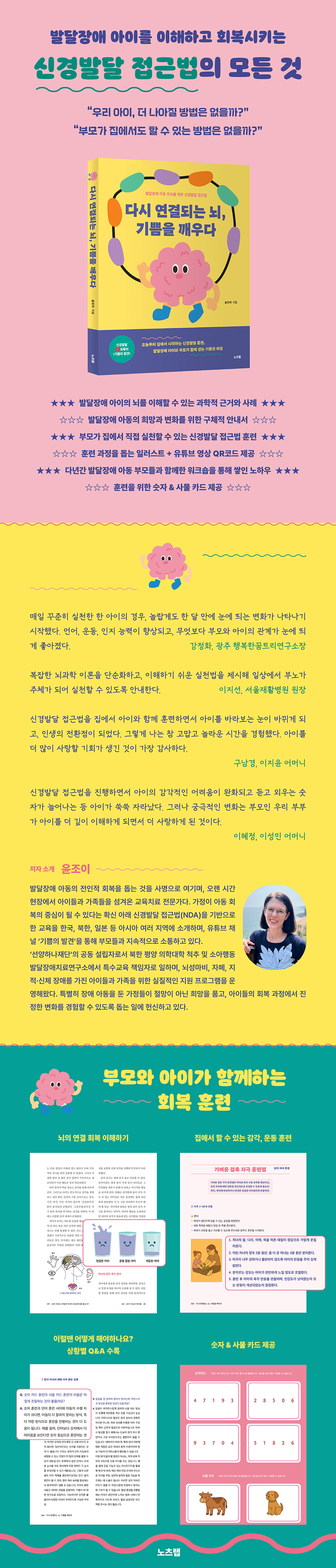
In particular, the text is filled with illustrations and step-by-step explanations, so parents can follow along and put it into practice right away.
All you need is a place to lie down with your child and a few simple tools.
The training methods contained in the book cover various developmental areas, including vision, hearing, movement, and language, in detail, and provide hope that children can see small changes with their own eyes.
"Reconnecting the Brain, Awakening Joy" is not a simple treatment guide, but a companion on the journey of parents and children growing together and restoring joy.
A child's tired mind is rekindled, and under the steady care of its parents, the child's brain displays amazing resilience.
This book is a solid guide that helps you believe and walk that path.
The author uses scientific evidence and vivid examples to demonstrate that children's brains can still change and grow.
It makes us see developmental disabilities not as a 'finished story', but as a process that can be reconnected and recovered.
The greatest strength of this book is that it provides specific guidance so that parents can learn the neurodevelopmental approach themselves and put it into practice with their children.
There is no need for complex specialized equipment or a large treatment space.
Even a small space at home and a parent's touch can stimulate a child's brain and help with development.
In particular, the text is filled with illustrations and step-by-step explanations, so parents can follow along and put it into practice right away.
All you need is a place to lie down with your child and a few simple tools.
The training methods contained in the book cover various developmental areas, including vision, hearing, movement, and language, in detail, and provide hope that children can see small changes with their own eyes.
"Reconnecting the Brain, Awakening Joy" is not a simple treatment guide, but a companion on the journey of parents and children growing together and restoring joy.
A child's tired mind is rekindled, and under the steady care of its parents, the child's brain displays amazing resilience.
This book is a solid guide that helps you believe and walk that path.
- You can preview some of the book's contents.
Preview
index
Part 1: Understanding Developmental Disabilities
Chapter 1: Focusing on Your Children
Chapter 2: Attachment Formation is Important
Part 2: Neurodevelopmental Approaches: Why Are They Important?
Chapter 1: The brain comes alive when it's connected.
Chapter 2: Normal Development and Neurodevelopmental Approaches
Part 3: As the brain develops, so does the child.
Chapter 1: Movement Organizes the Brain
Chapter 2: Sensory Stimuli Determine Motor Function
Chapter 3: A Child's Development Has a Sequence
Part 4: How does sensory processing help children process information?
Chapter 1: Difficulties with Sensory Functions
Chapter 2: How to Receive Sensory Information
Chapter 3 What is vestibular stimulation?
Chapter 4: Tactile and pressure stimulation are required.
Chapter 5: Visual Movement and Eye Coordination Are Important
Chapter 6: Processing Information
Chapter 7: Developing Auditory Information Processing Abilities
Chapter 8: Visual Information Processing Abilities Also Need Training
Part 5: How to maintain and strengthen?
Chapter 1: Information Storage is Determined by Dominant Function
Chapter 2: Hope Grows Until the End
Chapter 1: Focusing on Your Children
Chapter 2: Attachment Formation is Important
Part 2: Neurodevelopmental Approaches: Why Are They Important?
Chapter 1: The brain comes alive when it's connected.
Chapter 2: Normal Development and Neurodevelopmental Approaches
Part 3: As the brain develops, so does the child.
Chapter 1: Movement Organizes the Brain
Chapter 2: Sensory Stimuli Determine Motor Function
Chapter 3: A Child's Development Has a Sequence
Part 4: How does sensory processing help children process information?
Chapter 1: Difficulties with Sensory Functions
Chapter 2: How to Receive Sensory Information
Chapter 3 What is vestibular stimulation?
Chapter 4: Tactile and pressure stimulation are required.
Chapter 5: Visual Movement and Eye Coordination Are Important
Chapter 6: Processing Information
Chapter 7: Developing Auditory Information Processing Abilities
Chapter 8: Visual Information Processing Abilities Also Need Training
Part 5: How to maintain and strengthen?
Chapter 1: Information Storage is Determined by Dominant Function
Chapter 2: Hope Grows Until the End
Detailed image
Into the book
Before parents see their children as “children with disabilities,” they must first remember that they are simply children.
Every child has his or her own unique and innate worth.
...
When parents' hearts begin to change, then new hope appears.
A ray of light enters your weary mind, and from that point on, when your thoughts change, a new breakthrough opens up.
--- p.20 From “Part 1, Chapter 1: Focusing on Your Children”
The neurodevelopmental approach is a method that parents can use to train with their children at home to promote sustained recovery.
It allows parents to select and focus on the training that their child needs most, and opens the way for parents to directly support their child's development in their daily lives.
--- p.36 From “Part 2, Chapter 2: Normal Development and Neurodevelopmental Approaches”
The neurodevelopmental approach is not simply about treatment; it helps improve brain function and even enhance a child's academic abilities.
Brain training techniques can make daily life and learning much easier, ultimately improving the quality of life.
Above all, the biggest advantage is that parents can practice it safely and comfortably at home.
.
Every child has his or her own unique and innate worth.
...
When parents' hearts begin to change, then new hope appears.
A ray of light enters your weary mind, and from that point on, when your thoughts change, a new breakthrough opens up.
--- p.20 From “Part 1, Chapter 1: Focusing on Your Children”
The neurodevelopmental approach is a method that parents can use to train with their children at home to promote sustained recovery.
It allows parents to select and focus on the training that their child needs most, and opens the way for parents to directly support their child's development in their daily lives.
--- p.36 From “Part 2, Chapter 2: Normal Development and Neurodevelopmental Approaches”
The neurodevelopmental approach is not simply about treatment; it helps improve brain function and even enhance a child's academic abilities.
Brain training techniques can make daily life and learning much easier, ultimately improving the quality of life.
Above all, the biggest advantage is that parents can practice it safely and comfortably at home.
.
--- p.34 From “Part 2, Chapter 1: The brain becomes more functional when connected”
Publisher's Review
Recommendation
The advantage of using a 'neurodevelopmental approach' is that it does not require special space or equipment.
Most of the training programs presented in this book can be implemented in your living room or a small space, using readily available household items.
And there are QR codes throughout the book that, when accessed with a mobile phone, link to the author's YouTube video "Discovering Joy," which explains important theories and training programs related to brain development and sensory stimulation, helping with audiovisual comprehension.
Kim Yong-han, former principal of Yongin Gangnam School
We simplify complex neuroscience theories and present easy-to-understand practical methods, guiding parents to take the initiative and implement them in their daily lives.
If you continue to do this consistently at home, you will experience changes that not only affect your child's development, but also the hearts of both parents and children.
Lee Ji-seon, Director of Seoul Rehabilitation Hospital
I heard that great changes can occur in children regardless of their age, so I took Joy's Neurodevelopmental Approach class.
The more I learned about the neurodevelopmental approach, the more fascinated I became by its scientific principles and practical implications.
In the case of one child who practiced consistently every day, surprisingly, within a month, noticeable changes began to appear.
Language, motor, and cognitive abilities improved, emotional regulation skills improved, and most importantly, the parent-child relationship improved significantly.
This neurodevelopmental approach is the best approach for children and parents to expect change together from the moment they start, regardless of age.
Kang Jeong-hwa, Director of the Gwangju Happy Dream Tree Research Institute
As we progressed through the neurodevelopmental approach, Seongmin's sensory difficulties were alleviated and he grew rapidly, including increasing the number of things he could hear and memorize.
But the ultimate change was that Seongmin's parents, my husband and I, came to understand him more deeply and love him more.
We invite many families with disabilities, like us, to join us on our journey to discover an irreplaceable joy.
Lee Hye-jeong, Lee Seong-min's mother
This book explains in detail why children with developmental disabilities need neurodevelopmental training and how and in what areas it should be supplemented, through the actual training process of a family with a developmental disability.
A book that is like an instruction manual that parents can easily understand and follow at home.
This is exactly what we needed.
I would like to express my sincere gratitude to you for making this book.
I would highly recommend this book to anyone raising children similar to mine, as it serves as a guide to the true recovery of damaged brain nerves.
Kim Nan-hee, Shin On-yu's mother
If I were alone, I might have already given up because I was tired.
But thanks to meeting with several families each week to train and encourage each other, I was able to regain my strength, and I experienced even greater hope as I saw the changes in not only my child but also the children of other families.
I am truly grateful that this book has come out and will help more families become aware of the neurodevelopmental approach.
Seo Nam-hee and Lee Ho-jae's mother
The advantage of using a 'neurodevelopmental approach' is that it does not require special space or equipment.
Most of the training programs presented in this book can be implemented in your living room or a small space, using readily available household items.
And there are QR codes throughout the book that, when accessed with a mobile phone, link to the author's YouTube video "Discovering Joy," which explains important theories and training programs related to brain development and sensory stimulation, helping with audiovisual comprehension.
Kim Yong-han, former principal of Yongin Gangnam School
We simplify complex neuroscience theories and present easy-to-understand practical methods, guiding parents to take the initiative and implement them in their daily lives.
If you continue to do this consistently at home, you will experience changes that not only affect your child's development, but also the hearts of both parents and children.
Lee Ji-seon, Director of Seoul Rehabilitation Hospital
I heard that great changes can occur in children regardless of their age, so I took Joy's Neurodevelopmental Approach class.
The more I learned about the neurodevelopmental approach, the more fascinated I became by its scientific principles and practical implications.
In the case of one child who practiced consistently every day, surprisingly, within a month, noticeable changes began to appear.
Language, motor, and cognitive abilities improved, emotional regulation skills improved, and most importantly, the parent-child relationship improved significantly.
This neurodevelopmental approach is the best approach for children and parents to expect change together from the moment they start, regardless of age.
Kang Jeong-hwa, Director of the Gwangju Happy Dream Tree Research Institute
As we progressed through the neurodevelopmental approach, Seongmin's sensory difficulties were alleviated and he grew rapidly, including increasing the number of things he could hear and memorize.
But the ultimate change was that Seongmin's parents, my husband and I, came to understand him more deeply and love him more.
We invite many families with disabilities, like us, to join us on our journey to discover an irreplaceable joy.
Lee Hye-jeong, Lee Seong-min's mother
This book explains in detail why children with developmental disabilities need neurodevelopmental training and how and in what areas it should be supplemented, through the actual training process of a family with a developmental disability.
A book that is like an instruction manual that parents can easily understand and follow at home.
This is exactly what we needed.
I would like to express my sincere gratitude to you for making this book.
I would highly recommend this book to anyone raising children similar to mine, as it serves as a guide to the true recovery of damaged brain nerves.
Kim Nan-hee, Shin On-yu's mother
If I were alone, I might have already given up because I was tired.
But thanks to meeting with several families each week to train and encourage each other, I was able to regain my strength, and I experienced even greater hope as I saw the changes in not only my child but also the children of other families.
I am truly grateful that this book has come out and will help more families become aware of the neurodevelopmental approach.
Seo Nam-hee and Lee Ho-jae's mother
GOODS SPECIFICS
- Date of issue: October 1, 2025
- Page count, weight, size: 224 pages | 598g | 187*236*14mm
- ISBN13: 9791199497207
- ISBN10: 1199497207
You may also like
카테고리
korean


korean

![GQ KOREA Mark (Monthly): December [2025]](http://librairie.coreenne.fr/cdn/shop/files/8ef265dbbfbf186523ed75ba7319009d.jpg?v=1765340328&width=3840)


