

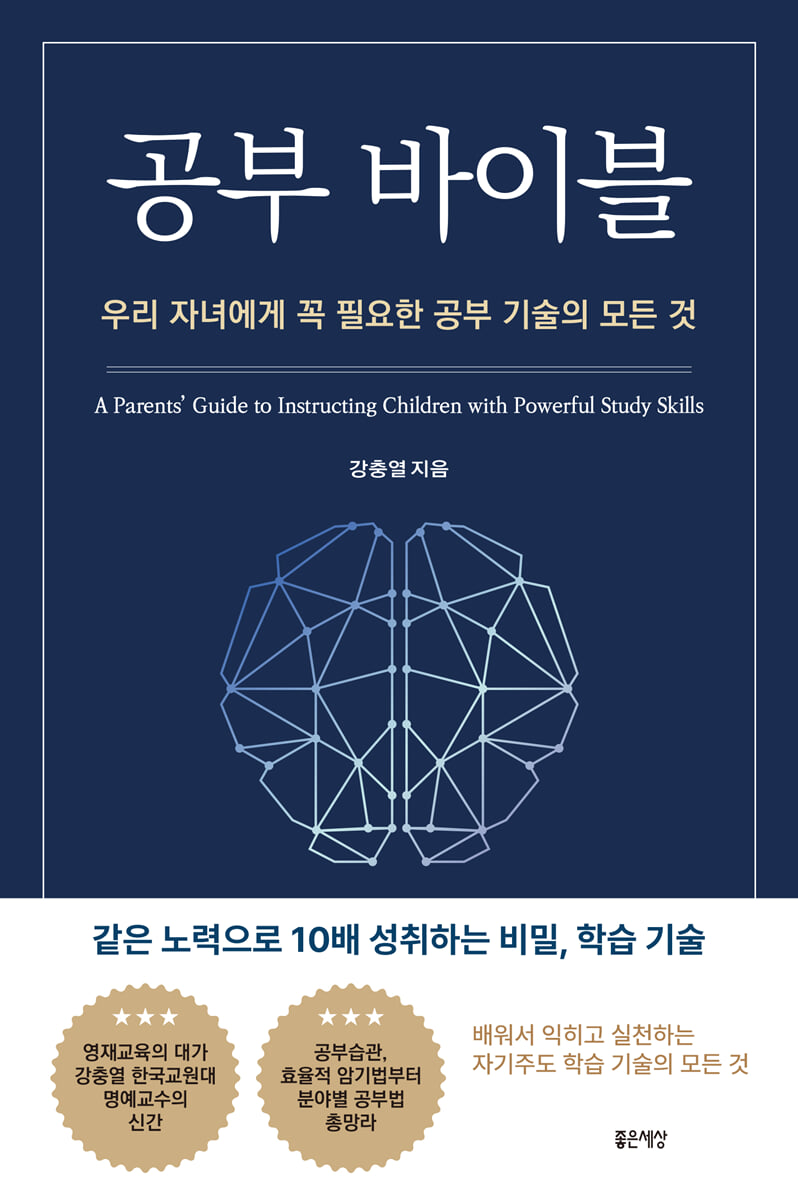
Study Bible
 |
Description
Book Introduction
The Secret to 10x the Achievement with the Same Effort: Learning Techniques
A new book by Kang Chung-yeol, a leading expert in gifted education and professor emeritus at Korea National University of Education.
A comprehensive guide to study habits, efficient memorization techniques, and study methods by subject.
Everything you need to know about self-directed learning techniques: learn, master, and practice.
Studying is like farming.
Just as a farmer must invest time and sweat to reap the harvest, a student must also invest time and effort to study well.
Studying is a very honest activity, like farming, where nothing is free.
However, investing time and effort is only a necessary condition for studying, but not a sufficient condition.
Just as there are scientific farming methods that allow you to get a lot of produce with the same amount of time and effort, there are also effective study methods that allow you to study well with the same amount of time and effort.
That's the study technique.
Study skills, also known as learning techniques, learning strategies, or study methods, are knowledge whose effectiveness has been proven through scientific research by scholars.
It is not easy for elementary and middle school students to acquire these study skills on their own, so they need to learn from adults who are well-versed in study skills.
This book provides parents and teachers with the study skills they need to support and coach their children's learning in elementary and middle school.
Helping children learn and consistently practice study skills from a young age will ultimately help them become self-directed learners, leading to academic success during their school years and increased expertise in their respective career fields as adults.
Study skills are survival skills that all modern people need in an increasingly competitive lifelong learning society.
A new book by Kang Chung-yeol, a leading expert in gifted education and professor emeritus at Korea National University of Education.
A comprehensive guide to study habits, efficient memorization techniques, and study methods by subject.
Everything you need to know about self-directed learning techniques: learn, master, and practice.
Studying is like farming.
Just as a farmer must invest time and sweat to reap the harvest, a student must also invest time and effort to study well.
Studying is a very honest activity, like farming, where nothing is free.
However, investing time and effort is only a necessary condition for studying, but not a sufficient condition.
Just as there are scientific farming methods that allow you to get a lot of produce with the same amount of time and effort, there are also effective study methods that allow you to study well with the same amount of time and effort.
That's the study technique.
Study skills, also known as learning techniques, learning strategies, or study methods, are knowledge whose effectiveness has been proven through scientific research by scholars.
It is not easy for elementary and middle school students to acquire these study skills on their own, so they need to learn from adults who are well-versed in study skills.
This book provides parents and teachers with the study skills they need to support and coach their children's learning in elementary and middle school.
Helping children learn and consistently practice study skills from a young age will ultimately help them become self-directed learners, leading to academic success during their school years and increased expertise in their respective career fields as adults.
Study skills are survival skills that all modern people need in an increasingly competitive lifelong learning society.
- You can preview some of the book's contents.
Preview
index
introduction
Part 1: A Basic Understanding of Study Skills
Chapter 1: Overview of Study Skills
1.
What are study skills?
2.
What are some study skills?
3.
What are the characteristics of study skills?
4.
How do study skills develop?
5.
What are the benefits of study skills?
Part 2: Introduction to Detailed Study Skills
Chapter 2 Primary Technologies
Section 1 Reading Skills
1.
Comprehension of reading
1) Learning to read
2) Reading for learning
2.
Detailed reading skills
1) Read while asking questions and finding answers.
2) Read while predicting the development of the text.
3) Read while finding the main sentence and supporting sentences.
4) Read while understanding the structure of the text
5) Read and evaluate the content of the text.
6) Reading while checking your level of understanding
7) Reading with signals and annotations
8) Finding the core idea through inference
9) Summarize
10) Read critically
Section 2 Writing Skills
1.
Understanding writing
1) Writing anxiety
2) Academic writing
3) Writing by type
2.
Detailed writing skills
1) Writing skills in the planning stage
2) Writing skills at the narrative stage
3) Writing skills during the review stage
Section 3 Speaking Skills
1.
Understanding Presentation Anxiety
2.
Detailed presentation technology
1) Strategy during the presentation preparation stage
2) Strategies during the presentation practice stage
3) Strategy at the actual presentation stage
3.
Effective Speaking Support Strategies
1) Use the I-message
2) Use descriptive rather than judgmental language.
3) Use body language
4) Avoid unnecessary words and unintended instructions.
Section 4 Listening Skills
1.
Comprehension of listening
1) Hearing disturbances
2) Listening process
2.
Detailed listening skills
1) Interpersonal skills needed for listening
2) Critical listening skills
3) Active listening skills
4) Skills for listening effectively in class
Section 5 Note-taking Techniques
1.
The effects of note-taking
2.
Effective Note-Taking Strategies
3.
Using the Cornell Note System
1) Taking class notes using the Cornell Note System
2) Note taking in Cornell notes
3) Review by combining class notes and text notes.
Section 6: Techniques for Improving English Vocabulary
1.
The importance of vocabulary
2.
Stages of Vocabulary Acquisition and Tips for Learning English Vocabulary
3.
Frontier Method
1) Three types of vocabulary
2) Stages of Frontier Vocabulary Expansion
4.
Learning vocabulary through roots
1) Commonly used roots and prefixes
2) 14 Master Words
Section 7: Mnemonics
1.
Understanding how memory works
2.
Technology to enhance memory
1) Try to remember
2) Focus on what you want to remember with a peaceful mind.
3) Understand the learning curve and practice distributed learning.
4) Connecting what you want to remember with prior knowledge
5) Organize what you want to remember
6) Create an image (mention) to remember
7) Memorize by creating acronyms, verses, rhythm patterns, and sentences.
8) Using the pillar word method
9) Keyword Law
10) Practice recitation and recovery
Section 8 Problem Solving Skills
1.
The three elements of the problem
2.
Techniques that enhance problem-solving skills
1) Technology in the problem discovery stage
2) Technology in the solution exploration stage
Chapter 3 Secondary Technologies
Section 1: The art of studying with a dream
1.
Setting your life purpose as a dream
2.
Engrave in your mind the image of your dream come true
3.
Planning to make your dreams come true
4.
Putting plans into action to achieve your dreams
Section 2 Time Management Skills
1.
Why You Should Plan Your Time
2.
Effective Time Use Strategies
3.
Step 3: Schedule Your Time
Section 3 Stress Management Techniques
1.
Understanding Stress
2.
Detecting stress
3.
Eliminate avoidable stress
1) Overcoming study procrastination
2) Eliminate general stress
4.
Promoting a correct attitude toward life
5.
Establish and maintain a healthy routine
Section 4 Learning Space Management Technology
1.
Decorating the study room
2.
Building a Learning Materials Management System
3.
Protecting Your Health from Computer Use
Section 5: Skills for preparing for and taking exams
1.
3 Stages of Exam Stress
2.
Prepare to overcome exam stress
1) Prepare academically
2) Prepare psychologically
3.
Approach the exam systematically
4.
Understand and cope with test question types
1) True or false question
2) Multiple choice questions
3) Connected problems
4) Completed questions
5) Essay type questions
6) Open book problem
7) Oral exam
5.
Learning through testing
Section 6: Technologies to Enhance Learning Motivation
1.
Dream recall and clarification of learning objectives
2.
Building Confidence for Academic Success
3.
Set a study time and stick to it
4.
Dealing with Study Boredom
5.
Record your achievements and pursue your peak
6.
Fostering intrinsic motivation for learning and achievement
Section 7: Concentration Enhancement Techniques
1.
Create a study environment conducive to concentration
2.
Keep your composure
3. Follow the PIC procedure
4.
Don't multitask
5.
Have a 5:1 study-rest pattern
6.
Balancing tasks and abilities
7.
Adjust your anxiety level according to the task
Section 8: Techniques for maximizing learning outcomes through classes
1.
Pre-Class Preparation Strategies
2.
Participation Strategies During Class
3.
Post-Class Review Strategies
Section 9 Self-Regulated Learning Skills
1.
The Importance of Self-Regulated Learning
2.
Developmental Status and Enhancement Strategies of Self-Regulated Learning Competencies
Section 10 Cooperative Learning Technology
1.
Cooperative learning group composition and structure
2.
Interaction skills within cooperative learning groups
1) Creating a mutually supportive group atmosphere
2) Setting the purpose and agenda for cooperative learning
3) Promoting the roles and responsibilities of members
4) Checking the progress of cooperative learning
5) Participate effectively in group discussions
6) Offer and accept constructive criticism.
3.
Cooperative Learning Contribution Rating Scale
Chapter 4 Metacognitive Skills
1.
Definition and Components of Metacognition
2.
The nature of metacognition
3.
Metacognitive Enhancement Strategies
Part 3: Guidance on Study Skills
Chapter 5: Study Skills Guidance
1.
Direct teaching
2.
Guidelines for Study Skills Guidance
3.
Teaching activities at each stage of the class
References
Part 1: A Basic Understanding of Study Skills
Chapter 1: Overview of Study Skills
1.
What are study skills?
2.
What are some study skills?
3.
What are the characteristics of study skills?
4.
How do study skills develop?
5.
What are the benefits of study skills?
Part 2: Introduction to Detailed Study Skills
Chapter 2 Primary Technologies
Section 1 Reading Skills
1.
Comprehension of reading
1) Learning to read
2) Reading for learning
2.
Detailed reading skills
1) Read while asking questions and finding answers.
2) Read while predicting the development of the text.
3) Read while finding the main sentence and supporting sentences.
4) Read while understanding the structure of the text
5) Read and evaluate the content of the text.
6) Reading while checking your level of understanding
7) Reading with signals and annotations
8) Finding the core idea through inference
9) Summarize
10) Read critically
Section 2 Writing Skills
1.
Understanding writing
1) Writing anxiety
2) Academic writing
3) Writing by type
2.
Detailed writing skills
1) Writing skills in the planning stage
2) Writing skills at the narrative stage
3) Writing skills during the review stage
Section 3 Speaking Skills
1.
Understanding Presentation Anxiety
2.
Detailed presentation technology
1) Strategy during the presentation preparation stage
2) Strategies during the presentation practice stage
3) Strategy at the actual presentation stage
3.
Effective Speaking Support Strategies
1) Use the I-message
2) Use descriptive rather than judgmental language.
3) Use body language
4) Avoid unnecessary words and unintended instructions.
Section 4 Listening Skills
1.
Comprehension of listening
1) Hearing disturbances
2) Listening process
2.
Detailed listening skills
1) Interpersonal skills needed for listening
2) Critical listening skills
3) Active listening skills
4) Skills for listening effectively in class
Section 5 Note-taking Techniques
1.
The effects of note-taking
2.
Effective Note-Taking Strategies
3.
Using the Cornell Note System
1) Taking class notes using the Cornell Note System
2) Note taking in Cornell notes
3) Review by combining class notes and text notes.
Section 6: Techniques for Improving English Vocabulary
1.
The importance of vocabulary
2.
Stages of Vocabulary Acquisition and Tips for Learning English Vocabulary
3.
Frontier Method
1) Three types of vocabulary
2) Stages of Frontier Vocabulary Expansion
4.
Learning vocabulary through roots
1) Commonly used roots and prefixes
2) 14 Master Words
Section 7: Mnemonics
1.
Understanding how memory works
2.
Technology to enhance memory
1) Try to remember
2) Focus on what you want to remember with a peaceful mind.
3) Understand the learning curve and practice distributed learning.
4) Connecting what you want to remember with prior knowledge
5) Organize what you want to remember
6) Create an image (mention) to remember
7) Memorize by creating acronyms, verses, rhythm patterns, and sentences.
8) Using the pillar word method
9) Keyword Law
10) Practice recitation and recovery
Section 8 Problem Solving Skills
1.
The three elements of the problem
2.
Techniques that enhance problem-solving skills
1) Technology in the problem discovery stage
2) Technology in the solution exploration stage
Chapter 3 Secondary Technologies
Section 1: The art of studying with a dream
1.
Setting your life purpose as a dream
2.
Engrave in your mind the image of your dream come true
3.
Planning to make your dreams come true
4.
Putting plans into action to achieve your dreams
Section 2 Time Management Skills
1.
Why You Should Plan Your Time
2.
Effective Time Use Strategies
3.
Step 3: Schedule Your Time
Section 3 Stress Management Techniques
1.
Understanding Stress
2.
Detecting stress
3.
Eliminate avoidable stress
1) Overcoming study procrastination
2) Eliminate general stress
4.
Promoting a correct attitude toward life
5.
Establish and maintain a healthy routine
Section 4 Learning Space Management Technology
1.
Decorating the study room
2.
Building a Learning Materials Management System
3.
Protecting Your Health from Computer Use
Section 5: Skills for preparing for and taking exams
1.
3 Stages of Exam Stress
2.
Prepare to overcome exam stress
1) Prepare academically
2) Prepare psychologically
3.
Approach the exam systematically
4.
Understand and cope with test question types
1) True or false question
2) Multiple choice questions
3) Connected problems
4) Completed questions
5) Essay type questions
6) Open book problem
7) Oral exam
5.
Learning through testing
Section 6: Technologies to Enhance Learning Motivation
1.
Dream recall and clarification of learning objectives
2.
Building Confidence for Academic Success
3.
Set a study time and stick to it
4.
Dealing with Study Boredom
5.
Record your achievements and pursue your peak
6.
Fostering intrinsic motivation for learning and achievement
Section 7: Concentration Enhancement Techniques
1.
Create a study environment conducive to concentration
2.
Keep your composure
3. Follow the PIC procedure
4.
Don't multitask
5.
Have a 5:1 study-rest pattern
6.
Balancing tasks and abilities
7.
Adjust your anxiety level according to the task
Section 8: Techniques for maximizing learning outcomes through classes
1.
Pre-Class Preparation Strategies
2.
Participation Strategies During Class
3.
Post-Class Review Strategies
Section 9 Self-Regulated Learning Skills
1.
The Importance of Self-Regulated Learning
2.
Developmental Status and Enhancement Strategies of Self-Regulated Learning Competencies
Section 10 Cooperative Learning Technology
1.
Cooperative learning group composition and structure
2.
Interaction skills within cooperative learning groups
1) Creating a mutually supportive group atmosphere
2) Setting the purpose and agenda for cooperative learning
3) Promoting the roles and responsibilities of members
4) Checking the progress of cooperative learning
5) Participate effectively in group discussions
6) Offer and accept constructive criticism.
3.
Cooperative Learning Contribution Rating Scale
Chapter 4 Metacognitive Skills
1.
Definition and Components of Metacognition
2.
The nature of metacognition
3.
Metacognitive Enhancement Strategies
Part 3: Guidance on Study Skills
Chapter 5: Study Skills Guidance
1.
Direct teaching
2.
Guidelines for Study Skills Guidance
3.
Teaching activities at each stage of the class
References
Into the book
Here are some questions to ask yourself to help you determine if the information is true:
⒜ How up-to-date is the information? If the information is outdated, it may have been modified or changed, and thus may not be true.
⒝ Is the information provider's language too subjective or absolute? If they use too many subjective terms rather than objective ones, or too many absolute terms like "always" or "never," their statements may be untrue.
⒞ Are the information cited by the author from relevant and reliable sources? The fewer or older the sources, the less likely the information based on them is to be factual.
⒟ Is the information primary or secondary? Primary information is the original author's undistorted source information, while secondary information refers to information that someone other than the original author has cited, translated, adapted, or evaluated from the primary source.
The more secondary the information, the more likely it is to be opinionated.
(2) Check facts and verify opinions.
If the information is true, can it be proven? Did the author omit anything important? If the information is an opinion, can it be logically verified? Can it be easily refuted? These are some of the questions we should ask ourselves.
(3) Evaluate the evidence.
When an author advocates a certain opinion, is that support rational and supported by sufficient evidence? Authors sometimes accidentally, but often intentionally, force themselves to reach their desired conclusions.
That is, it can cause logical errors.
Pauk and Owens give examples of two typical logical fallacies.
① Ice Cream Sale Fallacy
Since the increase in ice cream sales is somewhat commensurate with the increase in crime,
--- p.49
③ Use examples, evidence, or illustrations to support your argument.
④ When you feel anxious, you breathe more slowly than usual.
⑤ Speak a little slower than usual.
⑥ Make eye contact with at least one person in the group listening.
⑦ Briefly.
After stating your point, avoid restating what you have already said.
⑧ Speak clearly.
If there's anything in the group that seems confusing about what you're saying, say, "Let me explain in more detail," then repeat the statement and check to see if everyone understands.
⑨ Raise your voice so that everyone can hear.
If the listeners feel uncomfortable hearing the speaker's voice because it is too soft, they will understand less of what is being said, and the speaker will have to repeat the story several times.
⑩ Act confidently.
Even if you are not confident about what you are presenting, your actions will make you feel confident.
⑪ Even if you make a mistake, don't apologize.
Instead, smile.
--- p.100
1.
The importance of vocabulary
Vocabulary in Korean or English improves the ability to read, write, speak, and listen.
When we experience an event, we can better understand the experience if we have a vocabulary to refer to the experience (Cole & Scribner, 1974).
Therefore, vocabulary becomes a means to better understand the world.
Vocabulary has a high correlation with intelligence scores (r= .80), high school grades (r= .65), and college grades (r= .45) (Conry & Plant, 1965).
And vocabulary has a direct influence on human thinking and the quality of life.
The more powerful and sophisticated a person's vocabulary is, the more powerful and sophisticated his or her thinking becomes.
In other words, a powerful and sophisticated vocabulary transforms how we see the world, how we understand others, and how we form and express our thoughts.
Accordingly, developing an interest in vocabulary can change your life and lead to a high level of vocabulary.
It makes you think and express yourself in big ways.
The following two anecdotes are examples that show how vocabulary influences the quality of human life (Pauk & Owens, 2011, pp.129-130).
--- p.150
③ Not having enough time to think deeply about the problem.
Getzels and Csikszentmihalyi (1976) found that the amount of time art students spent examining and observing the subject before creating a still life was a better predictor of creative work production than the amount of time spent actually drawing.
Additionally, it was revealed that the discovery of problems was highly correlated with success as an artist seven years later.
--- p.200
⒞ Planning a schedule to carry out a special task.
◇ Tuesday 2:00 PM - 5:00 PM: I set aside three hours of library work each week to complete my end-of-semester report.
◇ Sunday 19:00-21:00: I set aside 2 hours every week to complete the end-of-semester report for the English department.
◇ After 12:00 PM on Saturday: No special schedule.
This time can be used for recreation, special projects that require intensive time investment, or additional study time to deepen your understanding of difficult subjects.
◇ Sunday: Until 7 PM, I designate it as ‘My Day’.
I study history before going to bed because my first class on Monday mornings is history.
③ Write a daily plan.
Every night before bed, take a few minutes to write a “to-do list” for tomorrow.
If there are tasks that need to be done continuously or finished before a certain date, write them down on your calendar so you don't forget.
Not only do you record your study time, but you also record phone calls, leisure activities, and household chores that you need to do.
This will free you from having to remember what to do the next day, allowing you to relax and get a good night's sleep.
I'll do it.
Write down your to-do list in order of priority in a notebook or on a small card, then carry it with you throughout the day and put it into practice.
The following is an example of a college student's daily plan (Pauk & Ownes, 2011, p.36).
The same principle applies to elementary and middle school children.
--- p.248
Here are some things to keep in mind when planning a special schedule one week before the exam:
⒜ Record your meal, sleep, recreation, and part-time work time.
A special schedule for exam preparation does not mean only planning study time.
It also includes activities necessary for life.
⒝ Record school class hours.
⒞ Record the time you will complete the assignments that are due by the end of the semester.
⒟ Weekends should be recorded as study time for exams, but the subjects and study times should be explicitly recorded (e.g., instead of saying “exam preparation,” specify “Social Studies Units 1 to 5”).
② This is a special schedule for the exam week.
The week the exam is administered also uses a special schedule identical to the special schedule for the week before the exam.
Here are some things to keep in mind when planning your time:
⒜ Record the time for the subject in which the test is taken.
⒝ Record your meal, rest, sleep, and exercise times (because these are activities that prepare you for the exam in the best possible condition, both physically and mentally).
⒞ Allocate time to review important content from the subject you will be testing on just before the subject test.
This is because the memory recall rate is highest when you review right before the test.
Review calmly and carefully so that you can take that mindset with you to the exam.
--- p.300
⑨ Study with a sense of closure.
A sense of closure refers to the positive emotional state felt when completing a task.
Without a sense of closure, you'll be surrounded by countless unfinished tasks, feeling anxious and fearful, losing confidence in your learning progress, and feeling bored.
To have a sense of closure
⒜ Divide a large task into manageable smaller tasks, then mark each task off the list as you complete it.
⒝ Do not move on to another task without completing one task.
If you frequently move on to other tasks while your assignments are incomplete, you waste time and lose motivation to learn.
Lingering also causes mental lapses, making it difficult to focus on new tasks, and when you return to previous tasks, you waste time repeatedly reviewing how far you've come and what steps remain.
--- p.350
⑥ Select and criticize only one or two points that are absolutely necessary for development.
⑦ Provide clear examples so that they can lead to practical development.
⑧ Only suggest changes that can be achieved.
⑨ Use a polite attitude and tone of voice so that the person receiving the criticism can accept the criticism.
It is also important for members to accept criticism constructively.
Here's how:
① Have an open mind and attitude to listen to and learn from critics.
② Assume that the critic has good intentions and is constructively critical.
Even if you don't feel that way, have the attitude of assuming that it is so.
③ Think about the content of the critique and find the truth within it.
④ Find out what the critic's core message is without doubting whether he or she has correctly understood his or her intentions.
⑤ If there is something you do not understand in what the critic says, ask a question or ask for a clear example.
⑥ Give the critic an opportunity to thank him or her for providing the critique.
3.
Cooperative Learning Contribution Rating Scale
Checking how much members within a group have contributed to cooperative learning and reflecting on it with each other helps in effectively operating cooperative learning in the future.
The following is a collaborative learning contribution scale suggested by Cottrell (2019, p.186).
⒜ How up-to-date is the information? If the information is outdated, it may have been modified or changed, and thus may not be true.
⒝ Is the information provider's language too subjective or absolute? If they use too many subjective terms rather than objective ones, or too many absolute terms like "always" or "never," their statements may be untrue.
⒞ Are the information cited by the author from relevant and reliable sources? The fewer or older the sources, the less likely the information based on them is to be factual.
⒟ Is the information primary or secondary? Primary information is the original author's undistorted source information, while secondary information refers to information that someone other than the original author has cited, translated, adapted, or evaluated from the primary source.
The more secondary the information, the more likely it is to be opinionated.
(2) Check facts and verify opinions.
If the information is true, can it be proven? Did the author omit anything important? If the information is an opinion, can it be logically verified? Can it be easily refuted? These are some of the questions we should ask ourselves.
(3) Evaluate the evidence.
When an author advocates a certain opinion, is that support rational and supported by sufficient evidence? Authors sometimes accidentally, but often intentionally, force themselves to reach their desired conclusions.
That is, it can cause logical errors.
Pauk and Owens give examples of two typical logical fallacies.
① Ice Cream Sale Fallacy
Since the increase in ice cream sales is somewhat commensurate with the increase in crime,
--- p.49
③ Use examples, evidence, or illustrations to support your argument.
④ When you feel anxious, you breathe more slowly than usual.
⑤ Speak a little slower than usual.
⑥ Make eye contact with at least one person in the group listening.
⑦ Briefly.
After stating your point, avoid restating what you have already said.
⑧ Speak clearly.
If there's anything in the group that seems confusing about what you're saying, say, "Let me explain in more detail," then repeat the statement and check to see if everyone understands.
⑨ Raise your voice so that everyone can hear.
If the listeners feel uncomfortable hearing the speaker's voice because it is too soft, they will understand less of what is being said, and the speaker will have to repeat the story several times.
⑩ Act confidently.
Even if you are not confident about what you are presenting, your actions will make you feel confident.
⑪ Even if you make a mistake, don't apologize.
Instead, smile.
--- p.100
1.
The importance of vocabulary
Vocabulary in Korean or English improves the ability to read, write, speak, and listen.
When we experience an event, we can better understand the experience if we have a vocabulary to refer to the experience (Cole & Scribner, 1974).
Therefore, vocabulary becomes a means to better understand the world.
Vocabulary has a high correlation with intelligence scores (r= .80), high school grades (r= .65), and college grades (r= .45) (Conry & Plant, 1965).
And vocabulary has a direct influence on human thinking and the quality of life.
The more powerful and sophisticated a person's vocabulary is, the more powerful and sophisticated his or her thinking becomes.
In other words, a powerful and sophisticated vocabulary transforms how we see the world, how we understand others, and how we form and express our thoughts.
Accordingly, developing an interest in vocabulary can change your life and lead to a high level of vocabulary.
It makes you think and express yourself in big ways.
The following two anecdotes are examples that show how vocabulary influences the quality of human life (Pauk & Owens, 2011, pp.129-130).
--- p.150
③ Not having enough time to think deeply about the problem.
Getzels and Csikszentmihalyi (1976) found that the amount of time art students spent examining and observing the subject before creating a still life was a better predictor of creative work production than the amount of time spent actually drawing.
Additionally, it was revealed that the discovery of problems was highly correlated with success as an artist seven years later.
--- p.200
⒞ Planning a schedule to carry out a special task.
◇ Tuesday 2:00 PM - 5:00 PM: I set aside three hours of library work each week to complete my end-of-semester report.
◇ Sunday 19:00-21:00: I set aside 2 hours every week to complete the end-of-semester report for the English department.
◇ After 12:00 PM on Saturday: No special schedule.
This time can be used for recreation, special projects that require intensive time investment, or additional study time to deepen your understanding of difficult subjects.
◇ Sunday: Until 7 PM, I designate it as ‘My Day’.
I study history before going to bed because my first class on Monday mornings is history.
③ Write a daily plan.
Every night before bed, take a few minutes to write a “to-do list” for tomorrow.
If there are tasks that need to be done continuously or finished before a certain date, write them down on your calendar so you don't forget.
Not only do you record your study time, but you also record phone calls, leisure activities, and household chores that you need to do.
This will free you from having to remember what to do the next day, allowing you to relax and get a good night's sleep.
I'll do it.
Write down your to-do list in order of priority in a notebook or on a small card, then carry it with you throughout the day and put it into practice.
The following is an example of a college student's daily plan (Pauk & Ownes, 2011, p.36).
The same principle applies to elementary and middle school children.
--- p.248
Here are some things to keep in mind when planning a special schedule one week before the exam:
⒜ Record your meal, sleep, recreation, and part-time work time.
A special schedule for exam preparation does not mean only planning study time.
It also includes activities necessary for life.
⒝ Record school class hours.
⒞ Record the time you will complete the assignments that are due by the end of the semester.
⒟ Weekends should be recorded as study time for exams, but the subjects and study times should be explicitly recorded (e.g., instead of saying “exam preparation,” specify “Social Studies Units 1 to 5”).
② This is a special schedule for the exam week.
The week the exam is administered also uses a special schedule identical to the special schedule for the week before the exam.
Here are some things to keep in mind when planning your time:
⒜ Record the time for the subject in which the test is taken.
⒝ Record your meal, rest, sleep, and exercise times (because these are activities that prepare you for the exam in the best possible condition, both physically and mentally).
⒞ Allocate time to review important content from the subject you will be testing on just before the subject test.
This is because the memory recall rate is highest when you review right before the test.
Review calmly and carefully so that you can take that mindset with you to the exam.
--- p.300
⑨ Study with a sense of closure.
A sense of closure refers to the positive emotional state felt when completing a task.
Without a sense of closure, you'll be surrounded by countless unfinished tasks, feeling anxious and fearful, losing confidence in your learning progress, and feeling bored.
To have a sense of closure
⒜ Divide a large task into manageable smaller tasks, then mark each task off the list as you complete it.
⒝ Do not move on to another task without completing one task.
If you frequently move on to other tasks while your assignments are incomplete, you waste time and lose motivation to learn.
Lingering also causes mental lapses, making it difficult to focus on new tasks, and when you return to previous tasks, you waste time repeatedly reviewing how far you've come and what steps remain.
--- p.350
⑥ Select and criticize only one or two points that are absolutely necessary for development.
⑦ Provide clear examples so that they can lead to practical development.
⑧ Only suggest changes that can be achieved.
⑨ Use a polite attitude and tone of voice so that the person receiving the criticism can accept the criticism.
It is also important for members to accept criticism constructively.
Here's how:
① Have an open mind and attitude to listen to and learn from critics.
② Assume that the critic has good intentions and is constructively critical.
Even if you don't feel that way, have the attitude of assuming that it is so.
③ Think about the content of the critique and find the truth within it.
④ Find out what the critic's core message is without doubting whether he or she has correctly understood his or her intentions.
⑤ If there is something you do not understand in what the critic says, ask a question or ask for a clear example.
⑥ Give the critic an opportunity to thank him or her for providing the critique.
3.
Cooperative Learning Contribution Rating Scale
Checking how much members within a group have contributed to cooperative learning and reflecting on it with each other helps in effectively operating cooperative learning in the future.
The following is a collaborative learning contribution scale suggested by Cottrell (2019, p.186).
--- p.400
GOODS SPECIFICS
- Date of issue: September 24, 2025
- Page count, weight, size: 484 pages | 612g | 145*218*24mm
- ISBN13: 9791199217607
- ISBN10: 1199217603
You may also like
카테고리
korean


korean

![GQ KOREA Mark (Monthly): December [2025]](http://librairie.coreenne.fr/cdn/shop/files/8ef265dbbfbf186523ed75ba7319009d.jpg?v=1765340328&width=3840)


