

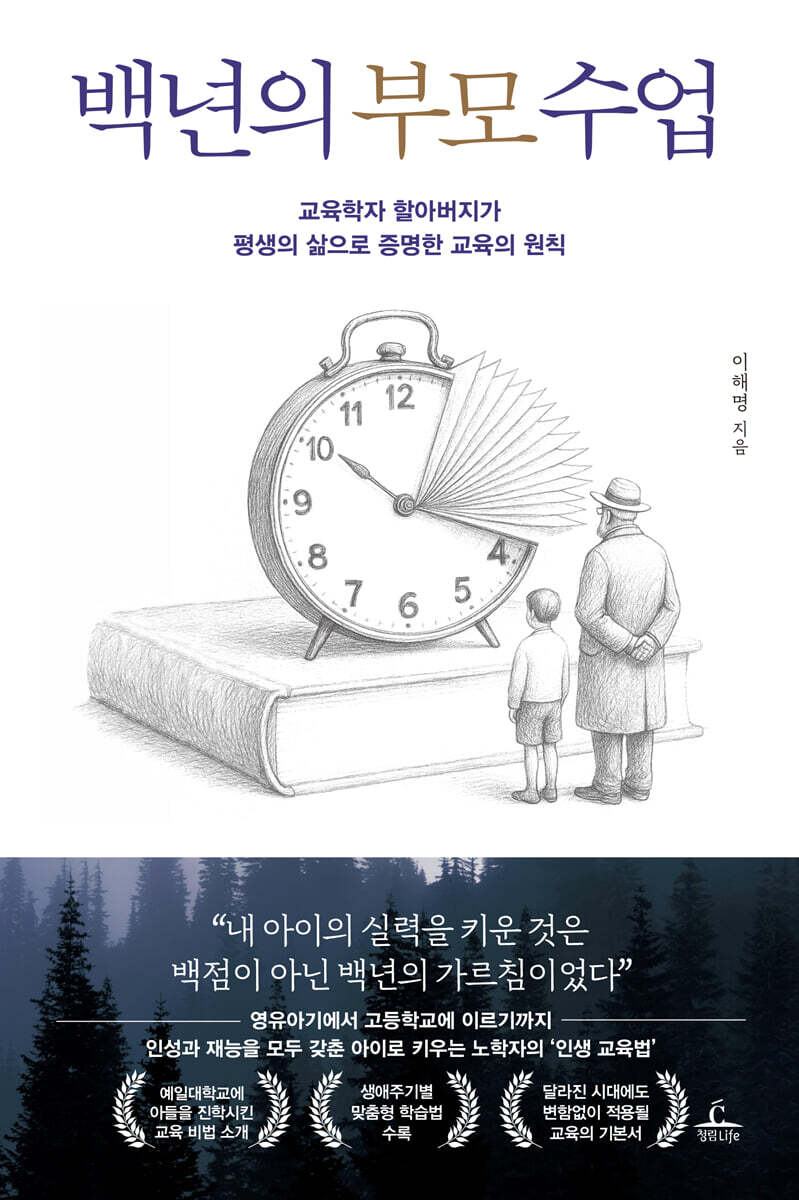
A Hundred Years of Parenting Classes
 |
Description
Book Introduction
This is an educational essay written by Professor Lee Hae-myeong, who has worked as an educator all his life until he was 80, and has summarized his life and research into advice for the younger generation of parents.
This book contains the timeless values and methods of education, including how he raised his children, how to develop life skills beyond test scores, and what the younger generation of parents are missing.
The author, who learned effective teaching methods and educational philosophies in the US and UK and applied them to his children, was able to get his son into Yale University as a result of consistent discipline, reading education, discussion, and writing classes tailored to his growth process.
This book, which meticulously explains the educational policies that should be focused on at each stage of life, from infancy to elementary school and high school, will be the 'first book' for new mothers and fathers to lay the foundation for their children's education.
This book contains the timeless values and methods of education, including how he raised his children, how to develop life skills beyond test scores, and what the younger generation of parents are missing.
The author, who learned effective teaching methods and educational philosophies in the US and UK and applied them to his children, was able to get his son into Yale University as a result of consistent discipline, reading education, discussion, and writing classes tailored to his growth process.
This book, which meticulously explains the educational policies that should be focused on at each stage of life, from infancy to elementary school and high school, will be the 'first book' for new mothers and fathers to lay the foundation for their children's education.
- You can preview some of the book's contents.
Preview
index
Introduction: A Journey of Teaching That Was Not Enough Even for a Century
Chapter 1: How Education Becomes a Legacy: The Great Investment in Raising a Child
For education to be a wise investment / Education is created by parents' sincerity and environment / The level of study that does not follow the trend of private education / Studying is something that teachers and children do together / The essence of study that is more needed as times change / School grades are not everything / The subject of education is the family / Parental attitude required during the attachment period / How should parents discipline their children / Until parental investment becomes a legacy
Chapter 2: How Children Grow: Brain Growth and Intelligence Development
Prenatal care methods for a healthy child / How does a child's brain develop? / The differentiation process of brain function / The influence of exercise on intellectual development / What genes can determine / The influence of genes and environment on intelligence and personality / We must carefully examine aptitude at an early age / Let's cultivate good character and skills in children.
+IQ does not determine intelligence
Chapter 3: Infants and Toddlers: The Beginning of Language Development
What parents should do for their child's brain development / Sensory motor skills that form the basis of cognitive development / How do children learn to speak / Listening is the beginning of language development / From speaking skills to reading and writing skills
+When is the best time to start learning a foreign language?
Chapter 4: Elementary School: A Time to Develop Thinking Power
Elementary school is a time when you're bursting with new things to know / Elementary school students learn the most vocabulary / Let's return to reading, discussion, and writing / How to build skills by studying English and Chinese characters / The basics of education begin in elementary school.
+The pros and cons of watching television
+Even if we fight a lot, it's better to have brothers than to be alone.
Chapter 5 Middle School: At the Crossroads of Self-Identity and Sociality
How middle school differs from elementary school / How to build your child's self-esteem / How to make friends and play / The difficulty of peer relationships that require 'recognition' / How to foster positive peer relationships / My experiences during a year in the UK
+The dangers of indiscriminate internet use
Chapter 6 High School: Choosing Your Life Direction
Which high school should I send my child to? / If you don't study in high school, you'll regret it for the rest of your life. / Think about your identity before choosing a college. / No one teaches you how to choose a major. / How to prepare for the College Scholastic Ability Test. / Raise your test score by discussing with your father. / Your relationship with your parents shapes your attitude toward sex. / How to foster morality at home.
+Why is international education necessary?
Chapter 7: The Educational Legacy I Inherited
Habits learned at age three last until eighty / How can I help others when I'm full / What I didn't learn because I didn't have a father / Thanks to my ancestors who raised me / My teacher's grace was like heaven / Cultural heritage of our people
+Humanities and arts education awakens us to a humane life.
Coming out
Chapter 1: How Education Becomes a Legacy: The Great Investment in Raising a Child
For education to be a wise investment / Education is created by parents' sincerity and environment / The level of study that does not follow the trend of private education / Studying is something that teachers and children do together / The essence of study that is more needed as times change / School grades are not everything / The subject of education is the family / Parental attitude required during the attachment period / How should parents discipline their children / Until parental investment becomes a legacy
Chapter 2: How Children Grow: Brain Growth and Intelligence Development
Prenatal care methods for a healthy child / How does a child's brain develop? / The differentiation process of brain function / The influence of exercise on intellectual development / What genes can determine / The influence of genes and environment on intelligence and personality / We must carefully examine aptitude at an early age / Let's cultivate good character and skills in children.
+IQ does not determine intelligence
Chapter 3: Infants and Toddlers: The Beginning of Language Development
What parents should do for their child's brain development / Sensory motor skills that form the basis of cognitive development / How do children learn to speak / Listening is the beginning of language development / From speaking skills to reading and writing skills
+When is the best time to start learning a foreign language?
Chapter 4: Elementary School: A Time to Develop Thinking Power
Elementary school is a time when you're bursting with new things to know / Elementary school students learn the most vocabulary / Let's return to reading, discussion, and writing / How to build skills by studying English and Chinese characters / The basics of education begin in elementary school.
+The pros and cons of watching television
+Even if we fight a lot, it's better to have brothers than to be alone.
Chapter 5 Middle School: At the Crossroads of Self-Identity and Sociality
How middle school differs from elementary school / How to build your child's self-esteem / How to make friends and play / The difficulty of peer relationships that require 'recognition' / How to foster positive peer relationships / My experiences during a year in the UK
+The dangers of indiscriminate internet use
Chapter 6 High School: Choosing Your Life Direction
Which high school should I send my child to? / If you don't study in high school, you'll regret it for the rest of your life. / Think about your identity before choosing a college. / No one teaches you how to choose a major. / How to prepare for the College Scholastic Ability Test. / Raise your test score by discussing with your father. / Your relationship with your parents shapes your attitude toward sex. / How to foster morality at home.
+Why is international education necessary?
Chapter 7: The Educational Legacy I Inherited
Habits learned at age three last until eighty / How can I help others when I'm full / What I didn't learn because I didn't have a father / Thanks to my ancestors who raised me / My teacher's grace was like heaven / Cultural heritage of our people
+Humanities and arts education awakens us to a humane life.
Coming out
Detailed image

Into the book
Entering
Recently, I've been taking care of my grandchildren a lot.
As I watched my infinitely lovely grandchild grow up, I thought back to the time I raised my own children.
There were some good things I did, but there were also many mistakes, so I wrote down my thoughts in the hope that they would be of some help to the younger generation of parents, and as a result, this book was published.
As a grandfather and educator, I would like to leave a legacy of education for the next generation.
--- p.4
Chapter 1: How Education Becomes a Legacy
The purpose of education is to create human beings with character and integrity.
However, many parents still believe that grades are everything in education.
I think that if I have good grades, I can get into a good university, and if I graduate from a good university, I can get a good job.
But this is short-sighted thinking.
Success at work isn't determined by grades alone.
Beyond solving multiple-choice test questions, you must have comprehensive 'competence' that includes passion for the job and adaptability.
People who love their work, work hard, and cooperate well with their team members are successful.
Therefore, investment in education must be made with a long-term perspective.
You shouldn't be obsessed with school grades.
--- p.29~30
Chapter 2: How Children Grow
Parents model and emphasize moral, religious, and political interests and values for their children.
The influence of the environment called ‘parent-child relationship’ is extremely great.
In particular, the experiences of siblings through parents have the greatest influence on personality formation.
Education is not achieved by simply providing a child with nice clothes and a nice home.
You need to talk to your child.
You need to know what they want and what they find difficult.
The most important thing is the parents' behavior.
“Children resemble their parents.” This is a common saying that we often overlook, but it carries a weight close to scientific truth.
--- p.61
Chapter 3: Infants and Toddlers: The Beginning of Language Development
According to a study from Harvard University, parents reading to their children is the best way to develop their language skills.
If possible, it is a good idea for parents to develop the habit of reading books to their children before they go to bed.
Spoken language and written language are interconnected and not independent.
If you are good at listening, you will be good at speaking, and if you become accustomed to listening and speaking, you will be good at reading and writing.
If you are good at reading and writing, your academic performance will also improve.
Remember that your school grades depend on your language skills.
--- p.93
Chapter 4: Elementary School: A Time to Develop Thinking Power
Since my job is a professor, I read a lot of books when I got home.
Especially when my child entered elementary school, I spent a lot of time working from home.
While I was reading a book, before I knew it, my child was sitting next to me and reading a book too.
My wife also read various magazines along with us.
The child practically lived in the neighborhood bookstore.
I mostly read science books for fun.
I had science professors introduce books to me and read them to my children.
After selecting a book and reading it, I had them present its contents in front of their family.
When the child presented the contents of the book he or she read, the whole family discussed the contents and wrote down the results.
When writing about the discussion, I also asked them to write their own opinions at the end.
In this way, reading, discussion, and writing must be connected as one to be effective.
This is a method of reading centered on a single topic, discussing whether the theory is realistic, and reaching your own conclusions.
If you read, discuss, and write separately, the effect will be halved.
--- p.119
Chapter 5 Middle School: At the Crossroads of Self-Identity and Sociality
As parents watch their children form new relationships with diverse peers in the new environment of middle school, they may worry that their children may engage in bad behavior when interacting with peers.
Conformity regarding peer pressure to encourage prosocial behavior does not vary with age.
However, conformity to peer pressure that encourages antisocial behavior increases dramatically during middle school.
Even though they know it is bad behavior, they follow it when their peers recommend it.
It is a very dangerous peer phenomenon.
This is most severe during middle school and then decreases.
Parents' concern is that their children will be swept up in this peer atmosphere.
(…) Children who are positively influenced by their parents are not swayed by peer pressure.
Children who live with parents who are warm, yet not too lax, and who have consistent rules will trust and follow their parents' wishes.
Rather than being influenced by unhealthy peers, they associate with peers who share their values.
Conversely, children who experience severe conflict with their parents tend to only socialize with peers and may make wrong decisions.
--- p.158~159
Chapter 6 High School: Choosing Your Life Direction
When the little boy became a high school student, he became interested in social issues.
He showed a particularly strong curiosity about politics.
Because our politics were in chaos at the time.
My child's school was in an awkward location that was difficult to get to by bus or subway.
I was responsible for taking my child to and from school for three years.
After dropping my child off at school at 8 a.m., I went to work.
And if there was nothing special, I would pick up my child from school on my way home from work.
Usually, my child goes to school early in the morning and comes home late at night, so I don't have time to see his face.
Although it was difficult, I used that time to talk to my little one.
The child, who usually doesn't say what's on his mind, talked about things that happened at school and his thoughts about society during this time.
The child asked me for alternatives to solve our country's political, economic, and social problems.
I excerpted materials such as newspaper editorials and had them read them.
As this happened repeatedly, our conversation devolved into a discussion.
First, we decided to discuss political issues among the problems our society faces.
Then, I looked for materials related to the issue, had my child read them, and presented them to a family discussion over the weekend.
At the time, Henry Kissinger's writings were widely quoted in newspapers.
I asked my child to read the English version of Kissinger's famous book, A World Restored: Europe After Napoleon.
The child said that after reading "A World Restored," the political situation in Europe at the time seemed as clear as looking at a map.
I felt a sense of accomplishment in teaching the child.
The time invested in my child was well worth it.
--- p.189~190
Chapter 7: The Educational Legacy I Inherited
I think that this is what people in the past meant by 'ancestral virtue'.
The virtue of ancestors is not to leave behind wealth, but to pass on to their descendants the honor of being “a descendant of such-and-such house.”
It lasts longer than wealth.
Inheriting wealth can ruin children if done wrong, but ancestors' good deeds can cultivate children's character and lead to a better life.
‘The virtue of our ancestors’ is a precious cultural heritage of education that reminds us that our growth is not our own.
Recently, I've been taking care of my grandchildren a lot.
As I watched my infinitely lovely grandchild grow up, I thought back to the time I raised my own children.
There were some good things I did, but there were also many mistakes, so I wrote down my thoughts in the hope that they would be of some help to the younger generation of parents, and as a result, this book was published.
As a grandfather and educator, I would like to leave a legacy of education for the next generation.
--- p.4
Chapter 1: How Education Becomes a Legacy
The purpose of education is to create human beings with character and integrity.
However, many parents still believe that grades are everything in education.
I think that if I have good grades, I can get into a good university, and if I graduate from a good university, I can get a good job.
But this is short-sighted thinking.
Success at work isn't determined by grades alone.
Beyond solving multiple-choice test questions, you must have comprehensive 'competence' that includes passion for the job and adaptability.
People who love their work, work hard, and cooperate well with their team members are successful.
Therefore, investment in education must be made with a long-term perspective.
You shouldn't be obsessed with school grades.
--- p.29~30
Chapter 2: How Children Grow
Parents model and emphasize moral, religious, and political interests and values for their children.
The influence of the environment called ‘parent-child relationship’ is extremely great.
In particular, the experiences of siblings through parents have the greatest influence on personality formation.
Education is not achieved by simply providing a child with nice clothes and a nice home.
You need to talk to your child.
You need to know what they want and what they find difficult.
The most important thing is the parents' behavior.
“Children resemble their parents.” This is a common saying that we often overlook, but it carries a weight close to scientific truth.
--- p.61
Chapter 3: Infants and Toddlers: The Beginning of Language Development
According to a study from Harvard University, parents reading to their children is the best way to develop their language skills.
If possible, it is a good idea for parents to develop the habit of reading books to their children before they go to bed.
Spoken language and written language are interconnected and not independent.
If you are good at listening, you will be good at speaking, and if you become accustomed to listening and speaking, you will be good at reading and writing.
If you are good at reading and writing, your academic performance will also improve.
Remember that your school grades depend on your language skills.
--- p.93
Chapter 4: Elementary School: A Time to Develop Thinking Power
Since my job is a professor, I read a lot of books when I got home.
Especially when my child entered elementary school, I spent a lot of time working from home.
While I was reading a book, before I knew it, my child was sitting next to me and reading a book too.
My wife also read various magazines along with us.
The child practically lived in the neighborhood bookstore.
I mostly read science books for fun.
I had science professors introduce books to me and read them to my children.
After selecting a book and reading it, I had them present its contents in front of their family.
When the child presented the contents of the book he or she read, the whole family discussed the contents and wrote down the results.
When writing about the discussion, I also asked them to write their own opinions at the end.
In this way, reading, discussion, and writing must be connected as one to be effective.
This is a method of reading centered on a single topic, discussing whether the theory is realistic, and reaching your own conclusions.
If you read, discuss, and write separately, the effect will be halved.
--- p.119
Chapter 5 Middle School: At the Crossroads of Self-Identity and Sociality
As parents watch their children form new relationships with diverse peers in the new environment of middle school, they may worry that their children may engage in bad behavior when interacting with peers.
Conformity regarding peer pressure to encourage prosocial behavior does not vary with age.
However, conformity to peer pressure that encourages antisocial behavior increases dramatically during middle school.
Even though they know it is bad behavior, they follow it when their peers recommend it.
It is a very dangerous peer phenomenon.
This is most severe during middle school and then decreases.
Parents' concern is that their children will be swept up in this peer atmosphere.
(…) Children who are positively influenced by their parents are not swayed by peer pressure.
Children who live with parents who are warm, yet not too lax, and who have consistent rules will trust and follow their parents' wishes.
Rather than being influenced by unhealthy peers, they associate with peers who share their values.
Conversely, children who experience severe conflict with their parents tend to only socialize with peers and may make wrong decisions.
--- p.158~159
Chapter 6 High School: Choosing Your Life Direction
When the little boy became a high school student, he became interested in social issues.
He showed a particularly strong curiosity about politics.
Because our politics were in chaos at the time.
My child's school was in an awkward location that was difficult to get to by bus or subway.
I was responsible for taking my child to and from school for three years.
After dropping my child off at school at 8 a.m., I went to work.
And if there was nothing special, I would pick up my child from school on my way home from work.
Usually, my child goes to school early in the morning and comes home late at night, so I don't have time to see his face.
Although it was difficult, I used that time to talk to my little one.
The child, who usually doesn't say what's on his mind, talked about things that happened at school and his thoughts about society during this time.
The child asked me for alternatives to solve our country's political, economic, and social problems.
I excerpted materials such as newspaper editorials and had them read them.
As this happened repeatedly, our conversation devolved into a discussion.
First, we decided to discuss political issues among the problems our society faces.
Then, I looked for materials related to the issue, had my child read them, and presented them to a family discussion over the weekend.
At the time, Henry Kissinger's writings were widely quoted in newspapers.
I asked my child to read the English version of Kissinger's famous book, A World Restored: Europe After Napoleon.
The child said that after reading "A World Restored," the political situation in Europe at the time seemed as clear as looking at a map.
I felt a sense of accomplishment in teaching the child.
The time invested in my child was well worth it.
--- p.189~190
Chapter 7: The Educational Legacy I Inherited
I think that this is what people in the past meant by 'ancestral virtue'.
The virtue of ancestors is not to leave behind wealth, but to pass on to their descendants the honor of being “a descendant of such-and-such house.”
It lasts longer than wealth.
Inheriting wealth can ruin children if done wrong, but ancestors' good deeds can cultivate children's character and lead to a better life.
‘The virtue of our ancestors’ is a precious cultural heritage of education that reminds us that our growth is not our own.
--- p.226~227
Publisher's Review
"A child's true talent is quietly demonstrated."
About the 'skills' in life that cannot be acquired through test scores
A century of teachings that will lay the foundation for my child's development, literacy, and character.
“A great teaching method will not fade even after a hundred years.”
A final message from an educator who has proven his philosophy through his own life.
In our society, education has always been both a 'highest value' and a 'brain' that takes priority over everything else.
Although 70% of people in their 20s and 30s are highly educated enough to attend college, parents and children have to endure tremendous competition and pressure while bearing the skyrocketing costs of private education.
Although the younger generation of parents today have easier access to information about education than in the past, and they say that they educate their children by respecting their opinions rather than unilaterally instilling them, many parents end up being caught up in the same, if not even more intense, 'score competition' as the previous generation, without fully understanding their children's condition.
The recent emergence of the issue of the absence of 'character education' or 'humanistic cultivation' for children can be said to be the result of this educational reality continuing for a long time.
And here, despite the difficult educational reality, there is a father educator who has successfully raised children with both character and ability.
《Parenting Classes for a Hundred Years》 is an educational essay written by Professor Lee Hae-myeong, who has worked as an educator all his life until he was 80, and has summarized his life and research into advice for the younger generation of parents.
This book contains the timeless values and methods of education, including how he raised his children, how to develop life skills beyond test scores, and what the younger generation of parents are missing.
The author, who learned effective teaching methods and educational philosophies in the US and UK and applied them to his children, was able to get his son into Yale University as a result of consistent discipline, reading education, discussion, and writing classes tailored to his growth process.
This book, which meticulously explains the educational policies that should be focused on at each stage of life, from infancy to elementary school and high school, will be the 'first book' for new mothers and fathers to lay the foundation for their children's education.
“70% of the intelligence you need for life is determined in elementary school.”
Infants and toddlers and elementary school years, when language skills and thinking abilities are developed
The author says that she experienced how difficult and arduous it is to raise a child from the very beginning, from pregnancy to childbirth.
As a pioneering advocate of 'father education' at the time, the author actively participated in the education of his children from infancy and devoted all his efforts to developing their language skills.
I wanted to apply scientifically proven educational methods while studying how a child's brain develops and how genes and the environment shape a child's intelligence. In particular, when my child was in elementary school, I was able to build the foundation of 'literacy' by spending time reading books together and talking about them.
The author addresses the challenges of early childhood education, a topic that even parents today are curious about, by drawing on various scientific research results and his own experience.
In particular, it emphasizes that the family environment, or 'a good relationship with parents', is more important than genes themselves in determining a child's intelligence and personality.
During the infant and toddler years when cognitive and language development begins, it is important for parents to actively interact with their children, talk to them, and engage in sensory play.
As children develop their 'listening skills' in this way, they enter elementary school, a period when they are bursting with things they want to know.
From this point on, the 'reading and writing' training begins in earnest, with reading aloud from the book.
As children become familiar with reading through the process of selecting and reading books with their parents, they have time to present and discuss the books they have read with their family at home, and then write an essay to organize the information.
Along with the learning method of 'reading, discussion, and writing' in this way, the author suggests 'memorizing entire sentences' as an effective method of learning foreign languages (English and Chinese) that should be done concurrently during the period of life when memory is at its strongest.
"Consider your identity and future while studying steadily."
Middle school and high school are the years when we move beyond entrance exams and toward growth.
As my child entered middle school, I spent more time listening to my children's concerns about friendships becoming more important than anything else.
The author supported and cared for the child so that he could gradually build an independent life, while maintaining a good relationship with the school teachers and not losing interest in how the child was doing at school.
However, the author regrets not having had a more in-depth conversation about the future and major selection when the child became a high school student, and urges parents to not only focus on entrance exam preparation but also consider the direction of their child's life.
The author incorporates his own experiences into the extremely realistic concerns of parents of adolescents.
First of all, I recommend that parents step forward and raise their children's 'self-esteem' so that middle school students, who are at a crossroads in forming their self-identity, do not lose their way.
Rather than unconditionally praising or elevating children, parents should help their children broaden their social skills by engaging in a variety of extracurricular activities based on what they are good at and what they enjoy.
And when it comes to high school, it's important to choose a school that offers a conducive learning environment. This means choosing a school that goes beyond simply being in a "good school district" and where your child can receive positive stimulation and build synergistic relationships with peers.
The author emphasizes that the best way to prepare for the College Scholastic Ability Test is through literacy, cultivated from elementary school onward. He even offers the advice that engaging in in-depth discussions on topics ranging from politics, economics, society, and culture, especially during high school, was extremely helpful.
The author's teaching method, which builds a "foundation for study" without sending children to academies or requiring them to do any advanced learning, provides a foundation for children to become independent and grow on their own, even if they don't immediately get good test scores or become "excellent students" in every way.
"Parents' investment in raising their children becomes a great legacy."
The first book on raising your children as 'human beings'
The author not only tells the story of raising his own children, but also covers the process of his grandson's admission and graduation from an American university, and conveys the value of education passed down from his ancestors, including the villagers who raised him and the virtues of his ancestors.
This book, which tightly captures the "journey of teaching that was not enough even for a century," goes beyond a mere collection of "success stories" to paint a portrait of the difficult relationship between parents and children, and furthermore, of our lives.
While offering a message of comfort to parents who can never be perfect in raising their children, it also points out the current state of affairs where teachers are treated at rock bottom, and warns that selfish parents can ruin their children's character.
Filled with both poignant advice and profound empathy, this book will remain with us for a long time as a legacy and a source of wisdom that will help us determine what kind of person we want our children to become.
About the 'skills' in life that cannot be acquired through test scores
A century of teachings that will lay the foundation for my child's development, literacy, and character.
“A great teaching method will not fade even after a hundred years.”
A final message from an educator who has proven his philosophy through his own life.
In our society, education has always been both a 'highest value' and a 'brain' that takes priority over everything else.
Although 70% of people in their 20s and 30s are highly educated enough to attend college, parents and children have to endure tremendous competition and pressure while bearing the skyrocketing costs of private education.
Although the younger generation of parents today have easier access to information about education than in the past, and they say that they educate their children by respecting their opinions rather than unilaterally instilling them, many parents end up being caught up in the same, if not even more intense, 'score competition' as the previous generation, without fully understanding their children's condition.
The recent emergence of the issue of the absence of 'character education' or 'humanistic cultivation' for children can be said to be the result of this educational reality continuing for a long time.
And here, despite the difficult educational reality, there is a father educator who has successfully raised children with both character and ability.
《Parenting Classes for a Hundred Years》 is an educational essay written by Professor Lee Hae-myeong, who has worked as an educator all his life until he was 80, and has summarized his life and research into advice for the younger generation of parents.
This book contains the timeless values and methods of education, including how he raised his children, how to develop life skills beyond test scores, and what the younger generation of parents are missing.
The author, who learned effective teaching methods and educational philosophies in the US and UK and applied them to his children, was able to get his son into Yale University as a result of consistent discipline, reading education, discussion, and writing classes tailored to his growth process.
This book, which meticulously explains the educational policies that should be focused on at each stage of life, from infancy to elementary school and high school, will be the 'first book' for new mothers and fathers to lay the foundation for their children's education.
“70% of the intelligence you need for life is determined in elementary school.”
Infants and toddlers and elementary school years, when language skills and thinking abilities are developed
The author says that she experienced how difficult and arduous it is to raise a child from the very beginning, from pregnancy to childbirth.
As a pioneering advocate of 'father education' at the time, the author actively participated in the education of his children from infancy and devoted all his efforts to developing their language skills.
I wanted to apply scientifically proven educational methods while studying how a child's brain develops and how genes and the environment shape a child's intelligence. In particular, when my child was in elementary school, I was able to build the foundation of 'literacy' by spending time reading books together and talking about them.
The author addresses the challenges of early childhood education, a topic that even parents today are curious about, by drawing on various scientific research results and his own experience.
In particular, it emphasizes that the family environment, or 'a good relationship with parents', is more important than genes themselves in determining a child's intelligence and personality.
During the infant and toddler years when cognitive and language development begins, it is important for parents to actively interact with their children, talk to them, and engage in sensory play.
As children develop their 'listening skills' in this way, they enter elementary school, a period when they are bursting with things they want to know.
From this point on, the 'reading and writing' training begins in earnest, with reading aloud from the book.
As children become familiar with reading through the process of selecting and reading books with their parents, they have time to present and discuss the books they have read with their family at home, and then write an essay to organize the information.
Along with the learning method of 'reading, discussion, and writing' in this way, the author suggests 'memorizing entire sentences' as an effective method of learning foreign languages (English and Chinese) that should be done concurrently during the period of life when memory is at its strongest.
"Consider your identity and future while studying steadily."
Middle school and high school are the years when we move beyond entrance exams and toward growth.
As my child entered middle school, I spent more time listening to my children's concerns about friendships becoming more important than anything else.
The author supported and cared for the child so that he could gradually build an independent life, while maintaining a good relationship with the school teachers and not losing interest in how the child was doing at school.
However, the author regrets not having had a more in-depth conversation about the future and major selection when the child became a high school student, and urges parents to not only focus on entrance exam preparation but also consider the direction of their child's life.
The author incorporates his own experiences into the extremely realistic concerns of parents of adolescents.
First of all, I recommend that parents step forward and raise their children's 'self-esteem' so that middle school students, who are at a crossroads in forming their self-identity, do not lose their way.
Rather than unconditionally praising or elevating children, parents should help their children broaden their social skills by engaging in a variety of extracurricular activities based on what they are good at and what they enjoy.
And when it comes to high school, it's important to choose a school that offers a conducive learning environment. This means choosing a school that goes beyond simply being in a "good school district" and where your child can receive positive stimulation and build synergistic relationships with peers.
The author emphasizes that the best way to prepare for the College Scholastic Ability Test is through literacy, cultivated from elementary school onward. He even offers the advice that engaging in in-depth discussions on topics ranging from politics, economics, society, and culture, especially during high school, was extremely helpful.
The author's teaching method, which builds a "foundation for study" without sending children to academies or requiring them to do any advanced learning, provides a foundation for children to become independent and grow on their own, even if they don't immediately get good test scores or become "excellent students" in every way.
"Parents' investment in raising their children becomes a great legacy."
The first book on raising your children as 'human beings'
The author not only tells the story of raising his own children, but also covers the process of his grandson's admission and graduation from an American university, and conveys the value of education passed down from his ancestors, including the villagers who raised him and the virtues of his ancestors.
This book, which tightly captures the "journey of teaching that was not enough even for a century," goes beyond a mere collection of "success stories" to paint a portrait of the difficult relationship between parents and children, and furthermore, of our lives.
While offering a message of comfort to parents who can never be perfect in raising their children, it also points out the current state of affairs where teachers are treated at rock bottom, and warns that selfish parents can ruin their children's character.
Filled with both poignant advice and profound empathy, this book will remain with us for a long time as a legacy and a source of wisdom that will help us determine what kind of person we want our children to become.
GOODS SPECIFICS
- Date of issue: August 6, 2025
- Page count, weight, size: 248 pages | 418g | 140*210*20mm
- ISBN13: 9791193842454
- ISBN10: 119384245X
You may also like
카테고리
korean


korean

![GQ KOREA Mark (Monthly): December [2025]](http://librairie.coreenne.fr/cdn/shop/files/8ef265dbbfbf186523ed75ba7319009d.jpg?v=1765340328&width=3840)


