

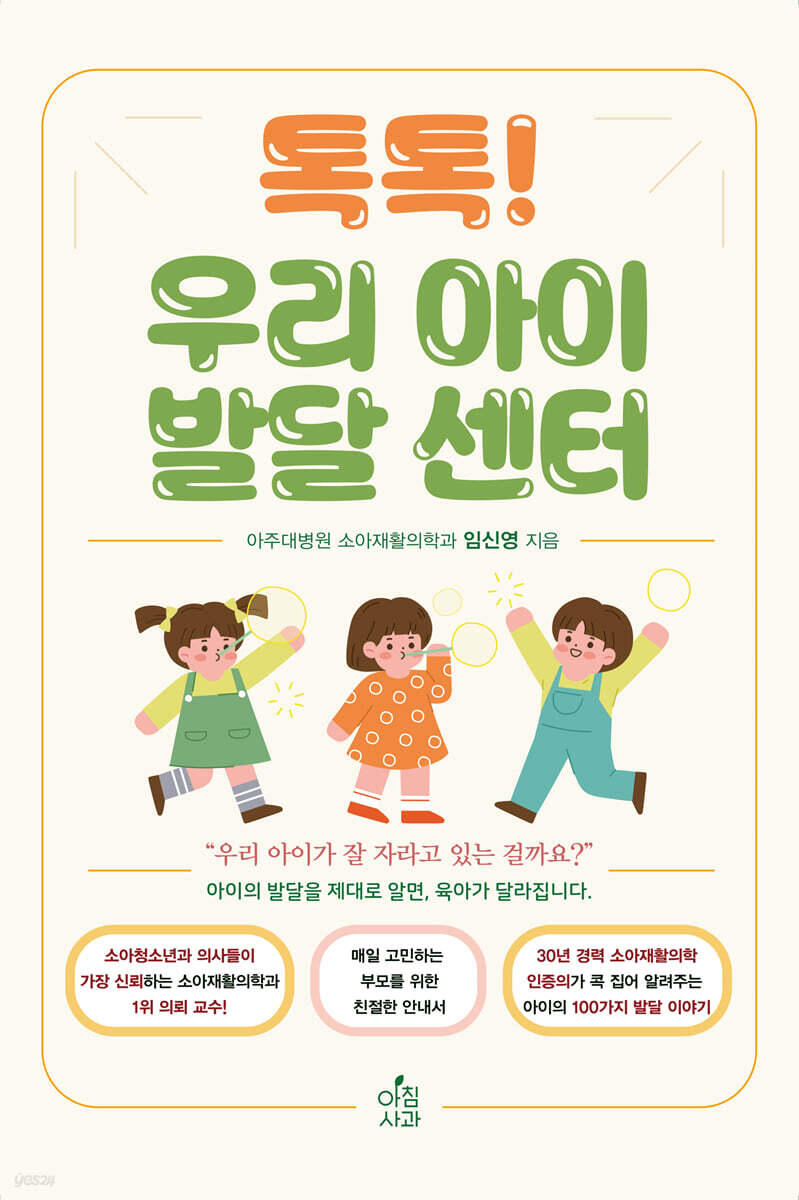
Tok Tok! Our Child Development Center
 |
Description
Book Introduction
“Every parent has questions about their child’s development.
This book is the warmest and most accurate answer to that question.”
“From worried parents to trusting and waiting parents.”
From newborns to elementary school students, there are countless changes and abnormalities encountered during the growth process.
"Tok Tok! Our Child's Development Center" presents a practical guide to supporting children's healthy growth, focusing on 100 key pieces of information parents must know during this period.
It covers a wide range of topics, from the five major developmental areas of gross motor skills, fine motor skills, language, cognition, and sociality, to premature infant care, parenting methods based on temperament, the truth about sitting in a W-shape, how to use digital media, and how to respond to developmental disabilities. It also includes only the most frequently asked questions from actual clinics.
Professor Im Sin-yeong, a pediatric rehabilitation specialist with 30 years of clinical experience and a mother of two, explains in a way that parents can easily understand based on her professional knowledge and extensive parenting experience.
This book is a reliable guide not only for parents who want to accurately understand and practically respond to their children's development, but also for childcare workers, therapists, and medical professionals.
This book is the warmest and most accurate answer to that question.”
“From worried parents to trusting and waiting parents.”
From newborns to elementary school students, there are countless changes and abnormalities encountered during the growth process.
"Tok Tok! Our Child's Development Center" presents a practical guide to supporting children's healthy growth, focusing on 100 key pieces of information parents must know during this period.
It covers a wide range of topics, from the five major developmental areas of gross motor skills, fine motor skills, language, cognition, and sociality, to premature infant care, parenting methods based on temperament, the truth about sitting in a W-shape, how to use digital media, and how to respond to developmental disabilities. It also includes only the most frequently asked questions from actual clinics.
Professor Im Sin-yeong, a pediatric rehabilitation specialist with 30 years of clinical experience and a mother of two, explains in a way that parents can easily understand based on her professional knowledge and extensive parenting experience.
This book is a reliable guide not only for parents who want to accurately understand and practically respond to their children's development, but also for childcare workers, therapists, and medical professionals.
- You can preview some of the book's contents.
Preview
index
Recommendation-4
Introduction-8
Part 1 Developmental Stages and Checkpoints
1.
Understanding Your Child's Development: 5 Key Areas - 18
2.
Gross Motor Development: Normal Stages and Helpful Signals - 22
3.
Fine Motor Development: Normal Stages and Observation Points - 26
4.
Language Development: Growth Stages and Early Detection Signs - 31
5.
Cognitive Development: A Step-by-Step Guide - 35
6.
Social Development: Making Friends and the Role of Parents - 39
7.
Premature Baby Development Guide: First Steps to Healthy Growth - 43
Part 2 Hand and fine motor development
8.
Thumb-Sucking: Is It Natural? -50
9.
Child with one hand over the other - 54
10.
Understanding Left-Handed Children: How to Play to Their Strengths - 57
11.
My thumb is bent! -61
Part 3 Leg Development and Posture Check
12.
Leg Development and Gait Problems in Children: Bow Legs, Cross Legs, Figure-O-Winged Walk, and In-Knee Walk - 66
13.
Magpie Step-70
14.
How can I take care of my child's foot health? -74
15.
Child with different leg lengths-81
Part 4 Spine and Postural Health
16.
Early scoliosis-86
17.
Exercises for Spinal Health - 91
Part 5 Language Development and Early Detection
18.
Language delay-100
19.
Developmental Language Disorder-107
20.
Selective Mutism-113
21.
Echo! A child who repeats words verbatim - 118
22.
Understanding Stuttering - 12223.
Genius and Gifted-128
Part 6 Cognitive Development and Learning Support
23.
Genius and Gifted-128
24. Understanding IQ Tests - 132
25.
Intellectual Disability and Borderline Intelligence-137
26.
Dyslexia-141
Part 7 Skin Health and Care
27.
Mongolian spot-148
28.
Salmon-151
29.
Neonatal Seborrheic Dermatitis-154
30.
Sleeping-157
31.
This pain-160
32.
Earwax Care: A Parent's Guide - 163
Part 8 Eye Health and Development
33.
Childhood Strabismus: What Parents Need to Know - 168
34.
Color Blindness and Color Weakness-172
Part 9 Children's Products and Safety Guide
35.
Choosing Newborn and Toddler Clothes - 178
36.
Swaddle and Swaddling-181
37.
How to Use Your Child's Pillow - 185
38.
Misconceptions and Truths About Baby Neck Tubes - 189
39.
How to Use a Car Seat: A Guide to Safe Car Travel - 192
40.
How to Use High Chairs and Tools: Choosing and Using Safe and Effective Chairs - 196
41.
Newborn Safety Guide: Swings, Bouncers, Walkers, and Carriers - 200
Part 10: The Story of a Child and Milk
42.
Misconceptions and Truths About Goat Milk - 208
43.
Misconceptions and Truths About A2 Milk - 212
44.
Finding the Right Milk for Your Child - 215
45.
When your baby is thirsty! Water? Milk? -218
46.
At what age can children drink raw milk? -221
Part 11 Practical Parenting Solutions
47.
Our Children's Neck Health: Understanding the Causes of Death - 226
48.
Sadhu and Guillotine-231
49.
Microcephaly-237
50.
Macrocephaly: Is Your Baby's Head Too Big? - 241
51.
Cephalohematoma: Bleeding on the head of a newborn - 246
52.
Infant Colic-251
53.
Facial asymmetry-256
54.
Thigh Wrinkle Asymmetry-260
55.
Butt Dimple-265
56.
Clavicle Fractures in Newborns: What You Need to Know - 269
57.
Newborn Ear Correction-272
58.
First Aid for Seizures and Fever-275
59.
Infant and Toddler Health Checkup Development Screening Test-278
60.
Moro Reflection-282
61.
Tummy Time: Special Time for Baby - 285
62.
If your baby's neck tilts during tummy time - 288
63.
Why Your Joints Pop: The Secret of the Bubbles - 291
64.
Baby rolling over on one side only - 295
65.
The crawling figure is strange-298
66.
The Myths and Truths About Sitting in a W-Shaped Position - 302
67.
Emergency! Child Fall Response Guide - 308
68.
Sudden Infant Death Syndrome-314
69.
Headbanging Boy-318
70.
The Problem with Overprotection - 321
71.
Tailored Parenting Methods Based on Temperament - 326
72.
The Impact of Early Media Exposure - 332
73.
Digital Media Usage-336
74.
Potty Training Method-340
75.
Manual Therapy: The Art of Maintaining Health with Your Fingertips - 346
76.
Growth Plate Test-349
Part 12 Developmental Disabilities and Special Support
77.
Infantile spasms-356
78.
Lennox-Gastaut Syndrome: What Parents Need to Know About Epilepsy - 360
79.
Attention Deficit Hyperactivity Disorder-364
80.
Autism Spectrum Disorder-370
81.
ABA Therapy for Children with Autism Spectrum Disorders - 376
82.
Savant Syndrome: People with Special Talents - 381
83.
Internet Gaming Disorder: Prevention and Treatment Guide-384
84.
Avoidant Restrictive Food Intake Disorder: Why Your Child Refuses Food and What to Do About It - 390
85.
Anorexia: Causes, Diagnosis, and Solutions - 395
86.
Bulimia: Bulimia Nervosa and Binge Eating Disorder - 401
87.
Cerebral Palsy-406
88.
Periventricular Leukomalacia: What Parents of Premature Babies Need to Know - 410
89.
Bobath Treatment-414
90.
Health Care for Adults with Cerebral Palsy - 417
91.
Down Syndrome-422
92.
Turner Syndrome-427
93.
Klinefelter Syndrome: What if my tall, thin son develops gynecomastia? - 433
94.
Neurofibromatosis Type 1: What Parents Need to Know - 437
95.
Tic Disorder-443
96.
Tourette Syndrome-449
Part 13 Healthy Pregnancy and Fetal Development
97.
The Effects of Alcohol on Baby Development - 456
98.
Risks of Smoking on the Fetus - 460
99.
Effects of Caffeine on the Fetus - 464
100.
Folic Acid Intake Guide for Pregnant Women - 468
Introduction-8
Part 1 Developmental Stages and Checkpoints
1.
Understanding Your Child's Development: 5 Key Areas - 18
2.
Gross Motor Development: Normal Stages and Helpful Signals - 22
3.
Fine Motor Development: Normal Stages and Observation Points - 26
4.
Language Development: Growth Stages and Early Detection Signs - 31
5.
Cognitive Development: A Step-by-Step Guide - 35
6.
Social Development: Making Friends and the Role of Parents - 39
7.
Premature Baby Development Guide: First Steps to Healthy Growth - 43
Part 2 Hand and fine motor development
8.
Thumb-Sucking: Is It Natural? -50
9.
Child with one hand over the other - 54
10.
Understanding Left-Handed Children: How to Play to Their Strengths - 57
11.
My thumb is bent! -61
Part 3 Leg Development and Posture Check
12.
Leg Development and Gait Problems in Children: Bow Legs, Cross Legs, Figure-O-Winged Walk, and In-Knee Walk - 66
13.
Magpie Step-70
14.
How can I take care of my child's foot health? -74
15.
Child with different leg lengths-81
Part 4 Spine and Postural Health
16.
Early scoliosis-86
17.
Exercises for Spinal Health - 91
Part 5 Language Development and Early Detection
18.
Language delay-100
19.
Developmental Language Disorder-107
20.
Selective Mutism-113
21.
Echo! A child who repeats words verbatim - 118
22.
Understanding Stuttering - 12223.
Genius and Gifted-128
Part 6 Cognitive Development and Learning Support
23.
Genius and Gifted-128
24. Understanding IQ Tests - 132
25.
Intellectual Disability and Borderline Intelligence-137
26.
Dyslexia-141
Part 7 Skin Health and Care
27.
Mongolian spot-148
28.
Salmon-151
29.
Neonatal Seborrheic Dermatitis-154
30.
Sleeping-157
31.
This pain-160
32.
Earwax Care: A Parent's Guide - 163
Part 8 Eye Health and Development
33.
Childhood Strabismus: What Parents Need to Know - 168
34.
Color Blindness and Color Weakness-172
Part 9 Children's Products and Safety Guide
35.
Choosing Newborn and Toddler Clothes - 178
36.
Swaddle and Swaddling-181
37.
How to Use Your Child's Pillow - 185
38.
Misconceptions and Truths About Baby Neck Tubes - 189
39.
How to Use a Car Seat: A Guide to Safe Car Travel - 192
40.
How to Use High Chairs and Tools: Choosing and Using Safe and Effective Chairs - 196
41.
Newborn Safety Guide: Swings, Bouncers, Walkers, and Carriers - 200
Part 10: The Story of a Child and Milk
42.
Misconceptions and Truths About Goat Milk - 208
43.
Misconceptions and Truths About A2 Milk - 212
44.
Finding the Right Milk for Your Child - 215
45.
When your baby is thirsty! Water? Milk? -218
46.
At what age can children drink raw milk? -221
Part 11 Practical Parenting Solutions
47.
Our Children's Neck Health: Understanding the Causes of Death - 226
48.
Sadhu and Guillotine-231
49.
Microcephaly-237
50.
Macrocephaly: Is Your Baby's Head Too Big? - 241
51.
Cephalohematoma: Bleeding on the head of a newborn - 246
52.
Infant Colic-251
53.
Facial asymmetry-256
54.
Thigh Wrinkle Asymmetry-260
55.
Butt Dimple-265
56.
Clavicle Fractures in Newborns: What You Need to Know - 269
57.
Newborn Ear Correction-272
58.
First Aid for Seizures and Fever-275
59.
Infant and Toddler Health Checkup Development Screening Test-278
60.
Moro Reflection-282
61.
Tummy Time: Special Time for Baby - 285
62.
If your baby's neck tilts during tummy time - 288
63.
Why Your Joints Pop: The Secret of the Bubbles - 291
64.
Baby rolling over on one side only - 295
65.
The crawling figure is strange-298
66.
The Myths and Truths About Sitting in a W-Shaped Position - 302
67.
Emergency! Child Fall Response Guide - 308
68.
Sudden Infant Death Syndrome-314
69.
Headbanging Boy-318
70.
The Problem with Overprotection - 321
71.
Tailored Parenting Methods Based on Temperament - 326
72.
The Impact of Early Media Exposure - 332
73.
Digital Media Usage-336
74.
Potty Training Method-340
75.
Manual Therapy: The Art of Maintaining Health with Your Fingertips - 346
76.
Growth Plate Test-349
Part 12 Developmental Disabilities and Special Support
77.
Infantile spasms-356
78.
Lennox-Gastaut Syndrome: What Parents Need to Know About Epilepsy - 360
79.
Attention Deficit Hyperactivity Disorder-364
80.
Autism Spectrum Disorder-370
81.
ABA Therapy for Children with Autism Spectrum Disorders - 376
82.
Savant Syndrome: People with Special Talents - 381
83.
Internet Gaming Disorder: Prevention and Treatment Guide-384
84.
Avoidant Restrictive Food Intake Disorder: Why Your Child Refuses Food and What to Do About It - 390
85.
Anorexia: Causes, Diagnosis, and Solutions - 395
86.
Bulimia: Bulimia Nervosa and Binge Eating Disorder - 401
87.
Cerebral Palsy-406
88.
Periventricular Leukomalacia: What Parents of Premature Babies Need to Know - 410
89.
Bobath Treatment-414
90.
Health Care for Adults with Cerebral Palsy - 417
91.
Down Syndrome-422
92.
Turner Syndrome-427
93.
Klinefelter Syndrome: What if my tall, thin son develops gynecomastia? - 433
94.
Neurofibromatosis Type 1: What Parents Need to Know - 437
95.
Tic Disorder-443
96.
Tourette Syndrome-449
Part 13 Healthy Pregnancy and Fetal Development
97.
The Effects of Alcohol on Baby Development - 456
98.
Risks of Smoking on the Fetus - 460
99.
Effects of Caffeine on the Fetus - 464
100.
Folic Acid Intake Guide for Pregnant Women - 468
Detailed image

Into the book
Causes of language delay
Language development goes beyond simple communication and is deeply connected to a child's social skills, eye contact, facial expressions, and nonverbal elements such as gestures.
There are many reasons why a child may not speak, and while it may simply be a delay in language development, it could also be an early sign of a learning disability such as intellectual disability, autism spectrum disorder, or dyslexia.
Moreover, language development is not just about being able to speak well, but also includes the social appropriateness of conversation.
So, even if someone speaks quickly and accurately, if they have trouble understanding other people's emotions or nonverbal cues, they may have a condition such as autism spectrum disorder.
It is very important to accurately identify the cause of language delay and provide appropriate treatment and support based on the cause.
--- p.102
A tip for parents! Do this in these situations!
Here are some practical ways to support language development:
1.
Make sure your child can point to their eyes, nose, and mouth.
By 24 months, your child should know basic body parts.
2.
Ask your child what their favorite animal or cartoon character is.
There are a few things you should know by 24 months.
3.
At 36 months, check to see if your child understands numbers and colors.
4.
Make sure your child responds when you call his or her name.
However, this alone cannot completely rule out hearing loss.
5.
If you are concerned about language development, consult a pediatrician or pediatric rehabilitation specialist.
I don't recommend just waiting.
Parents' active involvement greatly contributes to a child's language development! For example, small actions like making eye contact and talking with your child every day or praising the words they pronounce can make a big difference.
--- p.106
Is goat milk most similar to breast milk? Some advertisements claim that goat milk is the most similar to breast milk, but a comparison of nutritional properties proves otherwise.
Breast milk is 60-70% whey protein, but goat's milk is only 20% whey protein.
Additionally, oligosaccharides, which are abundant in breast milk, are present at very low levels in goat milk, which means that the supply of prebiotics, which are important for baby gut health, may be limited.
--- p.209
A pretty head is one that is neither abnormally small nor large, is symmetrical on both sides, and is slightly shorter from side to side than from front to back.
This is a prerequisite for a balanced head.
So, let's find out what types of abnormally deformed skulls there are.
- Flat head: A head with one side flattened at the front or back.
- Brachycephalic: A head that is flat on both sides and elongated from side to side.
- Long head: A head that is long from front to back and flat on the left and right.
- Cone head: This refers to a head shape with an unusually high forehead.
These head conditions are rare, with plagiocephaly and brachycephaly each occurring in about 1% of cases.
Since the practice of putting babies to sleep on their backs began in 1992 to prevent sudden infant death syndrome, a sevenfold increase in flat heads has been reported.
Both plagiocephaly and brachycephaly are usually considered cosmetic problems and do not significantly affect the baby's brain development.
However, if severe, you should consult a doctor to check for craniosynostosis.
You may need to seek professional advice in the following cases:
- When the head shape is noticeably asymmetrical or becomes increasingly asymmetrical
- When the baby turns his head only in one direction and his movements are limited
--- p.232
Buttock dimples are a cute cosmetic feature, much like dimples on the face, but in rare cases they can indicate health problems related to the spinal cord or spine.
Further evaluation is necessary, especially if the dimple is deep or is accompanied by surrounding features such as hair or spots.
We'll also show you how to tell the difference between safe and unsafe dimples.
--- p.265
If your neck gets sore when you do terminal time, try the following:
- Posture correction: During tummy time, guide your child's gaze in the opposite direction.
It can be helpful to use toys or sounds to attract your child's interest.
It is also effective to turn the head to the opposite side when laying the child down.
- Gentle Stretching: Gently stretch your neck muscles under the guidance of a professional.
Yes.
- Environmental adjustment: Parents should be close by to ensure the child feels safe during tummy time.
Yes.
- Adjust the terminal time: Start with a short terminal time and gradually increase it.
--- p.289
My knees are popping! Are you okay?
You may hear a popping sound not only in your fingers but also in your knees.
In particular, you may hear a clicking sound from your knees when bending and straightening them or when getting up after sitting for a long time.
And this sound is usually caused by the normal bubble formation process.
However, if you have pain with a sound, swelling or inflammation in your knee, or discomfort when walking, you may have arthritis, cartilage damage, etc., so it is recommended that you get examined by an orthopedic surgeon or rehabilitation medicine specialist.
--- p.293
Want to know why your baby rolls over to only one side?
This can happen when one side of the muscle is stronger or the other side is weaker.
In this case, you need to induce a flip to the opposite side.
Place your baby's favorite toy on a side where he or she is less likely to tip it over, and then say, "Come here!" to arouse his or her interest.
You may want to increase the amount of time they have free time to play on the floor.
If your baby always turns his head to the right and feels comfortable in that direction, you may suspect muscular torticollis.
Don't worry too much and contact a pediatrician or rehabilitation medicine specialist, as you may need a specialist's diagnosis and treatment.
--- p.296
While a unique four-legged crawling pattern may reflect your baby's individual developmental pattern, special observation is needed in the following cases:
For example, if you use only one leg or arm predominantly, or if your movements are very asymmetrical, a neurological problem may be suspected.
Additionally, if you experience persistent discomfort during the movement process or are unable to move from place to place at all, you may need to consult a professional.
--- p.300
The important thing about sitting in a W-shape is the foreground.
Anterior cruciate ligament refers to the angle at which the neck of the femur leans forward from the ground.
Simply put, think of the femur as looking like a stick tilted forward.
For example, if you imagine lifting your leg to kick a ball, it's easy to understand how this angle works.
--- p.303
Infantile spasms are a condition that begins before 12 months of age, and are caused by abnormal signals in the baby's brain, resulting in sudden convulsions in which the body bends or straightens.
It may seem like a simple surprise reaction, but early diagnosis is necessary.
It is characterized by brief, sudden muscle contractions, in which the baby leans forward or suddenly extends or bends the arms and legs.
West syndrome is a condition characterized by the concurrent presence of infantile spasms, developmental delay, and high-amplitude negative electroencephalograms (hysarry thmia).
It usually develops between 4 and 8 months of age and may be accompanied by developmental problems.
The syndrome was first reported in 1841 by the British physician William James West.
Characteristic high-amplitude anomalous EEGs are highly irregular and chaotic brain wave patterns, and early diagnosis and treatment are important.
Language development goes beyond simple communication and is deeply connected to a child's social skills, eye contact, facial expressions, and nonverbal elements such as gestures.
There are many reasons why a child may not speak, and while it may simply be a delay in language development, it could also be an early sign of a learning disability such as intellectual disability, autism spectrum disorder, or dyslexia.
Moreover, language development is not just about being able to speak well, but also includes the social appropriateness of conversation.
So, even if someone speaks quickly and accurately, if they have trouble understanding other people's emotions or nonverbal cues, they may have a condition such as autism spectrum disorder.
It is very important to accurately identify the cause of language delay and provide appropriate treatment and support based on the cause.
--- p.102
A tip for parents! Do this in these situations!
Here are some practical ways to support language development:
1.
Make sure your child can point to their eyes, nose, and mouth.
By 24 months, your child should know basic body parts.
2.
Ask your child what their favorite animal or cartoon character is.
There are a few things you should know by 24 months.
3.
At 36 months, check to see if your child understands numbers and colors.
4.
Make sure your child responds when you call his or her name.
However, this alone cannot completely rule out hearing loss.
5.
If you are concerned about language development, consult a pediatrician or pediatric rehabilitation specialist.
I don't recommend just waiting.
Parents' active involvement greatly contributes to a child's language development! For example, small actions like making eye contact and talking with your child every day or praising the words they pronounce can make a big difference.
--- p.106
Is goat milk most similar to breast milk? Some advertisements claim that goat milk is the most similar to breast milk, but a comparison of nutritional properties proves otherwise.
Breast milk is 60-70% whey protein, but goat's milk is only 20% whey protein.
Additionally, oligosaccharides, which are abundant in breast milk, are present at very low levels in goat milk, which means that the supply of prebiotics, which are important for baby gut health, may be limited.
--- p.209
A pretty head is one that is neither abnormally small nor large, is symmetrical on both sides, and is slightly shorter from side to side than from front to back.
This is a prerequisite for a balanced head.
So, let's find out what types of abnormally deformed skulls there are.
- Flat head: A head with one side flattened at the front or back.
- Brachycephalic: A head that is flat on both sides and elongated from side to side.
- Long head: A head that is long from front to back and flat on the left and right.
- Cone head: This refers to a head shape with an unusually high forehead.
These head conditions are rare, with plagiocephaly and brachycephaly each occurring in about 1% of cases.
Since the practice of putting babies to sleep on their backs began in 1992 to prevent sudden infant death syndrome, a sevenfold increase in flat heads has been reported.
Both plagiocephaly and brachycephaly are usually considered cosmetic problems and do not significantly affect the baby's brain development.
However, if severe, you should consult a doctor to check for craniosynostosis.
You may need to seek professional advice in the following cases:
- When the head shape is noticeably asymmetrical or becomes increasingly asymmetrical
- When the baby turns his head only in one direction and his movements are limited
--- p.232
Buttock dimples are a cute cosmetic feature, much like dimples on the face, but in rare cases they can indicate health problems related to the spinal cord or spine.
Further evaluation is necessary, especially if the dimple is deep or is accompanied by surrounding features such as hair or spots.
We'll also show you how to tell the difference between safe and unsafe dimples.
--- p.265
If your neck gets sore when you do terminal time, try the following:
- Posture correction: During tummy time, guide your child's gaze in the opposite direction.
It can be helpful to use toys or sounds to attract your child's interest.
It is also effective to turn the head to the opposite side when laying the child down.
- Gentle Stretching: Gently stretch your neck muscles under the guidance of a professional.
Yes.
- Environmental adjustment: Parents should be close by to ensure the child feels safe during tummy time.
Yes.
- Adjust the terminal time: Start with a short terminal time and gradually increase it.
--- p.289
My knees are popping! Are you okay?
You may hear a popping sound not only in your fingers but also in your knees.
In particular, you may hear a clicking sound from your knees when bending and straightening them or when getting up after sitting for a long time.
And this sound is usually caused by the normal bubble formation process.
However, if you have pain with a sound, swelling or inflammation in your knee, or discomfort when walking, you may have arthritis, cartilage damage, etc., so it is recommended that you get examined by an orthopedic surgeon or rehabilitation medicine specialist.
--- p.293
Want to know why your baby rolls over to only one side?
This can happen when one side of the muscle is stronger or the other side is weaker.
In this case, you need to induce a flip to the opposite side.
Place your baby's favorite toy on a side where he or she is less likely to tip it over, and then say, "Come here!" to arouse his or her interest.
You may want to increase the amount of time they have free time to play on the floor.
If your baby always turns his head to the right and feels comfortable in that direction, you may suspect muscular torticollis.
Don't worry too much and contact a pediatrician or rehabilitation medicine specialist, as you may need a specialist's diagnosis and treatment.
--- p.296
While a unique four-legged crawling pattern may reflect your baby's individual developmental pattern, special observation is needed in the following cases:
For example, if you use only one leg or arm predominantly, or if your movements are very asymmetrical, a neurological problem may be suspected.
Additionally, if you experience persistent discomfort during the movement process or are unable to move from place to place at all, you may need to consult a professional.
--- p.300
The important thing about sitting in a W-shape is the foreground.
Anterior cruciate ligament refers to the angle at which the neck of the femur leans forward from the ground.
Simply put, think of the femur as looking like a stick tilted forward.
For example, if you imagine lifting your leg to kick a ball, it's easy to understand how this angle works.
--- p.303
Infantile spasms are a condition that begins before 12 months of age, and are caused by abnormal signals in the baby's brain, resulting in sudden convulsions in which the body bends or straightens.
It may seem like a simple surprise reaction, but early diagnosis is necessary.
It is characterized by brief, sudden muscle contractions, in which the baby leans forward or suddenly extends or bends the arms and legs.
West syndrome is a condition characterized by the concurrent presence of infantile spasms, developmental delay, and high-amplitude negative electroencephalograms (hysarry thmia).
It usually develops between 4 and 8 months of age and may be accompanied by developmental problems.
The syndrome was first reported in 1841 by the British physician William James West.
Characteristic high-amplitude anomalous EEGs are highly irregular and chaotic brain wave patterns, and early diagnosis and treatment are important.
--- p.356
Publisher's Review
A guidebook that provides reassurance to anxious parents.
“Should I go to the hospital in this case?” “Is it okay to wait?”
Parents face numerous concerns even with small changes in their children.
However, the Internet only increases confusion with conflicting information, and it makes people hesitate to visit a hospital.
"Tok Tok! Our Child's Development Center" is a book for those anxious moments.
When you are concerned about your child's behavior, such as growth rate, posture, speech, or emotional expression, we provide kind and clear guidance on what criteria to use and what kind of help to receive.
The essence of practical parenting, rooted in 30 years of clinical experience.
The author, Professor Lim Sin-yeong, is a clinical expert in the field of pediatric rehabilitation medicine who has been working with children and their parents for over 30 years.
Questions that were repeated in the clinic, cases where a simple explanation brought relief, and signs of developmental delay that would have been better if they had been recognized a little earlier - this book was completed with voices from the field.
It is not just a simple theory book, but is full of practical advice that can be applied directly to real-life parenting situations.
Another great advantage is that it is easy for anyone to understand, thanks to the explanations that take into account both medical expertise and the parents' perspective.
A comprehensive parenting guide covering the entire child's developmental lifespan.
This book focuses on the characteristics and checkpoints for each of the five major developmental areas: gross motor skills, fine motor skills, language, cognition, and sociality, and covers a variety of practical examples, including premature infant care, early detection of developmental disabilities, digital media exposure, and parenting methods based on temperament.
We have organized the concerns that parents frequently ask about, such as 'a child who only uses one hand', 'a child who doesn't follow what is said', and 'the misunderstandings and truths about sitting in a W-shape', into 100 keywords so that you can easily find and put into practice the information you need.
It covers the entire lifespan of a child's development, including the K-DST developmental test, which is a health checkup for infants and toddlers, a safety guide for children's products, and information on folic acid intake for pregnant women.
The moment 'worry' becomes 'preparation,' parents become stronger.
"Tok Tok! Our Child Development Center" is not just a book that conveys information.
It provides parents with the knowledge and mental preparation to trust and wait for their children.
The book's message—"Every child develops at their own pace, and parents should respect those differences, observe them, and intervene when necessary"—instills a powerful sense of trust in anyone who observes a child's growth.
It naturally reminds us that a little attention and encouragement from parents can boost a child's self-esteem and create a bright future for the child.
A pediatric rehabilitation specialist most frequently referred by pediatricians and sought advice from doctors in the field.
Professor Lim Sin-yeong's 30 years of clinical experience and thousands of consultations are all contained in this book.
From parents curious about their children's development, caregivers unsure whether early diagnosis is necessary, childcare teachers and therapists seeking case-based resources, to medical professionals working with children with developmental delays—this book is a practical resource for everyone.
In this age of desperate need for reliable information, the one guidebook parents should choose first.
It is 『Tok Tok! Our Child Development Center』.
“Should I go to the hospital in this case?” “Is it okay to wait?”
Parents face numerous concerns even with small changes in their children.
However, the Internet only increases confusion with conflicting information, and it makes people hesitate to visit a hospital.
"Tok Tok! Our Child's Development Center" is a book for those anxious moments.
When you are concerned about your child's behavior, such as growth rate, posture, speech, or emotional expression, we provide kind and clear guidance on what criteria to use and what kind of help to receive.
The essence of practical parenting, rooted in 30 years of clinical experience.
The author, Professor Lim Sin-yeong, is a clinical expert in the field of pediatric rehabilitation medicine who has been working with children and their parents for over 30 years.
Questions that were repeated in the clinic, cases where a simple explanation brought relief, and signs of developmental delay that would have been better if they had been recognized a little earlier - this book was completed with voices from the field.
It is not just a simple theory book, but is full of practical advice that can be applied directly to real-life parenting situations.
Another great advantage is that it is easy for anyone to understand, thanks to the explanations that take into account both medical expertise and the parents' perspective.
A comprehensive parenting guide covering the entire child's developmental lifespan.
This book focuses on the characteristics and checkpoints for each of the five major developmental areas: gross motor skills, fine motor skills, language, cognition, and sociality, and covers a variety of practical examples, including premature infant care, early detection of developmental disabilities, digital media exposure, and parenting methods based on temperament.
We have organized the concerns that parents frequently ask about, such as 'a child who only uses one hand', 'a child who doesn't follow what is said', and 'the misunderstandings and truths about sitting in a W-shape', into 100 keywords so that you can easily find and put into practice the information you need.
It covers the entire lifespan of a child's development, including the K-DST developmental test, which is a health checkup for infants and toddlers, a safety guide for children's products, and information on folic acid intake for pregnant women.
The moment 'worry' becomes 'preparation,' parents become stronger.
"Tok Tok! Our Child Development Center" is not just a book that conveys information.
It provides parents with the knowledge and mental preparation to trust and wait for their children.
The book's message—"Every child develops at their own pace, and parents should respect those differences, observe them, and intervene when necessary"—instills a powerful sense of trust in anyone who observes a child's growth.
It naturally reminds us that a little attention and encouragement from parents can boost a child's self-esteem and create a bright future for the child.
A pediatric rehabilitation specialist most frequently referred by pediatricians and sought advice from doctors in the field.
Professor Lim Sin-yeong's 30 years of clinical experience and thousands of consultations are all contained in this book.
From parents curious about their children's development, caregivers unsure whether early diagnosis is necessary, childcare teachers and therapists seeking case-based resources, to medical professionals working with children with developmental delays—this book is a practical resource for everyone.
In this age of desperate need for reliable information, the one guidebook parents should choose first.
It is 『Tok Tok! Our Child Development Center』.
GOODS SPECIFICS
- Date of issue: August 4, 2025
- Page count, weight, size: 476 pages | 153*225*30mm
- ISBN13: 9791159435058
- ISBN10: 1159435057
You may also like
카테고리
korean


korean

![GQ KOREA Mark (Monthly): December [2025]](http://librairie.coreenne.fr/cdn/shop/files/8ef265dbbfbf186523ed75ba7319009d.jpg?v=1765340328&width=3840)


