

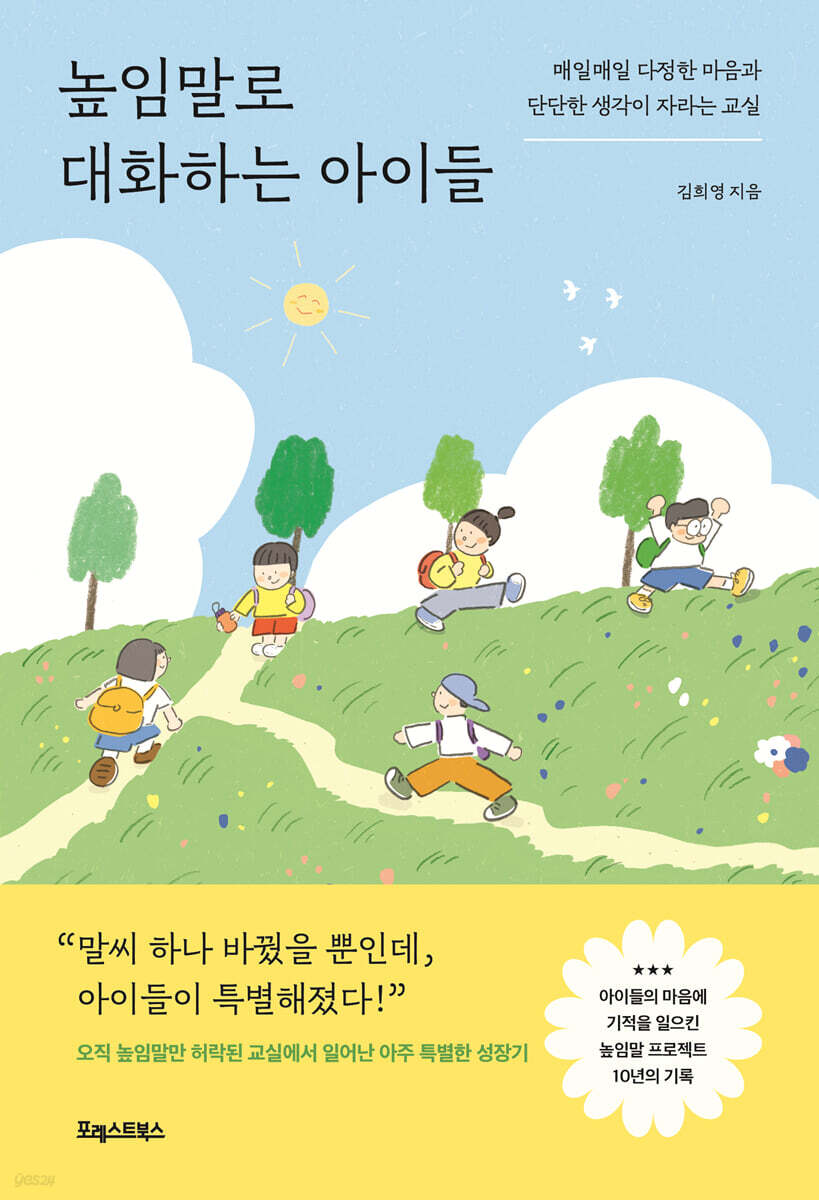
Children speaking in honorifics
 |
Description
Book Introduction
- A word from MD
-
A classroom where kind words growA classroom where children speak only in formal language all day long.
This project, led by author Kim Hee-young, an elementary school teacher with 20 years of experience, has been ongoing for over 10 years, demonstrating how small changes, such as speech, can transform children's attitudes, relationships, and even emotions.
In a time when we must learn attitudes before knowledge, this book makes us reconsider the essence of education that we have been missing.
Song Go-woon, producer of Home Living
The child I knew was a child who cared for others
The child who always complained became the child who praised
A quiet child becomes a courageous child
“Just by changing the way we speak, the children become special!”
A 10-Year Record of the Honorific Project, a Miracle in Children's Hearts
There is a classroom where children call each other “Mr. ○○” and “Ms. ○○” and naturally exchange affectionate words like “Can I borrow your eraser?”, “Take your time”, and “You’re really cool.”
The only language allowed in this classroom is 'honorifics'.
This book is the author's record of running a class that uses honorifics for the past ten years.
It contains meticulous observations and warm stories about how language changes people and how small, beautiful words can come together to create a great resonance.
A child's world grows with the language he hears and speaks every day.
The shape of a child's mind also changes depending on the language in which he or she lives each day.
This book proves that truth through ten years of classroom scenes.
In these times when the public's negative view of education is deepening, the heartfelt account of a teacher who still quietly strives to cultivate "good people" in the classroom will ask what role adults should play for children, and will quietly but clearly provide an answer.
The child who always complained became the child who praised
A quiet child becomes a courageous child
“Just by changing the way we speak, the children become special!”
A 10-Year Record of the Honorific Project, a Miracle in Children's Hearts
There is a classroom where children call each other “Mr. ○○” and “Ms. ○○” and naturally exchange affectionate words like “Can I borrow your eraser?”, “Take your time”, and “You’re really cool.”
The only language allowed in this classroom is 'honorifics'.
This book is the author's record of running a class that uses honorifics for the past ten years.
It contains meticulous observations and warm stories about how language changes people and how small, beautiful words can come together to create a great resonance.
A child's world grows with the language he hears and speaks every day.
The shape of a child's mind also changes depending on the language in which he or she lives each day.
This book proves that truth through ten years of classroom scenes.
In these times when the public's negative view of education is deepening, the heartfelt account of a teacher who still quietly strives to cultivate "good people" in the classroom will ask what role adults should play for children, and will quietly but clearly provide an answer.
- You can preview some of the book's contents.
Preview
index
Opening remarks.
A dream classroom where we sing in honorifics
Chapter 1.
Honorifics, the first step
Our class uses honorifics when speaking.
The belief that kind words raise kind children
A sign that honorifics have seeped in
Everyone in our class is presenting
Mr. Fear's Story of Overcoming Presentation
Thank you, I'm sorry
I will be happy, I will empathize, I will be considerate
Honorifics that cultivate language sensitivity
Chapter 2.
Respect and consideration fostered through honorifics
Take your time, I'll wait.
A beautiful person's place is also beautiful.
Can I change seats on the bus?
Just use the chair without asking.
As expected of our kind king, as expected of our neat queen
Thank you for taking the time to interview me.
I couldn't do it. No, I didn't do it.
Chapter 3.
The power of growing together through honorifics
It's something we should do
When sorrow is shared, it becomes a source of comfort.
The greatest team spirit in the world
Healthy snacks are a hit
I wanted to be a respectful welcome drinker
There is no room for conflict between honorifics.
Why there's nothing to be angry about with children
Chapter 4.
Depth of mind expressed in honorifics
Children expressing their feelings
A touching drama with a beautiful script
The "I Love You" Challenge in the Cafeteria
He who tells me of my evil is my teacher.
Children doing events
Silent comfort, this is heaven
The best words to express your sincerity
Chapter 5.
The power of honorifics shared together
What did you do to the children?
I'm a 6th grader who speaks in formal language.
Children's character is on the rise
Teacher Chuck Chuck's Honorific Challenge
Can younger children also use honorifics?
We speak in honorifics at home.
Nevertheless, honorifics
Conclusion / Supporting children who will shine brighter tomorrow than today
A dream classroom where we sing in honorifics
Chapter 1.
Honorifics, the first step
Our class uses honorifics when speaking.
The belief that kind words raise kind children
A sign that honorifics have seeped in
Everyone in our class is presenting
Mr. Fear's Story of Overcoming Presentation
Thank you, I'm sorry
I will be happy, I will empathize, I will be considerate
Honorifics that cultivate language sensitivity
Chapter 2.
Respect and consideration fostered through honorifics
Take your time, I'll wait.
A beautiful person's place is also beautiful.
Can I change seats on the bus?
Just use the chair without asking.
As expected of our kind king, as expected of our neat queen
Thank you for taking the time to interview me.
I couldn't do it. No, I didn't do it.
Chapter 3.
The power of growing together through honorifics
It's something we should do
When sorrow is shared, it becomes a source of comfort.
The greatest team spirit in the world
Healthy snacks are a hit
I wanted to be a respectful welcome drinker
There is no room for conflict between honorifics.
Why there's nothing to be angry about with children
Chapter 4.
Depth of mind expressed in honorifics
Children expressing their feelings
A touching drama with a beautiful script
The "I Love You" Challenge in the Cafeteria
He who tells me of my evil is my teacher.
Children doing events
Silent comfort, this is heaven
The best words to express your sincerity
Chapter 5.
The power of honorifics shared together
What did you do to the children?
I'm a 6th grader who speaks in formal language.
Children's character is on the rise
Teacher Chuck Chuck's Honorific Challenge
Can younger children also use honorifics?
We speak in honorifics at home.
Nevertheless, honorifics
Conclusion / Supporting children who will shine brighter tomorrow than today
Detailed image
.jpg)
Into the book
At the beginning of the school year, I often heard Mr. Neunggeunham speaking informally among his friends.
It was also because the honorifics were awkward and not a habit.
However, it seemed that there was a strong intention not to use honorifics.
Of course, as he got used to it, Mr. Leisure also started using honorifics out of habit, but he still seemed bothered by having to bother speaking in honorifics.
Why did Mr. Leisure, who used to be like that, come to see me alone?
“Teacher, this is really amazing.
The friends who were in my class last year are different.
I can do it all.
My friends in other classes are just good at everything they're not good at.
“I even eat kimchi well.”
It wasn't the chattering style.
He was not the type to be kind to others.
It was strange that Mr. Neunggeunham came alone and started talking about the new school year without being asked.
“At first, it was really weird because my 6th grade teacher called me ‘Neugeutham-ah’ instead of ‘Mr. Neugeutham.’
We don't use honorifics anymore.
But even if we don't use honorifics, the friends in my class speak a little differently.
Speak nicely.
And when I see friends from my class last year in the hallway, I still greet them politely.”
---- pp.29-30
Language habits are not formed overnight.
The better the language, the more so.
Compared to provocative language that quickly becomes ingrained, it takes time for pretty words to become a habit.
The beautiful sound seeps in slowly.
Polite expressions slowly creep in.
Once the atmosphere is established and stable, it is not difficult to maintain.
It delves deeply into children's lives over a long period of time and has a profound impact on their lives.
This is why children must be exposed to an environment where they can use the correct language from a young age.
What adults need to do to help children develop good language habits is to wait.
You should wait for the children to learn at their own pace and praise them for their nice words.
Children learn right from wrong by being praised.
Even the most trivial and obvious words can be strengthened and become special language through praise.
When you scold someone for using bad language, the focus shifts to the negative language.
Sharp words should not be made to stand out.
We must make beautiful words bigger and stronger, and cover up sharpness with softness.
---- pp.39-40
“Bang!”
A sharp sound broke the silence.
All eyes turned to where the sound came from.
A student's colored pencil case made of metal fell from the desk.
48 colored pencils spilled onto the floor.
All my friends around me lowered themselves to the floor and started picking up colored pencils.
There was no sound.
The only thing that was busy was picking up the colored pencils and putting them in the case.
In no time, the colored pencils were returned to their case.
"I'm sorry."
A student who accidentally dropped a colored pencil bowed his head and apologized to his friends.
"it's okay."
Friends around me answered.
“Thank you for picking up the colored pencils.”
He didn't even miss the thank you message.
The situation ended with everyone smiling.
I devoted myself to art work again.
The first grade teacher who witnessed this sight couldn't close his mouth in disbelief.
“This is a cultural shock.
"You mean it ends so politely? No, how do kids even use formal language with each other? How do they say things like 'I'm sorry,' 'It's okay,' and 'Thank you' so naturally?"
She returned home shocked and in shock, saying that this was something that could never happen in a first-grade classroom.
If someone else had witnessed the same scene, their reaction would not have been much different.
This was the daily routine in our class.
It was an ordinary day for us, nothing special at all.
---- pp.56-57
Slowly, Mr. Seed spoke to Mr. Waiting, who was walking along the learning path.
“Slowly, Mr. Slowly, you’re not finished yet? It’s okay.
Take your time.
“I’ll wait.”
Mr. Wait never rushed.
Rather, he encouraged the seed slowly.
“Slowly, Mr. Slowly, your drawing is awesome.
“It takes a long time to draw so well.”
"thank you.
I still have a long way to go.
“I’ll finish it and submit it.”
"no.
I'll wait while I play with my friends.
Let me know when you're done.
“I will submit it.”
"all right.
thank you.
“I will finish it as quickly as possible.”
I could only stare blankly at the brief conversation between Mr. Slow and Mr. Wait.
Because the consideration for each other is so beautiful.
If it were a student evaluation that should be conducted fairly, they would have asked us to submit our test papers like a knife.
But what if the study materials are handed in a few minutes late?
It is more important to cultivate a kind heart by speaking kind words.
---- pp.83-84
It was finally time to taste it.
Share your feelings with classmates through food.
That was the purpose of the activity of making healthy snacks, as I thought.
I can't just eat the snacks my friends lovingly made.
A fair price must be paid.
So, should we pay for it? What if we created our own class currency? Isn't our class known for its polite language and overflowing compliments? We set the price of each snack at "5 compliments."
You have to give five compliments to get a snack from another group.
“The snack looks really delicious.
The plating is excellent.
The sign is beautiful.
You cleaned up well too.
“I think eating this will make me healthy.”
As expected, they were skilled masters of praise.
He gave five compliments in rapid succession.
If you praise quickly, you can eat quickly.
“The food has pretty colors.
The smell is amazing.
How did you come up with this snack? Great idea.
It seems like the group members worked well together.
And the last one… …the chef has a handsome face.”
I even complimented the appearance of my friend who made a snack in a hurry.
Everyone burst into laughter and stuffed their mouths with delicious snacks.
---- pp.162-163
“You stepped on my bag first.
“I apologize.”
“Hey, you got angry first.”
But when I mediate, he quickly repents his mistake and speaks politely again.
“I got angry because Mr. ○○ stepped on my bag.
“It was my fault for getting angry first.”
“I felt bad because Mr. △△ got angry all of a sudden.
“I was wrong not to apologize right away.”
Even if a fight breaks out, it doesn't last long.
It will be resolved quickly.
He starts talking again in polite language as if he's never fought before.
Because we usually use polite language and have a considerate atmosphere, I know my friend lost his temper for a moment.
Honorifics have a magical power to soothe angry emotions.
When honorifics become the norm, major conflicts become arguments, and the worst-case scenario is speaking informally.
Honorifics elevate the level of the class community.
---- p.177
The honorific filter filters out harsh words and allows only purified words to come out of the mouth.
The same is true in writing.
It filters out negative thoughts and enables honest, clean writing composed of refined language.
When writing an explanatory text, using calm, formal language creates a systematic and friendly explanation.
In an argumentative essay, logical honorifics clarify the basis and increase the persuasiveness of the essay.
When writing a letter, is there any language better for expressing sincerity than honorifics?
Polite expressions convey your feelings carefully and add depth to your words.
How about when writing poetry?
Beautiful honorifics allow us to express our emotions more delicately.
Honorifics play a major role in purifying language and as a tool for expressing one's feelings honestly.
I feel that children's writing has become much softer and more beautiful since they started using honorifics.
The content has become richer and the expressions have become more fluid.
Properly organized thoughts, actions, and words are incorporated into writing and sublimated into developed 'writing power.'
---- p.239
Isn't using language correctly like learning to ride a bicycle? The moment you learn how to balance and pedal, someone who has never ridden a bicycle before transforms into a cyclist.
Even if you don't ride a bike every day, you won't forget how to ride one.
Even if it's been years since you've ridden a bike, you can move forward without having to learn anything new.
Once you learn the skills, you can be a cyclist for life.
The same goes for honorifics.
Once someone uses honorifics, they internalize the positive function of language.
Even in situations where honorifics are not used, the power of positive language that has already been formed does not disappear.
You can always take it out and use it skillfully when needed.
I believe that my children, who have spoken to me using polite language for a year, will live their entire lives as proper language users.
This is why we don't stop teaching honorifics, though.
It was also because the honorifics were awkward and not a habit.
However, it seemed that there was a strong intention not to use honorifics.
Of course, as he got used to it, Mr. Leisure also started using honorifics out of habit, but he still seemed bothered by having to bother speaking in honorifics.
Why did Mr. Leisure, who used to be like that, come to see me alone?
“Teacher, this is really amazing.
The friends who were in my class last year are different.
I can do it all.
My friends in other classes are just good at everything they're not good at.
“I even eat kimchi well.”
It wasn't the chattering style.
He was not the type to be kind to others.
It was strange that Mr. Neunggeunham came alone and started talking about the new school year without being asked.
“At first, it was really weird because my 6th grade teacher called me ‘Neugeutham-ah’ instead of ‘Mr. Neugeutham.’
We don't use honorifics anymore.
But even if we don't use honorifics, the friends in my class speak a little differently.
Speak nicely.
And when I see friends from my class last year in the hallway, I still greet them politely.”
---- pp.29-30
Language habits are not formed overnight.
The better the language, the more so.
Compared to provocative language that quickly becomes ingrained, it takes time for pretty words to become a habit.
The beautiful sound seeps in slowly.
Polite expressions slowly creep in.
Once the atmosphere is established and stable, it is not difficult to maintain.
It delves deeply into children's lives over a long period of time and has a profound impact on their lives.
This is why children must be exposed to an environment where they can use the correct language from a young age.
What adults need to do to help children develop good language habits is to wait.
You should wait for the children to learn at their own pace and praise them for their nice words.
Children learn right from wrong by being praised.
Even the most trivial and obvious words can be strengthened and become special language through praise.
When you scold someone for using bad language, the focus shifts to the negative language.
Sharp words should not be made to stand out.
We must make beautiful words bigger and stronger, and cover up sharpness with softness.
---- pp.39-40
“Bang!”
A sharp sound broke the silence.
All eyes turned to where the sound came from.
A student's colored pencil case made of metal fell from the desk.
48 colored pencils spilled onto the floor.
All my friends around me lowered themselves to the floor and started picking up colored pencils.
There was no sound.
The only thing that was busy was picking up the colored pencils and putting them in the case.
In no time, the colored pencils were returned to their case.
"I'm sorry."
A student who accidentally dropped a colored pencil bowed his head and apologized to his friends.
"it's okay."
Friends around me answered.
“Thank you for picking up the colored pencils.”
He didn't even miss the thank you message.
The situation ended with everyone smiling.
I devoted myself to art work again.
The first grade teacher who witnessed this sight couldn't close his mouth in disbelief.
“This is a cultural shock.
"You mean it ends so politely? No, how do kids even use formal language with each other? How do they say things like 'I'm sorry,' 'It's okay,' and 'Thank you' so naturally?"
She returned home shocked and in shock, saying that this was something that could never happen in a first-grade classroom.
If someone else had witnessed the same scene, their reaction would not have been much different.
This was the daily routine in our class.
It was an ordinary day for us, nothing special at all.
---- pp.56-57
Slowly, Mr. Seed spoke to Mr. Waiting, who was walking along the learning path.
“Slowly, Mr. Slowly, you’re not finished yet? It’s okay.
Take your time.
“I’ll wait.”
Mr. Wait never rushed.
Rather, he encouraged the seed slowly.
“Slowly, Mr. Slowly, your drawing is awesome.
“It takes a long time to draw so well.”
"thank you.
I still have a long way to go.
“I’ll finish it and submit it.”
"no.
I'll wait while I play with my friends.
Let me know when you're done.
“I will submit it.”
"all right.
thank you.
“I will finish it as quickly as possible.”
I could only stare blankly at the brief conversation between Mr. Slow and Mr. Wait.
Because the consideration for each other is so beautiful.
If it were a student evaluation that should be conducted fairly, they would have asked us to submit our test papers like a knife.
But what if the study materials are handed in a few minutes late?
It is more important to cultivate a kind heart by speaking kind words.
---- pp.83-84
It was finally time to taste it.
Share your feelings with classmates through food.
That was the purpose of the activity of making healthy snacks, as I thought.
I can't just eat the snacks my friends lovingly made.
A fair price must be paid.
So, should we pay for it? What if we created our own class currency? Isn't our class known for its polite language and overflowing compliments? We set the price of each snack at "5 compliments."
You have to give five compliments to get a snack from another group.
“The snack looks really delicious.
The plating is excellent.
The sign is beautiful.
You cleaned up well too.
“I think eating this will make me healthy.”
As expected, they were skilled masters of praise.
He gave five compliments in rapid succession.
If you praise quickly, you can eat quickly.
“The food has pretty colors.
The smell is amazing.
How did you come up with this snack? Great idea.
It seems like the group members worked well together.
And the last one… …the chef has a handsome face.”
I even complimented the appearance of my friend who made a snack in a hurry.
Everyone burst into laughter and stuffed their mouths with delicious snacks.
---- pp.162-163
“You stepped on my bag first.
“I apologize.”
“Hey, you got angry first.”
But when I mediate, he quickly repents his mistake and speaks politely again.
“I got angry because Mr. ○○ stepped on my bag.
“It was my fault for getting angry first.”
“I felt bad because Mr. △△ got angry all of a sudden.
“I was wrong not to apologize right away.”
Even if a fight breaks out, it doesn't last long.
It will be resolved quickly.
He starts talking again in polite language as if he's never fought before.
Because we usually use polite language and have a considerate atmosphere, I know my friend lost his temper for a moment.
Honorifics have a magical power to soothe angry emotions.
When honorifics become the norm, major conflicts become arguments, and the worst-case scenario is speaking informally.
Honorifics elevate the level of the class community.
---- p.177
The honorific filter filters out harsh words and allows only purified words to come out of the mouth.
The same is true in writing.
It filters out negative thoughts and enables honest, clean writing composed of refined language.
When writing an explanatory text, using calm, formal language creates a systematic and friendly explanation.
In an argumentative essay, logical honorifics clarify the basis and increase the persuasiveness of the essay.
When writing a letter, is there any language better for expressing sincerity than honorifics?
Polite expressions convey your feelings carefully and add depth to your words.
How about when writing poetry?
Beautiful honorifics allow us to express our emotions more delicately.
Honorifics play a major role in purifying language and as a tool for expressing one's feelings honestly.
I feel that children's writing has become much softer and more beautiful since they started using honorifics.
The content has become richer and the expressions have become more fluid.
Properly organized thoughts, actions, and words are incorporated into writing and sublimated into developed 'writing power.'
---- p.239
Isn't using language correctly like learning to ride a bicycle? The moment you learn how to balance and pedal, someone who has never ridden a bicycle before transforms into a cyclist.
Even if you don't ride a bike every day, you won't forget how to ride one.
Even if it's been years since you've ridden a bike, you can move forward without having to learn anything new.
Once you learn the skills, you can be a cyclist for life.
The same goes for honorifics.
Once someone uses honorifics, they internalize the positive function of language.
Even in situations where honorifics are not used, the power of positive language that has already been formed does not disappear.
You can always take it out and use it skillfully when needed.
I believe that my children, who have spoken to me using polite language for a year, will live their entire lives as proper language users.
This is why we don't stop teaching honorifics, though.
---- p.289
Publisher's Review
“Kids speak in formal language in the classroom?”
A day in a classroom where only honorifics are allowed begins in a special way.
From the morning, the children greet each other as they go to school by playing rock-paper-scissors with their homeroom teacher. If they win, they say, “I will be happy,” if they draw, they say, “I will empathize,” and if they lose, they say, “I will be considerate.”
In addition, according to the '1 compliment a day system', friends exchange compliments with each other using polite language, and each week, they write articles on various topics and leave comments using polite language to each other.
And they talk to each other in polite, respectful language, saying things like, “Can I borrow your eraser?”, “You write really well”, “I’m sorry”, and “Thank you.”
Kim Hee-young, author of “Children Who Speak in Honorifics” and an elementary school teacher with 20 years of experience, has been experimenting with using only honorifics in the classroom for 10 years.
Before he became a teacher who wanted to teach children well, he wanted to become an adult who helped them grow well, and he found the starting point in the 'language' that children use every day.
“A child’s speech becomes his or her heart.”
The power of language to foster strong thinking and a kind heart
As philosopher Wittgenstein said, “The limits of language are the limits of the world,” the range of language a child uses becomes the size of the world the child thinks and feels.
That is why the author chose honorifics as the language of the class.
Honorifics are not simply polite language; they imply an attitude of respect for others, the ability to refine one's emotions, and a caring and dignified way of thinking.
Therefore, I believed that when honorifics become a habit, it would bring about positive changes in children's thoughts and attitudes, and I created various classroom rules to guide children to naturally accept honorifics.
As a result, the children learned how to treat each other politely and learned how to resolve minor conflicts through quiet conversation.
As neat words accumulate, solid thoughts grow, and as you use kind words, your affectionate heart grows.
And this change extends beyond the classroom, into the child's inner self, relationships, and home.
The children's later comments, such as, "I became more careful with my speech when I spoke to them in polite language," and "Even when I was angry, my speech calmed me down," and the parents' feedback, "My child became brighter and warmer," clearly demonstrate the gentle influence that polite language has on children.
“In elementary school, nothing is more important than language habits.”
Before we get used to provocative words, we need to first teach them the power of kind words.
The younger we are, the deeper and longer-lasting our speech habits become.
Elementary school is a crucial period for the formation of language habits.
Depending on what language a child hears and uses repeatedly, his or her personality and sense of community will develop in completely different ways.
"Children Who Speak in Honorifics" vividly illustrates the importance of language education at this age through classroom stories.
Through the process of children speaking to each other using polite language, calling each other "Mr. ○○" and "Ms. ○○," it perfectly captures how a single word creates an attitude and how that attitude changes relationships.
Our children today are having more and more difficulties in peer relationships.
It has become common to lose control of one's emotions or to cut off conversations without resolving minor conflicts.
At this very moment, what children need is not more direction or discipline, but a change in the way we talk to them.
The author found the answer in honorifics.
Respectful language fosters a caring attitude, and that attitude fosters understanding.
This book will provide a solid guide to language for parents who want to raise their children properly and warmly.
A day in a classroom where only honorifics are allowed begins in a special way.
From the morning, the children greet each other as they go to school by playing rock-paper-scissors with their homeroom teacher. If they win, they say, “I will be happy,” if they draw, they say, “I will empathize,” and if they lose, they say, “I will be considerate.”
In addition, according to the '1 compliment a day system', friends exchange compliments with each other using polite language, and each week, they write articles on various topics and leave comments using polite language to each other.
And they talk to each other in polite, respectful language, saying things like, “Can I borrow your eraser?”, “You write really well”, “I’m sorry”, and “Thank you.”
Kim Hee-young, author of “Children Who Speak in Honorifics” and an elementary school teacher with 20 years of experience, has been experimenting with using only honorifics in the classroom for 10 years.
Before he became a teacher who wanted to teach children well, he wanted to become an adult who helped them grow well, and he found the starting point in the 'language' that children use every day.
“A child’s speech becomes his or her heart.”
The power of language to foster strong thinking and a kind heart
As philosopher Wittgenstein said, “The limits of language are the limits of the world,” the range of language a child uses becomes the size of the world the child thinks and feels.
That is why the author chose honorifics as the language of the class.
Honorifics are not simply polite language; they imply an attitude of respect for others, the ability to refine one's emotions, and a caring and dignified way of thinking.
Therefore, I believed that when honorifics become a habit, it would bring about positive changes in children's thoughts and attitudes, and I created various classroom rules to guide children to naturally accept honorifics.
As a result, the children learned how to treat each other politely and learned how to resolve minor conflicts through quiet conversation.
As neat words accumulate, solid thoughts grow, and as you use kind words, your affectionate heart grows.
And this change extends beyond the classroom, into the child's inner self, relationships, and home.
The children's later comments, such as, "I became more careful with my speech when I spoke to them in polite language," and "Even when I was angry, my speech calmed me down," and the parents' feedback, "My child became brighter and warmer," clearly demonstrate the gentle influence that polite language has on children.
“In elementary school, nothing is more important than language habits.”
Before we get used to provocative words, we need to first teach them the power of kind words.
The younger we are, the deeper and longer-lasting our speech habits become.
Elementary school is a crucial period for the formation of language habits.
Depending on what language a child hears and uses repeatedly, his or her personality and sense of community will develop in completely different ways.
"Children Who Speak in Honorifics" vividly illustrates the importance of language education at this age through classroom stories.
Through the process of children speaking to each other using polite language, calling each other "Mr. ○○" and "Ms. ○○," it perfectly captures how a single word creates an attitude and how that attitude changes relationships.
Our children today are having more and more difficulties in peer relationships.
It has become common to lose control of one's emotions or to cut off conversations without resolving minor conflicts.
At this very moment, what children need is not more direction or discipline, but a change in the way we talk to them.
The author found the answer in honorifics.
Respectful language fosters a caring attitude, and that attitude fosters understanding.
This book will provide a solid guide to language for parents who want to raise their children properly and warmly.
GOODS SPECIFICS
- Date of issue: July 18, 2025
- Page count, weight, size: 300 pages | 140*205*20mm
- ISBN13: 9791194530497
- ISBN10: 1194530494
You may also like
카테고리
korean


korean

![GQ KOREA Mark (Monthly): December [2025]](http://librairie.coreenne.fr/cdn/shop/files/8ef265dbbfbf186523ed75ba7319009d.jpg?v=1765340328&width=3840)


