

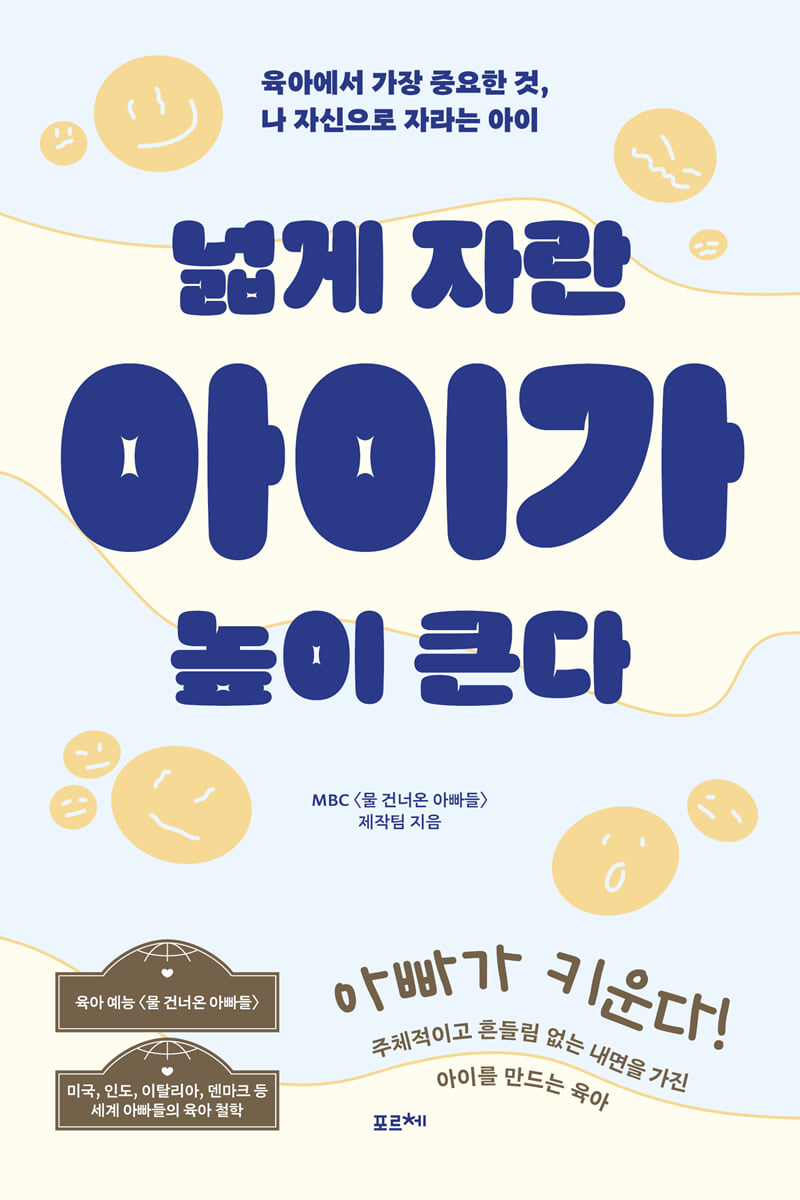
A child who grows wide grows taller.
 |
Description
Book Introduction
There is no right answer to parenting, but there is a direction!
How to Raise a Child with an Independent and Unwavering Inner Self
If parents want to raise their children to be independent individuals, they too must not be afraid of worry.
This book is based on the MBC program “Fathers from Across the Water,” in which foreign fathers raising children in Korea gathered together to share their honest parenting experiences.
The fathers from various countries, including India, the United States, Italy, South Africa, and Denmark, who appeared on this program experience trial and error while raising their children in an environment they are not accustomed to: Korea.
Let's explore the essence of 'raising a child' through 31 questions covering play, education, cultural differences, sociality, family relationships, and life direction.
How can we foster children's ability to think for themselves and live independently? How can we maintain a stable foundation across the various aspects of parenting, including academics, play, and autonomy? Through the diverse parenting philosophies presented in this book, parents themselves will broaden their perspectives and gain tips for parenting that will help their children "grow into their own selves."
This book's message is for parents who truly care about their children's autonomy and growth, parents who need the comfort that it's okay not to be perfect, and all parents who want to grow together with their children.
How to Raise a Child with an Independent and Unwavering Inner Self
If parents want to raise their children to be independent individuals, they too must not be afraid of worry.
This book is based on the MBC program “Fathers from Across the Water,” in which foreign fathers raising children in Korea gathered together to share their honest parenting experiences.
The fathers from various countries, including India, the United States, Italy, South Africa, and Denmark, who appeared on this program experience trial and error while raising their children in an environment they are not accustomed to: Korea.
Let's explore the essence of 'raising a child' through 31 questions covering play, education, cultural differences, sociality, family relationships, and life direction.
How can we foster children's ability to think for themselves and live independently? How can we maintain a stable foundation across the various aspects of parenting, including academics, play, and autonomy? Through the diverse parenting philosophies presented in this book, parents themselves will broaden their perspectives and gain tips for parenting that will help their children "grow into their own selves."
This book's message is for parents who truly care about their children's autonomy and growth, parents who need the comfort that it's okay not to be perfect, and all parents who want to grow together with their children.
- You can preview some of the book's contents.
Preview
index
Prologue - 4
Dads in this book - 6
Chapter 1: Play and Discipline: How to Take Steps at Your Child's Eye Level
How should I play when I'm physically exhausted? - 12
Can we be more creative and playful without our smartphones? - 21
How to Fix Your Child's Picky Eating - 30
Is Separate Sleep Training Really Necessary for Children? - 37
How can we foster independence that will enable us to adapt anywhere in the world? - 44
Dads who become weak when their children cry—is discipline really necessary? - 52
Chapter 2: Education: To Be a Guide to Learning
Are children's pre-school and private tutoring really necessary? - 62
How should we educate children in English, their native language, early? - 71
How can we effectively teach reading to foster creativity? - 79
How about experiencing history firsthand at a museum? - 86
What if your child wants to have your job? - 92
Chapter 3: Cultural Differences in Parenting: Growing Up in an Expanded World
How can I introduce my father to his native culture? - 102
Can't we raise children freely in nature, like in Africa? - 109
What should I do when my child begins to struggle with identity? - 118
What Korean culture would you most like to teach your children? - 127
Should I speak formally or informally to my parents? - 134
Chapter 4: Cultivating Social Skills: Taking Your First Steps into a Small Society
When is the best time to send your child to daycare? - 142
Will I be able to get along with my first peer friend? - 151
Tips for Socializing Your Child's First Day of Daycare - 158
How about attending a cultural center class with your parents? - 165
What if my child has a friend of the opposite sex? - 172
Chapter 5: Family Relationships: The Family Temperature That Shapes a Child's Emotions
How can I prevent and help my wife with postpartum depression? - 180
Won't the first child be sad when the second is born? - 188
How should we mediate fights between children who don't listen to their parents? - 195
Is it really important to teach children to yield? - 203
How about getting help from grandparents with twilight childcare? - 212
Chapter 6: Life Direction: Parents Make Happy Children
What are the parenting methods of the country with the highest child happiness index? - 222
How should we understand children's growth and development? - 230
What Should I Do When My Child Enters Puberty? - 237
How to Deal with a Child Who Takes on Their Parents' Flaws - 245
What if my child lives with someone before marriage? - 252
Epilogue - 261
Dads in this book - 6
Chapter 1: Play and Discipline: How to Take Steps at Your Child's Eye Level
How should I play when I'm physically exhausted? - 12
Can we be more creative and playful without our smartphones? - 21
How to Fix Your Child's Picky Eating - 30
Is Separate Sleep Training Really Necessary for Children? - 37
How can we foster independence that will enable us to adapt anywhere in the world? - 44
Dads who become weak when their children cry—is discipline really necessary? - 52
Chapter 2: Education: To Be a Guide to Learning
Are children's pre-school and private tutoring really necessary? - 62
How should we educate children in English, their native language, early? - 71
How can we effectively teach reading to foster creativity? - 79
How about experiencing history firsthand at a museum? - 86
What if your child wants to have your job? - 92
Chapter 3: Cultural Differences in Parenting: Growing Up in an Expanded World
How can I introduce my father to his native culture? - 102
Can't we raise children freely in nature, like in Africa? - 109
What should I do when my child begins to struggle with identity? - 118
What Korean culture would you most like to teach your children? - 127
Should I speak formally or informally to my parents? - 134
Chapter 4: Cultivating Social Skills: Taking Your First Steps into a Small Society
When is the best time to send your child to daycare? - 142
Will I be able to get along with my first peer friend? - 151
Tips for Socializing Your Child's First Day of Daycare - 158
How about attending a cultural center class with your parents? - 165
What if my child has a friend of the opposite sex? - 172
Chapter 5: Family Relationships: The Family Temperature That Shapes a Child's Emotions
How can I prevent and help my wife with postpartum depression? - 180
Won't the first child be sad when the second is born? - 188
How should we mediate fights between children who don't listen to their parents? - 195
Is it really important to teach children to yield? - 203
How about getting help from grandparents with twilight childcare? - 212
Chapter 6: Life Direction: Parents Make Happy Children
What are the parenting methods of the country with the highest child happiness index? - 222
How should we understand children's growth and development? - 230
What Should I Do When My Child Enters Puberty? - 237
How to Deal with a Child Who Takes on Their Parents' Flaws - 245
What if my child lives with someone before marriage? - 252
Epilogue - 261
Detailed image

Into the book
While the children play in nature, dad and mom take a short break.
As parents, it is important to play with your children, but it is equally important to manage your own energy so that it does not run out.
In the United States, parents often take their children to nature or science museums to spend time together, while parents take a short nap on a bench to relax.
Because then I can play with you again.
--- p.15, from “How should I play when I am physically exhausted?”
Peter Our children also slept separately from a young age, in the British style.
Since I was little, I've been assigned a room of my own and promised to sleep in that room, so even now, I always go to my room when I go to sleep.
On the one hand, I think it's important that couples can maintain their own space by sleeping separately.
--- p.42, from “Is it really necessary to teach children to sleep separately?”
Since we live in the US, Cherry will inevitably use English more than Korean when she enters kindergarten and starts school.
However, I believe that even if you live in the US, you absolutely must learn Korean, so I am trying to make it possible for you to naturally come into contact with Korean even now.
Above all, I hope that Cherry will not forget that her roots are also in Korea.
--- p.122, from “What should we do when a child begins to worry about his or her identity?”
Language is not just a technology, it is a tool for forming relationships.
Helping children learn to use formal and informal speech flexibly is ultimately a process of learning to respect others.
Teaching polite speech is not simply a matter of teaching speech patterns; it is an important foundation for developing social communication skills.
--- p.140, from “Should I speak politely or informally to my parents?”
The thing that parents worry about most when their child is about to start daycare for the first time is the separation anxiety and stress that their child may feel when separated from their parents in an unfamiliar environment.
Parents are bound to have many concerns, such as whether it is okay to force a crying child to go to daycare, whether their child will have trouble adjusting to daycare life, or whether conflicts will arise with their friends.
At this time, it is best to first experience the daycare environment with your child, if possible.
As parents, it is important to play with your children, but it is equally important to manage your own energy so that it does not run out.
In the United States, parents often take their children to nature or science museums to spend time together, while parents take a short nap on a bench to relax.
Because then I can play with you again.
--- p.15, from “How should I play when I am physically exhausted?”
Peter Our children also slept separately from a young age, in the British style.
Since I was little, I've been assigned a room of my own and promised to sleep in that room, so even now, I always go to my room when I go to sleep.
On the one hand, I think it's important that couples can maintain their own space by sleeping separately.
--- p.42, from “Is it really necessary to teach children to sleep separately?”
Since we live in the US, Cherry will inevitably use English more than Korean when she enters kindergarten and starts school.
However, I believe that even if you live in the US, you absolutely must learn Korean, so I am trying to make it possible for you to naturally come into contact with Korean even now.
Above all, I hope that Cherry will not forget that her roots are also in Korea.
--- p.122, from “What should we do when a child begins to worry about his or her identity?”
Language is not just a technology, it is a tool for forming relationships.
Helping children learn to use formal and informal speech flexibly is ultimately a process of learning to respect others.
Teaching polite speech is not simply a matter of teaching speech patterns; it is an important foundation for developing social communication skills.
--- p.140, from “Should I speak politely or informally to my parents?”
The thing that parents worry about most when their child is about to start daycare for the first time is the separation anxiety and stress that their child may feel when separated from their parents in an unfamiliar environment.
Parents are bound to have many concerns, such as whether it is okay to force a crying child to go to daycare, whether their child will have trouble adjusting to daycare life, or whether conflicts will arise with their friends.
At this time, it is best to first experience the daycare environment with your child, if possible.
--- p.159, from “Tips for social life of a child attending daycare for the first time?”
Publisher's Review
When different cultures meet, a child's world becomes stronger and broader.
Realistic fathering that gives children a wider world
What concerns do Indian, American, Italian, South African, and Danish fathers living in Korea have, and how do they raise their children? What's clear is that despite differences in culture, language, and values, their love for their children and their parental concerns are the same.
Although they experience conflict due to differences in culture and values, they are able to seriously consider what is more important to their children and what they want to give them, and strive to provide the best possible parenting.
Let's question the 'natural parenting' we have taken for granted through various parenting philosophies, such as the natural parenting of a South African dad who lets his children run around barefoot in nature, the free parenting of a Dutch dad who fosters individuality and independence, and the happy parenting of a Danish dad who teaches children to balance rules and respect.
There is no one way to raise children in the world.
What children need is not a uniform approach, but the power to grow on their own by being exposed to various perspectives.
So their story doesn't just apply to multicultural families.
This is because it is an example of ‘parenting that understands and respects differences’, which is necessary for all families today, where parents and children cannot help but have different thoughts and expectations.
Let's get hints on personalized parenting for my child through a broad perspective of global parenting.
Dad is raising it too!
For happy parenting where both children and parents grow
What should I do when playing with my child is physically demanding? What should I talk about if my child wants to have my job? How can I effectively discipline my child when he or she cries? Parenting is a series of worries and choices, and imperfect parents find it difficult and confusing.
But even parents who aren't perfect, and who sometimes make mistakes, can be a greater force to their children than anyone else in the world.
The important thing is to laugh with your child, fall down, get back up, and support each other's growth.
For parents who are exhausted under the pressure to "raise their children well," and for parents who want to learn to trust and wait for their children, this book offers both solid comfort and practical direction.
Parenting is not a competition, but a journey where children and parents find their own rhythm together.
I ask this question to all parents who are concerned about 'what kind of person I want to raise my child to be.'
It is time to start parenting in which you learn and grow together with your child, rather than parenting in which you memorize and follow the correct answers.
Let's break free from the pressure of 'having to raise them well'.
Instead of rushing your child or pushing yourself too hard, let's find a rhythm that works for each person.
It's okay if it's awkward and sloppy.
What's important is that both the child and the parents grow up strong.
This book is dedicated to all parents who dream of raising their children happily, respecting each other, and free from the pressure of having to raise them well.
Realistic fathering that gives children a wider world
What concerns do Indian, American, Italian, South African, and Danish fathers living in Korea have, and how do they raise their children? What's clear is that despite differences in culture, language, and values, their love for their children and their parental concerns are the same.
Although they experience conflict due to differences in culture and values, they are able to seriously consider what is more important to their children and what they want to give them, and strive to provide the best possible parenting.
Let's question the 'natural parenting' we have taken for granted through various parenting philosophies, such as the natural parenting of a South African dad who lets his children run around barefoot in nature, the free parenting of a Dutch dad who fosters individuality and independence, and the happy parenting of a Danish dad who teaches children to balance rules and respect.
There is no one way to raise children in the world.
What children need is not a uniform approach, but the power to grow on their own by being exposed to various perspectives.
So their story doesn't just apply to multicultural families.
This is because it is an example of ‘parenting that understands and respects differences’, which is necessary for all families today, where parents and children cannot help but have different thoughts and expectations.
Let's get hints on personalized parenting for my child through a broad perspective of global parenting.
Dad is raising it too!
For happy parenting where both children and parents grow
What should I do when playing with my child is physically demanding? What should I talk about if my child wants to have my job? How can I effectively discipline my child when he or she cries? Parenting is a series of worries and choices, and imperfect parents find it difficult and confusing.
But even parents who aren't perfect, and who sometimes make mistakes, can be a greater force to their children than anyone else in the world.
The important thing is to laugh with your child, fall down, get back up, and support each other's growth.
For parents who are exhausted under the pressure to "raise their children well," and for parents who want to learn to trust and wait for their children, this book offers both solid comfort and practical direction.
Parenting is not a competition, but a journey where children and parents find their own rhythm together.
I ask this question to all parents who are concerned about 'what kind of person I want to raise my child to be.'
It is time to start parenting in which you learn and grow together with your child, rather than parenting in which you memorize and follow the correct answers.
Let's break free from the pressure of 'having to raise them well'.
Instead of rushing your child or pushing yourself too hard, let's find a rhythm that works for each person.
It's okay if it's awkward and sloppy.
What's important is that both the child and the parents grow up strong.
This book is dedicated to all parents who dream of raising their children happily, respecting each other, and free from the pressure of having to raise them well.
GOODS SPECIFICS
- Date of issue: May 14, 2025
- Page count, weight, size: 264 pages | 140*210*20mm
- ISBN13: 9791194634249
- ISBN10: 1194634249
You may also like
카테고리
korean


korean

![GQ KOREA Mark (Monthly): December [2025]](http://librairie.coreenne.fr/cdn/shop/files/8ef265dbbfbf186523ed75ba7319009d.jpg?v=1765340328&width=3840)


