

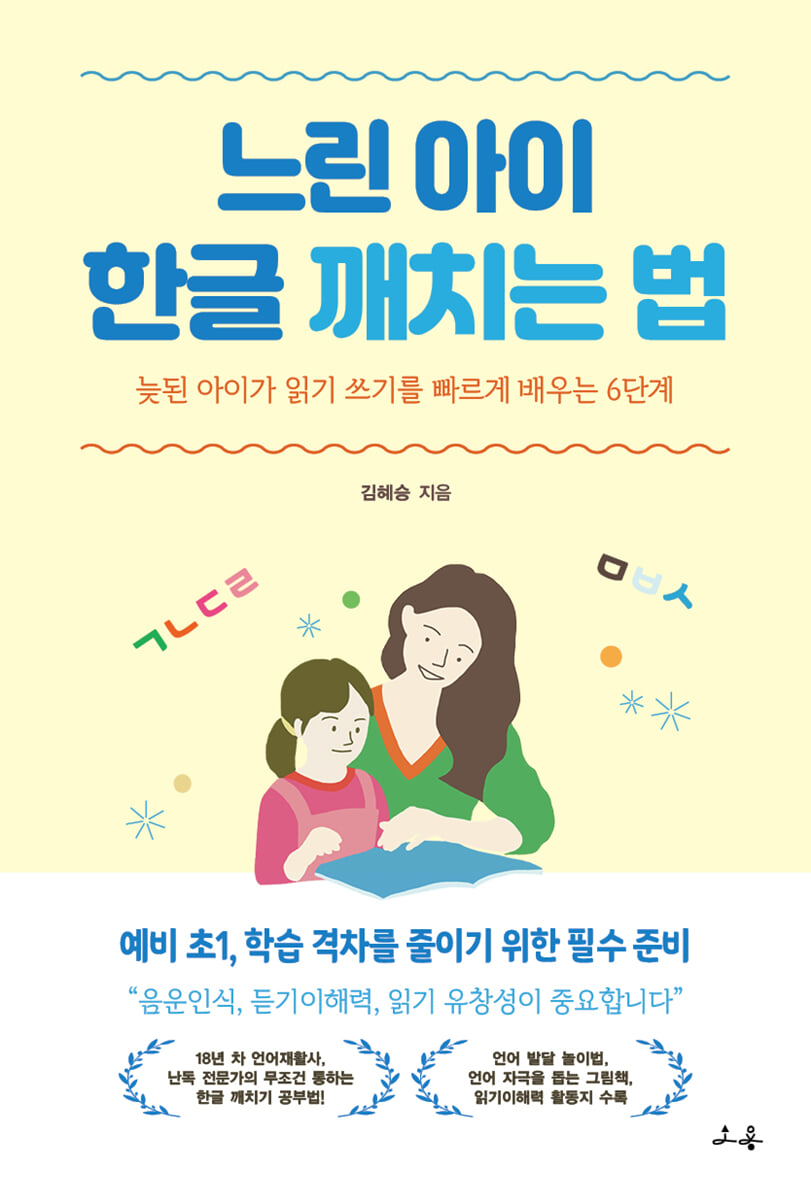
How to teach slow learners Korean
 |
Description
Book Introduction
6 Steps to Help Slow Learners Learn Korean Quickly
To reduce the learning gap in first graders,
Study Korean like this!
“He’s 7 years old, but he hates reading and refuses to learn Korean.”
“I need to know Korean to go to school, but I don’t even know the letter “ㄱ”, so I’m in big trouble.”
“I can’t read properly, and I read strangely.”
As children grow older and go to daycare or kindergarten, we naturally begin to focus on their Korean language development.
While it is important for a child to learn to walk and use diapers, learning Hangul requires even more careful attention.
When parents at the institution hear that other children are learning Hangul at the age of 5 or 6, they become anxious and worried that their children will fall behind.
Even if you teach your child Korean, if there is a child who cannot read Korean, you cannot help but worry.
"How to Teach Your Slow Child Korean" is a guide to learning Korean written to provide practical help to anxious and confused parents.
As a speech-language pathologist and dyslexia specialist, the author has helped countless children and adolescents develop their language skills in therapy for the past 18 years.
This book contains essential information for parents raising children with learning delays, ADHD, and dyslexia.
It contains detailed parenting guidelines, including diagnosis of each type of slow child, language development, study guidance, play methods that can be used in daily life, and special treatment.
This book will completely resolve the concerns parents of slow learners have about Korean.
『How to Teach Korean to Children Who Are Slow to Learn』 is divided into three parts: Part 1, Part 2, and an appendix.
Part 1 covers both general and special situations of why children have difficulty learning Korean.
This is an important topic that will help parents establish a standard for accurately assessing their child's condition and providing appropriate Korean language study methods.
In Part 2, the author organizes the know-how of Korean language education into six steps, which he has established through meeting numerous children in the field.
It is divided into stages: 1st stage phonological awareness, 2nd stage phonics, 3rd stage vocabulary, 4th stage reading fluency, 5th stage reading comprehension, and 6th stage writing.
The final appendix contains a list of picture books that stimulate language development and special activity sheets based on the author's expertise.
This activity sheet was developed by the author and is designed to help children develop their reading comprehension skills. It can be easily followed at home.
The sooner a child learns Korean, the sooner he or she will develop the ability to read the world.
Rather than waiting for your child to naturally learn when he or she reaches elementary school because he or she is a "developing child", let's read this book and create an opportunity to reach out to your child a little earlier.
Also, by reading this book, you will be able to see the situation of 'slow children', such as those with 'ADHD' or 'difficulty reading', who cannot understand Korean, in a timely manner.
It doesn't matter if your child is slower than other children.
Because if you know the study methods in this book, you can learn Korean without any problems.
Trust and follow the experience of a specialist who has helped hundreds of children change their lives in therapy for 18 years.
To reduce the learning gap in first graders,
Study Korean like this!
“He’s 7 years old, but he hates reading and refuses to learn Korean.”
“I need to know Korean to go to school, but I don’t even know the letter “ㄱ”, so I’m in big trouble.”
“I can’t read properly, and I read strangely.”
As children grow older and go to daycare or kindergarten, we naturally begin to focus on their Korean language development.
While it is important for a child to learn to walk and use diapers, learning Hangul requires even more careful attention.
When parents at the institution hear that other children are learning Hangul at the age of 5 or 6, they become anxious and worried that their children will fall behind.
Even if you teach your child Korean, if there is a child who cannot read Korean, you cannot help but worry.
"How to Teach Your Slow Child Korean" is a guide to learning Korean written to provide practical help to anxious and confused parents.
As a speech-language pathologist and dyslexia specialist, the author has helped countless children and adolescents develop their language skills in therapy for the past 18 years.
This book contains essential information for parents raising children with learning delays, ADHD, and dyslexia.
It contains detailed parenting guidelines, including diagnosis of each type of slow child, language development, study guidance, play methods that can be used in daily life, and special treatment.
This book will completely resolve the concerns parents of slow learners have about Korean.
『How to Teach Korean to Children Who Are Slow to Learn』 is divided into three parts: Part 1, Part 2, and an appendix.
Part 1 covers both general and special situations of why children have difficulty learning Korean.
This is an important topic that will help parents establish a standard for accurately assessing their child's condition and providing appropriate Korean language study methods.
In Part 2, the author organizes the know-how of Korean language education into six steps, which he has established through meeting numerous children in the field.
It is divided into stages: 1st stage phonological awareness, 2nd stage phonics, 3rd stage vocabulary, 4th stage reading fluency, 5th stage reading comprehension, and 6th stage writing.
The final appendix contains a list of picture books that stimulate language development and special activity sheets based on the author's expertise.
This activity sheet was developed by the author and is designed to help children develop their reading comprehension skills. It can be easily followed at home.
The sooner a child learns Korean, the sooner he or she will develop the ability to read the world.
Rather than waiting for your child to naturally learn when he or she reaches elementary school because he or she is a "developing child", let's read this book and create an opportunity to reach out to your child a little earlier.
Also, by reading this book, you will be able to see the situation of 'slow children', such as those with 'ADHD' or 'difficulty reading', who cannot understand Korean, in a timely manner.
It doesn't matter if your child is slower than other children.
Because if you know the study methods in this book, you can learn Korean without any problems.
Trust and follow the experience of a specialist who has helped hundreds of children change their lives in therapy for 18 years.
- You can preview some of the book's contents.
Preview
index
Entering
Don't wait and miss your chance
Part 1.
The reason why a slow child couldn't read Korean
If your child is insensitive to speech sounds
Why Reading Mistakes Occur: Quiet ADHD
Listening comprehension is important
Between mother's expectations and the child's slow development
You're reading a text, and it's difficult to read?
The inside story of a child who couldn't read
Slow children can learn enough
Q&A What should I do?_ A child who is not interested in Korean
Part 2.
6 Steps to Rapidly Improve Reading and Writing Skills
Step 1: 'Phoneme awareness' comes first.
Check your typographic and alphabet knowledge
Phonological awareness is the key to phonemic awareness.
What Slow Learners Need
The time when phonological development should be fostered
Games that develop phonological processing skills
Q&A What should I do? _ A child who reads books roughly
Step 2: Phonics: Understanding Phonemes and Syllables
Recognizes finely divided phonemes
How to Read a Book Repeatably Every Day
Advanced techniques to improve syllable processing skills
Let's get familiar with Korean slowly.
Make the text itself curious
Q&A What should I do? _ A child who has difficulty counting
Step 3: Build your vocabulary and become more confident.
Get used to the sound changes
Reading development begins with word development.
To become familiar with vocabulary through picture books
Q&A What should I do? _ Children with limited vocabulary
Step 4: Why Reading Fluency Matters
Literacy grows
What a child has when it comes to reading fluency
Misconceptions and prejudices about people who can't read
Problems that arise when reading fluency is low
There are ways to make it readable
Intelligence does not increase reading comprehension.
Q&A What should I do? _ A child who is afraid of writing
Step 5: Reading aloud develops reading comprehension.
Habits that improve reading comprehension
Reading comprehension skills are developed like this by age.
The more interested you are in books, the better you read.
There is no correlation between illiteracy and intelligence.
Is intelligence an indicator of good academic performance?
Q&A What should I do? _ My child won't learn from me
Step 6: Become a child who is good at 'writing'
Raising a child who is good at writing
Try writing words one by one on your own
Q&A What should I do? _ My child's handwriting is messy
supplement
1.
50 Picture Books to Help You Learn Korean
2.
Reading Comprehension Activity Sheet 15
footnote
Don't wait and miss your chance
Part 1.
The reason why a slow child couldn't read Korean
If your child is insensitive to speech sounds
Why Reading Mistakes Occur: Quiet ADHD
Listening comprehension is important
Between mother's expectations and the child's slow development
You're reading a text, and it's difficult to read?
The inside story of a child who couldn't read
Slow children can learn enough
Q&A What should I do?_ A child who is not interested in Korean
Part 2.
6 Steps to Rapidly Improve Reading and Writing Skills
Step 1: 'Phoneme awareness' comes first.
Check your typographic and alphabet knowledge
Phonological awareness is the key to phonemic awareness.
What Slow Learners Need
The time when phonological development should be fostered
Games that develop phonological processing skills
Q&A What should I do? _ A child who reads books roughly
Step 2: Phonics: Understanding Phonemes and Syllables
Recognizes finely divided phonemes
How to Read a Book Repeatably Every Day
Advanced techniques to improve syllable processing skills
Let's get familiar with Korean slowly.
Make the text itself curious
Q&A What should I do? _ A child who has difficulty counting
Step 3: Build your vocabulary and become more confident.
Get used to the sound changes
Reading development begins with word development.
To become familiar with vocabulary through picture books
Q&A What should I do? _ Children with limited vocabulary
Step 4: Why Reading Fluency Matters
Literacy grows
What a child has when it comes to reading fluency
Misconceptions and prejudices about people who can't read
Problems that arise when reading fluency is low
There are ways to make it readable
Intelligence does not increase reading comprehension.
Q&A What should I do? _ A child who is afraid of writing
Step 5: Reading aloud develops reading comprehension.
Habits that improve reading comprehension
Reading comprehension skills are developed like this by age.
The more interested you are in books, the better you read.
There is no correlation between illiteracy and intelligence.
Is intelligence an indicator of good academic performance?
Q&A What should I do? _ My child won't learn from me
Step 6: Become a child who is good at 'writing'
Raising a child who is good at writing
Try writing words one by one on your own
Q&A What should I do? _ My child's handwriting is messy
supplement
1.
50 Picture Books to Help You Learn Korean
2.
Reading Comprehension Activity Sheet 15
footnote
Detailed image

Into the book
Please take a look to see if your child is in this situation.
□ It seems like he has no interest in Korean at all.
□ I read, but I often make mistakes.
□ I understand well when I explain something verbally, but it takes a long time or I have difficulty reading and understanding it myself.
If so, take a close look at this book.
When your child begins to learn Hangul, you should put aside your worries about "When will my child learn Hangul?" and work hard with them until they can read and write Hangul.
---From "Don't miss the opportunity by waiting"
If you say your listening comprehension is poor, it means you have a poor ability to process listening and comprehension simultaneously.
This occurs because the child's language level is not developed enough or because the child lacks the ability to recognize speech sounds, making it difficult to recognize what is being said.
---From "Listening comprehension is important"
Because dyslexic children have normal intelligence, there may be many "hidden children" who are even more difficult to detect.
Dyslexia is a type of 'learning disability' in terms of special education.
Learning disabilities are defined as significant difficulties in listening, speaking, paying attention, perception, memory, problem solving, reading, writing, and mathematics.
---From "The Inside Story of a Child Who Couldn't Read"
For a slow child to learn Korean, six things must happen.
That's right, five reading sections and one writing section.
Reading areas include phonological awareness, phonics, vocabulary, reading fluency, and reading comprehension, and must also include writing activities in which students write their own texts.
---From "Check your typographic knowledge and alphabet knowledge"
In order to read Korean, you must have basic language skills and intellectual ability.
Children with developmental delays may struggle in all areas that should be developed for their age, and may not develop the ability to read Korean at an appropriate age.
Of course, just because a child is developmentally slow doesn't mean they have no ability to read Korean.
However, the ability to read and write is very closely related to a child's development.
---From "What Slow Learners Need"
For slow learners, presenting multiple speech sounds simultaneously is not effective for learning.
In particular, if you learn different speech sounds that have nothing in common at the same time, you will become very confused or confused, and it will be very difficult to apply the corresponding rules appropriately.
---From "Recognizes finely divided phonemes"
Children aged 4-5 years old can enjoy the activity of speaking backwards because they have the ability to manipulate syllables.
However, it is important to note that some children can easily reverse two-syllable words (e.g., ocean, spider, etc.), but may have difficulty reversing longer words of three or four syllables (e.g., ladder, motorcycle, slide, etc.).
---From "Advanced Techniques for Developing Syllable Processing Ability"
Fun is essential in fluency training too.
The reading material should be interesting, and you should read together and pay attention and focus to what the other person is reading.
To do this, we do activities where children read together in pairs, not just alone.
□ It seems like he has no interest in Korean at all.
□ I read, but I often make mistakes.
□ I understand well when I explain something verbally, but it takes a long time or I have difficulty reading and understanding it myself.
If so, take a close look at this book.
When your child begins to learn Hangul, you should put aside your worries about "When will my child learn Hangul?" and work hard with them until they can read and write Hangul.
---From "Don't miss the opportunity by waiting"
If you say your listening comprehension is poor, it means you have a poor ability to process listening and comprehension simultaneously.
This occurs because the child's language level is not developed enough or because the child lacks the ability to recognize speech sounds, making it difficult to recognize what is being said.
---From "Listening comprehension is important"
Because dyslexic children have normal intelligence, there may be many "hidden children" who are even more difficult to detect.
Dyslexia is a type of 'learning disability' in terms of special education.
Learning disabilities are defined as significant difficulties in listening, speaking, paying attention, perception, memory, problem solving, reading, writing, and mathematics.
---From "The Inside Story of a Child Who Couldn't Read"
For a slow child to learn Korean, six things must happen.
That's right, five reading sections and one writing section.
Reading areas include phonological awareness, phonics, vocabulary, reading fluency, and reading comprehension, and must also include writing activities in which students write their own texts.
---From "Check your typographic knowledge and alphabet knowledge"
In order to read Korean, you must have basic language skills and intellectual ability.
Children with developmental delays may struggle in all areas that should be developed for their age, and may not develop the ability to read Korean at an appropriate age.
Of course, just because a child is developmentally slow doesn't mean they have no ability to read Korean.
However, the ability to read and write is very closely related to a child's development.
---From "What Slow Learners Need"
For slow learners, presenting multiple speech sounds simultaneously is not effective for learning.
In particular, if you learn different speech sounds that have nothing in common at the same time, you will become very confused or confused, and it will be very difficult to apply the corresponding rules appropriately.
---From "Recognizes finely divided phonemes"
Children aged 4-5 years old can enjoy the activity of speaking backwards because they have the ability to manipulate syllables.
However, it is important to note that some children can easily reverse two-syllable words (e.g., ocean, spider, etc.), but may have difficulty reversing longer words of three or four syllables (e.g., ladder, motorcycle, slide, etc.).
---From "Advanced Techniques for Developing Syllable Processing Ability"
Fun is essential in fluency training too.
The reading material should be interesting, and you should read together and pay attention and focus to what the other person is reading.
To do this, we do activities where children read together in pairs, not just alone.
---From "What a Child Has When He Understands Reading Fluency"
Publisher's Review
Are you worried because your child can't read Korean yet?
Needed for children who are late learners, ADHD, and dyslexic
There are separate reading and writing methods.
* A speech therapist with 18 years of experience and a dyslexia expert's unconditional Korean learning method!
* Includes language development play methods, picture books to stimulate language, and reading comprehension activity sheets.
A slow learner needs special teaching methods to learn Korean.
This is the author's expertise as a speech therapist and dyslexia specialist with 18 years of experience, who has taught Korean language development to countless children, from typical learners to slow learners.
In this book, the author emphasizes the development of six areas: five reading areas and one writing area.
Reading areas include phonological awareness, phonics, vocabulary, reading fluency, and reading comprehension, and must also include writing activities in which students write their own texts.
All of these developmental processes and teaching methods are included in this book, “How to Teach Slow Children Korean.”
The slower a child is, the more careful observation and delicate guidance from parents are needed.
If your child is old enough to read Korean but still can't read or write, check out the checklist in this book and see what your child's current situation is.
The author says, “All children go through a fierce process to learn to read.
“If you have a lax mindset that your child will learn it on his own because it is his native language, you are only delaying the child’s opportunity to understand the world,” he emphasizes.
So, if it's time for your child to start reading and learning, read this book and empower them.
If you help your child at this time, he or she will grow wings to learn about the world more quickly.
You can find out without going to a speech therapy room
Questions about our children
Case 1.
“He’s a six-year-old boy, and I’m really worried because he has no interest in Korean.”
We heard that Woojin was good at speaking since he was little, and his mother always read books to him, so there were high expectations that he would learn Korean quickly.
However, whenever Woojin was told to study Korean, he would run away, pretend not to know, or avoid the subject.
The mother went to the treatment room to find out what was wrong with her child, but Woojin was a child who could learn Korean well enough with general language development stimulation play.
If you are curious about language development stimulation play methods, refer to this book.
Case 2.
“I think my child’s vocabulary is very limited, perhaps because he has been exposed to too many videos.
“Is there any way to increase my vocabulary?”
When explaining vocabulary to young children, it is better to use real-life examples rather than dictionary knowledge.
For example, if you're reading a book and your child asks, "What does 'trust' mean?" and you only explain the dictionary definition, the child will likely quickly forget the word.
First, you need to teach your child words with similar meanings and explain in what situations those words are used.
The method of how to tell a child is in the book.
This book also includes activities to help children with ADHD and dyslexia learn Korean, so please refer to it.
How to break down Hangul depends on your interest
It could be easy or difficult
When your child is learning Korean slowly, there are things to look out for.
That is, the child's cognitive abilities, the presence and degree of disabilities, and environmental factors such as home and school.
If it is not simply a case of 'lateness', we must examine from the perspective of why the child cannot read, write, or pronounce Korean properly.
Additionally, because each child's circumstances are different, a solution that is tailored to each child is needed.
Some children can communicate verbally, while others cannot speak but can communicate through a variety of means.
That is why it is necessary to check the professional contents contained in this book.
If your child is old enough to start school but still can't read Korean, he or she may desperately need your help during this difficult time.
Teaching your child to read Korean may or may not be easy.
A child may learn Hangul simply by reading books, but learning Hangul can be difficult even if you teach them consonants and vowels one by one.
Knowing the reasons and solutions for this can help ease the anxiety and worry you may have about your child not yet learning Korean.
If parents guide their children with a stable mind, the children will gradually develop the ability to read Korean, and with the understanding built on that foundation, they will be able to write Korean, and eventually do well in their studies.
If you want to help your child solve problems and move forward, read this book now and apply it to your parenting.
Needed for children who are late learners, ADHD, and dyslexic
There are separate reading and writing methods.
* A speech therapist with 18 years of experience and a dyslexia expert's unconditional Korean learning method!
* Includes language development play methods, picture books to stimulate language, and reading comprehension activity sheets.
A slow learner needs special teaching methods to learn Korean.
This is the author's expertise as a speech therapist and dyslexia specialist with 18 years of experience, who has taught Korean language development to countless children, from typical learners to slow learners.
In this book, the author emphasizes the development of six areas: five reading areas and one writing area.
Reading areas include phonological awareness, phonics, vocabulary, reading fluency, and reading comprehension, and must also include writing activities in which students write their own texts.
All of these developmental processes and teaching methods are included in this book, “How to Teach Slow Children Korean.”
The slower a child is, the more careful observation and delicate guidance from parents are needed.
If your child is old enough to read Korean but still can't read or write, check out the checklist in this book and see what your child's current situation is.
The author says, “All children go through a fierce process to learn to read.
“If you have a lax mindset that your child will learn it on his own because it is his native language, you are only delaying the child’s opportunity to understand the world,” he emphasizes.
So, if it's time for your child to start reading and learning, read this book and empower them.
If you help your child at this time, he or she will grow wings to learn about the world more quickly.
You can find out without going to a speech therapy room
Questions about our children
Case 1.
“He’s a six-year-old boy, and I’m really worried because he has no interest in Korean.”
We heard that Woojin was good at speaking since he was little, and his mother always read books to him, so there were high expectations that he would learn Korean quickly.
However, whenever Woojin was told to study Korean, he would run away, pretend not to know, or avoid the subject.
The mother went to the treatment room to find out what was wrong with her child, but Woojin was a child who could learn Korean well enough with general language development stimulation play.
If you are curious about language development stimulation play methods, refer to this book.
Case 2.
“I think my child’s vocabulary is very limited, perhaps because he has been exposed to too many videos.
“Is there any way to increase my vocabulary?”
When explaining vocabulary to young children, it is better to use real-life examples rather than dictionary knowledge.
For example, if you're reading a book and your child asks, "What does 'trust' mean?" and you only explain the dictionary definition, the child will likely quickly forget the word.
First, you need to teach your child words with similar meanings and explain in what situations those words are used.
The method of how to tell a child is in the book.
This book also includes activities to help children with ADHD and dyslexia learn Korean, so please refer to it.
How to break down Hangul depends on your interest
It could be easy or difficult
When your child is learning Korean slowly, there are things to look out for.
That is, the child's cognitive abilities, the presence and degree of disabilities, and environmental factors such as home and school.
If it is not simply a case of 'lateness', we must examine from the perspective of why the child cannot read, write, or pronounce Korean properly.
Additionally, because each child's circumstances are different, a solution that is tailored to each child is needed.
Some children can communicate verbally, while others cannot speak but can communicate through a variety of means.
That is why it is necessary to check the professional contents contained in this book.
If your child is old enough to start school but still can't read Korean, he or she may desperately need your help during this difficult time.
Teaching your child to read Korean may or may not be easy.
A child may learn Hangul simply by reading books, but learning Hangul can be difficult even if you teach them consonants and vowels one by one.
Knowing the reasons and solutions for this can help ease the anxiety and worry you may have about your child not yet learning Korean.
If parents guide their children with a stable mind, the children will gradually develop the ability to read Korean, and with the understanding built on that foundation, they will be able to write Korean, and eventually do well in their studies.
If you want to help your child solve problems and move forward, read this book now and apply it to your parenting.
GOODS SPECIFICS
- Date of issue: April 10, 2025
- Page count, weight, size: 268 pages | 366g | 142*210*20mm
- ISBN13: 9791194720010
- ISBN10: 1194720013
You may also like
카테고리
korean


korean

![GQ KOREA Mark (Monthly): December [2025]](http://librairie.coreenne.fr/cdn/shop/files/8ef265dbbfbf186523ed75ba7319009d.jpg?v=1765340328&width=3840)


