

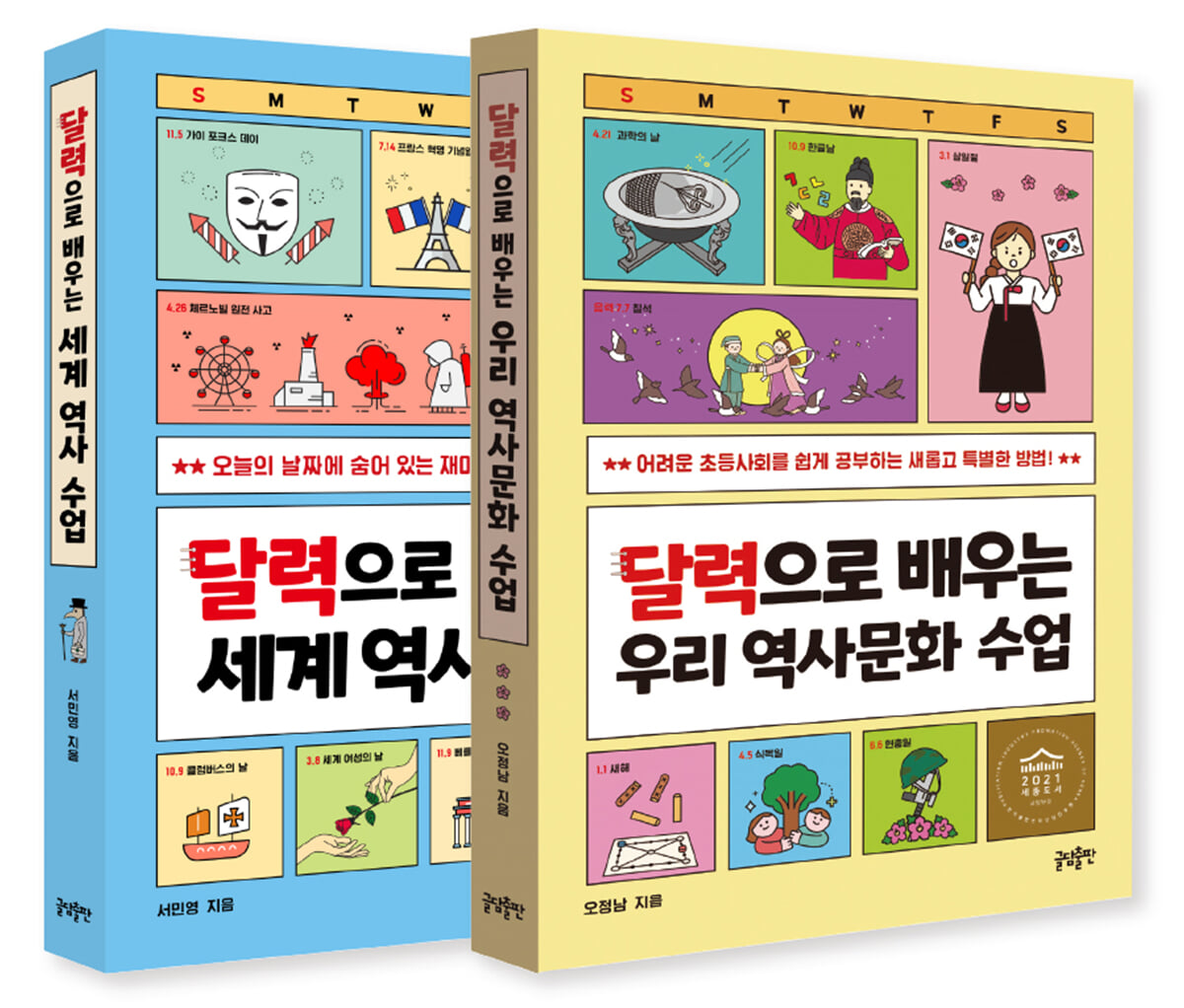
Our History and Culture Lessons through the Calendar + World History and Culture Lesson Set
 |
Description
Book Introduction
* 2021 Sejong Books * 2023 Youth Education Book of the Year Recommended Books
* School Library Journal Recommended Book * 100% Reflected in the Curriculum * Written by a Current Teacher
Just one minute a day is enough to immerse yourself in history!
A new history study book that doesn't require memorization!
Even children who don't like history can learn one thing a day in a fun way.
A 365-day calendar of historical stories
Learning our history and culture through the calendar
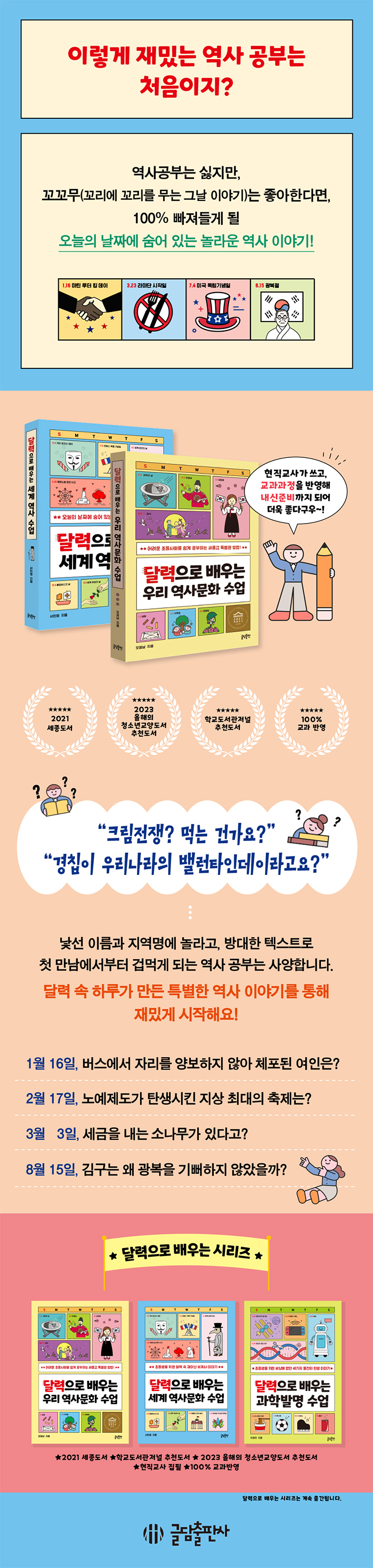
Is social studies something that must be memorized? Can't it be made easy and fun to study? This book contains the world's easiest social studies method, learned from a veteran elementary school teacher with 30 years of experience.
We introduce stories from the calendar that will naturally become a social study if you read one a day.
The calendar contains countless historical, cultural, and social stories.
For example, February 14th, known as Valentine's Day, holds the painful history of the death sentence given to Ahn Jung-geun, and seasonal holidays such as Ipchun and Sohan are steeped in our traditional culture.
Since elementary school teachers have carefully selected only the knowledge children need from a 365-day calendar, by the time you finish this book, you will have a solid foundation of background knowledge.
Textbooks become easier and understanding becomes faster.
It is told like a fun old story, so even children who hate studying or who hate books can enjoy it.
Going one step further, we've introduced activities and related knowledge that are good to do together on each date.
If you read, talk, and experience things together without any burden, your child's thinking will grow beyond recognition.
World History and Culture Lessons through the Calendar
For young people who struggle with history, a fascinating world history book has been published that is so fun to read that you'll get sucked in and even learn naturally.
A current teacher who is more dedicated to history education than anyone else tells the surprising world history stories hidden in the calendar.
It tells an interesting story that follows a single event, such as the day a war broke out because he loved tea so much, or the day the name of a bikini swimsuit was created.
Breaking free from the study of history that is confined to memorizing information such as years, people, and place names, it vividly shows the relevance of the events and their meaning to our lives today.
This makes us realize that today's ordinary day was once a historically significant day, and it shows us the fun and charm of history.
Yet, we did not miss the stories of the decisive events and key figures that changed the course of world history.
It also helps with schoolwork as it covers topics that are frequently tested and emphasized in the curriculum.
Another advantage is that it is easy to read without burden thanks to its short length and abundant photo materials.
* School Library Journal Recommended Book * 100% Reflected in the Curriculum * Written by a Current Teacher
Just one minute a day is enough to immerse yourself in history!
A new history study book that doesn't require memorization!
Even children who don't like history can learn one thing a day in a fun way.
A 365-day calendar of historical stories
Learning our history and culture through the calendar
Is social studies something that must be memorized? Can't it be made easy and fun to study? This book contains the world's easiest social studies method, learned from a veteran elementary school teacher with 30 years of experience.
We introduce stories from the calendar that will naturally become a social study if you read one a day.
The calendar contains countless historical, cultural, and social stories.
For example, February 14th, known as Valentine's Day, holds the painful history of the death sentence given to Ahn Jung-geun, and seasonal holidays such as Ipchun and Sohan are steeped in our traditional culture.
Since elementary school teachers have carefully selected only the knowledge children need from a 365-day calendar, by the time you finish this book, you will have a solid foundation of background knowledge.
Textbooks become easier and understanding becomes faster.
It is told like a fun old story, so even children who hate studying or who hate books can enjoy it.
Going one step further, we've introduced activities and related knowledge that are good to do together on each date.
If you read, talk, and experience things together without any burden, your child's thinking will grow beyond recognition.
World History and Culture Lessons through the Calendar
For young people who struggle with history, a fascinating world history book has been published that is so fun to read that you'll get sucked in and even learn naturally.
A current teacher who is more dedicated to history education than anyone else tells the surprising world history stories hidden in the calendar.
It tells an interesting story that follows a single event, such as the day a war broke out because he loved tea so much, or the day the name of a bikini swimsuit was created.
Breaking free from the study of history that is confined to memorizing information such as years, people, and place names, it vividly shows the relevance of the events and their meaning to our lives today.
This makes us realize that today's ordinary day was once a historically significant day, and it shows us the fun and charm of history.
Yet, we did not miss the stories of the decisive events and key figures that changed the course of world history.
It also helps with schoolwork as it covers topics that are frequently tested and emphasized in the curriculum.
Another advantage is that it is easy to read without burden thanks to its short length and abundant photo materials.
index
Learning our history and culture through the calendar
Chapter 1 Spring
From the Ipchunbang to the language of discrimination, our history and culture lessons are included from February to April.
-February
February 4th, the beginning of spring, a day to pray for good fortune to come with the arrival of spring.
The meaning of the first full moon of the lunar year, February 8th (the 15th day of the first lunar month)
Great people sentenced to death on Valentine's Day, February 14th
February 19th: Soybean Culture with Our People
Three Ways to Celebrate March 1st Independence Movement Day
March 3rd is Taxpayer's Day. There's a pine tree that pays taxes?
March 5th, Gyeongchip, Valentine's Day in Korea
-March
Three Ways to Celebrate March 1st Independence Movement Day
March 3rd is Taxpayer's Day. There's a pine tree that pays taxes?
March 5th, Gyeongchip, Valentine's Day in Korea
Why do we give out bread and roses on International Women's Day, March 8th?
March 15th, the anniversary of the March 15 Uprising, the first case in which the people regained their sovereignty.
March 20th, the first day of the spring equinox when ice is taken out of the icehouse.
March 22nd World Water Day: The Two Faces of Avocado
-April
April 4th, the day to extinguish the fire of Qingming
April 5th: A day to rekindle Korean cuisine
April 5th Arbor Day: A day to plant trees to commemorate the unification of the three kingdoms.
April 7, World Health Day: The King Who Suffered from Depression
April 11th, the anniversary of the establishment of the Provisional Government of the Republic of Korea. When did the name "Republic of Korea" come into being?
April 19th, the anniversary of the April 19 Revolution, laying the foundation for democracy in our country.
April 20th, the Day of Persons with Disabilities: The Language of Discrimination Used Unknowingly
April 21st Science Day: A science popularization movement launched for independence
April 22nd Information and Communications Day: The History of the Development of Communications in Korea
April 25th, Law Day: Is a bad law still a law?
April 28th, Admiral Yi Sun-sin's Birthday. The Reason Why Admiral Yi Sun-sin Was Able to Win
April 30th, Buddha's Birthday (April 8th in the lunar calendar) Calling for Equality in a Class-Based Society
Chapter 2 Summer
Our history and culture classes, from May to July, cover everything from Jeon Tae-il to the history of our country's constitution.
-May
May 1st Labor Day: Workers' Rescue Application
On May 5th, Children's Day, the world's first children's rights declaration was made.
Why do we give carnations on Parents' Day, May 8th?
May 15th Teacher's Day King Sejong, the teacher of the people
College students stand up to soldiers' gunfire on May 18, the anniversary of the May 18 Democratization Movement.
Coming of Age Day, May 18th (the third Monday in May) Did our country have a coming of age ceremony?
May 20th, the day when the Soman Bongsunga petals are dyed
Marine life suffering from trash on May 31st, World Oceans Day
-June
June 1st, Righteous Army Day, General Hong and the Taebaek Mountain Tiger
June 5th Environment Day: Swedish environmental activists changing the world
June 6th, Memorial Day: A day to learn the meaning of the fallen heroes
June 10th, the anniversary of the June 10th Democratic Uprising, aspirations for democracy
June 21st: If the King's virtue is lacking, there will be a drought.
June 25th, Dano (5th day of the 5th lunar month) The day when Chunhyang and Mongryong met
June 25th, the anniversary of the Korean War
-July
July 7th: The Great Men's Recreational Methods
Understanding why the Constitutional Law was amended on July 17th reveals modern history.
Chapter 3: Autumn
Our history and culture classes, from Korean independence to the history of punishment, from August to October.
-August
August 15th, Liberation Day: Why Kim Gu Wasn't Overjoyed by Liberation
August 23rd, the day of the first autumn
August 25th Chilseok (Lunar July 7th) The day when the Cowherd and the Weaver Girl meet
-September
Eating the morning dew of the white heron on September 7th cures internal ailments.
September 18th, Railway Day, the day when Korea's first railway opened
-october
Making Chuseok Together on October 1st (15th day of the 8th lunar month)
October 1st Armed Forces Day, a time when there was no military in our country
October 3rd National Foundation Day: Rereading the Dangun Myth
October 5th, World Korean Day: A Heartbreaking History of Overseas Migration
October 9th Hangeul Day Who really created Hangeul?
October 21st, Police Day. During the Goryeo Dynasty, soldiers were the police.
Who will be the president of the world on October 24th, United Nations Day?
October 25th, Dokdo Day: Proof that Dokdo is our country's territory
October 28th: Correction Day: The History of Punishment from Gojoseon to Joseon
Chapter 4 Winter
From the student independence movement to the coldest day of the year, our history and culture classes are covered from November to January.
-November
November 3rd, Student Independence Movement Day: The Lives of Students During the Japanese Colonial Period
Warm love and comfort delivered by Chigye-mi on November 7th
November 11th Farmers' Day Why is November 11th Farmers' Day?
Why Yun Bong-gil is so famous among the countless independence activists on November 17th, National Martyrs' Day.
-december
December 5th Trade Day: Fair Trade We Must Remember
December 21st, the day the sun comes back to life
December 25th Christmas Isn't December 25th the birthday of Jesus?
December 27th, Nuclear Safety and Promotion Day: The Chernobyl Nuclear Accident Caused by Human Error
-January
The reason why the New Year's Eve bell is struck 33 times on January 1st
January 6th: A solar term that announces the news of the cold season
World History and Culture Lessons through the Calendar
Chapter 1 Spring
World history lessons from March to May, from the women's suffrage struggle to Joan of Arc.
-March
March 8 * International Women's Day
Why did the female workers cry out for roses?
March 14 * Meiji Restoration Proclamation Day
Which country in Asia has modernized most quickly?
March 23 * Start of Ramadan (ninth month of the Islamic calendar)
Is there a religion where you can't eat for a month?
March 24 * World Tuberculosis Day
The day Koch, the father of bacteriology, discovered the tuberculosis bacillus
March 25 * International Day of Remembrance for the Victims of Slavery and the Atlantic Slave Trade
Why did the slave trade arise?
March 31 * Dalai Lama's exile
Why did Tibet's spiritual leader leave his country?
-April
April 6 * The first Athens Olympic Games were held.
Did the ancient Olympics have naked athletes?
April 7 * World Health Day
A plague that killed a third of Europe's population
April 23 * World Book and Copyright Day
What do world-renowned masters Shakespeare and Cervantes have in common?
April 26 * Chernobyl nuclear accident
Worst nuclear power plant explosion
April 29 * World Dance Day
Isn't France the birthplace of ballet?
-May
May 1st * Labor Day
If only I could work 8 hours a day… …!
May 4th * May 4th Movement
The Chinese independence movement that was sparked by Korea's March 1st Movement
May 12 * International Nurses Day
More people died because it was too dirty, not because of the war?
May 15 * First Middle East War
The war that began as a search for a Jewish homeland
May 27 * Buddha's Birthday (April 8th in the lunar calendar)
The truth realized under the Bodhi tree
May 30th * Joan of Arc Memorial Day
Joan of Arc, who saved her country as a neglected woman
Chapter 2.
summer
World history lessons from June to August, from the Normandy Landings to the atomic bomb.
-June
June 6 * Normandy Landings
The operation that decided victory in World War II
June 10 * Death of Alexander the Great
Alexander the Great, the conqueror who never lost a war
June 19th * Emancipation Day
The day all black American slaves found freedom
June 26 * World Day Against Drug Abuse
The war caused by Britain's excessive love of tea
June 28 * Sarajevo Incident
Two bullets that signaled the start of World War II
-July
July 4th * Independence Day
The Boston Tea Party, the signal for the American Revolution
July 14 * Bastille Day
Freedom and equality are the results of struggle.
July 15 * Crusaders' Conquest of Jerusalem
The 200-Year Battle Over Jerusalem
July 25 * Bayreuth Festival
Music you should never play in Israel
-August
August 2 * Battle of Cannae
Hannibal, the greatest general in history who rode an elephant
August 24 * Pompeii volcanic eruption
A city destroyed by a volcanic eruption
August 29 * International Day Against Nuclear Tests
The name of the swimsuit bikini is associated with nuclear testing?
Chapter 3: Autumn
World history lessons from September to November, from the end of World War II to Thanksgiving.
-September
September 2nd * End of World War II
The Japanese Emperor's Strange Apology
September 20th * Opening day of the 1st Cannes Film Festival
Why do we lay out a red carpet when welcoming distinguished guests?
-october
October 2 * International Day of Non-Violence
Gandhi liberated India from the British without violence.
October 2 * World Habitat Day (first Monday in October)
A fire that started in a bakery burns down houses in London.
October 9 * Columbus Day (second Monday in October)
Is this India? Please say India!
October 26 * Last case of smallpox
Why did an ancient civilization boasting advanced technology fall?
October 29 * Pulitzer's death date
Pulitzer, the guardian of the press
-November
November 5th * Guy Fawkes Day
A festival commemorating the failed assassination of the king
November 9 * Fall of the Berlin Wall
Unification achieved by German citizens
November 14th * Genghis Khan's birthday
Temujin, who hunted rats out of hunger, built the world's largest empire.
November 23 * Thanksgiving Day (fourth Thursday in November)
Immigrants who repaid kindness with enmity
Chapter 4 Winter
World history lessons from December to February, from the Nobel Prize to American independence.
-december
December 10 * Nobel Prize Ceremony
A day to award awards to people who have contributed to humanity around the world.
-January
January 3rd * Martin Luther's Excommunication Day
Can money erase the sins I've committed so far?
January 16 * Martin Luther King Day (third Monday in January)
Woman arrested for refusing to give up her seat on a bus
January 28 * The Humiliation of Canossa
The emperor stood barefoot in the snow and apologized to the Pope
-February
February 17th * Opening day of the Brazilian Carnival
The greatest festival on earth developed through slavery
February 19 * Copernicus' birthday
Copernicus was timid and reluctant to announce his heliocentric theory?
February 20 * President's Day (third Monday in February)
A day to commemorate the president who lost all his teeth while fighting for independence.
Chapter 1 Spring
From the Ipchunbang to the language of discrimination, our history and culture lessons are included from February to April.
-February
February 4th, the beginning of spring, a day to pray for good fortune to come with the arrival of spring.
The meaning of the first full moon of the lunar year, February 8th (the 15th day of the first lunar month)
Great people sentenced to death on Valentine's Day, February 14th
February 19th: Soybean Culture with Our People
Three Ways to Celebrate March 1st Independence Movement Day
March 3rd is Taxpayer's Day. There's a pine tree that pays taxes?
March 5th, Gyeongchip, Valentine's Day in Korea
-March
Three Ways to Celebrate March 1st Independence Movement Day
March 3rd is Taxpayer's Day. There's a pine tree that pays taxes?
March 5th, Gyeongchip, Valentine's Day in Korea
Why do we give out bread and roses on International Women's Day, March 8th?
March 15th, the anniversary of the March 15 Uprising, the first case in which the people regained their sovereignty.
March 20th, the first day of the spring equinox when ice is taken out of the icehouse.
March 22nd World Water Day: The Two Faces of Avocado
-April
April 4th, the day to extinguish the fire of Qingming
April 5th: A day to rekindle Korean cuisine
April 5th Arbor Day: A day to plant trees to commemorate the unification of the three kingdoms.
April 7, World Health Day: The King Who Suffered from Depression
April 11th, the anniversary of the establishment of the Provisional Government of the Republic of Korea. When did the name "Republic of Korea" come into being?
April 19th, the anniversary of the April 19 Revolution, laying the foundation for democracy in our country.
April 20th, the Day of Persons with Disabilities: The Language of Discrimination Used Unknowingly
April 21st Science Day: A science popularization movement launched for independence
April 22nd Information and Communications Day: The History of the Development of Communications in Korea
April 25th, Law Day: Is a bad law still a law?
April 28th, Admiral Yi Sun-sin's Birthday. The Reason Why Admiral Yi Sun-sin Was Able to Win
April 30th, Buddha's Birthday (April 8th in the lunar calendar) Calling for Equality in a Class-Based Society
Chapter 2 Summer
Our history and culture classes, from May to July, cover everything from Jeon Tae-il to the history of our country's constitution.
-May
May 1st Labor Day: Workers' Rescue Application
On May 5th, Children's Day, the world's first children's rights declaration was made.
Why do we give carnations on Parents' Day, May 8th?
May 15th Teacher's Day King Sejong, the teacher of the people
College students stand up to soldiers' gunfire on May 18, the anniversary of the May 18 Democratization Movement.
Coming of Age Day, May 18th (the third Monday in May) Did our country have a coming of age ceremony?
May 20th, the day when the Soman Bongsunga petals are dyed
Marine life suffering from trash on May 31st, World Oceans Day
-June
June 1st, Righteous Army Day, General Hong and the Taebaek Mountain Tiger
June 5th Environment Day: Swedish environmental activists changing the world
June 6th, Memorial Day: A day to learn the meaning of the fallen heroes
June 10th, the anniversary of the June 10th Democratic Uprising, aspirations for democracy
June 21st: If the King's virtue is lacking, there will be a drought.
June 25th, Dano (5th day of the 5th lunar month) The day when Chunhyang and Mongryong met
June 25th, the anniversary of the Korean War
-July
July 7th: The Great Men's Recreational Methods
Understanding why the Constitutional Law was amended on July 17th reveals modern history.
Chapter 3: Autumn
Our history and culture classes, from Korean independence to the history of punishment, from August to October.
-August
August 15th, Liberation Day: Why Kim Gu Wasn't Overjoyed by Liberation
August 23rd, the day of the first autumn
August 25th Chilseok (Lunar July 7th) The day when the Cowherd and the Weaver Girl meet
-September
Eating the morning dew of the white heron on September 7th cures internal ailments.
September 18th, Railway Day, the day when Korea's first railway opened
-october
Making Chuseok Together on October 1st (15th day of the 8th lunar month)
October 1st Armed Forces Day, a time when there was no military in our country
October 3rd National Foundation Day: Rereading the Dangun Myth
October 5th, World Korean Day: A Heartbreaking History of Overseas Migration
October 9th Hangeul Day Who really created Hangeul?
October 21st, Police Day. During the Goryeo Dynasty, soldiers were the police.
Who will be the president of the world on October 24th, United Nations Day?
October 25th, Dokdo Day: Proof that Dokdo is our country's territory
October 28th: Correction Day: The History of Punishment from Gojoseon to Joseon
Chapter 4 Winter
From the student independence movement to the coldest day of the year, our history and culture classes are covered from November to January.
-November
November 3rd, Student Independence Movement Day: The Lives of Students During the Japanese Colonial Period
Warm love and comfort delivered by Chigye-mi on November 7th
November 11th Farmers' Day Why is November 11th Farmers' Day?
Why Yun Bong-gil is so famous among the countless independence activists on November 17th, National Martyrs' Day.
-december
December 5th Trade Day: Fair Trade We Must Remember
December 21st, the day the sun comes back to life
December 25th Christmas Isn't December 25th the birthday of Jesus?
December 27th, Nuclear Safety and Promotion Day: The Chernobyl Nuclear Accident Caused by Human Error
-January
The reason why the New Year's Eve bell is struck 33 times on January 1st
January 6th: A solar term that announces the news of the cold season
World History and Culture Lessons through the Calendar
Chapter 1 Spring
World history lessons from March to May, from the women's suffrage struggle to Joan of Arc.
-March
March 8 * International Women's Day
Why did the female workers cry out for roses?
March 14 * Meiji Restoration Proclamation Day
Which country in Asia has modernized most quickly?
March 23 * Start of Ramadan (ninth month of the Islamic calendar)
Is there a religion where you can't eat for a month?
March 24 * World Tuberculosis Day
The day Koch, the father of bacteriology, discovered the tuberculosis bacillus
March 25 * International Day of Remembrance for the Victims of Slavery and the Atlantic Slave Trade
Why did the slave trade arise?
March 31 * Dalai Lama's exile
Why did Tibet's spiritual leader leave his country?
-April
April 6 * The first Athens Olympic Games were held.
Did the ancient Olympics have naked athletes?
April 7 * World Health Day
A plague that killed a third of Europe's population
April 23 * World Book and Copyright Day
What do world-renowned masters Shakespeare and Cervantes have in common?
April 26 * Chernobyl nuclear accident
Worst nuclear power plant explosion
April 29 * World Dance Day
Isn't France the birthplace of ballet?
-May
May 1st * Labor Day
If only I could work 8 hours a day… …!
May 4th * May 4th Movement
The Chinese independence movement that was sparked by Korea's March 1st Movement
May 12 * International Nurses Day
More people died because it was too dirty, not because of the war?
May 15 * First Middle East War
The war that began as a search for a Jewish homeland
May 27 * Buddha's Birthday (April 8th in the lunar calendar)
The truth realized under the Bodhi tree
May 30th * Joan of Arc Memorial Day
Joan of Arc, who saved her country as a neglected woman
Chapter 2.
summer
World history lessons from June to August, from the Normandy Landings to the atomic bomb.
-June
June 6 * Normandy Landings
The operation that decided victory in World War II
June 10 * Death of Alexander the Great
Alexander the Great, the conqueror who never lost a war
June 19th * Emancipation Day
The day all black American slaves found freedom
June 26 * World Day Against Drug Abuse
The war caused by Britain's excessive love of tea
June 28 * Sarajevo Incident
Two bullets that signaled the start of World War II
-July
July 4th * Independence Day
The Boston Tea Party, the signal for the American Revolution
July 14 * Bastille Day
Freedom and equality are the results of struggle.
July 15 * Crusaders' Conquest of Jerusalem
The 200-Year Battle Over Jerusalem
July 25 * Bayreuth Festival
Music you should never play in Israel
-August
August 2 * Battle of Cannae
Hannibal, the greatest general in history who rode an elephant
August 24 * Pompeii volcanic eruption
A city destroyed by a volcanic eruption
August 29 * International Day Against Nuclear Tests
The name of the swimsuit bikini is associated with nuclear testing?
Chapter 3: Autumn
World history lessons from September to November, from the end of World War II to Thanksgiving.
-September
September 2nd * End of World War II
The Japanese Emperor's Strange Apology
September 20th * Opening day of the 1st Cannes Film Festival
Why do we lay out a red carpet when welcoming distinguished guests?
-october
October 2 * International Day of Non-Violence
Gandhi liberated India from the British without violence.
October 2 * World Habitat Day (first Monday in October)
A fire that started in a bakery burns down houses in London.
October 9 * Columbus Day (second Monday in October)
Is this India? Please say India!
October 26 * Last case of smallpox
Why did an ancient civilization boasting advanced technology fall?
October 29 * Pulitzer's death date
Pulitzer, the guardian of the press
-November
November 5th * Guy Fawkes Day
A festival commemorating the failed assassination of the king
November 9 * Fall of the Berlin Wall
Unification achieved by German citizens
November 14th * Genghis Khan's birthday
Temujin, who hunted rats out of hunger, built the world's largest empire.
November 23 * Thanksgiving Day (fourth Thursday in November)
Immigrants who repaid kindness with enmity
Chapter 4 Winter
World history lessons from December to February, from the Nobel Prize to American independence.
-december
December 10 * Nobel Prize Ceremony
A day to award awards to people who have contributed to humanity around the world.
-January
January 3rd * Martin Luther's Excommunication Day
Can money erase the sins I've committed so far?
January 16 * Martin Luther King Day (third Monday in January)
Woman arrested for refusing to give up her seat on a bus
January 28 * The Humiliation of Canossa
The emperor stood barefoot in the snow and apologized to the Pope
-February
February 17th * Opening day of the Brazilian Carnival
The greatest festival on earth developed through slavery
February 19 * Copernicus' birthday
Copernicus was timid and reluctant to announce his heliocentric theory?
February 20 * President's Day (third Monday in February)
A day to commemorate the president who lost all his teeth while fighting for independence.
Detailed image
GOODS SPECIFICS
- Date of issue: March 20, 2025
- Page count, weight, size: 660 pages | 152*223*55mm
- ISBN13: 9791191309812
- ISBN10: 1191309819
You may also like
카테고리
korean


korean

![GQ KOREA Mark (Monthly): December [2025]](http://librairie.coreenne.fr/cdn/shop/files/8ef265dbbfbf186523ed75ba7319009d.jpg?v=1765340328&width=3840)


