

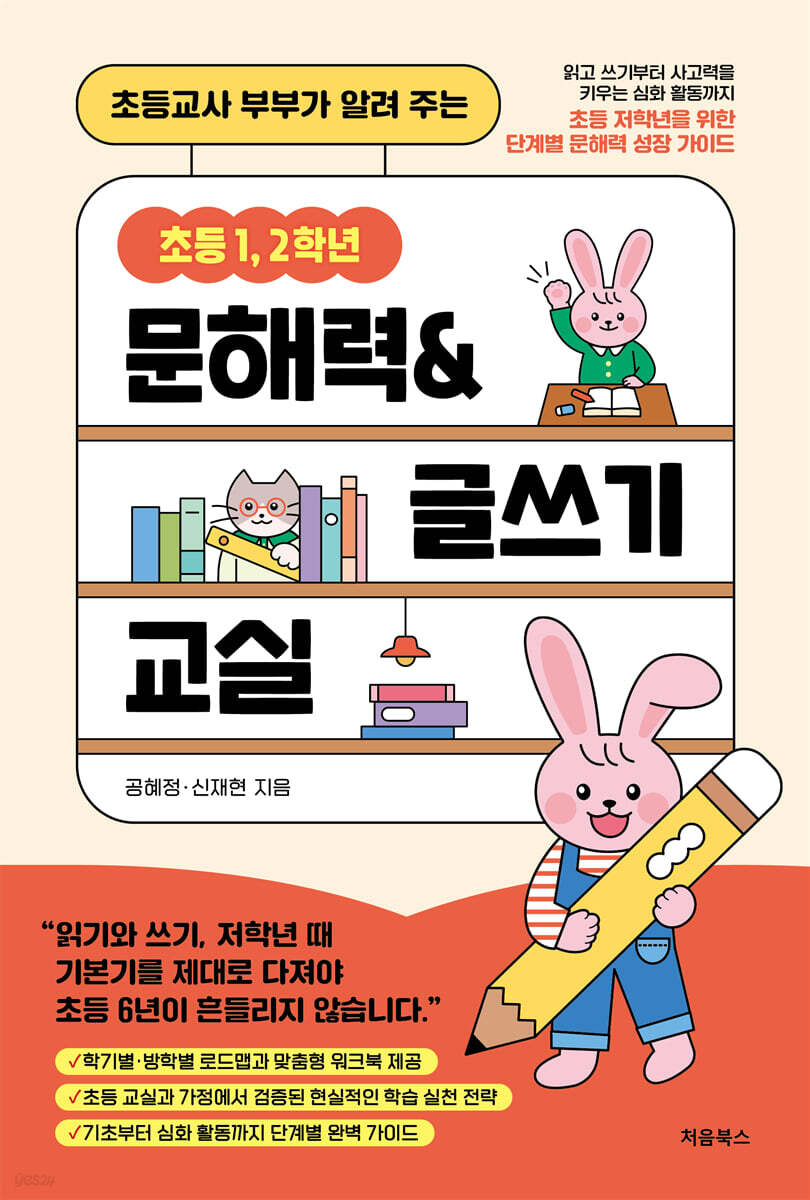
Literacy & Writing Class for 1st and 2nd Grade Elementary School Students
 |
Description
Book Introduction
A couple of current elementary school teachers who are serious about literacy education
Proven learning strategies implemented directly at school and at home!
The Complete Literacy Growth Guide for Early Elementary School Students
『Elementary 1st and 2nd Grade Literacy & Writing Classroom』 is a practical guide for literacy education in the lower elementary grades.
Elementary school teacher couple Gong Hye-jeong and Shin Jae-hyeon, who teach numerous children in their classrooms, have encountered the reality that the number of children who can read but do not understand is increasing.
These are children who can speak Korean just fine, but when they read a math problem, they get lost and don't know what to say, and when asked to write, they can't even organize a single sentence properly.
Children with poor literacy skills have difficulty not only learning but also making friends and expressing their emotions.
However, parents often think that it is 'okay' as long as their child can read.
Is that really true? Children today, accustomed to smartphones and YouTube videos, are increasingly losing their ability to read and understand long texts.
True literacy is not simply reading words, but understanding the content and expressing one's thoughts.
If literacy skills are not developed in the first and second grades of elementary school, students may face significant difficulties in later learning processes.
This book presents step-by-step reading and writing strategies that elementary school students must master.
This guide introduces how to integrate Korean language classes learned in school into the home, how to design a roadmap for improving literacy skills by semester and vacation, and a variety of activities proven effective in practice.
It also covers how to develop critical thinking and information interpretation skills, not just reading comprehension.
To help children develop literacy skills that will remain strong even in the age of YouTube and AI, we've also included practical literacy learning methods that can be practiced in a digital environment.
The final chapter contains answers to the most frequently asked questions from parents.
It offers clear answers to practical concerns such as, "What kind of environment do children with high literacy skills grow up in?", "Can literacy be improved while using digital devices?", and "Should I solve workbooks to improve literacy?"
Special appendices include dictation and central idea worksheets, classroom writing worksheets, and workbooks for tablet PC or printout.
This book is not simply a theory book, but is designed for children and parents to put into practice together.
The first and second grades of elementary school are a golden time to develop literacy skills.
If we miss this period, the learning gap will only widen.
"Elementary 1st and 2nd Grade Literacy & Writing Classroom" presents the most realistic and effective methods to help our children develop unwavering literacy skills.
Proven learning strategies implemented directly at school and at home!
The Complete Literacy Growth Guide for Early Elementary School Students
『Elementary 1st and 2nd Grade Literacy & Writing Classroom』 is a practical guide for literacy education in the lower elementary grades.
Elementary school teacher couple Gong Hye-jeong and Shin Jae-hyeon, who teach numerous children in their classrooms, have encountered the reality that the number of children who can read but do not understand is increasing.
These are children who can speak Korean just fine, but when they read a math problem, they get lost and don't know what to say, and when asked to write, they can't even organize a single sentence properly.
Children with poor literacy skills have difficulty not only learning but also making friends and expressing their emotions.
However, parents often think that it is 'okay' as long as their child can read.
Is that really true? Children today, accustomed to smartphones and YouTube videos, are increasingly losing their ability to read and understand long texts.
True literacy is not simply reading words, but understanding the content and expressing one's thoughts.
If literacy skills are not developed in the first and second grades of elementary school, students may face significant difficulties in later learning processes.
This book presents step-by-step reading and writing strategies that elementary school students must master.
This guide introduces how to integrate Korean language classes learned in school into the home, how to design a roadmap for improving literacy skills by semester and vacation, and a variety of activities proven effective in practice.
It also covers how to develop critical thinking and information interpretation skills, not just reading comprehension.
To help children develop literacy skills that will remain strong even in the age of YouTube and AI, we've also included practical literacy learning methods that can be practiced in a digital environment.
The final chapter contains answers to the most frequently asked questions from parents.
It offers clear answers to practical concerns such as, "What kind of environment do children with high literacy skills grow up in?", "Can literacy be improved while using digital devices?", and "Should I solve workbooks to improve literacy?"
Special appendices include dictation and central idea worksheets, classroom writing worksheets, and workbooks for tablet PC or printout.
This book is not simply a theory book, but is designed for children and parents to put into practice together.
The first and second grades of elementary school are a golden time to develop literacy skills.
If we miss this period, the learning gap will only widen.
"Elementary 1st and 2nd Grade Literacy & Writing Classroom" presents the most realistic and effective methods to help our children develop unwavering literacy skills.
- You can preview some of the book's contents.
Preview
index
Prologue: A Literacy Journey with Children
Chapter 1.
Elementary 1st and 2nd grade literacy skills you can't miss
Why is literacy important?
How does elementary school students' literacy develop?
Chapter 2.
How will Korean language education be conducted in first grade elementary school?
First grade Korean language, what will you learn in the first semester?
The effects of Korean language classes in the first semester of the first year
First grade Korean language, what will we learn in the second semester?
The effect of Korean language classes in the second semester of the first year
Chapter 3.
Elementary 1st Grade Literacy Enhancement Activities You Can Do at Home
First semester literacy enrichment activities
Summer Vacation Literacy Enhancement Activities
Second semester literacy enrichment activities
Winter Break Literacy Enhancement Activities
Chapter 4.
First Grade Literacy Writing at Home
First semester to become familiar with writing
A summer vacation that leaves unforgettable memories and records them.
Second semester, writing a short essay
Winter break to expand your writing thinking
Chapter 5.
How will Korean language education be conducted in second grade elementary school?
What will second grade Korean learn in the first semester?
The effects of Korean language classes in the first semester of the second year
What will second grade Korean learn in the second semester?
The effects of Korean language classes in the second semester of the second year
Chapter 6.
Second Grade Literacy Enhancement Activities You Can Do at Home
First semester literacy enrichment activities
Summer Vacation Literacy Enhancement Activities
Second semester literacy enrichment activities
Winter Break Literacy Enhancement Activities
Chapter 7.
Second Grade Literacy Writing at Home
The first semester, when full-fledged writing begins
Summer vacation where you can enjoy various activities
Second semester: experiencing practical writing
Winter break with fun writing activities
Chapter 8.
Elementary Literacy Q&A
Chapter 1.
Elementary 1st and 2nd grade literacy skills you can't miss
Why is literacy important?
How does elementary school students' literacy develop?
Chapter 2.
How will Korean language education be conducted in first grade elementary school?
First grade Korean language, what will you learn in the first semester?
The effects of Korean language classes in the first semester of the first year
First grade Korean language, what will we learn in the second semester?
The effect of Korean language classes in the second semester of the first year
Chapter 3.
Elementary 1st Grade Literacy Enhancement Activities You Can Do at Home
First semester literacy enrichment activities
Summer Vacation Literacy Enhancement Activities
Second semester literacy enrichment activities
Winter Break Literacy Enhancement Activities
Chapter 4.
First Grade Literacy Writing at Home
First semester to become familiar with writing
A summer vacation that leaves unforgettable memories and records them.
Second semester, writing a short essay
Winter break to expand your writing thinking
Chapter 5.
How will Korean language education be conducted in second grade elementary school?
What will second grade Korean learn in the first semester?
The effects of Korean language classes in the first semester of the second year
What will second grade Korean learn in the second semester?
The effects of Korean language classes in the second semester of the second year
Chapter 6.
Second Grade Literacy Enhancement Activities You Can Do at Home
First semester literacy enrichment activities
Summer Vacation Literacy Enhancement Activities
Second semester literacy enrichment activities
Winter Break Literacy Enhancement Activities
Chapter 7.
Second Grade Literacy Writing at Home
The first semester, when full-fledged writing begins
Summer vacation where you can enjoy various activities
Second semester: experiencing practical writing
Winter break with fun writing activities
Chapter 8.
Elementary Literacy Q&A
Detailed image

Into the book
The advent of AI has made literacy even more essential.
Now, it seems like AI and ChatGPT will write for us, find and summarize all the information our children want to know, and even do all their homework. But with the advent of such convenient AI, why has literacy become even more necessary?
Literacy has two dimensions.
There's functional literacy, which involves simply finding information and understanding superficial content, and higher-order literacy, which involves understanding or guessing at more complex contexts and grasping situations. With the advent of AI, functional literacy, which focuses on simple information processing, can now be entrusted to AI.
But when more is needed, the human role is crucial.
For children to effectively utilize AI, they need to go beyond simply asking questions to AI. They need to be able to think about what questions to ask and critically examine AI's answers.
So, in our children's generation, it is essential to have literacy skills that are not simple but complex.
It's done.
In other words, the ability to deeply understand and clearly grasp intent has become crucial. Based on the answers provided by AI, we need to be able to dig deeper, asking questions like, "Why did they give this answer?" and "Where did this information come from?"
Only by possessing these capabilities will you be able to properly ask questions or give commands to AI, and you will be able to skillfully delegate simple information processing tasks to AI as a tool.
In the AI era, children need to develop the ability to use AI wisely as a tool.
The foundation begins with literacy.
Now is the time to develop higher-level literacy skills that go beyond simple reading, to understanding context and thinking critically.
--- p..23~24
Literacy is not something that is accomplished all at once, but rather develops gradually through sequential stages.
After entering elementary school, students start at the early literacy stage (grades 1-2) and gradually move up to the basic literacy stage (grades 3-4) and functional literacy stage (grades 5-6).
Therefore, it is important to first establish a solid foundation in early literacy.
During this period, children learn the Korean alphabet, connect letters and sounds, and build the fundamental skills to read and write.
The biggest thing parents can do during this time is to clearly help their children learn Hangul.
It is important to master this process well because it is an important period in which the spoken language heard from childhood is converted into written language.
--- p..26~27
One of the important tasks after entering elementary school is forming peer relationships and developing social skills.
However, students with poor literacy skills also have difficulties in peer relationships.
When communicating with friends, you need to focus and participate in the communication between children, but when you fail to do so, problems may arise between friends.
There are times when we are unable to enjoy playing or playing games together.
Because they lack the ability to understand and communicate the rules, they are unable to participate in the game.
Let's take an example of what's happening in our classroom right now.
[Situation 1: Playing hide-and-seek]
· Children with high literacy skills_ They immediately understand the rules, such as 'The tagger closes his eyes and counts to 10, while the other friends hide,' and participate in the game.
· Children with poor literacy skills_ They may not fully understand the rule, “The tagger closes his eyes,” and may follow their friends with their eyes open, or instead of counting to 10, they may count to 5 and shout, “I found them all!”
This causes friends to complain, saying, “Why don’t you follow the rules?” and the child feels aggrieved or upset because he or she doesn’t know what he or she did wrong.
--- p..32~33
The important things to include are the date and weather.
Weather can be expressed in a variety of ways, such as through pictures or text. By encouraging diverse and creative expressions, such as “the day the sky is sad and sheds tears,” “the day I shower in sweat,” or “the day the world becomes a refrigerator,” your child’s observation skills will naturally develop.
Above all, you need to find a good subject to write about, but some friends have difficulty with this.
Even if there isn't anything particularly memorable about the daily routine, you should be able to capture something worth remembering when you look back on that day.
In fact, if you look closely, you may find something special in your everyday dinner, or you may encounter something unusual on your way to school.
Many children encounter difficulties with spacing and spelling when writing a diary by composing sentences.
I'm good at studying grammar, but when I actually write my diary, I often make mistakes in grammar.
There are many errors that occur, such as the period being placed in the wrong place, or the first space at the beginning being left blank when it should have been.
There is no child who is good at something all at once.
These parts can also be changed little by little and steadily.
--- p..78~79
Grammar studies continue intermittently during the second semester of the second year.
Let's continue to study how to write correctly by distinguishing between confusing pronunciations and spellings that are easy to misspell, so that we can read and write with correct pronunciation and spelling.
As the second semester draws to a close, you should strive to improve your Korean pronunciation and spelling accuracy.
[Please mark the sentence with the correct spelling among the following words.]
○ We built a new house.
( ) / We built a new house.
( )
○ The wind was very strong yesterday.
( ) / The wind was very strong yesterday.
( )
--- p..204~205
If you systematically write about your field trips or travel experiences during your vacation, it will be a time you will remember for a long time.
Although travel writing is a type of writing that is taught in higher grades, it is a good activity to ask appropriate questions and write by answering them, leaving aside the formal elements of travel writing.
Additionally, please include activities that allow students to compare their writing to other things when writing.
These activities are great because you can naturally learn elements like Korean language knowledge and grammar while writing.
If you incorporate elements of writing and grammar into your writing, your children's writing skills will improve significantly.
--- p..257
'Three-line writing' is a writing instruction method that is widely used in schools these days.
Giving children a topic they find interesting and relevant and having them write three lines about it is a great way to make writing less burdensome.
At school, we use morning activity time or creative writing time to do 'three-line writing'. Along with 'writing a gratitude journal', it is good because it doesn't take much time and can improve writing skills.
The three-line writing exercise, which fosters children's imagination and broad thinking skills, is also great for teaching at home.
If you find writing material that interests students and suggest writing material that suits their grade level and characteristics, students will be able to enjoy writing three lines.
Now, it seems like AI and ChatGPT will write for us, find and summarize all the information our children want to know, and even do all their homework. But with the advent of such convenient AI, why has literacy become even more necessary?
Literacy has two dimensions.
There's functional literacy, which involves simply finding information and understanding superficial content, and higher-order literacy, which involves understanding or guessing at more complex contexts and grasping situations. With the advent of AI, functional literacy, which focuses on simple information processing, can now be entrusted to AI.
But when more is needed, the human role is crucial.
For children to effectively utilize AI, they need to go beyond simply asking questions to AI. They need to be able to think about what questions to ask and critically examine AI's answers.
So, in our children's generation, it is essential to have literacy skills that are not simple but complex.
It's done.
In other words, the ability to deeply understand and clearly grasp intent has become crucial. Based on the answers provided by AI, we need to be able to dig deeper, asking questions like, "Why did they give this answer?" and "Where did this information come from?"
Only by possessing these capabilities will you be able to properly ask questions or give commands to AI, and you will be able to skillfully delegate simple information processing tasks to AI as a tool.
In the AI era, children need to develop the ability to use AI wisely as a tool.
The foundation begins with literacy.
Now is the time to develop higher-level literacy skills that go beyond simple reading, to understanding context and thinking critically.
--- p..23~24
Literacy is not something that is accomplished all at once, but rather develops gradually through sequential stages.
After entering elementary school, students start at the early literacy stage (grades 1-2) and gradually move up to the basic literacy stage (grades 3-4) and functional literacy stage (grades 5-6).
Therefore, it is important to first establish a solid foundation in early literacy.
During this period, children learn the Korean alphabet, connect letters and sounds, and build the fundamental skills to read and write.
The biggest thing parents can do during this time is to clearly help their children learn Hangul.
It is important to master this process well because it is an important period in which the spoken language heard from childhood is converted into written language.
--- p..26~27
One of the important tasks after entering elementary school is forming peer relationships and developing social skills.
However, students with poor literacy skills also have difficulties in peer relationships.
When communicating with friends, you need to focus and participate in the communication between children, but when you fail to do so, problems may arise between friends.
There are times when we are unable to enjoy playing or playing games together.
Because they lack the ability to understand and communicate the rules, they are unable to participate in the game.
Let's take an example of what's happening in our classroom right now.
[Situation 1: Playing hide-and-seek]
· Children with high literacy skills_ They immediately understand the rules, such as 'The tagger closes his eyes and counts to 10, while the other friends hide,' and participate in the game.
· Children with poor literacy skills_ They may not fully understand the rule, “The tagger closes his eyes,” and may follow their friends with their eyes open, or instead of counting to 10, they may count to 5 and shout, “I found them all!”
This causes friends to complain, saying, “Why don’t you follow the rules?” and the child feels aggrieved or upset because he or she doesn’t know what he or she did wrong.
--- p..32~33
The important things to include are the date and weather.
Weather can be expressed in a variety of ways, such as through pictures or text. By encouraging diverse and creative expressions, such as “the day the sky is sad and sheds tears,” “the day I shower in sweat,” or “the day the world becomes a refrigerator,” your child’s observation skills will naturally develop.
Above all, you need to find a good subject to write about, but some friends have difficulty with this.
Even if there isn't anything particularly memorable about the daily routine, you should be able to capture something worth remembering when you look back on that day.
In fact, if you look closely, you may find something special in your everyday dinner, or you may encounter something unusual on your way to school.
Many children encounter difficulties with spacing and spelling when writing a diary by composing sentences.
I'm good at studying grammar, but when I actually write my diary, I often make mistakes in grammar.
There are many errors that occur, such as the period being placed in the wrong place, or the first space at the beginning being left blank when it should have been.
There is no child who is good at something all at once.
These parts can also be changed little by little and steadily.
--- p..78~79
Grammar studies continue intermittently during the second semester of the second year.
Let's continue to study how to write correctly by distinguishing between confusing pronunciations and spellings that are easy to misspell, so that we can read and write with correct pronunciation and spelling.
As the second semester draws to a close, you should strive to improve your Korean pronunciation and spelling accuracy.
[Please mark the sentence with the correct spelling among the following words.]
○ We built a new house.
( ) / We built a new house.
( )
○ The wind was very strong yesterday.
( ) / The wind was very strong yesterday.
( )
--- p..204~205
If you systematically write about your field trips or travel experiences during your vacation, it will be a time you will remember for a long time.
Although travel writing is a type of writing that is taught in higher grades, it is a good activity to ask appropriate questions and write by answering them, leaving aside the formal elements of travel writing.
Additionally, please include activities that allow students to compare their writing to other things when writing.
These activities are great because you can naturally learn elements like Korean language knowledge and grammar while writing.
If you incorporate elements of writing and grammar into your writing, your children's writing skills will improve significantly.
--- p..257
'Three-line writing' is a writing instruction method that is widely used in schools these days.
Giving children a topic they find interesting and relevant and having them write three lines about it is a great way to make writing less burdensome.
At school, we use morning activity time or creative writing time to do 'three-line writing'. Along with 'writing a gratitude journal', it is good because it doesn't take much time and can improve writing skills.
The three-line writing exercise, which fosters children's imagination and broad thinking skills, is also great for teaching at home.
If you find writing material that interests students and suggest writing material that suits their grade level and characteristics, students will be able to enjoy writing three lines.
--- p..264
GOODS SPECIFICS
- Date of issue: April 1, 2025
- Page count, weight, size: 300 pages | 464g | 152*225*18mm
- ISBN13: 9791170222934
You may also like
카테고리
korean


korean

![GQ KOREA Mark (Monthly): December [2025]](http://librairie.coreenne.fr/cdn/shop/files/8ef265dbbfbf186523ed75ba7319009d.jpg?v=1765340328&width=3840)


