

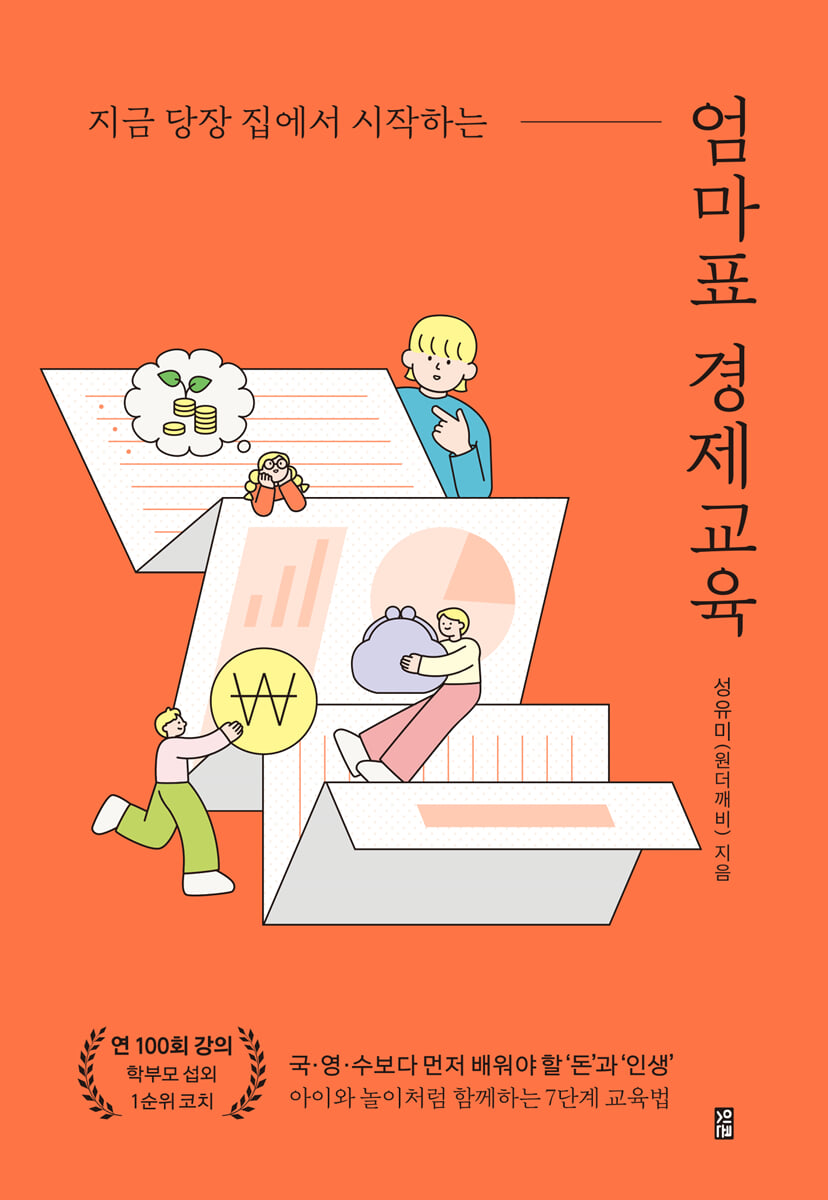
Mom's Economic Education
 |
Description
Book Introduction
The goal of mother-style economic education, as described by author Seong, is not to 'give children a lot of money.'
More importantly, it is about developing the power to protect oneself in a difficult world, that is, ‘self-direction’ and ‘judgment.’
The ultimate goal is to help children become confident and independent, and for parents to prepare for a stable retirement, by teaching them to wisely solve the big and small problems they encounter in life.
What you need for this is neither expensive lectures from famous lecturers nor an incredible amount of economic knowledge.
Only the parents' constant interest and questions are enough.
Don't put it off, start now, don't overthink it, and start at home, step by step, with your children, into the world of fun economic education.
More importantly, it is about developing the power to protect oneself in a difficult world, that is, ‘self-direction’ and ‘judgment.’
The ultimate goal is to help children become confident and independent, and for parents to prepare for a stable retirement, by teaching them to wisely solve the big and small problems they encounter in life.
What you need for this is neither expensive lectures from famous lecturers nor an incredible amount of economic knowledge.
Only the parents' constant interest and questions are enough.
Don't put it off, start now, don't overthink it, and start at home, step by step, with your children, into the world of fun economic education.
- You can preview some of the book's contents.
Preview
index
Prologue: In an age where it's hard to make friends without money
Chapter 1 · Hey guys, what on earth is money?
- These days, children's dream is to be a rich, unemployed person.
- Is there a proper children's economics school?
- Will our children be able to compete with AI?
7 Steps to Learning Money to Develop Self-Initiative
- [One Step Further] 3 Roles of Money We Never Knew
Chapter 2: Learning the Value of Labor through Housework
- Kids these days have never seen their parents earn money.
Home Part-time Jobs: Demonstrating the Value of Labor
- What kind of work should I do and how much should I pay?
- Types of home jobs available by age group
Chapter 3: Let's set some rules for our household allowance.
- How much allowance would be appropriate?
- Two ways to give pocket money
- 'Allowance Plan' where you decide on your own amount
- An allowance agreement written by parents and children together
- A 'fine menu' that replaces nagging
- [One step further] My child keeps asking me to pay.
Chapter 4: Create 3 Piggy Banks That Make Your Dreams Come True
- Adults split their bankbooks, children split their piggy banks.
- The beginning of money management is 'naming'.
- 'Pocket Money Map' that directly manages the flow of money
- How much should I put in which piggy bank?
- [One Step Further] The Problem of Reporting Gifts of Money Saved for a Child
Chapter 5: Learn to Spend Money Wisely
Pizza vs. Chicken: What Should I Eat for Dinner Tonight?
- A child who only plays games, a child who also plays games
The Value of "Convenience" Revealed by YouTube Subscription Fees
- Children's Sparrow Mill, Learning at a Convenience Store
- [One Step Further] Why Should I Use an Allowance Record Book?
Chapter 6: Earn Money Outside the Home
- The Little Farmers' 'Experience Life'
- Sell unused items at flea markets
- Online second-hand trading for children
- The story of founding 'Dragon's Cotton Candy' Co., Ltd.
- Mom, not everyone can do business.
- The story of my middle school-aged eldest son buying a buffet
- [One Step Further] Extracurricular Activities for Children to Showcase Their Talents
Chapter 7: Learn How Money Makes Money
- The concept of a joint stock company learned from the ramen factory video
- Our Child's First Stock Investment Story
- Investment ideas to explore with your kids
- What if cola gave you dollars instead of cavities?
- Rules of 'decimal investing' for children
- The end of those who 'speculated' rather than invested
- [One Step Further] The Story Behind the 'Dad' Project
Chapter 8: Sharing the Fruit I Have with the World
- What would you do if you had 10 billion won?
- Donating money through a donation piggy bank
- Donate goods by sending them directly
- Donate your time to help the world by moving your body.
- Donating talent to make each other happy with small skills
- [One step further] Where do I make a donation?
Chapter 9: Design Your Own Future
- Save up your allowance and go on a 'dream trip'
- Please make a dream business card for your child.
The ultimate goal of parenting should be the child's independence.
Epilogue: My Child Has Changed
Appendix: Materials to Support Mom's Economic Education
Chapter 1 · Hey guys, what on earth is money?
- These days, children's dream is to be a rich, unemployed person.
- Is there a proper children's economics school?
- Will our children be able to compete with AI?
7 Steps to Learning Money to Develop Self-Initiative
- [One Step Further] 3 Roles of Money We Never Knew
Chapter 2: Learning the Value of Labor through Housework
- Kids these days have never seen their parents earn money.
Home Part-time Jobs: Demonstrating the Value of Labor
- What kind of work should I do and how much should I pay?
- Types of home jobs available by age group
Chapter 3: Let's set some rules for our household allowance.
- How much allowance would be appropriate?
- Two ways to give pocket money
- 'Allowance Plan' where you decide on your own amount
- An allowance agreement written by parents and children together
- A 'fine menu' that replaces nagging
- [One step further] My child keeps asking me to pay.
Chapter 4: Create 3 Piggy Banks That Make Your Dreams Come True
- Adults split their bankbooks, children split their piggy banks.
- The beginning of money management is 'naming'.
- 'Pocket Money Map' that directly manages the flow of money
- How much should I put in which piggy bank?
- [One Step Further] The Problem of Reporting Gifts of Money Saved for a Child
Chapter 5: Learn to Spend Money Wisely
Pizza vs. Chicken: What Should I Eat for Dinner Tonight?
- A child who only plays games, a child who also plays games
The Value of "Convenience" Revealed by YouTube Subscription Fees
- Children's Sparrow Mill, Learning at a Convenience Store
- [One Step Further] Why Should I Use an Allowance Record Book?
Chapter 6: Earn Money Outside the Home
- The Little Farmers' 'Experience Life'
- Sell unused items at flea markets
- Online second-hand trading for children
- The story of founding 'Dragon's Cotton Candy' Co., Ltd.
- Mom, not everyone can do business.
- The story of my middle school-aged eldest son buying a buffet
- [One Step Further] Extracurricular Activities for Children to Showcase Their Talents
Chapter 7: Learn How Money Makes Money
- The concept of a joint stock company learned from the ramen factory video
- Our Child's First Stock Investment Story
- Investment ideas to explore with your kids
- What if cola gave you dollars instead of cavities?
- Rules of 'decimal investing' for children
- The end of those who 'speculated' rather than invested
- [One Step Further] The Story Behind the 'Dad' Project
Chapter 8: Sharing the Fruit I Have with the World
- What would you do if you had 10 billion won?
- Donating money through a donation piggy bank
- Donate goods by sending them directly
- Donate your time to help the world by moving your body.
- Donating talent to make each other happy with small skills
- [One step further] Where do I make a donation?
Chapter 9: Design Your Own Future
- Save up your allowance and go on a 'dream trip'
- Please make a dream business card for your child.
The ultimate goal of parenting should be the child's independence.
Epilogue: My Child Has Changed
Appendix: Materials to Support Mom's Economic Education
Detailed image

Into the book
“My child spends money without any sense.” “He always asks for an allowance, but I don’t know if it’s right to keep giving it to him.” In fact, many mothers feel the need for financial education around the third grade, when children begin to spend money in earnest.
(...) But there is something regrettable.
Money education should start with learning how to earn and save money, but children have already learned the 'taste of spending' first.
So, the earlier you start economic education, the better.
If possible, it's better to start before you get used to spending money.
It would be better if you were at an age where you could be grateful for even a single coin.
But we can't be discouraged by the delay, can we? After all, today is the earliest day of the remaining days.
--- p.6, from “In an era where it is difficult to make friends without money”
The production team asked fifth graders to draw a picture of themselves 20 years from now.
From a child who said he would become unemployed because he had nothing he wanted to do, to a child who said he would work part-time at a convenience store and play soccer, the children were talking about the very realities of life.
He was depressed, saying that the reason adults work is just to make money, and that he just wants to live comfortably like he does now without making money.
(…) Realistic kids who want to be unemployed anyway and become ‘rich’ unemployed, and on the other hand, kids who talk about empty dreams and ignore reality.
Who can blame them?
Maybe it was our adults who showed us that kind of behavior.
Because children learn everything from their parents, including their words, actions, and way of thinking.
--- p.18, from “These days, children’s dream is to be ‘rich, unemployed’”
I believe that economic education is a good means of developing the ability to think independently.
Can you discover and solve the world's problems, can you make rational choices in countless moments of choice?
Practicing this is what economic education is all about.
(...) In particular, the insight, problem-solving skills, and self-directedness that I mentioned earlier can all be trained through economic education.
Economic education is an education that not only solves current economic problems but also prepares for the future.
--- p.36, from “7 Steps to Studying Money to Develop Self-Initiative”
The best way to appreciate the value of labor is to earn money yourself.
Even we adults realize that it is really hard to take other people's money only after we get a job and start earning money.
So I think children's allowance should also be defined as earned income.
The idea is to establish allowance as an income that is earned through work, rather than receiving it for free.
(…) the experience of converting labor and time into money.
Through this, children will learn that earning money requires effort, and in the process, they will naturally learn the value of labor.
And wouldn't you naturally cherish the money you earn this way?
--- p.57, from “Home Part-time Jobs” that Show the Value of Labor
“My child is in grade ○ of elementary school. How much allowance is appropriate?” This is one of the most frequently asked questions during parent education sessions.
However, the amount of allowance has nothing to do with grade or age.
Some kids go straight to their academy after school without stopping by home, so they have to buy dinner out.
On the other hand, some friends live close by and can eat at home.
(...) List out your child's daily routine for a week.
And in between, check where and how much money you need.
Transportation, snacks, hobbies…
And we talk about how much extra money we need to spend on hanging out with friends.
Then you will get the basic amount of allowance you need.
--- p.79, from “How much allowance is appropriate?”
Have you established rules for receiving allowances and a clear plan for how to use them? Now, let's finally draw up a contract.
(...) Don't think too hard, don't be concerned about the format, let's start very comfortably.
Here's what should be included in your allowance agreement:
/ The person giving the allowance (A) and the person receiving it (B) / The obligations and rights of A and B and how to manage the allowance / The cycle, date, and amount of allowance payment / How to use the fine / Contract period / Special provisions (How to use special allowance such as New Year's money) (...) In my house, if you receive a special allowance, you have to save 50% unconditionally, but the amount that can be taken for consumption purposes is limited to a maximum of 50,000 won.
If you received 140,000 won as New Year's money, you should have originally saved 50% of it, which is 70,000 won, but you decided in advance that you can freely spend up to 50,000 won and save the remaining 90,000 won.
--- p.97, from “An allowance contract written by parents and children together”
When I receive my allowance, I first divide it into four categories: spending, saving, investing, and donating.
It's the process of physically dividing money.
Of these, the amount corresponding to 'consumption' will be kept in the wallet, and the amounts for savings, investment, and donation will be divided into three piggy banks with their respective names written on them.
You can decide with your child how much to put in each piggy bank.
In addition to the three piggy banks, you may also want to create a separate piggy bank for a special purpose.
My second child made a separate 'emergency fund' piggy bank, saying he would use it at the apartment night market, when going to the movies with friends, or when buying game money.
--- p.115, from “The Beginning of Money Management is ‘Naming’”
Mom: "Second child, if you buy it at the unmanned store over there, it's half price. Why did you buy it at the convenience store? You can get two for the same price there."
// Second: Mom, listen carefully.
Of course I want to eat two too.
But I saved time by eating two.
// Mom: What are you talking about? // Second: The convenience store is a minute away from the Taekwondo academy, but the unmanned store is a 7-8 minute walk away.
I think it's better to buy it at the convenience store even if it costs twice as much than to waste 15 minutes round trip.
Because my time is precious.
--- p.162, from “Children’s Sparrow Mill, Learning at a Convenience Store”
“If you give me half the price of the cotton candy machine, I’ll give you half of the money I make from selling cotton candy later!” (...) The next day, the child researched cotton candy making materials and sales tools and added them to his business plan.
And then I started looking through books I had at home and started studying about 'how to issue stocks'.
They say that stocks are like receipts, so you just have to write down how much you invested.
That way, investors will feel reassured.
Then, even though they haven't even bought the machine yet, they make a box to receive money from.
Oh my, this guy is serious about the cotton candy business?
--- p.188, from “The story of the founding of ‘Dinosaur Cotton Candy’ Co., Ltd.”
“Mother, your son is truly amazing. It’s rare to find a child with such specific dreams at this age.
But I was surprised when he told me in detail that his dream was to become a 'subway design designer' and what efforts he was making to achieve it.
“I heard you’re saving up money to go to Busan on the subway soon?” (...) At home, you were a strange child who seemed to lack something, but at school, you were talking about your dreams so confidently.
Isn't this the true effect of economic education?
(...) But there is something regrettable.
Money education should start with learning how to earn and save money, but children have already learned the 'taste of spending' first.
So, the earlier you start economic education, the better.
If possible, it's better to start before you get used to spending money.
It would be better if you were at an age where you could be grateful for even a single coin.
But we can't be discouraged by the delay, can we? After all, today is the earliest day of the remaining days.
--- p.6, from “In an era where it is difficult to make friends without money”
The production team asked fifth graders to draw a picture of themselves 20 years from now.
From a child who said he would become unemployed because he had nothing he wanted to do, to a child who said he would work part-time at a convenience store and play soccer, the children were talking about the very realities of life.
He was depressed, saying that the reason adults work is just to make money, and that he just wants to live comfortably like he does now without making money.
(…) Realistic kids who want to be unemployed anyway and become ‘rich’ unemployed, and on the other hand, kids who talk about empty dreams and ignore reality.
Who can blame them?
Maybe it was our adults who showed us that kind of behavior.
Because children learn everything from their parents, including their words, actions, and way of thinking.
--- p.18, from “These days, children’s dream is to be ‘rich, unemployed’”
I believe that economic education is a good means of developing the ability to think independently.
Can you discover and solve the world's problems, can you make rational choices in countless moments of choice?
Practicing this is what economic education is all about.
(...) In particular, the insight, problem-solving skills, and self-directedness that I mentioned earlier can all be trained through economic education.
Economic education is an education that not only solves current economic problems but also prepares for the future.
--- p.36, from “7 Steps to Studying Money to Develop Self-Initiative”
The best way to appreciate the value of labor is to earn money yourself.
Even we adults realize that it is really hard to take other people's money only after we get a job and start earning money.
So I think children's allowance should also be defined as earned income.
The idea is to establish allowance as an income that is earned through work, rather than receiving it for free.
(…) the experience of converting labor and time into money.
Through this, children will learn that earning money requires effort, and in the process, they will naturally learn the value of labor.
And wouldn't you naturally cherish the money you earn this way?
--- p.57, from “Home Part-time Jobs” that Show the Value of Labor
“My child is in grade ○ of elementary school. How much allowance is appropriate?” This is one of the most frequently asked questions during parent education sessions.
However, the amount of allowance has nothing to do with grade or age.
Some kids go straight to their academy after school without stopping by home, so they have to buy dinner out.
On the other hand, some friends live close by and can eat at home.
(...) List out your child's daily routine for a week.
And in between, check where and how much money you need.
Transportation, snacks, hobbies…
And we talk about how much extra money we need to spend on hanging out with friends.
Then you will get the basic amount of allowance you need.
--- p.79, from “How much allowance is appropriate?”
Have you established rules for receiving allowances and a clear plan for how to use them? Now, let's finally draw up a contract.
(...) Don't think too hard, don't be concerned about the format, let's start very comfortably.
Here's what should be included in your allowance agreement:
/ The person giving the allowance (A) and the person receiving it (B) / The obligations and rights of A and B and how to manage the allowance / The cycle, date, and amount of allowance payment / How to use the fine / Contract period / Special provisions (How to use special allowance such as New Year's money) (...) In my house, if you receive a special allowance, you have to save 50% unconditionally, but the amount that can be taken for consumption purposes is limited to a maximum of 50,000 won.
If you received 140,000 won as New Year's money, you should have originally saved 50% of it, which is 70,000 won, but you decided in advance that you can freely spend up to 50,000 won and save the remaining 90,000 won.
--- p.97, from “An allowance contract written by parents and children together”
When I receive my allowance, I first divide it into four categories: spending, saving, investing, and donating.
It's the process of physically dividing money.
Of these, the amount corresponding to 'consumption' will be kept in the wallet, and the amounts for savings, investment, and donation will be divided into three piggy banks with their respective names written on them.
You can decide with your child how much to put in each piggy bank.
In addition to the three piggy banks, you may also want to create a separate piggy bank for a special purpose.
My second child made a separate 'emergency fund' piggy bank, saying he would use it at the apartment night market, when going to the movies with friends, or when buying game money.
--- p.115, from “The Beginning of Money Management is ‘Naming’”
Mom: "Second child, if you buy it at the unmanned store over there, it's half price. Why did you buy it at the convenience store? You can get two for the same price there."
// Second: Mom, listen carefully.
Of course I want to eat two too.
But I saved time by eating two.
// Mom: What are you talking about? // Second: The convenience store is a minute away from the Taekwondo academy, but the unmanned store is a 7-8 minute walk away.
I think it's better to buy it at the convenience store even if it costs twice as much than to waste 15 minutes round trip.
Because my time is precious.
--- p.162, from “Children’s Sparrow Mill, Learning at a Convenience Store”
“If you give me half the price of the cotton candy machine, I’ll give you half of the money I make from selling cotton candy later!” (...) The next day, the child researched cotton candy making materials and sales tools and added them to his business plan.
And then I started looking through books I had at home and started studying about 'how to issue stocks'.
They say that stocks are like receipts, so you just have to write down how much you invested.
That way, investors will feel reassured.
Then, even though they haven't even bought the machine yet, they make a box to receive money from.
Oh my, this guy is serious about the cotton candy business?
--- p.188, from “The story of the founding of ‘Dinosaur Cotton Candy’ Co., Ltd.”
“Mother, your son is truly amazing. It’s rare to find a child with such specific dreams at this age.
But I was surprised when he told me in detail that his dream was to become a 'subway design designer' and what efforts he was making to achieve it.
“I heard you’re saving up money to go to Busan on the subway soon?” (...) At home, you were a strange child who seemed to lack something, but at school, you were talking about your dreams so confidently.
Isn't this the true effect of economic education?
--- p.281, from “Saving up pocket money and going on a ‘dream trip’”
Publisher's Review
"Money and Life": A Lesson You Should Learn Before Korean, English, and Math
Learn the 7-step educational method that allows you to play with your child.
In 2025, no parent in South Korea would want their child to grow up to be an innocent adult who doesn't know anything about money.
In a future where youth unemployment and the gap between rich and poor are sure to widen, I hope my child will grow up to be a bright adult who earns a lot of money and is good at managing his finances.
So, should I invest in stocks early? But what if I get sucked into short-term trading or coins?
No, actually, the future is not the problem.
How much allowance should I give my child right now? How can I break his spending habits? But if I forbid him to spend money, won't he feel intimidated by his friends?
There is an economic coach who personally works to help Korean parents who are caught in this dilemma.
Author Seong Yu-mi has gone from being an ordinary working mom to becoming the number one coach for parents.
Five years ago, author Seong started teaching her two elementary school-aged sons 'Mom's Economics Education' without any preparation.
Although he could not pass on a large fortune, he jumped into the struggle with the thought of wanting to pass on the 'DNA of a wealthy person that will last a lifetime', and the process was well-received by many parents, and his previous work, 'Children who know money have different dreams', which contained the process, became a bestseller.
The new book, "Mom's Economic Education (Start at Home Right Now)", systematizes the various attempts shown in the previous work into a "7-step curriculum."
This is a process that helps children earn their own allowance through household chores and various activities, divide the money into three piggy banks, and save it, preparing for their future and helping them save and grow money.
Through this, children are growing into adults who know how to set their own unique but certain dreams, plan various businesses at a young age, and carefully choose where to spend their limited resources.
It is not just the experience of one writer, but also the result of a long period of verification and improvement based on various examples from like-minded community members.
The goal of mother-style economic education, as described by author Seong, is not to 'give children a lot of money.'
More importantly, it is about developing the power to protect oneself in a difficult world, that is, ‘self-direction’ and ‘judgment.’
The ultimate goal is to help children become self-reliant and confident, and for parents to prepare for a stable retirement by teaching them to wisely solve the big and small problems they encounter in life.
What you need for this is neither expensive lectures from famous lecturers nor an incredible amount of economic knowledge.
Only the parents' constant interest and questions are enough.
Don't put it off, start now, don't overthink it, and start at home, step by step, with your children, into the world of fun economic education.
Learn the 7-step educational method that allows you to play with your child.
In 2025, no parent in South Korea would want their child to grow up to be an innocent adult who doesn't know anything about money.
In a future where youth unemployment and the gap between rich and poor are sure to widen, I hope my child will grow up to be a bright adult who earns a lot of money and is good at managing his finances.
So, should I invest in stocks early? But what if I get sucked into short-term trading or coins?
No, actually, the future is not the problem.
How much allowance should I give my child right now? How can I break his spending habits? But if I forbid him to spend money, won't he feel intimidated by his friends?
There is an economic coach who personally works to help Korean parents who are caught in this dilemma.
Author Seong Yu-mi has gone from being an ordinary working mom to becoming the number one coach for parents.
Five years ago, author Seong started teaching her two elementary school-aged sons 'Mom's Economics Education' without any preparation.
Although he could not pass on a large fortune, he jumped into the struggle with the thought of wanting to pass on the 'DNA of a wealthy person that will last a lifetime', and the process was well-received by many parents, and his previous work, 'Children who know money have different dreams', which contained the process, became a bestseller.
The new book, "Mom's Economic Education (Start at Home Right Now)", systematizes the various attempts shown in the previous work into a "7-step curriculum."
This is a process that helps children earn their own allowance through household chores and various activities, divide the money into three piggy banks, and save it, preparing for their future and helping them save and grow money.
Through this, children are growing into adults who know how to set their own unique but certain dreams, plan various businesses at a young age, and carefully choose where to spend their limited resources.
It is not just the experience of one writer, but also the result of a long period of verification and improvement based on various examples from like-minded community members.
The goal of mother-style economic education, as described by author Seong, is not to 'give children a lot of money.'
More importantly, it is about developing the power to protect oneself in a difficult world, that is, ‘self-direction’ and ‘judgment.’
The ultimate goal is to help children become self-reliant and confident, and for parents to prepare for a stable retirement by teaching them to wisely solve the big and small problems they encounter in life.
What you need for this is neither expensive lectures from famous lecturers nor an incredible amount of economic knowledge.
Only the parents' constant interest and questions are enough.
Don't put it off, start now, don't overthink it, and start at home, step by step, with your children, into the world of fun economic education.
GOODS SPECIFICS
- Date of issue: February 17, 2025
- Page count, weight, size: 306 pages | 388g | 130*188*25mm
- ISBN13: 9791190877930
- ISBN10: 1190877937
You may also like
카테고리
korean


korean

![GQ KOREA Mark (Monthly): December [2025]](http://librairie.coreenne.fr/cdn/shop/files/8ef265dbbfbf186523ed75ba7319009d.jpg?v=1765340328&width=3840)


