

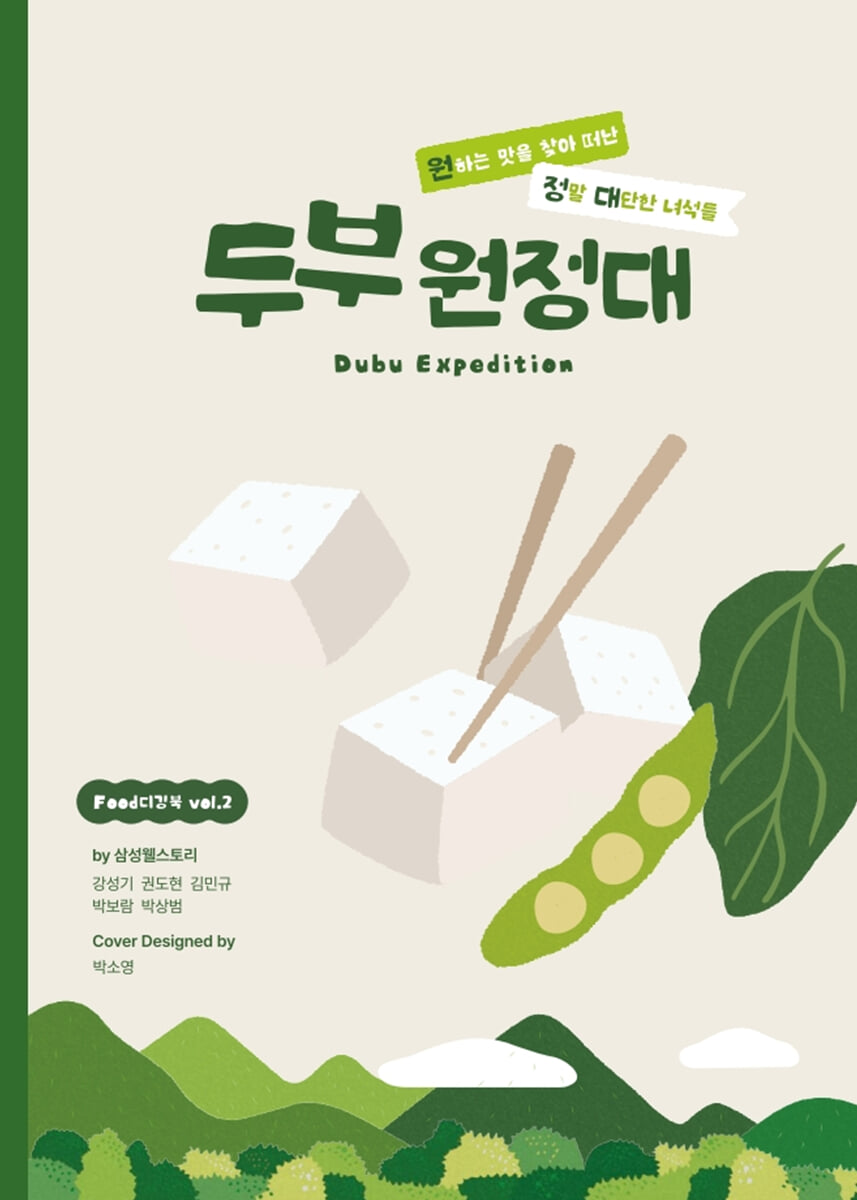
Tofu Expedition
 |
Description
Book Introduction
A tofu specialty book written and researched by five food and beverage experts, including a tofu specialty buyer.
A Comprehensive Guide to Tofu, Authentic and Rich in the Depths of Tofu
Tofu Expedition
This is the second series of Food Digging Books, following Samsung Welstory's "Dumpling Expedition," which delves into and introduces all information related to food.
It contains everything about tofu, a synonym for high-protein, low-calorie food and recently gaining popularity with the healthy pleasure craze.
"Tofu Expedition" details the origins of tofu, which began in China and spread to Korea and Japan, as well as the types and characteristics of tofu that vary depending on the soybeans, coagulant, and degree of pressing.
Through interviews with experts, including a 23-year veteran tofu researcher at Pulmuone, the first company in Korea to launch packaged tofu and dominate the US market, and the president of Margeunmul, a soybean processed food company, we show the present and future of tofu as seen by the food industry.
In addition, we introduce 9 special recipes that reduce calories and add healthy flavor by replacing meat, rice, and whipped cream with tofu, as well as about 30 domestic and international tofu restaurants, so that you can not only gain knowledge about tofu but also experience a variety of flavors.
A Comprehensive Guide to Tofu, Authentic and Rich in the Depths of Tofu
Tofu Expedition
This is the second series of Food Digging Books, following Samsung Welstory's "Dumpling Expedition," which delves into and introduces all information related to food.
It contains everything about tofu, a synonym for high-protein, low-calorie food and recently gaining popularity with the healthy pleasure craze.
"Tofu Expedition" details the origins of tofu, which began in China and spread to Korea and Japan, as well as the types and characteristics of tofu that vary depending on the soybeans, coagulant, and degree of pressing.
Through interviews with experts, including a 23-year veteran tofu researcher at Pulmuone, the first company in Korea to launch packaged tofu and dominate the US market, and the president of Margeunmul, a soybean processed food company, we show the present and future of tofu as seen by the food industry.
In addition, we introduce 9 special recipes that reduce calories and add healthy flavor by replacing meat, rice, and whipped cream with tofu, as well as about 30 domestic and international tofu restaurants, so that you can not only gain knowledge about tofu but also experience a variety of flavors.
index
Table of Contents Prologue
Recommendation
The origin and origin of tofu
When was tofu created?
CARTOON Tofu Where are you from?
Where do the 'soybeans' used to make tofu come from?
Tofu originating from China
An interesting story about the origin of tofu
The history of tofu in Korea
When did our country start eating tofu?
The origin of Korean tofu
The history of tofu in Korea
Tofu Expedition Interview: Pulmuone Team Leader Jo Seong-bin
Korea's representative tofu festival
Benefits of tofu
What are the benefits of tofu?
The best diet food, tofu
Rich nutrients in tofu
A unique transformation of tofu
Tofu Expedition Interview: Daesang Corporation Senior Researcher Yong-Geon Kim
Tofu recipe
How is tofu made?
Machine-made tofu vs. stone-milled tofu
There is no such thing as a "wrong taste," only a "different taste."
Millstone vs. Machine Tofu Making Methods
Tofu becomes even more special when you eat it with knowledge
CARTOON How much tofu can be made from 1 kg of soybeans?
Tofu Expedition Interview: Chairman Kim Seok-won of Clear Water
Important elements of tofu
How is the difference between tofu determined?
Are all tofus white?
Making tofu with seawater?
What is the difference between tofu for stew and tofu for pancakes?
Tofu Expedition Interview: SN Food CEO Jo Seong-eun
Types of tofu
In search of tofu from around the world!
Tofu loved by the world
Korean tofu
Chinese tofu
Japanese tofu
European tofu
Domestic and foreign tofu manufacturers
CARTOON Modubu's various transformations
Tofu Recipe
A delicious meal made with tofu
Grilled tofu with cod roe mayo
Tofu Rose Pasta
Noodle tofu kimbap
Crammy Tofu Balls
Mushroom Tofu Soup
Teriyaki grilled tofu
Tofu Noodle Salad
Agedashidofu
Almond Tofu Gangjeong
Best tofu restaurants in Korea and abroad
Find the best tofu restaurant!
[Domestic]
Seoul/Gyeonggi area
Gangwon region
Chungcheong/Daejeon region
Jeolla region
Gyeongsang/Daegu/Busan region
Jeju region
[Overseas]
Kyoto
Osaka
Recommendation
The origin and origin of tofu
When was tofu created?
CARTOON Tofu Where are you from?
Where do the 'soybeans' used to make tofu come from?
Tofu originating from China
An interesting story about the origin of tofu
The history of tofu in Korea
When did our country start eating tofu?
The origin of Korean tofu
The history of tofu in Korea
Tofu Expedition Interview: Pulmuone Team Leader Jo Seong-bin
Korea's representative tofu festival
Benefits of tofu
What are the benefits of tofu?
The best diet food, tofu
Rich nutrients in tofu
A unique transformation of tofu
Tofu Expedition Interview: Daesang Corporation Senior Researcher Yong-Geon Kim
Tofu recipe
How is tofu made?
Machine-made tofu vs. stone-milled tofu
There is no such thing as a "wrong taste," only a "different taste."
Millstone vs. Machine Tofu Making Methods
Tofu becomes even more special when you eat it with knowledge
CARTOON How much tofu can be made from 1 kg of soybeans?
Tofu Expedition Interview: Chairman Kim Seok-won of Clear Water
Important elements of tofu
How is the difference between tofu determined?
Are all tofus white?
Making tofu with seawater?
What is the difference between tofu for stew and tofu for pancakes?
Tofu Expedition Interview: SN Food CEO Jo Seong-eun
Types of tofu
In search of tofu from around the world!
Tofu loved by the world
Korean tofu
Chinese tofu
Japanese tofu
European tofu
Domestic and foreign tofu manufacturers
CARTOON Modubu's various transformations
Tofu Recipe
A delicious meal made with tofu
Grilled tofu with cod roe mayo
Tofu Rose Pasta
Noodle tofu kimbap
Crammy Tofu Balls
Mushroom Tofu Soup
Teriyaki grilled tofu
Tofu Noodle Salad
Agedashidofu
Almond Tofu Gangjeong
Best tofu restaurants in Korea and abroad
Find the best tofu restaurant!
[Domestic]
Seoul/Gyeonggi area
Gangwon region
Chungcheong/Daejeon region
Jeolla region
Gyeongsang/Daegu/Busan region
Jeju region
[Overseas]
Kyoto
Osaka
Into the book
Tofu is a familiar ingredient that often appears on our tables, but it feels more like a supporting role than a leading role.
As plain and unassuming as it looks, tofu is not a special or striking ingredient.
But if you look closely, tofu has a history of over 2,000 years and has been a part of our lives for a long time.
The appeal of tofu, which has recently been in the spotlight as a leading role in 'vegan' and 'health food', is endless.
--- From the "Prologue"
Tofu is an ingredient that originated in China.
In Korea, it is called 'tofu', in China, it is called 'dofu', and in Japan, it is called 'tofu', but around the world, it is generally called 'tofu'.
If you look at the Chinese character name, Du (豆) means 'bean' and Bu (腐) means 'rotten'.
However, contrary to its name, tofu is not a fermented food, but rather a food made by soaking, grinding, and solidifying soybeans.
In other words, the word ‘bu’ (腐) refers to the soft and elastic texture of tofu that is not fermented.
--- From “The Origin and Origin of Tofu”
Tofu is a representative processed food made by coagulating soybean protein.
Not only is it effective for dieting because it is low in calories, but it is also good for your health because you can consume various nutrients found in beans.
Moreover, it is not only high in protein content, but also has excellent protein components.
In particular, it contains a balanced amount of essential amino acids that are difficult or impossible to synthesize in the body and therefore hinder development and physiological functions if not consumed through food.
Among them, leucine and lysine account for a large proportion.
--- From "The Benefits of Tofu"
“Factory-made food can never beat the taste of food made by hand.”
When it comes to food preparation methods, most people would think this way.
This means that food mass-produced in factories cannot even be compared to food made by hand according to traditional methods.
Of course, there can be a clear difference in the taste of food produced by machines and food made using traditional methods.
But there is no 'correct answer' to the taste of food.
This is because the taste is different depending on the person who makes the food, the tools and ingredients used, and the method or order.
The same goes for tofu.
This is why tofu made with traditional methods using a millstone and tofu made with modern machines have different tastes and textures.
As plain and unassuming as it looks, tofu is not a special or striking ingredient.
But if you look closely, tofu has a history of over 2,000 years and has been a part of our lives for a long time.
The appeal of tofu, which has recently been in the spotlight as a leading role in 'vegan' and 'health food', is endless.
--- From the "Prologue"
Tofu is an ingredient that originated in China.
In Korea, it is called 'tofu', in China, it is called 'dofu', and in Japan, it is called 'tofu', but around the world, it is generally called 'tofu'.
If you look at the Chinese character name, Du (豆) means 'bean' and Bu (腐) means 'rotten'.
However, contrary to its name, tofu is not a fermented food, but rather a food made by soaking, grinding, and solidifying soybeans.
In other words, the word ‘bu’ (腐) refers to the soft and elastic texture of tofu that is not fermented.
--- From “The Origin and Origin of Tofu”
Tofu is a representative processed food made by coagulating soybean protein.
Not only is it effective for dieting because it is low in calories, but it is also good for your health because you can consume various nutrients found in beans.
Moreover, it is not only high in protein content, but also has excellent protein components.
In particular, it contains a balanced amount of essential amino acids that are difficult or impossible to synthesize in the body and therefore hinder development and physiological functions if not consumed through food.
Among them, leucine and lysine account for a large proportion.
--- From "The Benefits of Tofu"
“Factory-made food can never beat the taste of food made by hand.”
When it comes to food preparation methods, most people would think this way.
This means that food mass-produced in factories cannot even be compared to food made by hand according to traditional methods.
Of course, there can be a clear difference in the taste of food produced by machines and food made using traditional methods.
But there is no 'correct answer' to the taste of food.
This is because the taste is different depending on the person who makes the food, the tools and ingredients used, and the method or order.
The same goes for tofu.
This is why tofu made with traditional methods using a millstone and tofu made with modern machines have different tastes and textures.
--- From "Tofu Making Method"
Publisher's Review
This one square book is like a block of square tofu!
Just as soybeans are ground on a millstone to make a block of tofu, the solidified tofu is pressed into a mold, and countless stories and sincerity about tofu are packed into this book.
After reading this book, you will realize that tofu, which seemed bland, is no longer a supporting character on the dining table, but rather a rich and colorful protagonist.
Just as soybeans are ground on a millstone to make a block of tofu, the solidified tofu is pressed into a mold, and countless stories and sincerity about tofu are packed into this book.
After reading this book, you will realize that tofu, which seemed bland, is no longer a supporting character on the dining table, but rather a rich and colorful protagonist.
GOODS SPECIFICS
- Date of issue: January 31, 2025
- Page count, weight, size: 164 pages | 175*245*10mm
- ISBN13: 9791198972729
- ISBN10: 1198972726
You may also like
카테고리
korean


korean

![GQ KOREA Mark (Monthly): December [2025]](http://librairie.coreenne.fr/cdn/shop/files/8ef265dbbfbf186523ed75ba7319009d.jpg?v=1765340328&width=3840)


