

Nudge English
 |
Description
Book Introduction
What's most important for young children just beginning the English marathon? It's their feelings about English, their emotions about it.
Children who have positive feelings about English like English and find it fun.
Because it's fun, you keep doing it, and a virtuous cycle is created where you want to do better.
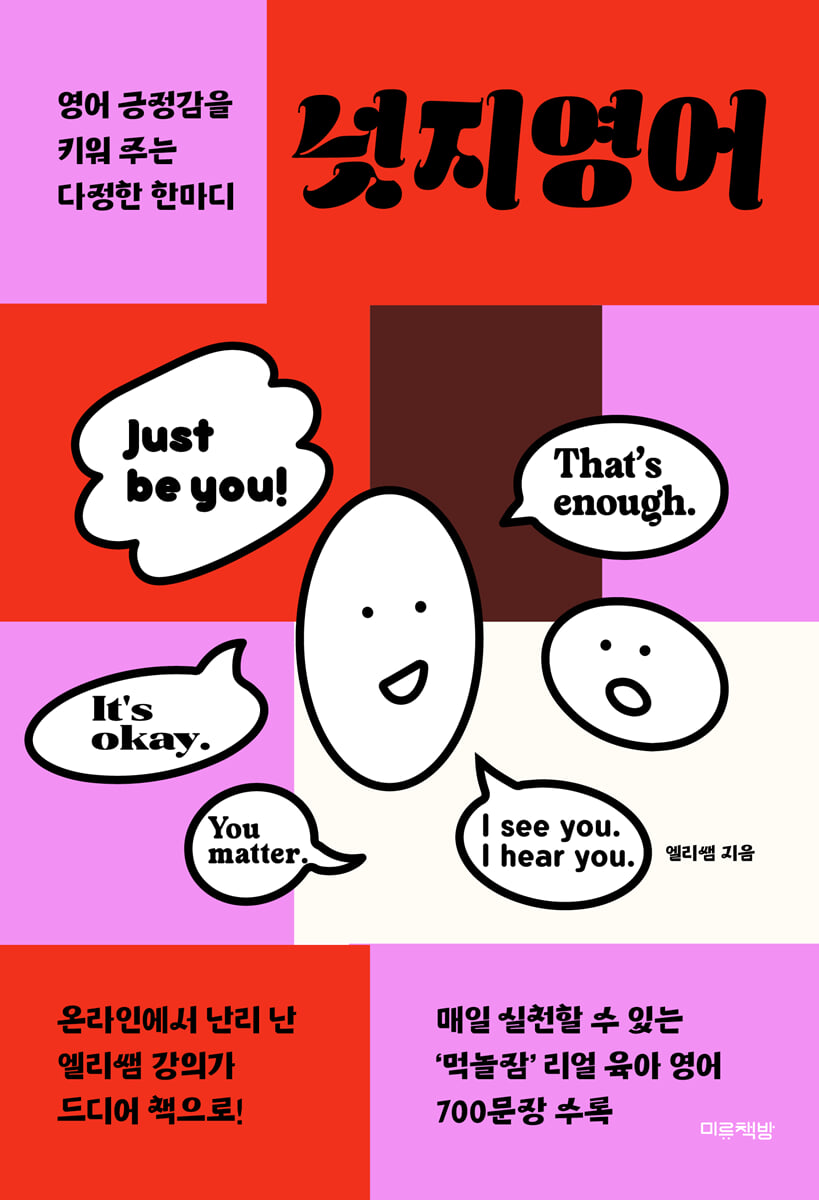
Nudge English is a 'mother's English' that helps children naturally accept English as a language in their daily lives.
Even parents who are not confident in English can do it with just 10% effort.
English expressions that we use countless times in everyday life with our children, such as “Did you sleep well?”, “I’ll change your diaper”, and “Let’s brush your teeth, just squeeze out a little toothpaste”, are neither difficult nor long.
By repeatedly giving appropriate words in this way at the right time and in the right context, children will learn English not as something to study while racking their brain, but as a 'language' for communicating with others.
Children who have positive feelings about English like English and find it fun.
Because it's fun, you keep doing it, and a virtuous cycle is created where you want to do better.
Nudge English is a 'mother's English' that helps children naturally accept English as a language in their daily lives.
Even parents who are not confident in English can do it with just 10% effort.
English expressions that we use countless times in everyday life with our children, such as “Did you sleep well?”, “I’ll change your diaper”, and “Let’s brush your teeth, just squeeze out a little toothpaste”, are neither difficult nor long.
By repeatedly giving appropriate words in this way at the right time and in the right context, children will learn English not as something to study while racking their brain, but as a 'language' for communicating with others.
- You can preview some of the book's contents.
Preview
index
Prologue 5
Part 1: In early childhood, English is all about positivity.
The Key to Success in Parenting English
Why Parenting Values Must Be Incorporated into Your English Parenting Guide
What is meaningful sound exposure?
Nudge English: 10% effort is enough.
So what the heck is nudge English?
When is the golden time for Nudge English?
Do parents really need to speak to their children in English?
Before you start Part 2 Parents' Table English, you must know this.
Understanding Your Child's Brain Development
English is not a mountain to conquer, but a desert to be walked silently.
Create a region-specific English environment like this
The Unavoidable Time: "My Child Refuses to Learn English"
Part 3: Parenting English for 'Eat, Play, Sleep'
Morning Routine: Basic Lifestyle Habits Filled with Love
① Good morning
② Brush your teeth
③ Wash your face
④ Eat breakfast
⑤ Get dressed
AfternoonRoutine: An afternoon routine to cultivate self-directed action.
① House of Representatives personnel
② Establishing habits after returning home
③ Go to the bathroom & wash your hands
④ Go for a walk (feat. Road safety)
EveningRoutine: A cozy evening
① Dinner
② Bedtime reading
③ Bedtime routine
PLayRoutine: Fun Playtime
① Clay play
② Block play
③ Role play: Hospital
④ Outdoor play: playground
Part 4: Create a Richer English Exposure Environment Like This
One word of nudge English, what happens next?
Reading English picture books that improve your effectiveness
Quantum Jump with Deeper Reading! Step-by-Step Checkpoints
List of recommended picture books by age
Synergy with high-quality videos
Recommended Videos List
30 Things Parents Say to Make Their Children's Hearts Bloom
Epilogue
Part 1: In early childhood, English is all about positivity.
The Key to Success in Parenting English
Why Parenting Values Must Be Incorporated into Your English Parenting Guide
What is meaningful sound exposure?
Nudge English: 10% effort is enough.
So what the heck is nudge English?
When is the golden time for Nudge English?
Do parents really need to speak to their children in English?
Before you start Part 2 Parents' Table English, you must know this.
Understanding Your Child's Brain Development
English is not a mountain to conquer, but a desert to be walked silently.
Create a region-specific English environment like this
The Unavoidable Time: "My Child Refuses to Learn English"
Part 3: Parenting English for 'Eat, Play, Sleep'
Morning Routine: Basic Lifestyle Habits Filled with Love
① Good morning
② Brush your teeth
③ Wash your face
④ Eat breakfast
⑤ Get dressed
AfternoonRoutine: An afternoon routine to cultivate self-directed action.
① House of Representatives personnel
② Establishing habits after returning home
③ Go to the bathroom & wash your hands
④ Go for a walk (feat. Road safety)
EveningRoutine: A cozy evening
① Dinner
② Bedtime reading
③ Bedtime routine
PLayRoutine: Fun Playtime
① Clay play
② Block play
③ Role play: Hospital
④ Outdoor play: playground
Part 4: Create a Richer English Exposure Environment Like This
One word of nudge English, what happens next?
Reading English picture books that improve your effectiveness
Quantum Jump with Deeper Reading! Step-by-Step Checkpoints
List of recommended picture books by age
Synergy with high-quality videos
Recommended Videos List
30 Things Parents Say to Make Their Children's Hearts Bloom
Epilogue
Detailed image

Into the book
No child is good at English from the beginning.
The key point of English exposure in infants and toddlers that creates a virtuous cycle is to start with emotional care and developing mental muscles.
What does this mean? Rather than simply knowing more English words, you should first cultivate an attitude of naturally accepting English as a language tool in your daily life and enjoying English-language media.
In other words, there is no need to worry about your child not being able to read English books fluently and master phonics at the age of 4 or 5.
--- p.19
Don't forget that a child who is fluent in English has parents who understand the essence of English acquisition.
If you understand the essence, even children who were not good at English or who rejected English can get on the virtuous cycle of saying, “I’m good at English too. Speak to me in English, read me an English book.”
The key to this success is English emotion and English positivity.
--- p.19~20
The key to English language for infants and toddlers is 'language that strengthens the relationship with the child.'
Through the effective and meaningful expressions taught by Nudge English, you will once again realize that the best way to develop deep-rooted affection and stable attachment is through everyday interactions.
As a parent of a preschooler, I have compiled a list of essential expressions for real-life parenting, so that I can speak English and raise my child fluently among the numerous English expressions needed at this age.
As children learn to use appropriate sentences appropriate for everyday situations, develop their thinking skills while playing with English picture books, and instill joy in their daily lives with English videos, they will build an 'automated English acquisition system' that they can master on their own.
Please remember that the infinite power of this system is the English emotion and positivity transfused from parents.
--- p.21
Just as raising a child is not easy for first-time parents, even those who are good at English are rare in that they are good at ‘parenting English.’
I speak English well in business meetings or conference calls, but I can't say things like "Don't hold it in" or "Cover your hand and let's get some water" to my child.
So, rejoice that your English skills are by no means a prerequisite for your child's success! If you feel your skills are somewhat lacking, simply work with your child to raise them as best you can.
Just as we don't get good at parenting from the beginning, but rather endlessly test ourselves to see if a child's crying is due to hunger or sleepiness, and become accustomed to it by washing a wet blanket, my parenting English also gradually improves as I 'practice' it in my daily life.
This book will teach you the practical, customized English expressions for parenting that are necessary for a win-win strategy that turns the time spent raising children into a time for growth for parents as well.
--- p.25
What kind of situation can a child understand? This is it.
When you wake up in the morning, you realize that your mom and dad are smiling, kissing you, stroking you, and looking at you with affectionate eyes while saying “Good morning!” and that this is your morning greeting. When you see your legs shaking or your eyes shaking with anxiety because you need to go to the toilet, and your parents say “Do you need to go potty?” and put you on the toilet, you realize that this is an expression used when you need to go to the toilet, and you feel good because you did it refreshed.
When brushing your teeth, not only say “Let's brush your teeth” but also feel the toothbrush moving back and forth, up and down while saying “Back and forth, up and down”.
After school or work, parents meet again and say, “I missed you so much!” and hug each other tightly, sharing the warmth of the day they couldn’t finish.
--- p.27~28
Nudge English's real parenting expressions don't just end with "brush your teeth," "wash your face," "put on your shoes," and "get dressed."
It consists of sentences that help you perform this task.
I believe that English is meaningful only when parents combine English with parenting, helping their children gain confidence and develop the ability to do things on their own.
Now we're going to break the stereotype that English conversational expressions have to be difficult.
Everyday conversations with children don't have to be difficult.
It's like teaching a child, "Did you sleep well, Mom and Dad?" without teaching them, "Did you sleep well, Mom and Dad?"
--- p.31~32
What's important here is speaking English to your child in everyday interactions during play and sleep.
Infants and toddlers are a very important period in their lives when they are equipped with an unconscious absorption and automatic language acquisition device.
This is the golden time when even a little effort can have a big effect.
If parents repeatedly nudge their children with appropriate words in a timely manner that fit the situation and context, the child will learn English not as something to study while racking his or her brain, but as a 'language' for communicating with others.
--- p.34
I understand that you may feel uncomfortable speaking to someone in English.
To ease that burden, let's look a little further ahead.
To put it bluntly, imparting a few words of everyday English only makes up a small part of the English environment that parents create.
That is, if you aim to do only as much as you can without feeling burdened, that's the end of it.
However, this simple gesture can also be an effective tool to build a positive foundation for your child to enjoy English books and videos.
--- p.40
Nudge English begins with a morning greeting.
Let’s start with the simple “Goodmorning!”
Think back to the first time we met a foreigner.
When we meet a foreigner, we greet them by saying “Hello~” or “Hi.”
The same goes for children.
The easiest thing we can do is open the door to the morning.
I need to start exposing my child to English by first opening up my own language with short, simple expressions like these.
From now on, equip yourself with the mindset of "It's so easy, it's so good!" and practice saying it out loud. It may seem easy, but putting it into practice is always harder than you think.
This is why we need to start with something very easy.
--- p.78~79
Expressing loving skinship
Let me give you a kiss.
I'll give you a kiss.
Morning hug! Morning hug~!
Kissy kissy! Kissy kissy!
Huggy huggy! (When hugging) Round and round, hug~!
Kissy on yourtoesies! Kissy on your toesies!
〈A Word from Teacher Ellie〉 This is an expression of skinship that I consider more important than the morning greeting itself.
You've probably had the experience that the first three minutes after waking up determines your mood for the day.
Be sure to express your love and gratitude with kind words and warm actions so that your child can start the day with love and gratitude.
This is the part where the children react the best.
The key point of English exposure in infants and toddlers that creates a virtuous cycle is to start with emotional care and developing mental muscles.
What does this mean? Rather than simply knowing more English words, you should first cultivate an attitude of naturally accepting English as a language tool in your daily life and enjoying English-language media.
In other words, there is no need to worry about your child not being able to read English books fluently and master phonics at the age of 4 or 5.
--- p.19
Don't forget that a child who is fluent in English has parents who understand the essence of English acquisition.
If you understand the essence, even children who were not good at English or who rejected English can get on the virtuous cycle of saying, “I’m good at English too. Speak to me in English, read me an English book.”
The key to this success is English emotion and English positivity.
--- p.19~20
The key to English language for infants and toddlers is 'language that strengthens the relationship with the child.'
Through the effective and meaningful expressions taught by Nudge English, you will once again realize that the best way to develop deep-rooted affection and stable attachment is through everyday interactions.
As a parent of a preschooler, I have compiled a list of essential expressions for real-life parenting, so that I can speak English and raise my child fluently among the numerous English expressions needed at this age.
As children learn to use appropriate sentences appropriate for everyday situations, develop their thinking skills while playing with English picture books, and instill joy in their daily lives with English videos, they will build an 'automated English acquisition system' that they can master on their own.
Please remember that the infinite power of this system is the English emotion and positivity transfused from parents.
--- p.21
Just as raising a child is not easy for first-time parents, even those who are good at English are rare in that they are good at ‘parenting English.’
I speak English well in business meetings or conference calls, but I can't say things like "Don't hold it in" or "Cover your hand and let's get some water" to my child.
So, rejoice that your English skills are by no means a prerequisite for your child's success! If you feel your skills are somewhat lacking, simply work with your child to raise them as best you can.
Just as we don't get good at parenting from the beginning, but rather endlessly test ourselves to see if a child's crying is due to hunger or sleepiness, and become accustomed to it by washing a wet blanket, my parenting English also gradually improves as I 'practice' it in my daily life.
This book will teach you the practical, customized English expressions for parenting that are necessary for a win-win strategy that turns the time spent raising children into a time for growth for parents as well.
--- p.25
What kind of situation can a child understand? This is it.
When you wake up in the morning, you realize that your mom and dad are smiling, kissing you, stroking you, and looking at you with affectionate eyes while saying “Good morning!” and that this is your morning greeting. When you see your legs shaking or your eyes shaking with anxiety because you need to go to the toilet, and your parents say “Do you need to go potty?” and put you on the toilet, you realize that this is an expression used when you need to go to the toilet, and you feel good because you did it refreshed.
When brushing your teeth, not only say “Let's brush your teeth” but also feel the toothbrush moving back and forth, up and down while saying “Back and forth, up and down”.
After school or work, parents meet again and say, “I missed you so much!” and hug each other tightly, sharing the warmth of the day they couldn’t finish.
--- p.27~28
Nudge English's real parenting expressions don't just end with "brush your teeth," "wash your face," "put on your shoes," and "get dressed."
It consists of sentences that help you perform this task.
I believe that English is meaningful only when parents combine English with parenting, helping their children gain confidence and develop the ability to do things on their own.
Now we're going to break the stereotype that English conversational expressions have to be difficult.
Everyday conversations with children don't have to be difficult.
It's like teaching a child, "Did you sleep well, Mom and Dad?" without teaching them, "Did you sleep well, Mom and Dad?"
--- p.31~32
What's important here is speaking English to your child in everyday interactions during play and sleep.
Infants and toddlers are a very important period in their lives when they are equipped with an unconscious absorption and automatic language acquisition device.
This is the golden time when even a little effort can have a big effect.
If parents repeatedly nudge their children with appropriate words in a timely manner that fit the situation and context, the child will learn English not as something to study while racking his or her brain, but as a 'language' for communicating with others.
--- p.34
I understand that you may feel uncomfortable speaking to someone in English.
To ease that burden, let's look a little further ahead.
To put it bluntly, imparting a few words of everyday English only makes up a small part of the English environment that parents create.
That is, if you aim to do only as much as you can without feeling burdened, that's the end of it.
However, this simple gesture can also be an effective tool to build a positive foundation for your child to enjoy English books and videos.
--- p.40
Nudge English begins with a morning greeting.
Let’s start with the simple “Goodmorning!”
Think back to the first time we met a foreigner.
When we meet a foreigner, we greet them by saying “Hello~” or “Hi.”
The same goes for children.
The easiest thing we can do is open the door to the morning.
I need to start exposing my child to English by first opening up my own language with short, simple expressions like these.
From now on, equip yourself with the mindset of "It's so easy, it's so good!" and practice saying it out loud. It may seem easy, but putting it into practice is always harder than you think.
This is why we need to start with something very easy.
--- p.78~79
Expressing loving skinship
Let me give you a kiss.
I'll give you a kiss.
Morning hug! Morning hug~!
Kissy kissy! Kissy kissy!
Huggy huggy! (When hugging) Round and round, hug~!
Kissy on yourtoesies! Kissy on your toesies!
〈A Word from Teacher Ellie〉 This is an expression of skinship that I consider more important than the morning greeting itself.
You've probably had the experience that the first three minutes after waking up determines your mood for the day.
Be sure to express your love and gratitude with kind words and warm actions so that your child can start the day with love and gratitude.
This is the part where the children react the best.
--- p.81
Publisher's Review
〈English sensibility is more important than immediate English skills!〉
There is no child who is good at English from the beginning.
However, there are children who like English and find it fun even though they can't speak many words.
If you have positive feelings about English.
These children find English fun, so they continue to learn it, and as they continue, they become good at it, creating a virtuous cycle.
This is why English emotion and positive feelings about English are most important for infants and toddlers.
How can we develop English sensibility?
Infants and toddlers are a very important period in life when they are equipped with an unconscious absorption device and automatic language acquisition device.
Therefore, it is a golden time when you can achieve great results with just a little effort.
During this period, if parents repeatedly 'nudge' their children with appropriate words for the situation and context, the child will learn English not as something to study while racking his or her brain, but as a 'language' for communicating with others.
To do that, it is important to impart English expressions that are truly used in real parenting situations where parents and children are together.
For parents raising children, daily routine is the perfect situation for endless repetition.
"No Negative Expressions, It Changes Your Parenting Values!"
Instead of using prohibitive or negative words like "don't" or "no," Nudge English uses expressions that show acceptance and empathy by considering the child's perspective.
The purpose of teaching English to children is not simply to create machines that can speak English well, but also to instill positive values through the English language.
When parents' language is positive, children also move in a positive way.
As a result, students who have already taken Ellie's lectures online (Class U) say, "If you do Nudge English, you will naturally start speaking Korean nicely" and "Your perspective on your child's behavior will change."
Although it started out as something for the child, it ultimately helps the mother reflect on herself and grow, increasing her parenting efficacy.
Parents' Efforts Make 10% of the Money! It's OK Even If You're Not Confident in English!
Talking to your child in English can be a challenge for parents who aren't confident in their English skills.
However, imparting a single word of English to your child is only a small part of the English environment that parents create.
In other words, your goal should be to do only as much as you can without feeling burdened.
Even if you're not very fluent in English, you already know at least phrases like "good morning," "did you sleep well?", "are you hungry?", and "let's brush your teeth."
First, you can start with soft and easy sentences like this.
Also, parents don't have to feel obligated to express everything.
The role of parents is to focus on one word that equips the child with English emotions and positivity.
Anything beyond that can be outsourced to picture books and videos.
〈700 Real English Phrases You Can Use Right Away!〉
We've compiled 700 practical parenting expressions based on children's daily lives of 'eating, playing, and sleeping.'
These are expressions that I use a lot as a mother who is currently raising my children, from the moment I open my eyes in the morning until I fall asleep at night.
Nudge English's real parenting expressions don't just end with "brush your teeth," "wash your face," "put on your shoes," and "get dressed."
It consists of various sentences that help you perform this task.
English is meaningful only when parents combine English with parenting to help their children gain confidence and develop the ability to do things on their own.
There is no child who is good at English from the beginning.
However, there are children who like English and find it fun even though they can't speak many words.
If you have positive feelings about English.
These children find English fun, so they continue to learn it, and as they continue, they become good at it, creating a virtuous cycle.
This is why English emotion and positive feelings about English are most important for infants and toddlers.
How can we develop English sensibility?
Infants and toddlers are a very important period in life when they are equipped with an unconscious absorption device and automatic language acquisition device.
Therefore, it is a golden time when you can achieve great results with just a little effort.
During this period, if parents repeatedly 'nudge' their children with appropriate words for the situation and context, the child will learn English not as something to study while racking his or her brain, but as a 'language' for communicating with others.
To do that, it is important to impart English expressions that are truly used in real parenting situations where parents and children are together.
For parents raising children, daily routine is the perfect situation for endless repetition.
"No Negative Expressions, It Changes Your Parenting Values!"
Instead of using prohibitive or negative words like "don't" or "no," Nudge English uses expressions that show acceptance and empathy by considering the child's perspective.
The purpose of teaching English to children is not simply to create machines that can speak English well, but also to instill positive values through the English language.
When parents' language is positive, children also move in a positive way.
As a result, students who have already taken Ellie's lectures online (Class U) say, "If you do Nudge English, you will naturally start speaking Korean nicely" and "Your perspective on your child's behavior will change."
Although it started out as something for the child, it ultimately helps the mother reflect on herself and grow, increasing her parenting efficacy.
Parents' Efforts Make 10% of the Money! It's OK Even If You're Not Confident in English!
Talking to your child in English can be a challenge for parents who aren't confident in their English skills.
However, imparting a single word of English to your child is only a small part of the English environment that parents create.
In other words, your goal should be to do only as much as you can without feeling burdened.
Even if you're not very fluent in English, you already know at least phrases like "good morning," "did you sleep well?", "are you hungry?", and "let's brush your teeth."
First, you can start with soft and easy sentences like this.
Also, parents don't have to feel obligated to express everything.
The role of parents is to focus on one word that equips the child with English emotions and positivity.
Anything beyond that can be outsourced to picture books and videos.
〈700 Real English Phrases You Can Use Right Away!〉
We've compiled 700 practical parenting expressions based on children's daily lives of 'eating, playing, and sleeping.'
These are expressions that I use a lot as a mother who is currently raising my children, from the moment I open my eyes in the morning until I fall asleep at night.
Nudge English's real parenting expressions don't just end with "brush your teeth," "wash your face," "put on your shoes," and "get dressed."
It consists of various sentences that help you perform this task.
English is meaningful only when parents combine English with parenting to help their children gain confidence and develop the ability to do things on their own.
GOODS SPECIFICS
- Date of issue: February 10, 2025
- Page count, weight, size: 240 pages | 326g | 140*205*16mm
- ISBN13: 9791188632251
- ISBN10: 1188632256
You may also like
카테고리
korean


korean

![GQ KOREA Mark (Monthly): December [2025]](http://librairie.coreenne.fr/cdn/shop/files/8ef265dbbfbf186523ed75ba7319009d.jpg?v=1765340328&width=3840)


