

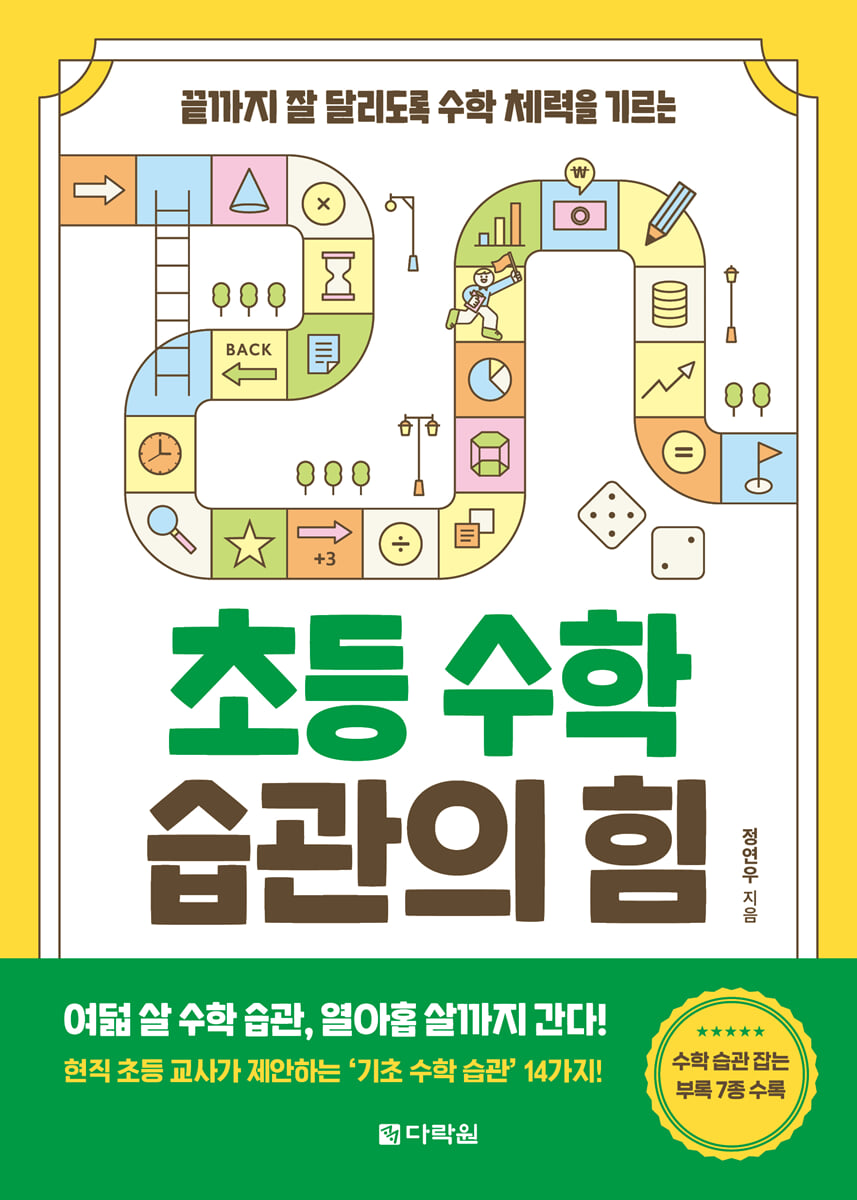
The Power of Elementary Math Habits
 |
Description
Book Introduction
If you ever wonder, 'Is my child doing well?'
It's time to check your child's habits!
Math is a subject that causes a lot of concern for both children and parents.
So, without knowing how to study, they try to maintain their grades by going to cram schools or solving lots of problems.
But the most important thing in studying math is to develop good habits.
In order to run consistently like a marathon with the goal of the CSAT, you need to build your math skills through 'basic math habits.'
Improvement in grades can be achieved based on this.
Four Math Seeds You Must Plant in Elementary School
What should you prepare before starting your studies? You need to develop basic lifestyle and study habits.
Just as you prepare textbooks and writing tools, you must also create an environment for your brain to study.
It's easy to think of math as a boring subject.
So it's important to create and maintain interest and spontaneity from an early age.
We need to help children find interesting points and solve problems on their own by looking at the problem.
Additionally, students should develop a positive attitude toward learning by taking care of their own books and homework, think about the purpose of studying math, and develop literacy through reading to understand problems.
The seeds planted in this way will become the foundation for studying mathematics.
Basic Math Habits for Unwavering Math Skills
Once you have built up your basic physical strength, you need to develop the math strength to run consistently.
Math strength is built by developing the most basic problem-solving habits.
Things that adults take for granted, such as writing correctly, writing only one number per line, and not solving problems at an angle, are difficult for children.
So children repeat small mistakes and their scores gradually drop.
The author, a current elementary school teacher, has observed children's mistakes over 17 years of teaching, and has developed 14 "Basic Math Habits" based on these insights into how to best study.
Here are some really basic and important habits that are surprisingly not practiced.
Please complete the 14 habits by following the contents of the book.
Then, you can easily tackle any type or difficulty level of problem without fear.
The shortcut to improving math grades: the "thinking-organizing study method."
If you can run consistently, you need to practice increasing your speed through metacognition.
Knowing where I stand, what problems I need to solve, and why I got them wrong can help me move forward.
This book guides you through 'thinking mathematics' and 'applied mathematics' by suggesting ways to solve problems and conquer word problems through metacognition.
Having metacognition will give you the strength to consistently maintain high grades.
It's time to check your child's habits!
Math is a subject that causes a lot of concern for both children and parents.
So, without knowing how to study, they try to maintain their grades by going to cram schools or solving lots of problems.
But the most important thing in studying math is to develop good habits.
In order to run consistently like a marathon with the goal of the CSAT, you need to build your math skills through 'basic math habits.'
Improvement in grades can be achieved based on this.
Four Math Seeds You Must Plant in Elementary School
What should you prepare before starting your studies? You need to develop basic lifestyle and study habits.
Just as you prepare textbooks and writing tools, you must also create an environment for your brain to study.
It's easy to think of math as a boring subject.
So it's important to create and maintain interest and spontaneity from an early age.
We need to help children find interesting points and solve problems on their own by looking at the problem.
Additionally, students should develop a positive attitude toward learning by taking care of their own books and homework, think about the purpose of studying math, and develop literacy through reading to understand problems.
The seeds planted in this way will become the foundation for studying mathematics.
Basic Math Habits for Unwavering Math Skills
Once you have built up your basic physical strength, you need to develop the math strength to run consistently.
Math strength is built by developing the most basic problem-solving habits.
Things that adults take for granted, such as writing correctly, writing only one number per line, and not solving problems at an angle, are difficult for children.
So children repeat small mistakes and their scores gradually drop.
The author, a current elementary school teacher, has observed children's mistakes over 17 years of teaching, and has developed 14 "Basic Math Habits" based on these insights into how to best study.
Here are some really basic and important habits that are surprisingly not practiced.
Please complete the 14 habits by following the contents of the book.
Then, you can easily tackle any type or difficulty level of problem without fear.
The shortcut to improving math grades: the "thinking-organizing study method."
If you can run consistently, you need to practice increasing your speed through metacognition.
Knowing where I stand, what problems I need to solve, and why I got them wrong can help me move forward.
This book guides you through 'thinking mathematics' and 'applied mathematics' by suggesting ways to solve problems and conquer word problems through metacognition.
Having metacognition will give you the strength to consistently maintain high grades.
- You can preview some of the book's contents.
Preview
index
Chapter 1: Is My Child's Math Studying Going Well?
01 Even a child who gets 100 points now could become a failure in the future.
02 Why do children who did well in elementary school fail in middle and high school?
03 The Main Cause of Weakened Math Skills: Excessive Studying
04 You need to prepare step by step to do well in 'high school math'.
05 What is the role of parents in their children's math studies?
06 Check what you say to your children.
Chapter 2: Building the Foundation for Math Studying
01 Four Math Seeds You Must Plant in Elementary School
02 Focusing in Math Class
03 How to properly solve math books and math practice books
Chapter 3: "Basic Math Habits" for Unwavering Math Skills
01 14 Basic Math Habits to Build Math Strength
02 Facts you need to know to establish basic math habits
Chapter 4: The Shortcut to Improving Math Grades: "The Study Method of Organizing Your Thoughts"
01 Metacognition and Thought Organization Study Method
02 Using metacognition
03 Conquering Word Problems with Metacognition
04 12 Ways to Improve Your Math Skills with Just One Workbook
05 How to solve incorrect answers to fill in my gaps
06 How should I prepare for the elementary school math test?
Chapter 5: Math Study Methods by Grade
01 Lower Grades: Building Basic Math Skills
02 Middle School: Building Math Skills
03 Upper Grades: Completing Math Physical Fitness
04 Identifying the most common incorrect answers in arithmetic operations
05 Board games that help with math study
Chapter 6: Math-Related Q&A Collection
01 Collection of Math-Related Q&As
01 Even a child who gets 100 points now could become a failure in the future.
02 Why do children who did well in elementary school fail in middle and high school?
03 The Main Cause of Weakened Math Skills: Excessive Studying
04 You need to prepare step by step to do well in 'high school math'.
05 What is the role of parents in their children's math studies?
06 Check what you say to your children.
Chapter 2: Building the Foundation for Math Studying
01 Four Math Seeds You Must Plant in Elementary School
02 Focusing in Math Class
03 How to properly solve math books and math practice books
Chapter 3: "Basic Math Habits" for Unwavering Math Skills
01 14 Basic Math Habits to Build Math Strength
02 Facts you need to know to establish basic math habits
Chapter 4: The Shortcut to Improving Math Grades: "The Study Method of Organizing Your Thoughts"
01 Metacognition and Thought Organization Study Method
02 Using metacognition
03 Conquering Word Problems with Metacognition
04 12 Ways to Improve Your Math Skills with Just One Workbook
05 How to solve incorrect answers to fill in my gaps
06 How should I prepare for the elementary school math test?
Chapter 5: Math Study Methods by Grade
01 Lower Grades: Building Basic Math Skills
02 Middle School: Building Math Skills
03 Upper Grades: Completing Math Physical Fitness
04 Identifying the most common incorrect answers in arithmetic operations
05 Board games that help with math study
Chapter 6: Math-Related Q&A Collection
01 Collection of Math-Related Q&As
Detailed image

Publisher's Review
Habits of an eight-year-old last until nineteen!
'Basic math habits' that you can develop from elementary school so that you can do well until the CSAT!
My math grades are good, but why do I keep making mistakes? Wouldn't my math skills improve naturally if I just worked on a lot of math workbooks? How can I maintain my math grades until the CSAT? If you're feeling overwhelmed with your elementary school child's math studies, try "The Power of Elementary Math Habits."
If you guide your children along the book, they will soon have strong mathematical skills.
This book, organized into six chapters, explains the problems of overstudying and the importance of good habits, and introduces the "four seeds of math" that must be planted before developing good math study habits.
In addition, we introduce 14 'basic math habits' that will help you build your math skills and guide you on how to improve your grades by using metacognition as a study method for math.
Lastly, we have included math study directions for each grade level and math-related Q&As to more carefully address parents' concerns.
The appendix, which can be downloaded from the Darakwon website, contains seven materials that can be printed and used with children.
The most important thing in studying math is to develop good study habits, not overstudy.
Even if you are at the top of your class in elementary school, if you don't develop good study habits, your scores will gradually drop starting in middle school.
With "Basic Math Habits," you'll be able to solve problems relentlessly, break free from the repetitive cycle of studying at school and at home, and develop the ability to think and solve problems on your own.
Then, you will be able to solve any problem without having to follow complicated curriculums and difficult study methods.
'Basic math habits' that you can develop from elementary school so that you can do well until the CSAT!
My math grades are good, but why do I keep making mistakes? Wouldn't my math skills improve naturally if I just worked on a lot of math workbooks? How can I maintain my math grades until the CSAT? If you're feeling overwhelmed with your elementary school child's math studies, try "The Power of Elementary Math Habits."
If you guide your children along the book, they will soon have strong mathematical skills.
This book, organized into six chapters, explains the problems of overstudying and the importance of good habits, and introduces the "four seeds of math" that must be planted before developing good math study habits.
In addition, we introduce 14 'basic math habits' that will help you build your math skills and guide you on how to improve your grades by using metacognition as a study method for math.
Lastly, we have included math study directions for each grade level and math-related Q&As to more carefully address parents' concerns.
The appendix, which can be downloaded from the Darakwon website, contains seven materials that can be printed and used with children.
The most important thing in studying math is to develop good study habits, not overstudy.
Even if you are at the top of your class in elementary school, if you don't develop good study habits, your scores will gradually drop starting in middle school.
With "Basic Math Habits," you'll be able to solve problems relentlessly, break free from the repetitive cycle of studying at school and at home, and develop the ability to think and solve problems on your own.
Then, you will be able to solve any problem without having to follow complicated curriculums and difficult study methods.
GOODS SPECIFICS
- Date of issue: December 16, 2024
- Page count, weight, size: 408 pages | 150*210*30mm
- ISBN13: 9788927748090
- ISBN10: 8927748093
You may also like
카테고리
korean


korean

![GQ KOREA Mark (Monthly): December [2025]](http://librairie.coreenne.fr/cdn/shop/files/8ef265dbbfbf186523ed75ba7319009d.jpg?v=1765340328&width=3840)


