

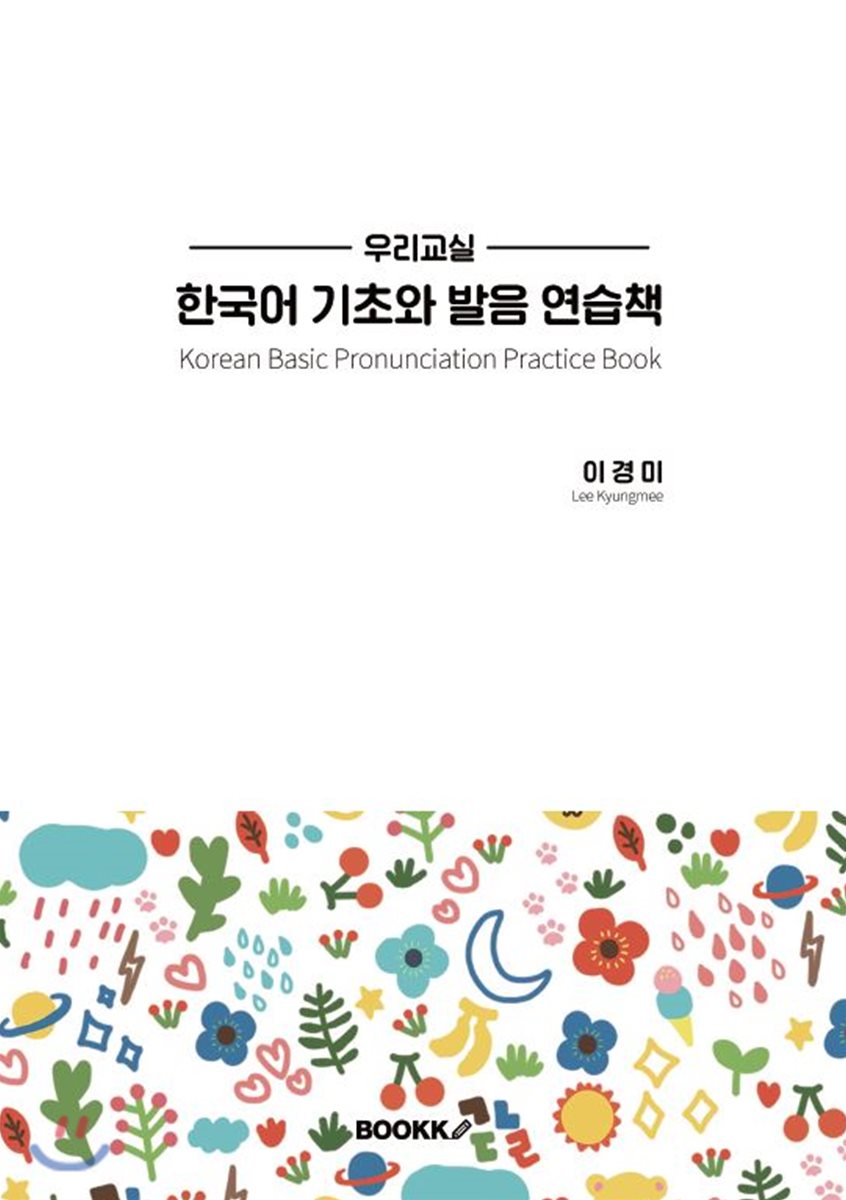
Our Classroom's Korean Basics and Pronunciation Practice Book
 |
Description
Book Introduction
Since 2005, we have been providing Korean language education to foreigners using various textbooks and teaching aids.
However, there are almost no basic and important Korean language basics and pronunciation practice materials for foreigners who are new to Korean.
Korean pronunciation practice materials, like English phonics, are absolutely necessary for students.
I've often thought that if there were easy and fun pronunciation practice materials, we could greatly reduce the number of errors foreigners make in Korean pronunciation.
In particular, Korean language education in multicultural preparatory schools requires more accurate pronunciation and grammar education than everyday Korean.
Since I have to live in Korea and continue my studies, I cannot emphasize enough the importance of reading accurately, speaking clearly, and pronouncing words to understand the meaning.
So, for the past four years, I have been producing and using textbooks for basic Korean language and pronunciation practice, “Basic Korean 1” and “Basic Korean 2.”
Students who were taught using self-made textbooks showed improved learning efficiency compared to previous students, and were often seen to have more confidence in reading, speaking, listening, and writing with accurate pronunciation.
Students' reactions also say, "It's easy and fun."
This book, “Our Classroom Korean Basics and Pronunciation Practice Book,” which was published with some modifications to the previously used “Korean Basics 1” and “Korean Basics 2,” begins with the process of reading and writing consonants and vowels, and then goes on to understand pronunciation theory by directly pronouncing Korean’s nasalization, aspirated consonants, hardening, ‘ㄴ’-added pronunciation ‘ㅎ’, and vowels, and reading conjugation sentences.
It also includes pronunciation practice for high-frequency particles and endings, honorifics, irregular and regular verbs, frequently used verbs, adjectives, and short sentences.
By understanding the difference between reading and writing Korean through “Reading and Writing Pronunciation and Reading Conjugation Sentences in [ ]” to help students learn the core pronunciation grammar easily and simply, I experienced firsthand that when teaching subsequent textbooks related to meaning (Standard Korean, Korean for Foreigners at Various Universities, Korean for Marriage Immigrants), teachers and students can have much more systematic and confident classes.
Publishing a book presented many challenges, different from simply producing and using a textbook. However, I am approaching the publication with the expectation that it will become a simple and easy-to-use Korean language basics and pronunciation practice book that is essential for many Korean language teachers and students.
However, there are almost no basic and important Korean language basics and pronunciation practice materials for foreigners who are new to Korean.
Korean pronunciation practice materials, like English phonics, are absolutely necessary for students.
I've often thought that if there were easy and fun pronunciation practice materials, we could greatly reduce the number of errors foreigners make in Korean pronunciation.
In particular, Korean language education in multicultural preparatory schools requires more accurate pronunciation and grammar education than everyday Korean.
Since I have to live in Korea and continue my studies, I cannot emphasize enough the importance of reading accurately, speaking clearly, and pronouncing words to understand the meaning.
So, for the past four years, I have been producing and using textbooks for basic Korean language and pronunciation practice, “Basic Korean 1” and “Basic Korean 2.”
Students who were taught using self-made textbooks showed improved learning efficiency compared to previous students, and were often seen to have more confidence in reading, speaking, listening, and writing with accurate pronunciation.
Students' reactions also say, "It's easy and fun."
This book, “Our Classroom Korean Basics and Pronunciation Practice Book,” which was published with some modifications to the previously used “Korean Basics 1” and “Korean Basics 2,” begins with the process of reading and writing consonants and vowels, and then goes on to understand pronunciation theory by directly pronouncing Korean’s nasalization, aspirated consonants, hardening, ‘ㄴ’-added pronunciation ‘ㅎ’, and vowels, and reading conjugation sentences.
It also includes pronunciation practice for high-frequency particles and endings, honorifics, irregular and regular verbs, frequently used verbs, adjectives, and short sentences.
By understanding the difference between reading and writing Korean through “Reading and Writing Pronunciation and Reading Conjugation Sentences in [ ]” to help students learn the core pronunciation grammar easily and simply, I experienced firsthand that when teaching subsequent textbooks related to meaning (Standard Korean, Korean for Foreigners at Various Universities, Korean for Marriage Immigrants), teachers and students can have much more systematic and confident classes.
Publishing a book presented many challenges, different from simply producing and using a textbook. However, I am approaching the publication with the expectation that it will become a simple and easy-to-use Korean language basics and pronunciation practice book that is essential for many Korean language teachers and students.
index
Korean Basics and Pronunciation Practice 1
Table of Contents
1.
Name Writing 7
2.
Short vowel (母音, vowel) 8
3.
Short vowel (母音, vowel) 9
4.
10 short vowel words
5.
Consonant sound position 11
6.
Consonant 12
7.
Reading consonants and vowels '-' 14
8.
Consonant + short vowel 16
9.
17 words with consonants + short vowels
10.
Diphthong (diphthong) 26
11.
Wait! Pronunciation of '의' 29
12.
Learn how to pronounce flat, hard, and aspirated sounds 30
13.
Consonants and Diphthongs 33
14.
Single consonants and pronunciation 34
15.
Reading single consonants 35
16.
Wait! Pronunciation of '-da' 41
17.
Single consonants and words 42
18.
Wait! 'ㅎ' consonant and vowel pronunciation 53
19.
Double consonants and pronunciation 54
20.
Overlapping and Word 55
21.
Reading double consonants 59
22.
60 Commonly Used Verbs
23.
65 Commonly Used Adjectives
Korean Basics and Pronunciation Practice 2
Table of Contents
1.
Pronunciation of final consonants and vowels 71
2.
Pronunciation of the 'ㅎ' consonant and vowels 73
3.
Pronunciation of 'together' 75
4.
Verb, adjective '-da' pronunciation 77
5.
Nominative particle 'i', 'ga' 80
6.
Objective particle 'eul', 'reul' 81
7.
'eun', 'neun' particle 82
8.
Nasal ringing sound 1 83
9.
Nasal ringing sound 2 85
10.
Nasal ringing sound 3 88
11.
Nasal ringing sound 4 90
12.
Nasal ringing sound 5 92
13.
'ㅎ' sound 1 93
14.
'ㅎ' sound 2 95
15.
Pronunciation of adding 'ㄴ' 97
16.
'ㄹ' 'ㄹ' sound 99
17.
1 101
18.
2 104
19.
3 106
20.
4 108
21.
5 110
22.
'ㄹ' elimination 111
23.
-seumnida, -bnida 112
24.
-Ayo, -eoyo, haeyo 114
25.
Pronunciation of 'of' 116
26.
Irregular 'ㄷ' 118
27.
'ㅂ' irregular 120
28.
'ㅅ' irregular (eliminated) 123
29.
'ㅡ' Elimination 125
30.
'여' irregular 126
31.
'Le' irregular 128
32.
'Ru' irregular 130
33.
Irregular 'ㅎ' 131
34.
Honorifics 133
35.
Korean Basics and Pronunciation Practice 2 Answer 134
Table of Contents
1.
Name Writing 7
2.
Short vowel (母音, vowel) 8
3.
Short vowel (母音, vowel) 9
4.
10 short vowel words
5.
Consonant sound position 11
6.
Consonant 12
7.
Reading consonants and vowels '-' 14
8.
Consonant + short vowel 16
9.
17 words with consonants + short vowels
10.
Diphthong (diphthong) 26
11.
Wait! Pronunciation of '의' 29
12.
Learn how to pronounce flat, hard, and aspirated sounds 30
13.
Consonants and Diphthongs 33
14.
Single consonants and pronunciation 34
15.
Reading single consonants 35
16.
Wait! Pronunciation of '-da' 41
17.
Single consonants and words 42
18.
Wait! 'ㅎ' consonant and vowel pronunciation 53
19.
Double consonants and pronunciation 54
20.
Overlapping and Word 55
21.
Reading double consonants 59
22.
60 Commonly Used Verbs
23.
65 Commonly Used Adjectives
Korean Basics and Pronunciation Practice 2
Table of Contents
1.
Pronunciation of final consonants and vowels 71
2.
Pronunciation of the 'ㅎ' consonant and vowels 73
3.
Pronunciation of 'together' 75
4.
Verb, adjective '-da' pronunciation 77
5.
Nominative particle 'i', 'ga' 80
6.
Objective particle 'eul', 'reul' 81
7.
'eun', 'neun' particle 82
8.
Nasal ringing sound 1 83
9.
Nasal ringing sound 2 85
10.
Nasal ringing sound 3 88
11.
Nasal ringing sound 4 90
12.
Nasal ringing sound 5 92
13.
'ㅎ' sound 1 93
14.
'ㅎ' sound 2 95
15.
Pronunciation of adding 'ㄴ' 97
16.
'ㄹ' 'ㄹ' sound 99
17.
1 101
18.
2 104
19.
3 106
20.
4 108
21.
5 110
22.
'ㄹ' elimination 111
23.
-seumnida, -bnida 112
24.
-Ayo, -eoyo, haeyo 114
25.
Pronunciation of 'of' 116
26.
Irregular 'ㄷ' 118
27.
'ㅂ' irregular 120
28.
'ㅅ' irregular (eliminated) 123
29.
'ㅡ' Elimination 125
30.
'여' irregular 126
31.
'Le' irregular 128
32.
'Ru' irregular 130
33.
Irregular 'ㅎ' 131
34.
Honorifics 133
35.
Korean Basics and Pronunciation Practice 2 Answer 134
GOODS SPECIFICS
- Page count, weight, size: 139 pages | 210*297*20mm
- ISBN13: 9791127235352
- ISBN10: 1127235354
You may also like
카테고리
korean


korean

![ELLE 엘르 스페셜 에디션 A형 : 12월 [2025]](http://librairie.coreenne.fr/cdn/shop/files/b8e27a3de6c9538896439686c6b0e8fb.jpg?v=1766436872&width=3840)


