

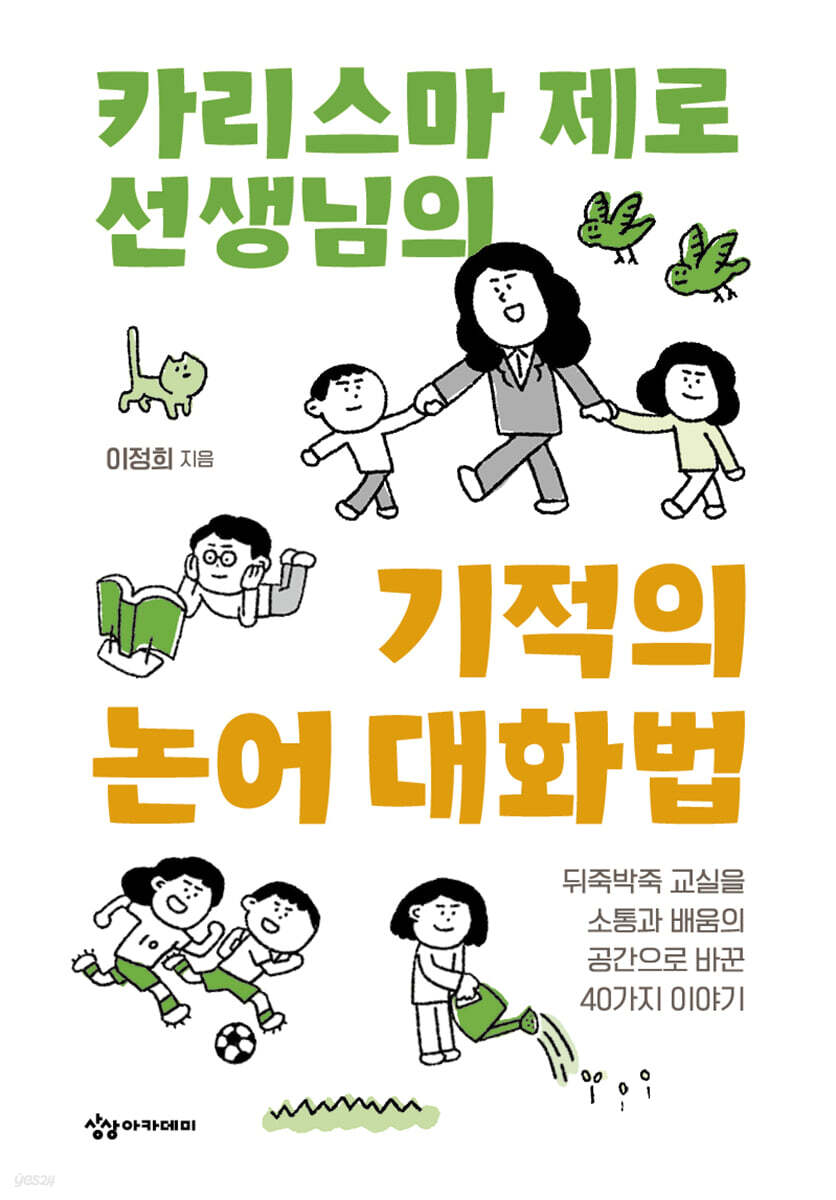
Charisma Zero Teacher's Miraculous Analects Dialogue Method
 |
Description
Book Introduction
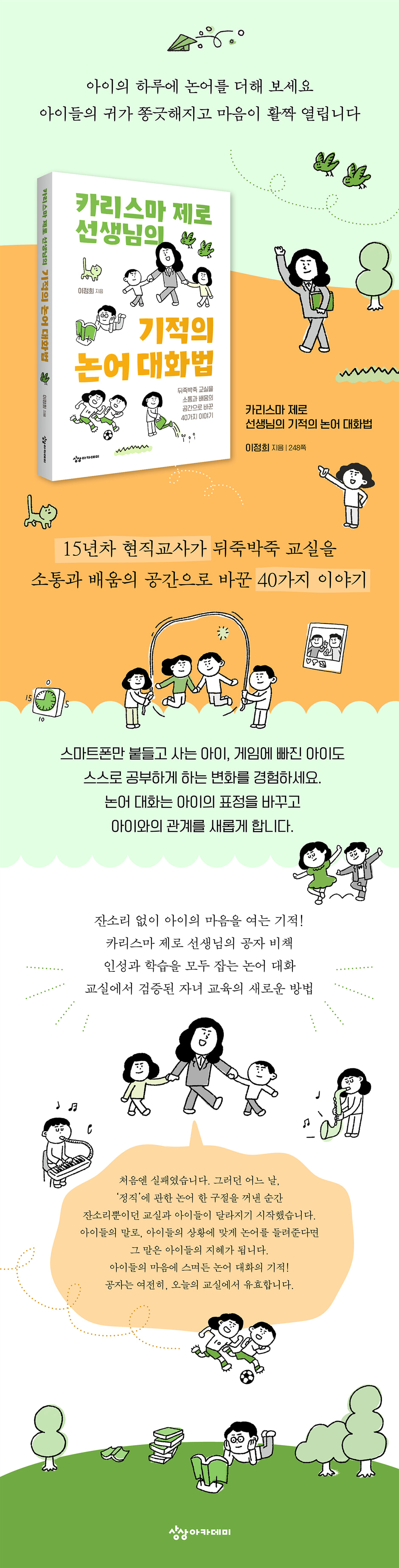
Instead of nagging, a line from the Analects!
Children's ears perk up and their hearts open wide.
40 Stories of How Chaotic Classrooms Transformed into Spaces for Communication and Learning
The special key that opens children's hearts isn't nagging or authority, but the Analects of Confucius! This book tells the story of an ordinary teacher who experienced classroom collapse and brought about change by connecting with his students through the wisdom of the Analects.
For children exhausted by smartphones, games, and schoolwork, and struggling with academic performance, relationships, and career paths, Confucius's wisdom provided living advice, opening hearts once closed to nagging.
This is not a simple classic commentary, but a moving collection of educational case studies that reinterprets students' specific and practical concerns about immersion, study, effort, honesty, friendship, and organization through the wisdom of Confucius.
For each topic, a ‘parent prescription’ was presented to provide educational guidelines that can be implemented at home.
A vivid guide that gives children wisdom and growth, and provides parents and teachers with a new path to education.
The miracle and inspiration of the Analects of Confucius dialogues that permeate children's hearts! Confucius remains relevant even in today's classrooms.
Children's ears perk up and their hearts open wide.
40 Stories of How Chaotic Classrooms Transformed into Spaces for Communication and Learning
The special key that opens children's hearts isn't nagging or authority, but the Analects of Confucius! This book tells the story of an ordinary teacher who experienced classroom collapse and brought about change by connecting with his students through the wisdom of the Analects.
For children exhausted by smartphones, games, and schoolwork, and struggling with academic performance, relationships, and career paths, Confucius's wisdom provided living advice, opening hearts once closed to nagging.
This is not a simple classic commentary, but a moving collection of educational case studies that reinterprets students' specific and practical concerns about immersion, study, effort, honesty, friendship, and organization through the wisdom of Confucius.
For each topic, a ‘parent prescription’ was presented to provide educational guidelines that can be implemented at home.
A vivid guide that gives children wisdom and growth, and provides parents and teachers with a new path to education.
The miracle and inspiration of the Analects of Confucius dialogues that permeate children's hearts! Confucius remains relevant even in today's classrooms.
- You can preview some of the book's contents.
Preview
index
Foreword: Confucius, though without charisma
Chapter 1 [Character] Analects Dialogue: Changing a Child's Life
[Friendship] I wish I didn't have a younger sibling.
[Self-esteem] How big is your house?
[Moderation] Can't we play for 10 more minutes?
[Goal] Do I really need to have a dream?
[Honest] I lied because I was afraid my friend would hate me.
[Speech] He gets irritated and speaks harshly at the drop of a hat.
[Reflection] Why are you only saying this to me?
[Laziness] Every morning is a battle
[Volunteer] How much will you pay me if I run an errand?
[Wrong] I stole my friend's stuff.
[Filial Piety] Falling down is also considered unfilial.
Chapter 2 [Study] Children who read the Analects also study well.
[Immersion ①] Environment - The desk is messy
[Immersion②] Interest - You have to be crazy to be crazy
[Immersion ③] Repetition? Practice - Just looking at a book makes me sleepy.
[Thought] I'm the only one who can't get a good score
[Motivation? Purpose] Reading a lot of books is useless.
[Question] I'm embarrassed to ask.
Chapter 3 [Growth] A Wise School Life: Gaining Wisdom from the Analects
[Cleanup] My locker is a mess
[Effort] He's smart, but he doesn't put in the effort.
[Process] I cheated because I wanted to get 100%.
[Friendship] I want to make friends
[Inner] I can't go out with my bare face
[Burden] My stomach hurts every time I come to school.
[Gossip] My friends tell me not to hang out with him.
[Consideration] I don't want to take the stairs.
[Promise] It's okay.
I won't get in trouble if I'm late
[Courage] Stop School Violence
[Competition] We had a soccer match with the class next door.
[Creativity] Why learn the old?
[Definition] I took my friend's stuff without knowing it.
Chapter 4 [Leap] Perfecting Our Children's Character with the Analects
[Relationship] Cheat Keys to Win Someone's Heart
[Sharing] The more you help, the better your grades will be?
[Admission] If you don't want to be obsessed with 'likes' on SNS
[Gossip] Speaking carelessly about other people's business will only hurt you.
[Leader] I want to quit being class president.
[Passion] I want to be the best
[Decision] Even your thoughts need a diet
[Loyalty] A friend who is there for you in times of need is a true friend.
[Conscience] Only when it is invisible can the truth be seen.
[Learning] Learning is completed through practice.
[Academics] Why study subjects that have nothing to do with your dreams?
Appendix: Collection of Analects and Original Texts Quoted in This Book
Chapter 1 [Character] Analects Dialogue: Changing a Child's Life
[Friendship] I wish I didn't have a younger sibling.
[Self-esteem] How big is your house?
[Moderation] Can't we play for 10 more minutes?
[Goal] Do I really need to have a dream?
[Honest] I lied because I was afraid my friend would hate me.
[Speech] He gets irritated and speaks harshly at the drop of a hat.
[Reflection] Why are you only saying this to me?
[Laziness] Every morning is a battle
[Volunteer] How much will you pay me if I run an errand?
[Wrong] I stole my friend's stuff.
[Filial Piety] Falling down is also considered unfilial.
Chapter 2 [Study] Children who read the Analects also study well.
[Immersion ①] Environment - The desk is messy
[Immersion②] Interest - You have to be crazy to be crazy
[Immersion ③] Repetition? Practice - Just looking at a book makes me sleepy.
[Thought] I'm the only one who can't get a good score
[Motivation? Purpose] Reading a lot of books is useless.
[Question] I'm embarrassed to ask.
Chapter 3 [Growth] A Wise School Life: Gaining Wisdom from the Analects
[Cleanup] My locker is a mess
[Effort] He's smart, but he doesn't put in the effort.
[Process] I cheated because I wanted to get 100%.
[Friendship] I want to make friends
[Inner] I can't go out with my bare face
[Burden] My stomach hurts every time I come to school.
[Gossip] My friends tell me not to hang out with him.
[Consideration] I don't want to take the stairs.
[Promise] It's okay.
I won't get in trouble if I'm late
[Courage] Stop School Violence
[Competition] We had a soccer match with the class next door.
[Creativity] Why learn the old?
[Definition] I took my friend's stuff without knowing it.
Chapter 4 [Leap] Perfecting Our Children's Character with the Analects
[Relationship] Cheat Keys to Win Someone's Heart
[Sharing] The more you help, the better your grades will be?
[Admission] If you don't want to be obsessed with 'likes' on SNS
[Gossip] Speaking carelessly about other people's business will only hurt you.
[Leader] I want to quit being class president.
[Passion] I want to be the best
[Decision] Even your thoughts need a diet
[Loyalty] A friend who is there for you in times of need is a true friend.
[Conscience] Only when it is invisible can the truth be seen.
[Learning] Learning is completed through practice.
[Academics] Why study subjects that have nothing to do with your dreams?
Appendix: Collection of Analects and Original Texts Quoted in This Book
Detailed image
Into the book
It wasn't like I started telling Analects stories to my children from the beginning.
It was when I was first assigned as a homeroom teacher.
How much I practiced speaking firmly so as not to seem inferior.
Was it because he insisted on a charisma that didn't suit him? The children didn't open their hearts to a teacher who only exuded authority.
It got to the point where even the class president was sighing.
--- p.5
It turns out that the Analects story you told me instead of nagging me wasn't wrong.
I could feel that the wisdom of the Analects resonated with children.
Even though it seems like the water is just draining away like bean sprouts in a steamer, someday the bean sprouts will grow lushly.
--- p.7
“Confucius told his disciples that it is rare for a person to go wrong by living a moderate life.
Maybe Dongjun also wants to be self-restrained, but it's not as easy as he wants.
So how can we live a life of moderation? It's all about setting an end.
In fact, for Dongjun, there was no end to games or studying.
I couldn't bring myself to start studying, but I couldn't stop playing games.
A beggar who couldn't control himself.
“Establishing a clear beginning and an end is how Dongjun will practice moderation.”
--- p.27
“Because I wasn’t honest with myself.
Misenggo was afraid that if he said there was no vinegar, he might be disappointed in himself.
I couldn't say that I didn't have something because I was too busy trying to please other people.
You've fooled yourself.
“Just as it takes courage to be hated.”
--- p.38
“What kind of attitude should we have when serving others? There is a saying in the Analects:
"A gentleman is conscious of righteousness, while a petty man is conscious of profit." Isn't the purpose of service outside of me, which is time? Since it moves according to profit, this is the heart of a petty man."
--- p.60
“There’s nothing better for focusing than starting with something you love.
It gets you immersed in no time.
You can tell just by looking at Confucius's appearance in the Analects.
They say that if you like something, you reach a point where you can become so immersed in it that you can't think of or see anything else.
"How much did Confucius love the music of the Shun Emperor? It was to the point where he forgot the taste of his favorite meat."
--- p.84
Through this passage, we can understand the concept of 'learning'.
‘學(學)’ is a Chinese character that means ‘to learn.’
I think you can think of it as the process of receiving instruction from a teacher during class.
Reviewing what you have learned is called 'practice'.
'習(習)' is a Chinese character that symbolizes the flapping wings [羽] of a baby bird with a white beak [白].
It is said that this character contains the meaning that in order for a baby bird to fly, it must repeatedly practice flapping its wings that it learned from its mother bird.
Tell me about the process of practicing and putting into practice what you have learned.
In that sense, for true learning to occur, a process of learning and reviewing is necessary.
--- p.89
Now that I'm an adult, I realize how hard it must have been for my parents to work to pay for my education.
I understood after experiencing it.
Confucius also said, “If you are not in that position, don’t talk about it.”
They say nothing in this world is easy.
What you guys are doing is also really great.
--- p.198
Confucius is said to have viewed the stages of knowledge as ‘knowing’, ‘liking’, and ‘enjoying’.
What about someone who does something not for competition or to impress others, but simply because it's fun in and of itself? It's a state where you can't quit even if you want to, a state where you simply enjoy it.
Enjoyment is the highest state of knowledge.
It was when I was first assigned as a homeroom teacher.
How much I practiced speaking firmly so as not to seem inferior.
Was it because he insisted on a charisma that didn't suit him? The children didn't open their hearts to a teacher who only exuded authority.
It got to the point where even the class president was sighing.
--- p.5
It turns out that the Analects story you told me instead of nagging me wasn't wrong.
I could feel that the wisdom of the Analects resonated with children.
Even though it seems like the water is just draining away like bean sprouts in a steamer, someday the bean sprouts will grow lushly.
--- p.7
“Confucius told his disciples that it is rare for a person to go wrong by living a moderate life.
Maybe Dongjun also wants to be self-restrained, but it's not as easy as he wants.
So how can we live a life of moderation? It's all about setting an end.
In fact, for Dongjun, there was no end to games or studying.
I couldn't bring myself to start studying, but I couldn't stop playing games.
A beggar who couldn't control himself.
“Establishing a clear beginning and an end is how Dongjun will practice moderation.”
--- p.27
“Because I wasn’t honest with myself.
Misenggo was afraid that if he said there was no vinegar, he might be disappointed in himself.
I couldn't say that I didn't have something because I was too busy trying to please other people.
You've fooled yourself.
“Just as it takes courage to be hated.”
--- p.38
“What kind of attitude should we have when serving others? There is a saying in the Analects:
"A gentleman is conscious of righteousness, while a petty man is conscious of profit." Isn't the purpose of service outside of me, which is time? Since it moves according to profit, this is the heart of a petty man."
--- p.60
“There’s nothing better for focusing than starting with something you love.
It gets you immersed in no time.
You can tell just by looking at Confucius's appearance in the Analects.
They say that if you like something, you reach a point where you can become so immersed in it that you can't think of or see anything else.
"How much did Confucius love the music of the Shun Emperor? It was to the point where he forgot the taste of his favorite meat."
--- p.84
Through this passage, we can understand the concept of 'learning'.
‘學(學)’ is a Chinese character that means ‘to learn.’
I think you can think of it as the process of receiving instruction from a teacher during class.
Reviewing what you have learned is called 'practice'.
'習(習)' is a Chinese character that symbolizes the flapping wings [羽] of a baby bird with a white beak [白].
It is said that this character contains the meaning that in order for a baby bird to fly, it must repeatedly practice flapping its wings that it learned from its mother bird.
Tell me about the process of practicing and putting into practice what you have learned.
In that sense, for true learning to occur, a process of learning and reviewing is necessary.
--- p.89
Now that I'm an adult, I realize how hard it must have been for my parents to work to pay for my education.
I understood after experiencing it.
Confucius also said, “If you are not in that position, don’t talk about it.”
They say nothing in this world is easy.
What you guys are doing is also really great.
--- p.198
Confucius is said to have viewed the stages of knowledge as ‘knowing’, ‘liking’, and ‘enjoying’.
What about someone who does something not for competition or to impress others, but simply because it's fun in and of itself? It's a state where you can't quit even if you want to, a state where you simply enjoy it.
Enjoyment is the highest state of knowledge.
--- pp.208~209
Publisher's Review
A warm and wise path for learning and growth,
Communicate with children through the Analects, not nagging!
The story of how an ordinary, charismatic teacher transformed his classroom and its students.
“That’s when I knew.
It turns out that the Analects story you told me instead of nagging me wasn't wrong.
I realized that the wisdom of the Analects was having a small impact on children's lives.
“Even if the water seems to drain away, it is like the bean sprouts in the steamer that will eventually grow lushly.” (Page 7)
An ordinary teacher with no charisma to guide children.
During his first year as a homeroom teacher, he experienced the collapse of the classroom because he was unable to win the hearts of the students due to his excessive authority. One day, he remembered the Analects of Confucius.
And instead of nagging the students, he begins to share the wisdom of the Analects.
But surprisingly, children begin to open their hearts, which had been closed by nagging, and listen to the message of the Analects.
This book contains the author's experiences and insights gained from communicating with children in the classroom through the wisdom of Confucius.
Rather than simply introducing and explaining passages from the Analects, it presents specific conversations and application cases on how the teachings of Confucius can be used to solve practical concerns faced by children today, such as “I lied because I was afraid my friend would hate me (honesty)”, “I was embarrassed to ask (question)”, “I cheated because I wanted to get a perfect score (process)”, “The more I help, the better my grades will be? (sharing)”, “I can’t go to school with a bare face (inner)”, “Why am I learning subjects that have nothing to do with my dreams? (academics)”.
The vivid conversations between teachers and children presented in this book confirm that the Analects offer timeless and effective answers to questions children face in all aspects of life, including academic performance, friendships, family issues, dreams and career paths, and self-esteem.
At the end of each story, a 'Parent Prescription' is provided to guide parents in communicating with their children through classics and helping them grow up properly.
It provides opportunities for growth and learning for both parents and children through specific methods that can be applied immediately at home, such as solving a child's laziness with the 'Pomodoro Technique' and 'roles', or teaching 'values' beyond material things.
This book is a moving guide that shows how the classics can come alive in our children's lives and how they can serve as a pathway to learning and growth.
This book, which helps children develop holistically by applying the wisdom of the Analects and classics to educational settings and the home, has the following characteristics.
1.
A realistic dialogue method that applies the wisdom of the Analects and classics to children's specific concerns.
The most significant feature of this book is that it directly applies the teachings of the Analects and classics to children's specific and realistic concerns, presenting them in vivid educational settings.
The author captures the conflicts and questions children face in their daily lives, citing passages from the Analects that perfectly capture the topic and guide the conversation. For example, for a child who feels intimidated by a question about the size of their house among friends, the author quotes the Analects, "You can take away the generalship of a great king, but you cannot take away the will of an ordinary man" (pp. 22-23), to illustrate the importance of unwavering resolve.
"What's the best cell phone in the world? It's the one I like.
No matter how expensive a cell phone is, if I don't like it, it won't be as good as the cheapest one.
No matter how cheap it is, if it's the best in my mind, it's the best.
Good things don't come in cheap prices.
“It depends on my heart,” he advises, awakening the inner strength that is not swayed by material things.
For children who are addicted to games and late for school, the phrase “It is rare for a person to go wrong while living a moderate life (page 27)” is suggested, and “I have to study, but I don’t want to.
Also, I was worried about the future, so I was just anxious.
Playing games frees you from studying, so you can temporarily escape your anxiety.
“The game of delaying the start of studying and saying ‘just 5 minutes, just 10 minutes’ has now started to last until dawn,” he says, and provides practical and effective solutions, not just simple scolding, such as understanding the child’s psychology and suggesting a ‘study timer and checklist’ as a customized solution.
This is a key strength that allows children to perceive classics not as boring old stories, but as practical wisdom that can transform their lives.
It also provides moving teachings by introducing Chinese character interpretations, the author's honest experiences, and various educational examples.
‘學(學)’ is a Chinese character that means ‘to learn.’
I think you can think of it as the process of receiving instruction from a teacher during class.
Reviewing what you have learned is called 'practice'.
'習(習)' is a Chinese character that symbolizes the flapping wings [羽] of a baby bird with a white beak [白].
It is said that this character contains the meaning that in order for a baby bird to fly, it must repeatedly practice flapping its wings that it learned from its mother bird.
Tell me about the process of practicing and putting into practice what you have learned.
In that sense, for true learning to occur, a process of learning and reviewing is necessary.
(Page 89)
2.
A profound resonance through interpretations of the Analects and literary metaphors tailored to children's level.
This book interprets classics at an appropriate level for children to easily understand, and the author adds his own warm and literary metaphors to provide a deep resonance.
Instead of relying on difficult Chinese characters or outdated expressions, the author unravels the core values of the Analects through stories from children's daily lives. The author's writing, which chronicles the pain of classroom collapse during his first homeroom teacher days and the subsequent transformation through his encounter with the Analects, leaves a profound impression on readers.
Both the nagging from my first homeroom days and the Analects stories I tell now are words I hope will do well for the children. However, one has cut off communication and silenced the children, and the other has seeped into their hearts.
Why was it? It was a difference in my perspective on children.
The nagging, full of commands, had no choice but to look down on the children.
Perhaps I believed that only then would my words have the power to reach the children.
But the Analects of Confucius are literally 'stories'.
We had to look at each other at the same eye level.
Like a traditional fairy tale with a lesson told by a grandmother.
(Page 8)
As this article demonstrates, the author's honest confessions and narrative of change demonstrate that this book is not simply an educational book, but a story of reflection and growth.
In particular, in the story about ‘honesty’, he tells the story of Misaenggo and says, “It’s because I wasn’t honest with myself.
Misenggo was afraid that if he said there was no vinegar, he might be disappointed in himself.
I couldn't say that I didn't have something because I was too busy trying to please other people.
The part that is interpreted as “You’re fooling yourself (page 38)” evokes empathy and realization not only in children but also in adults.
Also, in the story about 'laziness', Confucius scolds his lazy disciple Zaiyue, saying, "Rotten wood cannot be carved, and a wall built with dung clay cannot be manicured.
By applying the words, “What more can I scold Jae-yeo?” to the words of a student’s mother, “Let’s not talk, nagging just hurts our mouths,” he provides the insight that “the greatest scolding is for a teacher to give up on his student” (pp. 54-55).
This book solves even children's seemingly trivial problems with the wisdom of the classics, offering readers practical solutions.
For example, for a child who cannot find their workbook because their locker is a mess, the Analects of Confucius [Za Zhang Pian] reminds them that organizing and cleaning are not secondary tasks but the foundation of all work, through the phrase, “Which should you do first, and which should you put off and be lazy about?” (p. 113).
We introduce the miraculous change brought about by the simple act of organizing study materials, adding the example of how crime on the New York subway was significantly reduced by the simple act of erasing a single graffiti.
Stories about effort also resonate.
To a child who says, “I can’t do it no matter how hard I try” because his grades aren’t improving, I tell him the words of Confucius: “I am not someone who was born knowing, but someone who loves the old and diligently seeks out and learns” (p. 119).
Even Confucius, known as a genius, continued to learn through constant effort, leading us to understand the principle that small efforts accumulate to eventually lead to great achievements.
The transformation of a child who builds a sense of accomplishment through daily note-taking is deeply moving to the reader. The author emphasizes the value of the process as much as the outcome.
For a child who cheated on a performance assessment, “Look at a person’s actions, examine their motivations, and observe whether they are satisfied with them.
By introducing a passage from the Analects of Confucius [Wei Zheng Chapter] that says, “If you observe like that, you will not be able to hide what kind of person you are” (page 125), he informs us that exams are not just for grades, but are an opportunity to look back on the study process and fill in what is lacking.
It serves as a guide for parents and students who are obsessed with the results called grades.
Also, in a conversation about ‘friendship,’ a child who has difficulty making friends because he is not very talkative is told the Analects verse, “A gentleman wants to be slow in speaking but quick in action” (page 130).
By demonstrating that "trust and action to keep your word" are the driving force behind true friendship, rather than fluent speech, this book prompts children to rethink the meaning of true friendship. Translating classical teachings into heartwarming classroom stories, this book revives the Analects of Confucius, transcending mere ancient teachings and presenting them as practical wisdom for today's lives.
The friendly and touching dialogues in the Analects make Confucius' teachings more easily and clearly imprinted on the reader's mind, and they have the power to move the reader's heart.
3.
Presenting a practical 'parenting prescription' useful for both parents and teachers.
This book is not only a textbook on the Analects for children, but is also significant in that it provides practical educational guidance to parents and teachers, who have the closest influence on children.
The "Parent Prescription" provided at the end of each story offers concrete practical methods for applying the values of the classics to the home and educational settings, based on an understanding of children's concerns and problems.
For example, if a student steals something, “A gentleman’s mistake is like an eclipse of the sun or moon.
He emphasizes the importance of having the courage to admit mistakes by citing the Analects of Confucius, which says, “If you make a mistake, everyone will see it; if you correct it, everyone will look up to you.”
In addition, the ‘Parents’ Prescription’ states, “It takes a lot of courage to admit mistakes.
Help your child develop the wisdom of courage.
The first place where we learn wisdom is at home.
Adults can make mistakes too.
But don't just dismiss it as 'that could happen'.
Show your child that you admit your mistakes and apologize.
He advises, “Children learn by observing the example of adults (p. 68),” and encourages parents to set an example first. Furthermore, when a student mistreats his own body, he conveys the most fundamental meaning of filial piety through the [Wei Zheng Pian] passage, “Parents only worry about their children getting sick.” In addition, in the “Prescription for Parents,” he introduces various passages from the Analects related to filial piety, leading us to examine other values of filial piety that are worth noting today (p. 72-73).
For children who are having difficulty in relationships, quote the passage, “A virtuous person is not lonely; he or she will always have neighbors” (p. 184), and remind them that being tolerant of small mistakes is the key to friendship.
Parents' prescription for this advises that when a child is 'tattling', they should distinguish between the intention to embarrass the other person or the feeling of worry, and that they should teach the child that "this much is okay" for small mistakes, and that they should cultivate the child's morality in a balanced way.
For children who feel limited in their studies, the passage “A good person, if he wants to stand up for himself, helps others stand up, and if he wants to achieve something himself, helps others achieve something” (page 189) is used as an example to emphasize that helping friends through group activities is ultimately the path to personal growth.
The parent prescription advises that 'complete learning' can be achieved through activities such as explaining what children have learned on their own on a blackboard or blank sheet of paper.
For children obsessed with ‘likes’ on social media, the Analects teach us how to maintain an inner balance that is not swayed by external recognition, through the teaching that “we should not worry that others do not recognize us, but that we should worry that we do not recognize others” (p. 194).
The Parents' Prescription suggests educational methods that help children love themselves as they are, not as they appear to be.
For children struggling with leadership issues, the phrase “A gentleman is harmonious but not identical” (page 204) reminds them of the attitude of a leader who achieves harmony without losing standards.
The parental prescription introduces examples of humble leadership demonstrated by the kings of the Yao and Shun eras to prevent children from mistaking leadership for power.
This book goes beyond simply introducing the classics; it guides students to effectively apply their wisdom in real-world situations, including classrooms and homes.
By providing case studies, stories, and practical guidance for parents and teachers, it provides tools for parents and children to grow together.
Communicate with children through the Analects, not nagging!
The story of how an ordinary, charismatic teacher transformed his classroom and its students.
“That’s when I knew.
It turns out that the Analects story you told me instead of nagging me wasn't wrong.
I realized that the wisdom of the Analects was having a small impact on children's lives.
“Even if the water seems to drain away, it is like the bean sprouts in the steamer that will eventually grow lushly.” (Page 7)
An ordinary teacher with no charisma to guide children.
During his first year as a homeroom teacher, he experienced the collapse of the classroom because he was unable to win the hearts of the students due to his excessive authority. One day, he remembered the Analects of Confucius.
And instead of nagging the students, he begins to share the wisdom of the Analects.
But surprisingly, children begin to open their hearts, which had been closed by nagging, and listen to the message of the Analects.
This book contains the author's experiences and insights gained from communicating with children in the classroom through the wisdom of Confucius.
Rather than simply introducing and explaining passages from the Analects, it presents specific conversations and application cases on how the teachings of Confucius can be used to solve practical concerns faced by children today, such as “I lied because I was afraid my friend would hate me (honesty)”, “I was embarrassed to ask (question)”, “I cheated because I wanted to get a perfect score (process)”, “The more I help, the better my grades will be? (sharing)”, “I can’t go to school with a bare face (inner)”, “Why am I learning subjects that have nothing to do with my dreams? (academics)”.
The vivid conversations between teachers and children presented in this book confirm that the Analects offer timeless and effective answers to questions children face in all aspects of life, including academic performance, friendships, family issues, dreams and career paths, and self-esteem.
At the end of each story, a 'Parent Prescription' is provided to guide parents in communicating with their children through classics and helping them grow up properly.
It provides opportunities for growth and learning for both parents and children through specific methods that can be applied immediately at home, such as solving a child's laziness with the 'Pomodoro Technique' and 'roles', or teaching 'values' beyond material things.
This book is a moving guide that shows how the classics can come alive in our children's lives and how they can serve as a pathway to learning and growth.
This book, which helps children develop holistically by applying the wisdom of the Analects and classics to educational settings and the home, has the following characteristics.
1.
A realistic dialogue method that applies the wisdom of the Analects and classics to children's specific concerns.
The most significant feature of this book is that it directly applies the teachings of the Analects and classics to children's specific and realistic concerns, presenting them in vivid educational settings.
The author captures the conflicts and questions children face in their daily lives, citing passages from the Analects that perfectly capture the topic and guide the conversation. For example, for a child who feels intimidated by a question about the size of their house among friends, the author quotes the Analects, "You can take away the generalship of a great king, but you cannot take away the will of an ordinary man" (pp. 22-23), to illustrate the importance of unwavering resolve.
"What's the best cell phone in the world? It's the one I like.
No matter how expensive a cell phone is, if I don't like it, it won't be as good as the cheapest one.
No matter how cheap it is, if it's the best in my mind, it's the best.
Good things don't come in cheap prices.
“It depends on my heart,” he advises, awakening the inner strength that is not swayed by material things.
For children who are addicted to games and late for school, the phrase “It is rare for a person to go wrong while living a moderate life (page 27)” is suggested, and “I have to study, but I don’t want to.
Also, I was worried about the future, so I was just anxious.
Playing games frees you from studying, so you can temporarily escape your anxiety.
“The game of delaying the start of studying and saying ‘just 5 minutes, just 10 minutes’ has now started to last until dawn,” he says, and provides practical and effective solutions, not just simple scolding, such as understanding the child’s psychology and suggesting a ‘study timer and checklist’ as a customized solution.
This is a key strength that allows children to perceive classics not as boring old stories, but as practical wisdom that can transform their lives.
It also provides moving teachings by introducing Chinese character interpretations, the author's honest experiences, and various educational examples.
‘學(學)’ is a Chinese character that means ‘to learn.’
I think you can think of it as the process of receiving instruction from a teacher during class.
Reviewing what you have learned is called 'practice'.
'習(習)' is a Chinese character that symbolizes the flapping wings [羽] of a baby bird with a white beak [白].
It is said that this character contains the meaning that in order for a baby bird to fly, it must repeatedly practice flapping its wings that it learned from its mother bird.
Tell me about the process of practicing and putting into practice what you have learned.
In that sense, for true learning to occur, a process of learning and reviewing is necessary.
(Page 89)
2.
A profound resonance through interpretations of the Analects and literary metaphors tailored to children's level.
This book interprets classics at an appropriate level for children to easily understand, and the author adds his own warm and literary metaphors to provide a deep resonance.
Instead of relying on difficult Chinese characters or outdated expressions, the author unravels the core values of the Analects through stories from children's daily lives. The author's writing, which chronicles the pain of classroom collapse during his first homeroom teacher days and the subsequent transformation through his encounter with the Analects, leaves a profound impression on readers.
Both the nagging from my first homeroom days and the Analects stories I tell now are words I hope will do well for the children. However, one has cut off communication and silenced the children, and the other has seeped into their hearts.
Why was it? It was a difference in my perspective on children.
The nagging, full of commands, had no choice but to look down on the children.
Perhaps I believed that only then would my words have the power to reach the children.
But the Analects of Confucius are literally 'stories'.
We had to look at each other at the same eye level.
Like a traditional fairy tale with a lesson told by a grandmother.
(Page 8)
As this article demonstrates, the author's honest confessions and narrative of change demonstrate that this book is not simply an educational book, but a story of reflection and growth.
In particular, in the story about ‘honesty’, he tells the story of Misaenggo and says, “It’s because I wasn’t honest with myself.
Misenggo was afraid that if he said there was no vinegar, he might be disappointed in himself.
I couldn't say that I didn't have something because I was too busy trying to please other people.
The part that is interpreted as “You’re fooling yourself (page 38)” evokes empathy and realization not only in children but also in adults.
Also, in the story about 'laziness', Confucius scolds his lazy disciple Zaiyue, saying, "Rotten wood cannot be carved, and a wall built with dung clay cannot be manicured.
By applying the words, “What more can I scold Jae-yeo?” to the words of a student’s mother, “Let’s not talk, nagging just hurts our mouths,” he provides the insight that “the greatest scolding is for a teacher to give up on his student” (pp. 54-55).
This book solves even children's seemingly trivial problems with the wisdom of the classics, offering readers practical solutions.
For example, for a child who cannot find their workbook because their locker is a mess, the Analects of Confucius [Za Zhang Pian] reminds them that organizing and cleaning are not secondary tasks but the foundation of all work, through the phrase, “Which should you do first, and which should you put off and be lazy about?” (p. 113).
We introduce the miraculous change brought about by the simple act of organizing study materials, adding the example of how crime on the New York subway was significantly reduced by the simple act of erasing a single graffiti.
Stories about effort also resonate.
To a child who says, “I can’t do it no matter how hard I try” because his grades aren’t improving, I tell him the words of Confucius: “I am not someone who was born knowing, but someone who loves the old and diligently seeks out and learns” (p. 119).
Even Confucius, known as a genius, continued to learn through constant effort, leading us to understand the principle that small efforts accumulate to eventually lead to great achievements.
The transformation of a child who builds a sense of accomplishment through daily note-taking is deeply moving to the reader. The author emphasizes the value of the process as much as the outcome.
For a child who cheated on a performance assessment, “Look at a person’s actions, examine their motivations, and observe whether they are satisfied with them.
By introducing a passage from the Analects of Confucius [Wei Zheng Chapter] that says, “If you observe like that, you will not be able to hide what kind of person you are” (page 125), he informs us that exams are not just for grades, but are an opportunity to look back on the study process and fill in what is lacking.
It serves as a guide for parents and students who are obsessed with the results called grades.
Also, in a conversation about ‘friendship,’ a child who has difficulty making friends because he is not very talkative is told the Analects verse, “A gentleman wants to be slow in speaking but quick in action” (page 130).
By demonstrating that "trust and action to keep your word" are the driving force behind true friendship, rather than fluent speech, this book prompts children to rethink the meaning of true friendship. Translating classical teachings into heartwarming classroom stories, this book revives the Analects of Confucius, transcending mere ancient teachings and presenting them as practical wisdom for today's lives.
The friendly and touching dialogues in the Analects make Confucius' teachings more easily and clearly imprinted on the reader's mind, and they have the power to move the reader's heart.
3.
Presenting a practical 'parenting prescription' useful for both parents and teachers.
This book is not only a textbook on the Analects for children, but is also significant in that it provides practical educational guidance to parents and teachers, who have the closest influence on children.
The "Parent Prescription" provided at the end of each story offers concrete practical methods for applying the values of the classics to the home and educational settings, based on an understanding of children's concerns and problems.
For example, if a student steals something, “A gentleman’s mistake is like an eclipse of the sun or moon.
He emphasizes the importance of having the courage to admit mistakes by citing the Analects of Confucius, which says, “If you make a mistake, everyone will see it; if you correct it, everyone will look up to you.”
In addition, the ‘Parents’ Prescription’ states, “It takes a lot of courage to admit mistakes.
Help your child develop the wisdom of courage.
The first place where we learn wisdom is at home.
Adults can make mistakes too.
But don't just dismiss it as 'that could happen'.
Show your child that you admit your mistakes and apologize.
He advises, “Children learn by observing the example of adults (p. 68),” and encourages parents to set an example first. Furthermore, when a student mistreats his own body, he conveys the most fundamental meaning of filial piety through the [Wei Zheng Pian] passage, “Parents only worry about their children getting sick.” In addition, in the “Prescription for Parents,” he introduces various passages from the Analects related to filial piety, leading us to examine other values of filial piety that are worth noting today (p. 72-73).
For children who are having difficulty in relationships, quote the passage, “A virtuous person is not lonely; he or she will always have neighbors” (p. 184), and remind them that being tolerant of small mistakes is the key to friendship.
Parents' prescription for this advises that when a child is 'tattling', they should distinguish between the intention to embarrass the other person or the feeling of worry, and that they should teach the child that "this much is okay" for small mistakes, and that they should cultivate the child's morality in a balanced way.
For children who feel limited in their studies, the passage “A good person, if he wants to stand up for himself, helps others stand up, and if he wants to achieve something himself, helps others achieve something” (page 189) is used as an example to emphasize that helping friends through group activities is ultimately the path to personal growth.
The parent prescription advises that 'complete learning' can be achieved through activities such as explaining what children have learned on their own on a blackboard or blank sheet of paper.
For children obsessed with ‘likes’ on social media, the Analects teach us how to maintain an inner balance that is not swayed by external recognition, through the teaching that “we should not worry that others do not recognize us, but that we should worry that we do not recognize others” (p. 194).
The Parents' Prescription suggests educational methods that help children love themselves as they are, not as they appear to be.
For children struggling with leadership issues, the phrase “A gentleman is harmonious but not identical” (page 204) reminds them of the attitude of a leader who achieves harmony without losing standards.
The parental prescription introduces examples of humble leadership demonstrated by the kings of the Yao and Shun eras to prevent children from mistaking leadership for power.
This book goes beyond simply introducing the classics; it guides students to effectively apply their wisdom in real-world situations, including classrooms and homes.
By providing case studies, stories, and practical guidance for parents and teachers, it provides tools for parents and children to grow together.
GOODS SPECIFICS
- Date of issue: September 10, 2025
- Page count, weight, size: 248 pages | 342g | 136*195*13mm
- ISBN13: 9791193379585
- ISBN10: 119337958X
You may also like
카테고리
korean


korean

![GQ KOREA Mark (Monthly): December [2025]](http://librairie.coreenne.fr/cdn/shop/files/8ef265dbbfbf186523ed75ba7319009d.jpg?v=1765340328&width=3840)


