

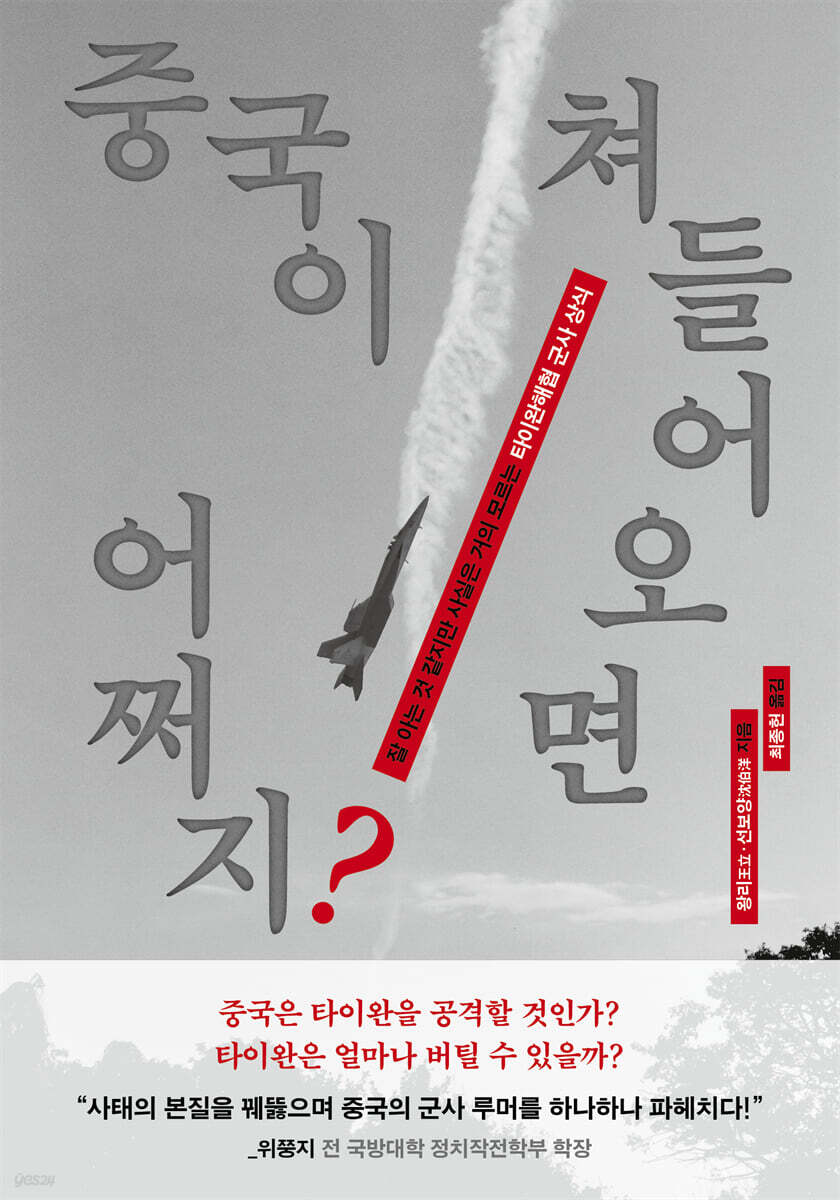
What if China invades?
 |
Description
Book Introduction
The most complete commentary on countering China's "cognitive war"
From debunking rumors to detailing various tactics.
Guidelines for Accurately Recognizing Enemy Threats
Will China attack Taiwan?
This book is about cognitive warfare, or a battle of wits.
Will China's People's Liberation Army attack Taiwan? If so, how long will Taiwan be able to withstand it? Will the United States come to Taiwan's aid? These questions often fill Taiwan with fear.
Some believe that with the strength of the Chinese military, Taiwan could be destroyed with just two or three attacks, and that their power will soon catch up with that of the United States, giving them global hegemony within a few years.
Taiwan is divided into two.
For this reason, when discussing military policy, political positions have a stronger influence than objective military knowledge.
Those who support unification with China always talk about the 'Taiwan's inevitable defeat' theory.
The problem is that even moderates and pro-Taiwan independence groups are influenced by these arguments.
Moreover, as the Democratic Progressive Party enters its second term in power and the power struggle between the US and China intensifies, the perception that war in the Taiwan Strait may be possible is gaining ground.
Taiwanese people want to protect their country, but rather than thinking strategically based on realistic understanding, they are psychologically biased and make the situation worse.
Accordingly, whenever the presidential election season comes around, rumors from China inevitably flow in, causing defeatism to sprout in the hearts of Taiwanese people.
What makes the situation worse these days is social media.
Disinformation is being spread more effectively through pro-Beijing groups, Kuomintang supporters, local Chinese collaborators, and closed social media groups within Taiwan. Social media users spread Chinese propaganda to Taiwanese people simply to increase their views, sometimes to push their political stances.
Taiwan's biggest problem today is that many citizens do not trust the Taiwanese military due to a lack of military knowledge and information.
Moreover, the academic community has conducted little research on the People's Liberation Army, and this, combined with errors in intelligence gathering and a lack of awareness of the Chinese Communist Party's organization, is exacerbating the situation.
In this context, the books by authors known as "cognitive warfare experts" for their ongoing in-depth discussions in the fields of national defense, security, and information warfare serve as perfect military commentary for the general public.
"What if China Invades?" not only compiles various military rumors about China's military unification of Taiwan that have been prevalent for the past 30 years, but also assesses the destructive power, propagation, and actual threat level of such rumors, and proposes various policy measures.
From debunking rumors to detailing various tactics.
Guidelines for Accurately Recognizing Enemy Threats
Will China attack Taiwan?
This book is about cognitive warfare, or a battle of wits.
Will China's People's Liberation Army attack Taiwan? If so, how long will Taiwan be able to withstand it? Will the United States come to Taiwan's aid? These questions often fill Taiwan with fear.
Some believe that with the strength of the Chinese military, Taiwan could be destroyed with just two or three attacks, and that their power will soon catch up with that of the United States, giving them global hegemony within a few years.
Taiwan is divided into two.
For this reason, when discussing military policy, political positions have a stronger influence than objective military knowledge.
Those who support unification with China always talk about the 'Taiwan's inevitable defeat' theory.
The problem is that even moderates and pro-Taiwan independence groups are influenced by these arguments.
Moreover, as the Democratic Progressive Party enters its second term in power and the power struggle between the US and China intensifies, the perception that war in the Taiwan Strait may be possible is gaining ground.
Taiwanese people want to protect their country, but rather than thinking strategically based on realistic understanding, they are psychologically biased and make the situation worse.
Accordingly, whenever the presidential election season comes around, rumors from China inevitably flow in, causing defeatism to sprout in the hearts of Taiwanese people.
What makes the situation worse these days is social media.
Disinformation is being spread more effectively through pro-Beijing groups, Kuomintang supporters, local Chinese collaborators, and closed social media groups within Taiwan. Social media users spread Chinese propaganda to Taiwanese people simply to increase their views, sometimes to push their political stances.
Taiwan's biggest problem today is that many citizens do not trust the Taiwanese military due to a lack of military knowledge and information.
Moreover, the academic community has conducted little research on the People's Liberation Army, and this, combined with errors in intelligence gathering and a lack of awareness of the Chinese Communist Party's organization, is exacerbating the situation.
In this context, the books by authors known as "cognitive warfare experts" for their ongoing in-depth discussions in the fields of national defense, security, and information warfare serve as perfect military commentary for the general public.
"What if China Invades?" not only compiles various military rumors about China's military unification of Taiwan that have been prevalent for the past 30 years, but also assesses the destructive power, propagation, and actual threat level of such rumors, and proposes various policy measures.
- You can preview some of the book's contents.
Preview
index
Recommendation
Dismantling the Cognitive Offensive from the Intangible State_Wi Zhongzhi, former Dean of the Department of Political Operations at the National Defense University
Fear Comes from Ignorance_Lin Ying-yu, Assistant Professor, Taiwan University
From Level 0 to Level 1 in Our Military Knowledge_Literary Critic Joo Yu-shin
Entering
Part 1: Debunking the Most Common Taiwan Invasion Rumors
1.
The theory of ballistic missile invincibility
2.
The theory of defense network paralysis by drones
3.
Airborne unit surprise attack factor assassination operation theory
4.
Theory of assassination operation by helicopter mobile strike force
5.
Airport occupation by civilian aircraft
6.
Theory of attacking Taiwan using all shipping assets
7.
Aircraft carrier joint attack theory (fall of eastern Taiwan)
8.
Container-type missile surprise attack theory (US aircraft carrier sinking theory)
9.
The theory of a Taiwan invasion using cruise missiles and long-range rockets is gaining popularity these days.
10.
The tenacious Taiwan containment theory
Part 1 Summary: Rumors Make People Defeatists
Part 2: China's Invasion Tactics in Taiwan
11.
Setting up a Taiwan invasion scenario
12.
pre-war preparations
13.
Early stage of war
14.
Stage of securing the right to provide and control the sea
15.
Landing operation entry stage
16.
Final stage: Establishing a bridgehead and advancing into key government and military areas.
Part 3: The ongoing war
17.
Information warfare
18.
War doesn't always leave ruins.
19.
China's other options for war besides regular landing operations
20.
What if we choose blockade or economic warfare instead of military conquest?
Part 4: Practical Strategic Planning for Taiwan and Surrounding Countries
21.
America's strategic planning
22.
Japan's strategic planning
23.
Strategic Planning of Countries Surrounding the South China Sea
24.
India's strategic planning
25.
Australia's strategic planning
26.
China's strategic planning
27.
Taiwan's strategic planning
A summary of each country's strategies
Conclusion
Reviews
Translator's Note
Dismantling the Cognitive Offensive from the Intangible State_Wi Zhongzhi, former Dean of the Department of Political Operations at the National Defense University
Fear Comes from Ignorance_Lin Ying-yu, Assistant Professor, Taiwan University
From Level 0 to Level 1 in Our Military Knowledge_Literary Critic Joo Yu-shin
Entering
Part 1: Debunking the Most Common Taiwan Invasion Rumors
1.
The theory of ballistic missile invincibility
2.
The theory of defense network paralysis by drones
3.
Airborne unit surprise attack factor assassination operation theory
4.
Theory of assassination operation by helicopter mobile strike force
5.
Airport occupation by civilian aircraft
6.
Theory of attacking Taiwan using all shipping assets
7.
Aircraft carrier joint attack theory (fall of eastern Taiwan)
8.
Container-type missile surprise attack theory (US aircraft carrier sinking theory)
9.
The theory of a Taiwan invasion using cruise missiles and long-range rockets is gaining popularity these days.
10.
The tenacious Taiwan containment theory
Part 1 Summary: Rumors Make People Defeatists
Part 2: China's Invasion Tactics in Taiwan
11.
Setting up a Taiwan invasion scenario
12.
pre-war preparations
13.
Early stage of war
14.
Stage of securing the right to provide and control the sea
15.
Landing operation entry stage
16.
Final stage: Establishing a bridgehead and advancing into key government and military areas.
Part 3: The ongoing war
17.
Information warfare
18.
War doesn't always leave ruins.
19.
China's other options for war besides regular landing operations
20.
What if we choose blockade or economic warfare instead of military conquest?
Part 4: Practical Strategic Planning for Taiwan and Surrounding Countries
21.
America's strategic planning
22.
Japan's strategic planning
23.
Strategic Planning of Countries Surrounding the South China Sea
24.
India's strategic planning
25.
Australia's strategic planning
26.
China's strategic planning
27.
Taiwan's strategic planning
A summary of each country's strategies
Conclusion
Reviews
Translator's Note
Into the book
Looking at it this way, the number of missiles that could pose a threat to Taiwan would be approximately 1,050 to 1,300, and the launch systems that would be most difficult to attack would be intermediate-range ballistic missiles.
However, the number of medium-range ballistic missile launchers is equal to the number of missiles.
And then there are the launchers for short-range missiles and ground-launched cruise missiles, which are 250 and 100 respectively, but their ranges are within Taiwan's counterattack range.
--- p.38
Simply put, if the maximum number of missiles that can be launched at one time in the event of an attack on Taiwan is 500, after the first launch, the number that can be launched at once is reduced to 350, and the maximum number of launches is three at most.
If the operating rate is calculated as 80 percent, the maximum number of missiles that can be launched in one round drops to 400.
In terms of the number of targets, there are 11 air force bases, 6 key military ports, 25 major army bases, 20 radar bases, and 5 key administrative organizations such as the Presidential Office in Taiwan, not counting power plants, substations, train stations, and important financial institutions.
So there are a total of 67 targets, and an average of 7.46 to 4.77 missiles can be fired per target.
--- p.39
Roughly speaking, if a Dongfeng-type ballistic missile with a warhead weighing over 500 kilograms were to directly hit a fighter hangar, both the fighter and the hangar would be completely destroyed.
If you want to prevent all the vital equipment inside the hangar from being destroyed, you have to reinforce it with very thick reinforced concrete.
This will prevent destruction by the shock wave after a direct hit.
Readers will undoubtedly ask how anyone can see something so powerful without feeling a sense of alarm and fear.
--- p.41
Two problems arise here that readers must be aware of.
First, there is the problem of low accuracy.
If a missile were to accidentally hit a civilian facility, such as a school or hospital, while targeting a government office or military installation within an urban area, it would be a horrific disaster that would bring shame to the entire world.
--- p.45
If the missile explodes in mid-air rather than hitting the runway directly, it will basically just create fragments and a small crater created by the fragments.
If it hits the runway surface and explodes, most of the explosive energy will spread upwards, leaving only a small crater.
The missile must penetrate the runway to a certain depth and explode to disable the runway.
Normally, a ballistic missile at that speed would leave a crater of considerable size if it were to hit the runway directly, but it is difficult to say how destructive it would be because there has been no actual experiment.
--- p.48
So, what is the approximate CEP of the People's Liberation Army's ballistic missiles? Government data and reliable sources suggest a range between tens and hundreds of meters, with the most common estimate being 100 to 300 meters.
The longer the distance, the larger the CEP.
However, since we need to overestimate the enemy as much as possible, CEP is usually set at 100 meters, but we will set it at 50 meters.
Considering recent developments in the People's Liberation Army, it seems reasonable to assume that the CEP of ballistic missiles is 50 meters.
But I can't help but laugh at China's boast that its science and technology has surpassed that of the United States.
--- p.52
What's the problem with this rumor? It completely ignores the actual nature of air combat and applies human wave tactics to air combat.
First, let's not discuss the question of 'how to do remote control?' and the problem of distance limitations of radio control.
Let's say you have a drone that's actually a converted old fighter jet that can fly 500 of them at once, and it's even equipped with weapons.
Well then, let me ask you a question here.
How will all these aircraft be flown? To this day, there is no concrete design for a mother-and-child aircraft on Earth.
Controlling by human power has limitations in processing.
It is impossible for one person to control ten drones simultaneously, and even if remotely controlled by a computer or using the drone's autonomous flight function, there are limits to perfectly imitating the flight abilities of a human pilot.
--- p.59~60
In theory, it is not at all impossible to paralyze Taiwan's air defense network by simultaneously dispatching hundreds of fighter jets.
However, there are limitations to the operational airspace, which are speed and space.
Simply put, the faster the aircraft, the more airspace it needs, and the slower the aircraft, the less airspace it needs.
However, under modern air defense systems, the faster the speed, the better the evasion ability, and the slower the speed, the less likely it is to survive.
So sending hundreds of slow, old fighter jets is like asking to be shot down.
--- p.71
It has been confirmed that China has recently acquired the ability to transport heavy equipment.
However, in actual training exercises that have been conducted several times, troops and equipment are still dropped separately, and the ability to drop them simultaneously has not yet been achieved.
What this shows is that the combat power of airborne troops is bound to be relatively weak, as it takes a considerable amount of time to assemble troops and secure equipment, making it impossible to immediately enter combat after landing.
--- p.76
Let's assume this.
If there were 50 such ports along the coast from Zhejiang to Fujian, 750,000 troops could embark in an instant.
It may sound very threatening at first glance, but it is not at all like that.
If you open Google Earth and look at the coastline of these two castles, you will see that the terrain is not suitable for stationing large numbers of troops.
Moreover, there are no railways around many ports, only roads.
Therefore, it is almost impossible to concentrate large forces in a fixed location.
In other words, the very assumption that a large force would be assembled around the port in advance and ready for operation does not hold true in reality because there is no space.
However, the number of medium-range ballistic missile launchers is equal to the number of missiles.
And then there are the launchers for short-range missiles and ground-launched cruise missiles, which are 250 and 100 respectively, but their ranges are within Taiwan's counterattack range.
--- p.38
Simply put, if the maximum number of missiles that can be launched at one time in the event of an attack on Taiwan is 500, after the first launch, the number that can be launched at once is reduced to 350, and the maximum number of launches is three at most.
If the operating rate is calculated as 80 percent, the maximum number of missiles that can be launched in one round drops to 400.
In terms of the number of targets, there are 11 air force bases, 6 key military ports, 25 major army bases, 20 radar bases, and 5 key administrative organizations such as the Presidential Office in Taiwan, not counting power plants, substations, train stations, and important financial institutions.
So there are a total of 67 targets, and an average of 7.46 to 4.77 missiles can be fired per target.
--- p.39
Roughly speaking, if a Dongfeng-type ballistic missile with a warhead weighing over 500 kilograms were to directly hit a fighter hangar, both the fighter and the hangar would be completely destroyed.
If you want to prevent all the vital equipment inside the hangar from being destroyed, you have to reinforce it with very thick reinforced concrete.
This will prevent destruction by the shock wave after a direct hit.
Readers will undoubtedly ask how anyone can see something so powerful without feeling a sense of alarm and fear.
--- p.41
Two problems arise here that readers must be aware of.
First, there is the problem of low accuracy.
If a missile were to accidentally hit a civilian facility, such as a school or hospital, while targeting a government office or military installation within an urban area, it would be a horrific disaster that would bring shame to the entire world.
--- p.45
If the missile explodes in mid-air rather than hitting the runway directly, it will basically just create fragments and a small crater created by the fragments.
If it hits the runway surface and explodes, most of the explosive energy will spread upwards, leaving only a small crater.
The missile must penetrate the runway to a certain depth and explode to disable the runway.
Normally, a ballistic missile at that speed would leave a crater of considerable size if it were to hit the runway directly, but it is difficult to say how destructive it would be because there has been no actual experiment.
--- p.48
So, what is the approximate CEP of the People's Liberation Army's ballistic missiles? Government data and reliable sources suggest a range between tens and hundreds of meters, with the most common estimate being 100 to 300 meters.
The longer the distance, the larger the CEP.
However, since we need to overestimate the enemy as much as possible, CEP is usually set at 100 meters, but we will set it at 50 meters.
Considering recent developments in the People's Liberation Army, it seems reasonable to assume that the CEP of ballistic missiles is 50 meters.
But I can't help but laugh at China's boast that its science and technology has surpassed that of the United States.
--- p.52
What's the problem with this rumor? It completely ignores the actual nature of air combat and applies human wave tactics to air combat.
First, let's not discuss the question of 'how to do remote control?' and the problem of distance limitations of radio control.
Let's say you have a drone that's actually a converted old fighter jet that can fly 500 of them at once, and it's even equipped with weapons.
Well then, let me ask you a question here.
How will all these aircraft be flown? To this day, there is no concrete design for a mother-and-child aircraft on Earth.
Controlling by human power has limitations in processing.
It is impossible for one person to control ten drones simultaneously, and even if remotely controlled by a computer or using the drone's autonomous flight function, there are limits to perfectly imitating the flight abilities of a human pilot.
--- p.59~60
In theory, it is not at all impossible to paralyze Taiwan's air defense network by simultaneously dispatching hundreds of fighter jets.
However, there are limitations to the operational airspace, which are speed and space.
Simply put, the faster the aircraft, the more airspace it needs, and the slower the aircraft, the less airspace it needs.
However, under modern air defense systems, the faster the speed, the better the evasion ability, and the slower the speed, the less likely it is to survive.
So sending hundreds of slow, old fighter jets is like asking to be shot down.
--- p.71
It has been confirmed that China has recently acquired the ability to transport heavy equipment.
However, in actual training exercises that have been conducted several times, troops and equipment are still dropped separately, and the ability to drop them simultaneously has not yet been achieved.
What this shows is that the combat power of airborne troops is bound to be relatively weak, as it takes a considerable amount of time to assemble troops and secure equipment, making it impossible to immediately enter combat after landing.
--- p.76
Let's assume this.
If there were 50 such ports along the coast from Zhejiang to Fujian, 750,000 troops could embark in an instant.
It may sound very threatening at first glance, but it is not at all like that.
If you open Google Earth and look at the coastline of these two castles, you will see that the terrain is not suitable for stationing large numbers of troops.
Moreover, there are no railways around many ports, only roads.
Therefore, it is almost impossible to concentrate large forces in a fixed location.
In other words, the very assumption that a large force would be assembled around the port in advance and ready for operation does not hold true in reality because there is no space.
--- p.98
Publisher's Review
A battle of wits is a psychological warfare.
What is most impressive about this book is its argumentative style.
Fake news or rumors are not made up entirely of lies.
There is always 30 percent truth in it, so people get caught up in partial facts or logic and make mistakes.
The authors debunk ten major rumors with logical yet realistic evidence.
This is the central theme of this book, and readers will ultimately learn that only by winning the cognitive battle can they effectively cope with reality.
For example, when dealing with the most powerful rumor, the theory of ballistic missile invincibility, he introduces the "circular communist error CEP" and explains to readers why even if China has 3,000 ballistic missiles, it is far from enough to defeat Taiwan's defense system.
Regardless of the weapon system, the factors that must be considered when China invades are time and space.
The authors calculate a series of procedures, including equipment dismantling, loading, transport, unloading, support, assembly, and testing, and estimate the probability of hit according to the number of shots fired, indicating its accuracy and power.
When the public learns that missiles have a surprisingly low hit rate and that their "explosive power" is not as great as expected, they can make realistic judgments rather than feel threatened by the military rumors and news they usually hear.
When discussing another rumor, the "Airborne Surprise Attack Operation," the authors explain the terrain conditions necessary for airborne troops to land and explain why such an operation would be impossible in densely populated Taiwan.
When discussing the "Taiwan attack theory using all naval assets," the difficulty of the landing operation is explained in detail through the process of the landing fleet going back and forth across the Taiwan Strait to load and unload supplies, and calculating the distance between the ship's waterline and the landing point.
In other words, it is an argument that argues what advantage the defending side has.
This logical development provides readers with a methodology for 'head-on confrontation' with external situations.
As Francis Bacon said, “If one is ignorant of vice, virtue cannot be protected, but must be harmed.”
The authors explain the current military situation in the Taiwan Strait and where Taiwan's strategic and tactical advantage lies.
This frees us from the anxiety that the United States will not come to our rescue when we encounter rumors spread by China.
The strength of this book is that it explains specialized knowledge, especially in the military field, in everyday language.
The composition consists of a total of 27 chapters in 4 parts.
In Part 1, we delve into the ten most frequently used military rumors about Taiwan by the Chinese Communist Party, focusing on refuting and verifying each.
Part 2 examines a four-stage hypothetical scenario for the invasion of Taiwan.
Part 3 deals with the silent war between the two sides.
The first three parts seem to be written in reverse order of general understanding.
First, we will discuss the limitations of the Chinese military's weaponry, then discuss the limitations of the means at their disposal, and finally discuss how the Chinese Communist Party could launch an invasion of Taiwan while the peace is still in place.
The author chose this narrative style to help readers grasp the concept first and understand that China's seemingly formidable invasion strategy was by no means an unstoppable trump card.
In other words, after fully grasping the concept based on a basic understanding, it is expanded to explain the tactics used by the People's Liberation Army and the range of reasonable application.
Part 4 introduces how the countries surrounding Taiwan develop their strategies from their own perspectives. Reading this section, you will see that many of the current rumors are directly contradictory to the strategies of the surrounding countries.
Uncovering the deceptive tactics of rumors
All the rumors that have been coming from China for years are based on the assumption that China is adopting an aggressive mindset.
Most rumors share three main deceptive techniques:
First, it forces us to accept extreme conditions that defy common sense by using the most extreme situations without mentioning any limitations of use, and attempts to draw universal conclusions from extreme conditions that are impossible to establish in the first place.
Second, it overestimates the strength of the People's Liberation Army by mixing up time and space, mixing together conditions that only apply individually, and even conditions that are contradictory.
For example, does China have landing ships capable of transporting tanks? Yes.
Does China have ships capable of carrying large numbers of people? Yes.
Then, China concludes that it can transport tanks across the sea with numerous ships.
But this is an argument that does not take into account the volume issue of the ship at all.
Third, they use straightforward and simple logic to make people accept the rumors through the concept that 'the enemy must be overestimated as much as possible', and if they don't accept them, they are accused of being ideologically biased.
For example, does China have aircraft carriers? Yes, they do.
Is there a carrier-based aircraft suitable for it? Yes.
Is it possible to deploy it within three years? Yes.
Is it possible to sail to the waters east of Taiwan? Yes.
Then, we can conclude that China's aircraft carriers can occupy the waters east of Taiwan and gain superiority in sea and air supremacy.
This is a classic example of a logical leap.
In fact, since the military reforms of 2016, the pace of modernization of the People's Liberation Army has continued to accelerate and has now entered a new phase.
Basically, the modernization of the military can be divided into four stages: theory, technology, organization, and talent, and the People's Liberation Army is achieving this kind of development.
Xi Jinping's military reform established the command principle that "the Military Commission supervises the whole, each theater focuses on combat, and each service branch focuses on military construction."
And by reorganizing the information, electronics, aviation systems, and rear supply systems that were previously dispersed across each unit and integrating them into independent "strategic support units" and "joint support units," the People's Liberation Army's command structure was made more compatible with unified joint operations.
But the People's Liberation Army is ultimately operated by people.
Therefore, their immediate task is how to train soldiers capable of conducting joint operations, and this is where the problem is revealed.
In addition, various failure factors are being pointed out, such as limitations in the rear supply system.
The first purpose of this book is to clear up misunderstandings.
Because accurate awareness is the most important condition for national defense.
In other words, the current reality facing Taiwan is that a military discourse from a Taiwanese perspective is urgent, and the authors address this.
The book excels especially in its political premises, discourse, and metaphors of thought.
What is most impressive about this book is its argumentative style.
Fake news or rumors are not made up entirely of lies.
There is always 30 percent truth in it, so people get caught up in partial facts or logic and make mistakes.
The authors debunk ten major rumors with logical yet realistic evidence.
This is the central theme of this book, and readers will ultimately learn that only by winning the cognitive battle can they effectively cope with reality.
For example, when dealing with the most powerful rumor, the theory of ballistic missile invincibility, he introduces the "circular communist error CEP" and explains to readers why even if China has 3,000 ballistic missiles, it is far from enough to defeat Taiwan's defense system.
Regardless of the weapon system, the factors that must be considered when China invades are time and space.
The authors calculate a series of procedures, including equipment dismantling, loading, transport, unloading, support, assembly, and testing, and estimate the probability of hit according to the number of shots fired, indicating its accuracy and power.
When the public learns that missiles have a surprisingly low hit rate and that their "explosive power" is not as great as expected, they can make realistic judgments rather than feel threatened by the military rumors and news they usually hear.
When discussing another rumor, the "Airborne Surprise Attack Operation," the authors explain the terrain conditions necessary for airborne troops to land and explain why such an operation would be impossible in densely populated Taiwan.
When discussing the "Taiwan attack theory using all naval assets," the difficulty of the landing operation is explained in detail through the process of the landing fleet going back and forth across the Taiwan Strait to load and unload supplies, and calculating the distance between the ship's waterline and the landing point.
In other words, it is an argument that argues what advantage the defending side has.
This logical development provides readers with a methodology for 'head-on confrontation' with external situations.
As Francis Bacon said, “If one is ignorant of vice, virtue cannot be protected, but must be harmed.”
The authors explain the current military situation in the Taiwan Strait and where Taiwan's strategic and tactical advantage lies.
This frees us from the anxiety that the United States will not come to our rescue when we encounter rumors spread by China.
The strength of this book is that it explains specialized knowledge, especially in the military field, in everyday language.
The composition consists of a total of 27 chapters in 4 parts.
In Part 1, we delve into the ten most frequently used military rumors about Taiwan by the Chinese Communist Party, focusing on refuting and verifying each.
Part 2 examines a four-stage hypothetical scenario for the invasion of Taiwan.
Part 3 deals with the silent war between the two sides.
The first three parts seem to be written in reverse order of general understanding.
First, we will discuss the limitations of the Chinese military's weaponry, then discuss the limitations of the means at their disposal, and finally discuss how the Chinese Communist Party could launch an invasion of Taiwan while the peace is still in place.
The author chose this narrative style to help readers grasp the concept first and understand that China's seemingly formidable invasion strategy was by no means an unstoppable trump card.
In other words, after fully grasping the concept based on a basic understanding, it is expanded to explain the tactics used by the People's Liberation Army and the range of reasonable application.
Part 4 introduces how the countries surrounding Taiwan develop their strategies from their own perspectives. Reading this section, you will see that many of the current rumors are directly contradictory to the strategies of the surrounding countries.
Uncovering the deceptive tactics of rumors
All the rumors that have been coming from China for years are based on the assumption that China is adopting an aggressive mindset.
Most rumors share three main deceptive techniques:
First, it forces us to accept extreme conditions that defy common sense by using the most extreme situations without mentioning any limitations of use, and attempts to draw universal conclusions from extreme conditions that are impossible to establish in the first place.
Second, it overestimates the strength of the People's Liberation Army by mixing up time and space, mixing together conditions that only apply individually, and even conditions that are contradictory.
For example, does China have landing ships capable of transporting tanks? Yes.
Does China have ships capable of carrying large numbers of people? Yes.
Then, China concludes that it can transport tanks across the sea with numerous ships.
But this is an argument that does not take into account the volume issue of the ship at all.
Third, they use straightforward and simple logic to make people accept the rumors through the concept that 'the enemy must be overestimated as much as possible', and if they don't accept them, they are accused of being ideologically biased.
For example, does China have aircraft carriers? Yes, they do.
Is there a carrier-based aircraft suitable for it? Yes.
Is it possible to deploy it within three years? Yes.
Is it possible to sail to the waters east of Taiwan? Yes.
Then, we can conclude that China's aircraft carriers can occupy the waters east of Taiwan and gain superiority in sea and air supremacy.
This is a classic example of a logical leap.
In fact, since the military reforms of 2016, the pace of modernization of the People's Liberation Army has continued to accelerate and has now entered a new phase.
Basically, the modernization of the military can be divided into four stages: theory, technology, organization, and talent, and the People's Liberation Army is achieving this kind of development.
Xi Jinping's military reform established the command principle that "the Military Commission supervises the whole, each theater focuses on combat, and each service branch focuses on military construction."
And by reorganizing the information, electronics, aviation systems, and rear supply systems that were previously dispersed across each unit and integrating them into independent "strategic support units" and "joint support units," the People's Liberation Army's command structure was made more compatible with unified joint operations.
But the People's Liberation Army is ultimately operated by people.
Therefore, their immediate task is how to train soldiers capable of conducting joint operations, and this is where the problem is revealed.
In addition, various failure factors are being pointed out, such as limitations in the rear supply system.
The first purpose of this book is to clear up misunderstandings.
Because accurate awareness is the most important condition for national defense.
In other words, the current reality facing Taiwan is that a military discourse from a Taiwanese perspective is urgent, and the authors address this.
The book excels especially in its political premises, discourse, and metaphors of thought.
GOODS SPECIFICS
- Date of issue: October 2, 2025
- Page count, weight, size: 408 pages | 594g | 140*200*26mm
- ISBN13: 9791169094313
You may also like
카테고리
korean


korean

![GQ KOREA Mark (Monthly): December [2025]](http://librairie.coreenne.fr/cdn/shop/files/8ef265dbbfbf186523ed75ba7319009d.jpg?v=1765340328&width=3840)


