

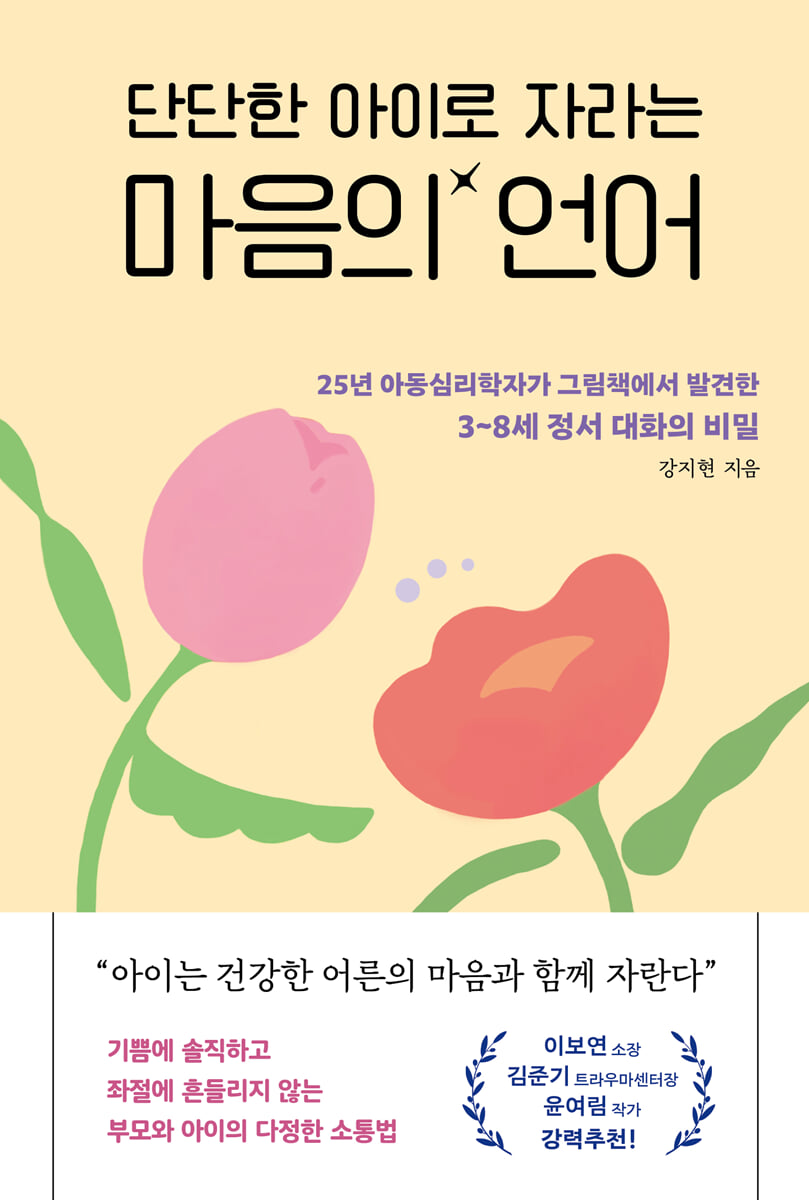
The Language of the Heart to Grow into a Strong Child
 |
Description
Book Introduction
This book introduces the principles of psychological healing, which contain heart-to-heart communication, emotion, and insight, discovered by the author, a child psychologist, counselor, and current professor with 25 years of experience, through connecting with children through picture books over several decades of counseling experience.
Based on his extensive clinical psychology knowledge and experience gained in schools, hospitals, and counseling centers, the author presents specific strategies and methods that can be easily applied in everyday settings such as homes, schools, daycare centers, and kindergartens.
It understands the big and small problems children face from a psychological perspective and contains practical approaches to improving them. It also explains the wisdom of psychological counseling expressed through metaphors and symbols in picture books so that anyone can understand and utilize it.
Above all, to prevent adults who read the book from being unable to see children as they are due to their own inner deficiencies or wounds, various devices are provided to help them reflect and understand themselves, and useful content is provided not only to parents but also to teachers, counselors, and all adults who come into close contact with children.
By exploring the themes of growth, emotions, relationships, and family introduced in this book one by one, you will be able to understand the essence of human psychology and grow together with your child, establishing a foundation for healthy relationships.
Based on his extensive clinical psychology knowledge and experience gained in schools, hospitals, and counseling centers, the author presents specific strategies and methods that can be easily applied in everyday settings such as homes, schools, daycare centers, and kindergartens.
It understands the big and small problems children face from a psychological perspective and contains practical approaches to improving them. It also explains the wisdom of psychological counseling expressed through metaphors and symbols in picture books so that anyone can understand and utilize it.
Above all, to prevent adults who read the book from being unable to see children as they are due to their own inner deficiencies or wounds, various devices are provided to help them reflect and understand themselves, and useful content is provided not only to parents but also to teachers, counselors, and all adults who come into close contact with children.
By exploring the themes of growth, emotions, relationships, and family introduced in this book one by one, you will be able to understand the essence of human psychology and grow together with your child, establishing a foundation for healthy relationships.
- You can preview some of the book's contents.
Preview
index
prolog
So that you can see the child with the right perspective
First time, growing me
Do You Love Me? - The Voice of Self-Affirmation
Will you listen to my story? Express your feelings with a louder voice.
Child growth requires patience - the closely connected body and mind
For Our Precious Ones - Self-Esteem Raised Through Sharing
It's okay, it's okay, I'll tell you countless times - you who have become an adult, you who will become an adult
Second Hour, Dealing with Emotions
The moment I rise through words - How to express emotions in words
Before This Heart Swallows You - Facing Your Child's Worries
Every emotion has a reason - Dealing with anger and rage
I felt like I was going to disappear - when anxiety and fear came
Wake Up Now - Dealing with Childhood Depression
Third Hour, The Foundation of Relationships
I'll eventually meet someone who understands me - About peer relationships
Just like you, everyone is precious - a heart that treats small and weak beings
You are my eternal universe - If I had a younger sibling one day
The Day My Child's Heart Broke - For a Stronger Connection Between Parents and Children
Just being there - the frustrations and failures a child must overcome
Fourth time, family name
Living life - becoming a couple and becoming parents of children
It was a fear that felt like the world was falling apart - finding a way to comfort myself.
It's Not Your Fault - Accepting a Divorced Family
I think I understand now - looking at my parents
I love you, I love you, I love you - about separation and mourning
So that you can see the child with the right perspective
First time, growing me
Do You Love Me? - The Voice of Self-Affirmation
Will you listen to my story? Express your feelings with a louder voice.
Child growth requires patience - the closely connected body and mind
For Our Precious Ones - Self-Esteem Raised Through Sharing
It's okay, it's okay, I'll tell you countless times - you who have become an adult, you who will become an adult
Second Hour, Dealing with Emotions
The moment I rise through words - How to express emotions in words
Before This Heart Swallows You - Facing Your Child's Worries
Every emotion has a reason - Dealing with anger and rage
I felt like I was going to disappear - when anxiety and fear came
Wake Up Now - Dealing with Childhood Depression
Third Hour, The Foundation of Relationships
I'll eventually meet someone who understands me - About peer relationships
Just like you, everyone is precious - a heart that treats small and weak beings
You are my eternal universe - If I had a younger sibling one day
The Day My Child's Heart Broke - For a Stronger Connection Between Parents and Children
Just being there - the frustrations and failures a child must overcome
Fourth time, family name
Living life - becoming a couple and becoming parents of children
It was a fear that felt like the world was falling apart - finding a way to comfort myself.
It's Not Your Fault - Accepting a Divorced Family
I think I understand now - looking at my parents
I love you, I love you, I love you - about separation and mourning
Detailed image

Into the book
If you find something or an aspect that your child envy, and if that aspect is something your child is lacking and needs to be filled, it would be good to think together about how to fill it in a healthy way.
I would like to show that big goals can be achieved by breaking them down into smaller ones and practicing and training them one step at a time.
Also, you need to find and encourage the aspects that your child can easily achieve without having to put in effort and that he or she is good at.
When adults know they have a lot to offer and are aware of their resources and strengths, they can comfortably acknowledge their shortcomings and shortcomings.
But children are more receptive to it.
So, you need a chance to discover the treasure you have.
--- p.22
When something upsetting happens, it helps to cry alone.
After crying a lot, you may feel refreshed and gain the courage to solve the problem.
However, crying alone can easily lead to self-pity.
So, to maximize healing, you need a witness.
If you pay attention to the situation with an understanding heart, without interrupting the client's cries or silent tears, it can become a time of healing.
Because it's a sign of approval that you deserve to enjoy this time.
You can decide to cry alone and free yourself, but if possible, cry in front of someone who fully supports you. This can be your spouse, a friend, a senior or junior colleague, or even better, a counselor.
--- p.58
If you feel that your child is not able to express his or her opinion appropriately when needed, you need to practice this part well.
What you can use at this time are scenes from fairy tales, comics, movies, etc.
For example, you could describe a scene where you are falsely accused, or are forced to do something you don't want to do, or want to apologize but can't get the chance. Then, discuss how you think the main character or other characters would feel in that situation and what they might say.
Or, if there is a scene where the mother thinks the child's response was inappropriate or inadequate, or if the mother was not present but heard about a situation where she thinks a more proactive response was needed, it is a good idea to reenact that situation.
--- p.71
If life were a river, the present moment, when we are struggling with anger or sadness, may be just a tiny drop of water.
Likewise, if life is a very long line, isn't this present moment, which feels painful and never-ending, just a tiny dot on that line? Many things in the world are constantly changing.
Just as the shape of clouds constantly changes, the emotions that cause us hardship also change.
If you can remember this fact, it may be a little easier to overcome the difficult emotions you are experiencing now.
When painful emotions come to us, we need to approach them with the understanding that these emotions too will change and pass.
--- p.94
If you want to expand your child's peer relationships, look at friends with whom your child frequently has conflicts and find out their strengths. Also, work together to find out what makes your child uncomfortable with the other child.
It is also helpful to examine whether your child has any misunderstandings about the other child.
Look for differences and see if there are ways in which those traits can benefit each other.
If you increase the opportunities to get along well with your child and share intimacy with close friends, and if you approach them with curiosity rather than avoiding them when you discover something unfamiliar, the relationship will deepen.
--- p.135
How should we deal with a child who has experienced failure? We've all experienced a time when things didn't go as planned.
I know how you felt at that time.
How painful it is to experience failure and frustration, whether due to one's own mistakes or external circumstances such as other people or things.
It's said to be helpful, but it still doesn't mean it doesn't hurt.
The best thing to do at this time is to talk about the situation.
If you talk about what happened, how you felt in that situation, and what you want to do about it, you'll feel less stuck.
--- p.171
How does your child care for and comfort themselves? When they're scolded by Mom or restrained by Dad, what does your child do to soothe their feelings? They might play with toys, sing, or read books.
You can solve puzzles, draw pictures, or work up a sweat playing basketball.
If your child doesn't yet know how to do this and just wants you to help them release their negative emotions, don't scold them or discourage them. Instead, work with them to find ways to help them release their emotions more easily on their own.
--- p.195
“Sometimes we forget about Grandpa, but that doesn’t mean we’ll forget him forever, so don’t feel bad about it.” These are words we should tell our children, but they’re also words we should tell ourselves.
I hope that you will embrace all of these things, including the sometimes hazy memories of the deceased, the dull sadness, and even the lenient gaze toward yourself, and use them all as a foundation for growth.
I would like to show that big goals can be achieved by breaking them down into smaller ones and practicing and training them one step at a time.
Also, you need to find and encourage the aspects that your child can easily achieve without having to put in effort and that he or she is good at.
When adults know they have a lot to offer and are aware of their resources and strengths, they can comfortably acknowledge their shortcomings and shortcomings.
But children are more receptive to it.
So, you need a chance to discover the treasure you have.
--- p.22
When something upsetting happens, it helps to cry alone.
After crying a lot, you may feel refreshed and gain the courage to solve the problem.
However, crying alone can easily lead to self-pity.
So, to maximize healing, you need a witness.
If you pay attention to the situation with an understanding heart, without interrupting the client's cries or silent tears, it can become a time of healing.
Because it's a sign of approval that you deserve to enjoy this time.
You can decide to cry alone and free yourself, but if possible, cry in front of someone who fully supports you. This can be your spouse, a friend, a senior or junior colleague, or even better, a counselor.
--- p.58
If you feel that your child is not able to express his or her opinion appropriately when needed, you need to practice this part well.
What you can use at this time are scenes from fairy tales, comics, movies, etc.
For example, you could describe a scene where you are falsely accused, or are forced to do something you don't want to do, or want to apologize but can't get the chance. Then, discuss how you think the main character or other characters would feel in that situation and what they might say.
Or, if there is a scene where the mother thinks the child's response was inappropriate or inadequate, or if the mother was not present but heard about a situation where she thinks a more proactive response was needed, it is a good idea to reenact that situation.
--- p.71
If life were a river, the present moment, when we are struggling with anger or sadness, may be just a tiny drop of water.
Likewise, if life is a very long line, isn't this present moment, which feels painful and never-ending, just a tiny dot on that line? Many things in the world are constantly changing.
Just as the shape of clouds constantly changes, the emotions that cause us hardship also change.
If you can remember this fact, it may be a little easier to overcome the difficult emotions you are experiencing now.
When painful emotions come to us, we need to approach them with the understanding that these emotions too will change and pass.
--- p.94
If you want to expand your child's peer relationships, look at friends with whom your child frequently has conflicts and find out their strengths. Also, work together to find out what makes your child uncomfortable with the other child.
It is also helpful to examine whether your child has any misunderstandings about the other child.
Look for differences and see if there are ways in which those traits can benefit each other.
If you increase the opportunities to get along well with your child and share intimacy with close friends, and if you approach them with curiosity rather than avoiding them when you discover something unfamiliar, the relationship will deepen.
--- p.135
How should we deal with a child who has experienced failure? We've all experienced a time when things didn't go as planned.
I know how you felt at that time.
How painful it is to experience failure and frustration, whether due to one's own mistakes or external circumstances such as other people or things.
It's said to be helpful, but it still doesn't mean it doesn't hurt.
The best thing to do at this time is to talk about the situation.
If you talk about what happened, how you felt in that situation, and what you want to do about it, you'll feel less stuck.
--- p.171
How does your child care for and comfort themselves? When they're scolded by Mom or restrained by Dad, what does your child do to soothe their feelings? They might play with toys, sing, or read books.
You can solve puzzles, draw pictures, or work up a sweat playing basketball.
If your child doesn't yet know how to do this and just wants you to help them release their negative emotions, don't scold them or discourage them. Instead, work with them to find ways to help them release their emotions more easily on their own.
--- p.195
“Sometimes we forget about Grandpa, but that doesn’t mean we’ll forget him forever, so don’t feel bad about it.” These are words we should tell our children, but they’re also words we should tell ourselves.
I hope that you will embrace all of these things, including the sometimes hazy memories of the deceased, the dull sadness, and even the lenient gaze toward yourself, and use them all as a foundation for growth.
--- p.231
Publisher's Review
“Children grow up with the healthy minds of adults!”
Honest in joy, unshaken by frustration
A loving way for parents and children to communicate!
“Our human heart grows from the outside in.
Because we form our self in someone's warm and sensitive care.
“For a child’s mind to grow up strong, the appropriate mentality of healthy adults is absolutely necessary.”
Every parent wonders, "Do I truly understand my child's feelings? Am I communicating appropriately with my child?"
"The Language of the Heart: Growing Up a Strong Child" is a book written by an author who has counseled children and their parents for 25 years. Based on the interpretations and psychological insights contained in picture books, the book helps children understand their core emotions and provides effective communication methods that enable them to safely express and recover their feelings.
This book follows a child's development and explains, through specific cases and research, how emotions like joy, anger, anxiety, and frustration are formed and healed. It emphasizes that conversations between parents and children are not simply exchanges of words, but the foundation of emotional connection, and suggests useful conversation methods that can actually be applied to children.
In particular, rather than viewing a child's mind as a fragmentary behavior, it approaches it from the perspective of a 'map for exploring the inner world', helping parents understand their child's emotions, reflect on their own parenting methods, and form healthier relationships.
The author shares practical methods discovered through his extensive counseling experience, offering easy-to-understand solutions to help children accept and use various emotional experiences, such as envy, depression, peer conflict, and understanding of family, as a foundation for growth.
Attachment, growth and development, emotional coaching, and even sociality
Vivid and special advice for a healthy connection between parents and children!
The book provides examples of picture book role-plays and various conversations, and guides parents to gain a deeper understanding of what emotions their children feel and what choices they can make as they practice reenacting scenes from fairy tales or movies and using their own voices.
Additionally, by following the questions, incomplete sentences, role-playing and conversation examples, and activities ranging from simple to complex, related to the picture book, children can naturally reflect on their inner selves together with their children and learn communication methods for growth.
The author says that parents should not spare encouragement, saying, “We must create opportunities for children to discover their own treasures.”
This book contains powerful insights that can be used not only by parents but also in educational and counseling settings, and it allows us to view a child's growth beyond simple "raising" as a "journey of growing together."
When parents serve as safe witnesses and supporters of their children's emotions, children develop the strength to express their feelings and the resilience to endure life.
Capturing the message contained in the picture book
A time of healing that embraces even the inner self of parents.
The book also vividly shows how children can turn their experiences of frustration, failure, conflict, and loss into opportunities for growth by sharing them with their parents.
It's about facing and dealing with your emotions, understanding the nature of loss and frustration, taking responsibility for your actions, and sometimes even speaking up, developing the strength to be considerate of others and support yourself.
The author emphasizes that a child's mental development can be fostered through relationships with healthy adults around them, through shared experiences of trial and error and reflection.
Ultimately, a child's growth and recovery come from the power to move forward, using imperfections rather than perfection, through the attention and support of adults.
It also gives parents, as well as children, the courage to stand tall as adults and grow into healthy human beings. It warmly accompanies parents and children while making them remember deep in their hearts that “difficult moments are just small drops of water on the river of life, small dots on the line.”
Honest in joy, unshaken by frustration
A loving way for parents and children to communicate!
“Our human heart grows from the outside in.
Because we form our self in someone's warm and sensitive care.
“For a child’s mind to grow up strong, the appropriate mentality of healthy adults is absolutely necessary.”
Every parent wonders, "Do I truly understand my child's feelings? Am I communicating appropriately with my child?"
"The Language of the Heart: Growing Up a Strong Child" is a book written by an author who has counseled children and their parents for 25 years. Based on the interpretations and psychological insights contained in picture books, the book helps children understand their core emotions and provides effective communication methods that enable them to safely express and recover their feelings.
This book follows a child's development and explains, through specific cases and research, how emotions like joy, anger, anxiety, and frustration are formed and healed. It emphasizes that conversations between parents and children are not simply exchanges of words, but the foundation of emotional connection, and suggests useful conversation methods that can actually be applied to children.
In particular, rather than viewing a child's mind as a fragmentary behavior, it approaches it from the perspective of a 'map for exploring the inner world', helping parents understand their child's emotions, reflect on their own parenting methods, and form healthier relationships.
The author shares practical methods discovered through his extensive counseling experience, offering easy-to-understand solutions to help children accept and use various emotional experiences, such as envy, depression, peer conflict, and understanding of family, as a foundation for growth.
Attachment, growth and development, emotional coaching, and even sociality
Vivid and special advice for a healthy connection between parents and children!
The book provides examples of picture book role-plays and various conversations, and guides parents to gain a deeper understanding of what emotions their children feel and what choices they can make as they practice reenacting scenes from fairy tales or movies and using their own voices.
Additionally, by following the questions, incomplete sentences, role-playing and conversation examples, and activities ranging from simple to complex, related to the picture book, children can naturally reflect on their inner selves together with their children and learn communication methods for growth.
The author says that parents should not spare encouragement, saying, “We must create opportunities for children to discover their own treasures.”
This book contains powerful insights that can be used not only by parents but also in educational and counseling settings, and it allows us to view a child's growth beyond simple "raising" as a "journey of growing together."
When parents serve as safe witnesses and supporters of their children's emotions, children develop the strength to express their feelings and the resilience to endure life.
Capturing the message contained in the picture book
A time of healing that embraces even the inner self of parents.
The book also vividly shows how children can turn their experiences of frustration, failure, conflict, and loss into opportunities for growth by sharing them with their parents.
It's about facing and dealing with your emotions, understanding the nature of loss and frustration, taking responsibility for your actions, and sometimes even speaking up, developing the strength to be considerate of others and support yourself.
The author emphasizes that a child's mental development can be fostered through relationships with healthy adults around them, through shared experiences of trial and error and reflection.
Ultimately, a child's growth and recovery come from the power to move forward, using imperfections rather than perfection, through the attention and support of adults.
It also gives parents, as well as children, the courage to stand tall as adults and grow into healthy human beings. It warmly accompanies parents and children while making them remember deep in their hearts that “difficult moments are just small drops of water on the river of life, small dots on the line.”
GOODS SPECIFICS
- Date of issue: October 13, 2025
- Page count, weight, size: 232 pages | 294g | 135*200*14mm
- ISBN13: 9791191462401
- ISBN10: 1191462404
You may also like
카테고리
korean


korean

![GQ KOREA Mark (Monthly): December [2025]](http://librairie.coreenne.fr/cdn/shop/files/8ef265dbbfbf186523ed75ba7319009d.jpg?v=1765340328&width=3840)


