

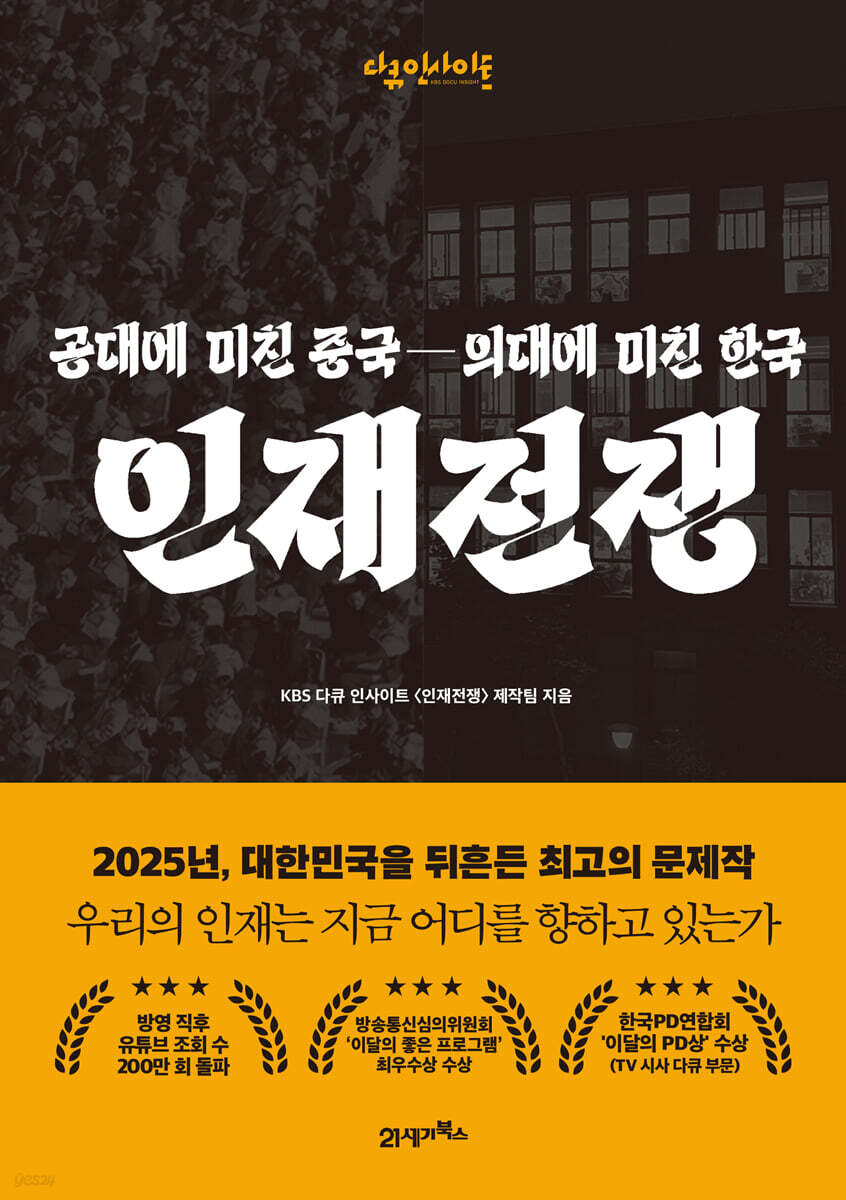
Talent war
 |
Description
Book Introduction
★ The video surpassed 2 million views immediately after airing!
★ Won the grand prize for 'Good Program of the Month' from the Korea Communications Standards Commission
★ Won the 'PD of the Month' award from the Korea PD Association
The most controversial work that shook South Korea this year!
“Where are our talents headed now?”
In 2025, the KBS documentary Insight "Talent War" created a sensation in Korean society.
Under the title, "China is crazy about engineering schools, Korea is crazy about medical schools," the program exposed the structural crisis facing South Korea's education and talent development system head-on, raising serious concerns for numerous viewers and the educational field.
As the world enters a race for technological supremacy, China has defined science and technology as a core national competitiveness and is comprehensively pursuing a talent cultivation strategy centered on engineering schools. Meanwhile, Korea is trapped in a "concentration of talent into medical schools," and the number of places for science and technology talent is steadily decreasing.
In a society where medical school is seen as the only path to success, talented individuals are choosing professional qualifications over research and development, or are moving abroad in search of broader opportunities and autonomy.
This suggests that the foundation of future core fields that determine the nation's competitiveness is gradually collapsing.
Based on the original, popular documentary, this book restores the message of the "Talent War" in a multi-layered way by revealing for the first time voices from domestic and international research sites, unpublished statistics, and interviews that were not fully captured on TV.
Centering on the fundamental question of Korean society—“Why do we no longer dream of becoming scientists?”—the discussion on national sustainability extends to the education system, national strategy, and social structure as a whole.
This book highlights the fact that the current reality of neglecting science and technology talent goes beyond individual career paths and threatens the future of the Republic of Korea. It raises a question that can no longer be postponed.
★ Won the grand prize for 'Good Program of the Month' from the Korea Communications Standards Commission
★ Won the 'PD of the Month' award from the Korea PD Association
The most controversial work that shook South Korea this year!
“Where are our talents headed now?”
In 2025, the KBS documentary Insight "Talent War" created a sensation in Korean society.
Under the title, "China is crazy about engineering schools, Korea is crazy about medical schools," the program exposed the structural crisis facing South Korea's education and talent development system head-on, raising serious concerns for numerous viewers and the educational field.
As the world enters a race for technological supremacy, China has defined science and technology as a core national competitiveness and is comprehensively pursuing a talent cultivation strategy centered on engineering schools. Meanwhile, Korea is trapped in a "concentration of talent into medical schools," and the number of places for science and technology talent is steadily decreasing.
In a society where medical school is seen as the only path to success, talented individuals are choosing professional qualifications over research and development, or are moving abroad in search of broader opportunities and autonomy.
This suggests that the foundation of future core fields that determine the nation's competitiveness is gradually collapsing.
Based on the original, popular documentary, this book restores the message of the "Talent War" in a multi-layered way by revealing for the first time voices from domestic and international research sites, unpublished statistics, and interviews that were not fully captured on TV.
Centering on the fundamental question of Korean society—“Why do we no longer dream of becoming scientists?”—the discussion on national sustainability extends to the education system, national strategy, and social structure as a whole.
This book highlights the fact that the current reality of neglecting science and technology talent goes beyond individual career paths and threatens the future of the Republic of Korea. It raises a question that can no longer be postponed.
- You can preview some of the book's contents.
Preview
index
Prologue: The Prelude to the Global Talent War
PART 1.
China's madness over engineering
1. The 'DeepChic Shock' that shook the world
2 Deep Seek is just the beginning
3 What Makes China a Tech Hub?
4 From a trade war to a war for talent
5 Geniuses Gathering in China
6 Chinese Scientists Treated as 'Heroes': China's Unstoppable Progress
7 Chinese talents head to engineering schools.
PART 2.
Korea's crazy about medical schools
1. Korean talent heads to medical school.
2. The Medical School Fever and the Crisis in the Science and Engineering Fields
Before the medical school craze, there was an engineering school craze.
4. A symbol of wealth and stability created by an anxious society
5 Korea on the Battlefield of Technological Hegemony
6 Talented People Leaving Korea
7 Where are the talents we need to protect now?
Epilogue│What kind of person do you think is talented?
PART 1.
China's madness over engineering
1. The 'DeepChic Shock' that shook the world
2 Deep Seek is just the beginning
3 What Makes China a Tech Hub?
4 From a trade war to a war for talent
5 Geniuses Gathering in China
6 Chinese Scientists Treated as 'Heroes': China's Unstoppable Progress
7 Chinese talents head to engineering schools.
PART 2.
Korea's crazy about medical schools
1. Korean talent heads to medical school.
2. The Medical School Fever and the Crisis in the Science and Engineering Fields
Before the medical school craze, there was an engineering school craze.
4. A symbol of wealth and stability created by an anxious society
5 Korea on the Battlefield of Technological Hegemony
6 Talented People Leaving Korea
7 Where are the talents we need to protect now?
Epilogue│What kind of person do you think is talented?
Detailed image

Into the book
“Unlike in the past, when there was a strong perception that only those from large corporations or experienced individuals could start a business, DeepSeek’s case has proven that even young researchers can take on challenges and succeed.
“Enabling young talent to conduct cutting-edge research in each field has changed the paradigm of AI research.” Ultimately, DeepSec’s success was possible because it was based on a “technology talent ecosystem” fostered by talent development education and a startup system that maximizes individual genius.
And this ecosystem heralds a wave of innovation that goes beyond the whirlwind of a single company.
--- From "The 'Deep Chic Shock' That Shook the World"
Until just 10 years ago, Korea had a clear advantage in cutting-edge industries.
In the trade specialization index, Korea showed high competitiveness, approaching 30, while China remained at around 10.
But the tide changed quickly.
While South Korea gradually declined, China continued its upward curve, and the two countries' graphs crossed around 2021.
--- From "Deep Seek is Just the Beginning"
In short, it is not a method of predicting potential and then selecting and nurturing talent, but rather a method of supporting achievements through a process of free development.
The selection system was also moving away from being solely based on test scores.
While college entrance exams remain the primary route, other pathways are now officially recognized, including international Olympiads, industry-academia projects, and corporate internships.
The system design reflected the recognition that not only students with high test scores have the capacity for innovation, and that some students with high creativity have below-average grades.
--- From "From Trade War to Talent War"
The most shocking news to him, who had been a scientist his entire life, was the news of R&D budget cuts in Korea around the time of his retirement.
I knew the scientific community had been neglected for a long time, but I believed that at least the budget would be protected.
But he felt a deep sense of frustration as he watched even that last bastion being torn down.
--- From "China's Scientists Treated as 'Heroes': China Never Stops"
C, a repeat student who took the 2025 CSAT and is preparing for the 2026 CSAT, wanted to enter Korea University's College of Engineering, but faced strong opposition from his parents.
My mother said, “You can’t go to engineering school.
The question, “What are you going to eat and live on?” was crucial.
Worries about finding a job were holding me back.
In the end, I applied to all medical schools through upward support, and ultimately had to retake the exam.
--- From "The Medical School Craze and the Crisis in the Science and Engineering Fields"
The key, in the end, is people, that is, talent.
The qualities of a talented person are the insight to define problems and find solutions, and the execution ability to connect ideas to actual results.
However, Korean society today lacks the institutional and cultural foundation to cultivate such talent.
Therefore, unless we make new strategic choices, we are in a precarious position where we will inevitably fall behind in the technological war.
“Enabling young talent to conduct cutting-edge research in each field has changed the paradigm of AI research.” Ultimately, DeepSec’s success was possible because it was based on a “technology talent ecosystem” fostered by talent development education and a startup system that maximizes individual genius.
And this ecosystem heralds a wave of innovation that goes beyond the whirlwind of a single company.
--- From "The 'Deep Chic Shock' That Shook the World"
Until just 10 years ago, Korea had a clear advantage in cutting-edge industries.
In the trade specialization index, Korea showed high competitiveness, approaching 30, while China remained at around 10.
But the tide changed quickly.
While South Korea gradually declined, China continued its upward curve, and the two countries' graphs crossed around 2021.
--- From "Deep Seek is Just the Beginning"
In short, it is not a method of predicting potential and then selecting and nurturing talent, but rather a method of supporting achievements through a process of free development.
The selection system was also moving away from being solely based on test scores.
While college entrance exams remain the primary route, other pathways are now officially recognized, including international Olympiads, industry-academia projects, and corporate internships.
The system design reflected the recognition that not only students with high test scores have the capacity for innovation, and that some students with high creativity have below-average grades.
--- From "From Trade War to Talent War"
The most shocking news to him, who had been a scientist his entire life, was the news of R&D budget cuts in Korea around the time of his retirement.
I knew the scientific community had been neglected for a long time, but I believed that at least the budget would be protected.
But he felt a deep sense of frustration as he watched even that last bastion being torn down.
--- From "China's Scientists Treated as 'Heroes': China Never Stops"
C, a repeat student who took the 2025 CSAT and is preparing for the 2026 CSAT, wanted to enter Korea University's College of Engineering, but faced strong opposition from his parents.
My mother said, “You can’t go to engineering school.
The question, “What are you going to eat and live on?” was crucial.
Worries about finding a job were holding me back.
In the end, I applied to all medical schools through upward support, and ultimately had to retake the exam.
--- From "The Medical School Craze and the Crisis in the Science and Engineering Fields"
The key, in the end, is people, that is, talent.
The qualities of a talented person are the insight to define problems and find solutions, and the execution ability to connect ideas to actual results.
However, Korean society today lacks the institutional and cultural foundation to cultivate such talent.
Therefore, unless we make new strategic choices, we are in a precarious position where we will inevitably fall behind in the technological war.
--- From "Korea on the Battlefield of Technological Hegemony"
Publisher's Review
Tech boom vs. medical school craze
The prelude to a "talent war" for future technological supremacy.
As we enter the era of the Fourth Industrial Revolution, countries around the world are embracing science and technology as a means of national survival, and are promoting the acquisition of talent as a strategic resource for the future.
Who will nurture and secure more talent, and how will they establish the structure? The world is now in the midst of a war to seize this opportunity.
And China is at the forefront of this trend.
Technological advancement is set as a national task, and education, industry, and policy move toward a single goal.
For example, when the central government issues a five-year plan, companies, schools, and public institutions develop detailed talent development plans in line with it.
We move away from a system focused on early selection or an elite few, prioritizing a balance of universal education and opportunity that strengthens the base, and intensively nurturing talent by evaluating problem-solving skills and creativity.
On the other hand, Korean talents flock to medical schools.
One of the key reasons for this is the social atmosphere that pursues only "certificates that guarantee a secure future" within the logic of stability behind national policies that emphasize strengthening technological competitiveness.
While the nation's vision of fostering science and technology remains intact, the short-term performance-oriented evaluation system and low compensation are accelerating the exodus of science and engineering students from medical schools, gradually weakening the technological ecosystem.
Basic science departments, facing structural decline, and industries struggling to fill their vacancies with advanced technical personnel are gradually losing their momentum for growth.
The book diagnoses that the current reality in Korea is that the crisis in the science and engineering fields leads to industrial stagnation, and industrial stagnation inevitably leads to a sense of anxiety.
In an era of technological supremacy without guns, the world is once again being tested for the balance between technology and humanity, between efficiency and dignity.
This book confronts the reality of the anxiety that dominates Korean society amidst this immense competition and questions its unwavering values and direction.
If technological advancement is for the good of humanity, where should we go now?
"Talent War" is a desperate quest to reclaim fading dreams and hopes, and the final question toward a better future.
“It was difficult to fit everything into a 47-minute broadcast!”
A record of the great questions posed to Korean society and the fierce responses.
"Talent War" began with a fundamental question: what values are our society cultivating talent based on?
To answer this question, the production team visited the sites where China cultivates technological talent, from a startup lab in Hangzhou, China, to Zhejiang University, which produced DeepSec CEO Liang Wenfeng, to the site of China's college entrance exam, the Gaokao, and recorded in detail the scenes of young researchers working towards a single goal at the center of cutting-edge industries.
It captures China's talent development system, where technology operates as the "road for the nation."
At the same time, in Korea, we closely analyzed how social anxiety leads to a "competition for stable jobs" by tracking the entrance exam sites and science and engineering education and research sites in major school districts in the metropolitan area.
What I encountered in the process was that Korea's talent development system is driven by the emotion of fear: 'How can we avoid failure?'
This has resulted in the constant reproduction of competition as a tool to stifle individual choice and avoid anxiety in society as a whole.
The book follows the documentary's sharp perspective and raises the fundamental question, "What is talent?" by asking, "What are we competing for?"
A society that values anxiety as its order will inevitably reveal its limitations. This book diagnoses Korea's current state while simultaneously urging the search for better values that will drive society.
Korean society consumed by anxiety
Social questions that remain after the logic of competition
Immediately after the broadcast ended, the short phrase, “China is crazy about engineering schools, Korea is crazy about medical schools,” quickly emerged as an important keyword.
It soon led to a social debate surrounding the topic of 'talent'.
Viewers interpreted the sentences, each from their own perspectives, as they condensed the direction of education, the hierarchy of industry, and the density of anxiety felt by each generation.
Teachers and instructors thought about the direction their students wanted to take, parents thought about their children's lives, researchers thought about the future of technology, and students thought about where they stood.
And the majority of society members once again reflected on the meaning of the anxiety surrounding South Korea.
"Talent War" visualizes the anxiety in Korean society by linking issues of education, industry, generation, and system together.
What <Talent War> ultimately asks us to do is reflect on the direction of our society.
After a period of dazzling development, we finally achieved abundance, but behind it all, we were trapped in a new poverty called insecurity.
Competition for jobs is intensifying by the day, but trust has disappeared. Everyone was just running to live better, but when they came to their senses, they ended up running to avoid falling.
Therefore, the book argues that it is time for all members of society living in an age of uncertainty to pause for a moment and critically consider what to preserve and what to discard, and above all, it is time for the foundation for this change to be reorganized at the institutional level as soon as possible.
It also subtly shows that the power to overcome crises is already inherent in our society, suggesting the possibility of hope.
The prelude to a "talent war" for future technological supremacy.
As we enter the era of the Fourth Industrial Revolution, countries around the world are embracing science and technology as a means of national survival, and are promoting the acquisition of talent as a strategic resource for the future.
Who will nurture and secure more talent, and how will they establish the structure? The world is now in the midst of a war to seize this opportunity.
And China is at the forefront of this trend.
Technological advancement is set as a national task, and education, industry, and policy move toward a single goal.
For example, when the central government issues a five-year plan, companies, schools, and public institutions develop detailed talent development plans in line with it.
We move away from a system focused on early selection or an elite few, prioritizing a balance of universal education and opportunity that strengthens the base, and intensively nurturing talent by evaluating problem-solving skills and creativity.
On the other hand, Korean talents flock to medical schools.
One of the key reasons for this is the social atmosphere that pursues only "certificates that guarantee a secure future" within the logic of stability behind national policies that emphasize strengthening technological competitiveness.
While the nation's vision of fostering science and technology remains intact, the short-term performance-oriented evaluation system and low compensation are accelerating the exodus of science and engineering students from medical schools, gradually weakening the technological ecosystem.
Basic science departments, facing structural decline, and industries struggling to fill their vacancies with advanced technical personnel are gradually losing their momentum for growth.
The book diagnoses that the current reality in Korea is that the crisis in the science and engineering fields leads to industrial stagnation, and industrial stagnation inevitably leads to a sense of anxiety.
In an era of technological supremacy without guns, the world is once again being tested for the balance between technology and humanity, between efficiency and dignity.
This book confronts the reality of the anxiety that dominates Korean society amidst this immense competition and questions its unwavering values and direction.
If technological advancement is for the good of humanity, where should we go now?
"Talent War" is a desperate quest to reclaim fading dreams and hopes, and the final question toward a better future.
“It was difficult to fit everything into a 47-minute broadcast!”
A record of the great questions posed to Korean society and the fierce responses.
"Talent War" began with a fundamental question: what values are our society cultivating talent based on?
To answer this question, the production team visited the sites where China cultivates technological talent, from a startup lab in Hangzhou, China, to Zhejiang University, which produced DeepSec CEO Liang Wenfeng, to the site of China's college entrance exam, the Gaokao, and recorded in detail the scenes of young researchers working towards a single goal at the center of cutting-edge industries.
It captures China's talent development system, where technology operates as the "road for the nation."
At the same time, in Korea, we closely analyzed how social anxiety leads to a "competition for stable jobs" by tracking the entrance exam sites and science and engineering education and research sites in major school districts in the metropolitan area.
What I encountered in the process was that Korea's talent development system is driven by the emotion of fear: 'How can we avoid failure?'
This has resulted in the constant reproduction of competition as a tool to stifle individual choice and avoid anxiety in society as a whole.
The book follows the documentary's sharp perspective and raises the fundamental question, "What is talent?" by asking, "What are we competing for?"
A society that values anxiety as its order will inevitably reveal its limitations. This book diagnoses Korea's current state while simultaneously urging the search for better values that will drive society.
Korean society consumed by anxiety
Social questions that remain after the logic of competition
Immediately after the broadcast ended, the short phrase, “China is crazy about engineering schools, Korea is crazy about medical schools,” quickly emerged as an important keyword.
It soon led to a social debate surrounding the topic of 'talent'.
Viewers interpreted the sentences, each from their own perspectives, as they condensed the direction of education, the hierarchy of industry, and the density of anxiety felt by each generation.
Teachers and instructors thought about the direction their students wanted to take, parents thought about their children's lives, researchers thought about the future of technology, and students thought about where they stood.
And the majority of society members once again reflected on the meaning of the anxiety surrounding South Korea.
"Talent War" visualizes the anxiety in Korean society by linking issues of education, industry, generation, and system together.
What <Talent War> ultimately asks us to do is reflect on the direction of our society.
After a period of dazzling development, we finally achieved abundance, but behind it all, we were trapped in a new poverty called insecurity.
Competition for jobs is intensifying by the day, but trust has disappeared. Everyone was just running to live better, but when they came to their senses, they ended up running to avoid falling.
Therefore, the book argues that it is time for all members of society living in an age of uncertainty to pause for a moment and critically consider what to preserve and what to discard, and above all, it is time for the foundation for this change to be reorganized at the institutional level as soon as possible.
It also subtly shows that the power to overcome crises is already inherent in our society, suggesting the possibility of hope.
GOODS SPECIFICS
- Date of issue: November 5, 2025
- Page count, weight, size: 192 pages | 148*210*20mm
- ISBN13: 9791173575686
- ISBN10: 1173575685
You may also like
카테고리
korean


korean

![GQ KOREA Mark (Monthly): December [2025]](http://librairie.coreenne.fr/cdn/shop/files/8ef265dbbfbf186523ed75ba7319009d.jpg?v=1765340328&width=3840)


