

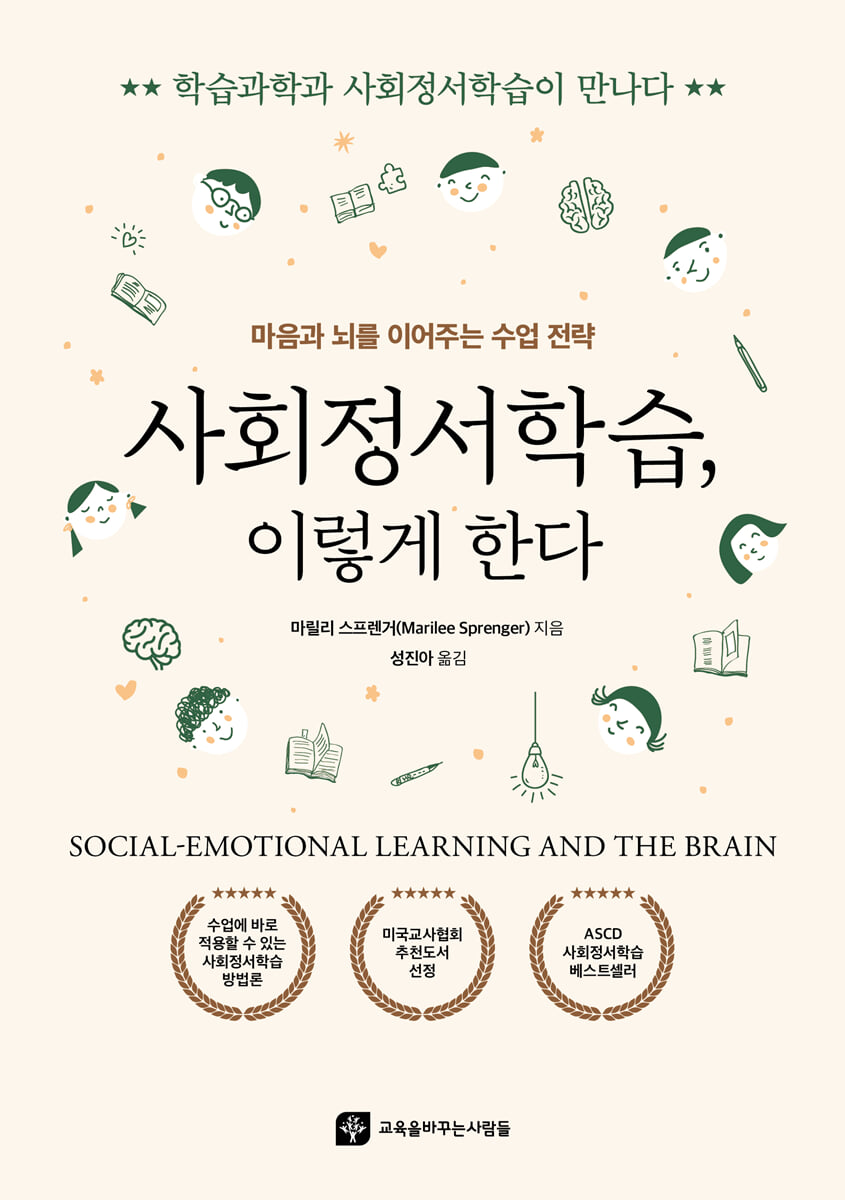
Social-Emotional Learning: How to Do It
 |
Description
Book Introduction
Learning Science and Social-Emotional Learning Meet
Social and emotional learning methodologies that can be applied directly to the classroom
There are two important things that must be kept in mind in education.
These are social-emotional learning (SEL) and trauma-based approaches.
Many students come to school with scars from negative childhood experiences.
Social-emotional learning is a powerful tool to alleviate their trauma, empower them to recover, and create positive experiences in the classroom and in class.
Many of the strategies used in social-emotional learning are intertwined with a trauma-based approach, and implementing them together can be even more effective.
Since the COVID-19 crisis, the number of children lost in an unstable educational ecosystem has been increasing.
Although social-emotional learning is gaining attention as an alternative, many in the field are still at a loss as to how to proceed.
Teachers are deeply concerned about which methods are effective and how to apply them efficiently in complex classroom environments.
Drawing on her extensive teaching and research experience, Marilyn Sprenger offers effective methods that reach children directly, utilizing limited class time while caring for each student's individual needs, and provides a wealth of case studies.
Every child has their own story, and teachers listen to those stories to help them make wise and sound choices for their future.
To achieve this, the ability to build warm relationships, the sensitivity to understand and empathize with others, self-management to recognize and manage one's emotions, and social awareness and relationship skills to cooperate with others are essential.
This book explores social-emotional learning, which cultivates these very capabilities, based on the achievements of brain science and learning science.
The author explains 'why such a phenomenon occurs' based on the operating principles of the brain and presents specific practical methods that can be immediately applied in the classroom.
Social-emotional learning, designed based on learning science, becomes a language of education that can be practiced in everyday life, not an abstract slogan.
This book conveys the language of recovery, connection, empathy, and action that is needed in the classroom today.
Social and emotional learning methodologies that can be applied directly to the classroom
There are two important things that must be kept in mind in education.
These are social-emotional learning (SEL) and trauma-based approaches.
Many students come to school with scars from negative childhood experiences.
Social-emotional learning is a powerful tool to alleviate their trauma, empower them to recover, and create positive experiences in the classroom and in class.
Many of the strategies used in social-emotional learning are intertwined with a trauma-based approach, and implementing them together can be even more effective.
Since the COVID-19 crisis, the number of children lost in an unstable educational ecosystem has been increasing.
Although social-emotional learning is gaining attention as an alternative, many in the field are still at a loss as to how to proceed.
Teachers are deeply concerned about which methods are effective and how to apply them efficiently in complex classroom environments.
Drawing on her extensive teaching and research experience, Marilyn Sprenger offers effective methods that reach children directly, utilizing limited class time while caring for each student's individual needs, and provides a wealth of case studies.
Every child has their own story, and teachers listen to those stories to help them make wise and sound choices for their future.
To achieve this, the ability to build warm relationships, the sensitivity to understand and empathize with others, self-management to recognize and manage one's emotions, and social awareness and relationship skills to cooperate with others are essential.
This book explores social-emotional learning, which cultivates these very capabilities, based on the achievements of brain science and learning science.
The author explains 'why such a phenomenon occurs' based on the operating principles of the brain and presents specific practical methods that can be immediately applied in the classroom.
Social-emotional learning, designed based on learning science, becomes a language of education that can be practiced in everyday life, not an abstract slogan.
This book conveys the language of recovery, connection, empathy, and action that is needed in the classroom today.
- You can preview some of the book's contents.
Preview
index
Enteringㆍ9
1.
Building relationships
Maslow before Bloomㆍ31
Relationship Building and the Brainㆍ33
Teaching Strategies to Help Build Relationshipsㆍ35
Approaching Students' Storiesㆍ61
2.
Empathy
Why We Need to Teach Empathyㆍ67
Types of Empathyㆍ69
Empathy and the Brainㆍ72
Teaching Strategies for Developing Empathyㆍ75
Approaching Students' Storiesㆍ94
3.
self-awareness
Self-Awareness and the Brainㆍ104
Teaching Strategies for Developing Self-Awarenessㆍ107
Approaching Students' Storiesㆍ131
4.
self-care
Self-Care and the Brainㆍ138
Teaching Strategies for Impulse Controlㆍ139
Teaching Strategies for Developing Stress Management Skillsㆍ144
Teaching Strategies for Developing Self-Control Skillsㆍ164
Teaching Strategies for Developing Self-Motivationㆍ167
Teaching Strategies to Improve Goal Setting and Organizational Skillsㆍ168
Approaching Students' Storiesㆍ171
5.
social awareness
Social Cognition and the Brainㆍ179
Prosocial Skills and Normsㆍ181
Social Painㆍ183
Emotional Contagionㆍ186
The Role of Empathyㆍ189
Teaching Strategies to Help Increase Social Awarenessㆍ191
Approaching Students' Storiesㆍ205
6.
Relationship skills
Interpersonal Relationships and the Brainㆍ212
Teaching Strategies for Developing Collaborative Skillsㆍ226
Teaching Strategies to Help Build Relationshipsㆍ229
Approaching Students' Storiesㆍ237
7.
Responsible decision-making
Social-Emotional Learning and Responsible Decision-Makingㆍ245
Decision-making and the Brainㆍ247
Elements of Decision Makingㆍ249
Maintaining Mindfulnessㆍ256
Teaching Strategies for Developing Decision-Making Skillsㆍ257
Using Classroom Decision Makingㆍ273
Approaching Students' Storiesㆍ275
8.
Teacher over program
From solving teacher stressㆍ283
Three Threats to Teachers' Mental Healthㆍ285
The Impact of Emotions on Decision-Makingㆍ289
From Negative to Positive Experienceㆍ291
Reaching out to all studentsㆍ294
Approaching Students' Storiesㆍ295
Referencesㆍ299
Searchㆍ314
List of charts
Figure 1.1 Brain regions involved in relationship buildingㆍ34
Figure 2.1 Brain regions involved in empathyㆍ72
Figure 3.1 Brain regions involved in self-awarenessㆍ104
Figure 3.2 Example of an Emotional Vocabulary Listㆍ109
Figure 4.1 Brain regions involved in self-careㆍ138
Figure 4.2 4x4 Breathingㆍ160
Figure 4.3 Emotion Diaryㆍ163
Figure 5.1 Brain regions involved in social cognitionㆍ180
Figure 6.1 Brain regions involved in relationship skillsㆍ212
Figure 6.2 Group Score Tableㆍ218
Figure 7.1 Brain regions involved in decision-makingㆍ248
1.
Building relationships
Maslow before Bloomㆍ31
Relationship Building and the Brainㆍ33
Teaching Strategies to Help Build Relationshipsㆍ35
Approaching Students' Storiesㆍ61
2.
Empathy
Why We Need to Teach Empathyㆍ67
Types of Empathyㆍ69
Empathy and the Brainㆍ72
Teaching Strategies for Developing Empathyㆍ75
Approaching Students' Storiesㆍ94
3.
self-awareness
Self-Awareness and the Brainㆍ104
Teaching Strategies for Developing Self-Awarenessㆍ107
Approaching Students' Storiesㆍ131
4.
self-care
Self-Care and the Brainㆍ138
Teaching Strategies for Impulse Controlㆍ139
Teaching Strategies for Developing Stress Management Skillsㆍ144
Teaching Strategies for Developing Self-Control Skillsㆍ164
Teaching Strategies for Developing Self-Motivationㆍ167
Teaching Strategies to Improve Goal Setting and Organizational Skillsㆍ168
Approaching Students' Storiesㆍ171
5.
social awareness
Social Cognition and the Brainㆍ179
Prosocial Skills and Normsㆍ181
Social Painㆍ183
Emotional Contagionㆍ186
The Role of Empathyㆍ189
Teaching Strategies to Help Increase Social Awarenessㆍ191
Approaching Students' Storiesㆍ205
6.
Relationship skills
Interpersonal Relationships and the Brainㆍ212
Teaching Strategies for Developing Collaborative Skillsㆍ226
Teaching Strategies to Help Build Relationshipsㆍ229
Approaching Students' Storiesㆍ237
7.
Responsible decision-making
Social-Emotional Learning and Responsible Decision-Makingㆍ245
Decision-making and the Brainㆍ247
Elements of Decision Makingㆍ249
Maintaining Mindfulnessㆍ256
Teaching Strategies for Developing Decision-Making Skillsㆍ257
Using Classroom Decision Makingㆍ273
Approaching Students' Storiesㆍ275
8.
Teacher over program
From solving teacher stressㆍ283
Three Threats to Teachers' Mental Healthㆍ285
The Impact of Emotions on Decision-Makingㆍ289
From Negative to Positive Experienceㆍ291
Reaching out to all studentsㆍ294
Approaching Students' Storiesㆍ295
Referencesㆍ299
Searchㆍ314
List of charts
Figure 1.1 Brain regions involved in relationship buildingㆍ34
Figure 2.1 Brain regions involved in empathyㆍ72
Figure 3.1 Brain regions involved in self-awarenessㆍ104
Figure 3.2 Example of an Emotional Vocabulary Listㆍ109
Figure 4.1 Brain regions involved in self-careㆍ138
Figure 4.2 4x4 Breathingㆍ160
Figure 4.3 Emotion Diaryㆍ163
Figure 5.1 Brain regions involved in social cognitionㆍ180
Figure 6.1 Brain regions involved in relationship skillsㆍ212
Figure 6.2 Group Score Tableㆍ218
Figure 7.1 Brain regions involved in decision-makingㆍ248
Detailed image

Into the book
The message this book is trying to convey is clear.
Every child has their own story.
I hope that the content shared in this book will rewrite children's stories and provide them with the strength to protect them even more firmly.
Then, it becomes clear what the teacher must do.
It's about building warm relationships so that children can feel love, trust, and a sense of belonging within the school, teaching empathy so that they can understand the feelings of others, and guiding them to recognize and manage their own emotions.
We must also cultivate social awareness that allows us to interact and get along with others in the world we live in, and teach relationship skills that enable us to study and cooperate with people from diverse backgrounds and cultures.
It is also important to guide people to make wise and right choices for the future.
--- p.9~10
If we look at the structure and function of the brain, we can see that learning is ultimately a process that occurs at an emotional level.
The ability to recognize and regulate your emotions helps you build positive relationships, successfully solve problems, and make responsible decisions.
Understanding the brain allows both students and teachers to activate the appropriate parts of the brain and employ appropriate strategies for each situation.
For example, if you know that when you get angry, your limbic system (the emotional brain) becomes activated and your frontal lobe (the thinking brain) becomes disconnected, you'll naturally understand why you need to develop self-calming strategies before speaking or acting.
--- p.13
The brain continues to develop until your mid-20s, so it needs a lot of guidance until then.
Knowing how important the relationship between teacher and student is is the foundation for helping students grow properly and form healthy relationships with others.
If you're a teacher reading this, whether you teach kindergarten or graduate students, consider setting aside just a few hours a week to cultivate healthy relationships.
Whether it's studying or working, your efficiency will greatly improve.
Whether in the classroom, the staff room, or a conference room, building positive relationships with students should always be a top priority.
--- p.30~31
There are teachers who are so busy and tired that they can't even spare two minutes a day.
I used to be like that too.
When I see a teacher like this, I approach them first and cautiously ask if I can observe their class.
When observing a class, focus on the teacher's 'time'.
Time is one of a teacher's most precious resources.
However, I often see scenes where we spend anywhere from a few seconds to several minutes correcting a student's behavior during class.
I write down the time and show it to the teacher after class.
Not only the time spent on discipline, but also the time it takes to get back to focusing on the lesson is usually more than two minutes.
--- p.52
When asking questions to students, the teacher's attitude is very important, especially not being assertive (Beach, 2010).
In fact, many adults tend to be too judgmental about what children are feeling.
Saying things like, “You’re sad because of that.” or “You seem angry.”
Of course, it is not meant to be bad, but such words should be used with caution as they may not accurately capture the other person's feelings (Barrett, 2018).
Rather, allowing students to express their feelings and gently asking, “Am I right?” or “Can you tell me how you feel?” can be the key to opening the door to empathy.
--- p.79
What teachers say when a student experiencing trauma asks for help is very important.
Most students feel a great burden about things that adults consider trivial and want to be empathized with.
In times like these, it is not appropriate to say carelessly, “It will pass soon.”
From an adult's perspective, it may be a temporary problem, but from a student's perspective, that moment can feel so heavy that it can shake their entire life.
Do you want to improve problem behavior? Do you want to improve academic performance? To bring about positive change in your students, starting with the right words is key.
Sometimes a single word from a teacher can make or break a relationship with a student.
It takes much more time and energy to repair a broken relationship.
--- p.94~95
Emotions such as anger, rage, sadness, and fear are all handled by the limbic system of the brain.
However, once we become 'aware' of our emotions, the brain responsible for rational thinking can become involved in regulating them.
However, because this brain region, the prefrontal cortex, is not fully developed until the mid-20s, children and adolescents have difficulty controlling their emotions.
Therefore, adults around them should sometimes act as a rational brain from the outside to prevent teenagers from engaging in reckless behavior.
--- p.106
Adults and children alike often have to stop what they are doing to figure out their feelings.
I, too, have often had moments in my life when I realized I couldn't handle it anymore or was just too angry, but I don't know why.
At times like that, I need to stop for a moment and just feel my emotions for a few minutes.
Only then can I realize that I am feeling sad, angry, or frustrated, and then identify and deal with the source of those feelings.
Within a person, there exists a wide spectrum of emotions, from positive to negative.
To experience true joy, you must give your body and mind opportunities to experience joy.
--- p.121~122
The aftereffects of the COVID-19 pandemic are still impacting students, exacerbating existing stress.
Even though they are back in school, students still suffer from the aftereffects of fear and nervous system dysregulation.
Because when you lose control in constant fear, changes inevitably occur in your brain.
Therefore, alleviating students' fears is important for restoring old relationships and forming new ones.
What these students need is predictability.
To do this, it is very helpful to establish a regular routine and to let people know in advance what will happen.
During the pandemic, no one knew what lay ahead, and everyone lived in uncertainty and fear.
In this state, the brain has no choice but to pour all its energy into survival rather than learning.
Students' cognitive, emotional, and social abilities vary depending on the state of their brains, and their learning abilities also change dynamically.
Students will return to the classroom with extreme stress, and this stress can easily tire their bodies and minds.
Therefore, students will have less concentration and become more irritable.
--- p.149
The role of a teacher is truly numerous.
It is the teacher's role to help students recognize their own emotions and those of others, to use that information to guide their thinking and actions, to discern the motivations behind others' thoughts, feelings, and actions, and to understand how others perceive specific situations.
It also includes helping children understand social rules and ethical norms for behavior, and helping them recognize and utilize resources and supports from home, school, and the community.
We need to help students reflect on their own cultural identity and their attitudes toward cultural differences (doesn't that sound like a lot to read?)
--- p.177~178
Some students complain of headaches or stomachaches when they get angry.
The pain the student feels may not actually be physical pain.
When a couple breaks up, one of them may feel pain as if a leg has been broken.
According to Liberman (2019), acetaminophen, a common pain reliever, can be used to alleviate extreme sadness! Most students experience social distress due to rejection.
Students feel hurt and distressed when they are denied the opportunity to sit with their friends at lunch or socialize on the bus or playground.
When we experience this pain, our brain has difficulty functioning properly.
This is because working memory, which enables higher-order thinking such as decision-making or finding answers, temporarily stops functioning.
--- p.183~184
Problem behaviors in the classroom can also be gradually improved through restorative conversation.
Restorative conversations aim to understand the context of a situation by asking "what happened" rather than simply "what was done."
It also allows for deep reflection on restoring relationships by encouraging people to think together about what they were thinking at the time, how they think now, who they think was harmed, and how they can recover from the situation.
One way to initiate restorative dialogue is to use a "peacemaking circle," where the entire class, including the teacher, gathers to listen to the victim and the offender, and helps the offender find ways to repair the harm done to the victim.
--- p.235
Social emotional learning is not simply about 'teaching'.
It doesn't end with implementing a social emotional learning program or having a 30-minute social emotional learning class every Friday.
Social-emotional learning should be integrated seamlessly into all school activities, among all faculty, staff, and students.
Furthermore, social-emotional learning must be based on an understanding of trauma.
Both teachers and students need to trust each other and feel secure knowing they are part of a community.
Creating such an environment requires establishing support systems for everyone, fostering healthy collaborative relationships, and fostering a culture where emotions are handled safely.
Every child has their own story.
I hope that the content shared in this book will rewrite children's stories and provide them with the strength to protect them even more firmly.
Then, it becomes clear what the teacher must do.
It's about building warm relationships so that children can feel love, trust, and a sense of belonging within the school, teaching empathy so that they can understand the feelings of others, and guiding them to recognize and manage their own emotions.
We must also cultivate social awareness that allows us to interact and get along with others in the world we live in, and teach relationship skills that enable us to study and cooperate with people from diverse backgrounds and cultures.
It is also important to guide people to make wise and right choices for the future.
--- p.9~10
If we look at the structure and function of the brain, we can see that learning is ultimately a process that occurs at an emotional level.
The ability to recognize and regulate your emotions helps you build positive relationships, successfully solve problems, and make responsible decisions.
Understanding the brain allows both students and teachers to activate the appropriate parts of the brain and employ appropriate strategies for each situation.
For example, if you know that when you get angry, your limbic system (the emotional brain) becomes activated and your frontal lobe (the thinking brain) becomes disconnected, you'll naturally understand why you need to develop self-calming strategies before speaking or acting.
--- p.13
The brain continues to develop until your mid-20s, so it needs a lot of guidance until then.
Knowing how important the relationship between teacher and student is is the foundation for helping students grow properly and form healthy relationships with others.
If you're a teacher reading this, whether you teach kindergarten or graduate students, consider setting aside just a few hours a week to cultivate healthy relationships.
Whether it's studying or working, your efficiency will greatly improve.
Whether in the classroom, the staff room, or a conference room, building positive relationships with students should always be a top priority.
--- p.30~31
There are teachers who are so busy and tired that they can't even spare two minutes a day.
I used to be like that too.
When I see a teacher like this, I approach them first and cautiously ask if I can observe their class.
When observing a class, focus on the teacher's 'time'.
Time is one of a teacher's most precious resources.
However, I often see scenes where we spend anywhere from a few seconds to several minutes correcting a student's behavior during class.
I write down the time and show it to the teacher after class.
Not only the time spent on discipline, but also the time it takes to get back to focusing on the lesson is usually more than two minutes.
--- p.52
When asking questions to students, the teacher's attitude is very important, especially not being assertive (Beach, 2010).
In fact, many adults tend to be too judgmental about what children are feeling.
Saying things like, “You’re sad because of that.” or “You seem angry.”
Of course, it is not meant to be bad, but such words should be used with caution as they may not accurately capture the other person's feelings (Barrett, 2018).
Rather, allowing students to express their feelings and gently asking, “Am I right?” or “Can you tell me how you feel?” can be the key to opening the door to empathy.
--- p.79
What teachers say when a student experiencing trauma asks for help is very important.
Most students feel a great burden about things that adults consider trivial and want to be empathized with.
In times like these, it is not appropriate to say carelessly, “It will pass soon.”
From an adult's perspective, it may be a temporary problem, but from a student's perspective, that moment can feel so heavy that it can shake their entire life.
Do you want to improve problem behavior? Do you want to improve academic performance? To bring about positive change in your students, starting with the right words is key.
Sometimes a single word from a teacher can make or break a relationship with a student.
It takes much more time and energy to repair a broken relationship.
--- p.94~95
Emotions such as anger, rage, sadness, and fear are all handled by the limbic system of the brain.
However, once we become 'aware' of our emotions, the brain responsible for rational thinking can become involved in regulating them.
However, because this brain region, the prefrontal cortex, is not fully developed until the mid-20s, children and adolescents have difficulty controlling their emotions.
Therefore, adults around them should sometimes act as a rational brain from the outside to prevent teenagers from engaging in reckless behavior.
--- p.106
Adults and children alike often have to stop what they are doing to figure out their feelings.
I, too, have often had moments in my life when I realized I couldn't handle it anymore or was just too angry, but I don't know why.
At times like that, I need to stop for a moment and just feel my emotions for a few minutes.
Only then can I realize that I am feeling sad, angry, or frustrated, and then identify and deal with the source of those feelings.
Within a person, there exists a wide spectrum of emotions, from positive to negative.
To experience true joy, you must give your body and mind opportunities to experience joy.
--- p.121~122
The aftereffects of the COVID-19 pandemic are still impacting students, exacerbating existing stress.
Even though they are back in school, students still suffer from the aftereffects of fear and nervous system dysregulation.
Because when you lose control in constant fear, changes inevitably occur in your brain.
Therefore, alleviating students' fears is important for restoring old relationships and forming new ones.
What these students need is predictability.
To do this, it is very helpful to establish a regular routine and to let people know in advance what will happen.
During the pandemic, no one knew what lay ahead, and everyone lived in uncertainty and fear.
In this state, the brain has no choice but to pour all its energy into survival rather than learning.
Students' cognitive, emotional, and social abilities vary depending on the state of their brains, and their learning abilities also change dynamically.
Students will return to the classroom with extreme stress, and this stress can easily tire their bodies and minds.
Therefore, students will have less concentration and become more irritable.
--- p.149
The role of a teacher is truly numerous.
It is the teacher's role to help students recognize their own emotions and those of others, to use that information to guide their thinking and actions, to discern the motivations behind others' thoughts, feelings, and actions, and to understand how others perceive specific situations.
It also includes helping children understand social rules and ethical norms for behavior, and helping them recognize and utilize resources and supports from home, school, and the community.
We need to help students reflect on their own cultural identity and their attitudes toward cultural differences (doesn't that sound like a lot to read?)
--- p.177~178
Some students complain of headaches or stomachaches when they get angry.
The pain the student feels may not actually be physical pain.
When a couple breaks up, one of them may feel pain as if a leg has been broken.
According to Liberman (2019), acetaminophen, a common pain reliever, can be used to alleviate extreme sadness! Most students experience social distress due to rejection.
Students feel hurt and distressed when they are denied the opportunity to sit with their friends at lunch or socialize on the bus or playground.
When we experience this pain, our brain has difficulty functioning properly.
This is because working memory, which enables higher-order thinking such as decision-making or finding answers, temporarily stops functioning.
--- p.183~184
Problem behaviors in the classroom can also be gradually improved through restorative conversation.
Restorative conversations aim to understand the context of a situation by asking "what happened" rather than simply "what was done."
It also allows for deep reflection on restoring relationships by encouraging people to think together about what they were thinking at the time, how they think now, who they think was harmed, and how they can recover from the situation.
One way to initiate restorative dialogue is to use a "peacemaking circle," where the entire class, including the teacher, gathers to listen to the victim and the offender, and helps the offender find ways to repair the harm done to the victim.
--- p.235
Social emotional learning is not simply about 'teaching'.
It doesn't end with implementing a social emotional learning program or having a 30-minute social emotional learning class every Friday.
Social-emotional learning should be integrated seamlessly into all school activities, among all faculty, staff, and students.
Furthermore, social-emotional learning must be based on an understanding of trauma.
Both teachers and students need to trust each other and feel secure knowing they are part of a community.
Creating such an environment requires establishing support systems for everyone, fostering healthy collaborative relationships, and fostering a culture where emotions are handled safely.
--- p.295
Publisher's Review
Social-emotional learning is an educational approach that develops students' abilities to understand and manage themselves, others, and social relationships.
Since the COVID-19 pandemic, classrooms have become more about mental recovery than learning.
In an era of rapid change and uncertainty, the need for social-emotional learning has never been greater.
However, social emotional learning does not end with a few classes.
It is an attitude and a mindset that permeates our daily lives, our classes, and our relationships.
This book examines how children's minds work through the principles of brain science and provides specific guidance on how social-emotional learning should be implemented in the classroom.
This practical guide, steeped in the author's expertise and over 25 years of experience in the educational field, contains a variety of strategies and activity examples that teachers can immediately apply even within the constraints of real-world situations.
It is not a simple theoretical book, but a realistic and practical guide that takes into account the time and energy required in the field.
The Council on Academic and Social-Emotional Learning (CASEL) in the United States suggests 'self-awareness,' 'self-management,' 'social awareness,' 'relationship skills,' and 'responsible decision-making' as the core competencies of social-emotional learning.
This book covers each of these five competencies with ample examples, and includes separate chapters on 'relationship building' and 'empathy,' which should precede them.
Furthermore, to ensure that social-emotional learning continues and is fully embedded, we emphasize self-care, stress management, and healthy communication among teachers, which are more important than any other educational program.
Social emotional learning is not simply about 'teaching'.
It doesn't end with implementing a social emotional learning program or having a 30-minute social emotional learning class every Friday.
Social-emotional learning should be integrated seamlessly into all school activities, among all faculty, staff, and students.
It is not the program that changes people, it is the people.
The agents of change are you, me, and us who are reading this.
Since the COVID-19 pandemic, classrooms have become more about mental recovery than learning.
In an era of rapid change and uncertainty, the need for social-emotional learning has never been greater.
However, social emotional learning does not end with a few classes.
It is an attitude and a mindset that permeates our daily lives, our classes, and our relationships.
This book examines how children's minds work through the principles of brain science and provides specific guidance on how social-emotional learning should be implemented in the classroom.
This practical guide, steeped in the author's expertise and over 25 years of experience in the educational field, contains a variety of strategies and activity examples that teachers can immediately apply even within the constraints of real-world situations.
It is not a simple theoretical book, but a realistic and practical guide that takes into account the time and energy required in the field.
The Council on Academic and Social-Emotional Learning (CASEL) in the United States suggests 'self-awareness,' 'self-management,' 'social awareness,' 'relationship skills,' and 'responsible decision-making' as the core competencies of social-emotional learning.
This book covers each of these five competencies with ample examples, and includes separate chapters on 'relationship building' and 'empathy,' which should precede them.
Furthermore, to ensure that social-emotional learning continues and is fully embedded, we emphasize self-care, stress management, and healthy communication among teachers, which are more important than any other educational program.
Social emotional learning is not simply about 'teaching'.
It doesn't end with implementing a social emotional learning program or having a 30-minute social emotional learning class every Friday.
Social-emotional learning should be integrated seamlessly into all school activities, among all faculty, staff, and students.
It is not the program that changes people, it is the people.
The agents of change are you, me, and us who are reading this.
GOODS SPECIFICS
- Date of issue: October 10, 2025
- Page count, weight, size: 320 pages | 148*210*30mm
- ISBN13: 9788997724444
- ISBN10: 8997724444
You may also like
카테고리
korean


korean

![GQ KOREA Mark (Monthly): December [2025]](http://librairie.coreenne.fr/cdn/shop/files/8ef265dbbfbf186523ed75ba7319009d.jpg?v=1765340328&width=3840)


