

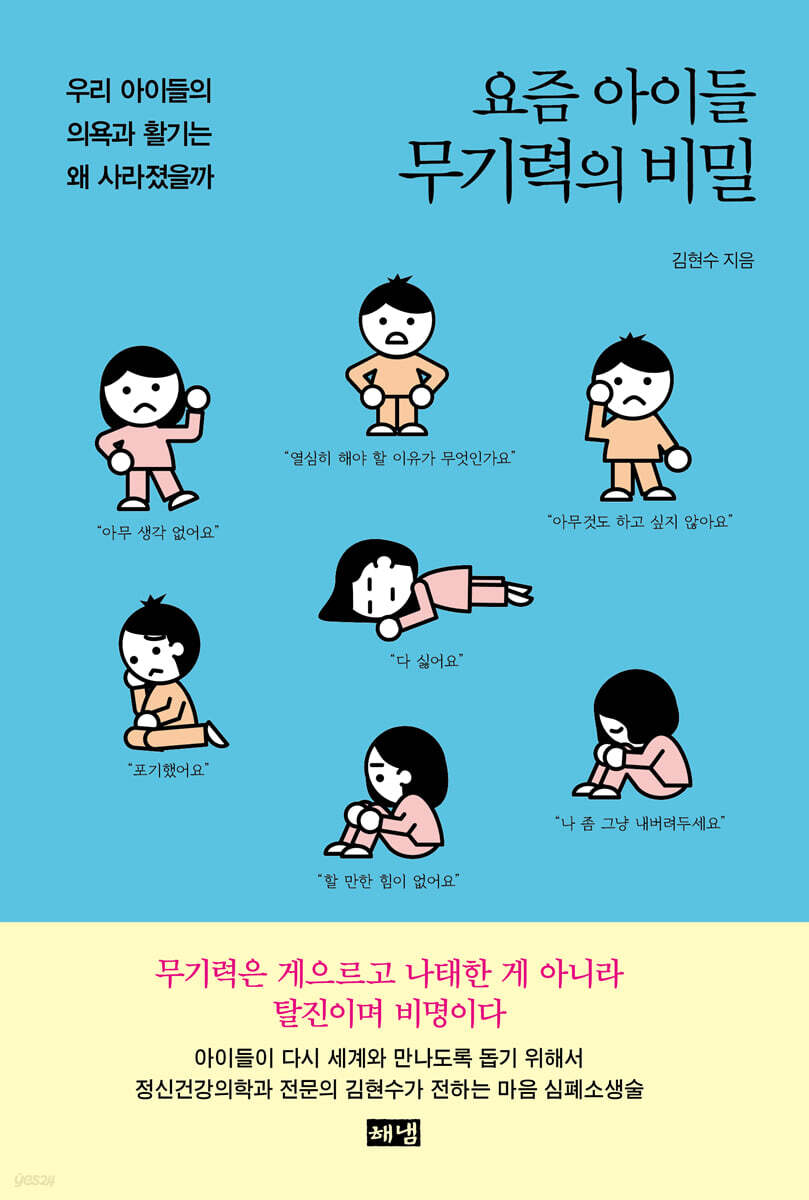
The secret to today's children's apathy
 |
Description
Book Introduction
“I don’t want to do anything.” “I don’t have the strength to do anything.” “I’ve given up.”
To save the children who scream silently
What adults need to learn today, according to psychiatrist Kim Hyun-soo.
Kids who come to school, sleep on their desks, and when they get home, they don't let go of their phones and are absorbed in games...
At an age when children should be full of energy, they are becoming listless and listless.
On the other hand, the parent generation, who has little experience with being unmotivated, has a hard time accepting this kind of behavior in their children.
Moreover, when adults hear children say things like, “I don’t have any thoughts,” “I won’t do it,” or “I gave up,” they feel anxious and worried.
How did this happen? For over 30 years, Dr. Kim Hyun-soo, a psychiatrist, has been working to heal wounded youth and work with the community to resolve their issues.
He is also the principal of the healing alternative school ‘Growth School Star’, and until recently, he served as the director of the Seoul Suicide Prevention Center and the head of the Seoul COVID-19 Psychological Support Team, meeting and interpreting the hearts of countless children at schools and clinics.
Based on that experience, I argue that the apathy of children today is a result, not a cause.
In other words, they claim that a ‘winner-takes-all society’, ‘evaluation based on uniformity’, and ‘endless ranking’ have made children helpless.
In a social system where only the survivors can take everything, it is natural for children who are not able to do so to become helpless, and in this process, the few winners and the many losers become equally unhappy.
In this regard, the author analyzes the causes of children's unwillingness to do anything and suggests ways to help them in "The Secret of Today's Children's Apathy."
This book is also a revised edition of the bestseller “The Secret of Helplessness,” published in 2016.
Even though more than 10 years have passed since its publication, the number of apathetic children continues to increase.
The symptoms are getting worse and worse, and this is a wake-up call to society once again.
I want to share with you the healing and recovery methods that teachers, parents, and other adults in this society should practice for children.
This book, consisting of 12 chapters in 2 parts, examines in Part 1 how the system of 'helplessness' operates in society, schools, and families.
We examine the current state of apathy among teenagers and introduce in detail the five psychological types of apathy.
Part 2 will teach you how to give CPR to help helpless children.
From conversation techniques that turn positive situations into positive ones to hospitality, respect, and encouragement, we guide you through easy-to-practice methods for everyday life.
In particular, it presents ways to approach children by type of apathy and support strategies to help them.
The author argues that adolescent apathy is also the result of a series of lack of communication.
For a conversation to occur, one must be able to see into each other or listen to what the other person is saying. Unfortunately, most adults at school and at home only engage in one-sided monologues and are unable to engage in two-way communication.
This revised edition adds examples of communication patterns that can lead to helplessness, helping adults recognize their own conversation patterns and approach children more affectionately.
In addition, through extensive field experience and research theories in psychoanalysis, psychology, and philosophy, we provide reliable insights and directions for recovery.
In a time when the educational and parenting environment has rapidly changed due to the COVID-19 pandemic, AI, and social media, and the number of apathetic children has increased, this book will provide direction for families, schools, and society to work together to develop comprehensive and diverse recovery measures so that children can heal and recover at their own pace.
To save the children who scream silently
What adults need to learn today, according to psychiatrist Kim Hyun-soo.
Kids who come to school, sleep on their desks, and when they get home, they don't let go of their phones and are absorbed in games...
At an age when children should be full of energy, they are becoming listless and listless.
On the other hand, the parent generation, who has little experience with being unmotivated, has a hard time accepting this kind of behavior in their children.
Moreover, when adults hear children say things like, “I don’t have any thoughts,” “I won’t do it,” or “I gave up,” they feel anxious and worried.
How did this happen? For over 30 years, Dr. Kim Hyun-soo, a psychiatrist, has been working to heal wounded youth and work with the community to resolve their issues.
He is also the principal of the healing alternative school ‘Growth School Star’, and until recently, he served as the director of the Seoul Suicide Prevention Center and the head of the Seoul COVID-19 Psychological Support Team, meeting and interpreting the hearts of countless children at schools and clinics.
Based on that experience, I argue that the apathy of children today is a result, not a cause.
In other words, they claim that a ‘winner-takes-all society’, ‘evaluation based on uniformity’, and ‘endless ranking’ have made children helpless.
In a social system where only the survivors can take everything, it is natural for children who are not able to do so to become helpless, and in this process, the few winners and the many losers become equally unhappy.
In this regard, the author analyzes the causes of children's unwillingness to do anything and suggests ways to help them in "The Secret of Today's Children's Apathy."
This book is also a revised edition of the bestseller “The Secret of Helplessness,” published in 2016.
Even though more than 10 years have passed since its publication, the number of apathetic children continues to increase.
The symptoms are getting worse and worse, and this is a wake-up call to society once again.
I want to share with you the healing and recovery methods that teachers, parents, and other adults in this society should practice for children.
This book, consisting of 12 chapters in 2 parts, examines in Part 1 how the system of 'helplessness' operates in society, schools, and families.
We examine the current state of apathy among teenagers and introduce in detail the five psychological types of apathy.
Part 2 will teach you how to give CPR to help helpless children.
From conversation techniques that turn positive situations into positive ones to hospitality, respect, and encouragement, we guide you through easy-to-practice methods for everyday life.
In particular, it presents ways to approach children by type of apathy and support strategies to help them.
The author argues that adolescent apathy is also the result of a series of lack of communication.
For a conversation to occur, one must be able to see into each other or listen to what the other person is saying. Unfortunately, most adults at school and at home only engage in one-sided monologues and are unable to engage in two-way communication.
This revised edition adds examples of communication patterns that can lead to helplessness, helping adults recognize their own conversation patterns and approach children more affectionately.
In addition, through extensive field experience and research theories in psychoanalysis, psychology, and philosophy, we provide reliable insights and directions for recovery.
In a time when the educational and parenting environment has rapidly changed due to the COVID-19 pandemic, AI, and social media, and the number of apathetic children has increased, this book will provide direction for families, schools, and society to work together to develop comprehensive and diverse recovery measures so that children can heal and recover at their own pace.
- You can preview some of the book's contents.
Preview
index
Revised Edition Prologue: A World That Makes Children More Apathetic
Prologue: The Secret of Apathy That Adults Have Ignored
Part 1: The Birth of Helpless Children
Opening remarks_ How did I become a sleeping child?
1 Understanding the feeling of not wanting to do anything
2 What has happened to the children so far?
3 Seven Perspectives on Understanding the Hidden Meaning of Apathy
4 Children crushed by social pressure
5. Apathy Born from the Education and Parenting System
6 Five Psychological Types of Apathy
7 Four Paradigms That Demonstrate Incompetence
Closing remarks: What is the cause of children's lethargy?
Part 2: Helping Helpless Children
Opening Remarks_ Rescuing One Person at a Time
1. CPR Leading Change? Paradox and Positivity
2 CPR that Leads Change ② Hospitality, Participation, and Respect
3 Things Adults Should Do to Help Children Live Again and Encourage Them
4 Ways to Approach Children with Apathy by Type - Deficiency Type, Over-Eager Type, and Chronic Type
5 Support Strategies to Help Children Who Are Apathetic - Resilience, Relationships, and Achievement Experiences
Closing Remarks_ Have I lived my life to the fullest?
Epilogue: What You Need to Do Now to Awaken the Sleeping Giant
Revised Edition Epilogue_To Exist Is to Communicate
References
Prologue: The Secret of Apathy That Adults Have Ignored
Part 1: The Birth of Helpless Children
Opening remarks_ How did I become a sleeping child?
1 Understanding the feeling of not wanting to do anything
2 What has happened to the children so far?
3 Seven Perspectives on Understanding the Hidden Meaning of Apathy
4 Children crushed by social pressure
5. Apathy Born from the Education and Parenting System
6 Five Psychological Types of Apathy
7 Four Paradigms That Demonstrate Incompetence
Closing remarks: What is the cause of children's lethargy?
Part 2: Helping Helpless Children
Opening Remarks_ Rescuing One Person at a Time
1. CPR Leading Change? Paradox and Positivity
2 CPR that Leads Change ② Hospitality, Participation, and Respect
3 Things Adults Should Do to Help Children Live Again and Encourage Them
4 Ways to Approach Children with Apathy by Type - Deficiency Type, Over-Eager Type, and Chronic Type
5 Support Strategies to Help Children Who Are Apathetic - Resilience, Relationships, and Achievement Experiences
Closing Remarks_ Have I lived my life to the fullest?
Epilogue: What You Need to Do Now to Awaken the Sleeping Giant
Revised Edition Epilogue_To Exist Is to Communicate
References
Detailed image

Into the book
When we use adjectives to describe apathetic children in school, that is, when we call them apathetic children now, we use terms with a similar meaning to the phrase “they are apathetic”: unmotivated children, lazy children, children without dreams, depressed children, children who have given up, etc.
As the expressions listed above show, apathetic children are often judged as lazy and easily labeled as children who find everything bothersome or uninteresting.
And the more parents or teachers work hard and have strong motivation, the more they tend to think of these children as 'bad guys.'
It is common to encounter parents or teachers raising their voices and saying, “What kind of bad guys are these, sleeping in school?”
However, assuming that these children are just like that is actually the worst way to misunderstand a helpless child.
--- From "1-1 Understanding the Feeling of Not Wanting to Do Anything"
It is clear that children do not like to be listless.
First of all, being listless is not in line with the nature of living things, so if you look closely at the minds of children, you will find that there is not a single child who truly wants to be listless.
I just want to have fun, but I can't, and I've tried many things to have fun, but they all fail, so I think it's better to just stay the course for now than to fuss and struggle about trying again. That's just the behavior I chose.
--- From "1-2 What has happened to the children so far?"
Michael Eigan used the term "psychological death" in his analysis of patients who were mentally dysfunctional and living like zombies, and apathetic children who were just killing time are in a similar state.
Because we are living a life without subjectivity, a life without content, a life where we do what others tell us to do, a life where we move like a machine.
The same goes for children who are partially dead and partially alive, children who have killed the part that touches the world and live only by clinging to their inner fantasies.
What they have in common is 'loss of sensation', and the core of it is 'loss of pain'.
The pain is so severe that the sense of pain is killed when you are alive.
To do that, you have to kill your mind or spirit, and what can replace the death of your mind and spirit is deep sleep, or activities similar to sleep, such as games, television, or something similar.
Another way to live that is similar to being dead is to choose a dissociated life.
Dead during class and awake during break, dead in front of demanding adults, alive in front of understanding friends, incompetent in front of forced tasks, crazy and explosive in front of things they like, hiding and showing, going on and off, they live a double life, going back and forth between life and death like a pendulum.
--- From "1-3 Seven Perspectives on Understanding the Hidden Meaning of Apathy"
Schools have been biased in favor of 'good kids'.
We were clumsy in respecting children's diversity and were also lacking in providing equal opportunities.
In the field of academics, competition is the basis, and children who excel are given more opportunities and privileges, leading to hierarchical guidance based on grades.
Children who do not belong to the group of 'good kids' suffer the injustice of being ignored and given no opportunities, like shadows or ghosts.
The children soon learned that the school had little interest in students who were average or below average, and that they were fortunate as long as they didn't cause any major trouble.
I also realized that I didn't have a teacher who really knew me well.
--- From "1-5 Apathy Born from the Education and Parenting System"
Children who become addicted to games or smartphones later in life are a little different from children who started playing games early and became addicted to games in the classic sense.
This apathetic group jumps into gaming in earnest after their grades drop at some point. Some of them are very good at gaming, but most are just average. Most of them hide in gaming because they are discouraged from not meeting their own expectations and those of their parents.
As is well known, the game is another life league that allows you to experience vicarious satisfaction through status advancement and leveling up in exchange for lost grades.
The vicarious satisfaction of 'grades go down, levels go up' in games is somewhat effective when you're in the game world, but it feels very uncomfortable when you return to the real world.
--- From "1-6 Five Psychological Types of Apathy"
The first thing to do is to stop nagging.
The most pathological approach to perpetuating a negative relationship is to repeat the same nagging over and over again for years.
If you just repeat the scolding your child is expecting, nothing will change.
Nagging is boring and only worsens the relationship, so when I counsel my children, I always harshly criticize parents who nag.
Whether it's not putting things back where they belong, not washing up properly, holding your phone for too long, playing games, sleeping late, or having bad posture, if teachers or parents were to set their minds to it, there would be no end to nagging about all the things that make you seem lethargic and lazy.
But often times, things that don't change are things that are difficult to change.
So one day, you just have to stop nagging.
This alone has a tremendous effect.
--- From “2-1 CPR that Leads to Change ① Paradox and Positivity”
Don't we all know the awkwardness of forcing ourselves to sit down in a place that doesn't welcome us?
The feeling of being somewhere you shouldn't be, of being in a place you shouldn't be, of being stuck in a place that wants to be left out and excluded, of being a crow among the herons, further intensifies the feeling of helplessness.
Not only does it make you feel lethargic, but it also awakens dormant hostility.
“No matter what you do, this is where you belong.”
“This is exactly where you belong.”
By conveying this message and offering a welcome of presence and belonging, we can ignite the seeds of joy.
Hospitality is a powerful tool for energizing existence and opening hearts.
As the expressions listed above show, apathetic children are often judged as lazy and easily labeled as children who find everything bothersome or uninteresting.
And the more parents or teachers work hard and have strong motivation, the more they tend to think of these children as 'bad guys.'
It is common to encounter parents or teachers raising their voices and saying, “What kind of bad guys are these, sleeping in school?”
However, assuming that these children are just like that is actually the worst way to misunderstand a helpless child.
--- From "1-1 Understanding the Feeling of Not Wanting to Do Anything"
It is clear that children do not like to be listless.
First of all, being listless is not in line with the nature of living things, so if you look closely at the minds of children, you will find that there is not a single child who truly wants to be listless.
I just want to have fun, but I can't, and I've tried many things to have fun, but they all fail, so I think it's better to just stay the course for now than to fuss and struggle about trying again. That's just the behavior I chose.
--- From "1-2 What has happened to the children so far?"
Michael Eigan used the term "psychological death" in his analysis of patients who were mentally dysfunctional and living like zombies, and apathetic children who were just killing time are in a similar state.
Because we are living a life without subjectivity, a life without content, a life where we do what others tell us to do, a life where we move like a machine.
The same goes for children who are partially dead and partially alive, children who have killed the part that touches the world and live only by clinging to their inner fantasies.
What they have in common is 'loss of sensation', and the core of it is 'loss of pain'.
The pain is so severe that the sense of pain is killed when you are alive.
To do that, you have to kill your mind or spirit, and what can replace the death of your mind and spirit is deep sleep, or activities similar to sleep, such as games, television, or something similar.
Another way to live that is similar to being dead is to choose a dissociated life.
Dead during class and awake during break, dead in front of demanding adults, alive in front of understanding friends, incompetent in front of forced tasks, crazy and explosive in front of things they like, hiding and showing, going on and off, they live a double life, going back and forth between life and death like a pendulum.
--- From "1-3 Seven Perspectives on Understanding the Hidden Meaning of Apathy"
Schools have been biased in favor of 'good kids'.
We were clumsy in respecting children's diversity and were also lacking in providing equal opportunities.
In the field of academics, competition is the basis, and children who excel are given more opportunities and privileges, leading to hierarchical guidance based on grades.
Children who do not belong to the group of 'good kids' suffer the injustice of being ignored and given no opportunities, like shadows or ghosts.
The children soon learned that the school had little interest in students who were average or below average, and that they were fortunate as long as they didn't cause any major trouble.
I also realized that I didn't have a teacher who really knew me well.
--- From "1-5 Apathy Born from the Education and Parenting System"
Children who become addicted to games or smartphones later in life are a little different from children who started playing games early and became addicted to games in the classic sense.
This apathetic group jumps into gaming in earnest after their grades drop at some point. Some of them are very good at gaming, but most are just average. Most of them hide in gaming because they are discouraged from not meeting their own expectations and those of their parents.
As is well known, the game is another life league that allows you to experience vicarious satisfaction through status advancement and leveling up in exchange for lost grades.
The vicarious satisfaction of 'grades go down, levels go up' in games is somewhat effective when you're in the game world, but it feels very uncomfortable when you return to the real world.
--- From "1-6 Five Psychological Types of Apathy"
The first thing to do is to stop nagging.
The most pathological approach to perpetuating a negative relationship is to repeat the same nagging over and over again for years.
If you just repeat the scolding your child is expecting, nothing will change.
Nagging is boring and only worsens the relationship, so when I counsel my children, I always harshly criticize parents who nag.
Whether it's not putting things back where they belong, not washing up properly, holding your phone for too long, playing games, sleeping late, or having bad posture, if teachers or parents were to set their minds to it, there would be no end to nagging about all the things that make you seem lethargic and lazy.
But often times, things that don't change are things that are difficult to change.
So one day, you just have to stop nagging.
This alone has a tremendous effect.
--- From “2-1 CPR that Leads to Change ① Paradox and Positivity”
Don't we all know the awkwardness of forcing ourselves to sit down in a place that doesn't welcome us?
The feeling of being somewhere you shouldn't be, of being in a place you shouldn't be, of being stuck in a place that wants to be left out and excluded, of being a crow among the herons, further intensifies the feeling of helplessness.
Not only does it make you feel lethargic, but it also awakens dormant hostility.
“No matter what you do, this is where you belong.”
“This is exactly where you belong.”
By conveying this message and offering a welcome of presence and belonging, we can ignite the seeds of joy.
Hospitality is a powerful tool for energizing existence and opening hearts.
--- From “2-2 CPR that Leads to Change ② Hospitality, Participation, and Respect”
Publisher's Review
A world that makes children more helpless
The older generation was poor, but they had hope, and as they achieved that hope, they learned to have more hope.
But today's young generation has learned that although they are rich, there is no hope, and that hope is difficult to achieve, and they have naturally learned the futility of hope.
So, they can remain in a state of helplessness that adults cannot understand for a long time.
Why is it becoming more difficult for them to have hope? There are many reasons.
Adults who are kind, compassionate, and supportive, who understand and empathize with the reasons behind their actions, can save helpless adolescents and young adults.
The older generation was poor, but they had hope, and as they achieved that hope, they learned to have more hope.
But today's young generation has learned that although they are rich, there is no hope, and that hope is difficult to achieve, and they have naturally learned the futility of hope.
So, they can remain in a state of helplessness that adults cannot understand for a long time.
Why is it becoming more difficult for them to have hope? There are many reasons.
Adults who are kind, compassionate, and supportive, who understand and empathize with the reasons behind their actions, can save helpless adolescents and young adults.
GOODS SPECIFICS
- Date of issue: August 25, 2025
- Page count, weight, size: 256 pages | 426g | 145*215*15mm
- ISBN13: 9791167141231
- ISBN10: 1167141237
You may also like
카테고리
korean


korean

![GQ KOREA Mark (Monthly): December [2025]](http://librairie.coreenne.fr/cdn/shop/files/8ef265dbbfbf186523ed75ba7319009d.jpg?v=1765340328&width=3840)


