

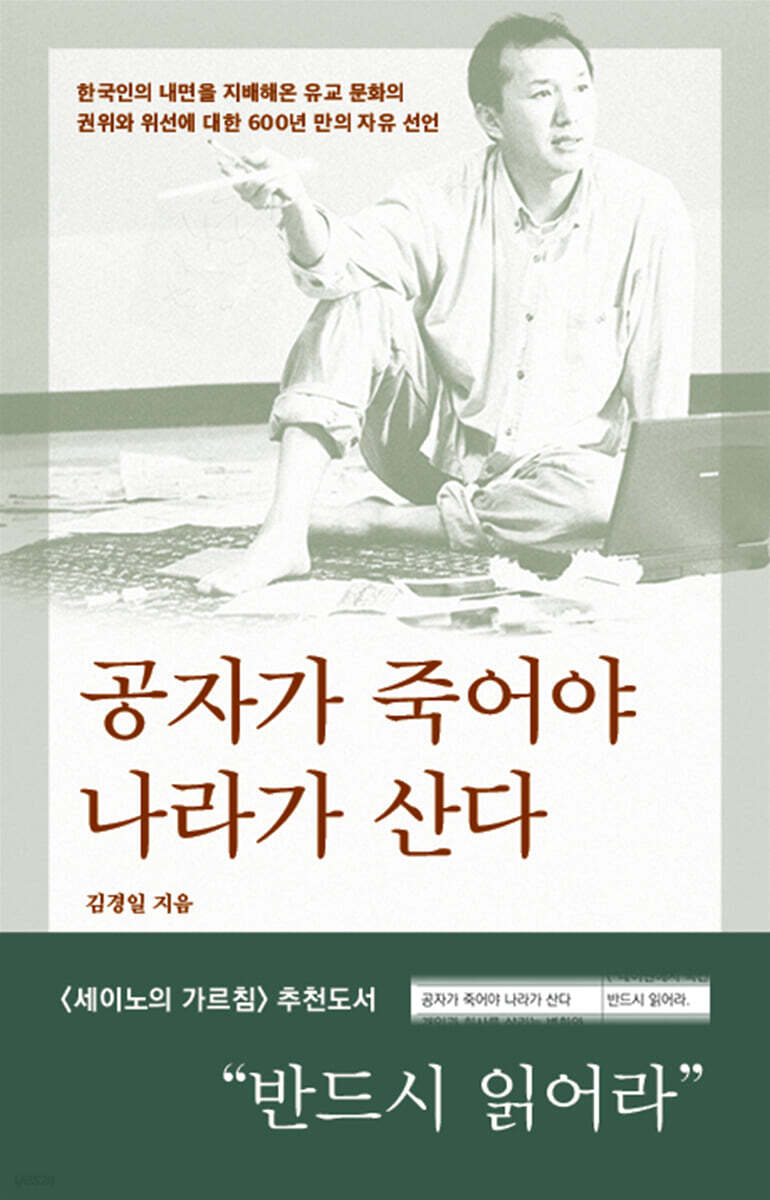
Confucius must die for the nation to live.
 |
Description
Book Introduction
A fundamental critique of Confucius and Confucian culture, the root of Korean social problems.
A sharp diagnosis of Koreans' cultural isolation and complexes, which prevent them from adapting to the era of globalization.
The origins and distortions of Confucianism, recently revealed through the excavation of oracle bone inscriptions, are introduced in detail for the first time in Korea.
Approaches to mutual understanding of Korean, Chinese, and Japanese cultures and the search for the right direction for foreign language and institutional education.
The unexpected IMF typhoon that struck us in late 1997 brought us the shock of unprecedented mass layoffs, unemployment, and a chain of bankruptcies among small and medium-sized enterprises.
The media and the intellectual class were unanimous in denouncing the structural ills of Korean society, saying that the nation's survival depended on the crisis.
However, without even a thorough diagnosis of the problems in our society, self-reflection, or concrete solutions, it soon became quiet as if nothing had happened.
And so the crisis was forgotten once again, leaving behind only empty slogans and self-praise, such as “a great nation that overcomes adversity” and “a nation that can do it.”
We overcame national crises in the same way during the Japan-Korea Annexation Treaty of 1910 and the Korean War in 1950.
In the midst of resignation, self-rationalization, division, and fighting, the problem was gradually diluted, and the 'poor people' who were actually suffering were played by the politicians' games and kept repeating to themselves, "This isn't right."
No one has seriously considered the nature of the recurring crisis that comes every 50 years.
This book dares to speak to the essence of that crisis.
The gist of this book is very simple.
At the heart of Korean social problems lies the Confucian ideology represented by Confucius.
Why Confucius, of all people? Who today honors and speaks of Confucius? Some might ask, isn't this an anachronistic claim, valid only for a small number of Confucian scholars or the residents of Cheonghak-dong?
However, even if a person knows nothing about Confucius and has no interest in him, since he was born and raised in Korea, he is thoroughly brainwashed to the bone with Confucian ideology.
Take a look around.
You will come to realize that, without exception, the shadow of Confucius and Confucianism lies behind the serious problems of Korean society.
A sharp diagnosis of Koreans' cultural isolation and complexes, which prevent them from adapting to the era of globalization.
The origins and distortions of Confucianism, recently revealed through the excavation of oracle bone inscriptions, are introduced in detail for the first time in Korea.
Approaches to mutual understanding of Korean, Chinese, and Japanese cultures and the search for the right direction for foreign language and institutional education.
The unexpected IMF typhoon that struck us in late 1997 brought us the shock of unprecedented mass layoffs, unemployment, and a chain of bankruptcies among small and medium-sized enterprises.
The media and the intellectual class were unanimous in denouncing the structural ills of Korean society, saying that the nation's survival depended on the crisis.
However, without even a thorough diagnosis of the problems in our society, self-reflection, or concrete solutions, it soon became quiet as if nothing had happened.
And so the crisis was forgotten once again, leaving behind only empty slogans and self-praise, such as “a great nation that overcomes adversity” and “a nation that can do it.”
We overcame national crises in the same way during the Japan-Korea Annexation Treaty of 1910 and the Korean War in 1950.
In the midst of resignation, self-rationalization, division, and fighting, the problem was gradually diluted, and the 'poor people' who were actually suffering were played by the politicians' games and kept repeating to themselves, "This isn't right."
No one has seriously considered the nature of the recurring crisis that comes every 50 years.
This book dares to speak to the essence of that crisis.
The gist of this book is very simple.
At the heart of Korean social problems lies the Confucian ideology represented by Confucius.
Why Confucius, of all people? Who today honors and speaks of Confucius? Some might ask, isn't this an anachronistic claim, valid only for a small number of Confucian scholars or the residents of Cheonghak-dong?
However, even if a person knows nothing about Confucius and has no interest in him, since he was born and raised in Korea, he is thoroughly brainwashed to the bone with Confucian ideology.
Take a look around.
You will come to realize that, without exception, the shadow of Confucius and Confucianism lies behind the serious problems of Korean society.
- You can preview some of the book's contents.
Preview
index
1 Ten Hardships of Living as a Korean
Now the map is torn-19
I hate Shinto-27
A Country Ruined by a Glass of Alcohol - 34
If you feel wronged, get promoted - 39
Why the Rule of Law Doesn't Work - 46
It's all about bloodlines! -50
A country where everyone is a royal descendant - 55
Why did Chan-ho and Seri go to America? -63
The DNA of the Three Kims: 'Geosigi' and 'Chara' - 71
What Makes Us Korean? - 83
2. Confucius must die for the country to live.
Confucianism's shelf life is over -95
Why China and Japan Abandoned Confucianism - 100
The False Beginnings of Confucianism: Distortion of History, Distortion of History - 108
The Origins of Ancestor Worship Rituals - 116
Why Confucius Lied - 123
Are we a perpetual vassal state of China? - 132
Zhu Xi's teachings, the great fraud - 141
The country ruled by the late Park Chung-hee - 151
Confucius Virus-157
How Confucian Culture Ruins a Nation - 163
Filial piety kills people - 171
Women in Confucianism, Women Outside Confucianism - 181
3 Japan, come in! China, wait!
Every knife tastes different - 199
Forgive Japan - 209
A Look at the Roots of Japanese Culture - 214
Learning from Japanese Comics - 220
How Confucianism Killed Our Imagination - 228
Why is Japanese culture so rife with violence and sex? - 233
The problem is creativity - 239
To beat China, first become a thorough merchant - 244
The Real Truth of Those Who Advocate for the Use of Chinese Characters - 252
It's not a Chinese character, it's an Asia Sign - 259
Learn Chinese Characters Easily - 265
4 Studying is over
Studying is over - 275
Find that "sheep" right now - 280
English is no longer a foreign language - 285
Skill is Morality - 294
Why Our Kids Are So Tired - 301
Goodbye, Teacher - 308
Argumentation is Making Fools - 314
Shin Young's "Together at School" - 319
5 Beyond Koreans
Beyond Koreans-333
Small is Beautiful - 338
Kick the Calf-345
An Jung-geun, Seo Taiji, and Jang Bogo-351
Speak Up-358
I'm afraid of a reunification that will come like Hwang Jang-yeop's - 365
Now the map is torn-19
I hate Shinto-27
A Country Ruined by a Glass of Alcohol - 34
If you feel wronged, get promoted - 39
Why the Rule of Law Doesn't Work - 46
It's all about bloodlines! -50
A country where everyone is a royal descendant - 55
Why did Chan-ho and Seri go to America? -63
The DNA of the Three Kims: 'Geosigi' and 'Chara' - 71
What Makes Us Korean? - 83
2. Confucius must die for the country to live.
Confucianism's shelf life is over -95
Why China and Japan Abandoned Confucianism - 100
The False Beginnings of Confucianism: Distortion of History, Distortion of History - 108
The Origins of Ancestor Worship Rituals - 116
Why Confucius Lied - 123
Are we a perpetual vassal state of China? - 132
Zhu Xi's teachings, the great fraud - 141
The country ruled by the late Park Chung-hee - 151
Confucius Virus-157
How Confucian Culture Ruins a Nation - 163
Filial piety kills people - 171
Women in Confucianism, Women Outside Confucianism - 181
3 Japan, come in! China, wait!
Every knife tastes different - 199
Forgive Japan - 209
A Look at the Roots of Japanese Culture - 214
Learning from Japanese Comics - 220
How Confucianism Killed Our Imagination - 228
Why is Japanese culture so rife with violence and sex? - 233
The problem is creativity - 239
To beat China, first become a thorough merchant - 244
The Real Truth of Those Who Advocate for the Use of Chinese Characters - 252
It's not a Chinese character, it's an Asia Sign - 259
Learn Chinese Characters Easily - 265
4 Studying is over
Studying is over - 275
Find that "sheep" right now - 280
English is no longer a foreign language - 285
Skill is Morality - 294
Why Our Kids Are So Tired - 301
Goodbye, Teacher - 308
Argumentation is Making Fools - 314
Shin Young's "Together at School" - 319
5 Beyond Koreans
Beyond Koreans-333
Small is Beautiful - 338
Kick the Calf-345
An Jung-geun, Seo Taiji, and Jang Bogo-351
Speak Up-358
I'm afraid of a reunification that will come like Hwang Jang-yeop's - 365
Detailed image
Publisher's Review
Koreans' cultural isolation and complexes
The world is changing rapidly these days.
The development of information and communication technology has dramatically shortened time and space and activated the foundations of global financial capital and multinational corporations.
As futurists have pointed out, we have now entered a new era of nomadism, where borders and nationalities in the traditional sense are becoming meaningless.
Only by correctly understanding and following the mighty wave of globalization can we ensure our survival and future.
Without openness, individuals, societies, and nations will all die.
It is an urgent time for a change in attitude toward cultural coexistence.
But what is our reality?
Among the slogans that emerged after the Uruguay Round was concluded and agricultural markets opened, the one that was a huge hit was “We must eat what grows on our own land” (身土不二).
Farmers and the media, who had been extremely uneasy about import liberalization, enthusiastically cheered this astonishing logic.
But if you look at it objectively, there is almost nothing that is purely 'ours'.
The fruits, livestock, and their seeds are mostly imported from abroad.
Let us not be swayed by emotional relief, but take a closer look at ourselves.
The more we say 'ours' or 'ours', the smaller we become.
No matter how I look at it, it just sounds like you lack confidence.
We shouldn't do it among ourselves, but compete with others to hear people say, "I like your stuff."
It's not satisfying to earn money by circling the Earth, but it's a shameful thing to sit in a room and only think about protecting what's ours.
In our society, there is a kind of phobia and cultural isolation hidden in the ‘Shinto-Buli’.
One of the things we are proud of to the world is that we are a single people that has lasted for half a millennium.
It's doubtful whether they truly share a single bloodline, but even if it were, why do those who, with nothing to boast about, are most proud of their single ethnic lineage export orphans? Is it because they believe that whatever happens to their children's bloodlines, as long as their own remains pure, they care?
Perhaps it is only natural that we, who still cannot shake off the foolish notion that everyone except the descendants of some seed or sect is not even human, are being pushed out and eliminated in the globalized era where we must accept other countries and cultures without any resistance.
Now that the discourse of globalization has become commonplace, nationalism has become an embarrassing topic.
Moreover, our bloodline culture, which cannot escape from the bloodline-based thinking that can be seen as a lower-class sentiment rather than nationalism, is utterly shameful to us.
The frog-in-a-well, blind-eye, and scheming practices that run counter to the universal trends and order of the world, carried out in the name of patriotism, are still rampant.
Being so obsessed with our own things, our bloodline, our nation, is nothing more than a reflection of an excessive sense of victimization and a complex.
Like Westerners' Orientalism, we also have a tendency to interpret and beautify history in a self-serving manner, and this can be seen as a manifestation of our pride in trying to cover up our poor history with pretense.
Behind this cultural complex lie the painful twists and turns of our modern and contemporary history, including the authoritarian rule of the long-standing military dictatorship, the anti-communist ideology that became entrenched after liberation and the Korean War, and the colonial rule of Japan.
However, if we trace back its origins further, there is Joseon's Confucianism, Confucianism, Zhu Xi, and Confucius.
Now is the time to change our attitude toward cultural coexistence.
No, it may have already passed.
It is time to secure our identity not as Koreans, but as human beings.
The more we cling to our 'national identity', which may not be able to guarantee a humane life, the more unhappy we may become.
Rather, when we open our doors with an open mind and a flexible attitude and can coexist with other cultures, 'ours' will gain its own space to survive.
Confucianism: A History of Concealment and Distortion
Tracing back to the origins of Confucianism, we see how it concealed and distorted the truth, and how it forced us to mistakenly pursue the values of fabricated and fabricated fictions as truth.
The facts learned through the recently discovered oracle bone inscriptions of the 『Shangshu』 are summarized as follows.
In ancient Yin Dynasty, there was a man named Jo Gap who drove out his older brother and usurped the throne.
As a means of justifying the power he has acquired, Jo Gap deifies his ancestors and rewrites the genealogy accordingly.
Even after the fall of the Yin Dynasty and the rise of the Zhou Dynasty, the Confucian class that performed ancestral rites survived and came up with ideas to perpetuate the rule of the rulers.
One of the descendants of that class was Confucius.
Confucius distorts the facts about Jo Gap's coup.
Confucius, who was the editor of the current ??Shangshu (Book of Documents)??, absurdly states that Zhao Jia did not usurp the throne, but rather inherited it rightfully.
The only records of ancient history were distorted by Confucius's naive(?) intention to hide unpleasant facts and idealize the past.
『Shangshu』 has been a textbook for those taking the civil service examination since ancient times.
It is only natural that the elites, who were forced to understand the state and administration through distorted literature, could not have the eyes and mind to correctly perceive the phenomenon.
While they pretended to tremble with the most moral values on the surface, they were actually learning lies, distortions, and dirty compromises from the most important texts of Confucianism.
And these facts would never have been known if it had not been for the discovery of the oracle bone script, which was buried underground and fortunately escaped the distortion and manipulation of Confucian fundamentalists.
Confucius not only presented the fictional values that existed in the past, but also urged his disciples to actively pursue them.
In their search for meaning that essentially did not exist, Confucius's disciples had to delve into the past, distorting and embellishing all historical facts according to that fictitious order.
And then they found themselves caught in the net of the past.
Now, the 'past' has become not a past in time, but a very 'dangerous past' in terms of values that determines the meaning of life.
In this respect, Confucius was not only the teacher of Eastern society, but also the person who dragged the entire Eastern society into lies and distortion.
These Confucian ideas were established as the ruling ideology of the state by Dong Zhongshu, and then became a universal cosmology and an inviolable absolute truth by Zhu Xi.
However, as can be seen through the 500-year history of the Joseon Dynasty, morality and cosmology are all nonsense.
It was just a mask anyway.
Scholars were only focused on eliminating their political enemies through it.
Since it was an absurd logic anyway, there was no way it could come to a conclusion.
It was a seed that had been conceived since the time when Jo Gap of the Yin Dynasty enlisted his ancestors for his own political advancement.
This vicious fight, which would drive the enemy to their deaths, was as if foreshadowed from the beginning.
Some Reasons to Abandon Confucianism
Confucian culture is a culture of looking back.
As soon as the IMF crisis broke out, the Park Chung-hee syndrome spread throughout society.
It was a moment when the obsession with the past, with the "long live the old days" and the "learning from the past to learn from the new" that permeates our society, was once again clearly revealed.
Koreans are particularly obsessed with history.
Of course, sometimes it is necessary to refer to the past, but Koreans believe that all answers lie in the past, and they turn to old scriptures whenever a new phenomenon arises.
Because of this, anything that does not fit the old has been denied its value, and those who advocate for something new have been buried by those who spread the scriptures.
New things are in new places.
As long as we continue to use the same language as before, no new future will be created.
The 'culture of looking back', which is engraved in the minds of Koreans, often holds back young people who are looking toward the future.
Because of this 'culture of looking back', Koreans have long been unable to see into the future.
As the new year approaches, the eldest daughter-in-law of the ancestral home draws dozens of circles on the calendar, counting down the lunar dates for the ancestral rites that must be performed that year.
The new year is already filled with the past, and tomorrow is reduced to a time spent reliving yesterday's funeral memories.
Even if we say that it is an action for the future, it is only at the level of looking at the grave site in advance.
Even if we always dream of the future, it is not easy to create a beautiful tomorrow. In a society where almost all members always remember yesterday and the past, we live.
Will the members of this society be able to correctly predict and adapt to the future society that is changing at a dizzying pace?
Confucian culture kills women
The biggest victims of Confucian culture are women.
The Confucian classics, “Shang Shu” and “When a hen crows, the household will fall apart” and Confucius’s words in the Analects, “Women and mean people are difficult to raise,” have become the standards for determining the status of women in Eastern society.
Although laws such as same-sex marriage and inheritance laws have been passed through the National Assembly with great difficulty, the cultural legacy of male superiority and female inferiority still persists.
However, this exploitation and oppression of women ultimately resulted in harm to men.
As psychoanalysis says, every man has a feminine personality in his unconscious.
Men yearn for and search for a woman who matches their needs, and this is the emotion called 'anima'.
Confucian culture can be said to be a cultural structure that discourages men's anima by making it too easy to possess women.
Men in Confucian society controlled women in an attempt to possess them completely, but in the end, they gained nothing.
Many of the Confucian devices created to completely possess women ended up killing them.
Women in Confucianism were no longer human or feminine.
It was nothing but a distorted life form, nothing but chaos bound by resentment.
Eventually, the women exploded and left the men.
The Oriental men, having lost the pure feminine nature of the primitive, ended up losing everything.
Even if the anti-gender discrimination law is passed, the oppression of the anima created by the long-standing culture of gender discrimination has not yet been restored.
Confucian culture stifles creativity.
I don't know about other fields, but Japan reigns supreme in the world when it comes to manga and animation.
It was the power of unbridled imagination that made it possible.
The reason most older Koreans have an aversion to Japanese comics is not because of the violence and sexual content of Japanese comics, but rather because of their own Confucian values of solemnity.
In other words, Confucian solemnity cannot tolerate the bombast and frivolity of Japanese manga.
But the boastfulness and frivolity, on the other hand, are also amazing imagination and wit.
If imagination and wit are the core of comics, the core of Confucianism is reality and solemnity.
There's no way these two can get along.
Confucian values always belittle and slander comics.
Confucius said this:
“I don’t talk about weird, forced, confusing things, or ghost stories.”
This means, in other words, to say only what is normal, pure, simple, and human.
Because of this, our imagination, which has been suppressed for over 600 years from the Joseon Dynasty to the present day, is unable to burst forth even today, as the 21st century approaches.
The coming century is often referred to as the age of creativity.
However, the poverty of imagination that Confucian values create makes expectations of cultural creativity impossible.
That's why the culture of copying is so extreme.
Meanwhile, Confucian culture had an attitude of reverence for writing and restraint toward speech.
This trend persists even today, with writing becoming the mainstream ability test, from dictation in first grade elementary school to essay tests for college entrance exams and job interviews.
However, the 'writing' at this time had a more serious problem in that it was not creative writing, but 'copying' within the framework of the classics (textbooks). (Look at the uniform composition and conclusion of essay test answers.) This 'copying' culture originated from Confucius's declaration of 'copying but not creating', and it became established as a social ill in Eastern Confucian society due to the 'writing must contain morality' trend of the Tang and Song Dynasties.
In any case, communication, which should be the top priority in learning a foreign language, is ignored, and textbooks are created with a focus on handling written text.
Also, teachers only teach spelling and grammar, which are not related to communication.
So, students read English books as if they were Chinese books, and focus only on understanding their deeper meaning.
They only study to pass the test without realizing that English is a 'language'.
As a result, they end up becoming idiots who know the deep(?) meaning of words but cannot say a single easy word.
Confucian culture destroys society
The critical flaw of Confucian culture is that it plunges the social system into a vicious cycle of collapse.
Confucian culture contains inherent contradictions that lead to its own collapse.
Confucian culture is like a virus that corrodes the society it lives in, ultimately leading to its collapse.
It hides itself in various parts of a program like a Trojan horse, or sometimes like a computer virus, and starts working when the timing is right.
And then finally, it paralyzes the entire program it is in.
When a new political power emerges, they invariably wave the flag of lofty morality.
It doesn't matter whether the content is 'Let's live well', 'Building a just society', 'Ordinary people', 'Correcting history', or 'Second founding of the nation'.
They exercise extra-legal power under that banner and destroy the basic rules of social operation.
In their exercise of power, the professional community is relegated to a secondary position, and objective warning devices for social collapse are neutralized one by one.
This phenomenon spreads through the corrosion of professional systems in each social class, and eventually collapses immediately when a decisive external shock or internal chaos occurs.
So is that the end? Not at all.
A new moral flag will be raised to resolve the situation.
Their slogans are consistent.
“Koreans are a great people, once again!” Of course, that is only the beginning of another cycle of collapse.
Unless we boldly weed out Confucian culture, we cannot avoid this vicious cycle of collapse.
Events like the Japan-Korea Annexation, the Korean War, and the IMF crisis will happen again at any time.
The world is changing rapidly these days.
The development of information and communication technology has dramatically shortened time and space and activated the foundations of global financial capital and multinational corporations.
As futurists have pointed out, we have now entered a new era of nomadism, where borders and nationalities in the traditional sense are becoming meaningless.
Only by correctly understanding and following the mighty wave of globalization can we ensure our survival and future.
Without openness, individuals, societies, and nations will all die.
It is an urgent time for a change in attitude toward cultural coexistence.
But what is our reality?
Among the slogans that emerged after the Uruguay Round was concluded and agricultural markets opened, the one that was a huge hit was “We must eat what grows on our own land” (身土不二).
Farmers and the media, who had been extremely uneasy about import liberalization, enthusiastically cheered this astonishing logic.
But if you look at it objectively, there is almost nothing that is purely 'ours'.
The fruits, livestock, and their seeds are mostly imported from abroad.
Let us not be swayed by emotional relief, but take a closer look at ourselves.
The more we say 'ours' or 'ours', the smaller we become.
No matter how I look at it, it just sounds like you lack confidence.
We shouldn't do it among ourselves, but compete with others to hear people say, "I like your stuff."
It's not satisfying to earn money by circling the Earth, but it's a shameful thing to sit in a room and only think about protecting what's ours.
In our society, there is a kind of phobia and cultural isolation hidden in the ‘Shinto-Buli’.
One of the things we are proud of to the world is that we are a single people that has lasted for half a millennium.
It's doubtful whether they truly share a single bloodline, but even if it were, why do those who, with nothing to boast about, are most proud of their single ethnic lineage export orphans? Is it because they believe that whatever happens to their children's bloodlines, as long as their own remains pure, they care?
Perhaps it is only natural that we, who still cannot shake off the foolish notion that everyone except the descendants of some seed or sect is not even human, are being pushed out and eliminated in the globalized era where we must accept other countries and cultures without any resistance.
Now that the discourse of globalization has become commonplace, nationalism has become an embarrassing topic.
Moreover, our bloodline culture, which cannot escape from the bloodline-based thinking that can be seen as a lower-class sentiment rather than nationalism, is utterly shameful to us.
The frog-in-a-well, blind-eye, and scheming practices that run counter to the universal trends and order of the world, carried out in the name of patriotism, are still rampant.
Being so obsessed with our own things, our bloodline, our nation, is nothing more than a reflection of an excessive sense of victimization and a complex.
Like Westerners' Orientalism, we also have a tendency to interpret and beautify history in a self-serving manner, and this can be seen as a manifestation of our pride in trying to cover up our poor history with pretense.
Behind this cultural complex lie the painful twists and turns of our modern and contemporary history, including the authoritarian rule of the long-standing military dictatorship, the anti-communist ideology that became entrenched after liberation and the Korean War, and the colonial rule of Japan.
However, if we trace back its origins further, there is Joseon's Confucianism, Confucianism, Zhu Xi, and Confucius.
Now is the time to change our attitude toward cultural coexistence.
No, it may have already passed.
It is time to secure our identity not as Koreans, but as human beings.
The more we cling to our 'national identity', which may not be able to guarantee a humane life, the more unhappy we may become.
Rather, when we open our doors with an open mind and a flexible attitude and can coexist with other cultures, 'ours' will gain its own space to survive.
Confucianism: A History of Concealment and Distortion
Tracing back to the origins of Confucianism, we see how it concealed and distorted the truth, and how it forced us to mistakenly pursue the values of fabricated and fabricated fictions as truth.
The facts learned through the recently discovered oracle bone inscriptions of the 『Shangshu』 are summarized as follows.
In ancient Yin Dynasty, there was a man named Jo Gap who drove out his older brother and usurped the throne.
As a means of justifying the power he has acquired, Jo Gap deifies his ancestors and rewrites the genealogy accordingly.
Even after the fall of the Yin Dynasty and the rise of the Zhou Dynasty, the Confucian class that performed ancestral rites survived and came up with ideas to perpetuate the rule of the rulers.
One of the descendants of that class was Confucius.
Confucius distorts the facts about Jo Gap's coup.
Confucius, who was the editor of the current ??Shangshu (Book of Documents)??, absurdly states that Zhao Jia did not usurp the throne, but rather inherited it rightfully.
The only records of ancient history were distorted by Confucius's naive(?) intention to hide unpleasant facts and idealize the past.
『Shangshu』 has been a textbook for those taking the civil service examination since ancient times.
It is only natural that the elites, who were forced to understand the state and administration through distorted literature, could not have the eyes and mind to correctly perceive the phenomenon.
While they pretended to tremble with the most moral values on the surface, they were actually learning lies, distortions, and dirty compromises from the most important texts of Confucianism.
And these facts would never have been known if it had not been for the discovery of the oracle bone script, which was buried underground and fortunately escaped the distortion and manipulation of Confucian fundamentalists.
Confucius not only presented the fictional values that existed in the past, but also urged his disciples to actively pursue them.
In their search for meaning that essentially did not exist, Confucius's disciples had to delve into the past, distorting and embellishing all historical facts according to that fictitious order.
And then they found themselves caught in the net of the past.
Now, the 'past' has become not a past in time, but a very 'dangerous past' in terms of values that determines the meaning of life.
In this respect, Confucius was not only the teacher of Eastern society, but also the person who dragged the entire Eastern society into lies and distortion.
These Confucian ideas were established as the ruling ideology of the state by Dong Zhongshu, and then became a universal cosmology and an inviolable absolute truth by Zhu Xi.
However, as can be seen through the 500-year history of the Joseon Dynasty, morality and cosmology are all nonsense.
It was just a mask anyway.
Scholars were only focused on eliminating their political enemies through it.
Since it was an absurd logic anyway, there was no way it could come to a conclusion.
It was a seed that had been conceived since the time when Jo Gap of the Yin Dynasty enlisted his ancestors for his own political advancement.
This vicious fight, which would drive the enemy to their deaths, was as if foreshadowed from the beginning.
Some Reasons to Abandon Confucianism
Confucian culture is a culture of looking back.
As soon as the IMF crisis broke out, the Park Chung-hee syndrome spread throughout society.
It was a moment when the obsession with the past, with the "long live the old days" and the "learning from the past to learn from the new" that permeates our society, was once again clearly revealed.
Koreans are particularly obsessed with history.
Of course, sometimes it is necessary to refer to the past, but Koreans believe that all answers lie in the past, and they turn to old scriptures whenever a new phenomenon arises.
Because of this, anything that does not fit the old has been denied its value, and those who advocate for something new have been buried by those who spread the scriptures.
New things are in new places.
As long as we continue to use the same language as before, no new future will be created.
The 'culture of looking back', which is engraved in the minds of Koreans, often holds back young people who are looking toward the future.
Because of this 'culture of looking back', Koreans have long been unable to see into the future.
As the new year approaches, the eldest daughter-in-law of the ancestral home draws dozens of circles on the calendar, counting down the lunar dates for the ancestral rites that must be performed that year.
The new year is already filled with the past, and tomorrow is reduced to a time spent reliving yesterday's funeral memories.
Even if we say that it is an action for the future, it is only at the level of looking at the grave site in advance.
Even if we always dream of the future, it is not easy to create a beautiful tomorrow. In a society where almost all members always remember yesterday and the past, we live.
Will the members of this society be able to correctly predict and adapt to the future society that is changing at a dizzying pace?
Confucian culture kills women
The biggest victims of Confucian culture are women.
The Confucian classics, “Shang Shu” and “When a hen crows, the household will fall apart” and Confucius’s words in the Analects, “Women and mean people are difficult to raise,” have become the standards for determining the status of women in Eastern society.
Although laws such as same-sex marriage and inheritance laws have been passed through the National Assembly with great difficulty, the cultural legacy of male superiority and female inferiority still persists.
However, this exploitation and oppression of women ultimately resulted in harm to men.
As psychoanalysis says, every man has a feminine personality in his unconscious.
Men yearn for and search for a woman who matches their needs, and this is the emotion called 'anima'.
Confucian culture can be said to be a cultural structure that discourages men's anima by making it too easy to possess women.
Men in Confucian society controlled women in an attempt to possess them completely, but in the end, they gained nothing.
Many of the Confucian devices created to completely possess women ended up killing them.
Women in Confucianism were no longer human or feminine.
It was nothing but a distorted life form, nothing but chaos bound by resentment.
Eventually, the women exploded and left the men.
The Oriental men, having lost the pure feminine nature of the primitive, ended up losing everything.
Even if the anti-gender discrimination law is passed, the oppression of the anima created by the long-standing culture of gender discrimination has not yet been restored.
Confucian culture stifles creativity.
I don't know about other fields, but Japan reigns supreme in the world when it comes to manga and animation.
It was the power of unbridled imagination that made it possible.
The reason most older Koreans have an aversion to Japanese comics is not because of the violence and sexual content of Japanese comics, but rather because of their own Confucian values of solemnity.
In other words, Confucian solemnity cannot tolerate the bombast and frivolity of Japanese manga.
But the boastfulness and frivolity, on the other hand, are also amazing imagination and wit.
If imagination and wit are the core of comics, the core of Confucianism is reality and solemnity.
There's no way these two can get along.
Confucian values always belittle and slander comics.
Confucius said this:
“I don’t talk about weird, forced, confusing things, or ghost stories.”
This means, in other words, to say only what is normal, pure, simple, and human.
Because of this, our imagination, which has been suppressed for over 600 years from the Joseon Dynasty to the present day, is unable to burst forth even today, as the 21st century approaches.
The coming century is often referred to as the age of creativity.
However, the poverty of imagination that Confucian values create makes expectations of cultural creativity impossible.
That's why the culture of copying is so extreme.
Meanwhile, Confucian culture had an attitude of reverence for writing and restraint toward speech.
This trend persists even today, with writing becoming the mainstream ability test, from dictation in first grade elementary school to essay tests for college entrance exams and job interviews.
However, the 'writing' at this time had a more serious problem in that it was not creative writing, but 'copying' within the framework of the classics (textbooks). (Look at the uniform composition and conclusion of essay test answers.) This 'copying' culture originated from Confucius's declaration of 'copying but not creating', and it became established as a social ill in Eastern Confucian society due to the 'writing must contain morality' trend of the Tang and Song Dynasties.
In any case, communication, which should be the top priority in learning a foreign language, is ignored, and textbooks are created with a focus on handling written text.
Also, teachers only teach spelling and grammar, which are not related to communication.
So, students read English books as if they were Chinese books, and focus only on understanding their deeper meaning.
They only study to pass the test without realizing that English is a 'language'.
As a result, they end up becoming idiots who know the deep(?) meaning of words but cannot say a single easy word.
Confucian culture destroys society
The critical flaw of Confucian culture is that it plunges the social system into a vicious cycle of collapse.
Confucian culture contains inherent contradictions that lead to its own collapse.
Confucian culture is like a virus that corrodes the society it lives in, ultimately leading to its collapse.
It hides itself in various parts of a program like a Trojan horse, or sometimes like a computer virus, and starts working when the timing is right.
And then finally, it paralyzes the entire program it is in.
When a new political power emerges, they invariably wave the flag of lofty morality.
It doesn't matter whether the content is 'Let's live well', 'Building a just society', 'Ordinary people', 'Correcting history', or 'Second founding of the nation'.
They exercise extra-legal power under that banner and destroy the basic rules of social operation.
In their exercise of power, the professional community is relegated to a secondary position, and objective warning devices for social collapse are neutralized one by one.
This phenomenon spreads through the corrosion of professional systems in each social class, and eventually collapses immediately when a decisive external shock or internal chaos occurs.
So is that the end? Not at all.
A new moral flag will be raised to resolve the situation.
Their slogans are consistent.
“Koreans are a great people, once again!” Of course, that is only the beginning of another cycle of collapse.
Unless we boldly weed out Confucian culture, we cannot avoid this vicious cycle of collapse.
Events like the Japan-Korea Annexation, the Korean War, and the IMF crisis will happen again at any time.
GOODS SPECIFICS
- Date of issue: June 1, 2023
- Page count, weight, size: 384 pages | 462g | 122*190*30mm
- ISBN13: 9791166891533
You may also like
카테고리
korean


korean

![GQ KOREA Mark (Monthly): December [2025]](http://librairie.coreenne.fr/cdn/shop/files/8ef265dbbfbf186523ed75ba7319009d.jpg?v=1765340328&width=3840)


