

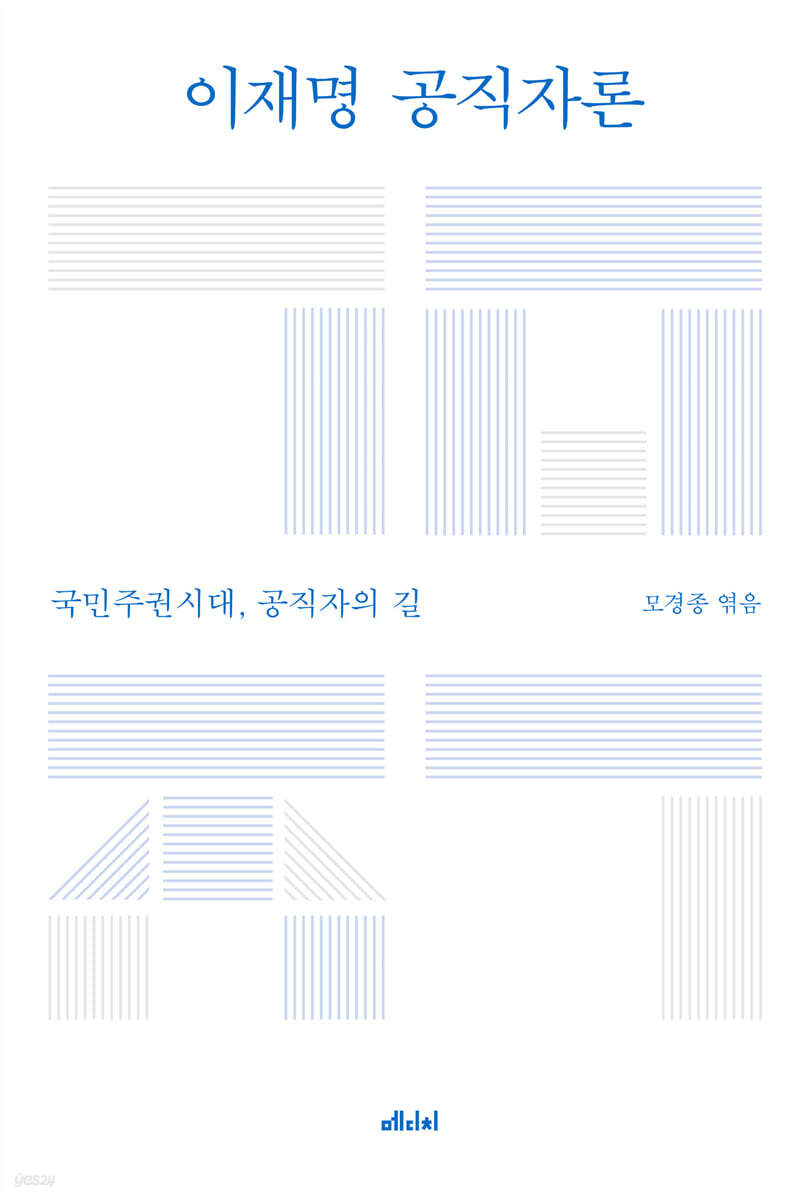
Lee Jae-myung's theory of public officials
 |
Description
Book Introduction
The era of popular sovereignty,
The attitude and virtues required of public officials, and even Lee Jae-myung's personnel principles
Talking about the path of public officials in the Republic of Korea!
"Lee Jae-myung's Public Official Theory" is the first record that summarizes the public office philosophy and administrative leadership of the 21st President Lee Jae-myung.
From his time as mayor of Seongnam, governor of Gyeonggi Province, member of the National Assembly, and then president, Lee Jae-myung has consistently emphasized that “public officials are tools of the people.”
What is Lee Jae-myung's theory of public service, as observed and heard closely by Rep. Mo Kyung-jong, who has assisted him in the Gyeonggi Provincial Government and the National Assembly, and practiced alongside him? This book vividly captures everything required of public officials in the era of popular sovereignty.
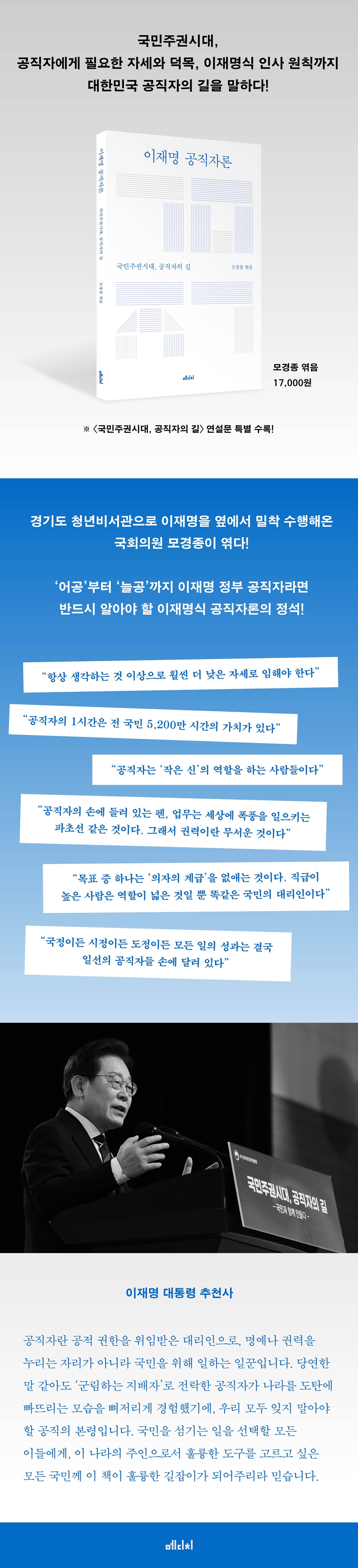
President Lee Jae-myung said, “One hour of public service is worth 52 million hours of the nation’s time.”
He likens the weight of public office to a 'banana leaf' and emphasizes that public officials' big and small decisions can move the lives of the people and determine the rise and fall of the country.
In an era where the people are the masters, public officials must maintain a humble attitude commensurate with the extent of their authority.
What Korean society needs today to leap forward again is more "Lee Jae-myung-type public officials."
We need public officials who are not afraid of failure, who listen to the voices of those in power, and who value serving the people above all else.
"Lee Jae-myung's Public Official Theory" is a contemporary question and practical guide for contemporary public officials.
The attitude and virtues required of public officials, and even Lee Jae-myung's personnel principles
Talking about the path of public officials in the Republic of Korea!
"Lee Jae-myung's Public Official Theory" is the first record that summarizes the public office philosophy and administrative leadership of the 21st President Lee Jae-myung.
From his time as mayor of Seongnam, governor of Gyeonggi Province, member of the National Assembly, and then president, Lee Jae-myung has consistently emphasized that “public officials are tools of the people.”
What is Lee Jae-myung's theory of public service, as observed and heard closely by Rep. Mo Kyung-jong, who has assisted him in the Gyeonggi Provincial Government and the National Assembly, and practiced alongside him? This book vividly captures everything required of public officials in the era of popular sovereignty.
President Lee Jae-myung said, “One hour of public service is worth 52 million hours of the nation’s time.”
He likens the weight of public office to a 'banana leaf' and emphasizes that public officials' big and small decisions can move the lives of the people and determine the rise and fall of the country.
In an era where the people are the masters, public officials must maintain a humble attitude commensurate with the extent of their authority.
What Korean society needs today to leap forward again is more "Lee Jae-myung-type public officials."
We need public officials who are not afraid of failure, who listen to the voices of those in power, and who value serving the people above all else.
"Lee Jae-myung's Public Official Theory" is a contemporary question and practical guide for contemporary public officials.
- You can preview some of the book's contents.
Preview
index
A word of recommendation to all who choose to serve the people.
Entering and asking about the path of public officials in the Republic of Korea
Chapter 1: What is the Era of Popular Sovereignty?
1. Why is Lee Jae-myung's public official theory relevant now?
2. Realization of popular sovereignty
3. The Attitude of Public Officials Required in the Era of Popular Sovereignty
4 Elected and Appointed Officials, and 'Nulgong'
Chapter 2: The Evolution of Lee Jae-myung's Public Official Theory
1. Seongnam Mayor Lee Jae-myung's Public Official Theory Begins
2 Gyeonggi Province Governors Experience a Microcosm of South Korea
3 Members of the National Assembly, from administration to legislation
Chapter 3: The Path of a Public Official
1. What public officials do and must do
2. Relationship between public officials and the people
3. Public service culture in the welfare sector
4. Lee Jae-myung's theory of public officials emphasizing on-site communication
5 Three Virtues of a Public Official
6 Principles of Lee Jae-myung's Personnel Management
Chapter 4: President Lee Jae-myung's Speech: "The Path of Public Officials in the Era of Popular Sovereignty"
1. The Path of a Public Official in the Era of Popular Sovereignty
? Created together with the people
2 The Era of Popular Sovereignty: The Path of a Public Official
? One step closer to the people
Entering and asking about the path of public officials in the Republic of Korea
Chapter 1: What is the Era of Popular Sovereignty?
1. Why is Lee Jae-myung's public official theory relevant now?
2. Realization of popular sovereignty
3. The Attitude of Public Officials Required in the Era of Popular Sovereignty
4 Elected and Appointed Officials, and 'Nulgong'
Chapter 2: The Evolution of Lee Jae-myung's Public Official Theory
1. Seongnam Mayor Lee Jae-myung's Public Official Theory Begins
2 Gyeonggi Province Governors Experience a Microcosm of South Korea
3 Members of the National Assembly, from administration to legislation
Chapter 3: The Path of a Public Official
1. What public officials do and must do
2. Relationship between public officials and the people
3. Public service culture in the welfare sector
4. Lee Jae-myung's theory of public officials emphasizing on-site communication
5 Three Virtues of a Public Official
6 Principles of Lee Jae-myung's Personnel Management
Chapter 4: President Lee Jae-myung's Speech: "The Path of Public Officials in the Era of Popular Sovereignty"
1. The Path of a Public Official in the Era of Popular Sovereignty
? Created together with the people
2 The Era of Popular Sovereignty: The Path of a Public Official
? One step closer to the people
Detailed image
Into the book
That responsibility immediately leads to questions that public officials must ask themselves.
"Who do I work for? What must I protect?" Lee Jae-myung, whom I've observed from the side, has always remained unwavering in the face of these questions.
It is more difficult than you might think to remain unwavering as a public official.
Because when you rise to a position of power, all kinds of temptations and pressures come pouring in.
Therefore, in order to live as a ‘servant of the people,’ constant effort is required to fulfill one’s duty at every moment.
--- From "Entering"
Lifestyle leadership is a leadership style that always lives alongside residents, identifying and solving their problems first and most accurately.
To truly achieve this, we need to not rely on the answers in textbooks or manuals, but rather seek answers within the lives of our citizens; we need the flexibility to wisely navigate numerous variables and diverse environments; and we need the continuous problem-solving skills to seek more efficient and accurate alternatives.
--- From "Why is Lee Jae-myung a public official now?"
President Lee Jae-myung says public officials are like "little gods" to the people.
The expression "little god" ultimately means that each and every decision made by public officials is directly related to the lives and quality of life of the people.
It also affects the people's spiritual values such as suffering, hope, and happiness.
President Lee Jae-myung's words emphasized the ethical responsibility and moral weight of public officials.
Therefore, public officials must use their authority properly.
--- From “The Relationship Between Public Officials and the People”
There is a famous anecdote from when I was mayor of Seongnam.
Tancheon, a river that flows into the Han River, passes through Seongnam City.
Mayor Lee Jae-myung walked here every day with his aides.
He said that he asked each and every resident he met while walking around every day what they needed and wrote down even the smallest details.
And he said that he resolved any issues that could be resolved the very next day and immediately contacted the complainant.
It was an administration that touched the skin of the residents.
--- From "Seongnam Mayor, the Beginning of the Public Official Theory of Lee Jae-myung"
Governor Lee Jae-myung creates the position of conflict mediator, which was also present in Seongnam City, Gyeonggi Province.
Gyeonggi Province public officials directly mediate and adjust numerous conflicts within the province.
In situations of civil conflict or conflict between the parties involved, it is difficult to narrow the differences of opinion due to each party's position.
So, in many cases, problems were resolved by bringing in an intermediary judge called a conflict mediator.
The conflict mediator actually created many solutions.
--- From "Gyeonggi Province Governor, Experiencing a Microcosm of the Republic of Korea"
What kind of public officials does President Lee Jae-myung like to work with? Lee Jae-myung lists the following three virtues as qualities a public official should possess.
(Omitted) When evaluating a person, President Lee Jae-myung focuses on that person's 'first sentence.'
Whether it's a report or discussion on a specific topic, look at how you structure the first sentence.
Because I think the first sentence tells you how much this person has prepared and what they want to say.
--- From “Three Virtues of a Public Official”
As the saying goes, “Personnel is everything,” personnel are very important in any organization.
In particular, personnel management is considered very important in the public sector because it is one of the ways to verify the fairness of an organization.
President Lee Jae-myung has been aware of this point for a long time.
So what are President Lee Jae-myung's personnel principles?
--- From "Lee Jae-myung's Personnel Principles"
“Whether it is national, municipal, or provincial administration, the success of all work ultimately rests in the hands of public officials on the front lines.
The fate of this country rests in your hands.
“Your life and future depend on what you do today, at this moment, and from now on.”
"Who do I work for? What must I protect?" Lee Jae-myung, whom I've observed from the side, has always remained unwavering in the face of these questions.
It is more difficult than you might think to remain unwavering as a public official.
Because when you rise to a position of power, all kinds of temptations and pressures come pouring in.
Therefore, in order to live as a ‘servant of the people,’ constant effort is required to fulfill one’s duty at every moment.
--- From "Entering"
Lifestyle leadership is a leadership style that always lives alongside residents, identifying and solving their problems first and most accurately.
To truly achieve this, we need to not rely on the answers in textbooks or manuals, but rather seek answers within the lives of our citizens; we need the flexibility to wisely navigate numerous variables and diverse environments; and we need the continuous problem-solving skills to seek more efficient and accurate alternatives.
--- From "Why is Lee Jae-myung a public official now?"
President Lee Jae-myung says public officials are like "little gods" to the people.
The expression "little god" ultimately means that each and every decision made by public officials is directly related to the lives and quality of life of the people.
It also affects the people's spiritual values such as suffering, hope, and happiness.
President Lee Jae-myung's words emphasized the ethical responsibility and moral weight of public officials.
Therefore, public officials must use their authority properly.
--- From “The Relationship Between Public Officials and the People”
There is a famous anecdote from when I was mayor of Seongnam.
Tancheon, a river that flows into the Han River, passes through Seongnam City.
Mayor Lee Jae-myung walked here every day with his aides.
He said that he asked each and every resident he met while walking around every day what they needed and wrote down even the smallest details.
And he said that he resolved any issues that could be resolved the very next day and immediately contacted the complainant.
It was an administration that touched the skin of the residents.
--- From "Seongnam Mayor, the Beginning of the Public Official Theory of Lee Jae-myung"
Governor Lee Jae-myung creates the position of conflict mediator, which was also present in Seongnam City, Gyeonggi Province.
Gyeonggi Province public officials directly mediate and adjust numerous conflicts within the province.
In situations of civil conflict or conflict between the parties involved, it is difficult to narrow the differences of opinion due to each party's position.
So, in many cases, problems were resolved by bringing in an intermediary judge called a conflict mediator.
The conflict mediator actually created many solutions.
--- From "Gyeonggi Province Governor, Experiencing a Microcosm of the Republic of Korea"
What kind of public officials does President Lee Jae-myung like to work with? Lee Jae-myung lists the following three virtues as qualities a public official should possess.
(Omitted) When evaluating a person, President Lee Jae-myung focuses on that person's 'first sentence.'
Whether it's a report or discussion on a specific topic, look at how you structure the first sentence.
Because I think the first sentence tells you how much this person has prepared and what they want to say.
--- From “Three Virtues of a Public Official”
As the saying goes, “Personnel is everything,” personnel are very important in any organization.
In particular, personnel management is considered very important in the public sector because it is one of the ways to verify the fairness of an organization.
President Lee Jae-myung has been aware of this point for a long time.
So what are President Lee Jae-myung's personnel principles?
--- From "Lee Jae-myung's Personnel Principles"
“Whether it is national, municipal, or provincial administration, the success of all work ultimately rests in the hands of public officials on the front lines.
The fate of this country rests in your hands.
“Your life and future depend on what you do today, at this moment, and from now on.”
--- From President Lee Jae-myung's speech, "The Path of Public Officials in the Era of Popular Sovereignty"
Publisher's Review
“Public officials are people who act as ‘little gods.’”
The era of popular sovereignty,
Speaking of the path of public officials in the Republic of Korea
From 'Eogong' to 'Neulgong', if you are a public official in the Lee Jae-myung administration
The essential principles of Lee Jae-myung's public official theory that you must know!
"Lee Jae-myung's Public Official Theory" is the first record that organizes the public office and social views of Lee Jae-myung, who will be inaugurated as the 21st President of the Republic of Korea in 2025.
National Assemblyman Mo Kyung-jong, who has closely assisted Lee Jae-myung in the Gyeonggi Provincial Government and the National Assembly, has compiled his experiences on how Lee Jae-myung, a "servant of the people" and "tool," has fulfilled his duties as a public official.
Lee Jae-myung served as mayor of Seongnam for eight years.
He is a practical administrator who has directly addressed the lives of the people while serving as the governor of Gyeonggi Province for four years.
He is a public official who has emphasized responsibility and practice as a public official rather than the vague pursuit of power.
Even during extreme times such as harsh investigations, trials, and hunger strikes, he never ceased to worry about the people. Now, as the president of the era of popular sovereignty, he is responsible for the next five years of the Republic of Korea.
Rep. Mo Kyung-jong, who compiled this book, recalls that during his first meeting with Lee Jae-myung, he was told, “Always be more humble than you think.”
That one word has now become the philosophy of public service that every public official in the Republic of Korea must keep in mind.
Why is Lee Jae-myung's public official theory being discussed now?
South Korea is currently facing a situation where it must address structural crises such as inequality, low birth rate and aging population, climate crisis, and local extinction.
However, it is difficult to solve this complex crisis by responding to it in the same way as before.
This book argues that we are in a time when we need leaders who can most accurately identify and resolve on-site problems, and who seek answers within the lives of the people rather than relying on correct answers and manuals.
After becoming president, Lee Jae-myung said, “One hour of public service is worth 52 million hours of the entire nation.”
Public officials in the era of popular sovereignty must be humble enough to match the magnitude of their authority, and they must be extremely cautious when making decisions that change the lives of the people.
Public officials are not simply beings who enjoy power and honor, but are tools of the people and workers who exist to carry out the will of the sovereign.
It is important to understand and practice that public office is not an individual's job, but a position that moves the time and lives of all citizens.
What Korean society needs today to leap forward again is more 'Lee Jae-myungs.'
We need public officials who value serving the people above all else, listen to even the smallest voices, and are not afraid of failure.
Only when there are more public officials like this can the clock of the 52 million citizens, which had been at a standstill, begin to move again, and the Republic of Korea can truly move forward as a nation of the people.
"Lee Jae-myung's Public Official Theory" provides an answer to the question, "Why is Lee Jae-myung's public official theory now?"
This book, compiled through Lee Jae-myung's administrative experience and Lee Jae-myung's own words, specifically demonstrates how public officials should exercise the power entrusted to them by the people, what attitude they should have to fulfill their duties even in the face of external temptations and pressures, and what attitude they should have toward the people as workers in the era of popular sovereignty.
This book is a must-read for all public officials in the Republic of Korea in the era of popular sovereignty, and for all citizens who dream of becoming public officials.
The era of popular sovereignty,
Speaking of the path of public officials in the Republic of Korea
From 'Eogong' to 'Neulgong', if you are a public official in the Lee Jae-myung administration
The essential principles of Lee Jae-myung's public official theory that you must know!
"Lee Jae-myung's Public Official Theory" is the first record that organizes the public office and social views of Lee Jae-myung, who will be inaugurated as the 21st President of the Republic of Korea in 2025.
National Assemblyman Mo Kyung-jong, who has closely assisted Lee Jae-myung in the Gyeonggi Provincial Government and the National Assembly, has compiled his experiences on how Lee Jae-myung, a "servant of the people" and "tool," has fulfilled his duties as a public official.
Lee Jae-myung served as mayor of Seongnam for eight years.
He is a practical administrator who has directly addressed the lives of the people while serving as the governor of Gyeonggi Province for four years.
He is a public official who has emphasized responsibility and practice as a public official rather than the vague pursuit of power.
Even during extreme times such as harsh investigations, trials, and hunger strikes, he never ceased to worry about the people. Now, as the president of the era of popular sovereignty, he is responsible for the next five years of the Republic of Korea.
Rep. Mo Kyung-jong, who compiled this book, recalls that during his first meeting with Lee Jae-myung, he was told, “Always be more humble than you think.”
That one word has now become the philosophy of public service that every public official in the Republic of Korea must keep in mind.
Why is Lee Jae-myung's public official theory being discussed now?
South Korea is currently facing a situation where it must address structural crises such as inequality, low birth rate and aging population, climate crisis, and local extinction.
However, it is difficult to solve this complex crisis by responding to it in the same way as before.
This book argues that we are in a time when we need leaders who can most accurately identify and resolve on-site problems, and who seek answers within the lives of the people rather than relying on correct answers and manuals.
After becoming president, Lee Jae-myung said, “One hour of public service is worth 52 million hours of the entire nation.”
Public officials in the era of popular sovereignty must be humble enough to match the magnitude of their authority, and they must be extremely cautious when making decisions that change the lives of the people.
Public officials are not simply beings who enjoy power and honor, but are tools of the people and workers who exist to carry out the will of the sovereign.
It is important to understand and practice that public office is not an individual's job, but a position that moves the time and lives of all citizens.
What Korean society needs today to leap forward again is more 'Lee Jae-myungs.'
We need public officials who value serving the people above all else, listen to even the smallest voices, and are not afraid of failure.
Only when there are more public officials like this can the clock of the 52 million citizens, which had been at a standstill, begin to move again, and the Republic of Korea can truly move forward as a nation of the people.
"Lee Jae-myung's Public Official Theory" provides an answer to the question, "Why is Lee Jae-myung's public official theory now?"
This book, compiled through Lee Jae-myung's administrative experience and Lee Jae-myung's own words, specifically demonstrates how public officials should exercise the power entrusted to them by the people, what attitude they should have to fulfill their duties even in the face of external temptations and pressures, and what attitude they should have toward the people as workers in the era of popular sovereignty.
This book is a must-read for all public officials in the Republic of Korea in the era of popular sovereignty, and for all citizens who dream of becoming public officials.
GOODS SPECIFICS
- Date of issue: November 10, 2025
- Page count, weight, size: 164 pages | 248g | 136*200*10mm
- ISBN13: 9791157064793
You may also like
카테고리
korean


korean

![GQ KOREA Mark (Monthly): December [2025]](http://librairie.coreenne.fr/cdn/shop/files/8ef265dbbfbf186523ed75ba7319009d.jpg?v=1765340328&width=3840)


