

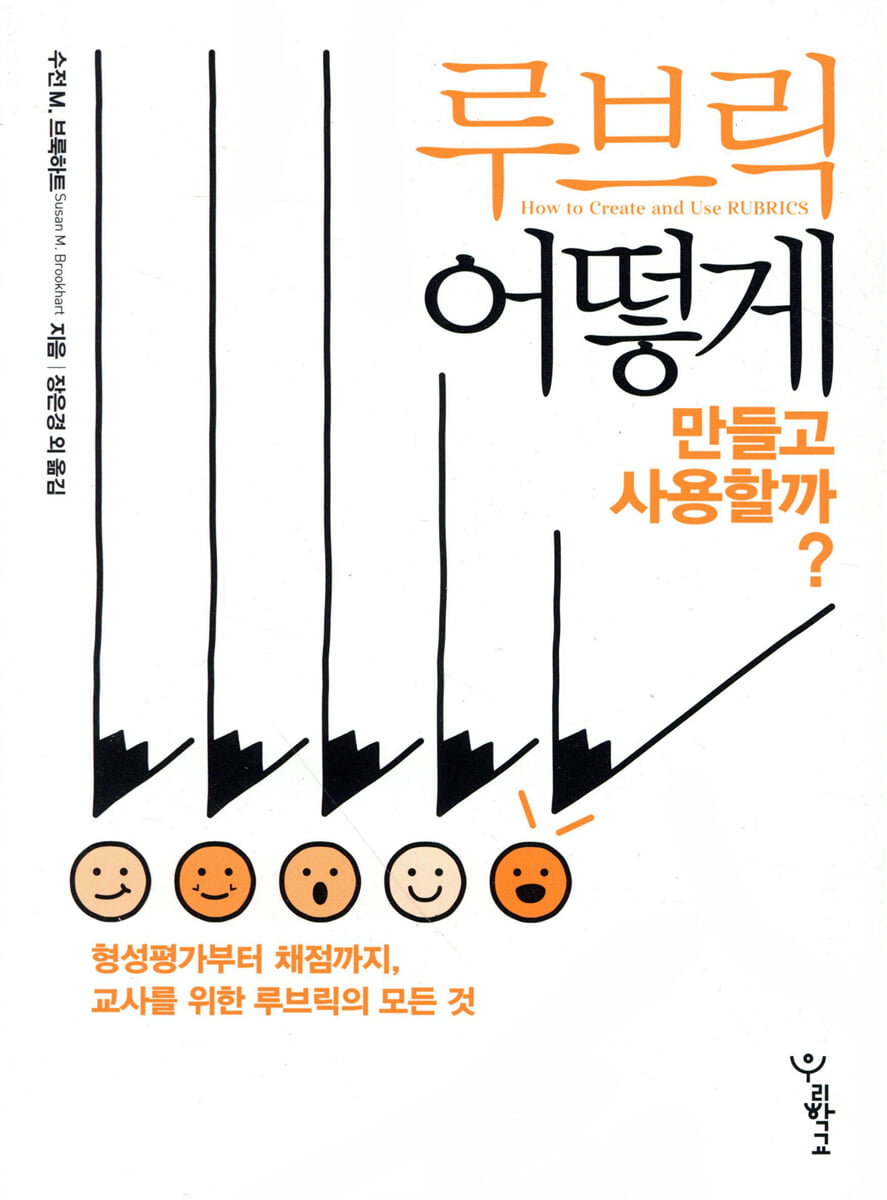
Rubrics: How to Create and Use Them?
 |
Description
Book Introduction
How can we teach properly and evaluate correctly?
The Ladder of Learning Growth: Everything You Need to Know About Creating and Using Rubrics
Rubrics have become common in educational settings recently, but they are often not used properly.
"How to Create and Use Rubrics" corrects misconceptions about rubrics and guides the creation and use of effective rubrics through clear explanations and various examples.
Part 1 provides guidance on what a rubric is and how to create one, using various examples. Part 2 covers how to effectively use rubrics in teaching and learning.
The author provides specific information on correct and incorrect rubrics, and suggests various evaluation factors and appropriate techniques for each topic, helping teachers in the field to avoid getting lost and organize student learning according to the nature and purpose of the rubric.
The top priority in assessment should not be grading and grading, but rather, “How does this assessment support students’ learning?”
Through this book, teacher readers will realize that rubrics are ultimately for student learning and growth, and that the process itself is also for teacher learning and growth.
The Ladder of Learning Growth: Everything You Need to Know About Creating and Using Rubrics
Rubrics have become common in educational settings recently, but they are often not used properly.
"How to Create and Use Rubrics" corrects misconceptions about rubrics and guides the creation and use of effective rubrics through clear explanations and various examples.
Part 1 provides guidance on what a rubric is and how to create one, using various examples. Part 2 covers how to effectively use rubrics in teaching and learning.
The author provides specific information on correct and incorrect rubrics, and suggests various evaluation factors and appropriate techniques for each topic, helping teachers in the field to avoid getting lost and organize student learning according to the nature and purpose of the rubric.
The top priority in assessment should not be grading and grading, but rather, “How does this assessment support students’ learning?”
Through this book, teacher readers will realize that rubrics are ultimately for student learning and growth, and that the process itself is also for teacher learning and growth.
- You can preview some of the book's contents.
Preview
index
Translator's Note: From Formative Assessment to Grading, Finding Powerful Tools for Student Growth 6
Introduction: To all teachers who use rubrics 14
Part 1: All Kinds of Rubrics and How to Make Them
1 What is a rubric, and why is it important? 19
What is a rubric? 20 / What is the purpose of a rubric? 21 / What are the pros and cons of different types of rubrics? 24 / Why are rubrics important? 32 / Summary 38
2 Common Misconceptions About Rubrics 39
Problem 40: Confusing tasks with learning outcomes / Problem 45: Confusing rubrics with requirements or counting / Problem 51: Confusing rubrics with rating scales / Summary 52
3 Creating and Selecting Effective Rubrics 54
How to Select Appropriate Evaluation Criteria? 55 / How to Describe Performance Levels? 59 / Two Common Approaches to Rubric Design 64 / Summary 79
4 General Rubric for Assessing Basic Skills 81
Writing: 6+1 Trait Writing Rubric 82 / Math Problem Solving Rubric 92 / Written Report Writing Rubric 97 / Creativity Rubric 100 / Summarizing Rubric 106
5 Task-specific rubrics and grading systems for specific purposes 108
When to Use Task-Specific Rubrics? 109 / Grading with Task-Specific Rubrics 111 / Creating Task-Specific Rubrics 114 / Grading with Item-Specific Rubrics 115 / Creating Item-Specific Rubrics 117 / Summarizing 118
6. Grading Based on Achievement Criteria with Proficiency-Based Rubrics 120
Creating Proficiency-Based Rubrics 121 / Using Proficiency-Based Rubrics in Formative Assessment 132 / Using Proficiency-Based Rubrics in Standards-Based Grading 135 / Summary 137
7 Checklists and Rating Scales: Related Assessment Tools, Not Rubrics 138
Rating Scale 141 / Summary 147
8 Examples of Rubrics for Various Topics and Types 149
Reading Aloud Fluency Rubric 149 / Science Lab Report Rubric 154 / Welding Rubric 156 / Summarizing Rubric 160
Part 2: Effective Rubric Use for Students and Teachers
9 Rubrics and Formative Assessment: Sharing Learning Objectives with Students 165
Sharing Learning Objectives and Assessment Factors with Rubrics 167 / Summary 181
10 Rubrics and Formative Assessment: Feedback and Student Self-Assessment 182
Using Rubrics for Teacher and Peer Feedback 183 / Using Rubrics for Student Self-Assessment and Goal Setting
189 / Using Rubrics Effectively for Performance 195 / Summarizing 199
11 Grading Methods Using Rubrics 201
What is Grading? 202 / Summary 225
Conclusion: Hoping for more effective rubric-based instruction and assessment 227
Acknowledgments 229
Reference 230
Appendix A 235
Appendix B 251
Introduction: To all teachers who use rubrics 14
Part 1: All Kinds of Rubrics and How to Make Them
1 What is a rubric, and why is it important? 19
What is a rubric? 20 / What is the purpose of a rubric? 21 / What are the pros and cons of different types of rubrics? 24 / Why are rubrics important? 32 / Summary 38
2 Common Misconceptions About Rubrics 39
Problem 40: Confusing tasks with learning outcomes / Problem 45: Confusing rubrics with requirements or counting / Problem 51: Confusing rubrics with rating scales / Summary 52
3 Creating and Selecting Effective Rubrics 54
How to Select Appropriate Evaluation Criteria? 55 / How to Describe Performance Levels? 59 / Two Common Approaches to Rubric Design 64 / Summary 79
4 General Rubric for Assessing Basic Skills 81
Writing: 6+1 Trait Writing Rubric 82 / Math Problem Solving Rubric 92 / Written Report Writing Rubric 97 / Creativity Rubric 100 / Summarizing Rubric 106
5 Task-specific rubrics and grading systems for specific purposes 108
When to Use Task-Specific Rubrics? 109 / Grading with Task-Specific Rubrics 111 / Creating Task-Specific Rubrics 114 / Grading with Item-Specific Rubrics 115 / Creating Item-Specific Rubrics 117 / Summarizing 118
6. Grading Based on Achievement Criteria with Proficiency-Based Rubrics 120
Creating Proficiency-Based Rubrics 121 / Using Proficiency-Based Rubrics in Formative Assessment 132 / Using Proficiency-Based Rubrics in Standards-Based Grading 135 / Summary 137
7 Checklists and Rating Scales: Related Assessment Tools, Not Rubrics 138
Rating Scale 141 / Summary 147
8 Examples of Rubrics for Various Topics and Types 149
Reading Aloud Fluency Rubric 149 / Science Lab Report Rubric 154 / Welding Rubric 156 / Summarizing Rubric 160
Part 2: Effective Rubric Use for Students and Teachers
9 Rubrics and Formative Assessment: Sharing Learning Objectives with Students 165
Sharing Learning Objectives and Assessment Factors with Rubrics 167 / Summary 181
10 Rubrics and Formative Assessment: Feedback and Student Self-Assessment 182
Using Rubrics for Teacher and Peer Feedback 183 / Using Rubrics for Student Self-Assessment and Goal Setting
189 / Using Rubrics Effectively for Performance 195 / Summarizing 199
11 Grading Methods Using Rubrics 201
What is Grading? 202 / Summary 225
Conclusion: Hoping for more effective rubric-based instruction and assessment 227
Acknowledgments 229
Reference 230
Appendix A 235
Appendix B 251
Into the book
This book is divided into two major parts.
Part 1 is about rubrics themselves, covering what they are, how to write them, and various examples.
Part 2 covers how to use rubrics in teaching and learning.
---From "Preface: To All Teachers Using Rubrics"
Rubrics are unique in that they are descriptive rather than evaluative.
Of course, rubrics are used for evaluation.
However, the actual principle of using a rubric is not to “judge” the performance results, but to “connect” them to the skills at each performance level on the rubric.
Therefore, to determine whether a rubric is good or bad, we must examine whether the evaluation factors have been properly selected and whether the corresponding performance levels have been properly described.
An effective rubric has appropriate assessment factors and well-written performance descriptions.
---From "Chapter 1: What is a Rubric and Why is it Important?"
What should be assessed by a rubric is the learning outcome, not the task used to assess the learning outcome.
These two should not be confused.
A rubric is more than just a table with instructions for an assignment.
The biggest mistake teachers make when using rubrics in performance assessment is focusing on the task—the product—rather than on the learning outcomes or proficiency students are expected to demonstrate through the task.
I have had this experience myself, and other studies have confirmed this.
---From "2 Common Misconceptions About Rubrics"
The role of technology in a rubric is to allow assessment factors to be identified along a continuum of qualitative levels.
A piece with three minor grammatical errors may demonstrate a much more “complex” and “sophisticated” English communication ability than a piece with only one error but only a few short sentences.
---From “3 Creating and Selecting Effective Rubrics”
The most meaningful part of this rubric, which expresses thinking from a student's perspective, is the description of the level of performance of 'demonstrating mathematical knowledge'.
A math problem-solving rubric written from an adult's perspective describes a student's problem-solving process with terms such as "demonstrates understanding of mathematical concepts and principles," "uses appropriate terminology and notation," and "executes an algorithm completely and correctly."
However, we cannot ask students to assess their own “understanding of mathematical concepts and principles.”
That is a judgment that must be made by an outside observer.
This student-friendly rubric flips the concept of understanding from something the teacher observes to something the student does.
---From "4 General Rubrics for Basic Ability Assessment"
Although task-specific rubrics and grading scales are not the most important grading methods, both should be on a teacher's grading repertoire and available for use when needed.
Task-specific rubrics are intended for grading purposes.
In comparison, general rubrics are much more flexible and serve both learning and grading purposes.
Above all, the author places greater value on general rubrics than on task-specific rubrics because general rubrics can be used with students.
General rubrics are especially valuable when schools and teachers adopt a standards-based grading policy that demonstrates proficiency levels and align all rubrics accordingly.
---From “5 Task-Specific Rubrics and Grading Systems for Specific Purposes”
Let's think about the correct counting method and percentage scale that have traditionally been used in grading.
The percentage is just a number that shows what percentage of the test content you got right, and it does not directly indicate the achievement standard.
If a teacher grades a student based on achievement criteria when he or she gets 100% on a test, he or she might be tempted to label the student as “proficient.”
But what if the test questions only measured basic comprehension, as required by the achievement standards, and did not ask questions requiring higher-order thinking skills? This 100% accuracy rate simply indicates that the student is "proficient."
---From “6 Achievement-Based Grading with Proficiency-Based Rubrics”
Quality rating scales skip steps and lead to hasty judgments.
In other words, it means making a judgment without explaining the evidence.
In reality, the quality assessment scale is very definitive, saying things like “it is excellent because the evaluator rated it as excellent,” and although there is a “performance level,” there is no explanation of the level.
You'll see many examples of what are called "rubrics" in schools and on the internet, but they're actually quality rating scales based on "criteria" for the task rather than the learning itself.
---From "7 Checklists and Rating Scales: Not Rubrics, but Related Assessment Tools"
We hope that teachers will be able to inductively generalize the characteristics of desirable rubrics through numerous examples.
Let's put the characteristics of a desirable rubric mentioned in this book side by side with the conclusions we've drawn ourselves and see how well they match up.
If the two are similar, you have a clear idea of what an effective rubric is.
---From “8 Examples of Rubrics on Various Topics and Types”
If the rubric says, “Understand the author’s intent and support this judgment using details from the text,” highlight the statement in the rubric and then highlight the parts of the example that demonstrate the author’s intent and the supporting evidence.
Students learn what the evaluation elements and performance skills at each level mean by finding and reviewing relevant parts of examples of performance outcomes like this.
This activity can also be used directly in students' assignments for formative assessment.
Before beginning their assignments, students can work through this activity using examples of their work and discuss with their partners, groups, or the entire class where they highlighted and why.
---From "9 Rubrics and Formative Assessment: Sharing Learning Goals with Students"
Peer feedback works best in classroom cultures that believe constructive criticism is an important part of learning.
However, in classrooms characterized by a grade-centric culture that emphasizes grades (“What grade did you get?”), peer feedback is less effective.
In such classrooms, students may be hesitant to criticize their peers for fear of implying that something is “wrong.”
So, you should only attempt peer feedback when you are confident that students value the opportunity to learn.
If peer feedback isn't working well despite careful preparation, consider whether students are more concerned about getting good grades than improving their work.
---From "10 Rubrics and Formative Assessment: Feedback and Student Self-Assessment"
I was once asked by a teacher at a grading workshop about a rubric that awarded a 1 point for the lowest performance level.
Typically, the lowest level of a rubric will say something like “The answer is difficult to determine” or “No answer was given.”
The teacher expressed concern about whether it was okay to “get points” for doing virtually nothing.
This interesting question is based on the premise that students can only earn points when they perform something.
Grades are supposed to show how much students have accomplished, but they are ultimately measured by arbitrary scales created by teachers.
---From "11 Grading Methods Using Rubrics"
Rubrics have become very common these days.
But in my experience, it's far more often than not used properly.
Too often, rubrics are used in the same way as other point-based grading systems, either by finding assessment factors based on trivial facts or lists, such as “there are four adjectives in the paragraph,” or by completely neglecting the formative and student-centered assessment opportunities that are the greatest strengths of rubrics.
Part 1 is about rubrics themselves, covering what they are, how to write them, and various examples.
Part 2 covers how to use rubrics in teaching and learning.
---From "Preface: To All Teachers Using Rubrics"
Rubrics are unique in that they are descriptive rather than evaluative.
Of course, rubrics are used for evaluation.
However, the actual principle of using a rubric is not to “judge” the performance results, but to “connect” them to the skills at each performance level on the rubric.
Therefore, to determine whether a rubric is good or bad, we must examine whether the evaluation factors have been properly selected and whether the corresponding performance levels have been properly described.
An effective rubric has appropriate assessment factors and well-written performance descriptions.
---From "Chapter 1: What is a Rubric and Why is it Important?"
What should be assessed by a rubric is the learning outcome, not the task used to assess the learning outcome.
These two should not be confused.
A rubric is more than just a table with instructions for an assignment.
The biggest mistake teachers make when using rubrics in performance assessment is focusing on the task—the product—rather than on the learning outcomes or proficiency students are expected to demonstrate through the task.
I have had this experience myself, and other studies have confirmed this.
---From "2 Common Misconceptions About Rubrics"
The role of technology in a rubric is to allow assessment factors to be identified along a continuum of qualitative levels.
A piece with three minor grammatical errors may demonstrate a much more “complex” and “sophisticated” English communication ability than a piece with only one error but only a few short sentences.
---From “3 Creating and Selecting Effective Rubrics”
The most meaningful part of this rubric, which expresses thinking from a student's perspective, is the description of the level of performance of 'demonstrating mathematical knowledge'.
A math problem-solving rubric written from an adult's perspective describes a student's problem-solving process with terms such as "demonstrates understanding of mathematical concepts and principles," "uses appropriate terminology and notation," and "executes an algorithm completely and correctly."
However, we cannot ask students to assess their own “understanding of mathematical concepts and principles.”
That is a judgment that must be made by an outside observer.
This student-friendly rubric flips the concept of understanding from something the teacher observes to something the student does.
---From "4 General Rubrics for Basic Ability Assessment"
Although task-specific rubrics and grading scales are not the most important grading methods, both should be on a teacher's grading repertoire and available for use when needed.
Task-specific rubrics are intended for grading purposes.
In comparison, general rubrics are much more flexible and serve both learning and grading purposes.
Above all, the author places greater value on general rubrics than on task-specific rubrics because general rubrics can be used with students.
General rubrics are especially valuable when schools and teachers adopt a standards-based grading policy that demonstrates proficiency levels and align all rubrics accordingly.
---From “5 Task-Specific Rubrics and Grading Systems for Specific Purposes”
Let's think about the correct counting method and percentage scale that have traditionally been used in grading.
The percentage is just a number that shows what percentage of the test content you got right, and it does not directly indicate the achievement standard.
If a teacher grades a student based on achievement criteria when he or she gets 100% on a test, he or she might be tempted to label the student as “proficient.”
But what if the test questions only measured basic comprehension, as required by the achievement standards, and did not ask questions requiring higher-order thinking skills? This 100% accuracy rate simply indicates that the student is "proficient."
---From “6 Achievement-Based Grading with Proficiency-Based Rubrics”
Quality rating scales skip steps and lead to hasty judgments.
In other words, it means making a judgment without explaining the evidence.
In reality, the quality assessment scale is very definitive, saying things like “it is excellent because the evaluator rated it as excellent,” and although there is a “performance level,” there is no explanation of the level.
You'll see many examples of what are called "rubrics" in schools and on the internet, but they're actually quality rating scales based on "criteria" for the task rather than the learning itself.
---From "7 Checklists and Rating Scales: Not Rubrics, but Related Assessment Tools"
We hope that teachers will be able to inductively generalize the characteristics of desirable rubrics through numerous examples.
Let's put the characteristics of a desirable rubric mentioned in this book side by side with the conclusions we've drawn ourselves and see how well they match up.
If the two are similar, you have a clear idea of what an effective rubric is.
---From “8 Examples of Rubrics on Various Topics and Types”
If the rubric says, “Understand the author’s intent and support this judgment using details from the text,” highlight the statement in the rubric and then highlight the parts of the example that demonstrate the author’s intent and the supporting evidence.
Students learn what the evaluation elements and performance skills at each level mean by finding and reviewing relevant parts of examples of performance outcomes like this.
This activity can also be used directly in students' assignments for formative assessment.
Before beginning their assignments, students can work through this activity using examples of their work and discuss with their partners, groups, or the entire class where they highlighted and why.
---From "9 Rubrics and Formative Assessment: Sharing Learning Goals with Students"
Peer feedback works best in classroom cultures that believe constructive criticism is an important part of learning.
However, in classrooms characterized by a grade-centric culture that emphasizes grades (“What grade did you get?”), peer feedback is less effective.
In such classrooms, students may be hesitant to criticize their peers for fear of implying that something is “wrong.”
So, you should only attempt peer feedback when you are confident that students value the opportunity to learn.
If peer feedback isn't working well despite careful preparation, consider whether students are more concerned about getting good grades than improving their work.
---From "10 Rubrics and Formative Assessment: Feedback and Student Self-Assessment"
I was once asked by a teacher at a grading workshop about a rubric that awarded a 1 point for the lowest performance level.
Typically, the lowest level of a rubric will say something like “The answer is difficult to determine” or “No answer was given.”
The teacher expressed concern about whether it was okay to “get points” for doing virtually nothing.
This interesting question is based on the premise that students can only earn points when they perform something.
Grades are supposed to show how much students have accomplished, but they are ultimately measured by arbitrary scales created by teachers.
---From "11 Grading Methods Using Rubrics"
Rubrics have become very common these days.
But in my experience, it's far more often than not used properly.
Too often, rubrics are used in the same way as other point-based grading systems, either by finding assessment factors based on trivial facts or lists, such as “there are four adjectives in the paragraph,” or by completely neglecting the formative and student-centered assessment opportunities that are the greatest strengths of rubrics.
---From “Conclusion: Hoping for more effective rubric-based classes and assessments”
Publisher's Review
How can we teach properly and evaluate correctly?
The Ultimate Rubric Guide for Every Teacher Who Wants to Teach and Evaluate Well
Renowned educational consultant Susan M.
The Korean edition of Brookhart's best-selling educational book, "How to Create and Use Rubrics for Formative Assessment and Grading," has finally been published.
The translation was done by seven current teachers who want to bring about change in the field by collecting small practices.
Rubrics have become more common these days, but they are often misused.
This book is more than just a solution to your rubric-related problems.
With clear explanations, numerous examples, and teaching strategies for using rubrics, this book will give you the confidence to create effective rubric-based lessons and assessments.
In particular, you can get specific help on how to engage students more actively in assessment and learning.
The book shines throughout with its wealth of useful manuals and resources, including a discussion of how to create and use proper rubrics, a student assessment method that differs from the conventional one, a keen insight into the problem of confusing rubrics with other assessment scales, examples of rubrics on various topics, and interviews with and theories from teachers and educational researchers.
The Ladder of Learning Growth: Everything You Need to Know About Creating and Using Rubrics for Teachers
“What really matters is the evidence of learning, that is, how can we verify that learning has occurred properly?”
Simply put, a rubric is an integrated assessment tool that combines evaluation element selection and performance level-specific description.
The primary function of a rubric is to help you find a description, or "skill," that fits the performance, rather than making an immediate "judgment" about it.
The focus is not on the outcome of the score, but on the performance of the process.
From this perspective, it is worth pointing out the author's criticism that many materials commonly used as rubrics in schools are not actually proper rubrics.
If you are a teacher, you should ask yourself, 'Am I using the right rubric?'
The author's criticisms of 'meaningless (nonsensical) rubrics such as the counting method', 'grading elements unrelated to class objectives', and 'the problem of confusing assignments with learning objectives' are sharp and important.
It is necessary to explain the evaluation elements and techniques for the purpose of actual performance results, but it is necessary to pay attention to the harsh criticism that the evaluation elements and techniques with the wrong direction are a 'fake rubric in the form of a rubric.'
The criteria for filtering out fakes and real ones are clear.
"Why should we use this rubric?" "What is the purpose of assessing with this rubric?" "Is its purpose along the same lines as focusing on student performance?" These are the fundamental and core questions that permeate the proper creation and use of rubrics.
From this perspective, teachers have no choice but to reexamine the assessment materials they currently use to determine what the problems are, what needs to be improved, and what their ultimate goal should be.
Fortunately, the author provides specific information about countless good and bad rubrics, and suggests various assessment elements and techniques appropriate for each topic, helping teachers in the field not to get lost and to structure student learning according to the nature and purpose of the rubric.
Moreover, as the author repeatedly emphasizes, rubrics can be used for many more purposes than simply “grading or grading.”
The main purpose of a rubric is to 'evaluate student performance'.
What types of performance you should be able to do will depend on your achievement standards, curriculum goals, and lesson objectives.
Rubrics become the best assessment tools and ultimately the best learning tools when students' performance—what they do, create, say, and write—is the best indicator of the intended classroom outcomes.
How to create and use rubrics of various types and topics, self-reflection questions, and examples of student rubric answers.
Includes teaching theory and appendix, and a quick quiz to help you understand the rubric!
Through classifications such as analytical and holistic rubrics, general and task-specific rubrics, and their pros and cons, teachers can acquire the ability to select, improve, and use appropriate rubrics according to their lesson objectives.
In this process, a variety of rubrics are provided for various subjects such as math, science, Korean, and art.
You can track your learning objectives simply by reading the assessment factors and performance level descriptions listed here.
And that's a well-made rubric.
Ultimately, the reason rubrics are becoming increasingly important in the educational field is because they help teachers teach well and harmonize classes and assessments.
And most importantly, it allows us to ‘find evidence of learning from students.’
The great advantage of a rubric is that it is not simply for evaluation and grading, but rather for students to learn, to self-evaluate with the teacher and peers, and to understand the objectives of the lesson.
This book presents materials for a variety of grade levels, from elementary school through high school, and is rich in engaging rubric answers and teaching theories.
In this process, we repeatedly ask ourselves the ‘essence of teaching’ with the rubric.
We pay close attention to the growth of each student and check what they can learn from this class.
In particular, the evaluation elements and performance level description examples are specific and excellent enough to be applied immediately.
Provides resources to change the practice of inappropriately combining rubric-based scores with other test scores or grades calculated in other ways, which misrepresents student achievement in final grades.
It offers a detailed explanation of how various rubric materials can be organically aggregated and scored, and how a fair and appropriate grading system is possible without reverting to the percentage-based grading method we have criticized, providing many insights.
The appendix provides the '6+1 Characteristic Writing Rubric' developed by the author's team for elementary through high school students. Just by looking at the evaluation elements and performance level descriptions provided here, you can grasp the core of the rubric.
Above all, this book is more than just a rubric guide.
Through this book, teacher readers will realize that rubrics are ultimately for student learning and growth, and that the process itself is also for teacher learning and growth.
The Ultimate Rubric Guide for Every Teacher Who Wants to Teach and Evaluate Well
Renowned educational consultant Susan M.
The Korean edition of Brookhart's best-selling educational book, "How to Create and Use Rubrics for Formative Assessment and Grading," has finally been published.
The translation was done by seven current teachers who want to bring about change in the field by collecting small practices.
Rubrics have become more common these days, but they are often misused.
This book is more than just a solution to your rubric-related problems.
With clear explanations, numerous examples, and teaching strategies for using rubrics, this book will give you the confidence to create effective rubric-based lessons and assessments.
In particular, you can get specific help on how to engage students more actively in assessment and learning.
The book shines throughout with its wealth of useful manuals and resources, including a discussion of how to create and use proper rubrics, a student assessment method that differs from the conventional one, a keen insight into the problem of confusing rubrics with other assessment scales, examples of rubrics on various topics, and interviews with and theories from teachers and educational researchers.
The Ladder of Learning Growth: Everything You Need to Know About Creating and Using Rubrics for Teachers
“What really matters is the evidence of learning, that is, how can we verify that learning has occurred properly?”
Simply put, a rubric is an integrated assessment tool that combines evaluation element selection and performance level-specific description.
The primary function of a rubric is to help you find a description, or "skill," that fits the performance, rather than making an immediate "judgment" about it.
The focus is not on the outcome of the score, but on the performance of the process.
From this perspective, it is worth pointing out the author's criticism that many materials commonly used as rubrics in schools are not actually proper rubrics.
If you are a teacher, you should ask yourself, 'Am I using the right rubric?'
The author's criticisms of 'meaningless (nonsensical) rubrics such as the counting method', 'grading elements unrelated to class objectives', and 'the problem of confusing assignments with learning objectives' are sharp and important.
It is necessary to explain the evaluation elements and techniques for the purpose of actual performance results, but it is necessary to pay attention to the harsh criticism that the evaluation elements and techniques with the wrong direction are a 'fake rubric in the form of a rubric.'
The criteria for filtering out fakes and real ones are clear.
"Why should we use this rubric?" "What is the purpose of assessing with this rubric?" "Is its purpose along the same lines as focusing on student performance?" These are the fundamental and core questions that permeate the proper creation and use of rubrics.
From this perspective, teachers have no choice but to reexamine the assessment materials they currently use to determine what the problems are, what needs to be improved, and what their ultimate goal should be.
Fortunately, the author provides specific information about countless good and bad rubrics, and suggests various assessment elements and techniques appropriate for each topic, helping teachers in the field not to get lost and to structure student learning according to the nature and purpose of the rubric.
Moreover, as the author repeatedly emphasizes, rubrics can be used for many more purposes than simply “grading or grading.”
The main purpose of a rubric is to 'evaluate student performance'.
What types of performance you should be able to do will depend on your achievement standards, curriculum goals, and lesson objectives.
Rubrics become the best assessment tools and ultimately the best learning tools when students' performance—what they do, create, say, and write—is the best indicator of the intended classroom outcomes.
How to create and use rubrics of various types and topics, self-reflection questions, and examples of student rubric answers.
Includes teaching theory and appendix, and a quick quiz to help you understand the rubric!
Through classifications such as analytical and holistic rubrics, general and task-specific rubrics, and their pros and cons, teachers can acquire the ability to select, improve, and use appropriate rubrics according to their lesson objectives.
In this process, a variety of rubrics are provided for various subjects such as math, science, Korean, and art.
You can track your learning objectives simply by reading the assessment factors and performance level descriptions listed here.
And that's a well-made rubric.
Ultimately, the reason rubrics are becoming increasingly important in the educational field is because they help teachers teach well and harmonize classes and assessments.
And most importantly, it allows us to ‘find evidence of learning from students.’
The great advantage of a rubric is that it is not simply for evaluation and grading, but rather for students to learn, to self-evaluate with the teacher and peers, and to understand the objectives of the lesson.
This book presents materials for a variety of grade levels, from elementary school through high school, and is rich in engaging rubric answers and teaching theories.
In this process, we repeatedly ask ourselves the ‘essence of teaching’ with the rubric.
We pay close attention to the growth of each student and check what they can learn from this class.
In particular, the evaluation elements and performance level description examples are specific and excellent enough to be applied immediately.
Provides resources to change the practice of inappropriately combining rubric-based scores with other test scores or grades calculated in other ways, which misrepresents student achievement in final grades.
It offers a detailed explanation of how various rubric materials can be organically aggregated and scored, and how a fair and appropriate grading system is possible without reverting to the percentage-based grading method we have criticized, providing many insights.
The appendix provides the '6+1 Characteristic Writing Rubric' developed by the author's team for elementary through high school students. Just by looking at the evaluation elements and performance level descriptions provided here, you can grasp the core of the rubric.
Above all, this book is more than just a rubric guide.
Through this book, teacher readers will realize that rubrics are ultimately for student learning and growth, and that the process itself is also for teacher learning and growth.
GOODS SPECIFICS
- Publication date: December 23, 2022
- Page count, weight, size: 264 pages | 386g | 152*205*20mm
- ISBN13: 9791167550873
- ISBN10: 1167550870
You may also like
카테고리
korean


korean

![GQ KOREA Mark (Monthly): December [2025]](http://librairie.coreenne.fr/cdn/shop/files/8ef265dbbfbf186523ed75ba7319009d.jpg?v=1765340328&width=3840)


