

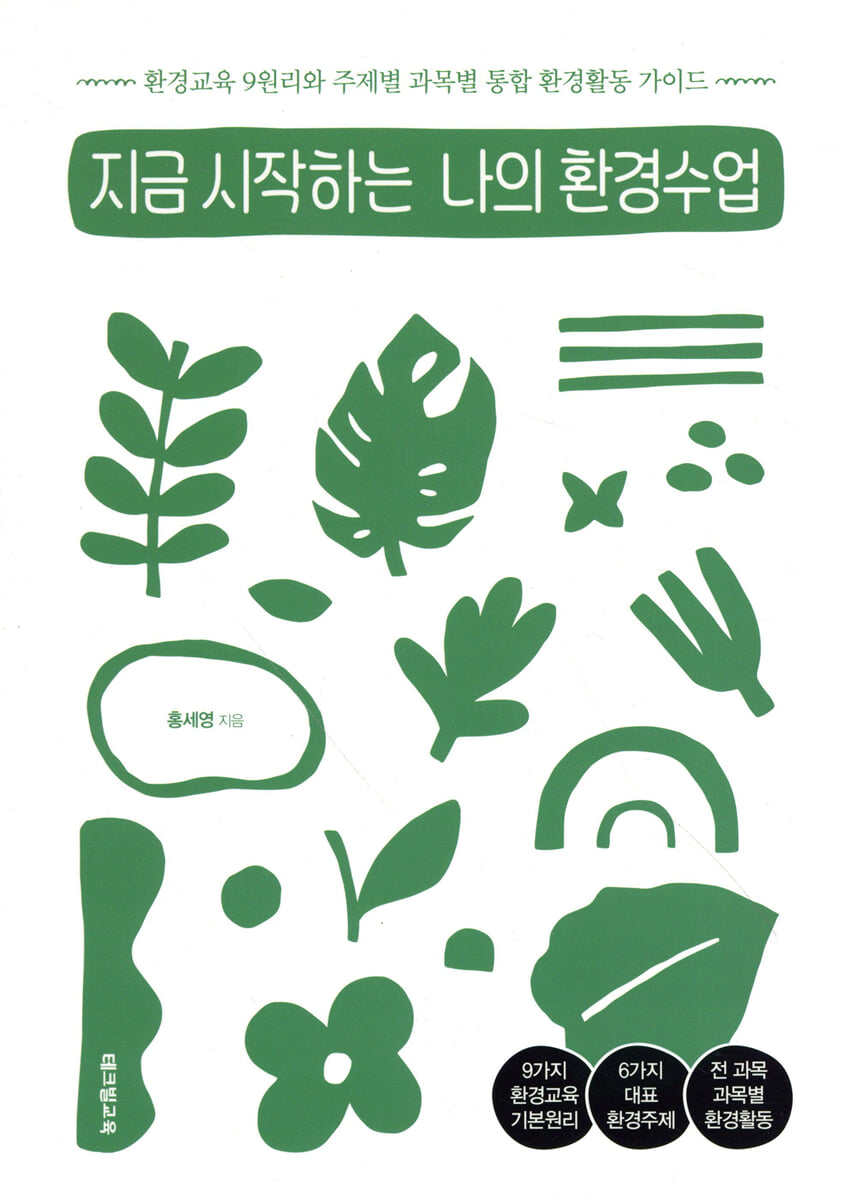
My environmental class starting now
 |
Description
Book Introduction
For teachers who love the Earth but feel a little lost,
A guide to environmental education from a teacher with 10 years of experience teaching environmental classes.
9 principles of environmental education + 6 major environmental classes + environmental activities for all subjects
A new environmental book has been published to guide teachers through ESD environmental classes, our classes that save the Earth.
The author of this book, who recommends his first environmental class to anyone, shares his 10 years of experience and says, “There is nothing wrong with a child who thinks about the environment,” and “Environmental classes change both children and teachers.” He started environmental classes 10 years ago when awareness of environmental education was not what it is now, and received a master’s degree in environmental education from graduate school.
This book, which is packed with practical information that can be applied directly to classes as well as a thorough introduction to help fellow teachers who are taking on the challenge of teaching environmental classes, contains all of the author's 10 years of environmental education know-how, including (1) 9 basic principles of environmental education that will help our precious Earth remain sustainable, (2) a guide to environmental classes by topic using creative time (6 representative topics: atmosphere, resource circulation, energy, carbon neutrality, food, ecology), and (3) subject-specific environmental activity ideas using class time (for all subjects).
The appendix at the end of the book is also informative, introducing a selection of beneficial environmental content, including movies, documentaries, books, and magazines.
A guide to environmental education from a teacher with 10 years of experience teaching environmental classes.
9 principles of environmental education + 6 major environmental classes + environmental activities for all subjects
A new environmental book has been published to guide teachers through ESD environmental classes, our classes that save the Earth.
The author of this book, who recommends his first environmental class to anyone, shares his 10 years of experience and says, “There is nothing wrong with a child who thinks about the environment,” and “Environmental classes change both children and teachers.” He started environmental classes 10 years ago when awareness of environmental education was not what it is now, and received a master’s degree in environmental education from graduate school.
This book, which is packed with practical information that can be applied directly to classes as well as a thorough introduction to help fellow teachers who are taking on the challenge of teaching environmental classes, contains all of the author's 10 years of environmental education know-how, including (1) 9 basic principles of environmental education that will help our precious Earth remain sustainable, (2) a guide to environmental classes by topic using creative time (6 representative topics: atmosphere, resource circulation, energy, carbon neutrality, food, ecology), and (3) subject-specific environmental activity ideas using class time (for all subjects).
The appendix at the end of the book is also informative, introducing a selection of beneficial environmental content, including movies, documentaries, books, and magazines.
- You can preview some of the book's contents.
Preview
index
Preface_ A place to plant seeds
Part 1.
The power of environmental education
: Environmental classes that change teachers and students
Environmental classes that changed children
- Children who listen attentively to environmental complaints
- There is nothing wrong with a child who cares about the environment.
- Cultivating environmental talents who will be in the spotlight in the future.
Environmental classes that changed teachers
The '○○ Diet' that changed my life
- I found a new outlook on life.
Conscious Life
- Two perspectives on conscious living
- Three valuable lessons learned after 10 years of environmental education
Part 2.
Let's take an environmental class together
: Let's start the first class
Important but not urgent
Environmental classes in the curriculum
There's an environmental class I confidently recommend to everyone.
The most natural ecology class
There are classes that work best when taught together: environmental citizens as teachers.
Creating a Learning Community for Teachers through Environmental Education
Part 3.
9 Basic Principles of Environmental Education for Beginners
: Basic Manual for Eco-Friendly Environmental Classes
[Principle 1] There are fake eco-friendly classes.
[Principle 2] The purpose of environmental education is not to solve environmental problems.
[Principle 3] Be the first to admire without hesitation: Where is my environmental view?
[Principle 4] First Knowledge About the Environment: What is the Environment?
[Principle 5] Three Basic Class Patterns for Developing Environmentally-conscious Citizens
[Principle 6] A great tip for securing sufficient time for environmental activities: Environmental activities can be done in any subject.
[Principle 7] The One Thing You Need for an Ecology Class
[Principle 8] To make environmental education sustainable: Upcycle your environmental education.
[Principle 9] Considering More Eco-Friendly Environmental Education: How to Enhance Environmental Education Expertise
Part 4.
Integrated Environmental Education: 6 Topic-Specific Guides
: Utilizing creative experiential activities
Creating a Topic-Integrated Lesson in 6 Steps
[Topic 1] Atmosphere: Fine Dust
[Topic 2] Resource Circulation: Waste
[Topic 3] Energy
[Topic 4] Climate Change: Carbon Neutrality
[Topic 5] Food
[Topic 6] Ecology
Part 5.
Integrated Environmental Education Subject-by-Subject Guide
: Utilize all subject class hours
[Korean] Thinking deeply about and expressing the environment
[Society] Critically Viewing and Participating in the Environment
[Morals] Making choices and taking action for the environment and myself
[Mathematics] Analyzing and Interpreting Environmental Data
[Science] Explaining the natural environment with interest
[Homework] Developing Life Skills for the Environment
[Physical Education] Exercise to Protect Yourself and the Planet's Health
[Art (Music, Art)] Feeling and expressing the beauty of nature
Becoming a Global Citizen and Communicating
supplement
Key points of the middle school environmental education curriculum
Simple Tips for Environmentally-Friendly Classroom Management: Daily, Monthly, and Semester Class Activities
Reliable references, bookmark major sites
Recommendations! Videos, newspapers/magazines, documentaries/films, and books
Where to rent or purchase environmental equipment
Part 1.
The power of environmental education
: Environmental classes that change teachers and students
Environmental classes that changed children
- Children who listen attentively to environmental complaints
- There is nothing wrong with a child who cares about the environment.
- Cultivating environmental talents who will be in the spotlight in the future.
Environmental classes that changed teachers
The '○○ Diet' that changed my life
- I found a new outlook on life.
Conscious Life
- Two perspectives on conscious living
- Three valuable lessons learned after 10 years of environmental education
Part 2.
Let's take an environmental class together
: Let's start the first class
Important but not urgent
Environmental classes in the curriculum
There's an environmental class I confidently recommend to everyone.
The most natural ecology class
There are classes that work best when taught together: environmental citizens as teachers.
Creating a Learning Community for Teachers through Environmental Education
Part 3.
9 Basic Principles of Environmental Education for Beginners
: Basic Manual for Eco-Friendly Environmental Classes
[Principle 1] There are fake eco-friendly classes.
[Principle 2] The purpose of environmental education is not to solve environmental problems.
[Principle 3] Be the first to admire without hesitation: Where is my environmental view?
[Principle 4] First Knowledge About the Environment: What is the Environment?
[Principle 5] Three Basic Class Patterns for Developing Environmentally-conscious Citizens
[Principle 6] A great tip for securing sufficient time for environmental activities: Environmental activities can be done in any subject.
[Principle 7] The One Thing You Need for an Ecology Class
[Principle 8] To make environmental education sustainable: Upcycle your environmental education.
[Principle 9] Considering More Eco-Friendly Environmental Education: How to Enhance Environmental Education Expertise
Part 4.
Integrated Environmental Education: 6 Topic-Specific Guides
: Utilizing creative experiential activities
Creating a Topic-Integrated Lesson in 6 Steps
[Topic 1] Atmosphere: Fine Dust
[Topic 2] Resource Circulation: Waste
[Topic 3] Energy
[Topic 4] Climate Change: Carbon Neutrality
[Topic 5] Food
[Topic 6] Ecology
Part 5.
Integrated Environmental Education Subject-by-Subject Guide
: Utilize all subject class hours
[Korean] Thinking deeply about and expressing the environment
[Society] Critically Viewing and Participating in the Environment
[Morals] Making choices and taking action for the environment and myself
[Mathematics] Analyzing and Interpreting Environmental Data
[Science] Explaining the natural environment with interest
[Homework] Developing Life Skills for the Environment
[Physical Education] Exercise to Protect Yourself and the Planet's Health
[Art (Music, Art)] Feeling and expressing the beauty of nature
Becoming a Global Citizen and Communicating
supplement
Key points of the middle school environmental education curriculum
Simple Tips for Environmentally-Friendly Classroom Management: Daily, Monthly, and Semester Class Activities
Reliable references, bookmark major sites
Recommendations! Videos, newspapers/magazines, documentaries/films, and books
Where to rent or purchase environmental equipment
Publisher's Review
For teachers who love the Earth but feel a little lost,
A Guide to Environmental Education from a Teacher with 10 Years of Experience
Awareness of the severity of environmental problems and the sustainability of the Earth has increased significantly across all sectors of society.
Eco-friendly consumption is gaining attention in the market, and ESG management is rapidly emerging.
The social need for environmental education has also greatly increased.
In fact, many teachers are already fully aware of the severity of environmental issues and the need for environmental education, but somehow environmental classes continue to be neglected, pushed aside by academic classes.
Above all, you want to teach environmental education, but you're at a loss as to how to do it! For teachers stuck at this point, Hong Se-young, who started teaching environmental education 10 years ago, has published a book detailing the reasons, principles, methods, and examples of environmental education.
The case studies were designed to be immediately applicable to creative learning and all subject classes.
Learn the 9 Basic Principles of Environmental Education
While a growing number of collections of case studies are being published here and there, we should also pay attention to the fundamental principles of environmental education.
This is because only then can our environmental education become sustainable.
Accordingly, teacher Hong Se-young organized the basic matters that teachers should examine and check when organizing environmental classes and presented them as ‘9 Basic Principles of Environmental Education’ in PART 3.
Let's design environmental classes based on nine fundamental principles and review past lessons! The first of these fundamental principles is "There are fake environmentally friendly classes: Check! Teaching materials."
Environmental books focusing on environmental issues (X) and environmental classes (O)
Unlike existing books that focus on a single area such as educational theater, ecological education, environmental movement, or anniversary, this book focuses on the educational area of environmental education/environmental classes and comprehensively covers various topics such as the atmosphere (fine dust), resource circulation (waste), energy, climate change (carbon neutrality), food, and ecology. In Part 4 of this book, environmental class guidance for each of these six representative topics is presented in detail.
This section also provides '6 Steps to Create a Theme-Integrated Lesson', which guides teachers to create their own environmental lessons using any topic other than the six representative topics.
The appendix at the end of this book contains tips for managing an environmentally conscious classroom, a list of videos/documentaries/movies/books that are good to use in class, and information on where to rent/purchase environmental education materials.
Environmental classes and activities that can be applied directly to creative and academic time
If you want to utilize creative time, follow Part 4, and if you want to utilize class time, follow Part 5. Part 4 contains environmental class guides and case studies for six representative environmental topics, and Part 5 presents various examples of fun environmental activities that can be conducted by subject across all subjects, including Korean, social studies, ethics, math, science, practical arts, physical education, art (music and art), and English.
The magical energy of environmental education that brings happiness to both children and teachers.
Author Hong Se-young shares her own experiences, saying, “There is nothing wrong with a child who thinks about the environment,” and “Environmental classes change both children and teachers.” She is anxious to see more teachers put environmental classes into practice.
Part 1 of the book contains vivid accounts of how environmental education changed children and the author himself.
What was the classroom moment that drew Hong Se-young to environmental education? What was the "○○ Diet" that so profoundly transformed her life? And what were the three valuable lessons she gained after 10 years of environmental education?
There are classes that work best when you do them together.
Teacher Hong Se-young confidently recommends one environmental class to everyone, and she chooses none other than the "first class." She also shares her own experience that environmental classes are much better if the students teach individually, but also prepare for the class and hold meetings online and offline to share their thoughts.
In addition, we shared the method and process of creating an environmental education learning community, as well as operational tips, in PART 2.
In the preface to this book, the author invites us to stand together at the “place where seeds are planted.”
Let's become environmental teachers who properly plant the seeds of environmental sensitivity in children's hearts so that they can grow into healthy environmental citizens. If we do that, most of the children will grow into healthy environmental citizens as we intend, and perhaps some of them will grow even bigger and become great people who have an environmental impact on the next generation. So, let's persuade them to plant this seed of hope together.
The decision is up to the reader.
A Guide to Environmental Education from a Teacher with 10 Years of Experience
Awareness of the severity of environmental problems and the sustainability of the Earth has increased significantly across all sectors of society.
Eco-friendly consumption is gaining attention in the market, and ESG management is rapidly emerging.
The social need for environmental education has also greatly increased.
In fact, many teachers are already fully aware of the severity of environmental issues and the need for environmental education, but somehow environmental classes continue to be neglected, pushed aside by academic classes.
Above all, you want to teach environmental education, but you're at a loss as to how to do it! For teachers stuck at this point, Hong Se-young, who started teaching environmental education 10 years ago, has published a book detailing the reasons, principles, methods, and examples of environmental education.
The case studies were designed to be immediately applicable to creative learning and all subject classes.
Learn the 9 Basic Principles of Environmental Education
While a growing number of collections of case studies are being published here and there, we should also pay attention to the fundamental principles of environmental education.
This is because only then can our environmental education become sustainable.
Accordingly, teacher Hong Se-young organized the basic matters that teachers should examine and check when organizing environmental classes and presented them as ‘9 Basic Principles of Environmental Education’ in PART 3.
Let's design environmental classes based on nine fundamental principles and review past lessons! The first of these fundamental principles is "There are fake environmentally friendly classes: Check! Teaching materials."
Environmental books focusing on environmental issues (X) and environmental classes (O)
Unlike existing books that focus on a single area such as educational theater, ecological education, environmental movement, or anniversary, this book focuses on the educational area of environmental education/environmental classes and comprehensively covers various topics such as the atmosphere (fine dust), resource circulation (waste), energy, climate change (carbon neutrality), food, and ecology. In Part 4 of this book, environmental class guidance for each of these six representative topics is presented in detail.
This section also provides '6 Steps to Create a Theme-Integrated Lesson', which guides teachers to create their own environmental lessons using any topic other than the six representative topics.
The appendix at the end of this book contains tips for managing an environmentally conscious classroom, a list of videos/documentaries/movies/books that are good to use in class, and information on where to rent/purchase environmental education materials.
Environmental classes and activities that can be applied directly to creative and academic time
If you want to utilize creative time, follow Part 4, and if you want to utilize class time, follow Part 5. Part 4 contains environmental class guides and case studies for six representative environmental topics, and Part 5 presents various examples of fun environmental activities that can be conducted by subject across all subjects, including Korean, social studies, ethics, math, science, practical arts, physical education, art (music and art), and English.
The magical energy of environmental education that brings happiness to both children and teachers.
Author Hong Se-young shares her own experiences, saying, “There is nothing wrong with a child who thinks about the environment,” and “Environmental classes change both children and teachers.” She is anxious to see more teachers put environmental classes into practice.
Part 1 of the book contains vivid accounts of how environmental education changed children and the author himself.
What was the classroom moment that drew Hong Se-young to environmental education? What was the "○○ Diet" that so profoundly transformed her life? And what were the three valuable lessons she gained after 10 years of environmental education?
There are classes that work best when you do them together.
Teacher Hong Se-young confidently recommends one environmental class to everyone, and she chooses none other than the "first class." She also shares her own experience that environmental classes are much better if the students teach individually, but also prepare for the class and hold meetings online and offline to share their thoughts.
In addition, we shared the method and process of creating an environmental education learning community, as well as operational tips, in PART 2.
In the preface to this book, the author invites us to stand together at the “place where seeds are planted.”
Let's become environmental teachers who properly plant the seeds of environmental sensitivity in children's hearts so that they can grow into healthy environmental citizens. If we do that, most of the children will grow into healthy environmental citizens as we intend, and perhaps some of them will grow even bigger and become great people who have an environmental impact on the next generation. So, let's persuade them to plant this seed of hope together.
The decision is up to the reader.
GOODS SPECIFICS
- Publication date: August 15, 2022
- Page count, weight, size: 288 pages | 600g | 170*240*18mm
- ISBN13: 9791163467793
- ISBN10: 1163467790
You may also like
카테고리
korean


korean

![GQ KOREA Mark (Monthly): December [2025]](http://librairie.coreenne.fr/cdn/shop/files/8ef265dbbfbf186523ed75ba7319009d.jpg?v=1765340328&width=3840)


