

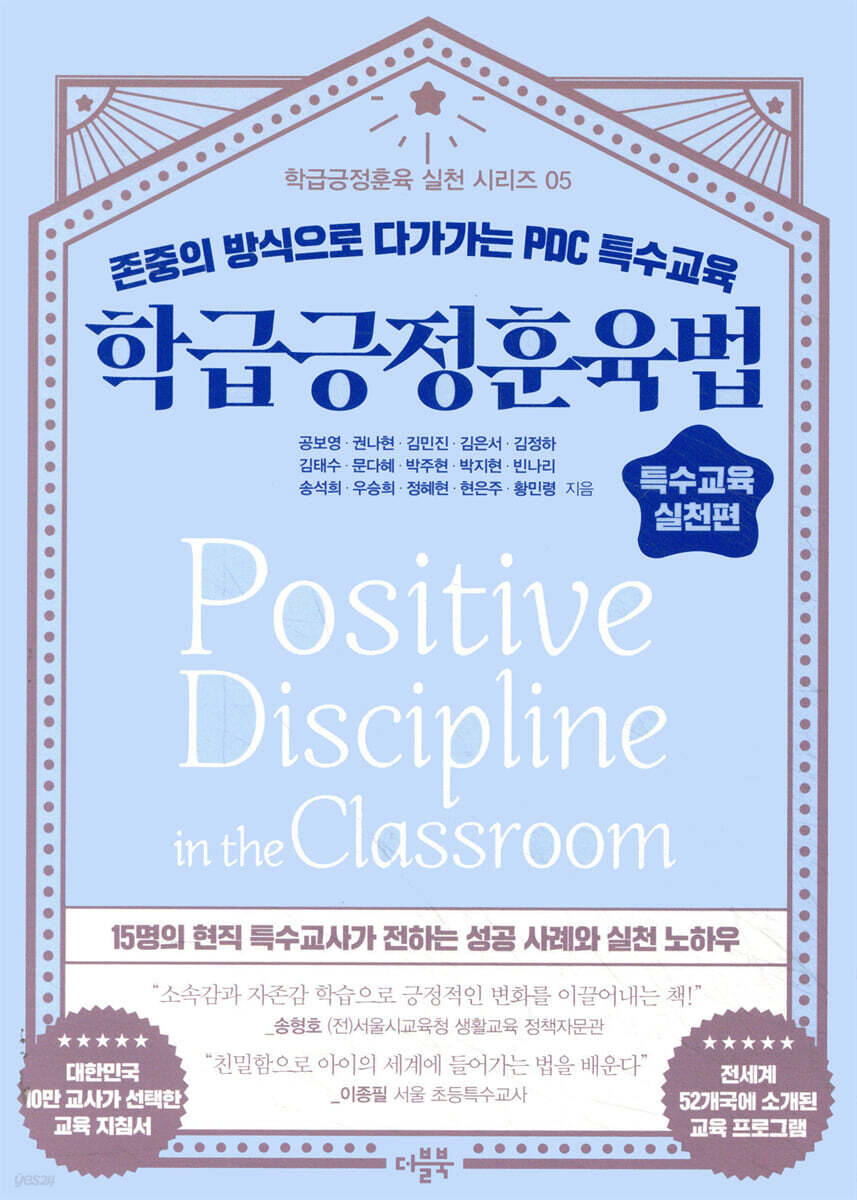
Classroom Positive Discipline: Special Education Practice
 |
Description
Book Introduction
Success stories and practical know-how from 15 current special education teachers.
Presenting the future of special education through positive classroom discipline.
A book filled with the heart of a special education teacher who grows with children while opening their hearts!
Every student has the right to an education without discrimination.
However, infrastructure and resources for special education remain inadequate, and while social awareness of disabilities is improving, prejudice and discrimination persist.
Even in this reality, there are many special education teachers who are dedicated to special education.
Written by 15 current special education teachers, "Classroom Positive Discipline: Special Education Practice" is filled with touching examples filled with special warmth and sincerity.
We hope that this educational program, which offers a glimpse into the future and vision of special education, will become widely known.
This book contains stories of students who puzzle their teachers.
Teachers are candidly revealing the feelings of bewilderment and confusion they experience when meeting children.
But these stories go beyond mere anecdotes; they are practical examples grounded in a solid theoretical framework of classroom positive discipline, demonstrating the process of building a sense of belonging and self-esteem.
Children grow up in their own unique environments and personalities, and through positive discipline, they learn to respect each other's differences and work together.
Teachers also learn from their students the "courage to be imperfect," encourage themselves, and show them how to get back up again.
With the promise that teachers who can encourage themselves can encourage students, we systematically present what kind and firm education is from the perspective of 'positive classroom discipline.'
I hope this book will become a seed of hope and pride for the many teachers struggling in special education today, and I hope it will also be widely used as an educational guide for parents of precious and special children.
Presenting the future of special education through positive classroom discipline.
A book filled with the heart of a special education teacher who grows with children while opening their hearts!
Every student has the right to an education without discrimination.
However, infrastructure and resources for special education remain inadequate, and while social awareness of disabilities is improving, prejudice and discrimination persist.
Even in this reality, there are many special education teachers who are dedicated to special education.
Written by 15 current special education teachers, "Classroom Positive Discipline: Special Education Practice" is filled with touching examples filled with special warmth and sincerity.
We hope that this educational program, which offers a glimpse into the future and vision of special education, will become widely known.
This book contains stories of students who puzzle their teachers.
Teachers are candidly revealing the feelings of bewilderment and confusion they experience when meeting children.
But these stories go beyond mere anecdotes; they are practical examples grounded in a solid theoretical framework of classroom positive discipline, demonstrating the process of building a sense of belonging and self-esteem.
Children grow up in their own unique environments and personalities, and through positive discipline, they learn to respect each other's differences and work together.
Teachers also learn from their students the "courage to be imperfect," encourage themselves, and show them how to get back up again.
With the promise that teachers who can encourage themselves can encourage students, we systematically present what kind and firm education is from the perspective of 'positive classroom discipline.'
I hope this book will become a seed of hope and pride for the many teachers struggling in special education today, and I hope it will also be widely used as an educational guide for parents of precious and special children.
- You can preview some of the book's contents.
Preview
index
Recommendation
Approach with respect
Kim Seong-hwan, Chairman of the Korea Positive Discipline Association
Entering the world of children by reading their minds
Jeong Yu-jin, Director of the People and Education Research Institute
Learn the core and methods of positive discipline.
Song Hyeong-ho, author, former Seoul Metropolitan Office of Education life education policy advisor
The best choice for forming intimate relationships
Lee Jong-pil, Seoul elementary school special education teacher
Opening remarks
Getting started
Guide to Getting Started with Positive Discipline in the Classroom (PDC)
Song Seok-hee, Busan elementary school special education teacher
In the name of discipline
Things to consider before training
Why did they act like that?
The beginning of positive discipline
Practicing positive discipline
Part 1: Behavior as Seen Through the PDC
1.
I want power and attention
Face the child
Entering the world of children
Connect to PDC
2.
Give me a choice
Face the child
Entering the world of children
Connect to PDC
3.
I want to do whatever I want
Face the child
Entering the world of children
Connect to PDC
Part 2: Classes at PDC
[Special Education Class for Toddlers]
1.
Me, you, and we set off in one boat!
wandering the streets
Connect to PDC
[Elementary Special Class]
2.
Creating a healthy us and our class through joint ground-building activities
wandering the streets
Finding your way through the PDC
Connect to PDC
3.
A classroom where people grow with a sense of belonging and self-esteem
wandering the streets
Finding your way through the PDC
Connect to PDC
4.
Recovering from mistakes together
wandering the streets
Finding your way through the PDC
Connect to PDC
5.
The "I'm Moving to Find My Own Light" Exploration Team
wandering the streets
Finding your way through the PDC
Connect to PDC
[Middle School Special Class]
6.
We grow from confidence to pride
wandering the streets
Finding your way through the PDC
Connect to PDC
7.
The courage to accept my imperfections
wandering the streets
Finding your way through the PDC
Connect to PDC
[Special School]
8.
Trust me and jump into the world!
wandering the streets
Finding your way through the PDC
Connect to PDC
Move forward
Part 3: Building Relationships and Cooperation with PDC
1.
Walking side by side with parents with empathy and encouragement
Thinking about relationships
Connect to PDC
2.
Creating a connection with integrated teachers
Thinking about relationships
Connect to PDC
3. We, who 'empathy + respect = coexistence'
Thinking about relationships
Connect to PDC
4.
We grow through encouragement
Thinking about relationships
Connect to PDC
Closing Remarks: Proposing a Path to Special Education Through Positive Discipline
main
References
About the author
Approach with respect
Kim Seong-hwan, Chairman of the Korea Positive Discipline Association
Entering the world of children by reading their minds
Jeong Yu-jin, Director of the People and Education Research Institute
Learn the core and methods of positive discipline.
Song Hyeong-ho, author, former Seoul Metropolitan Office of Education life education policy advisor
The best choice for forming intimate relationships
Lee Jong-pil, Seoul elementary school special education teacher
Opening remarks
Getting started
Guide to Getting Started with Positive Discipline in the Classroom (PDC)
Song Seok-hee, Busan elementary school special education teacher
In the name of discipline
Things to consider before training
Why did they act like that?
The beginning of positive discipline
Practicing positive discipline
Part 1: Behavior as Seen Through the PDC
1.
I want power and attention
Face the child
Entering the world of children
Connect to PDC
2.
Give me a choice
Face the child
Entering the world of children
Connect to PDC
3.
I want to do whatever I want
Face the child
Entering the world of children
Connect to PDC
Part 2: Classes at PDC
[Special Education Class for Toddlers]
1.
Me, you, and we set off in one boat!
wandering the streets
Connect to PDC
[Elementary Special Class]
2.
Creating a healthy us and our class through joint ground-building activities
wandering the streets
Finding your way through the PDC
Connect to PDC
3.
A classroom where people grow with a sense of belonging and self-esteem
wandering the streets
Finding your way through the PDC
Connect to PDC
4.
Recovering from mistakes together
wandering the streets
Finding your way through the PDC
Connect to PDC
5.
The "I'm Moving to Find My Own Light" Exploration Team
wandering the streets
Finding your way through the PDC
Connect to PDC
[Middle School Special Class]
6.
We grow from confidence to pride
wandering the streets
Finding your way through the PDC
Connect to PDC
7.
The courage to accept my imperfections
wandering the streets
Finding your way through the PDC
Connect to PDC
[Special School]
8.
Trust me and jump into the world!
wandering the streets
Finding your way through the PDC
Connect to PDC
Move forward
Part 3: Building Relationships and Cooperation with PDC
1.
Walking side by side with parents with empathy and encouragement
Thinking about relationships
Connect to PDC
2.
Creating a connection with integrated teachers
Thinking about relationships
Connect to PDC
3. We, who 'empathy + respect = coexistence'
Thinking about relationships
Connect to PDC
4.
We grow through encouragement
Thinking about relationships
Connect to PDC
Closing Remarks: Proposing a Path to Special Education Through Positive Discipline
main
References
About the author
Detailed image
.jpg)
Into the book
“All humans are born small and weak...
“The moment our students are labeled ‘special’...” When this phrase caught my eye, I thought of the ‘special’ children who had come to our classroom.
It was a special relationship that was not 'slow and more difficult', but rather one that required more effort, and so we grew together and were even more touched.
--- p.10
This book is a story about the classrooms of ordinary teachers.
Just because the word 'special' is attached to it, we see many things 'differently.'
So, special education teachers sometimes blame themselves, wondering if the child's disability and the resulting difficulties are due to their own shortcomings as teachers.
I've often felt tormented by thoughts like, "Wouldn't it have been better if it had been another teacher?" "Wouldn't the child have done better if it had been another teacher?" I've even felt like my child's difficulties were due to my own incompetence.
The philosophy of positive discipline, which creates schools and classrooms where everyone respects one another, is also connected to education for all.
So, the special education teachers in this book also began to practice 'positive discipline'.
--- p.15
Unfortunately, kind and firm discipline doesn't happen overnight.
If a teacher's attitude is usually biased towards either kindness or firmness, it is more natural for him to fail.
Here I'm going to show you the magic word that can be both kind and firm at the same time.
--- p.37
Being a teacher doesn't always mean you'll be successful.
You can't be good at something from the beginning.
Teachers are beings who grow and develop together with their students.
So, teachers, like students, are also in the process of learning.
This would be the same for parents as well as teachers.
However, many teachers are kind to their students but overly strict with themselves.
If you tell your students not to be discouraged by mistakes and to try again, you should tell yourself the same.
--- p.47
Among our emotions, when we get angry, when our anger explodes, many destructive actions come out.
In particular, Eunha would explode with anger if the numbers were even slightly off.
Until now, Eunha had been controlling her surroundings and getting what she wanted by venting her anger, so she was easily angered by even the smallest rejection or trivial things.
Together with the galaxy, we approached understanding emotions using the palmar brain theory.
The process of emotions occurring in the brain was easily explained by following the teacher and making hand shapes with visual aids.
By connecting the palm brain theory to the mirror theory, we were able to see that our emotions can be transmitted to others. We looked in an actual mirror and made facial expressions of happiness, sadness, fear, and anger, and practiced them with the teacher.
--- p.73
We are 'imperfect PDC teachers' who repeat trial and error and mistakes, but learn from them and constantly try to involve children in our problem-solving.
I experienced freedom and liberation by accepting my imperfect self.
So, I am willing to move forward today as well, to become a ‘PDC teacher’, which has led me to have the courage to be imperfect.
--- p.94
Coexistence means that two or more things or phenomena exist together, helping each other to exist together.
It contains the hope that all students exist together and help each other to live.
We also planned a class on “coexistence” by taking the first letters of the two characters, “empathy,” which means feeling or feeling the same way about the thoughts or feelings of others, and “respect,” which means that all people should be treated as valuable just by their existence.
“The moment our students are labeled ‘special’...” When this phrase caught my eye, I thought of the ‘special’ children who had come to our classroom.
It was a special relationship that was not 'slow and more difficult', but rather one that required more effort, and so we grew together and were even more touched.
--- p.10
This book is a story about the classrooms of ordinary teachers.
Just because the word 'special' is attached to it, we see many things 'differently.'
So, special education teachers sometimes blame themselves, wondering if the child's disability and the resulting difficulties are due to their own shortcomings as teachers.
I've often felt tormented by thoughts like, "Wouldn't it have been better if it had been another teacher?" "Wouldn't the child have done better if it had been another teacher?" I've even felt like my child's difficulties were due to my own incompetence.
The philosophy of positive discipline, which creates schools and classrooms where everyone respects one another, is also connected to education for all.
So, the special education teachers in this book also began to practice 'positive discipline'.
--- p.15
Unfortunately, kind and firm discipline doesn't happen overnight.
If a teacher's attitude is usually biased towards either kindness or firmness, it is more natural for him to fail.
Here I'm going to show you the magic word that can be both kind and firm at the same time.
--- p.37
Being a teacher doesn't always mean you'll be successful.
You can't be good at something from the beginning.
Teachers are beings who grow and develop together with their students.
So, teachers, like students, are also in the process of learning.
This would be the same for parents as well as teachers.
However, many teachers are kind to their students but overly strict with themselves.
If you tell your students not to be discouraged by mistakes and to try again, you should tell yourself the same.
--- p.47
Among our emotions, when we get angry, when our anger explodes, many destructive actions come out.
In particular, Eunha would explode with anger if the numbers were even slightly off.
Until now, Eunha had been controlling her surroundings and getting what she wanted by venting her anger, so she was easily angered by even the smallest rejection or trivial things.
Together with the galaxy, we approached understanding emotions using the palmar brain theory.
The process of emotions occurring in the brain was easily explained by following the teacher and making hand shapes with visual aids.
By connecting the palm brain theory to the mirror theory, we were able to see that our emotions can be transmitted to others. We looked in an actual mirror and made facial expressions of happiness, sadness, fear, and anger, and practiced them with the teacher.
--- p.73
We are 'imperfect PDC teachers' who repeat trial and error and mistakes, but learn from them and constantly try to involve children in our problem-solving.
I experienced freedom and liberation by accepting my imperfect self.
So, I am willing to move forward today as well, to become a ‘PDC teacher’, which has led me to have the courage to be imperfect.
--- p.94
Coexistence means that two or more things or phenomena exist together, helping each other to exist together.
It contains the hope that all students exist together and help each other to live.
We also planned a class on “coexistence” by taking the first letters of the two characters, “empathy,” which means feeling or feeling the same way about the thoughts or feelings of others, and “respect,” which means that all people should be treated as valuable just by their existence.
--- p.246
Publisher's Review
Classroom Positive Discipline: A Guide to Special Education
Special education teachers have been guiding children with special needs to learn self-understanding, respect for others, and skills to live in the community so that they can grow into healthy adults at school.
This is an important element that children in our society must learn during their school years.
Unfortunately, however, there were few textbooks or guides on this topic, and there was even a lack of practical introductory books that could be used to learn before becoming a teacher.
In these challenging environments, teachers have been learning, practicing, and generating new ideas through collaboration with their colleagues.
Fortunately, "Positive Discipline in the Classroom" is a theoretical and reference book suitable for teachers to learn and practice, systematically organizing everything from concepts to activities.
Special education teachers continue to practice this through local study groups and professional learning communities.
This book is the result of the combined efforts of 15 special education experts from across the country, and is a beautiful culmination of their hard work and passion.
A book that brings about positive change through learning self-esteem and a sense of belonging.
Positive discipline has its roots in Adler's theory, one of the many theories that examine human behavior and psychology.
Adler believed that people act based on basic motivations such as self-esteem and a sense of belonging.
Students also say they act to feel socially useful: "I am competent," "I have good relationships with others," and "I am helping others."
Whether this behavior is useful for gaining self-esteem and a sense of belonging depends on how you interpret the other person's reaction after performing the behavior.
The results of this interpretation create beliefs.
The process of developing one's own beliefs based on the motivation to feel self-esteem and a sense of belonging and observing others' reactions to one's actions is something that everyone goes through, regardless of age or disability.
This process also has a particularly strong impact on social behavior, which is closely related to self-esteem and a sense of belonging.
This book systematically introduces the core and methods of positive discipline based on Adler's theory in an easy-to-understand manner.
A time to learn the courage to be imperfect and the courage to live.
Adler and Drakes said that the most important courage for humans is the 'courage to be imperfect.'
Their emphasis on the courage to be imperfect stems from their firm belief in human nature.
The courage to accept ourselves as we are, as imperfect beings, is the courage to be imperfect, and it is often said that 'true healing is being ourselves as we are.'
Our students often feel discouraged by frequent failures and mistakes, and they often feel that the label "special" symbolizes this.
Because physical discomfort is more visible to others, many students are preoccupied with negative feelings about themselves.
At this time, a single word from the teacher is important.
What if you were grateful for what you're good at, rather than what you can't change? "I'm good enough just the way I am." It takes time to learn how to look at yourself courageously and speak courageously.
The same goes for teachers.
When students make mistakes, we say that mistakes are learning opportunities, but when teachers make their own mistakes, they easily become frustrated and disappointed.
We may not always be perfect, but we are making progress every moment.
Every moment spent with students practicing positive discipline is also a moment for teachers to grow.
Through this book, I hope that students and teachers alike will learn to love themselves and gain the courage to live in harmony with others.
Special education teachers have been guiding children with special needs to learn self-understanding, respect for others, and skills to live in the community so that they can grow into healthy adults at school.
This is an important element that children in our society must learn during their school years.
Unfortunately, however, there were few textbooks or guides on this topic, and there was even a lack of practical introductory books that could be used to learn before becoming a teacher.
In these challenging environments, teachers have been learning, practicing, and generating new ideas through collaboration with their colleagues.
Fortunately, "Positive Discipline in the Classroom" is a theoretical and reference book suitable for teachers to learn and practice, systematically organizing everything from concepts to activities.
Special education teachers continue to practice this through local study groups and professional learning communities.
This book is the result of the combined efforts of 15 special education experts from across the country, and is a beautiful culmination of their hard work and passion.
A book that brings about positive change through learning self-esteem and a sense of belonging.
Positive discipline has its roots in Adler's theory, one of the many theories that examine human behavior and psychology.
Adler believed that people act based on basic motivations such as self-esteem and a sense of belonging.
Students also say they act to feel socially useful: "I am competent," "I have good relationships with others," and "I am helping others."
Whether this behavior is useful for gaining self-esteem and a sense of belonging depends on how you interpret the other person's reaction after performing the behavior.
The results of this interpretation create beliefs.
The process of developing one's own beliefs based on the motivation to feel self-esteem and a sense of belonging and observing others' reactions to one's actions is something that everyone goes through, regardless of age or disability.
This process also has a particularly strong impact on social behavior, which is closely related to self-esteem and a sense of belonging.
This book systematically introduces the core and methods of positive discipline based on Adler's theory in an easy-to-understand manner.
A time to learn the courage to be imperfect and the courage to live.
Adler and Drakes said that the most important courage for humans is the 'courage to be imperfect.'
Their emphasis on the courage to be imperfect stems from their firm belief in human nature.
The courage to accept ourselves as we are, as imperfect beings, is the courage to be imperfect, and it is often said that 'true healing is being ourselves as we are.'
Our students often feel discouraged by frequent failures and mistakes, and they often feel that the label "special" symbolizes this.
Because physical discomfort is more visible to others, many students are preoccupied with negative feelings about themselves.
At this time, a single word from the teacher is important.
What if you were grateful for what you're good at, rather than what you can't change? "I'm good enough just the way I am." It takes time to learn how to look at yourself courageously and speak courageously.
The same goes for teachers.
When students make mistakes, we say that mistakes are learning opportunities, but when teachers make their own mistakes, they easily become frustrated and disappointed.
We may not always be perfect, but we are making progress every moment.
Every moment spent with students practicing positive discipline is also a moment for teachers to grow.
Through this book, I hope that students and teachers alike will learn to love themselves and gain the courage to live in harmony with others.
GOODS SPECIFICS
- Date of issue: February 21, 2025
- Page count, weight, size: 294 pages | 148*210*20mm
- ISBN13: 9791193153581
- ISBN10: 1193153581
You may also like
카테고리
korean


korean

![GQ KOREA Mark (Monthly): December [2025]](http://librairie.coreenne.fr/cdn/shop/files/8ef265dbbfbf186523ed75ba7319009d.jpg?v=1765340328&width=3840)


