

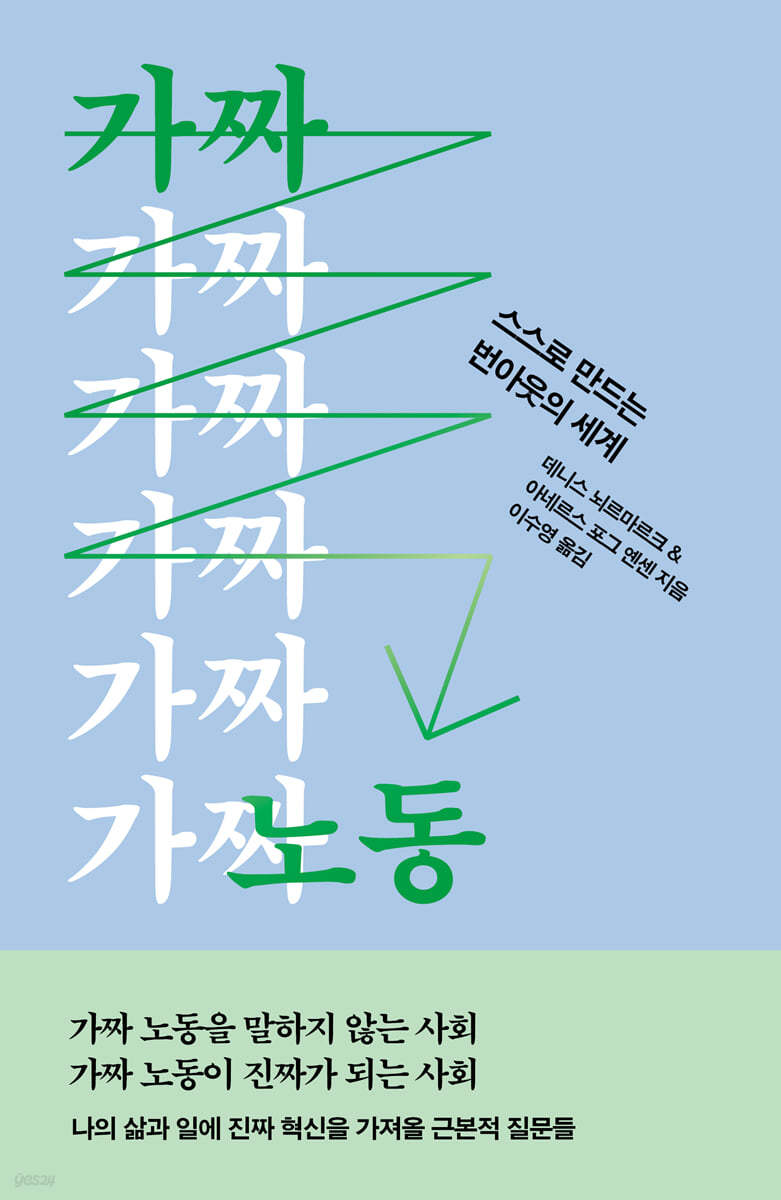
fake labor
 |
Description
Book Introduction
The Real Reason We Do More
tvN [Knowing Bros] Professor Kim Sang-wook strongly recommends!
Highly recommended Danish daily newspapers, including Politiken and Daily Börsen!
“Why do we work 8 hours when we created a society where we only have to work 4 hours?”
The era of 'fake labor' where people don't work
The Real Reason We Do More
"Fake Labor: The World of Burnout You Create Yourself" is a story about "fake labor," the work that has been taboo in our society, where people just waste time doing nothing but being busy and meaningless.
The two authors of this book delve deeply into what fake labor is and how it has led to our overwork.
In addition to practical statistical data, you can uncover the distorted reality of labor through conversations with labor experts and candid interviews with people who have recognized fake labor in various organizations.
In this book, anthropologist Dennis Nørmark and philosopher Anders Fogg Jensen, who have written some of the most cited works in Danish anthropology, present a new philosophical perspective on labor based on their extensive knowledge of labor, culture, politics, history, and society.
It is largely divided into three parts: ‘Lost Time,’ ‘Lost Meaning,’ and ‘Recovering Time and Meaning,’ and highlights various labor issues that any working person is likely to encounter at least once.
Moreover, it goes beyond simply highlighting the problem, and presents courageous alternatives that can help people break free from fake labor, find real work, and rediscover the essence of labor and the meaning of life.
Through this book, we will have the opportunity to dispel the distorted perceptions and doubts we have had about labor.
Highly recommended Danish daily newspapers, including Politiken and Daily Börsen!
“Why do we work 8 hours when we created a society where we only have to work 4 hours?”
The era of 'fake labor' where people don't work
The Real Reason We Do More
"Fake Labor: The World of Burnout You Create Yourself" is a story about "fake labor," the work that has been taboo in our society, where people just waste time doing nothing but being busy and meaningless.
The two authors of this book delve deeply into what fake labor is and how it has led to our overwork.
In addition to practical statistical data, you can uncover the distorted reality of labor through conversations with labor experts and candid interviews with people who have recognized fake labor in various organizations.
In this book, anthropologist Dennis Nørmark and philosopher Anders Fogg Jensen, who have written some of the most cited works in Danish anthropology, present a new philosophical perspective on labor based on their extensive knowledge of labor, culture, politics, history, and society.
It is largely divided into three parts: ‘Lost Time,’ ‘Lost Meaning,’ and ‘Recovering Time and Meaning,’ and highlights various labor issues that any working person is likely to encounter at least once.
Moreover, it goes beyond simply highlighting the problem, and presents courageous alternatives that can help people break free from fake labor, find real work, and rediscover the essence of labor and the meaning of life.
Through this book, we will have the opportunity to dispel the distorted perceptions and doubts we have had about labor.
- You can preview some of the book's contents.
Preview
index
introduction
prolog
Part 1.
Lost time
Chapter 1.
Excessive workload
A future that has not yet arrived │ A society that worries about having too much free time │ A present that is very different from expectations │ Shortened working hours and progress toward a better life │ The Stone Age that still remains │ Belief in labor │ The birth of fake office workers │ Excuses for labor efficiency, the increase in management positions │ Overeducation and surplus knowledge workers │ Harsh labor traded for innovation │ Progress that goes against expectations, the era of the Great Recession │ What on earth do we do all day long?
Chapter 2.
The emptying of labor
Leaving work without anyone noticing │ The reason why job satisfaction is decreasing │ We work less than we think │ People who spend their days doing things unrelated to work │ The social taboo of saying you are not busy │ The suffering of employees with nothing to do │ If you are bored with everything, you may also have bore-out syndrome │ When my work feels meaningless │ Is the labor market really rational?
Chapter 3.
The nature and change of labor
Four types of empty labor: idling, increasing hours, increasing work, and fabricating work │ Things worse than empty labor │ Definitions of fake labor │ Visible labor, invisible labor │ Different perspectives on rationality and reason │ The reality of technology that does not work as intended │ The paradox of acceleration │ The false formation of labor │ Things we do without realizing it │ People who recognize their fake labor
Part 2.
Lost meaning
Chapter 4.
People who don't give up fake labor
Two months for fake labor │ The art of fake projects │ The temptation of executives with less work and more responsibility │ Work that increases just to fit the given time │ Management positions keep increasing, but when it comes to cutting, production workers come first │ Bosses' competition to show off │ The price of pretending to be busy │ Decorating your desk to look busy │ Will a company go bankrupt without a logo │ Fake labor in school │ Reducing hours to reduce work │ A society where work, not leisure, is a privilege │ If you have nothing to do, go home
Chapter 5.
Problems brought about by solutions
Solutions for the system, not the user │ Core tasks and fake labor │ 142 fake questions and made-up answers │ A world that does its best to find solutions │ The public sector imitating the private sector │ Facts hidden in corporate myths │ Hack work instead of finding solutions │ Beware of managers with too much time on their hands │ Stop endless improvement and focus on the core business │ The reality of creative organizations │ The art of being satisfied with less
Chapter 6.
Let's stop imitating others
Solutions to non-existent problems │ Documenting everything │ Mimicking superiors │ Putting great ideas before core tasks │ The cult of novelty that breeds fake labor │ The occupations that cause the worst waste of time │ The corporate instinct to imitate │ Avoiding responsibility using regulations │ Annual reports that no one reads │ Before blindly resisting fake labor
Chapter 7.
Let's return to Earth from space
Leadership porn and the alien language of jargon │ Accumulation of problems, cynicism and ignorance, and low self-esteem │ A weak internal structure that is incapable of criticism │ Differentiation and explosion of publicity, and management for publicity │ Excessive competition and over-education │ Clues of fake labor hidden in multiple layers │ Examples of ostentatious projects │ The aesthetic pleasure of false activity
Chapter 8.
A society dominated by positivity
Positivity is much more powerful than negativity │ Positivity creates more work │ The first karmic retribution of positivity │ The absurd and superficial fat of positivity │ Positivity must include everyone │ Fake participation with a set answer │ Buried in reference emails │ To escape the dominance of positivity
Chapter 9.
Reducing meaningless working hours
There was no agenda in that meeting │ Real rest, not fake rest │ The chronic disease called meetings │ The sole purpose of meetings │ Companies that only work until Thursday │ If you reduce your hours, you get more work │ The relationship between the length of the workday and productivity │ Uninterrupted Pomodoro time │ People stuck in the swamp of email │ Breaking free from the shackles of email │ If you reduce your hours, the quality of work increases
Chapter 10.
Let go of the idea of working hours
Fair compensation for real labor │ The strange greed of corporations │ The birth of hourly labor │ Boredom during work hours: From pain to shame │ Zombies appearing in the offices of large corporations │ Coordinating other activities │ If you are also doing fake labor
Chapter 11.
Trust people
Fake reports that no one reads │ Setting of forced goals and false procedures │ Excessive inspections and regulations to avoid responsibility │ Nonsense done out of habit │ Idle circles that never stop despite meaninglessness │ Side tasks of work evaluation: agreement │ Reporting is the top priority │ Tools and techniques designed for fake labor │ The price of emphasizing distrust and control
Part 3.
Reclaiming time and meaning
Chapter 12.
Labor and the Nature of Man
Why do we work? │ Ancient Greek and Christian perspectives │ Organic interaction with the world │ Belonging or alienated │ The real harm caused by fake work │ The hall of mirrors that distorts the truth │ Why fake work is taboo │ The problem is not the individual │ Motives for work │ Fake work that covers up anxiety
Chapter 13.
Our Strategy for Change
Leave work without worrying about what others think │ Now, let's do something truly meaningful │ The shorter the meeting, the better │ Accept imperfection │ You must first give faith to build trust │ Clearly distinguish fake labor │ Be wary of imitating others │ Do not measure by time │ Other ways of self-development │ Let's devote ourselves to real work │ The duty not to obey │ Do not dilute moral responsibility │ You too may be caught up in fake labor │ Me Too: Adding a hashtag to fake labor
Chapter 14.
Meaningful Advice for Managers
The courage to confront fake labor │ Why did management continue to do fake labor? │ Accept roles and authority │ Make decisions directly │ Balance between relationship-oriented leaders and experts │ The fewer managers, the better │ The need to reward critical questions │ Evaluate results more important than process or time │ Sometimes, it is necessary to trust and delegate │ Let them play if they want │ Get away from meaningless work │ Focus on realistic work
Chapter 15.
A society without fake labor
Why rationalization and efficiency improvement have failed │ It's time to liberate our time from fake labor │ Reasons to take a break from work │ Education to become a fake worker │ There are many jobs in the world │ Universal basic income │ Taking more risks │ Reclaiming meaning in work and life
References
prolog
Part 1.
Lost time
Chapter 1.
Excessive workload
A future that has not yet arrived │ A society that worries about having too much free time │ A present that is very different from expectations │ Shortened working hours and progress toward a better life │ The Stone Age that still remains │ Belief in labor │ The birth of fake office workers │ Excuses for labor efficiency, the increase in management positions │ Overeducation and surplus knowledge workers │ Harsh labor traded for innovation │ Progress that goes against expectations, the era of the Great Recession │ What on earth do we do all day long?
Chapter 2.
The emptying of labor
Leaving work without anyone noticing │ The reason why job satisfaction is decreasing │ We work less than we think │ People who spend their days doing things unrelated to work │ The social taboo of saying you are not busy │ The suffering of employees with nothing to do │ If you are bored with everything, you may also have bore-out syndrome │ When my work feels meaningless │ Is the labor market really rational?
Chapter 3.
The nature and change of labor
Four types of empty labor: idling, increasing hours, increasing work, and fabricating work │ Things worse than empty labor │ Definitions of fake labor │ Visible labor, invisible labor │ Different perspectives on rationality and reason │ The reality of technology that does not work as intended │ The paradox of acceleration │ The false formation of labor │ Things we do without realizing it │ People who recognize their fake labor
Part 2.
Lost meaning
Chapter 4.
People who don't give up fake labor
Two months for fake labor │ The art of fake projects │ The temptation of executives with less work and more responsibility │ Work that increases just to fit the given time │ Management positions keep increasing, but when it comes to cutting, production workers come first │ Bosses' competition to show off │ The price of pretending to be busy │ Decorating your desk to look busy │ Will a company go bankrupt without a logo │ Fake labor in school │ Reducing hours to reduce work │ A society where work, not leisure, is a privilege │ If you have nothing to do, go home
Chapter 5.
Problems brought about by solutions
Solutions for the system, not the user │ Core tasks and fake labor │ 142 fake questions and made-up answers │ A world that does its best to find solutions │ The public sector imitating the private sector │ Facts hidden in corporate myths │ Hack work instead of finding solutions │ Beware of managers with too much time on their hands │ Stop endless improvement and focus on the core business │ The reality of creative organizations │ The art of being satisfied with less
Chapter 6.
Let's stop imitating others
Solutions to non-existent problems │ Documenting everything │ Mimicking superiors │ Putting great ideas before core tasks │ The cult of novelty that breeds fake labor │ The occupations that cause the worst waste of time │ The corporate instinct to imitate │ Avoiding responsibility using regulations │ Annual reports that no one reads │ Before blindly resisting fake labor
Chapter 7.
Let's return to Earth from space
Leadership porn and the alien language of jargon │ Accumulation of problems, cynicism and ignorance, and low self-esteem │ A weak internal structure that is incapable of criticism │ Differentiation and explosion of publicity, and management for publicity │ Excessive competition and over-education │ Clues of fake labor hidden in multiple layers │ Examples of ostentatious projects │ The aesthetic pleasure of false activity
Chapter 8.
A society dominated by positivity
Positivity is much more powerful than negativity │ Positivity creates more work │ The first karmic retribution of positivity │ The absurd and superficial fat of positivity │ Positivity must include everyone │ Fake participation with a set answer │ Buried in reference emails │ To escape the dominance of positivity
Chapter 9.
Reducing meaningless working hours
There was no agenda in that meeting │ Real rest, not fake rest │ The chronic disease called meetings │ The sole purpose of meetings │ Companies that only work until Thursday │ If you reduce your hours, you get more work │ The relationship between the length of the workday and productivity │ Uninterrupted Pomodoro time │ People stuck in the swamp of email │ Breaking free from the shackles of email │ If you reduce your hours, the quality of work increases
Chapter 10.
Let go of the idea of working hours
Fair compensation for real labor │ The strange greed of corporations │ The birth of hourly labor │ Boredom during work hours: From pain to shame │ Zombies appearing in the offices of large corporations │ Coordinating other activities │ If you are also doing fake labor
Chapter 11.
Trust people
Fake reports that no one reads │ Setting of forced goals and false procedures │ Excessive inspections and regulations to avoid responsibility │ Nonsense done out of habit │ Idle circles that never stop despite meaninglessness │ Side tasks of work evaluation: agreement │ Reporting is the top priority │ Tools and techniques designed for fake labor │ The price of emphasizing distrust and control
Part 3.
Reclaiming time and meaning
Chapter 12.
Labor and the Nature of Man
Why do we work? │ Ancient Greek and Christian perspectives │ Organic interaction with the world │ Belonging or alienated │ The real harm caused by fake work │ The hall of mirrors that distorts the truth │ Why fake work is taboo │ The problem is not the individual │ Motives for work │ Fake work that covers up anxiety
Chapter 13.
Our Strategy for Change
Leave work without worrying about what others think │ Now, let's do something truly meaningful │ The shorter the meeting, the better │ Accept imperfection │ You must first give faith to build trust │ Clearly distinguish fake labor │ Be wary of imitating others │ Do not measure by time │ Other ways of self-development │ Let's devote ourselves to real work │ The duty not to obey │ Do not dilute moral responsibility │ You too may be caught up in fake labor │ Me Too: Adding a hashtag to fake labor
Chapter 14.
Meaningful Advice for Managers
The courage to confront fake labor │ Why did management continue to do fake labor? │ Accept roles and authority │ Make decisions directly │ Balance between relationship-oriented leaders and experts │ The fewer managers, the better │ The need to reward critical questions │ Evaluate results more important than process or time │ Sometimes, it is necessary to trust and delegate │ Let them play if they want │ Get away from meaningless work │ Focus on realistic work
Chapter 15.
A society without fake labor
Why rationalization and efficiency improvement have failed │ It's time to liberate our time from fake labor │ Reasons to take a break from work │ Education to become a fake worker │ There are many jobs in the world │ Universal basic income │ Taking more risks │ Reclaiming meaning in work and life
References
Detailed image

Into the book
This book gave them a different perspective.
In other words, the real problem lies within organizations, management, leadership, and society.
Many people also suggested the term 'fake labor' to describe the vague feelings they had been harboring for a long time.
Readers now have a concept for a situation that is not only a massive waste of time and energy for society as a whole, but also a catastrophic and existential waste for individual lives.
So to speak, like the naked king and his ministers, they realized that they had been deceived all along and learned how to effectively deal with this pathetic procession.
---From the "Preface"
The COVID-19 crisis has been a strange kind of trigger.
It has become a catalyst for us to reevaluate what we do all day long during a time we considered 'normal.'
But reflection on such fundamental questions as what we do should not be a flash in the pan when a pandemic rages.
We need to engage in meaningful reflection like this periodically.
A life without reflection is blind and foolish.
Not only is it a waste of time and resources at work, it's also a waste of our precious lives.
I hope this book will be of some help in leading that process of reflection.
---From the "Preface"
We needed an alternative to the concept of "empty labor," which encompassed work that was not at all difficult but extremely stressful, work that could not be explained to anyone, and work that no one could understand even if explained to them.
So we came up with a suitable term: 'pseudowork'.
Fake labor encompasses a wider range of situations.
This includes tasks that are ordered, tasks that are paid, tasks required by the organization, and tasks that look like labor but are not labor.
Fake work keeps us busy without us feeling like we're doing any real work.
Or, if there is any work among the things we know that we suspect is meaningless, that is fake labor.
---From "Chapter 3: The Nature and Change of Labor"
For example, if you assign a large project that everyone knows is a waste of time to a relatively young employee just to give them something to do, that's fake labor.
Meetings where you hear about things you already know are also fake labor.
A presentation that is forgotten as soon as the projector is turned off, or supervision or management that fails to prevent things from going wrong, are also fake labor.
Also, doing things like redoing all your paperwork to cover up the fact that you have nothing to do or to maintain your self-esteem by maintaining the feeling that you are a working person is also fake work.
---From "Chapter 3: The Nature and Change of Labor"
Some people have come to see through the false formation and its alienating nature, and they recognize that what they were doing or are doing is fake work.
We decided to find these people and ask them what they actually do in the workplace.
Such people were surprisingly easy to find.
When they contacted us after seeing our ads on social media or just happened to run into us, they were delighted and rushed to us.
He was openly frustrated, knowing full well that much of his work was a waste of time, a pointless spin on the plate.
---From "Chapter 3: The Nature and Change of Labor"
If any of you reading this book are hearing about Parkinson's Law for the first time, you've been missing out on one of the most fascinating and important theories about how organizations operate.
Parkinson's law was discovered and developed by British maritime historian Cyril Northcote Parkinson.
He summarized his thoughts in an article published in The Economist in 1955.
The series of ideas and hypotheses presented in that paper included concepts that would live on for generations and bear his name.
"Work expands to fill the time allowed for its completion." What does this mean? Parkinson was referring to the infinitely expanding capacity of bureaucracy.
---From "Chapter 4: People Who Don't Give Up Fake Labor"
If people are given 10 hours to do something, they will use those 10 hours.
But if you were given 25 hours to do the same thing, surprisingly, it would end up taking 25 hours.
It's not that people are lazy, deceitful, or intentionally trying to deceive, it's simply that "the tasks we have to accomplish grow in importance and complexity in proportion to the time we have to devote to them."
No one wants to be left behind.
Therefore, working hours must be used for something.
So people work as slowly as possible, triple-check, and distract themselves every now and then.
---From "Chapter 4: People Who Don't Give Up Fake Labor"
In many ways, Toke's way of working is a reverse version of Parkinson's Law.
“Traditionally, lectures are held for four hours, and no one raises questions.” But after three hours, students lose focus, making the last hour pointless.
So he rebelled against the norm and shortened his classes to three hours.
But other instructors fight the opposite battle.
It's about allocating more time to your subject.
“That’s because it matches the number of PowerPoint slides they’ve designed, and it’s difficult to reduce that,” Toke thought.
---From "Chapter 4: People Who Don't Give Up Fake Labor"
“We were submitting way too much, way too much.
Since the management actually only needed the core information, we were able to reduce it to about 10 pages.
The management team was also well aware of this fact.
In fact, one of their regular duties was to edit the bulky reports our team submitted to the board and create a 10-page summary or so.” In other words, the board never saw the 60 pages of Kirsten’s annual report.
“Nobody told me that one-seventh was enough.
They always complimented our work and said it looked really cool.”
---From "Chapter 6: Stop Imitating Others"
According to Cal Newport, companies have been defending ideas like "connection," "synergy," and "co-creation" for decades, creating a culture that subtly instills in us the idea that we always have the right to disrupt other people's work.
This is a tempting rationalization.
We subordinate ourselves to that directive and use various technologies: email, chat, cell phones, frequent meetings, and open-plan offices.
In such offices, we can hear our colleagues chattering, coughing, and answering their phones, and we can be interrupted at any time by questions or casual remarks.
---From "Chapter 9: Reducing Meaningless Working Hours"
When you go to work and don't do anything, time feels seriously long.
Eventually, boredom transforms from existential suffering to shame.
Because it doesn't do anything useful and doesn't interact with the world through work.
Being worthless and yet being paid for it leads to self-loathing, shame, and a feeling of owing something to those around you.
People around me also find it easier to understand that I have too much work than too little.
Those who have experienced unemployment will probably have felt it.
Inaction brings isolation.
For many people with illnesses, sick leave may be an appropriate course of action, but not in this case.
It's like prescribing lethargy to lethargy.
---From "Chapter 10: Letting Go of the Idea of Working Hours"
After all, you only live once.
Time is limited, and that's why we've decided to pay each other for our time.
Because we know the value of time, we have agreed to compensate those who sacrifice something for others by paying them an hourly wage.
Also, because there was no way to measure the quality of labor by other criteria, they had no choice but to pay hourly wages.
As we will see in the next chapter, organizations sometimes desperately try to find other criteria by which to measure labor.
And misfortune
This also forces them into more fake labor.
---From "Chapter 10: Letting Go of the Idea of Working Hours"
According to Hegel and Marx at least, humans can find a sense of belonging in the world only through labor.
But this also means that work can make people feel alienated from the world.
The creation and collapse of humanity both depend on labor.
Therefore, the question of why we work so much is much more fundamental.
Although the question of how time is spent and whether it is appropriately compensated is also somewhat important.
In this sense, the problem of fake labor is related to the nature of human beings.
---From "Chapter 12 Labor and the Nature of Man"
One of the reasons it's so difficult to recognize fake work is because so many people work within the mirrored hall of "alienated normality."
Fake labor is constantly reflected back upon itself, creating more fake labor, fake projects, and fake positions.
In this way, marginalization gradually becomes the norm.
If that's really the case, it would be hard to believe any answer to the following question:
'Is what you're doing important to your customers, citizens, your company, your country, the world?' Perhaps you're so used to writing reports that no one reads that you'll say yes.
---From "Chapter 12 Labor and the Nature of Man"
When you leave work and go home, interact organically with the world.
Prepare and experience that interaction in a way that is meaningful to you.
Instead of quitting fake work, let's start looking for other jobs.
That's just as bad as fake labor.
If it's soccer coaching, volunteer work, or lumberjacking, it doesn't matter.
All you have to do is externalize your inner self and interact with the world.
Let's fix things rather than change them.
It's also a great way to get to know things better.
I get to know myself better in the world I helped create.
Unlike fake labor, real labor resonates.
---From "Chapter 13: Our Strategy for Change"
Humanity must develop and invent more.
To do this, we must stop wasting time on fake labor, follow Russell's advice and allow time for play and leisure, and promote deep thinking rather than superficial thinking.
With exploding population growth and impending climate catastrophe, humanity faces enormous challenges that require careful reflection rather than simply producing more annual reports.
In other words, we need to free up time from fake labor and devote it to self-development.
We need to give ourselves the space and freedom to think, play, and experiment.
---From "Chapter 15: A Society Without Fake Labor"
Our proposal is quite simple.
The idea is to change the prerequisites for taking a break from work.
In other words, the idea is to replace some of the non-stop work with vacation time.
It will take some time to learn how to live that way, to find time to relax and rediscover activities you enjoy engaging in whenever you feel like it.
Many people would be at a loss as to what to do when suddenly freed from their hectic work schedule.
Employees should be able to take leave for reasons other than childcare or sick leave.
We are civilized people, not savages, we are cultured people and we need vacations to develop ourselves.
The Pythagorean theorem was not discovered in an open-plan office.
We do not want these vacations to be used for education and training.
Because education and training are also part of the problem.
Let's use it for 'self-development'.
In other words, the real problem lies within organizations, management, leadership, and society.
Many people also suggested the term 'fake labor' to describe the vague feelings they had been harboring for a long time.
Readers now have a concept for a situation that is not only a massive waste of time and energy for society as a whole, but also a catastrophic and existential waste for individual lives.
So to speak, like the naked king and his ministers, they realized that they had been deceived all along and learned how to effectively deal with this pathetic procession.
---From the "Preface"
The COVID-19 crisis has been a strange kind of trigger.
It has become a catalyst for us to reevaluate what we do all day long during a time we considered 'normal.'
But reflection on such fundamental questions as what we do should not be a flash in the pan when a pandemic rages.
We need to engage in meaningful reflection like this periodically.
A life without reflection is blind and foolish.
Not only is it a waste of time and resources at work, it's also a waste of our precious lives.
I hope this book will be of some help in leading that process of reflection.
---From the "Preface"
We needed an alternative to the concept of "empty labor," which encompassed work that was not at all difficult but extremely stressful, work that could not be explained to anyone, and work that no one could understand even if explained to them.
So we came up with a suitable term: 'pseudowork'.
Fake labor encompasses a wider range of situations.
This includes tasks that are ordered, tasks that are paid, tasks required by the organization, and tasks that look like labor but are not labor.
Fake work keeps us busy without us feeling like we're doing any real work.
Or, if there is any work among the things we know that we suspect is meaningless, that is fake labor.
---From "Chapter 3: The Nature and Change of Labor"
For example, if you assign a large project that everyone knows is a waste of time to a relatively young employee just to give them something to do, that's fake labor.
Meetings where you hear about things you already know are also fake labor.
A presentation that is forgotten as soon as the projector is turned off, or supervision or management that fails to prevent things from going wrong, are also fake labor.
Also, doing things like redoing all your paperwork to cover up the fact that you have nothing to do or to maintain your self-esteem by maintaining the feeling that you are a working person is also fake work.
---From "Chapter 3: The Nature and Change of Labor"
Some people have come to see through the false formation and its alienating nature, and they recognize that what they were doing or are doing is fake work.
We decided to find these people and ask them what they actually do in the workplace.
Such people were surprisingly easy to find.
When they contacted us after seeing our ads on social media or just happened to run into us, they were delighted and rushed to us.
He was openly frustrated, knowing full well that much of his work was a waste of time, a pointless spin on the plate.
---From "Chapter 3: The Nature and Change of Labor"
If any of you reading this book are hearing about Parkinson's Law for the first time, you've been missing out on one of the most fascinating and important theories about how organizations operate.
Parkinson's law was discovered and developed by British maritime historian Cyril Northcote Parkinson.
He summarized his thoughts in an article published in The Economist in 1955.
The series of ideas and hypotheses presented in that paper included concepts that would live on for generations and bear his name.
"Work expands to fill the time allowed for its completion." What does this mean? Parkinson was referring to the infinitely expanding capacity of bureaucracy.
---From "Chapter 4: People Who Don't Give Up Fake Labor"
If people are given 10 hours to do something, they will use those 10 hours.
But if you were given 25 hours to do the same thing, surprisingly, it would end up taking 25 hours.
It's not that people are lazy, deceitful, or intentionally trying to deceive, it's simply that "the tasks we have to accomplish grow in importance and complexity in proportion to the time we have to devote to them."
No one wants to be left behind.
Therefore, working hours must be used for something.
So people work as slowly as possible, triple-check, and distract themselves every now and then.
---From "Chapter 4: People Who Don't Give Up Fake Labor"
In many ways, Toke's way of working is a reverse version of Parkinson's Law.
“Traditionally, lectures are held for four hours, and no one raises questions.” But after three hours, students lose focus, making the last hour pointless.
So he rebelled against the norm and shortened his classes to three hours.
But other instructors fight the opposite battle.
It's about allocating more time to your subject.
“That’s because it matches the number of PowerPoint slides they’ve designed, and it’s difficult to reduce that,” Toke thought.
---From "Chapter 4: People Who Don't Give Up Fake Labor"
“We were submitting way too much, way too much.
Since the management actually only needed the core information, we were able to reduce it to about 10 pages.
The management team was also well aware of this fact.
In fact, one of their regular duties was to edit the bulky reports our team submitted to the board and create a 10-page summary or so.” In other words, the board never saw the 60 pages of Kirsten’s annual report.
“Nobody told me that one-seventh was enough.
They always complimented our work and said it looked really cool.”
---From "Chapter 6: Stop Imitating Others"
According to Cal Newport, companies have been defending ideas like "connection," "synergy," and "co-creation" for decades, creating a culture that subtly instills in us the idea that we always have the right to disrupt other people's work.
This is a tempting rationalization.
We subordinate ourselves to that directive and use various technologies: email, chat, cell phones, frequent meetings, and open-plan offices.
In such offices, we can hear our colleagues chattering, coughing, and answering their phones, and we can be interrupted at any time by questions or casual remarks.
---From "Chapter 9: Reducing Meaningless Working Hours"
When you go to work and don't do anything, time feels seriously long.
Eventually, boredom transforms from existential suffering to shame.
Because it doesn't do anything useful and doesn't interact with the world through work.
Being worthless and yet being paid for it leads to self-loathing, shame, and a feeling of owing something to those around you.
People around me also find it easier to understand that I have too much work than too little.
Those who have experienced unemployment will probably have felt it.
Inaction brings isolation.
For many people with illnesses, sick leave may be an appropriate course of action, but not in this case.
It's like prescribing lethargy to lethargy.
---From "Chapter 10: Letting Go of the Idea of Working Hours"
After all, you only live once.
Time is limited, and that's why we've decided to pay each other for our time.
Because we know the value of time, we have agreed to compensate those who sacrifice something for others by paying them an hourly wage.
Also, because there was no way to measure the quality of labor by other criteria, they had no choice but to pay hourly wages.
As we will see in the next chapter, organizations sometimes desperately try to find other criteria by which to measure labor.
And misfortune
This also forces them into more fake labor.
---From "Chapter 10: Letting Go of the Idea of Working Hours"
According to Hegel and Marx at least, humans can find a sense of belonging in the world only through labor.
But this also means that work can make people feel alienated from the world.
The creation and collapse of humanity both depend on labor.
Therefore, the question of why we work so much is much more fundamental.
Although the question of how time is spent and whether it is appropriately compensated is also somewhat important.
In this sense, the problem of fake labor is related to the nature of human beings.
---From "Chapter 12 Labor and the Nature of Man"
One of the reasons it's so difficult to recognize fake work is because so many people work within the mirrored hall of "alienated normality."
Fake labor is constantly reflected back upon itself, creating more fake labor, fake projects, and fake positions.
In this way, marginalization gradually becomes the norm.
If that's really the case, it would be hard to believe any answer to the following question:
'Is what you're doing important to your customers, citizens, your company, your country, the world?' Perhaps you're so used to writing reports that no one reads that you'll say yes.
---From "Chapter 12 Labor and the Nature of Man"
When you leave work and go home, interact organically with the world.
Prepare and experience that interaction in a way that is meaningful to you.
Instead of quitting fake work, let's start looking for other jobs.
That's just as bad as fake labor.
If it's soccer coaching, volunteer work, or lumberjacking, it doesn't matter.
All you have to do is externalize your inner self and interact with the world.
Let's fix things rather than change them.
It's also a great way to get to know things better.
I get to know myself better in the world I helped create.
Unlike fake labor, real labor resonates.
---From "Chapter 13: Our Strategy for Change"
Humanity must develop and invent more.
To do this, we must stop wasting time on fake labor, follow Russell's advice and allow time for play and leisure, and promote deep thinking rather than superficial thinking.
With exploding population growth and impending climate catastrophe, humanity faces enormous challenges that require careful reflection rather than simply producing more annual reports.
In other words, we need to free up time from fake labor and devote it to self-development.
We need to give ourselves the space and freedom to think, play, and experiment.
---From "Chapter 15: A Society Without Fake Labor"
Our proposal is quite simple.
The idea is to change the prerequisites for taking a break from work.
In other words, the idea is to replace some of the non-stop work with vacation time.
It will take some time to learn how to live that way, to find time to relax and rediscover activities you enjoy engaging in whenever you feel like it.
Many people would be at a loss as to what to do when suddenly freed from their hectic work schedule.
Employees should be able to take leave for reasons other than childcare or sick leave.
We are civilized people, not savages, we are cultured people and we need vacations to develop ourselves.
The Pythagorean theorem was not discovered in an open-plan office.
We do not want these vacations to be used for education and training.
Because education and training are also part of the problem.
Let's use it for 'self-development'.
---From "Chapter 15: A Society Without Fake Labor"
Publisher's Review
★ tvN [Knowing Bros] Highly recommended by Professor Kim Sang-wook!
★ Highly recommended Danish daily newspapers such as Politiken and Daily Börsen!
“Why do we work 8 hours when we created a society where we only have to work 4 hours?”
Why do we feel proud when we say we're busy?
Are you doing real work most of the time during the day?
There is something wrong with our work!
“Humans are still constantly creating work due to the compulsion to work.
The profits from time and efficiency savings are simply being used to do more work.
This book addresses just that question.”
_Professor Kim Sang-wook, from tvN's [Know-It-All]
A society that doesn't talk about fake labor
A society where fake labor becomes real
Fundamental questions that will bring about real innovation in work and life
* “If we really want to end fake labor, everyone needs to take responsibility and speak out.
This book contains that voice.” 《Politiken》
* “It’s thought-provoking, provocative, and entertaining at the same time.” Daily Börsen
* “A book that awakens us to our distorted perception of work.” Bearingske
* “This book presents a philosophical and fresh perspective on labor, drawing on a wealth of cultural, social, and historical knowledge.” (Journalist)
A more fundamental problem than work-life balance, workability, or career alignment
The impact and changes that fake labor has on individuals, organizations, and society
Denmark, a country known for its high moral standards and fairness in its labor market, has also been left reeling from the significant changes in the labor environment brought about by the COVID-19 pandemic.
This was a global problem.
Life seemed to have returned to normal, but problems, big and small, continued to arise at work.
In particular, people who returned to the office after working from home had difficulty adjusting to the work environment.
A strange thing happened: tasks that could be completed in two or three hours while working from home took several times longer to complete in the office.
This question began to arise in a corner of people's minds.
'Is what I'm doing meaningful?' However, these doubts, anxieties, and dissatisfaction with work were easily hidden behind the excuse of 'I'm busy' and were not easily revealed.
Many people feel a sense of inexplicable suffocation after work, but few have figured out the cause.
In reality, many people waste their time doing "fake work"—work that doesn't contribute to their personal development at all, just busywork with no real outcomes.
The problem is that the working hours increase as the really important tasks are mixed with the completely unimportant ones, but the people doing the work don't realize it.
"Why do we work so much?" To answer this question, the authors of this book directly investigated and revealed the absurdity of what we believe to be work.
In particular, the title of this book, 'Pseudoarbejde?Pseudowork', is a new word coined by the two authors to accurately identify and analyze the fundamental problem.
“This book gave them a different perspective.
In other words, the real problem lies within organizations, management, leadership, and society.
Many people also suggested the term 'fake labor' to describe the vague feelings they had been harboring for a long time.
Readers now have a concept for a situation that is not only a massive waste of time and energy for society as a whole, but also a catastrophic and existential waste for individual lives.” _From the Preface
The causes of fake labor, which the two authors discovered after meeting and discussing with many people in the field, were diverse.
Key among them were the emergence of rationality, technique and technology in modern society.
Rationality and new technologies for human development and invention have created more 'labor'.
And so people get stuck in a strange cycle of working incredibly hard but getting nothing done, mired in systems that change with the times, unnecessary chores, time-consuming meetings, and mountains of reference emails.
You have little to do, but you are constantly busy, leaving you with no time to relax, develop yourself, or spend time with your family.
So how can we escape this vicious cycle? The authors of this book advise us to delve deeper into the situation where people appear to be doing something, but in reality, they're just doing unnecessary chores, unable to even leave work.
In other words, we need meaningful reflection on fundamental issues and the reflective judgment to distinguish between what is fake labor and what is real labor.
Based on this awareness, 『Fake Labor: The World of Burnout We Create』 discusses the causes and solutions of fake labor through the voices of those who have admitted to and honestly talked about their fake labor, and addresses the problem of “the meaningless labor we escape from, which is pulling us deeper and deeper into emptiness.”
So why is it 'fake labor' now?
Why should you care?
The impact of the COVID-19 pandemic on the global work environment is not limited to the European countries presented in this book.
Our country's work environment has also changed completely from before.
The transition to the digital age has been rapid, starting with the diversification of work arrangements, such as working from home and remotely.
In the midst of change, people ask various questions about the nature of work.
And through that question, we discover a fatal problem: the difficulty of finding meaning in what we do.
Recently, the labor market has shown a trend of increasing early retirement rates among the newly arrived MZ generation.
Why can't people stay in a place they worked so hard to get a job at?
Feeling busy, exhausted, and like something is wrong with you without any real results is not just an individual problem.
“The real problem lies within organizations, management, leadership, and society.” In other words, people have been mired in the swamp of fake labor for quite some time, not just now.
So how do we escape from fake labor?
The authors of this book delve deeper into a reality filled with meaningless, empty things to find the answer to this question.
The first thing we'll look at is that about 100 years ago, many intellectuals, including John Maynard Keynes, Bertrand Russell, Frank Lloyd Wright, and Benjamin Franklin, predicted that people would work far less in the future.
This content naturally raises one question.
'But why are we spending more time working?' This question sparks the introduction of the book.
Part 1, "Lost Time," explores how much we work, why we still work so much, and the nature of working hours.
It covers everything from the nature and quantity of labor from the Stone Age to the present, to various studies on empty and useless labor.
It also details the concept of why it's called "fake labor" instead of "empty labor" or "idling," and the mechanisms at work within the workplace that make it seem rational to create more fake labor.
In Part 2, "The Lost Meaning," we meet sources from various professions who tell their candid stories about fake labor.
It deals specifically with the work that office workers do, and discusses the various aspects of meaninglessness and absurdity that keep people tied to their jobs for too long and lead them to engage in meaningless actions.
It reveals what creates more meaningless labor in real workplaces.
We also see how efficient and rational solutions often create far more work, leaving workers so busy that they barely get anything done until the afternoon is over.
Other factors that contribute to increased workload include things like "other companies are doing it so we want to do it too" regardless of practical need, showy language, seemingly important titles, organizational goal statements and various formalities, and long, poorly planned meetings that constantly disrupt one another.
The latter part of Part 2 features a visit to a company that operates a four-day workweek that only ends on Thursdays.
We question why modern society insists on using time as a metric for measuring the amount of work, and analyze the distrust of organizations toward employees who commit overtime work and the desire of companies, including HR and audit teams, to monitor employees.
In Part 3, “Reclaiming Time and Meaning,” we explore how to break free from fake labor and reclaim time and meaning.
Before exploring how to regain meaning, let's explore what work is and why it's important for humans to have a healthy relationship with work.
And then we look at what an individual can do at work.
We've also compiled some meaningful advice for managers, who play a crucial role in breaking free from fake labor.
The final chapter removes the taboo of fake work and explores what we can all do.
Face to face with the fake labor we have done so far
Reclaiming my control over my real work
Anything that has nothing to do with performance, is just for show, is just for taking up space, or is meaningless and just for looking busy is fake work.
Work is not just a means of making money and surviving, but is connected to the fundamentals of human life.
So, fake work damages a person's self-esteem, endangers their existence, and causes them to suffer from boredom and burnout syndrome, making it impossible for them to work for a long time.
That's why we must ask:
'Why do we work long hours?' 'Am I doing fake work or real work?' These questions can bring about real innovation in our lives and work.
As the unpredictable instability of the future deepens—climate change, low birth rates and an aging population, inflation, and economic stagnation—we must break free from the long-held deception of fake work and engage in truly meaningful work.
To address the fundamental issues of our work, "Fake Work: The World of Burnout We Create" delves into the long-standing problems of work that we have tacitly hidden and ignored.
If you occasionally doubt whether what you're doing is meaningful, if that unfounded anxiety and doubt persists, you can diagnose your condition through the various voices contained in this book.
What this book is trying to say is simple.
We will carefully reflect on our own labor by asking the natural and fundamental question, “Why do we work so much?”
Stop wasting time on fake labor and use the time you spend on meaningless tasks for more valuable purposes.
Ultimately, this is also about realizing what we have been wishing for in our hearts.
By freeing up the time you've been trapped in fake labor, you can work when you need to work, and do what you want to do when you don't, such as rest, spend time with loved ones, or develop yourself.
The true way to find meaning in work and life lies neither in solving the root of the problem nor in anything external.
Liberation from fake labor begins with myself.
For those seeking answers to the many frustrating problems they face at work and those hoping to be liberated from meaningless tasks, the perspectives and methods presented in this book will undoubtedly be helpful.
Before seeking a solution, I encourage you to embark on a journey into the absurdity and irrationality inherent in modern working life, as the authors of this book suggest.
★ Highly recommended Danish daily newspapers such as Politiken and Daily Börsen!
“Why do we work 8 hours when we created a society where we only have to work 4 hours?”
Why do we feel proud when we say we're busy?
Are you doing real work most of the time during the day?
There is something wrong with our work!
“Humans are still constantly creating work due to the compulsion to work.
The profits from time and efficiency savings are simply being used to do more work.
This book addresses just that question.”
_Professor Kim Sang-wook, from tvN's [Know-It-All]
A society that doesn't talk about fake labor
A society where fake labor becomes real
Fundamental questions that will bring about real innovation in work and life
* “If we really want to end fake labor, everyone needs to take responsibility and speak out.
This book contains that voice.” 《Politiken》
* “It’s thought-provoking, provocative, and entertaining at the same time.” Daily Börsen
* “A book that awakens us to our distorted perception of work.” Bearingske
* “This book presents a philosophical and fresh perspective on labor, drawing on a wealth of cultural, social, and historical knowledge.” (Journalist)
A more fundamental problem than work-life balance, workability, or career alignment
The impact and changes that fake labor has on individuals, organizations, and society
Denmark, a country known for its high moral standards and fairness in its labor market, has also been left reeling from the significant changes in the labor environment brought about by the COVID-19 pandemic.
This was a global problem.
Life seemed to have returned to normal, but problems, big and small, continued to arise at work.
In particular, people who returned to the office after working from home had difficulty adjusting to the work environment.
A strange thing happened: tasks that could be completed in two or three hours while working from home took several times longer to complete in the office.
This question began to arise in a corner of people's minds.
'Is what I'm doing meaningful?' However, these doubts, anxieties, and dissatisfaction with work were easily hidden behind the excuse of 'I'm busy' and were not easily revealed.
Many people feel a sense of inexplicable suffocation after work, but few have figured out the cause.
In reality, many people waste their time doing "fake work"—work that doesn't contribute to their personal development at all, just busywork with no real outcomes.
The problem is that the working hours increase as the really important tasks are mixed with the completely unimportant ones, but the people doing the work don't realize it.
"Why do we work so much?" To answer this question, the authors of this book directly investigated and revealed the absurdity of what we believe to be work.
In particular, the title of this book, 'Pseudoarbejde?Pseudowork', is a new word coined by the two authors to accurately identify and analyze the fundamental problem.
“This book gave them a different perspective.
In other words, the real problem lies within organizations, management, leadership, and society.
Many people also suggested the term 'fake labor' to describe the vague feelings they had been harboring for a long time.
Readers now have a concept for a situation that is not only a massive waste of time and energy for society as a whole, but also a catastrophic and existential waste for individual lives.” _From the Preface
The causes of fake labor, which the two authors discovered after meeting and discussing with many people in the field, were diverse.
Key among them were the emergence of rationality, technique and technology in modern society.
Rationality and new technologies for human development and invention have created more 'labor'.
And so people get stuck in a strange cycle of working incredibly hard but getting nothing done, mired in systems that change with the times, unnecessary chores, time-consuming meetings, and mountains of reference emails.
You have little to do, but you are constantly busy, leaving you with no time to relax, develop yourself, or spend time with your family.
So how can we escape this vicious cycle? The authors of this book advise us to delve deeper into the situation where people appear to be doing something, but in reality, they're just doing unnecessary chores, unable to even leave work.
In other words, we need meaningful reflection on fundamental issues and the reflective judgment to distinguish between what is fake labor and what is real labor.
Based on this awareness, 『Fake Labor: The World of Burnout We Create』 discusses the causes and solutions of fake labor through the voices of those who have admitted to and honestly talked about their fake labor, and addresses the problem of “the meaningless labor we escape from, which is pulling us deeper and deeper into emptiness.”
So why is it 'fake labor' now?
Why should you care?
The impact of the COVID-19 pandemic on the global work environment is not limited to the European countries presented in this book.
Our country's work environment has also changed completely from before.
The transition to the digital age has been rapid, starting with the diversification of work arrangements, such as working from home and remotely.
In the midst of change, people ask various questions about the nature of work.
And through that question, we discover a fatal problem: the difficulty of finding meaning in what we do.
Recently, the labor market has shown a trend of increasing early retirement rates among the newly arrived MZ generation.
Why can't people stay in a place they worked so hard to get a job at?
Feeling busy, exhausted, and like something is wrong with you without any real results is not just an individual problem.
“The real problem lies within organizations, management, leadership, and society.” In other words, people have been mired in the swamp of fake labor for quite some time, not just now.
So how do we escape from fake labor?
The authors of this book delve deeper into a reality filled with meaningless, empty things to find the answer to this question.
The first thing we'll look at is that about 100 years ago, many intellectuals, including John Maynard Keynes, Bertrand Russell, Frank Lloyd Wright, and Benjamin Franklin, predicted that people would work far less in the future.
This content naturally raises one question.
'But why are we spending more time working?' This question sparks the introduction of the book.
Part 1, "Lost Time," explores how much we work, why we still work so much, and the nature of working hours.
It covers everything from the nature and quantity of labor from the Stone Age to the present, to various studies on empty and useless labor.
It also details the concept of why it's called "fake labor" instead of "empty labor" or "idling," and the mechanisms at work within the workplace that make it seem rational to create more fake labor.
In Part 2, "The Lost Meaning," we meet sources from various professions who tell their candid stories about fake labor.
It deals specifically with the work that office workers do, and discusses the various aspects of meaninglessness and absurdity that keep people tied to their jobs for too long and lead them to engage in meaningless actions.
It reveals what creates more meaningless labor in real workplaces.
We also see how efficient and rational solutions often create far more work, leaving workers so busy that they barely get anything done until the afternoon is over.
Other factors that contribute to increased workload include things like "other companies are doing it so we want to do it too" regardless of practical need, showy language, seemingly important titles, organizational goal statements and various formalities, and long, poorly planned meetings that constantly disrupt one another.
The latter part of Part 2 features a visit to a company that operates a four-day workweek that only ends on Thursdays.
We question why modern society insists on using time as a metric for measuring the amount of work, and analyze the distrust of organizations toward employees who commit overtime work and the desire of companies, including HR and audit teams, to monitor employees.
In Part 3, “Reclaiming Time and Meaning,” we explore how to break free from fake labor and reclaim time and meaning.
Before exploring how to regain meaning, let's explore what work is and why it's important for humans to have a healthy relationship with work.
And then we look at what an individual can do at work.
We've also compiled some meaningful advice for managers, who play a crucial role in breaking free from fake labor.
The final chapter removes the taboo of fake work and explores what we can all do.
Face to face with the fake labor we have done so far
Reclaiming my control over my real work
Anything that has nothing to do with performance, is just for show, is just for taking up space, or is meaningless and just for looking busy is fake work.
Work is not just a means of making money and surviving, but is connected to the fundamentals of human life.
So, fake work damages a person's self-esteem, endangers their existence, and causes them to suffer from boredom and burnout syndrome, making it impossible for them to work for a long time.
That's why we must ask:
'Why do we work long hours?' 'Am I doing fake work or real work?' These questions can bring about real innovation in our lives and work.
As the unpredictable instability of the future deepens—climate change, low birth rates and an aging population, inflation, and economic stagnation—we must break free from the long-held deception of fake work and engage in truly meaningful work.
To address the fundamental issues of our work, "Fake Work: The World of Burnout We Create" delves into the long-standing problems of work that we have tacitly hidden and ignored.
If you occasionally doubt whether what you're doing is meaningful, if that unfounded anxiety and doubt persists, you can diagnose your condition through the various voices contained in this book.
What this book is trying to say is simple.
We will carefully reflect on our own labor by asking the natural and fundamental question, “Why do we work so much?”
Stop wasting time on fake labor and use the time you spend on meaningless tasks for more valuable purposes.
Ultimately, this is also about realizing what we have been wishing for in our hearts.
By freeing up the time you've been trapped in fake labor, you can work when you need to work, and do what you want to do when you don't, such as rest, spend time with loved ones, or develop yourself.
The true way to find meaning in work and life lies neither in solving the root of the problem nor in anything external.
Liberation from fake labor begins with myself.
For those seeking answers to the many frustrating problems they face at work and those hoping to be liberated from meaningless tasks, the perspectives and methods presented in this book will undoubtedly be helpful.
Before seeking a solution, I encourage you to embark on a journey into the absurdity and irrationality inherent in modern working life, as the authors of this book suggest.
GOODS SPECIFICS
- Date of issue: August 8, 2022
- Page count, weight, size: 412 pages | 544g | 140*215*30mm
- ISBN13: 9788954448413
- ISBN10: 8954448410
You may also like
카테고리
korean


korean

![GQ KOREA Mark (Monthly): December [2025]](http://librairie.coreenne.fr/cdn/shop/files/8ef265dbbfbf186523ed75ba7319009d.jpg?v=1765340328&width=3840)


