

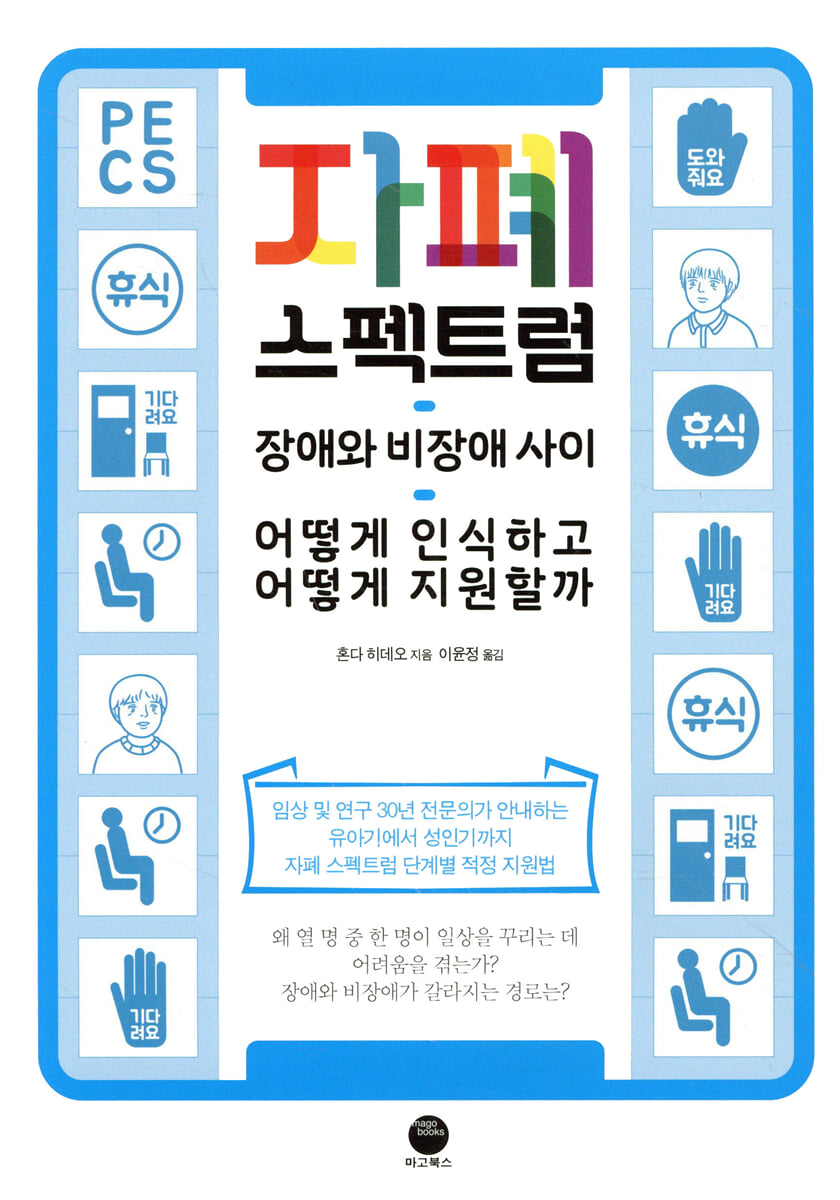
autism spectrum
 |
Description
Book Introduction
'People who are awkward at improvising interpersonal relationships and are obsessed with their own interests and methods.'
Autism spectrum disorder affects approximately 10 percent of the population, even when included in the non-disabled category!
A psychiatrist with 30 years of clinical and research experience in developmental disorders identifies the causes of the "daily difficulties" experienced by one in ten people and provides comprehensive explanations, including early detection, treatment education, and support methods.
Autism spectrum disorder affects approximately 10 percent of the population, even when included in the non-disabled category!
A psychiatrist with 30 years of clinical and research experience in developmental disorders identifies the causes of the "daily difficulties" experienced by one in ten people and provides comprehensive explanations, including early detection, treatment education, and support methods.
index
Chapter 1: You, Too, Might Be on the Autism Spectrum
Are you familiar with the 'autism spectrum'?
From 'pervasive developmental disorder' to 'autism spectrum'
Autism spectrum is not someone else's problem
People on the autism spectrum who lead normal social lives
Various types
Chapter 2 Understanding the Autism Spectrum by Characteristics
1.
Common Characteristics ① Clumsy in improvising interpersonal relationships
Infancy to early childhood
Late infancy to school age
Interpersonal behavioral characteristics persist beyond adolescence.
Psychological mechanisms of characteristic interpersonal behavior
More subtly misaligned communication
2. Common characteristics ② Strong 'obsession'
As cognition develops, so does obsession.
The Law of Conservation of Attachment
Let's use our obsession!
The psychological mechanism of obsession
Interpersonal Relationships and Rubin's Vase
Sometimes you become obsessed with interpersonal relationships
3. Other characteristics that appear
sensory disturbances
Strong orientation toward specific and clear information
I'm not good at sports
Once you memorize something, you don't forget it easily.
It's difficult to understand the relative relationship
4. Coexisting mental and neurological problems
intellectual disability
learning disabilities (LD)
Attention Deficit Hyperactivity Disorder (ADHD)
Sleep abnormalities
epilepsy
5. Secondary problems that can easily occur
victim of bullying
School avoidance, school refusal
reclusive loner
physical symptoms
Tic symptoms
melancholia
adjustment disorder
unrest
obsessive-compulsive disorder
Post-traumatic stress disorder (PTSD)
victim consciousness
Chapter 3: The Difficult Lines of the Autism Spectrum
1. Is it a disability or an individuality?
Autism Spectrum and Autism Spectrum Disorder
'Disability' as an administrative term
Non-disabled autism spectrum disorder
People on the autism spectrum who are prone to stress
The truth only those who don't write autobiographies can tell
Mr. E, who received support through adulthood after early detection
2. To what extent does the autism spectrum exist?
The discovery of 'childhood autism'
From 'autism' to 'autism spectrum'
Can we draw a line?
The intensity of autistic features is distributed continuously.
There is a potential 10% of people on the autism spectrum.
Chapter 4: How to Support People on the Autism Spectrum
1. Support tailored to each developmental type
Autism spectrum disorder is a group of people with a unique developmental pattern.
When you become an adult, you may fit the average standard.
What you can do if you teach and what you can't do if you teach
Low-key parenting theory
How to Set Low-Aim Goals
Autonomous skills and social skills
What determines the presence or severity of a disability is 'daily living skills'.
Support tailored to your life stage: The key lies in adolescence!
2. Pre-pubertal support
Principles of Support
Early detection
Parental awareness and diagnosis notification
The Pitfalls of 'Early Treatment'
Improving IQ does not cure autism.
Autonomous skills and social skills starting from infancy
Let's teach 'agreement'
'Structuring' is the beginning of consensus
Things I wish I had mastered by puberty
Excessive training is prohibited, even if the goal is to overcome weak areas.
Thoughts on the game
3. Support after puberty
Trial and error under support
The role of parents after puberty is that of 'shadow helper'
Let's aim for a bright, confident personality with a goal in mind.
Criteria for choosing a career path
higher education
Issues surrounding employment
People who come out after entering society
4. Responding to coexisting problems and secondary problems
Responding to Coexisting Problems
Responding to secondary issues
5. Creating a structure for social participation
Inclusion
What is inclusion education for children on the autism spectrum?
Structural problems in school education
There are three ways to be considerate of disabilities.
Inclusion in the workplace
Creating a hub for activities for people on the autism spectrum
How people around you treat you
Chapter 5: If You Think You Might Be on the Autism Spectrum…
Things to do
If you have autism spectrum disorder
For non-disabled autism spectrum
Conclusion
After moving
References
Are you familiar with the 'autism spectrum'?
From 'pervasive developmental disorder' to 'autism spectrum'
Autism spectrum is not someone else's problem
People on the autism spectrum who lead normal social lives
Various types
Chapter 2 Understanding the Autism Spectrum by Characteristics
1.
Common Characteristics ① Clumsy in improvising interpersonal relationships
Infancy to early childhood
Late infancy to school age
Interpersonal behavioral characteristics persist beyond adolescence.
Psychological mechanisms of characteristic interpersonal behavior
More subtly misaligned communication
2. Common characteristics ② Strong 'obsession'
As cognition develops, so does obsession.
The Law of Conservation of Attachment
Let's use our obsession!
The psychological mechanism of obsession
Interpersonal Relationships and Rubin's Vase
Sometimes you become obsessed with interpersonal relationships
3. Other characteristics that appear
sensory disturbances
Strong orientation toward specific and clear information
I'm not good at sports
Once you memorize something, you don't forget it easily.
It's difficult to understand the relative relationship
4. Coexisting mental and neurological problems
intellectual disability
learning disabilities (LD)
Attention Deficit Hyperactivity Disorder (ADHD)
Sleep abnormalities
epilepsy
5. Secondary problems that can easily occur
victim of bullying
School avoidance, school refusal
reclusive loner
physical symptoms
Tic symptoms
melancholia
adjustment disorder
unrest
obsessive-compulsive disorder
Post-traumatic stress disorder (PTSD)
victim consciousness
Chapter 3: The Difficult Lines of the Autism Spectrum
1. Is it a disability or an individuality?
Autism Spectrum and Autism Spectrum Disorder
'Disability' as an administrative term
Non-disabled autism spectrum disorder
People on the autism spectrum who are prone to stress
The truth only those who don't write autobiographies can tell
Mr. E, who received support through adulthood after early detection
2. To what extent does the autism spectrum exist?
The discovery of 'childhood autism'
From 'autism' to 'autism spectrum'
Can we draw a line?
The intensity of autistic features is distributed continuously.
There is a potential 10% of people on the autism spectrum.
Chapter 4: How to Support People on the Autism Spectrum
1. Support tailored to each developmental type
Autism spectrum disorder is a group of people with a unique developmental pattern.
When you become an adult, you may fit the average standard.
What you can do if you teach and what you can't do if you teach
Low-key parenting theory
How to Set Low-Aim Goals
Autonomous skills and social skills
What determines the presence or severity of a disability is 'daily living skills'.
Support tailored to your life stage: The key lies in adolescence!
2. Pre-pubertal support
Principles of Support
Early detection
Parental awareness and diagnosis notification
The Pitfalls of 'Early Treatment'
Improving IQ does not cure autism.
Autonomous skills and social skills starting from infancy
Let's teach 'agreement'
'Structuring' is the beginning of consensus
Things I wish I had mastered by puberty
Excessive training is prohibited, even if the goal is to overcome weak areas.
Thoughts on the game
3. Support after puberty
Trial and error under support
The role of parents after puberty is that of 'shadow helper'
Let's aim for a bright, confident personality with a goal in mind.
Criteria for choosing a career path
higher education
Issues surrounding employment
People who come out after entering society
4. Responding to coexisting problems and secondary problems
Responding to Coexisting Problems
Responding to secondary issues
5. Creating a structure for social participation
Inclusion
What is inclusion education for children on the autism spectrum?
Structural problems in school education
There are three ways to be considerate of disabilities.
Inclusion in the workplace
Creating a hub for activities for people on the autism spectrum
How people around you treat you
Chapter 5: If You Think You Might Be on the Autism Spectrum…
Things to do
If you have autism spectrum disorder
For non-disabled autism spectrum
Conclusion
After moving
References
Into the book
At the Yokohama City Comprehensive Rehabilitation Center where I worked, I was solely responsible for providing regular medical care and counseling to local children whose development was of concern.
Many children have received support here before they started school and have continued counseling into adulthood.
My nearly 20 years of clinical experience here has allowed me to continuously observe individual children with developmental concerns from infancy through adulthood.
Psychiatrists with this kind of clinical experience are still very few in Japan and globally.
Based on this valuable experience, the knowledge and wisdom I've gained are largely similar to what you'll find in existing books on developmental disabilities, but there are also some differences.
The most prominent of these is the position on how far the category of “autism spectrum” should be expanded and how much should be included.
Compared to the average psychiatrist today, I have a fairly broad understanding of the 'autism spectrum'.
As I will explain in detail in Chapter 3, this perspective was developed as a result of my long-term, ongoing treatment of individual children with developmental disabilities in the local community.
When viewed so broadly, the 'autism spectrum' is thought to exist in about 10% of the general population.
Now data supporting this is starting to emerge.
--- p.14~15
Aren't there quite a few people around you, like Mr. A, who struggle to grasp the subtle nuances of a situation, and who, while conscientious, have a tendency to stick to their own idiosyncratic methods? Or perhaps you've lived your life like Mr. B, feeling somehow out of place?
Because of these characteristics, many people have difficulty leading a smooth social life.
Imagine this.
People who indiscriminately interrupt other people's conversations, people who talk to themselves in public places, people who throw tantrums because they can't watch a scheduled broadcast because of breaking news...
Unfortunately, I think there are quite a few people who feel reluctant to become close friends with such people.
Conversely, let's think from your own perspective.
Many people understand a story, but they cannot understand it on their own.
A story that everyone finds funny, no matter how hard I try, I never find it funny.
When I start talking about things I'm interested in, for some reason, no one responds.
If this kind of experience continues every day, you will end up not liking socializing.
Nowadays, there are many people on the autism spectrum who are in this situation and experiencing difficulties in their daily lives.
Autism spectrum disorders can take many forms and appear throughout childhood and adulthood.
--- p.21~22
Back when even experts were still unaware of the relationship between autism's unique symptoms and intellectual developmental delays, some researchers hoped that cognitive development might lead to improvements in autism's characteristics.
So there have been several attempts to develop teaching materials aimed at improving cognitive function and teaching them to children with autism.
But unfortunately, it didn't go as expected.
Now, with increased knowledge of the autism spectrum, including "high-functioning autism" without intellectual disability, many experts recognize that the characteristics of autism do not disappear even with cognitive development.
As cognitive function develops, communication skills clearly improve, including increased speech production.
Even so, as described in Chapter 1, we still struggle to improvise and manage subtle interpersonal relationships.
More importantly, as cognitive functions develop, obsessions also continue to develop along with performance.
People with high-functioning autism spectrum disorder, such as the recently well-known 'Asperger's syndrome', sometimes acquire fanatical knowledge about fields of interest as they grow up, and are sometimes called 'otaku'.
If you look at such cases, you will be able to realize that 'as cognition develops, so does obsession.'
--- p.39
Among people on the autism spectrum, there is a certain percentage of people who fall into the narrow definition of autism spectrum disorder.
However, the phenomenon of people who become disabled due to the coexistence of other problems (hereinafter referred to as the 'coexisting group') is influenced by social factors.
Modern society, especially in Japan, may at first glance appear to value individuality, but in reality, the psychological mechanisms that discriminate against and exclude those who are excluded from the majority are actually being strengthened.
The worsening of bullying is a symbol of this.
Among them, criticism of those who ‘cannot read the atmosphere’ is intensifying.
In the past, 'not bending one's beliefs no matter what others say' was a positive evaluation, but these days, such individuality has changed to a negative evaluation of 'not being able to read the mood', and has become an increasingly common target of discrimination or exclusion.
People on the autism spectrum who struggle with improvisational interpersonal relationships and are prone to clinginess are at increased risk of such discrimination and exclusion.
It can be said that people on the autism spectrum are in a situation similar to being discriminated against as a minority.
In a country where a certain ethnic group lives in large numbers, systems and culture based on the values of the majority ethnic group take root, and when an exclusive atmosphere develops regarding everything else, the minority ethnic group is socially oppressed.
Maintaining the unique culture of a particular ethnic group is essential for the people of that ethnic group to maintain a healthy lifestyle.
If it is limited, it will naturally always cause psychological stress.
Likewise, in modern society, people on the autism spectrum are constantly placed in situations that are prone to psychological stress.
People who have been in that situation for a long time are part of the autism spectrum disorder group, which is a coexisting group.
Conversely, people who are able to avoid such stress or manage it well can lead independent social lives.
These are people on the 'non-disabled autism spectrum'.
--- p.79~81
Generally speaking, applicants try to raise their children to a high standard from infancy to early elementary school.
Meanwhile, around the time when students graduate from middle school and enter high school, the number of applicants with low expectations begins to increase.
As adults, we almost certainly support lower eye level support.
But from a child's perspective, these two ways of thinking are contradictory.
When I was young, I was told, “You have to work hard.
They would push me to “work hard to improve my skills,” but then one day, when I reached puberty, they would suddenly say, “You’ve reached your limit, so give up.”
The policy has changed 180 degrees.
Around that time, you start to become quite conscious of the people around you.
'People around me tell me that I can stop trying now, but I've tried so hard so far, but I can't do it properly, so I'm a hopeless person.' Then I get a huge shock and lose confidence.
The reason applicants strive so hard during the early years of childhood is simply because they have no vision of what their child will become in the future.
As a professional who has observed children on the autism spectrum from infancy through adulthood at a community-based center, I find that a blind, high-level approach that fails to predict the future is extremely dangerous.
No matter how young a child is, an expert is someone who can provide some kind of goal for what the child is likely to be like in the future.
With that in mind, try to practice low-key parenting.
This is the best support.
And the sooner you start, the better.
Of course, it is inevitable that there will be some variation in that goal.
However, in such cases, parents and teachers tend to unconsciously aim for a high goal.
But rather the opposite is better.
We need to lower our expectations when raising children and set lower goals for the future.
Children who have received support through this kind of low-key parenting theory are living the most fulfilling lives in adulthood.
--- p.110~111
When a specialist identifies a child's developmental problems during a child health checkup, it is very difficult to convey this information to the parents right away.
First, we don't know whether parents perceive their child's problems in the same way as experts do.
Even if they are aware of this, it is rare to see that the child's problems will continue into the future and that these characteristics will remain even after they become adults.
Parents at this age are wavering between 'noticing and worrying about their child's developmental problems' and 'wanting to think that the current problems are temporary and will eventually get better.'
Another dilemma arises when communicating a child's developmental issues to parents.
People on the autism spectrum are not equally delayed in all areas of development, but rather have areas of strength and weakness in their development.
When communicating developmental issues to parents, it is important to point out areas of delay in the child.
However, in support, it is more important to develop areas that are good rather than training areas that are lagging.
It's difficult to convey this well.
Most parents who hear that their child has a developmental delay assume that if they start training early and repeatedly, they will eventually catch up with other children.
The more limited the area of weakness, and the less significant the delay, the stronger this feeling becomes.
But when you actually try to train, things aren't that simple.
As a result, parents become more anxious and their negativity and criticism of their children gradually accelerate, increasing the risk of secondary problems occurring.
On the other hand, if you avoid explicitly talking about areas where your child is weak and only point out areas where he or she is strong, you will not be able to make parents aware of his or her child's characteristics.
Parents who think, "My child is fine because the expert didn't point anything out," end up worrying about the areas where their child is not good, and end up training their child excessively, thinking, "Since my child is fine, I can overcome what he or she is not good at if I try hard."
When communicating a child's developmental issues to parents, it's important to be specific about the areas in which the child is developing well and those areas in which he or she is struggling, and to make it clear that these characteristics are likely to persist throughout life.
Then, we must convey that placing too much emphasis on training in areas where they are weak increases the risk of secondary problems arising, and that the most necessary support is to boost their self-esteem by developing areas where they are strong.
After explaining all of these, the diagnosis is announced.
--- p.130~131
Earlier, I said that for people on the autism spectrum, the key to determining their lives lies in adolescence.
Those who can develop values and motivation for these skills during adolescence can enter society with confidence and a sense of accomplishment.
What should I do before puberty to do that?
As for autonomous skills, as we get older, we gradually practice structuring things on our own.
Practice visualization by planning your work, creating a schedule, and more, tailored to your individual understanding and communication skills.
However, if you try to do something complicated that is beyond your ability or interest, your motivation will decrease.
The ideal assignment is one that allows you to gradually increase your experience of doing things you couldn't do on your own with just a little bit of thinking.
People who believe that 'the effort they put into something was rewarded' can improve their self-esteem and increase their motivation.
Then, you can have the will to challenge yourself with new things and truly enjoy the things you like.
On the other hand, people who grow up without feeling rewarded for their hard work or having a sense of accomplishment have lower self-esteem.
He is always hesitant and cannot take the initiative in doing anything.
In social skills, we teach 'reporting, contacting, and consulting' little by little.
A person cannot do anything on his own.
You should develop the habit of letting others know what you are doing.
For example, when a company employee goes on a business trip and stays out overnight, he or she usually tells his or her family, “I will be out on a business trip on the XX/XX date.”
No matter how capable you are of staying out alone, if you stay out without telling your family, you are no different from a missing person.
Social skills are about reporting and contacting people to inform them of your actions.
Therefore, the goal is not just to be able to do things on your own, but also to be able to report to others and consult with others when something happens.
To develop such a habit, you need to have the experience of 'doing something with someone else and it ending up with a good result.'
If you don't learn this properly, you will lose interest in 'doing something with others' and will quickly give up when problems arise.
You become isolated and shoulder all your problems alone.
Moreover, some people develop a sense of victimhood and start blaming others.
When this happens, even if people around you try to offer help, it becomes really difficult to resolve the issue because you distrust others and refuse such help.
Having experiences learning from others can motivate you to share things with others, which in turn builds social skills.
--- p.145~147
Adolescents on the autism spectrum need to have goals to live life without regrets.
A person who has a set goal, a person who feels that he or she is making choices or decisions based on the power of that goal, a person who feels that he or she has overcome difficulties or frustrations with his or her own strength.
Failure after puberty is about getting back up and doing well after failing, which builds confidence.
When a person with autism spectrum disorder grows up well, they develop into a personality that is evaluated as 'Dr. ○○', 'craftsman-like', or 'a person who stands out but is somehow lovable'.
Although the word "autism" has a dark connotation, people on the autism spectrum, if growing well, generally have bright personalities.
Even when it comes to being bad at reading other people's minds and not being good at reading the mood, they say, "I'm not good at reading the mood, but I don't think that's a big deal."
It's about having the confidence that you can live well even if you can't read the mood.
This is a very important point.
There are also people who experience severe panic when a problem arises, but then become calm as soon as they overcome the problem.
Even after causing such a fuss, he says with a natural expression, “I’m strong even when I hit a wall.”
I think this might be the original nature of people on the autism spectrum that prevented secondary problems.
Many children have received support here before they started school and have continued counseling into adulthood.
My nearly 20 years of clinical experience here has allowed me to continuously observe individual children with developmental concerns from infancy through adulthood.
Psychiatrists with this kind of clinical experience are still very few in Japan and globally.
Based on this valuable experience, the knowledge and wisdom I've gained are largely similar to what you'll find in existing books on developmental disabilities, but there are also some differences.
The most prominent of these is the position on how far the category of “autism spectrum” should be expanded and how much should be included.
Compared to the average psychiatrist today, I have a fairly broad understanding of the 'autism spectrum'.
As I will explain in detail in Chapter 3, this perspective was developed as a result of my long-term, ongoing treatment of individual children with developmental disabilities in the local community.
When viewed so broadly, the 'autism spectrum' is thought to exist in about 10% of the general population.
Now data supporting this is starting to emerge.
--- p.14~15
Aren't there quite a few people around you, like Mr. A, who struggle to grasp the subtle nuances of a situation, and who, while conscientious, have a tendency to stick to their own idiosyncratic methods? Or perhaps you've lived your life like Mr. B, feeling somehow out of place?
Because of these characteristics, many people have difficulty leading a smooth social life.
Imagine this.
People who indiscriminately interrupt other people's conversations, people who talk to themselves in public places, people who throw tantrums because they can't watch a scheduled broadcast because of breaking news...
Unfortunately, I think there are quite a few people who feel reluctant to become close friends with such people.
Conversely, let's think from your own perspective.
Many people understand a story, but they cannot understand it on their own.
A story that everyone finds funny, no matter how hard I try, I never find it funny.
When I start talking about things I'm interested in, for some reason, no one responds.
If this kind of experience continues every day, you will end up not liking socializing.
Nowadays, there are many people on the autism spectrum who are in this situation and experiencing difficulties in their daily lives.
Autism spectrum disorders can take many forms and appear throughout childhood and adulthood.
--- p.21~22
Back when even experts were still unaware of the relationship between autism's unique symptoms and intellectual developmental delays, some researchers hoped that cognitive development might lead to improvements in autism's characteristics.
So there have been several attempts to develop teaching materials aimed at improving cognitive function and teaching them to children with autism.
But unfortunately, it didn't go as expected.
Now, with increased knowledge of the autism spectrum, including "high-functioning autism" without intellectual disability, many experts recognize that the characteristics of autism do not disappear even with cognitive development.
As cognitive function develops, communication skills clearly improve, including increased speech production.
Even so, as described in Chapter 1, we still struggle to improvise and manage subtle interpersonal relationships.
More importantly, as cognitive functions develop, obsessions also continue to develop along with performance.
People with high-functioning autism spectrum disorder, such as the recently well-known 'Asperger's syndrome', sometimes acquire fanatical knowledge about fields of interest as they grow up, and are sometimes called 'otaku'.
If you look at such cases, you will be able to realize that 'as cognition develops, so does obsession.'
--- p.39
Among people on the autism spectrum, there is a certain percentage of people who fall into the narrow definition of autism spectrum disorder.
However, the phenomenon of people who become disabled due to the coexistence of other problems (hereinafter referred to as the 'coexisting group') is influenced by social factors.
Modern society, especially in Japan, may at first glance appear to value individuality, but in reality, the psychological mechanisms that discriminate against and exclude those who are excluded from the majority are actually being strengthened.
The worsening of bullying is a symbol of this.
Among them, criticism of those who ‘cannot read the atmosphere’ is intensifying.
In the past, 'not bending one's beliefs no matter what others say' was a positive evaluation, but these days, such individuality has changed to a negative evaluation of 'not being able to read the mood', and has become an increasingly common target of discrimination or exclusion.
People on the autism spectrum who struggle with improvisational interpersonal relationships and are prone to clinginess are at increased risk of such discrimination and exclusion.
It can be said that people on the autism spectrum are in a situation similar to being discriminated against as a minority.
In a country where a certain ethnic group lives in large numbers, systems and culture based on the values of the majority ethnic group take root, and when an exclusive atmosphere develops regarding everything else, the minority ethnic group is socially oppressed.
Maintaining the unique culture of a particular ethnic group is essential for the people of that ethnic group to maintain a healthy lifestyle.
If it is limited, it will naturally always cause psychological stress.
Likewise, in modern society, people on the autism spectrum are constantly placed in situations that are prone to psychological stress.
People who have been in that situation for a long time are part of the autism spectrum disorder group, which is a coexisting group.
Conversely, people who are able to avoid such stress or manage it well can lead independent social lives.
These are people on the 'non-disabled autism spectrum'.
--- p.79~81
Generally speaking, applicants try to raise their children to a high standard from infancy to early elementary school.
Meanwhile, around the time when students graduate from middle school and enter high school, the number of applicants with low expectations begins to increase.
As adults, we almost certainly support lower eye level support.
But from a child's perspective, these two ways of thinking are contradictory.
When I was young, I was told, “You have to work hard.
They would push me to “work hard to improve my skills,” but then one day, when I reached puberty, they would suddenly say, “You’ve reached your limit, so give up.”
The policy has changed 180 degrees.
Around that time, you start to become quite conscious of the people around you.
'People around me tell me that I can stop trying now, but I've tried so hard so far, but I can't do it properly, so I'm a hopeless person.' Then I get a huge shock and lose confidence.
The reason applicants strive so hard during the early years of childhood is simply because they have no vision of what their child will become in the future.
As a professional who has observed children on the autism spectrum from infancy through adulthood at a community-based center, I find that a blind, high-level approach that fails to predict the future is extremely dangerous.
No matter how young a child is, an expert is someone who can provide some kind of goal for what the child is likely to be like in the future.
With that in mind, try to practice low-key parenting.
This is the best support.
And the sooner you start, the better.
Of course, it is inevitable that there will be some variation in that goal.
However, in such cases, parents and teachers tend to unconsciously aim for a high goal.
But rather the opposite is better.
We need to lower our expectations when raising children and set lower goals for the future.
Children who have received support through this kind of low-key parenting theory are living the most fulfilling lives in adulthood.
--- p.110~111
When a specialist identifies a child's developmental problems during a child health checkup, it is very difficult to convey this information to the parents right away.
First, we don't know whether parents perceive their child's problems in the same way as experts do.
Even if they are aware of this, it is rare to see that the child's problems will continue into the future and that these characteristics will remain even after they become adults.
Parents at this age are wavering between 'noticing and worrying about their child's developmental problems' and 'wanting to think that the current problems are temporary and will eventually get better.'
Another dilemma arises when communicating a child's developmental issues to parents.
People on the autism spectrum are not equally delayed in all areas of development, but rather have areas of strength and weakness in their development.
When communicating developmental issues to parents, it is important to point out areas of delay in the child.
However, in support, it is more important to develop areas that are good rather than training areas that are lagging.
It's difficult to convey this well.
Most parents who hear that their child has a developmental delay assume that if they start training early and repeatedly, they will eventually catch up with other children.
The more limited the area of weakness, and the less significant the delay, the stronger this feeling becomes.
But when you actually try to train, things aren't that simple.
As a result, parents become more anxious and their negativity and criticism of their children gradually accelerate, increasing the risk of secondary problems occurring.
On the other hand, if you avoid explicitly talking about areas where your child is weak and only point out areas where he or she is strong, you will not be able to make parents aware of his or her child's characteristics.
Parents who think, "My child is fine because the expert didn't point anything out," end up worrying about the areas where their child is not good, and end up training their child excessively, thinking, "Since my child is fine, I can overcome what he or she is not good at if I try hard."
When communicating a child's developmental issues to parents, it's important to be specific about the areas in which the child is developing well and those areas in which he or she is struggling, and to make it clear that these characteristics are likely to persist throughout life.
Then, we must convey that placing too much emphasis on training in areas where they are weak increases the risk of secondary problems arising, and that the most necessary support is to boost their self-esteem by developing areas where they are strong.
After explaining all of these, the diagnosis is announced.
--- p.130~131
Earlier, I said that for people on the autism spectrum, the key to determining their lives lies in adolescence.
Those who can develop values and motivation for these skills during adolescence can enter society with confidence and a sense of accomplishment.
What should I do before puberty to do that?
As for autonomous skills, as we get older, we gradually practice structuring things on our own.
Practice visualization by planning your work, creating a schedule, and more, tailored to your individual understanding and communication skills.
However, if you try to do something complicated that is beyond your ability or interest, your motivation will decrease.
The ideal assignment is one that allows you to gradually increase your experience of doing things you couldn't do on your own with just a little bit of thinking.
People who believe that 'the effort they put into something was rewarded' can improve their self-esteem and increase their motivation.
Then, you can have the will to challenge yourself with new things and truly enjoy the things you like.
On the other hand, people who grow up without feeling rewarded for their hard work or having a sense of accomplishment have lower self-esteem.
He is always hesitant and cannot take the initiative in doing anything.
In social skills, we teach 'reporting, contacting, and consulting' little by little.
A person cannot do anything on his own.
You should develop the habit of letting others know what you are doing.
For example, when a company employee goes on a business trip and stays out overnight, he or she usually tells his or her family, “I will be out on a business trip on the XX/XX date.”
No matter how capable you are of staying out alone, if you stay out without telling your family, you are no different from a missing person.
Social skills are about reporting and contacting people to inform them of your actions.
Therefore, the goal is not just to be able to do things on your own, but also to be able to report to others and consult with others when something happens.
To develop such a habit, you need to have the experience of 'doing something with someone else and it ending up with a good result.'
If you don't learn this properly, you will lose interest in 'doing something with others' and will quickly give up when problems arise.
You become isolated and shoulder all your problems alone.
Moreover, some people develop a sense of victimhood and start blaming others.
When this happens, even if people around you try to offer help, it becomes really difficult to resolve the issue because you distrust others and refuse such help.
Having experiences learning from others can motivate you to share things with others, which in turn builds social skills.
--- p.145~147
Adolescents on the autism spectrum need to have goals to live life without regrets.
A person who has a set goal, a person who feels that he or she is making choices or decisions based on the power of that goal, a person who feels that he or she has overcome difficulties or frustrations with his or her own strength.
Failure after puberty is about getting back up and doing well after failing, which builds confidence.
When a person with autism spectrum disorder grows up well, they develop into a personality that is evaluated as 'Dr. ○○', 'craftsman-like', or 'a person who stands out but is somehow lovable'.
Although the word "autism" has a dark connotation, people on the autism spectrum, if growing well, generally have bright personalities.
Even when it comes to being bad at reading other people's minds and not being good at reading the mood, they say, "I'm not good at reading the mood, but I don't think that's a big deal."
It's about having the confidence that you can live well even if you can't read the mood.
This is a very important point.
There are also people who experience severe panic when a problem arises, but then become calm as soon as they overcome the problem.
Even after causing such a fuss, he says with a natural expression, “I’m strong even when I hit a wall.”
I think this might be the original nature of people on the autism spectrum that prevented secondary problems.
--- p.156~157
Publisher's Review
This book draws on the unique clinical experience of a developmental psychiatrist who continuously followed hundreds of children with developmental concerns from infancy through adulthood.
The author has been supporting children at the Yokohama City Comprehensive Rehabilitation Center in Japan for 20 years, from before they start school to counseling them until they reach adulthood.
This valuable resource provides guidance on key points to consider at each life stage, appropriate support methods, and the importance of guiding individuals toward the non-disabled autism spectrum through prevention of secondary problems.
One of the main themes the author addresses in this book is the challenges people on the autism spectrum and those around them face in their daily lives without being aware of it.
The autism spectrum is literally a continuous form with no distinct boundaries, and when including people with non-disabled types, it is estimated to affect up to 10% of the population, making it a very common symptom that is 'not someone else's problem'.
Even if it is not a disability, the starting point is to guide the person and those around them to recognize where the difficulties they experience stem from their characteristics of being 'unskilled in improvising interpersonal relationships and having a strong instinctive tendency to prioritize maintaining their own interests, methods, and pace.'
Another is a support methodology for people on the autism spectrum.
In relation to developmental disabilities, difficulties in the lives of the person involved and concerns of those around them are discussed at each stage of life, such as infancy, school age, adolescence, and adulthood, but experts generally only intervene during a limited period.
The author, who has observed from a long-term perspective how individuals who experience everyday difficulties grow from infancy to adulthood, how their problems and concerns change, and how they change with appropriate support, provides guidance on support methods that open a new perspective on the autism spectrum.
In particular, a support theory that is faithful to the basics, such as the pitfalls of early treatment that parents are prone to get hung up on, the harm of excessive training, the importance of 'autonomous skills' and 'social skills' starting from infancy, and the fact that it is not cognitive ability but daily life skills that determine the presence or degree of disability, will provide strong strength to parents who are shaken by anxiety.
The fact that the author himself is a non-disabled person on the autism spectrum also has significant implications.
The author has been supporting children at the Yokohama City Comprehensive Rehabilitation Center in Japan for 20 years, from before they start school to counseling them until they reach adulthood.
This valuable resource provides guidance on key points to consider at each life stage, appropriate support methods, and the importance of guiding individuals toward the non-disabled autism spectrum through prevention of secondary problems.
One of the main themes the author addresses in this book is the challenges people on the autism spectrum and those around them face in their daily lives without being aware of it.
The autism spectrum is literally a continuous form with no distinct boundaries, and when including people with non-disabled types, it is estimated to affect up to 10% of the population, making it a very common symptom that is 'not someone else's problem'.
Even if it is not a disability, the starting point is to guide the person and those around them to recognize where the difficulties they experience stem from their characteristics of being 'unskilled in improvising interpersonal relationships and having a strong instinctive tendency to prioritize maintaining their own interests, methods, and pace.'
Another is a support methodology for people on the autism spectrum.
In relation to developmental disabilities, difficulties in the lives of the person involved and concerns of those around them are discussed at each stage of life, such as infancy, school age, adolescence, and adulthood, but experts generally only intervene during a limited period.
The author, who has observed from a long-term perspective how individuals who experience everyday difficulties grow from infancy to adulthood, how their problems and concerns change, and how they change with appropriate support, provides guidance on support methods that open a new perspective on the autism spectrum.
In particular, a support theory that is faithful to the basics, such as the pitfalls of early treatment that parents are prone to get hung up on, the harm of excessive training, the importance of 'autonomous skills' and 'social skills' starting from infancy, and the fact that it is not cognitive ability but daily life skills that determine the presence or degree of disability, will provide strong strength to parents who are shaken by anxiety.
The fact that the author himself is a non-disabled person on the autism spectrum also has significant implications.
GOODS SPECIFICS
- Publication date: March 30, 2022
- Page count, weight, size: 220 pages | 374g | 150*210*20mm
- ISBN13: 9791187282051
- ISBN10: 1187282057
You may also like
카테고리
korean


korean

![GQ KOREA Mark (Monthly): December [2025]](http://librairie.coreenne.fr/cdn/shop/files/8ef265dbbfbf186523ed75ba7319009d.jpg?v=1765340328&width=3840)


