

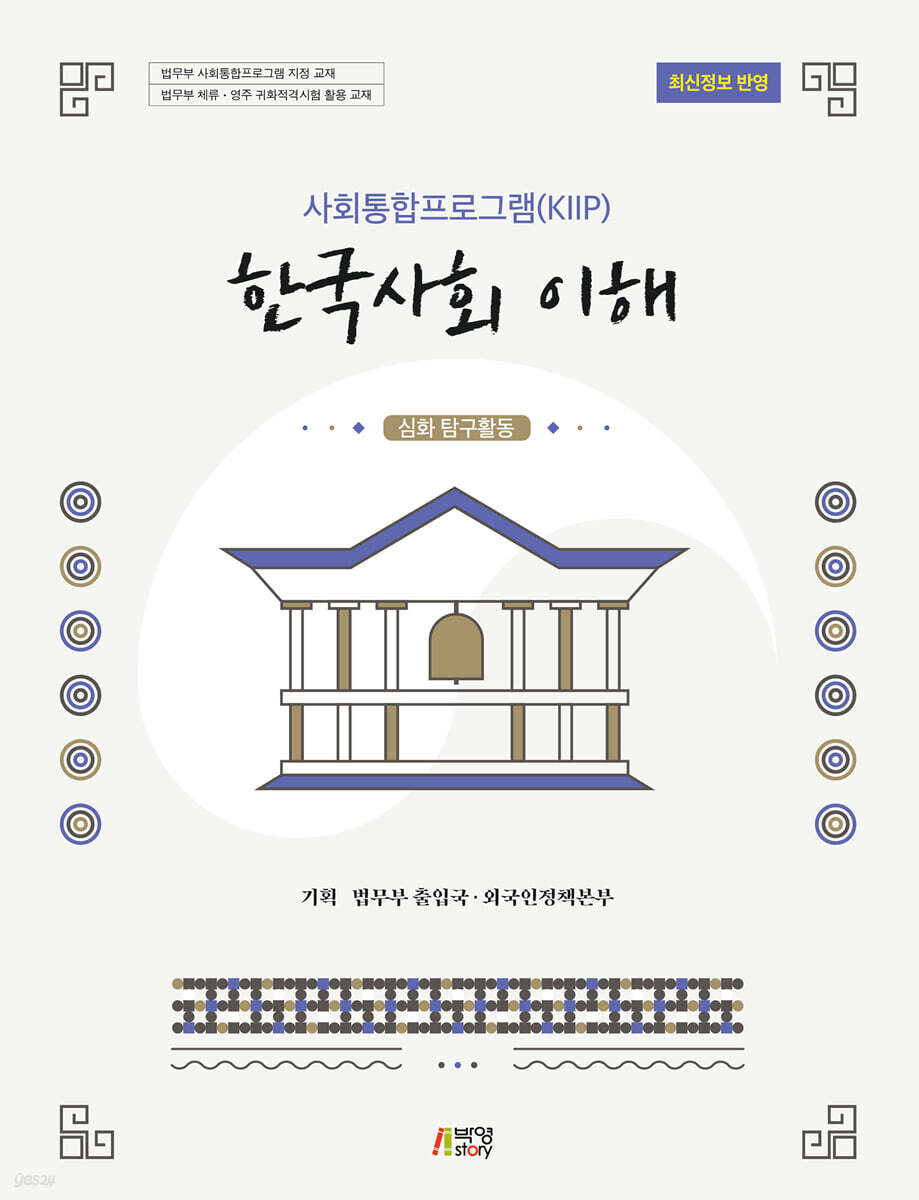
Understanding Korean Society through the Korean Integration Program (KIIP): In-Depth Exploration Activities (Up-to-Date Information)
 |
Description
index
Part 1: Citizens of the Republic of Korea
Lesson 1: The Identity and Constitution of the Republic of Korea
Chapter 2 Rights of Citizens of the Republic of Korea
Chapter 3: Duties of Citizens of the Republic of Korea
Lesson 4: Welfare for the People of the Republic of Korea
Part 2: History and Development of the Republic of Korea
Chapter 5: Establishment of the Government of the Republic of Korea
Lesson 6: The Korean War and Inter-Korean Relations
Lesson 7: The Development of Democracy
Lesson 8 Social Change
Part 3: Politics and Diplomacy in the Republic of Korea
Lesson 9 Political Process and Civic Participation
Lesson 10 Elections and Political Parties
Lesson 11 Diplomacy and International Relations
Lesson 12: Efforts for Unification of North and South Korea
Part 4: The Economy of the Republic of Korea
Lesson 13: Korea's Economic System
Lesson 14 Finance and Asset Management
Lesson 15: Businesses and Workers
Lesson 16: National Economy and International Trade
Part 5: The Legal Order of the Republic of Korea
Lesson 17 Family Issues and the Law
Lesson 18 Property Issues and the Law
Lesson 19: Work Life and the Law
Lesson 20: Crime and Law
Lesson 1: The Identity and Constitution of the Republic of Korea
Chapter 2 Rights of Citizens of the Republic of Korea
Chapter 3: Duties of Citizens of the Republic of Korea
Lesson 4: Welfare for the People of the Republic of Korea
Part 2: History and Development of the Republic of Korea
Chapter 5: Establishment of the Government of the Republic of Korea
Lesson 6: The Korean War and Inter-Korean Relations
Lesson 7: The Development of Democracy
Lesson 8 Social Change
Part 3: Politics and Diplomacy in the Republic of Korea
Lesson 9 Political Process and Civic Participation
Lesson 10 Elections and Political Parties
Lesson 11 Diplomacy and International Relations
Lesson 12: Efforts for Unification of North and South Korea
Part 4: The Economy of the Republic of Korea
Lesson 13: Korea's Economic System
Lesson 14 Finance and Asset Management
Lesson 15: Businesses and Workers
Lesson 16: National Economy and International Trade
Part 5: The Legal Order of the Republic of Korea
Lesson 17 Family Issues and the Law
Lesson 18 Property Issues and the Law
Lesson 19: Work Life and the Law
Lesson 20: Crime and Law
Detailed image

Publisher's Review
Social Integration Program Understanding Korean Society Appendix
Ministry of Justice Social Integration Program Designated Textbook
Ministry of Justice Naturalization Eligibility Test Use Materials
Preface
Now, our country is in the process of becoming an immigrant society, with over 2.5 million foreigners living here, including 800,000 Koreans, 180,000 international students, and 160,000 marriage immigrants.
As the ministry responsible for overall immigration policy, the Immigration and Foreigner Policy Headquarters of the Ministry of Justice pursues social integration policies in accordance with the Framework Act on the Treatment of Foreigners in Korea to enable foreigners immigrating to the Republic of Korea to fully demonstrate their individual abilities as members of our society and to adapt more stably to our society.
In particular, the Korea Immigration & Integration Program (KIIP), which began in 2009, aims to support immigrants to become stable and independent members of our society by cultivating the basic skills necessary for becoming members of the Korean community through understanding the Korean language and Korean society.
Since July 2016, the Ministry of Justice's Immigration and Foreigner Policy Headquarters has been operating the Korean Society Understanding textbook, which was previously structured as a single course, by dividing it into basic and advanced courses to meet the diverse needs of social integration seekers. Through this reorganization, the Ministry has reflected the changes made over the years and developed supplementary teaching materials such as inquiry activities and teacher's guides to help immigrants increase their understanding of Korean society more systematically.
I sincerely hope that this textbook will be widely used not only by immigrants participating in social integration programs but also by many foreigners residing in Korea, broadening their understanding of Korean society and helping them live as contributing members of Korean society.
I would also like to express my deepest gratitude to Professor Seol Gyu-ju and the various researchers at Gyeongin National University of Education who helped in the publication of this textbook, as well as to CEO Noh Hyeon of PYMate and other related personnel who assisted in the publication.
2020.
12.
Cha Gyu-geun, Director General of the Immigration and Foreigner Policy Bureau, Ministry of Justice
Ministry of Justice Social Integration Program Designated Textbook
Ministry of Justice Naturalization Eligibility Test Use Materials
Preface
Now, our country is in the process of becoming an immigrant society, with over 2.5 million foreigners living here, including 800,000 Koreans, 180,000 international students, and 160,000 marriage immigrants.
As the ministry responsible for overall immigration policy, the Immigration and Foreigner Policy Headquarters of the Ministry of Justice pursues social integration policies in accordance with the Framework Act on the Treatment of Foreigners in Korea to enable foreigners immigrating to the Republic of Korea to fully demonstrate their individual abilities as members of our society and to adapt more stably to our society.
In particular, the Korea Immigration & Integration Program (KIIP), which began in 2009, aims to support immigrants to become stable and independent members of our society by cultivating the basic skills necessary for becoming members of the Korean community through understanding the Korean language and Korean society.
Since July 2016, the Ministry of Justice's Immigration and Foreigner Policy Headquarters has been operating the Korean Society Understanding textbook, which was previously structured as a single course, by dividing it into basic and advanced courses to meet the diverse needs of social integration seekers. Through this reorganization, the Ministry has reflected the changes made over the years and developed supplementary teaching materials such as inquiry activities and teacher's guides to help immigrants increase their understanding of Korean society more systematically.
I sincerely hope that this textbook will be widely used not only by immigrants participating in social integration programs but also by many foreigners residing in Korea, broadening their understanding of Korean society and helping them live as contributing members of Korean society.
I would also like to express my deepest gratitude to Professor Seol Gyu-ju and the various researchers at Gyeongin National University of Education who helped in the publication of this textbook, as well as to CEO Noh Hyeon of PYMate and other related personnel who assisted in the publication.
2020.
12.
Cha Gyu-geun, Director General of the Immigration and Foreigner Policy Bureau, Ministry of Justice
GOODS SPECIFICS
- Publication date: December 11, 2020
- Page count, weight, size: 60 pages | 214g | 210*297*15mm
- ISBN13: 9791186140369
- ISBN10: 1186140364
You may also like
카테고리
korean


korean

![GQ KOREA Mark (Monthly): December [2025]](http://librairie.coreenne.fr/cdn/shop/files/8ef265dbbfbf186523ed75ba7319009d.jpg?v=1765340328&width=3840)


