

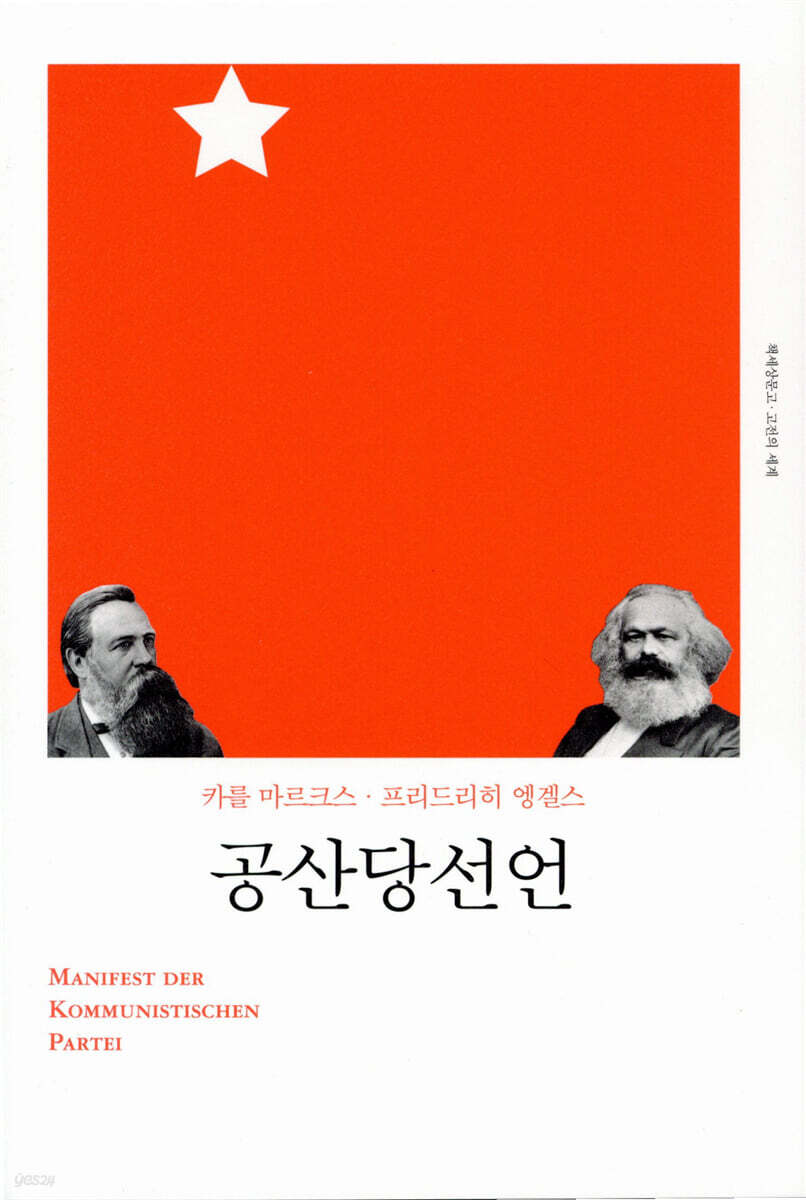
Communist Manifesto
 |
Description
Book Introduction
The book that made Marx one of the most influential ideological thinkers in history.
Written by Marx and Engels in 1847 as the platform of the Communist League, this book declares that the history of class struggles that have continued through various stages of social development has now reached a point where the proletariat, the exploited and oppressed class, cannot be liberated from the bourgeoisie, the exploiting and oppressing class, without permanently liberating the whole of society from exploitation, oppression and class struggle.
Written by Marx and Engels in 1847 as the platform of the Communist League, this book declares that the history of class struggles that have continued through various stages of social development has now reached a point where the proletariat, the exploited and oppressed class, cannot be liberated from the bourgeoisie, the exploiting and oppressing class, without permanently liberating the whole of society from exploitation, oppression and class struggle.
- You can preview some of the book's contents.
Preview
index
Introduction
Chapter 1: The Communist Manifesto
1.
bourgeoisie and proletariat
2.
Proletarians and Communists
3.
Socialist and Communist Literature
4.
The Communist Position on Various Opposing Parties
Chapter 2: The Principles of Communism
Chapter 3: Preface to the Second Edition and Translations of the Communist Manifesto
1.
Preface to the 1872 German edition / 2.
Preface to the 1882 Russian edition
3.
Preface to the 1883 German edition / 4.
Preface to the 1888 English edition
5.
Preface to the 1890 German edition / 6.
Preface to the 1892 Polish edition
7.
Preface to the 1893 Italian edition - To the Italian reader
Unraveling - Philosopher Marx, From Communism to Symbiosis
1.
The Universalization of Capitalism and the Meaning of the Communist Manifesto
2.
Marx's life and thought
3.
The Philosophical Origins of the Communist Manifesto
4.
Communist ideology and utopian modernism
5.
Communism as a Movement and the Anatomy of Civil Society
6.
The Modern Meaning of the Communist Manifesto and Postmodern Symbiosis
main
Further Reading
About the Translator
Publisher's Review
1.
The Communist Manifesto, which dreamed of class liberation and, furthermore, human liberation.
Communism, a revolutionary entity that once terrified all conservative forces in Europe, seemed to take root as a revolutionary, scientific ideology and practical program through the thinker Marx.
However, Marx's prediction that capitalism would eventually perish due to its own contradictions did not come true.
Marxism became rigid as an ideology that justified the ruling power of the communist elite, and with the collapse of real socialism that had accepted that ideology, it could no longer enjoy its absolute status.
Thus, rather than facing the destruction of capitalism due to its own contradictions, capitalism is becoming universalized throughout the world, and the ideology of communism is being accepted as a trite, outdated relic of an era, relegated to the back pages of history.
So, have all the problems of capitalism, so keenly analyzed by Marx, been resolved? In the neoliberal global market, where only the law of the jungle—the survival of the fittest—applies, workers are once again at risk of becoming slaves to capitalism.
Moreover, the numerous mechanisms by which modern capitalism conceals real problems still contain problems that undermine humanity.
So, shouldn't we look at Marx again from a different angle?
The Communist Manifesto is the document that made Marx the most influential ideological thinker in history and the culmination of Marx's philosophical thought. It was written with Engels as the party platform to be announced at the 1947 conference of the Communist League (international workers' organization).
But its fundamental ideas are entirely Marx's, as Engels makes clear in the preface to the 1883 German edition.
The Communist Manifesto, which attempts to reconcile ideology and reality by maintaining a scientific attitude that seeks to derive principles capable of reforming reality from reality itself, maintains a universally valid philosophical stance at this very point, and continues to function as a problematic text even in its time.
2.
A thorough philosophical reflection on human liberation
The Communist Manifesto has a dual nature as an 'ideology' and a 'philosophical reflection'.
As Marxism developed into real socialism, the Communist Manifesto was absolutized as an 'ideology', but with the collapse of socialism, it became an object of ridicule.
Much of the ridicule directed at Marx stems from the fact that his prophecies did not come true.
But is the capitalist system so perfect that Marx's critique has no impact? Or is Marx's critique of capitalism still valid, but its true meaning has been distorted by rigid Marxist ideology? If it's true that capitalism still has many problems, we must now pay attention to his "philosophical reflections" to accurately understand its problems.
Marx was wary of the dogmatic attitude of simply opposing ideological ideas to reality, and by deriving principles capable of reforming reality from reality itself, he melted the passion for revolution with the cool-headedness of analyzing reality.
Therefore, his thought should not be distorted into an ideology that gives theoretical justification to revolutionary passion, or should be rigidly interpreted as a simple methodology for scientifically analyzing reality.
Marx, as he himself expressed, is a revolutionary thinker.
Despite his predictions being wrong, he is still worth reading because, above all, he is a philosopher who thoroughly thought about the problem of human liberation.
The proletariat class he focused on symbolizes distorted humanity, oppressed humanity, humanity subjected to all kinds of injustice, and humanity reduced to nothingness.
Marx's radical thinking grasped the problem of human alienation from its roots.
This is why we must not overlook the fact that the Communist Manifesto is a thorough philosophical reflection on human liberation before being an ideological platform for the workers' movement.
3.
Structure of this book
This book is a complete translation of The Communist Manifesto, which Marx and Engels co-wrote as a platform for the Communist League, and Principles of Communism, which Engels drafted as a platform before The Communist Manifesto was written.
And I collected seven prefaces to the reprints and translations of the Communist Manifesto.
Chapter 1, The Communist Manifesto, consists of four sections and fundamentally states that "the history of all hitherto existing society is the history of class struggles" and that "the theory of communism can be summed up in the single expression: the abolition of private property."
These propositions, which can be further compressed into the concepts of 'proletariat' and 'private property' respectively, describe the direction of communism and provide a pretext for criticizing communism.
Communism sought to abolish the ruling structure and realize the freedom of all individuals through the sharing of the means of production. However, it was proven to be a historical fiction, as the social organization that shared, managed, and monopolized the means of production actually produced an even more closed, absolutist state.
However, communism, which coolly analyzed the given conditions while at the same time dreaming of a union in which each person's free development became a condition for the free development of all, should ultimately be seen as aiming for human liberation.
Chapter 2, "The Principles of Communism," is the program of the Communist League written by Engels in the form of a catechism.
However, Engels, who regarded this document as only a provisional draft, urged Marx to abandon the old catechism format and write the program in the form of the Communist Manifesto.
The Second Congress of the Communist League entrusted these two men with the task of drafting a manifesto, and in writing the Communist Manifesto, the founders of Marxism revived the propositions developed in the Principles of Communism.
Chapter 3 collects the prefaces to the second edition and translations of The Communist Manifesto, first published in England in February 1848 in a 23-page edition.
From the preface to the German edition of 1872 to the preface to the Italian edition of 1893, one can directly witness the influence of the Communist Manifesto, which raged for about 50 years from its first publication in 1848.
Engels wrote and signed the preface to editions published after Marx's death.
Even if the 1848 revolution was not a socialist revolution, it paved the way for it and prepared the foundation for it.
This spread of the Communist Manifesto clearly provides an insight into the international joint response of workers at the time.
GOODS SPECIFICS
- Date of publication: June 20, 2018
- Page count, weight, size: 196 pages | 222g | 128*188*20mm
- ISBN13: 9791159312496
- ISBN10: 1159312494
You may also like
카테고리
korean


korean

![GQ KOREA Mark (Monthly): December [2025]](http://librairie.coreenne.fr/cdn/shop/files/8ef265dbbfbf186523ed75ba7319009d.jpg?v=1765340328&width=3840)


