

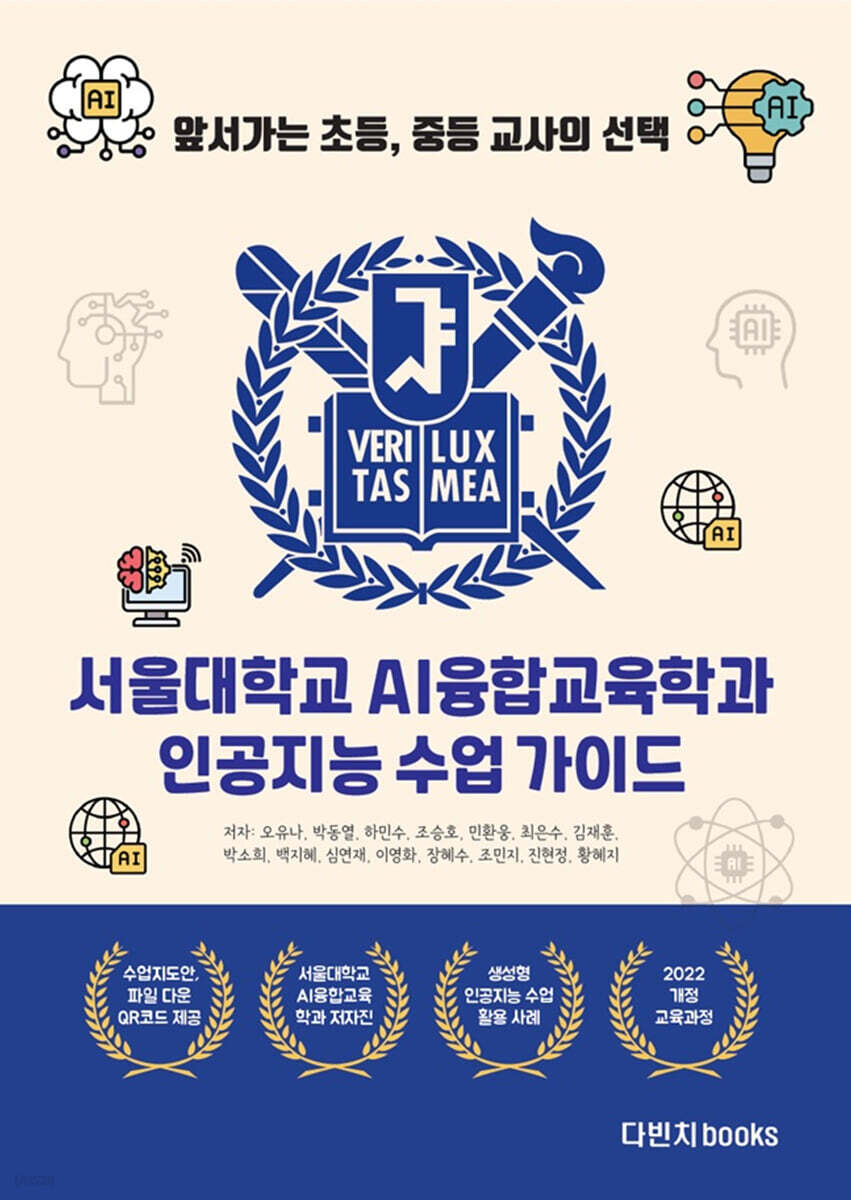
Seoul National University Department of AI Convergence Education AI Class Guide
 |
Description
Book Introduction
· How is Seoul National University's Department of AI Convergence Education operated and researched?
· Know-how in innovating AI classes through collaboration with AI in the classroom
· This book covers everything from class design to operation and evaluation cases.
View AI as an "educational companion," not just a teaching tool!
The Department of AI Convergence Education was established to provide current faculty with a curriculum covering the fundamentals and applications of core AI technologies, SW utilization for AI, and AI convergence teaching methods.
We educate students to systematically acquire fundamental AI skills, cultivate creative problem-solving skills through integration with existing academic knowledge, and lead innovation in the educational content and methods of each subject.
There are a total of 47 universities in 7 regions nationwide that offer master's-level AI convergence education majors.
However, it is operated to take advantage of the characteristics of each university.
This book, "A Leading Elementary and Secondary School Teacher's Choice: Seoul National University AI Convergence Education Department Artificial Intelligence Class Guide," is a collection of AI convergence class practice cases written by current elementary and secondary school teachers at the Seoul National University Graduate School of Education's AI Convergence Education Department, which was established through an agreement between the Seoul Metropolitan Office of Education and Seoul National University. It was planned to be a reference for universities that have established AI Convergence Education majors.
This book also contains real-life stories of classes designed, run, and even evaluated using AI as a teacher's colleague and student partner, rather than a simple teaching assistant.
We introduce various AI tools that have been used and verified in classrooms, such as ChatGPT, Canva, Padlet, Entry, OctoStudio, Gamma, Streamlit, Dream by WOMBO, Looker Studio, and Suno AI. Each chapter includes tool descriptions, lesson flow, precautions, and activity sheets, making it a guide that can be applied immediately in the classroom.
Covering a wide range of settings, from elementary to middle school, from slow learners to special education students, this course presents methods for designing lessons that collaborate with AI rather than simply utilizing it, and for fostering student initiative in critically understanding and interpreting AI.
This book, a collaborative effort of Seoul National University's AI Convergence Education Department teachers, will serve as a practical and reliable guide for teachers who are still unsure of how to begin AI education.
· Know-how in innovating AI classes through collaboration with AI in the classroom
· This book covers everything from class design to operation and evaluation cases.
View AI as an "educational companion," not just a teaching tool!
The Department of AI Convergence Education was established to provide current faculty with a curriculum covering the fundamentals and applications of core AI technologies, SW utilization for AI, and AI convergence teaching methods.
We educate students to systematically acquire fundamental AI skills, cultivate creative problem-solving skills through integration with existing academic knowledge, and lead innovation in the educational content and methods of each subject.
There are a total of 47 universities in 7 regions nationwide that offer master's-level AI convergence education majors.
However, it is operated to take advantage of the characteristics of each university.
This book, "A Leading Elementary and Secondary School Teacher's Choice: Seoul National University AI Convergence Education Department Artificial Intelligence Class Guide," is a collection of AI convergence class practice cases written by current elementary and secondary school teachers at the Seoul National University Graduate School of Education's AI Convergence Education Department, which was established through an agreement between the Seoul Metropolitan Office of Education and Seoul National University. It was planned to be a reference for universities that have established AI Convergence Education majors.
This book also contains real-life stories of classes designed, run, and even evaluated using AI as a teacher's colleague and student partner, rather than a simple teaching assistant.
We introduce various AI tools that have been used and verified in classrooms, such as ChatGPT, Canva, Padlet, Entry, OctoStudio, Gamma, Streamlit, Dream by WOMBO, Looker Studio, and Suno AI. Each chapter includes tool descriptions, lesson flow, precautions, and activity sheets, making it a guide that can be applied immediately in the classroom.
Covering a wide range of settings, from elementary to middle school, from slow learners to special education students, this course presents methods for designing lessons that collaborate with AI rather than simply utilizing it, and for fostering student initiative in critically understanding and interpreting AI.
This book, a collaborative effort of Seoul National University's AI Convergence Education Department teachers, will serve as a practical and reliable guide for teachers who are still unsure of how to begin AI education.
- You can preview some of the book's contents.
Preview
index
The need and direction of AI convergence education
1. The Need and Direction of AI Convergence Education
(1) The impact of artificial intelligence (AI) on education
(2) Why AI convergence education is necessary
(3) Current limitations of education and the complementary role of AI
(4) Utilizing AI to cultivate future talent
2. Methods and Effects of AI Convergence Education
(1) Personalized learning support
(2) Improving students' creativity and problem-solving skills
(3) Improving data-based teaching and learning
(4) Increase learner motivation and participation
(5) Improving the efficiency of class preparation
3. Challenges and Issues of AI Convergence Education
(1) Changes in the teacher's role and problems
(2) Limitations and ethical issues of AI
(3) Reaffirming the direction and necessity of AI convergence education.
01 Create your own presentation by weaving together winter thoughts
Integrated Classroom Instruction through AI Convergence Education
02 The Key to Survival Discovered in AI Reinforcement Learning: Surviving with "Reward" 61
- My own game coding class with animal and plant survival strategies -
03 Collaborative Decision-Making with Decision Trees 85
- Creating AI Products through Group Learning Lesson 04: Exploring the World of Fractals: Where Math and Coding Meet 112
- Coding Creation Class to Unravel the Secrets of Sequences -
05 Determining Who Owns AI-Generated Works 133
- Understanding Copyright with Generative AI -
06 Exploring Collaboration Between AI Chatbots and Teachers 153
- Student-created AI chatbot collaborative class -
07 Dissecting Deepfakes
- AI Ethics Class in the Classroom -
08 Solving Global Problems with AI
- A class that solves social problems through smart questions -
09 Speaking English with ChatGPT using prompting
- Generative AI-integrated classes to improve English communication skills -
10 Designing Programming Lessons with Generative AI
- AI Data Class Created with Prompts -
11 Practicing Data-Driven Sustainable Living
- Vegetarian meal menu development class using data visualization -
12 Descriptive Assessments with GPT
- Descriptive Evaluation Automated Scoring and Feedback System -
13 Understanding and Questions about AI Convergence Education
1.
The age of artificial intelligence
2.
Artificial intelligence entering schools
3. Department of AI Convergence Education
(1) Current status
(2) Seoul National University Department of AI Convergence Education
(3) AI convergence education and educational environment
4. Questions for AI Convergence Education
(1) For what purpose is AI technology used?
(2) Can we trust AI’s judgment?
(3) What kind of education is required to become the master of AI?
(4) Is Edu-tech Governance necessary?
References
1. The Need and Direction of AI Convergence Education
(1) The impact of artificial intelligence (AI) on education
(2) Why AI convergence education is necessary
(3) Current limitations of education and the complementary role of AI
(4) Utilizing AI to cultivate future talent
2. Methods and Effects of AI Convergence Education
(1) Personalized learning support
(2) Improving students' creativity and problem-solving skills
(3) Improving data-based teaching and learning
(4) Increase learner motivation and participation
(5) Improving the efficiency of class preparation
3. Challenges and Issues of AI Convergence Education
(1) Changes in the teacher's role and problems
(2) Limitations and ethical issues of AI
(3) Reaffirming the direction and necessity of AI convergence education.
01 Create your own presentation by weaving together winter thoughts
Integrated Classroom Instruction through AI Convergence Education
02 The Key to Survival Discovered in AI Reinforcement Learning: Surviving with "Reward" 61
- My own game coding class with animal and plant survival strategies -
03 Collaborative Decision-Making with Decision Trees 85
- Creating AI Products through Group Learning Lesson 04: Exploring the World of Fractals: Where Math and Coding Meet 112
- Coding Creation Class to Unravel the Secrets of Sequences -
05 Determining Who Owns AI-Generated Works 133
- Understanding Copyright with Generative AI -
06 Exploring Collaboration Between AI Chatbots and Teachers 153
- Student-created AI chatbot collaborative class -
07 Dissecting Deepfakes
- AI Ethics Class in the Classroom -
08 Solving Global Problems with AI
- A class that solves social problems through smart questions -
09 Speaking English with ChatGPT using prompting
- Generative AI-integrated classes to improve English communication skills -
10 Designing Programming Lessons with Generative AI
- AI Data Class Created with Prompts -
11 Practicing Data-Driven Sustainable Living
- Vegetarian meal menu development class using data visualization -
12 Descriptive Assessments with GPT
- Descriptive Evaluation Automated Scoring and Feedback System -
13 Understanding and Questions about AI Convergence Education
1.
The age of artificial intelligence
2.
Artificial intelligence entering schools
3. Department of AI Convergence Education
(1) Current status
(2) Seoul National University Department of AI Convergence Education
(3) AI convergence education and educational environment
4. Questions for AI Convergence Education
(1) For what purpose is AI technology used?
(2) Can we trust AI’s judgment?
(3) What kind of education is required to become the master of AI?
(4) Is Edu-tech Governance necessary?
References
Detailed image

Publisher's Review
Just because AI enters the classroom, classes won't automatically change.
Simply deploying digital devices and learning new tools does not fundamentally change students' learning.
This book shows that the starting point of change is not 'technology', but the practices and concerns of teachers.
These case studies, designed and implemented directly by teachers in the field, contain educational context and design intent that are more important than AI tools, the flow of learning for students, and the insights teachers have discovered through trial and error.
From elementary to middle school, from general classes to special education.
Every classroom is different, and every child is different, so each class employs different strategies and tools. However, a common philosophy underlying all of them is "student-centered learning." AI doesn't provide the right answers for teaching.
However, in the learning journey we create together, it can become an incredibly strong companion.
I hope this book will serve as a realistic and warm companion for teachers embarking on that journey.
Simply deploying digital devices and learning new tools does not fundamentally change students' learning.
This book shows that the starting point of change is not 'technology', but the practices and concerns of teachers.
These case studies, designed and implemented directly by teachers in the field, contain educational context and design intent that are more important than AI tools, the flow of learning for students, and the insights teachers have discovered through trial and error.
From elementary to middle school, from general classes to special education.
Every classroom is different, and every child is different, so each class employs different strategies and tools. However, a common philosophy underlying all of them is "student-centered learning." AI doesn't provide the right answers for teaching.
However, in the learning journey we create together, it can become an incredibly strong companion.
I hope this book will serve as a realistic and warm companion for teachers embarking on that journey.
GOODS SPECIFICS
- Date of issue: July 10, 2025
- Page count, weight, size: 340 pages | 152*223*30mm
- ISBN13: 9791192775364
- ISBN10: 1192775368
You may also like
카테고리
korean


korean

![GQ KOREA Mark (Monthly): December [2025]](http://librairie.coreenne.fr/cdn/shop/files/8ef265dbbfbf186523ed75ba7319009d.jpg?v=1765340328&width=3840)


