

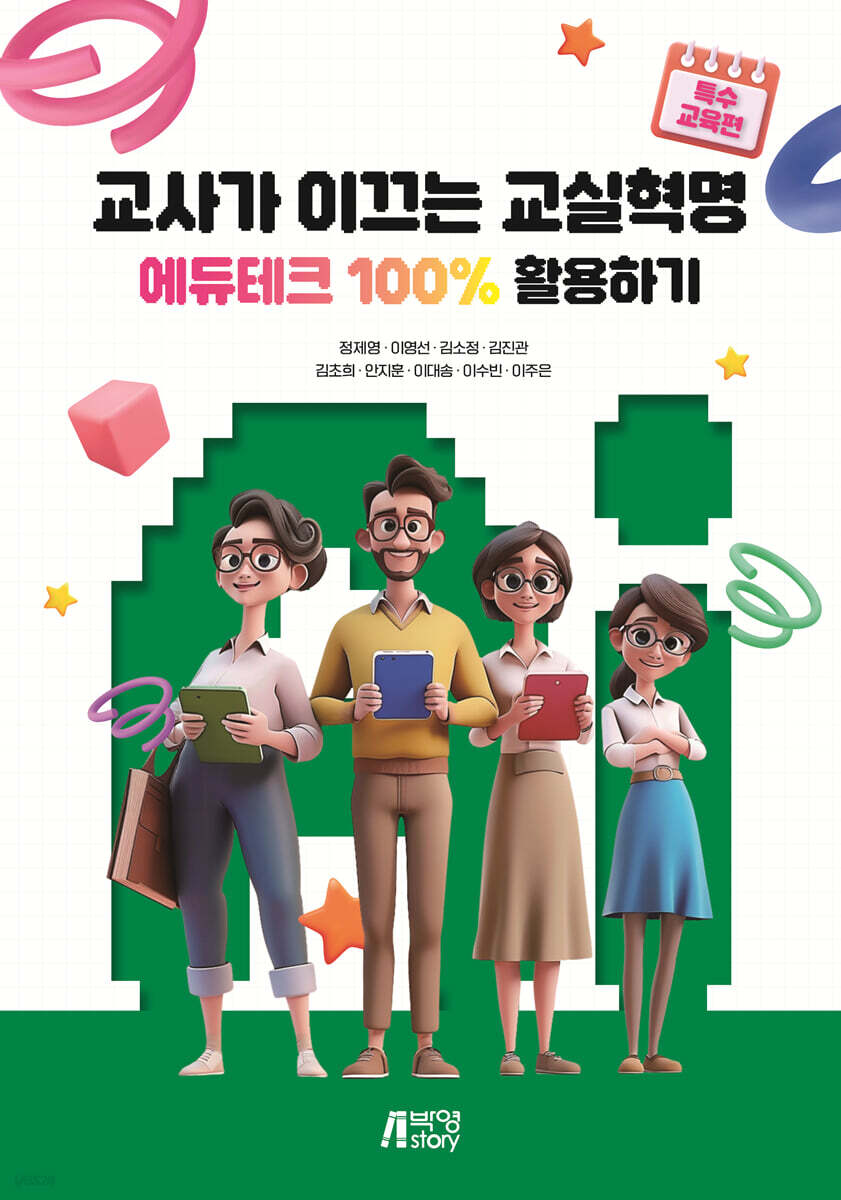
Teacher-Led Classroom Revolution: Utilizing EdTech Fully (Special Education Edition)
 |
Description
Book Introduction
We are experiencing fundamental changes across society due to the digital transformation and rapid advancements in artificial intelligence technology.
These technological advancements are having a profound impact not only on our daily lives but also on education.
School education is being required to change the content of education, the method of education, the accessibility of learning, and the content and method of educational evaluation.
This book was designed from the perspective that teachers should not be subject to policies that reflect changes in the educational environment.
When the authors first planned this book, they agreed that teachers should be the driving force behind educational innovation and that education should be designed to enable all students to succeed in their studies according to their own paths.
Advances in digital technology have made it crucial to leverage not only AI-powered digital textbooks, but also a variety of methods and tools to achieve educational outcomes.
The most important factor in educational innovation is ‘teacher leadership.’
This book aims to support the Ministry of Education's "Teacher-Led Classroom Revolution" policy, enabling teachers to take the lead in innovating their classes.
In other words, we support teachers in exploring ways to proactively lead educational innovation amidst the digital transformation.
This book explores how digital technologies and artificial intelligence can be used to enhance students' learning experiences, facilitate interaction between teachers and students, and provide personalized education tailored to the needs of individual learners.
We believe that continuous innovation is possible in education when theory and practice are combined.
Looking at the forest, two professors and seven teachers with expertise participated as authors with a grand ambition to capture the entirety of the forest, from each tree, each trunk, each leaf, and each flower.
These technological advancements are having a profound impact not only on our daily lives but also on education.
School education is being required to change the content of education, the method of education, the accessibility of learning, and the content and method of educational evaluation.
This book was designed from the perspective that teachers should not be subject to policies that reflect changes in the educational environment.
When the authors first planned this book, they agreed that teachers should be the driving force behind educational innovation and that education should be designed to enable all students to succeed in their studies according to their own paths.
Advances in digital technology have made it crucial to leverage not only AI-powered digital textbooks, but also a variety of methods and tools to achieve educational outcomes.
The most important factor in educational innovation is ‘teacher leadership.’
This book aims to support the Ministry of Education's "Teacher-Led Classroom Revolution" policy, enabling teachers to take the lead in innovating their classes.
In other words, we support teachers in exploring ways to proactively lead educational innovation amidst the digital transformation.
This book explores how digital technologies and artificial intelligence can be used to enhance students' learning experiences, facilitate interaction between teachers and students, and provide personalized education tailored to the needs of individual learners.
We believe that continuous innovation is possible in education when theory and practice are combined.
Looking at the forest, two professors and seven teachers with expertise participated as authors with a grand ambition to capture the entirety of the forest, from each tree, each trunk, each leaf, and each flower.
- You can preview some of the book's contents.
Preview
index
PART 01 Digital Education is Coming 6
CHAPTER 1: Directions for Digital-Based Education Innovation (Jeong Je-young)
1 The advent of the digital transformation and the era of artificial intelligence 1 4
2 School Innovation Directions for the Future 1 7
1 A Systematic Approach to Future Education 1 7
2 Directions for Innovation in Education Using Digital Technology 2 1
3 Direction of the Teacher-Led Classroom Revolution 27
1. Digital-Based Future Education: High-Tech Education 27
2 High-Touch High-Tech Education 30
3 Teacher-led classroom revolution 36
· References 42
CHAPTER 2: Applying AI and Digital Technology in Special Education (Lee Young-seon)
1. Special Education Recipients and Special Education 44
1. Special Education Students: What Makes Them Special? 44
2 Special Education: What Specially Designed Education Means 47
3 Digital Transformation: Special Education Targets in the AI Era 5 1
1 Technology's Potential and New Barriers 5 1
2 Accessibility and Assistive Technology to Support Difficulties Due to Disabilities 56
3 Inclusive Technologies to Enhance Digital Accessibility 60
4 AI Digital Textbook Era: Technology Application Directions for Special Education Students 67
1. The Changes and Potential of Special Education Brought About by AI Digital Textbooks 67
2 Principles for Introducing and Implementing AI Digital Courseware in Special Education 69
3 The Role of Special Education Teachers Becomes More Important in the AI Era 7 1
· References and Sites 73
CHAPTER 3: Understanding Digital-Based Special Education (Daesong Lee)
1 Special Education Digital Education Policy 74
1. The 6th Five-Year Plan for Special Education Development (2023-2027) 74
2 2022 Revised Special Education Curriculum General Principles 85
3 2022 Revised Special Education Basic Curriculum Korean Language 86
2 Special Education Digital Teaching and Learning Materials 88
1 Multimedia Book 88
2 Realistic Content 92
3 Understanding AI Digital Textbooks 97
1 AI Digital Textbook Promotion 97
2 Differences Between Digital Textbooks and AI Digital Textbooks
3 AI Digital Textbook Core Services 102
4 Special Education AI Digital Textbooks 104
4 AI Digital Textbook Review 106
1 Promotional Video 106
2 AI Digital Textbook Web Display System 107
3 AI Digital Textbook Publisher's Website 109
· References and Sites 1 1 1
PART 02 Teacher-led classroom revolution
CHAPTER 1: Lesson Design Using Digital Tools in Special Education (Lee Su-bin)
1 The Secrets of Customized Curriculum in the Digital Transformation Era 114
1 Digital Transformation and the Changing Face of Education 114
2. A Turning Point in Special Education: Digital Companionship for Customized Learning 119
2 Roadmap for Designing Personalized Lessons with Digital Tools 126
1. A 3-Step Roadmap for Designing Digital Special Education Lessons 126
2 Special Education Meets Digital: A Collection of Vivid Lessons. ZIP 133
3. New possibilities for special education opened up by digital technology 148
· References and Sites 150
CHAPTER 2: AI Courseware Mapping and Personalized Education
: Understanding and Utilizing Special Education (Kim So-jeong)
1 Understanding AI Courseware 152
1. The Educational Significance and Value of AI Courseware 152
2 Meaning in the context of special education 153
3 Potential as a Tool to Support Individualized Education Plans (IEPs) 155
2 Key Features of AI Courseware 156
3 Individualized Learning Support Features 159
4. Real-World Applications of AI Courseware 163
1 Considerations Before Implementing AI Courseware 163
2. Application Cases of Special Education Mathematics Classes 168
3 Utilization methods by disability type 1 7 1
5 Suggestions for Effective Use 173
· References and Sites 176
CHAPTER 3: High-Touch, High-Tech (HTHT) Education in Special Education (Lee Joo-eun)
1 Understanding High-Touch, High-Tech (HTHT) Education 178
1 The Meaning of High-Touch, High-Tech (HTHT) Education 179
2 Teacher-Led High-Touch, High-Tech (HTHT) Education 180
2. Real-world High-Touch, High-Tech (HTHT) Education in Special Education Settings 183
1. High-Touch, High-Tech (HTHT) Education Using Artificial Intelligence Programs for String Instrument Performance 183
2 High-Touch, High-Tech (HTHT) Education Using Generative Artificial Intelligence 188
3 High-Touch, High-Tech (HTHT) Education through Interactive Reading Activities 195
3 Expectations for High-Touch, High-Tech (HTHT) Education in Special Education 202
1 New possibilities for special education opened up by HTHT education 202
2 Challenges and Solutions for Introducing HTHT Education 205
3 The Future of HTHT Education and Special Education 206
· References and Sites 207
CHAPTER 4 In an integrated classroom using AI digital textbooks
Professor Adaptation (Kim Cho-hee)
1. The Concept of Faculty Adaptation 208
1. Definition and Necessity of Faculty Adaptation 208
2 The Meaning of Instructional Adaptation in the Context of Special Education and Inclusive Classes 209
3 Basic Principles of Faculty Adaptation 2 1 1
4 Types of Faculty Adaptation 2 1 2
2 Adapting Teaching Methods in Integrated Classrooms Using AI Digital Textbooks 2 1 3
1 Faculty Adaptation Procedure 2 1 3
2 Adapting the teaching environment 2 1 4
3 Faculty Group Adaptation 2 1 7
4 Adapting the teaching content 2 1 8
5 Adapting teaching methods 220
6 Assessment Fit 222
3 Cases of Subject-Specific Instructional Adaptation in Integrated Classes 225
1. Mathematics (Textbook & AIDT Parallel) 225
2 English (AIDT Intensive) 230
4. The Practice and Future of Teaching Adaptation through AI Digital Textbooks 234
· References 236
PART 03: A Classroom Revolution Created by Teachers
CHAPTER 1: The Future of Digital-Based Special Education (Ji-Hoon Ahn)
1. Encountering Inclusive Technology in Special Education 238
1 Education for All: Special Education Meets Inclusive Technology 238
2 Accessibility and the Role of UDL in Special Education and Inclusive Education 246
1 Special Education and Universal Design for Learning (UDL) 247
2 Special Education and Accessibility 252
3 Universal Learning Design and Accessibility for Inclusive Education 258
· References and Sites 263
CHAPTER 2: Classroom Revolution: Teachers' Core Competencies for Future Education (Jin-Kwan Kim)
1. The Direction of Digital-Based Education Innovation and the Role of AI Digital Tools 266
1. Personalized, personalized learning is another world of Io 266
2 The message of greatest change may be 'AI technology itself' 268
The Age of the Nuclear Individual: Collaboration with AI 270
4 Educational Innovation: Autonomous Class Innovation 272
2. Real Concerns About Digital Education and Overcoming Them 275
1 Stockdale Paradox 275
2 Could AI digital tools become magic wands? 276
3 Are the legitimacy and justification of policy formulation sufficient? 281
4 Are there sufficient regulations to manage and oversee ethical issues? 282
5 Can AI Digital Tools Ensure Quality Education? 283
3 Teachers as the Core and Leading Force of Digital-Based Education Innovation 285
1 Newly Required Teacher Competencies 285
2 The Role of Teachers as a Key to Digital-Based Education Innovation 2 9 1
4 How AI Digital Tools Become Teachers' Weapons 292
1 The Teacher's Capacity as an Artist 292
2 AI Digital Tools: A Helper for Artists 293
3 You don't have to fill every class moment digitally. 295
4 Adding another possibility to teachers' lesson design 296
5 Suggestions for the Educational Application of AI Digital Tools 297
1. Sophistication based on selection and focus 298
2 Tools to promote interaction that support student-centered classes 299
3 Digital Class Design and Implementation Tools that Support Various Achievement Standards 299
4 AI Digital Tools to Support Capacity Building and Deep Learning 301
5. Securing Systematic Strengthening of Teacher Capacity 302
6 Building Infrastructure and Policy Support for Digital Transformation in Schools 304
7 Collaboration between schools, communities, and education authorities, centering on teachers 305
6 In conclusion 306
· References and Sites 309
CHAPTER 1: Directions for Digital-Based Education Innovation (Jeong Je-young)
1 The advent of the digital transformation and the era of artificial intelligence 1 4
2 School Innovation Directions for the Future 1 7
1 A Systematic Approach to Future Education 1 7
2 Directions for Innovation in Education Using Digital Technology 2 1
3 Direction of the Teacher-Led Classroom Revolution 27
1. Digital-Based Future Education: High-Tech Education 27
2 High-Touch High-Tech Education 30
3 Teacher-led classroom revolution 36
· References 42
CHAPTER 2: Applying AI and Digital Technology in Special Education (Lee Young-seon)
1. Special Education Recipients and Special Education 44
1. Special Education Students: What Makes Them Special? 44
2 Special Education: What Specially Designed Education Means 47
3 Digital Transformation: Special Education Targets in the AI Era 5 1
1 Technology's Potential and New Barriers 5 1
2 Accessibility and Assistive Technology to Support Difficulties Due to Disabilities 56
3 Inclusive Technologies to Enhance Digital Accessibility 60
4 AI Digital Textbook Era: Technology Application Directions for Special Education Students 67
1. The Changes and Potential of Special Education Brought About by AI Digital Textbooks 67
2 Principles for Introducing and Implementing AI Digital Courseware in Special Education 69
3 The Role of Special Education Teachers Becomes More Important in the AI Era 7 1
· References and Sites 73
CHAPTER 3: Understanding Digital-Based Special Education (Daesong Lee)
1 Special Education Digital Education Policy 74
1. The 6th Five-Year Plan for Special Education Development (2023-2027) 74
2 2022 Revised Special Education Curriculum General Principles 85
3 2022 Revised Special Education Basic Curriculum Korean Language 86
2 Special Education Digital Teaching and Learning Materials 88
1 Multimedia Book 88
2 Realistic Content 92
3 Understanding AI Digital Textbooks 97
1 AI Digital Textbook Promotion 97
2 Differences Between Digital Textbooks and AI Digital Textbooks
3 AI Digital Textbook Core Services 102
4 Special Education AI Digital Textbooks 104
4 AI Digital Textbook Review 106
1 Promotional Video 106
2 AI Digital Textbook Web Display System 107
3 AI Digital Textbook Publisher's Website 109
· References and Sites 1 1 1
PART 02 Teacher-led classroom revolution
CHAPTER 1: Lesson Design Using Digital Tools in Special Education (Lee Su-bin)
1 The Secrets of Customized Curriculum in the Digital Transformation Era 114
1 Digital Transformation and the Changing Face of Education 114
2. A Turning Point in Special Education: Digital Companionship for Customized Learning 119
2 Roadmap for Designing Personalized Lessons with Digital Tools 126
1. A 3-Step Roadmap for Designing Digital Special Education Lessons 126
2 Special Education Meets Digital: A Collection of Vivid Lessons. ZIP 133
3. New possibilities for special education opened up by digital technology 148
· References and Sites 150
CHAPTER 2: AI Courseware Mapping and Personalized Education
: Understanding and Utilizing Special Education (Kim So-jeong)
1 Understanding AI Courseware 152
1. The Educational Significance and Value of AI Courseware 152
2 Meaning in the context of special education 153
3 Potential as a Tool to Support Individualized Education Plans (IEPs) 155
2 Key Features of AI Courseware 156
3 Individualized Learning Support Features 159
4. Real-World Applications of AI Courseware 163
1 Considerations Before Implementing AI Courseware 163
2. Application Cases of Special Education Mathematics Classes 168
3 Utilization methods by disability type 1 7 1
5 Suggestions for Effective Use 173
· References and Sites 176
CHAPTER 3: High-Touch, High-Tech (HTHT) Education in Special Education (Lee Joo-eun)
1 Understanding High-Touch, High-Tech (HTHT) Education 178
1 The Meaning of High-Touch, High-Tech (HTHT) Education 179
2 Teacher-Led High-Touch, High-Tech (HTHT) Education 180
2. Real-world High-Touch, High-Tech (HTHT) Education in Special Education Settings 183
1. High-Touch, High-Tech (HTHT) Education Using Artificial Intelligence Programs for String Instrument Performance 183
2 High-Touch, High-Tech (HTHT) Education Using Generative Artificial Intelligence 188
3 High-Touch, High-Tech (HTHT) Education through Interactive Reading Activities 195
3 Expectations for High-Touch, High-Tech (HTHT) Education in Special Education 202
1 New possibilities for special education opened up by HTHT education 202
2 Challenges and Solutions for Introducing HTHT Education 205
3 The Future of HTHT Education and Special Education 206
· References and Sites 207
CHAPTER 4 In an integrated classroom using AI digital textbooks
Professor Adaptation (Kim Cho-hee)
1. The Concept of Faculty Adaptation 208
1. Definition and Necessity of Faculty Adaptation 208
2 The Meaning of Instructional Adaptation in the Context of Special Education and Inclusive Classes 209
3 Basic Principles of Faculty Adaptation 2 1 1
4 Types of Faculty Adaptation 2 1 2
2 Adapting Teaching Methods in Integrated Classrooms Using AI Digital Textbooks 2 1 3
1 Faculty Adaptation Procedure 2 1 3
2 Adapting the teaching environment 2 1 4
3 Faculty Group Adaptation 2 1 7
4 Adapting the teaching content 2 1 8
5 Adapting teaching methods 220
6 Assessment Fit 222
3 Cases of Subject-Specific Instructional Adaptation in Integrated Classes 225
1. Mathematics (Textbook & AIDT Parallel) 225
2 English (AIDT Intensive) 230
4. The Practice and Future of Teaching Adaptation through AI Digital Textbooks 234
· References 236
PART 03: A Classroom Revolution Created by Teachers
CHAPTER 1: The Future of Digital-Based Special Education (Ji-Hoon Ahn)
1. Encountering Inclusive Technology in Special Education 238
1 Education for All: Special Education Meets Inclusive Technology 238
2 Accessibility and the Role of UDL in Special Education and Inclusive Education 246
1 Special Education and Universal Design for Learning (UDL) 247
2 Special Education and Accessibility 252
3 Universal Learning Design and Accessibility for Inclusive Education 258
· References and Sites 263
CHAPTER 2: Classroom Revolution: Teachers' Core Competencies for Future Education (Jin-Kwan Kim)
1. The Direction of Digital-Based Education Innovation and the Role of AI Digital Tools 266
1. Personalized, personalized learning is another world of Io 266
2 The message of greatest change may be 'AI technology itself' 268
The Age of the Nuclear Individual: Collaboration with AI 270
4 Educational Innovation: Autonomous Class Innovation 272
2. Real Concerns About Digital Education and Overcoming Them 275
1 Stockdale Paradox 275
2 Could AI digital tools become magic wands? 276
3 Are the legitimacy and justification of policy formulation sufficient? 281
4 Are there sufficient regulations to manage and oversee ethical issues? 282
5 Can AI Digital Tools Ensure Quality Education? 283
3 Teachers as the Core and Leading Force of Digital-Based Education Innovation 285
1 Newly Required Teacher Competencies 285
2 The Role of Teachers as a Key to Digital-Based Education Innovation 2 9 1
4 How AI Digital Tools Become Teachers' Weapons 292
1 The Teacher's Capacity as an Artist 292
2 AI Digital Tools: A Helper for Artists 293
3 You don't have to fill every class moment digitally. 295
4 Adding another possibility to teachers' lesson design 296
5 Suggestions for the Educational Application of AI Digital Tools 297
1. Sophistication based on selection and focus 298
2 Tools to promote interaction that support student-centered classes 299
3 Digital Class Design and Implementation Tools that Support Various Achievement Standards 299
4 AI Digital Tools to Support Capacity Building and Deep Learning 301
5. Securing Systematic Strengthening of Teacher Capacity 302
6 Building Infrastructure and Policy Support for Digital Transformation in Schools 304
7 Collaboration between schools, communities, and education authorities, centering on teachers 305
6 In conclusion 306
· References and Sites 309
Detailed image

Publisher's Review
We are experiencing fundamental changes across society due to the digital transformation and rapid advancements in artificial intelligence technology.
These technological advancements are having a profound impact not only on our daily lives but also on education.
School education is being required to change the content of education, the method of education, the accessibility of learning, and the content and method of educational evaluation.
This book was designed from the perspective that teachers should not be subject to policies that reflect changes in the educational environment.
When the authors first planned this book, they agreed that teachers should be the driving force behind educational innovation and that education should be designed to enable all students to succeed in their studies according to their own paths.
Advances in digital technology have made it crucial to leverage not only AI-powered digital textbooks, but also a variety of methods and tools to achieve educational outcomes.
The most important factor in educational innovation is ‘teacher leadership.’
This book aims to support the Ministry of Education's "Teacher-Led Classroom Revolution" policy, enabling teachers to take the lead in innovating their classes.
In other words, we support teachers in exploring ways to proactively lead educational innovation amidst the digital transformation.
This book explores how digital technologies and artificial intelligence can be used to enhance students' learning experiences, facilitate interaction between teachers and students, and provide personalized education tailored to the needs of individual learners.
We believe that continuous innovation is possible in education when theory and practice are combined.
Looking at the forest, two professors and seven teachers with expertise participated as authors with a grand ambition to capture the entirety of the forest, from each tree, each trunk, each leaf, and each flower.
This book is divided into three parts and nine chapters.
Chapter 1 of Part 01 was written by Professor Jeong Je-young.
With the advent of the digital transformation and artificial intelligence era, we are presenting the future direction of innovation for schools.
We emphasize a holistic, systemic approach, reflecting the lesson of history that partial improvements do not lead to innovation in the school system.
And it presented the direction of personalized education led by teachers, that is, high-touch, high-tech education.
Chapter 2 was written by Professor Lee Young-seon on the application of digital technology (AI) in special education.
This chapter explores how digital technologies can support learning accessibility and independence for students with disabilities, enabling personalized and individualized education.
By analyzing learning data and providing personalized content, we offer a way to reduce repetitive teacher tasks while allowing teachers to focus on emotional support and interaction.
Furthermore, we emphasized the importance of inclusive technology and discussed the potential for technology to expand the essential value of special education and enhance the learning participation and achievement of students with disabilities through design that considers accessibility and usability.
Chapter 3 was written by Professor Lee Dae-song about digital-based special education.
This chapter examines digital education and policies in special education through the "6th Five-Year Plan for Special Education Development (2023-2027)" and the "2022 Revised Special Education Curriculum." It also introduces how various digital teaching and learning materials, such as multimedia books and immersive content, are applied to special education.
Finally, after examining the background of AI digital textbooks, the differences from digital textbooks, key functions, and special education AI digital textbooks, we explained how to directly examine AI digital textbooks using promotional videos and web exhibition systems.
Chapter 1 of Part 02 was written by Professor Lee Su-bin about lesson design using digital tools in special education.
This chapter explores the significance of personalized curricula in special education in the era of digital transformation and presents examples of how digital technology is fostering diversity in learning in special education settings.
Explore real-world classroom examples by following a three-step roadmap for designing digital special education lessons using digital tools.
I hope this chapter will provide an opportunity to explore the new possibilities for special education opened up by digital technology.
Chapter 2 was written by Professor Kim So-jeong about the functions of AI courseware and customized education.
This chapter examines the educational significance and value of AI courseware in the context of special education and explores its potential as a tool to support Individualized Education Plans (IEPs). We delve into key AI courseware functions, including learner data analysis and diagnostic assessment, and present practical applications in educational settings.
We also discuss considerations for applying AI courseware and provide practical examples of its application in special education mathematics classes.
Chapter 3 was written by Professor Lee Ju-eun about high-touch, high-tech (HTHT) education in special education.
This chapter explores how HTHT education combines technological tools (high-tech) and emotional support (high-touch) to provide an optimized learning environment for students with disabilities.
We propose ways to maximize learning effectiveness by leveraging cutting-edge technologies such as artificial intelligence (AI) and augmented reality (AR) to support personalized learning and complement the role of teachers.
This chapter explores, through a variety of case studies, how HTHT education fosters learning engagement and interest, and creates an environment where students can reach their potential.
We also discussed how the combination of technical elements and human support can contribute to realizing the essential goals of special education.
Chapter 4 was written by teacher Kim Cho-hee about teaching adaptation in integrated classes using AI digital textbooks.
This chapter covers the definition and necessity of teaching adaptation, as well as its basic principles and types. Based on this, we present a teaching adaptation strategy for integrated classes utilizing AI digital textbooks.
We specifically discussed ways to effectively utilize the functions of AI digital textbooks in various aspects of teaching adaptation, such as teaching environment, groups, content, methods, and evaluation. Using examples from mathematics and English subjects, we proposed teaching methods that appropriately utilize paper textbooks and AI digital textbooks according to subject characteristics and learning content.
This discussion comprehensively explains how AI digital textbooks can support teaching adaptation in inclusive classrooms and meet the learning needs of individual students.
Chapter 1 of Part 03 was written by Professor Ji-Hoon Ahn about the future of digital-based special education through the intersection of special education and inclusive technology.
This chapter examines the significance and value of AI digital tools as inclusive technologies that unlock the learning potential of students with disabilities, and explores ways to build educational environments for all learners through Universal Design for Learning (UDL) and the principles of accessibility.
In particular, we presented specific practical application plans for AI digital tools in various aspects, such as UDL based on inclusive technology, accessibility, and technology utilization in inclusive education, and comprehensively discussed the future direction and challenges that special education should pursue.
Chapter 2 was written by Professor Jin-Kwan Kim about teachers' capabilities for future education.
He emphasized that personalized AI-powered education is not simply about introducing technology. He emphasized that the fundamental reason and ultimate goal of educational innovation based on AI digital tools is to innovate classes, and therefore, the focus should be on finding ways to effectively integrate technology into education.
Emphasizing the role of teachers as key players and agents of educational innovation, the paper offers suggestions for the successful application of AI digital tools, offering a direction for a classroom revolution led by teachers in this era of digital transformation. It emphasizes that educational innovation utilizing AI digital tools must go beyond the introduction of technology and focus on strengthening teacher capabilities, integrating them with the curriculum, fostering a learner-centered educational environment, and fostering deep learning and capacity building in students.
Now is the golden time to transform digital education.
However, the Ministry of Education's policies alone cannot bring about changes in classrooms.
Because the person who actually conducts the class in the classroom is the teacher.
There is no separate way for teachers to become the subject.
The most important thing is teacher initiative, and the policy supports this.
As the number of teachers who innovate themselves increases, we expect to see changes in Korean classrooms, and small changes will accumulate and expand into revolutionary changes.
In educational innovation, establishing policies based on theory and data is crucial.
However, theory alone lacks detail and can lead to hasty generalizations.
On the other hand, if you only emphasize the details of the class, you run the risk of missing the big picture.
We believe that the classroom revolution we desire can be achieved when theory-based policies and practical efforts are combined.
I hope this book will be a small beginning for a classroom revolution.
The authors of this book came together with the small hope of creating a classroom revolution led by teachers.
I would like to express my gratitude to the authors who passionately participated despite their busy schedules, and to the CEO and staff of Park Young Story who have always provided consistent assistance with planning, editing, and publishing.
I hope this will be of some help to prospective teachers and current teachers who wish to innovate in digital education.
However, this book is not finished, but a work in progress.
We look forward to further upgrading to keep pace with the ever-changing environment and technology.
- April 2025, Jeong Je-yeong on behalf of the author
These technological advancements are having a profound impact not only on our daily lives but also on education.
School education is being required to change the content of education, the method of education, the accessibility of learning, and the content and method of educational evaluation.
This book was designed from the perspective that teachers should not be subject to policies that reflect changes in the educational environment.
When the authors first planned this book, they agreed that teachers should be the driving force behind educational innovation and that education should be designed to enable all students to succeed in their studies according to their own paths.
Advances in digital technology have made it crucial to leverage not only AI-powered digital textbooks, but also a variety of methods and tools to achieve educational outcomes.
The most important factor in educational innovation is ‘teacher leadership.’
This book aims to support the Ministry of Education's "Teacher-Led Classroom Revolution" policy, enabling teachers to take the lead in innovating their classes.
In other words, we support teachers in exploring ways to proactively lead educational innovation amidst the digital transformation.
This book explores how digital technologies and artificial intelligence can be used to enhance students' learning experiences, facilitate interaction between teachers and students, and provide personalized education tailored to the needs of individual learners.
We believe that continuous innovation is possible in education when theory and practice are combined.
Looking at the forest, two professors and seven teachers with expertise participated as authors with a grand ambition to capture the entirety of the forest, from each tree, each trunk, each leaf, and each flower.
This book is divided into three parts and nine chapters.
Chapter 1 of Part 01 was written by Professor Jeong Je-young.
With the advent of the digital transformation and artificial intelligence era, we are presenting the future direction of innovation for schools.
We emphasize a holistic, systemic approach, reflecting the lesson of history that partial improvements do not lead to innovation in the school system.
And it presented the direction of personalized education led by teachers, that is, high-touch, high-tech education.
Chapter 2 was written by Professor Lee Young-seon on the application of digital technology (AI) in special education.
This chapter explores how digital technologies can support learning accessibility and independence for students with disabilities, enabling personalized and individualized education.
By analyzing learning data and providing personalized content, we offer a way to reduce repetitive teacher tasks while allowing teachers to focus on emotional support and interaction.
Furthermore, we emphasized the importance of inclusive technology and discussed the potential for technology to expand the essential value of special education and enhance the learning participation and achievement of students with disabilities through design that considers accessibility and usability.
Chapter 3 was written by Professor Lee Dae-song about digital-based special education.
This chapter examines digital education and policies in special education through the "6th Five-Year Plan for Special Education Development (2023-2027)" and the "2022 Revised Special Education Curriculum." It also introduces how various digital teaching and learning materials, such as multimedia books and immersive content, are applied to special education.
Finally, after examining the background of AI digital textbooks, the differences from digital textbooks, key functions, and special education AI digital textbooks, we explained how to directly examine AI digital textbooks using promotional videos and web exhibition systems.
Chapter 1 of Part 02 was written by Professor Lee Su-bin about lesson design using digital tools in special education.
This chapter explores the significance of personalized curricula in special education in the era of digital transformation and presents examples of how digital technology is fostering diversity in learning in special education settings.
Explore real-world classroom examples by following a three-step roadmap for designing digital special education lessons using digital tools.
I hope this chapter will provide an opportunity to explore the new possibilities for special education opened up by digital technology.
Chapter 2 was written by Professor Kim So-jeong about the functions of AI courseware and customized education.
This chapter examines the educational significance and value of AI courseware in the context of special education and explores its potential as a tool to support Individualized Education Plans (IEPs). We delve into key AI courseware functions, including learner data analysis and diagnostic assessment, and present practical applications in educational settings.
We also discuss considerations for applying AI courseware and provide practical examples of its application in special education mathematics classes.
Chapter 3 was written by Professor Lee Ju-eun about high-touch, high-tech (HTHT) education in special education.
This chapter explores how HTHT education combines technological tools (high-tech) and emotional support (high-touch) to provide an optimized learning environment for students with disabilities.
We propose ways to maximize learning effectiveness by leveraging cutting-edge technologies such as artificial intelligence (AI) and augmented reality (AR) to support personalized learning and complement the role of teachers.
This chapter explores, through a variety of case studies, how HTHT education fosters learning engagement and interest, and creates an environment where students can reach their potential.
We also discussed how the combination of technical elements and human support can contribute to realizing the essential goals of special education.
Chapter 4 was written by teacher Kim Cho-hee about teaching adaptation in integrated classes using AI digital textbooks.
This chapter covers the definition and necessity of teaching adaptation, as well as its basic principles and types. Based on this, we present a teaching adaptation strategy for integrated classes utilizing AI digital textbooks.
We specifically discussed ways to effectively utilize the functions of AI digital textbooks in various aspects of teaching adaptation, such as teaching environment, groups, content, methods, and evaluation. Using examples from mathematics and English subjects, we proposed teaching methods that appropriately utilize paper textbooks and AI digital textbooks according to subject characteristics and learning content.
This discussion comprehensively explains how AI digital textbooks can support teaching adaptation in inclusive classrooms and meet the learning needs of individual students.
Chapter 1 of Part 03 was written by Professor Ji-Hoon Ahn about the future of digital-based special education through the intersection of special education and inclusive technology.
This chapter examines the significance and value of AI digital tools as inclusive technologies that unlock the learning potential of students with disabilities, and explores ways to build educational environments for all learners through Universal Design for Learning (UDL) and the principles of accessibility.
In particular, we presented specific practical application plans for AI digital tools in various aspects, such as UDL based on inclusive technology, accessibility, and technology utilization in inclusive education, and comprehensively discussed the future direction and challenges that special education should pursue.
Chapter 2 was written by Professor Jin-Kwan Kim about teachers' capabilities for future education.
He emphasized that personalized AI-powered education is not simply about introducing technology. He emphasized that the fundamental reason and ultimate goal of educational innovation based on AI digital tools is to innovate classes, and therefore, the focus should be on finding ways to effectively integrate technology into education.
Emphasizing the role of teachers as key players and agents of educational innovation, the paper offers suggestions for the successful application of AI digital tools, offering a direction for a classroom revolution led by teachers in this era of digital transformation. It emphasizes that educational innovation utilizing AI digital tools must go beyond the introduction of technology and focus on strengthening teacher capabilities, integrating them with the curriculum, fostering a learner-centered educational environment, and fostering deep learning and capacity building in students.
Now is the golden time to transform digital education.
However, the Ministry of Education's policies alone cannot bring about changes in classrooms.
Because the person who actually conducts the class in the classroom is the teacher.
There is no separate way for teachers to become the subject.
The most important thing is teacher initiative, and the policy supports this.
As the number of teachers who innovate themselves increases, we expect to see changes in Korean classrooms, and small changes will accumulate and expand into revolutionary changes.
In educational innovation, establishing policies based on theory and data is crucial.
However, theory alone lacks detail and can lead to hasty generalizations.
On the other hand, if you only emphasize the details of the class, you run the risk of missing the big picture.
We believe that the classroom revolution we desire can be achieved when theory-based policies and practical efforts are combined.
I hope this book will be a small beginning for a classroom revolution.
The authors of this book came together with the small hope of creating a classroom revolution led by teachers.
I would like to express my gratitude to the authors who passionately participated despite their busy schedules, and to the CEO and staff of Park Young Story who have always provided consistent assistance with planning, editing, and publishing.
I hope this will be of some help to prospective teachers and current teachers who wish to innovate in digital education.
However, this book is not finished, but a work in progress.
We look forward to further upgrading to keep pace with the ever-changing environment and technology.
- April 2025, Jeong Je-yeong on behalf of the author
GOODS SPECIFICS
- Date of issue: April 1, 2025
- Page count, weight, size: 316 pages | 176*248*30mm
- ISBN13: 9791172790615
- ISBN10: 1172790612
You may also like
카테고리
korean


korean

![GQ KOREA Mark (Monthly): December [2025]](http://librairie.coreenne.fr/cdn/shop/files/8ef265dbbfbf186523ed75ba7319009d.jpg?v=1765340328&width=3840)


