

Happy Storybook Lesson 99
 |
Description
Book Introduction
“One fun storybook is worth ten parishes!”
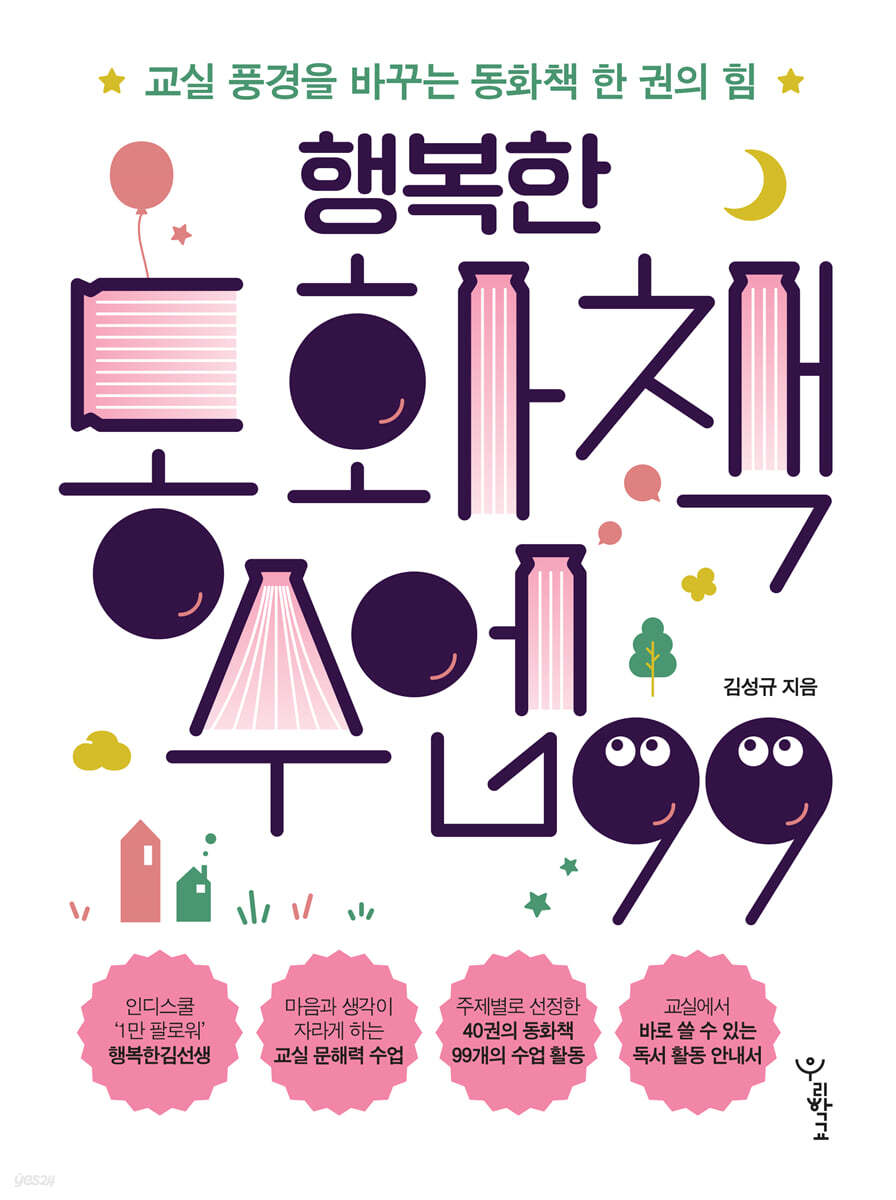
A mentor to 10,000 teachers, a leader in classroom activities, ‘Happy Teacher Kim’
Happy Fairy Tale Class Know-How
How can we create a class where all children willingly participate, a class that fosters reading and critical thinking? Kim Seong-gyu, an elementary school teacher and author of "99 Happy Storybook Classes," confidently states, "With just one good book, it's possible."
Teacher Kim Seong-gyu is more famous by his nickname, ‘Happy Teacher Kim’, than by his real name.
This is because I have been active for a long time on personal blogs and elementary school teacher communities such as Indie School, and have generously shared various teaching materials and know-how with fellow teachers.
Teacher Kim Seong-gyu says that for a class to be successful, learning and fun must occur simultaneously.
He was more concerned than anyone else about classes that truly touched the hearts of children.
Then, a fairy tale book he came across by chance solved the teacher's problem.
The classroom atmosphere completely changed when I used the picture books I enjoyed reading in class.
In "Happy Storybook Class 99," we carefully selected 40 books that are fun to read with any child.
And we've grouped carefully selected fairy tales into eight themes: self-esteem, relationships, communication, civic consciousness, love, honesty, history, and death.
It covers topics that are relevant to children's daily lives while also introducing them to a new world, enriching the classroom storybook lessons.
Children gain knowledge while experiencing deepening their thinking.
We also introduced 99 activities that everyone can enjoy, beyond simple reading and writing activities.
Because it contains rich content from various subjects such as Korean, social studies, ethics, art, music, and practical arts, students can sufficiently learn the content of the subjects through picture book classes alone.
It also includes easy-to-follow edutech usage methods in the classroom.
Now, let's start a happy storybook class for both teachers and children.
Come experience our completely different classroom.
A mentor to 10,000 teachers, a leader in classroom activities, ‘Happy Teacher Kim’
Happy Fairy Tale Class Know-How
How can we create a class where all children willingly participate, a class that fosters reading and critical thinking? Kim Seong-gyu, an elementary school teacher and author of "99 Happy Storybook Classes," confidently states, "With just one good book, it's possible."
Teacher Kim Seong-gyu is more famous by his nickname, ‘Happy Teacher Kim’, than by his real name.
This is because I have been active for a long time on personal blogs and elementary school teacher communities such as Indie School, and have generously shared various teaching materials and know-how with fellow teachers.
Teacher Kim Seong-gyu says that for a class to be successful, learning and fun must occur simultaneously.
He was more concerned than anyone else about classes that truly touched the hearts of children.
Then, a fairy tale book he came across by chance solved the teacher's problem.
The classroom atmosphere completely changed when I used the picture books I enjoyed reading in class.
In "Happy Storybook Class 99," we carefully selected 40 books that are fun to read with any child.
And we've grouped carefully selected fairy tales into eight themes: self-esteem, relationships, communication, civic consciousness, love, honesty, history, and death.
It covers topics that are relevant to children's daily lives while also introducing them to a new world, enriching the classroom storybook lessons.
Children gain knowledge while experiencing deepening their thinking.
We also introduced 99 activities that everyone can enjoy, beyond simple reading and writing activities.
Because it contains rich content from various subjects such as Korean, social studies, ethics, art, music, and practical arts, students can sufficiently learn the content of the subjects through picture book classes alone.
It also includes easy-to-follow edutech usage methods in the classroom.
Now, let's start a happy storybook class for both teachers and children.
Come experience our completely different classroom.
- You can preview some of the book's contents.
Preview
index
Introductory remarks I hope that the teacher's fairy tale class will be happy.
Chapter 1: A Fairy Tale Book That Comes to Me
Finding the real me
I support you who loves me
If I could live someone else's life
You can't have everything
Will I be happy if I just have good looks?
Chapter 2 A Storybook to Learn About Relationships
We walked together too
The Storm and Stress Period
Things you don't know unless you tell them
It's pretty when you look closely
Time to understand each other
Chapter 3: A fairy tale about the importance of language and communication
Sometimes kind, sometimes firm
I hear your voice
Things that can only be seen when spoken
The courage to admit mistakes
Because it's us, we're not lonely
Chapter 4: A Picture Book for Understanding Social Media
We were distorted by group chats
I wish I had a sister like this
Messenger that digs into everyday life
I'm getting addicted without even knowing it
The Scary Online Trap
Chapter 5: A Storybook That Makes You Feel Love
A love story of three people and three colors
Heartbreaking first love
A bittersweet confession
We also live in love
Growing up with love
Chapter 6: A Fairy Tale that Contemplates Truth and Lies
Is honesty always just?
The Hidden Truth in the Cyber World
The truth that must be told
If everyone has no conscience
The truth doesn't matter
Chapter 7: A Fairy Tale Book that Experiences History
Meet the young Jeongjo
Being able to live like a human being
Go beyond the limits
People who lived during the Japanese colonial period
A flame still alive
Chapter 8: A Fairy Tale of Facing Death
Why we must remember even the pain
Love lasts forever
Pain also needs time to be accepted
Time to prepare for death
A Miracle Between Death and Love
supplement
Chapter 1: A Fairy Tale Book That Comes to Me
Finding the real me
I support you who loves me
If I could live someone else's life
You can't have everything
Will I be happy if I just have good looks?
Chapter 2 A Storybook to Learn About Relationships
We walked together too
The Storm and Stress Period
Things you don't know unless you tell them
It's pretty when you look closely
Time to understand each other
Chapter 3: A fairy tale about the importance of language and communication
Sometimes kind, sometimes firm
I hear your voice
Things that can only be seen when spoken
The courage to admit mistakes
Because it's us, we're not lonely
Chapter 4: A Picture Book for Understanding Social Media
We were distorted by group chats
I wish I had a sister like this
Messenger that digs into everyday life
I'm getting addicted without even knowing it
The Scary Online Trap
Chapter 5: A Storybook That Makes You Feel Love
A love story of three people and three colors
Heartbreaking first love
A bittersweet confession
We also live in love
Growing up with love
Chapter 6: A Fairy Tale that Contemplates Truth and Lies
Is honesty always just?
The Hidden Truth in the Cyber World
The truth that must be told
If everyone has no conscience
The truth doesn't matter
Chapter 7: A Fairy Tale Book that Experiences History
Meet the young Jeongjo
Being able to live like a human being
Go beyond the limits
People who lived during the Japanese colonial period
A flame still alive
Chapter 8: A Fairy Tale of Facing Death
Why we must remember even the pain
Love lasts forever
Pain also needs time to be accepted
Time to prepare for death
A Miracle Between Death and Love
supplement
Into the book
A child insisted on skipping physical education so we could focus on moral education, a child jumped up and down, saying he never knew books could be this fun, and another ran to the library as soon as recess ended to browse through books! I was taken aback by the reactions of these children, who I never imagined.
Parents also said, “As soon as my child got home, he kept asking me to buy him books, so I bought him some.
I was so curious as to say, “What on earth did you teach in school?”
--- p.5~6
This is a book I read with my children when studying 'independent living' in ethics class.
I looked deeply into the idea of an independent life through my current situation of abandoning myself and choosing someone else's life.
So, what is the beginning of an independent life? Isn't it starting with a self-respecting heart and a clear understanding of oneself? "Creating a Thinking Map" is an activity that helps children reflect on themselves and organize themselves systematically, thereby solidifying the foundation for an independent life.
--- p.41
The most important thing required in Korean language classes for upper elementary school students is 'discussion/debate skills.'
So, in the classroom, you get to experience a lot of different types of debates, not just pros and cons debates.
The 'PMI Debate' we're introducing today is a debate format that not only allows beginners to participate without feeling pressured, but is also ideal for practicing weighing the pros and cons of an issue and finding the most reasonable conclusion possible.
--- p.61
When reading a picture book with a lot of text, it is a good idea to read about halfway through, summarize the plot, and then read it again.
Because you can closely follow the emotional line of the work by organizing the characters, events, and background.
There are many ways to summarize a plot, but among them, the 'plot film' using the window panning technique is the most popular activity for children.
This is a great activity to link with the Korean language curriculum's 'Reading and Summarizing Stories', 'Reading Stories While Recalling Experiences', and 'Reading Stories While Thinking About Characters, Events, and Background' units, so we recommend actively using it in various classes.
--- p.87
Summarizing what you've read so far is also a great way to improve your child's literacy skills because it means they understand the main plot and theme of the story.
There are many ways to summarize the contents of a book, but I'll introduce one that is the easiest, most convenient, and most fun to use.
This is 'Say it in 1-5 letters', which summarizes the content of the book with key words while gradually increasing the number of letters.
--- p.191
Watching the complex love equations of these four people intertwine and unravel, you'll truly be amazed at how a love story between twelve-year-olds can be so exciting.
How can I effectively organize the content of a book full of twists and turns? While pondering this, the "Reading Cube" activity suddenly came to mind.
I highly recommend this activity without hesitation, as it is one of my kids' favorite ways to organize their plot.
--- p.249
One activity that helps you fully understand the content of a book is creating an advertisement to promote it.
To advertise a book, you need to present the main content and subject matter of the book as attractively as possible to stimulate the desire to purchase it from many people.
There are many different types of book advertising, but with the recent rise of edtech tools, creating "book trailers" has become a popular activity.
Parents also said, “As soon as my child got home, he kept asking me to buy him books, so I bought him some.
I was so curious as to say, “What on earth did you teach in school?”
--- p.5~6
This is a book I read with my children when studying 'independent living' in ethics class.
I looked deeply into the idea of an independent life through my current situation of abandoning myself and choosing someone else's life.
So, what is the beginning of an independent life? Isn't it starting with a self-respecting heart and a clear understanding of oneself? "Creating a Thinking Map" is an activity that helps children reflect on themselves and organize themselves systematically, thereby solidifying the foundation for an independent life.
--- p.41
The most important thing required in Korean language classes for upper elementary school students is 'discussion/debate skills.'
So, in the classroom, you get to experience a lot of different types of debates, not just pros and cons debates.
The 'PMI Debate' we're introducing today is a debate format that not only allows beginners to participate without feeling pressured, but is also ideal for practicing weighing the pros and cons of an issue and finding the most reasonable conclusion possible.
--- p.61
When reading a picture book with a lot of text, it is a good idea to read about halfway through, summarize the plot, and then read it again.
Because you can closely follow the emotional line of the work by organizing the characters, events, and background.
There are many ways to summarize a plot, but among them, the 'plot film' using the window panning technique is the most popular activity for children.
This is a great activity to link with the Korean language curriculum's 'Reading and Summarizing Stories', 'Reading Stories While Recalling Experiences', and 'Reading Stories While Thinking About Characters, Events, and Background' units, so we recommend actively using it in various classes.
--- p.87
Summarizing what you've read so far is also a great way to improve your child's literacy skills because it means they understand the main plot and theme of the story.
There are many ways to summarize the contents of a book, but I'll introduce one that is the easiest, most convenient, and most fun to use.
This is 'Say it in 1-5 letters', which summarizes the content of the book with key words while gradually increasing the number of letters.
--- p.191
Watching the complex love equations of these four people intertwine and unravel, you'll truly be amazed at how a love story between twelve-year-olds can be so exciting.
How can I effectively organize the content of a book full of twists and turns? While pondering this, the "Reading Cube" activity suddenly came to mind.
I highly recommend this activity without hesitation, as it is one of my kids' favorite ways to organize their plot.
--- p.249
One activity that helps you fully understand the content of a book is creating an advertisement to promote it.
To advertise a book, you need to present the main content and subject matter of the book as attractively as possible to stimulate the desire to purchase it from many people.
There are many different types of book advertising, but with the recent rise of edtech tools, creating "book trailers" has become a popular activity.
--- p.336
Publisher's Review
A storybook that reads smoothly, our class's literacy is growing rapidly.
A storybook class that encompasses both the height of knowledge and the depth of thought.
Literacy is the power that comes from a child reading and thinking for himself.
But the world our children live in is so full of interesting things, and it's becoming increasingly difficult to provide them with deep reading experiences.
How can teachers instill the joy of reading in children in schools? "Happy Storybook Class 99" is a practical educational guide by Kim Seong-gyu, aka "Happy Kim Teacher," who actively shares educational content for middle and high school homeroom teachers both online and offline.
Although he is now active as a mentor to 10,000 teachers, even the happy Mr. Kim had difficult times.
“There was a time when I felt ashamed because I thought that no matter how many different activities I did, they were only for a moment and that the classes were not truly engaging with the children’s hearts.”
After much thought and research, he developed various teaching know-hows and packed them into “Happy Storybook Class 99.”
According to the author, children are unable to read because they do not know which books are interesting.
When you come across a truly interesting book, you find yourself searching for it, and as you read the storybook, you gain knowledge, think for yourself, and spontaneously share your thoughts.
In the process, literacy grows naturally.
When children are immersed in a story, the teacher can clearly convey the content of the lesson he or she is trying to convey.
Appropriate to each grade level, appropriate to the size of the class and school, appropriate to the individuality of the children.
Specialized for practical use! A classroom guidebook you can use right away.
A key feature of this book is the 99 post-reading activities introduced by the author.
The strength is that it is easy to follow, despite being non-obvious.
For example, if you are teaching a 'summarizing the plot' class in the Korean language class, you can introduce various activities that can be applied differently to the same class, such as 'plot film', 'tell in 1-5 letters', 'reading cube', 'one-line critical comments', and 'making a badge'.
Although it is introduced in conjunction with 40 picture books, each activity can be applied to other books as well.
We've also included tips on how to easily change activities when they're too difficult for the children in your class, and how to finish activities without spending too much time.
Are you worried that our school is too small to utilize? Or that our class is too large to accommodate everyone? Don't worry about that.
As a veteran teacher with experience in a variety of classrooms, the author understands the concerns of his fellow teachers.
So, we included lesson activities that fit various classroom situations.
For example, the 'senior citizen busking' and 'village walking' activities, which were carried out as part of a small school joint curriculum, not only link moral, music, and social studies subjects, but are also good for use during independent study time at school.
Additionally, activities like the 'Sticker Gallery Walk' and 'Mole Presentation' are even more beneficial because all children can participate, even in large classes, and both active and passive children can participate without feeling burdened.
Each time a new activity is introduced in the book, the "This activity for this situation!" section provides guidance on how it can be used in certain subjects or situations.
From class president elections, beginning-of-the-year self-introductions, and festivals, all essential classroom activities, to cross-curricular lessons aligned with the 2022 revised curriculum, can all be completed in one volume of "Happy Storybook Class 99."
A storybook class that encompasses both the height of knowledge and the depth of thought.
Literacy is the power that comes from a child reading and thinking for himself.
But the world our children live in is so full of interesting things, and it's becoming increasingly difficult to provide them with deep reading experiences.
How can teachers instill the joy of reading in children in schools? "Happy Storybook Class 99" is a practical educational guide by Kim Seong-gyu, aka "Happy Kim Teacher," who actively shares educational content for middle and high school homeroom teachers both online and offline.
Although he is now active as a mentor to 10,000 teachers, even the happy Mr. Kim had difficult times.
“There was a time when I felt ashamed because I thought that no matter how many different activities I did, they were only for a moment and that the classes were not truly engaging with the children’s hearts.”
After much thought and research, he developed various teaching know-hows and packed them into “Happy Storybook Class 99.”
According to the author, children are unable to read because they do not know which books are interesting.
When you come across a truly interesting book, you find yourself searching for it, and as you read the storybook, you gain knowledge, think for yourself, and spontaneously share your thoughts.
In the process, literacy grows naturally.
When children are immersed in a story, the teacher can clearly convey the content of the lesson he or she is trying to convey.
Appropriate to each grade level, appropriate to the size of the class and school, appropriate to the individuality of the children.
Specialized for practical use! A classroom guidebook you can use right away.
A key feature of this book is the 99 post-reading activities introduced by the author.
The strength is that it is easy to follow, despite being non-obvious.
For example, if you are teaching a 'summarizing the plot' class in the Korean language class, you can introduce various activities that can be applied differently to the same class, such as 'plot film', 'tell in 1-5 letters', 'reading cube', 'one-line critical comments', and 'making a badge'.
Although it is introduced in conjunction with 40 picture books, each activity can be applied to other books as well.
We've also included tips on how to easily change activities when they're too difficult for the children in your class, and how to finish activities without spending too much time.
Are you worried that our school is too small to utilize? Or that our class is too large to accommodate everyone? Don't worry about that.
As a veteran teacher with experience in a variety of classrooms, the author understands the concerns of his fellow teachers.
So, we included lesson activities that fit various classroom situations.
For example, the 'senior citizen busking' and 'village walking' activities, which were carried out as part of a small school joint curriculum, not only link moral, music, and social studies subjects, but are also good for use during independent study time at school.
Additionally, activities like the 'Sticker Gallery Walk' and 'Mole Presentation' are even more beneficial because all children can participate, even in large classes, and both active and passive children can participate without feeling burdened.
Each time a new activity is introduced in the book, the "This activity for this situation!" section provides guidance on how it can be used in certain subjects or situations.
From class president elections, beginning-of-the-year self-introductions, and festivals, all essential classroom activities, to cross-curricular lessons aligned with the 2022 revised curriculum, can all be completed in one volume of "Happy Storybook Class 99."
GOODS SPECIFICS
- Date of issue: December 13, 2024
- Page count, weight, size: 416 pages | 794g | 168*228*25mm
- ISBN13: 9791167552976
You may also like
카테고리
korean


korean

![GQ KOREA Mark (Monthly): December [2025]](http://librairie.coreenne.fr/cdn/shop/files/8ef265dbbfbf186523ed75ba7319009d.jpg?v=1765340328&width=3840)


