

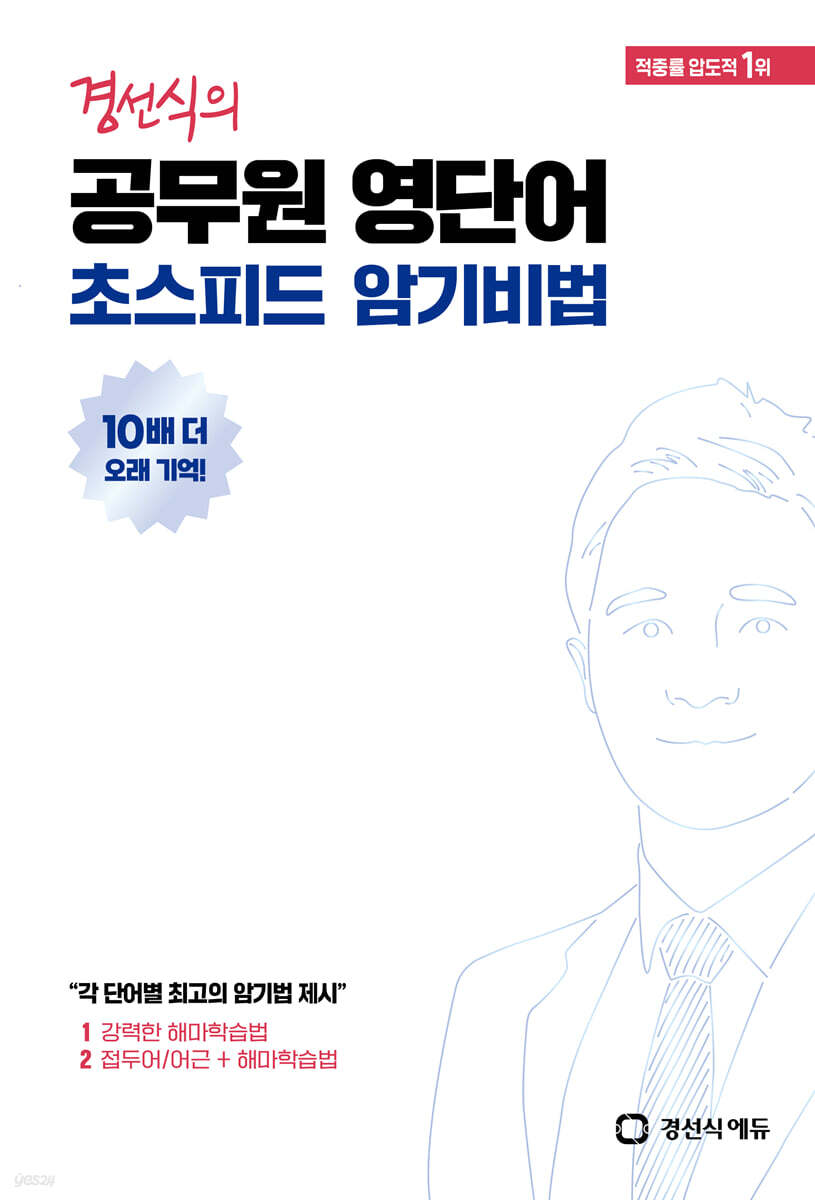
Super-speed memorization tips for civil servant English vocabulary from the primary elections
 |
Description
Book Introduction
The most important thing in studying civil service English vocabulary is accuracy.
The secret to memorizing English vocabulary at lightning speed for the civil service exam is overwhelmingly #1 in accuracy.
“The best memorization technique for each word” to help you remember 10 times longer!
"How to shorten the civil service exam study period by more than six months?" Memorize perfectly in 20 days using the Hippocampus Learning Method.
1.
Powerful hippocampus learning method
2.
Prefix/root + hippocampus learning method
3.
Enhanced memorization effect with the inclusion of associative cartoons and upgraded associative methods
4.
The "Kyungseonsik English Vocabulary" series, which sold 3.6 million copies
The "Kyungseonsik English Vocabulary" series has been a steady seller, read by over 3.6 million students since its first publication in 2003.
The secret to memorizing civil servant English vocabulary at lightning speed includes 3,000 essential CSAT vocabulary words and 340 high-difficulty vocabulary words.
A total of 3,400 important words are included in order of priority.
In particular, it perfectly analyzes the exam according to the changes in the 2025 exam pattern, showing an overwhelming accuracy rate compared to other civil service books.
Additionally, by utilizing video lectures to achieve a definite 10x effect, you can complete the civil servant English vocabulary required for more than 6 months in just 20 days by taking 3 hours of classes per day.
The secret to memorizing English vocabulary at lightning speed for the civil service exam is overwhelmingly #1 in accuracy.
“The best memorization technique for each word” to help you remember 10 times longer!
"How to shorten the civil service exam study period by more than six months?" Memorize perfectly in 20 days using the Hippocampus Learning Method.
1.
Powerful hippocampus learning method
2.
Prefix/root + hippocampus learning method
3.
Enhanced memorization effect with the inclusion of associative cartoons and upgraded associative methods
4.
The "Kyungseonsik English Vocabulary" series, which sold 3.6 million copies
The "Kyungseonsik English Vocabulary" series has been a steady seller, read by over 3.6 million students since its first publication in 2003.
The secret to memorizing civil servant English vocabulary at lightning speed includes 3,000 essential CSAT vocabulary words and 340 high-difficulty vocabulary words.
A total of 3,400 important words are included in order of priority.
In particular, it perfectly analyzes the exam according to the changes in the 2025 exam pattern, showing an overwhelming accuracy rate compared to other civil service books.
Additionally, by utilizing video lectures to achieve a definite 10x effect, you can complete the civil servant English vocabulary required for more than 6 months in just 20 days by taking 3 hours of classes per day.
- You can preview some of the book's contents.
Preview
index
PART I Basics - Civil Service Basic Vocabulary
01.
Hippocampus Learning Method Lessons 1-37
02.
Prefix/Root + Hippocampus Learning Method Lessons 38-49
Other key vocabulary
PART II Completion - Civil Service Vocabulary (Essential Vocabulary for Scoring 95 or More on the Civil Service Exam)
01.
Hippocampus Learning Method Lessons 1-38
02 Prefixes/Roots + Hippocampus Learning Method Lessons 39-50
Other key vocabulary
PART III: High-Difficulty Vocabulary for Civil Service Exams (Required High-Difficulty Vocabulary for a Perfect Score on the Civil Service Exam)
01.
Hippocampus Learning Method Lessons 1-15
INDEX
01.
Hippocampus Learning Method Lessons 1-37
02.
Prefix/Root + Hippocampus Learning Method Lessons 38-49
Other key vocabulary
PART II Completion - Civil Service Vocabulary (Essential Vocabulary for Scoring 95 or More on the Civil Service Exam)
01.
Hippocampus Learning Method Lessons 1-38
02 Prefixes/Roots + Hippocampus Learning Method Lessons 39-50
Other key vocabulary
PART III: High-Difficulty Vocabulary for Civil Service Exams (Required High-Difficulty Vocabulary for a Perfect Score on the Civil Service Exam)
01.
Hippocampus Learning Method Lessons 1-15
INDEX
Detailed image

Publisher's Review
There is a part of our brain called the hippocampus.
This hippocampus is where we focus our efforts when we make memories.
When we memorize English words by reading or writing them without thinking, the hippocampus is hardly activated. However, experiments have clearly proven that when we memorize by imagining a situation and drawing a picture in our heads, the hippocampus becomes more active.
If you imagine and memorize a scene like this, you will be able to remember it for a much longer period of time than if you just memorize it blindly.
Ultimately, the hippocampus learning method is an effective learning method that maximizes the memorization effect by making it easy to associate difficult-to-memorize content with images.
- What is the hippocampus learning method?
There is a part of our brain called the hippocampus.
It is named after its similar shape to a sea animal, the hippocampus, and this hippocampus is the area that is intensively used when we remember things.
However, when we memorize English words by reading or writing them without thinking, this hippocampus part is hardly activated.
On the other hand, it has been clearly experimentally proven that when you imagine a situation and memorize it by drawing a picture in your head, the hippocampus becomes more active.
If you imagine and memorize a scene like this, you will be able to remember it for a much longer period of time than if you just memorize it blindly.
Ultimately, the hippocampus learning method is an effective learning method that maximizes the memorization effect by making it easy to associate difficult-to-memorize content with images.
- Example of application of hippocampus learning method
To apply the hippocampus learning method to memorizing words, you need to create an appropriate image for each word.
For example, in order to memorize 'fruit (fruit-t: fruit)', you need to connect the word 'fruit' and its meaning with a video image, but the pronunciation 'fruit-t' can be recognized as a Korean word with a similar pronunciation, such as 'purut'.
That is, while pronouncing 'fruit' correctly, imagine the image of a green 'fruit' and remember it as a picture.
If you pronounce a word like this and bring to mind a visual image related to the meaning of the word, you will easily memorize the meaning and remember it for a long time.
- The memory strategy introduced in the K-broadcasting series 'How to Study Well' is the hippocampus learning method.
In the 'How to Study Well' series on K Broadcasting, the effectiveness of memory using association methods was measured and introduced.
Among a total of 100 subjects, 10 people whose memorization ability was ranked between 90th and 100th were trained to memorize using the association method. As a result, their memorization ability rankings improved significantly to 37th, 32nd, and 13th.
The association method increases brain utilization by equally utilizing the left brain, which remembers words and numbers, and the right brain, which remembers images.
Many experts agree that this hippocampal learning method is very effective in improving memory.
Maximize your memorization! How to use this book 200% for maximum effectiveness.
1.
The goal is to memorize the 'meaning'.
The goal is to memorize the meaning.
Focus on the part that connects the association to the meaning, and memorize it by feeling, acting, and thinking about the meaning directly through empathy.
2.
If you can't remember the meaning within 1 second, review it.
When reviewing, if you cannot remember the meaning of a word within 1 second, it means that you have not memorized it perfectly, so mark it in the review section and memorize it repeatedly.
3.
Review should be done within 5 minutes or so after finishing studying.
You can memorize it perfectly if you review it for about 3 minutes right after the lecture, but if you review it later, it will take even more time.
(Look up Ebbinghaus' forgetting curve.)
4.
Study examples after you have memorized 100% of the vocabulary.
When you feel confident that you have memorized 100% of the vocabulary in the book from the first lesson to the last, then study the example sentences.
However, if you don't quite understand the meaning of a word or don't know how to use it, try looking at an example sentence at least at the beginning.
5.
Please review without missing any of the 1st, 5th, and 25th lessons.
You must review all units, including units 1, 5, and 25, without fail.
While reviewing, mark words that you have trouble remembering and review those marked words over and over again until you have memorized them perfectly.
6.
At first, just focus on memorizing the titles.
At first, just focus on memorizing the titles.
After reading the entire book or lecture once, study the derivatives. To study the derivatives, read them lightly once or twice, paying attention to the conjugation of the endings to see how they change from the title word.
As you study in this way, you will naturally learn the conjugation of derivative words and study the entire book's derivative words.
After that, it would be an efficient method to memorize the derivatives more thoroughly from Lesson 1 again.
7.
Never take notes while listening to a lecture!
The lecture itself is a time for memorizing vocabulary.
Taking notes can make it difficult to concentrate on the lecture.
Try to focus on the lecture as much as possible, memorize it by imitating the teacher's pronunciation, and sometimes even imitating the actions, so that you can focus only on memorizing the words.
8.
Save study time by increasing the lecture speed.
Once you become familiar with the lecture, try listening at a higher speed without interfering with memorization.
You can save more time.
(You will be able to memorize a whole river perfectly in 10 to 15 minutes.)
This hippocampus is where we focus our efforts when we make memories.
When we memorize English words by reading or writing them without thinking, the hippocampus is hardly activated. However, experiments have clearly proven that when we memorize by imagining a situation and drawing a picture in our heads, the hippocampus becomes more active.
If you imagine and memorize a scene like this, you will be able to remember it for a much longer period of time than if you just memorize it blindly.
Ultimately, the hippocampus learning method is an effective learning method that maximizes the memorization effect by making it easy to associate difficult-to-memorize content with images.
- What is the hippocampus learning method?
There is a part of our brain called the hippocampus.
It is named after its similar shape to a sea animal, the hippocampus, and this hippocampus is the area that is intensively used when we remember things.
However, when we memorize English words by reading or writing them without thinking, this hippocampus part is hardly activated.
On the other hand, it has been clearly experimentally proven that when you imagine a situation and memorize it by drawing a picture in your head, the hippocampus becomes more active.
If you imagine and memorize a scene like this, you will be able to remember it for a much longer period of time than if you just memorize it blindly.
Ultimately, the hippocampus learning method is an effective learning method that maximizes the memorization effect by making it easy to associate difficult-to-memorize content with images.
- Example of application of hippocampus learning method
To apply the hippocampus learning method to memorizing words, you need to create an appropriate image for each word.
For example, in order to memorize 'fruit (fruit-t: fruit)', you need to connect the word 'fruit' and its meaning with a video image, but the pronunciation 'fruit-t' can be recognized as a Korean word with a similar pronunciation, such as 'purut'.
That is, while pronouncing 'fruit' correctly, imagine the image of a green 'fruit' and remember it as a picture.
If you pronounce a word like this and bring to mind a visual image related to the meaning of the word, you will easily memorize the meaning and remember it for a long time.
- The memory strategy introduced in the K-broadcasting series 'How to Study Well' is the hippocampus learning method.
In the 'How to Study Well' series on K Broadcasting, the effectiveness of memory using association methods was measured and introduced.
Among a total of 100 subjects, 10 people whose memorization ability was ranked between 90th and 100th were trained to memorize using the association method. As a result, their memorization ability rankings improved significantly to 37th, 32nd, and 13th.
The association method increases brain utilization by equally utilizing the left brain, which remembers words and numbers, and the right brain, which remembers images.
Many experts agree that this hippocampal learning method is very effective in improving memory.
Maximize your memorization! How to use this book 200% for maximum effectiveness.
1.
The goal is to memorize the 'meaning'.
The goal is to memorize the meaning.
Focus on the part that connects the association to the meaning, and memorize it by feeling, acting, and thinking about the meaning directly through empathy.
2.
If you can't remember the meaning within 1 second, review it.
When reviewing, if you cannot remember the meaning of a word within 1 second, it means that you have not memorized it perfectly, so mark it in the review section and memorize it repeatedly.
3.
Review should be done within 5 minutes or so after finishing studying.
You can memorize it perfectly if you review it for about 3 minutes right after the lecture, but if you review it later, it will take even more time.
(Look up Ebbinghaus' forgetting curve.)
4.
Study examples after you have memorized 100% of the vocabulary.
When you feel confident that you have memorized 100% of the vocabulary in the book from the first lesson to the last, then study the example sentences.
However, if you don't quite understand the meaning of a word or don't know how to use it, try looking at an example sentence at least at the beginning.
5.
Please review without missing any of the 1st, 5th, and 25th lessons.
You must review all units, including units 1, 5, and 25, without fail.
While reviewing, mark words that you have trouble remembering and review those marked words over and over again until you have memorized them perfectly.
6.
At first, just focus on memorizing the titles.
At first, just focus on memorizing the titles.
After reading the entire book or lecture once, study the derivatives. To study the derivatives, read them lightly once or twice, paying attention to the conjugation of the endings to see how they change from the title word.
As you study in this way, you will naturally learn the conjugation of derivative words and study the entire book's derivative words.
After that, it would be an efficient method to memorize the derivatives more thoroughly from Lesson 1 again.
7.
Never take notes while listening to a lecture!
The lecture itself is a time for memorizing vocabulary.
Taking notes can make it difficult to concentrate on the lecture.
Try to focus on the lecture as much as possible, memorize it by imitating the teacher's pronunciation, and sometimes even imitating the actions, so that you can focus only on memorizing the words.
8.
Save study time by increasing the lecture speed.
Once you become familiar with the lecture, try listening at a higher speed without interfering with memorization.
You can save more time.
(You will be able to memorize a whole river perfectly in 10 to 15 minutes.)
GOODS SPECIFICS
- Date of issue: July 15, 2025
- Page count, weight, size: 656 pages | 170*250*23mm
- ISBN13: 9791189902216
- ISBN10: 1189902214
You may also like
카테고리
korean


korean

![ELLE 엘르 스페셜 에디션 A형 : 12월 [2025]](http://librairie.coreenne.fr/cdn/shop/files/b8e27a3de6c9538896439686c6b0e8fb.jpg?v=1766436872&width=3840)


