

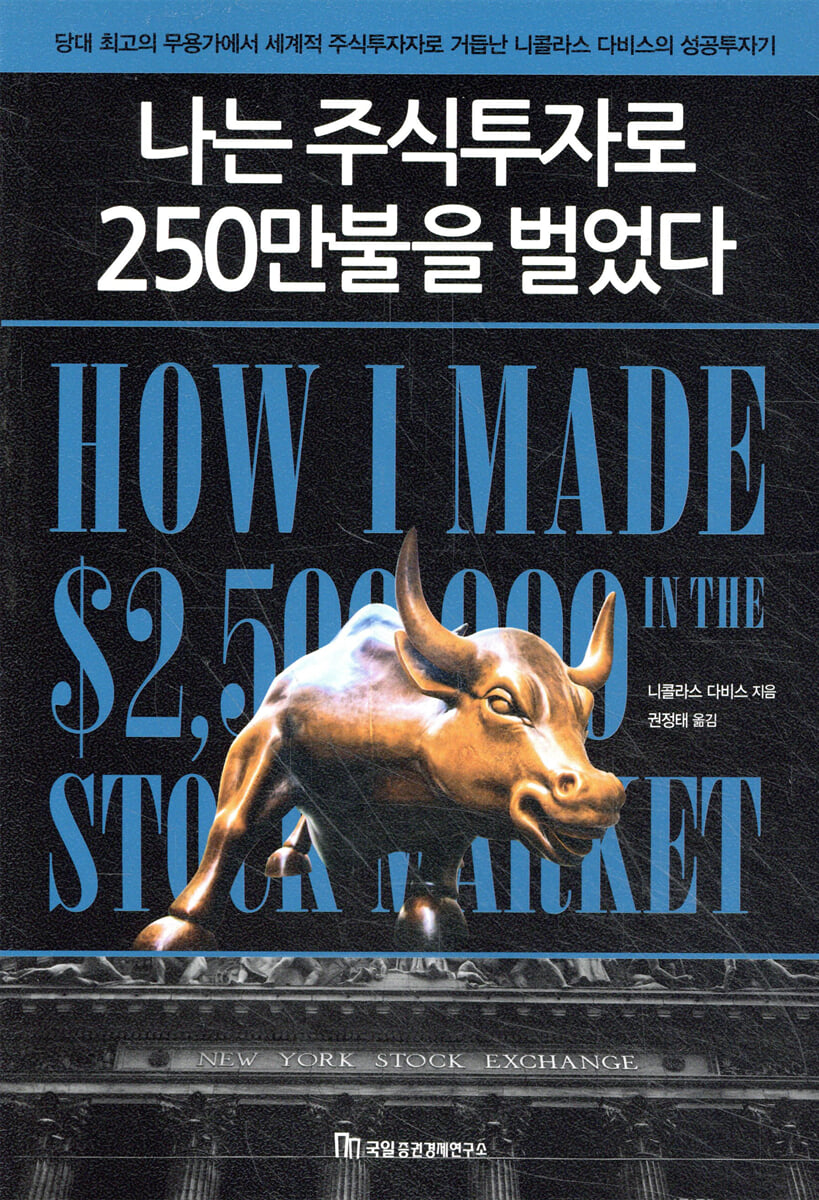
I made $2.5 million investing in stocks.
 |
Description
Book Introduction
From world-renowned dancer to stock investor
Nicholas Davis' investment success story!
In the 1950s, the story of the success of the greatest dancer of his time, who made a whopping $2.5 million in stock investment, a feat that even American stock experts would have found difficult to achieve, has been republished in a new and improved form.
This book, which was published a long time ago and became a bestseller worldwide, was until recently considered a best practice by stockbrokers and many investors, and has been consistently loved as a financial management strategy book for companies.
This book is based on investment experiences from 60 years ago, but it also guides you in forming an "investment mindset" regarding the mindset with which you should invest.
This fascinating account of the success story of a dancer who was a complete novice in stock investment and became a world-class investment expert, along with the countless errors and analytical processes, is presented.
The appendix contains a summary of questions the author has received since the book was published, along with detailed answers to those questions.
Through this book, you will learn that even in the ever-changing securities industry, there are principles of stock investment that remain unchanged.
Nicholas Davis' investment success story!
In the 1950s, the story of the success of the greatest dancer of his time, who made a whopping $2.5 million in stock investment, a feat that even American stock experts would have found difficult to achieve, has been republished in a new and improved form.
This book, which was published a long time ago and became a bestseller worldwide, was until recently considered a best practice by stockbrokers and many investors, and has been consistently loved as a financial management strategy book for companies.
This book is based on investment experiences from 60 years ago, but it also guides you in forming an "investment mindset" regarding the mindset with which you should invest.
This fascinating account of the success story of a dancer who was a complete novice in stock investment and became a world-class investment expert, along with the countless errors and analytical processes, is presented.
The appendix contains a summary of questions the author has received since the book was published, along with detailed answers to those questions.
Through this book, you will learn that even in the ever-changing securities industry, there are principles of stock investment that remain unchanged.
- You can preview some of the book's contents.
Preview
index
Part 1: Speculation, Not Investment
Chapter 1: Investing in Stocks for the First Time in My Life
Part 2: The Principled Era
Chapter 2: Entering Wall Street
Chapter 3: The First Crisis I Faced
Part 3: Becoming a Technical Analyst
Chapter 4: Development of Box Theory
Chapter 5: Stock Trading via International Telegraph
Part 4: Becoming a Technical Fundamentalist
Chapter 6: The Recession Market Period
Chapter 7: The Theory Begins to Fit
Chapter 8 My First Half a Million Dollars
Chapter 9: The Second Crisis That Befell Me
Chapter 10 Earn $2 Million
supplement
Interview with Time magazine
ㆍTrading using telegrams
Weekly prices and trading volume for major stocks
ㆍAnswers to readers' questions
Chapter 1: Investing in Stocks for the First Time in My Life
Part 2: The Principled Era
Chapter 2: Entering Wall Street
Chapter 3: The First Crisis I Faced
Part 3: Becoming a Technical Analyst
Chapter 4: Development of Box Theory
Chapter 5: Stock Trading via International Telegraph
Part 4: Becoming a Technical Fundamentalist
Chapter 6: The Recession Market Period
Chapter 7: The Theory Begins to Fit
Chapter 8 My First Half a Million Dollars
Chapter 9: The Second Crisis That Befell Me
Chapter 10 Earn $2 Million
supplement
Interview with Time magazine
ㆍTrading using telegrams
Weekly prices and trading volume for major stocks
ㆍAnswers to readers' questions
Detailed image

Into the book
If some wild beauty climbed onto a table and started dancing wildly, no one would be very surprised.
Because people expect her to have that kind of personality.
But if an older, respectable woman suddenly did something like that, people would see her as abnormal and immediately say something like this:
“There are all sorts of things going on.
“Why on earth is it like that?”
Likewise, if a stock that has always been stable suddenly becomes more active, it can be inferred that something is different from usual.
If the price rises at this time, you can consider buying.
In other words, behind this stock's unusual behavior, there are people somewhere who have heard good news in advance and are buying it.
If I buy this stock at this time, I too will become a silent comrade of theirs.
Because people expect her to have that kind of personality.
But if an older, respectable woman suddenly did something like that, people would see her as abnormal and immediately say something like this:
“There are all sorts of things going on.
“Why on earth is it like that?”
Likewise, if a stock that has always been stable suddenly becomes more active, it can be inferred that something is different from usual.
If the price rises at this time, you can consider buying.
In other words, behind this stock's unusual behavior, there are people somewhere who have heard good news in advance and are buying it.
If I buy this stock at this time, I too will become a silent comrade of theirs.
--- p.68
Publisher's Review
Discover the principles of stock investment by discovering the 'box theory'!
“Stock price fluctuations never occur by chance.
Once a stock price has decided on a direction, it tends to continue moving in that direction for a while.
“While moving in this set direction, the stock price repeats its movements within a certain framework. I called this framework a ‘box.’”
Davis started investing in stocks by chance and after seeing profits, he became fascinated by the allure of stock investment.
He studied the financial analysis of a company in his own way and met many people to get good information, but he eventually realized that by the time he learned the information, it was already reflected in the stock price.
He meticulously recorded the stocks he bought and sold, their prices at the time, and his profits and losses. As he experienced numerous profits and losses, he gradually learned the principles of stock investment.
He created the 'box theory', which is still used as an important indicator in technical analysis today.
In short, the box theory states that once a stock price has decided on a direction, it will continue to move in that direction for a while, while repeating the movement within a certain framework.
Davis says that when a stock price that has formed a certain box breaks out of the box upward, there are factors for an increase, and when it breaks out of the box downward, there are factors for a decrease. Therefore, the key to investing is to analyze this direction and appropriately select the timing for buying and selling.
Additionally, it is said that if you set up automatic stop loss, you are more likely to make a profit while minimizing losses.
Easy and fun investment strategy book
Rather than being a professional stock investment guide, this book is a friendly account of how Hungarian dancer Nicholas Davis came to invest in stocks, and the countless mistakes and analytical processes he went through on his way to success.
Just reading Davis's words will make you nod your head in agreement with his unique theory.
- Focus on buying stocks that break out of the box upwards, and sell them when they break out downwards, setting a stop-loss price in advance.
-Flexibly adjust the stop-loss price according to the stock price trend (when the stock price starts to rise, raise the standard for the box rights, purchase additional volume, and raise the sell price and stop-loss price.)
-Do not sell rising stocks (however, always be prepared to cut your losses and sell stocks as quickly as possible when the trend reverses).
-Trade only blue-chip stocks and do not touch over-the-counter stocks with low trading volume. (I chose to purchase only stocks that break above the trading range by placing a limit buy order in advance, and automatically place a stop-loss order when the specified price is reached.)
There is an economic downturn, a recession, and people are complaining all over the place.
Anyone who is considering investing in stocks at the right time will find it useful to read this book, practice understanding market trends, and apply it to real-world situations.
“Stock price fluctuations never occur by chance.
Once a stock price has decided on a direction, it tends to continue moving in that direction for a while.
“While moving in this set direction, the stock price repeats its movements within a certain framework. I called this framework a ‘box.’”
Davis started investing in stocks by chance and after seeing profits, he became fascinated by the allure of stock investment.
He studied the financial analysis of a company in his own way and met many people to get good information, but he eventually realized that by the time he learned the information, it was already reflected in the stock price.
He meticulously recorded the stocks he bought and sold, their prices at the time, and his profits and losses. As he experienced numerous profits and losses, he gradually learned the principles of stock investment.
He created the 'box theory', which is still used as an important indicator in technical analysis today.
In short, the box theory states that once a stock price has decided on a direction, it will continue to move in that direction for a while, while repeating the movement within a certain framework.
Davis says that when a stock price that has formed a certain box breaks out of the box upward, there are factors for an increase, and when it breaks out of the box downward, there are factors for a decrease. Therefore, the key to investing is to analyze this direction and appropriately select the timing for buying and selling.
Additionally, it is said that if you set up automatic stop loss, you are more likely to make a profit while minimizing losses.
Easy and fun investment strategy book
Rather than being a professional stock investment guide, this book is a friendly account of how Hungarian dancer Nicholas Davis came to invest in stocks, and the countless mistakes and analytical processes he went through on his way to success.
Just reading Davis's words will make you nod your head in agreement with his unique theory.
- Focus on buying stocks that break out of the box upwards, and sell them when they break out downwards, setting a stop-loss price in advance.
-Flexibly adjust the stop-loss price according to the stock price trend (when the stock price starts to rise, raise the standard for the box rights, purchase additional volume, and raise the sell price and stop-loss price.)
-Do not sell rising stocks (however, always be prepared to cut your losses and sell stocks as quickly as possible when the trend reverses).
-Trade only blue-chip stocks and do not touch over-the-counter stocks with low trading volume. (I chose to purchase only stocks that break above the trading range by placing a limit buy order in advance, and automatically place a stop-loss order when the specified price is reached.)
There is an economic downturn, a recession, and people are complaining all over the place.
Anyone who is considering investing in stocks at the right time will find it useful to read this book, practice understanding market trends, and apply it to real-world situations.
GOODS SPECIFICS
- Publication date: January 10, 2021
- Page count, weight, size: 232 pages | 436g | 152*223*20mm
- ISBN13: 9788957821336
- ISBN10: 8957821333
You may also like
카테고리
korean


korean

![GQ KOREA Mark (Monthly): December [2025]](http://librairie.coreenne.fr/cdn/shop/files/8ef265dbbfbf186523ed75ba7319009d.jpg?v=1765340328&width=3840)


