

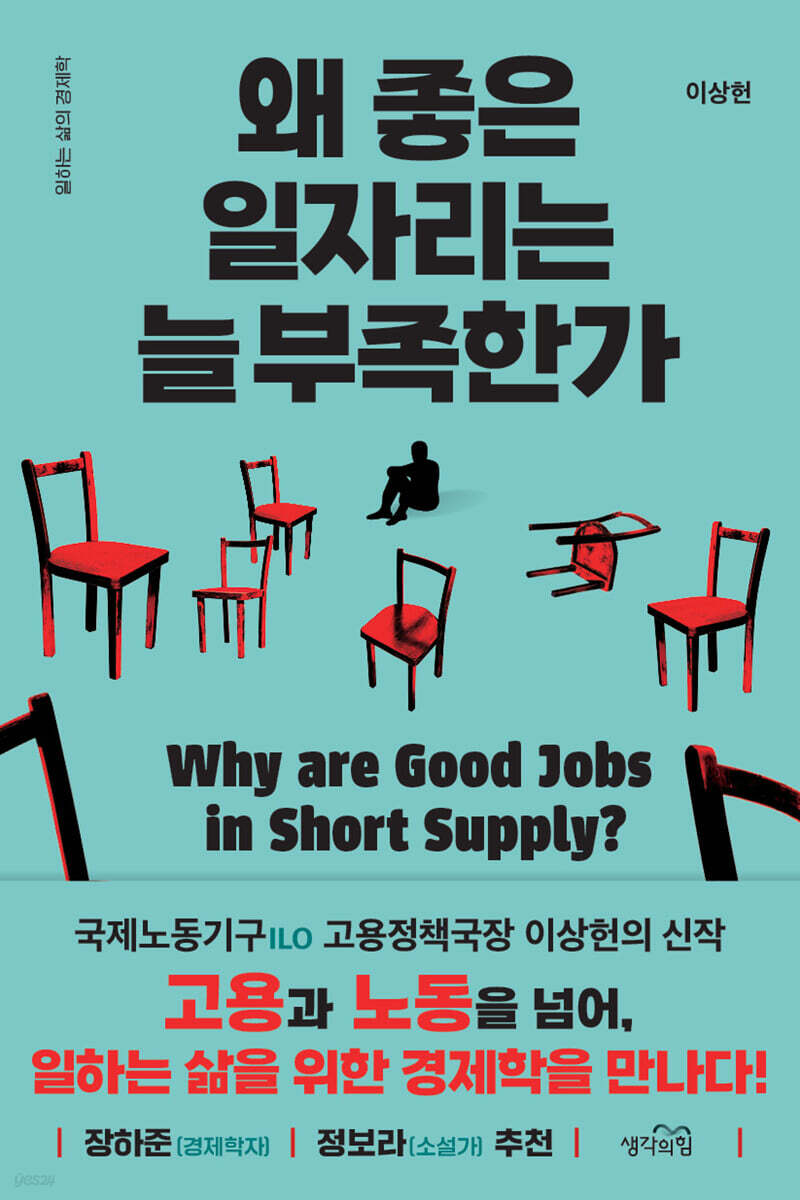
Why Good Jobs Are Always Scarce
 |
Description
Book Introduction
A book has been published that redefines 'work as the meaning of life' between market logic and human dignity.
Lee Sang-heon, Director of the Employment Policy Department of the International Labour Organization (ILO), examines the essence of today's employment problems through a series titled "The Economics of Working Life."
To see beyond the numbers and find a way through the discord, we must confront head-on the challenges that Korean society must address here and now.
Having spent the past 30 years developing and advising policy at the forefront of international organizations, policymaking, and economics research, he presents an introductory book on employment that combines academic insights with practical considerations.
The first book in the series, "Why Good Jobs Are Always Scarce," goes beyond economic analysis, which provides a clear answer, and asks again about the value of "working life" that exists outside the narrow concepts of labor and employment.
The book, consisting of nine chapters, vividly depicts working life in this country based on a multi-layered awareness of the issues surrounding "good jobs" in each chapter and seeks realistic alternatives throughout.
Covering a wide range of topics, including unemployment, the social value of work, compensation or wages, minimum wage, working hours, technological change, migrant labor, and the roles of government and corporations, it fundamentally shakes up the way we view work and employment.
Drawing on various economic theories, research findings, and the latest international case studies, it offers insights that transcend the limitations of conventional economics, leading readers on a fascinating and rewarding journey as they piece together the complex puzzle before us.
Lee Sang-heon, Director of the Employment Policy Department of the International Labour Organization (ILO), examines the essence of today's employment problems through a series titled "The Economics of Working Life."
To see beyond the numbers and find a way through the discord, we must confront head-on the challenges that Korean society must address here and now.
Having spent the past 30 years developing and advising policy at the forefront of international organizations, policymaking, and economics research, he presents an introductory book on employment that combines academic insights with practical considerations.
The first book in the series, "Why Good Jobs Are Always Scarce," goes beyond economic analysis, which provides a clear answer, and asks again about the value of "working life" that exists outside the narrow concepts of labor and employment.
The book, consisting of nine chapters, vividly depicts working life in this country based on a multi-layered awareness of the issues surrounding "good jobs" in each chapter and seeks realistic alternatives throughout.
Covering a wide range of topics, including unemployment, the social value of work, compensation or wages, minimum wage, working hours, technological change, migrant labor, and the roles of government and corporations, it fundamentally shakes up the way we view work and employment.
Drawing on various economic theories, research findings, and the latest international case studies, it offers insights that transcend the limitations of conventional economics, leading readers on a fascinating and rewarding journey as they piece together the complex puzzle before us.
- You can preview some of the book's contents.
Preview
index
Recommendation
Entering
Chapter 1: Unemployment: One Reality, Diverging Ideas
The Labor Market and the Discord Between Supply and Demand | Is Unemployment Labor's Fault or the Government's? | Not the 'Invisible Hand' but the 'Visible Hand': Adam Smith's Guide to the 'World' | Is Unemployment a Strategic Tool of Capitalism? | Is Unemployment a Chronic Disease of Capitalism, but Not an Incurable One? | Is the Government a Quack Doctor? | Reinterpreting Full Employment: 'Natural' Unemployment? | Summary: Why Are There Different Views on Unemployment?
Chapter 2 The World of Work: Beyond Employment and Labor
What is Employment? | Unemployment: Another Ambiguous World | Employment or Work? | Summary: What on Earth is 'Work'?
Chapter 3: The Value of Jobs: Social Value and Contributory Justice
The recurring pain of unemployment | The epidemic of unemployment | The misery of unemployment breeds hatred | The labor market that undervalues good jobs and overvalues bad jobs | Jobs and social justice: contributory justice | Summary: To make the social value of work the cornerstone of society and the economy
Chapter 4: The Price of Work: Wages Too High, Wages Too Low
Baekbeom Kim Gu's Concerns: What on Earth Are Wages (Labor Wages)? | Labor Contracts Full of Holes | 'Scientific' Wage Determination?: 'Scientific Management' That's Not So Scientific | Neglectful Workers, Responsive Workers | Voices and Negotiations to Fill the Holes in Contracts | Shrinking Voices, Growing Inequality: Running Productivity, Crawling Wages | The Common and Wrong Prescription of Moderating Wage Increases | An Uneven Playing Field Endangers Everyone: The Boomerang of Inequality | Inflation Episode: 'Don't Believe What They Say' | Summary: The Myth of 'Because of Too High Wages'
Chapter 5: The Price of Low Work: Is the Minimum Wage a Blessing or a Mistake?
The Division of the Wage World and Low-Wage Jobs | Is the Minimum Wage a Warm Sweater or a Clumsy Devil? | Negative Employment Effects?: Strong Theoretical Arguments, Weak Empirical Evidence, and Implicit Bias | Why the Minimum Wage is 'Productive' | Why the Minimum Wage Reduces Market Inefficiency: Monopsony and Market Failure | How It's Operated, That's the Question | Summary: The Minimum Wage is a Cautious Blessing
Chapter 6: Working Hours: The Dream and Frustration of Shorter Working Hours
Why Optimism Fails | Working Hours Will Not Decrease Automatically: Ask and You Will Get! | The Uneconomical Effects of Long Working Hours: Long Working Hours Are Neither Healthy nor Productive | Why Are Legal Regulations on Working Hours Necessary? | Too Long, Too Short: Is Short-Term Work a Virtue or a Trap? | Housework Time: Invisible Time, Unequal Time | Let's Reduce Working Hours and Increase Jobs?: The Possibilities and Limits of Job Sharing | Summary: The Dual Challenges of Working Hours
Chapter 7: Technological Change: Abundance and Shadow, Differentiated Jobs and Fragmented Workplaces
The inevitable bias that new technologies will reduce overall employment | Why predictions fail: Between pessimism and optimism | Job disappearance and creation and the risk of polarization | The trade-offs of education and training: So important, yet so little investment? | The economic rationality of social support: The breakwater of employment insurance | Summary: The use and choice of technology for working people
Chapter 8: Cross-Border Labor: Migrant Labor, Misunderstandings, and Prejudice
People Crossing Borders in Search of Jobs | Labor Called Out of Necessity, Another Invisible Labor | Are Migrant Workers Taking My Job and Lowering My Wages? | Why the Underdogs in the Labor Market Fear Migrant Workers, Another Underdog | Discrimination Against Migrant Workers Comes Back Like a Boomerang: Three Possibilities | Summary: Working and Living with Migrant Workers Beyond Prejudice and Misunderstanding
Chapter 9: A Society Investing in Working Life
It takes a village to create a job: The Marienthal Experiment | The first step toward a society that creates good jobs: Investments in contributory justice | The right to work, a constitutional right | Jobs as a goal of monetary policy | Fiscal policy for jobs | Job-friendly industrial policy | Job-friendly technology policy | Public investment in social service jobs | Just transition and good jobs in response to climate change | Support for companies that create or maintain good jobs | Policies to reduce bad jobs: Minimum wage, working hours, occupational safety, employment security | Gardening to create good jobs: Investment in education and training | A society that equally shares good jobs | Jobs for everyone!: The possibilities and limits of a universal jobs guarantee | The devil is in the details: Effective operation of labor market policies | Speaking, communicating, and spreading good jobs: A battle of narratives
Going out
main
References
Entering
Chapter 1: Unemployment: One Reality, Diverging Ideas
The Labor Market and the Discord Between Supply and Demand | Is Unemployment Labor's Fault or the Government's? | Not the 'Invisible Hand' but the 'Visible Hand': Adam Smith's Guide to the 'World' | Is Unemployment a Strategic Tool of Capitalism? | Is Unemployment a Chronic Disease of Capitalism, but Not an Incurable One? | Is the Government a Quack Doctor? | Reinterpreting Full Employment: 'Natural' Unemployment? | Summary: Why Are There Different Views on Unemployment?
Chapter 2 The World of Work: Beyond Employment and Labor
What is Employment? | Unemployment: Another Ambiguous World | Employment or Work? | Summary: What on Earth is 'Work'?
Chapter 3: The Value of Jobs: Social Value and Contributory Justice
The recurring pain of unemployment | The epidemic of unemployment | The misery of unemployment breeds hatred | The labor market that undervalues good jobs and overvalues bad jobs | Jobs and social justice: contributory justice | Summary: To make the social value of work the cornerstone of society and the economy
Chapter 4: The Price of Work: Wages Too High, Wages Too Low
Baekbeom Kim Gu's Concerns: What on Earth Are Wages (Labor Wages)? | Labor Contracts Full of Holes | 'Scientific' Wage Determination?: 'Scientific Management' That's Not So Scientific | Neglectful Workers, Responsive Workers | Voices and Negotiations to Fill the Holes in Contracts | Shrinking Voices, Growing Inequality: Running Productivity, Crawling Wages | The Common and Wrong Prescription of Moderating Wage Increases | An Uneven Playing Field Endangers Everyone: The Boomerang of Inequality | Inflation Episode: 'Don't Believe What They Say' | Summary: The Myth of 'Because of Too High Wages'
Chapter 5: The Price of Low Work: Is the Minimum Wage a Blessing or a Mistake?
The Division of the Wage World and Low-Wage Jobs | Is the Minimum Wage a Warm Sweater or a Clumsy Devil? | Negative Employment Effects?: Strong Theoretical Arguments, Weak Empirical Evidence, and Implicit Bias | Why the Minimum Wage is 'Productive' | Why the Minimum Wage Reduces Market Inefficiency: Monopsony and Market Failure | How It's Operated, That's the Question | Summary: The Minimum Wage is a Cautious Blessing
Chapter 6: Working Hours: The Dream and Frustration of Shorter Working Hours
Why Optimism Fails | Working Hours Will Not Decrease Automatically: Ask and You Will Get! | The Uneconomical Effects of Long Working Hours: Long Working Hours Are Neither Healthy nor Productive | Why Are Legal Regulations on Working Hours Necessary? | Too Long, Too Short: Is Short-Term Work a Virtue or a Trap? | Housework Time: Invisible Time, Unequal Time | Let's Reduce Working Hours and Increase Jobs?: The Possibilities and Limits of Job Sharing | Summary: The Dual Challenges of Working Hours
Chapter 7: Technological Change: Abundance and Shadow, Differentiated Jobs and Fragmented Workplaces
The inevitable bias that new technologies will reduce overall employment | Why predictions fail: Between pessimism and optimism | Job disappearance and creation and the risk of polarization | The trade-offs of education and training: So important, yet so little investment? | The economic rationality of social support: The breakwater of employment insurance | Summary: The use and choice of technology for working people
Chapter 8: Cross-Border Labor: Migrant Labor, Misunderstandings, and Prejudice
People Crossing Borders in Search of Jobs | Labor Called Out of Necessity, Another Invisible Labor | Are Migrant Workers Taking My Job and Lowering My Wages? | Why the Underdogs in the Labor Market Fear Migrant Workers, Another Underdog | Discrimination Against Migrant Workers Comes Back Like a Boomerang: Three Possibilities | Summary: Working and Living with Migrant Workers Beyond Prejudice and Misunderstanding
Chapter 9: A Society Investing in Working Life
It takes a village to create a job: The Marienthal Experiment | The first step toward a society that creates good jobs: Investments in contributory justice | The right to work, a constitutional right | Jobs as a goal of monetary policy | Fiscal policy for jobs | Job-friendly industrial policy | Job-friendly technology policy | Public investment in social service jobs | Just transition and good jobs in response to climate change | Support for companies that create or maintain good jobs | Policies to reduce bad jobs: Minimum wage, working hours, occupational safety, employment security | Gardening to create good jobs: Investment in education and training | A society that equally shares good jobs | Jobs for everyone!: The possibilities and limits of a universal jobs guarantee | The devil is in the details: Effective operation of labor market policies | Speaking, communicating, and spreading good jobs: A battle of narratives
Going out
main
References
Detailed image

Into the book
The problem needs to be clarified.
It is not accurate to ask, “Why are there a shortage of jobs?”
If you go to a poor village in Africa, everyone works.
By the numbers, this is a 'full employment' situation.
If you don't work, you can't make a living, so you have to go out on the street and sell woodcrafts you made overnight.
In places where unemployment is a 'luxury', everyone has to work, and so the ridiculous situation of no shortage of jobs arises.
What's missing are 'good' jobs.
It's no different in a rich country.
There are plenty of jobs that require people to endure hardship and danger for barely enough to earn minimum wage.
It is a common daily routine, especially for young people, women, and the elderly.
So the question we need to ask is, “Why are there so few ‘good’ jobs?”
--- p.14, from “Introduction”
How does the labor market become a "market"? To put it bluntly, the definition of a market is infinitely complex. So, let's simplify it: "A market is a place where prices and transaction volumes are determined by supply and demand."
Of course, the term market does not necessarily refer to a physical space where transactions are conducted face-to-face, like a department store.
The stock market is also a market, where millions of dollars are traded across borders the moment you press a computer keyboard, and you don't know or need to know who your counterparty is.
Coming to the market in search of a job means submitting oneself to the logic of supply and demand.
I'll explain it step by step, since it's good to know.
When the price of labor (for convenience, 'wages') rises, the supply of labor increases because more people want to do more work.
If we represent this on a graph, a line is drawn that goes up to the right as the amount of labor increases along with the increase in wages.
In difficult terms, it is the labor supply curve.
However, the company's position is the opposite.
As wages rise, costs rise accordingly, so unless other conditions change, companies tend to reduce employment.
If we represent this on a graph, a line is drawn that goes down to the right, indicating that as wages rise, employment decreases.
Again, in difficult terms, it is the labor demand curve.
--- pp.31~32, from “Chapter 1, Unemployment: One Reality, Dividing Thoughts”
However, there are many forms of labor in the world that are not subject to 'trade' but are socially useful.
We don't have to look far to find it; just look at our daily lives.
Most domestic work, including care work, is crucial to human survival and well-being, but there is no explicit compensation for it.
Some people see it as a realm of sacrifice and duty.
According to the definition of employment discussed above, this type of work is not 'employment'.
But is that really the case?
Let's think about it.
There was a woman who had been caring for her sick mother at home for a while, but things became difficult when she had a child.
I had no choice but to pay a caregiver to take care of my mother.
In this case, the work of caring for the mother itself remains the same, but the ‘non-employment’ is changed to ‘employment’.
In other words, there is no change in the content of care work, but the socioeconomic perception and classification of it are different.
Now let's say that things change again when this woman's child turns one.
Let's say that he, who had been performing care work at home due to childbirth and childcare, decided to return to the workforce and hired a housekeeper for this purpose.
As a result, statistically, the number of employed people increases by two.
Although monetary economic activity has doubled, it is unclear how much social benefit this has generated.
Let's say that the housekeeper has to leave her elementary school-aged child home alone while she works, and the woman who has returned to the workforce has to pay a significant portion of her salary to the housekeeper.
The calculation of overall social benefits becomes more complex.
--- p.74, from Chapter 2, “The World of Work: Beyond Employment and Labor”
The logic of externalities also applies to jobs.
As we have seen, the impact a job has on the worker, their family, their community, and society is not adequately reflected in monetary compensation.
Even if it is reflected, it is mostly compensation for immediate and short-term impacts and does not include mid- to long-term impacts.
Current job losses have a significant and lasting impact on future jobs and income in the long term, but this is not taken into account in your paycheck.
Of course, it is not easy to estimate exactly how much difference there is between the private and social value of a job.
Measuring non-monetary aspects is difficult in itself, and their differences vary depending on personal, social, cultural, and national circumstances.
According to previous studies, approximately 85-93% of the social costs of unemployment are non-monetary costs, and only 7-15% are monetary costs (Winkelmann & Winkelmann, 1995).
What happens when the size of jobs is determined solely by market logic, without properly reflecting the social value of work? The result is a failure to reach the socially optimal level.
In other words, the labor market always has an undersupply of jobs.
To put it another way, job reductions (e.g. layoffs) are always carried out at an excessive level.
Jean Tirole, winner of the 2014 Nobel Prize in Economics, pointed out that it is precisely for this reason that market economies have a “tendency to fire workers too often” (Tirole, 2017).
If we fail to take into account the social externalities of work, we end up in a situation where we are slow and insufficient in creating jobs, but too quick in destroying them.
--- pp.94~95, from “Chapter 3, “The Value of Jobs: Social Value and Contributory Justice”
Difficulties come from other places too.
It is economic policy.
The boomerang effect of worsening distribution, as discussed above, is not reflected in conventional economic policies.
Quite the contrary, whenever there is news of a wage increase, economists and policymakers are startled.
I'm worried that prices will rise.
This is also part of the logic that worries about a 'vicious cycle of rising wages and prices'.
Moreover, those leading monetary policy today remember the stagflation of the 1970s and 1980s, a textbook example of this vicious cycle.
While they may make decisions in a complex and dazzling world of numbers, it's hard to ignore the power of memory.
“To understand a man, you must know what happened to him when he was twenty.” This is what Napoleon said, who experienced the French Revolution at the age of twenty.
Since the issues of wages and inflation are intertwined like a tangled web, each stakeholder's thoughts and judgments will vary.
It's an economic but also a political issue.
But the past few years (2022-2024), when global inflation was driven by skyrocketing energy prices following the COVID-19 pandemic, have shown that past experiences are simply the past.
--- pp.140~141, from “Chapter 4, “The Price of Work: Too High Wages, Too Low Wages”
Economic textbooks strongly argue that minimum wages have negative employment effects, but paradoxically, over the past 40 years, minimum wage systems have become more widespread in more countries.
So to speak, the 'political' popularity of the minimum wage is growing.
So, is the minimum wage a reckless own goal that politicians commit at the great cost of job losses? So, does the minimum wage actually reduce employment? As paradoxical as the situation is, so too is the answer.
Economists have diligently conducted empirical research on the theoretical "prophecies" of economics regarding the minimum wage, but the result is that it is generally difficult to find anyone who "will testify about Jesus."
In other words, there is generally little empirical evidence to support the economic prediction that the minimum wage reduces employment.
I also reviewed decades of empirical research around 2010, but the empirical evidence for the claim that minimum wages reduce employment was very weak (ILO, 2010).
The most monumental study was by David Card and Alan Kruger, who won the 2021 Nobel Prize in Economics.
They used more rigorous techniques to measure the employment effects of minimum wage changes in the late 1980s and early 1990s, and the results were striking.
The minimum wage significantly increased wages, but had no significant negative impact on employment.
There were even research results showing that employment actually increased.
There has been much debate over the results that go against the 'common sense' of the theory of supply and demand, but these conclusions have been supported by empirical research.
The book they compiled their research results in had a title that gave us a good idea of what it would be about.
Myth and Measurement: The new economics of the minimum wage (Card & Krueger, 1995).
The argument is that conventional economic theory should be reduced to a 'myth' and that a 'new' economics of minimum wage is needed through accurate 'measurement' of reality.
--- pp.158~159, from “Chapter 5, “The Price of Low Work: Is the Minimum Wage a Blessing or a Mistake?”
Korea's experience is no different.
Working hours, which once reached 3,000 hours, have gradually decreased, reaching 2,228 hours in 2008 and 1,872 hours in 2023.
It was shortened by about 350 hours in 15 years.
Based on 40 hours of work, it amounts to 9 weeks, or approximately 2 months.
These changes were not a linear process that occurred naturally along with rising incomes.
Although there have been persistent complaints that statutory working hours do not adequately regulate actual working hours, actual working hours have also decreased significantly each time statutory working hours were reduced from 48 hours to 44 hours (in 1989) and then to 40 hours (in 2003) due to sociopolitical pressure.
In other words, the process of reducing working hours is more like going down a wide staircase rather than a smoothly descending escalator.
It is a scene where one takes a big step down, walks flat, and then takes a big step down again (Lee & McCann, 2011).
Although progress has been made, working hours in Korea remain relatively high.
It stands out even compared to other Asian countries (Figure 6-2).
It is still well above the OECD average and is now close to the US level.
One reason why annual working hours in Korea and the United States are similar is the lack of paid vacation.
The United States is unique in that it does not have a federal law guaranteeing paid leave.
While "good" jobs often provide paid vacation through employment contracts, many less-than-ideal jobs don't.
Although Korea guarantees paid vacation, the rate of people actually using it is low.
According to a 2024 survey, regular workers in workplaces with five or more employees were given an average of 16.6 days of annual leave, but the utilization rate was only 76%.
Although it is guaranteed by law, it is not sufficient in reality.
Even legal guarantees are not guaranteed unless you demand and seek them.
In short, nothing sums up the history of working hours more exquisitely than the verse from the Gospel of Matthew: “Ask and you will receive.”
--- pp. 188~190, from “Chapter 6, Working Time: The Dream and Frustration of Reducing Working Hours”
If jobs are becoming more differentiated or polarized due to technological change, the location of jobs should not be taken lightly.
When the waves of globalization were high, economists and policymakers only considered the secondary question of where jobs were being lost and where they were being created.
For example, if a job disappears in Michigan, USA, and a new one is created in Silicon Valley, or even moves to China, I believed that a replacement job would be created somewhere else.
In the process of globalization, there are bound to be winners and losers, but I thought it was okay if the combined gains of the winners and the losses of the losers resulted in an overall benefit.
This excessive belief in averages has led to strong backlash against globalization.
The job problem is more serious.
As I've emphasized many times, jobs aren't just numbers; they're people.
In other words, a job is a physical space formed by family, friends, community, society, etc., where a person performs a specific productive act and receives compensation for it.
Because of the ‘physicality’ of these jobs, people tend to be reluctant to move when jobs disappear from their own neighborhood or city and are replaced by new ones in cities far away (Goldstein, 2017).
This tendency is especially stronger when the social and cultural gap between regions is large.
That's why, when a city's jobs are hit hard by technological change or other factors, it often becomes a ruin filled with unemployment, tension, and violence.
In other words, the polarization of jobs leads to the polarization of regions.
As we saw in Chapter 3, this means that the social value of jobs is that great.
Therefore, while it may not be possible to completely restore jobs destroyed by technological shocks, it is necessary for cities and communities to actively create new jobs.
Jobs must be created where people are.
In short, it is important to get people to find new jobs, but it is also very important to make sure that new jobs are accessible to people.
To borrow an expression from Beveridge, the architect of the British welfare state, “Jobs, rather than men, should wait” (Beveridge, 1944).
--- pp.230~231, from Chapter 7, “Technological Change: Abundance and Shadow, Differentiated Jobs and Fragmented Workplaces”
There is a problem that needs to be addressed immediately.
Why is migrant labor increasing? The conventional economic approach is to ask, "Is it a demand factor or a supply factor?"
You might be criticized for saying, "Another obvious story," but this time, the difference is important.
To put it bluntly, the question is, "Are migrant workers pushed here or called here?" This simple question has enormous political repercussions.
If they are 'displaced people', it becomes a problem of border control and immigration management, and if they are 'call' people, it becomes a problem of acceptance and hospitality.
On one hand, it is said like this.
The number of migrant workers has increased as people from poor countries, unable to find decent jobs in their own countries, flock to our country where the pay is much better.
The policies and politics that failed to properly control this are largely responsible.
This is a typical supply-led theory.
On the other hand, it is said like this:
Both businesses and households are struggling due to the chronic labor shortage.
If we don't bring in workers from outside the country, our economy and livelihoods will become even more difficult.
We must actively utilize foreign manpower.
This is a typical demand-led theory.
--- p.253, from Chapter 8, “Labor Across Borders: Migrant Labor, Misunderstandings, and Prejudices”
Although a long time has passed, this town still remembers those days.
We remember the memories, but we also do not forget the lesson that we must not repeat the pain.
So, when the number of unemployed people started to rise recently, the town introduced a temporary program that guaranteed jobs for everyone.
This program helps people who have been unemployed for a long time to get jobs in private companies or social enterprises that provide services needed by the local community after completing an eight-week training course.
If you get a job at a private company, you will receive an employment subsidy, and in any case, your salary must be at least the minimum wage.
Most of them got jobs at social enterprises.
There is no compulsion at all.
You can only benefit from the program if you want to, and if you don't want to, you can continue to receive unemployment benefits.
It is a type of job guarantee project, and its official name is the 'Marienthal Job Guarantee Pilot Project'.
It is a name that contains both past history and present will.
All the village policies are coordinated to support this project.
The whole town rolled up its sleeves and got together to create jobs.
The office overseeing the job security program is located on the site of a former textile factory.
History and experience continue like that.
And the mayor of the village, who initiated this business, wrote his master's thesis on the historical experience of Marienthal.
His words are blunt.
“You know Adam Smith, right?
That gentleman always said the market was right.
If you don't have a job, you might say you can just work for less money, but that's completely wrong.
(…) What are you talking about when there are no jobs at all?” Smith may feel somewhat wronged by this misunderstanding, but the mayor’s will is that strong.
The town's ambitious undertakings are expected to continue for the foreseeable future.
There is a saying, “It takes a village to raise a child.”
It is believed to be an African proverb.
And in a small Austrian town called Mariental, they are raising jobs like they are raising children.
It is not accurate to ask, “Why are there a shortage of jobs?”
If you go to a poor village in Africa, everyone works.
By the numbers, this is a 'full employment' situation.
If you don't work, you can't make a living, so you have to go out on the street and sell woodcrafts you made overnight.
In places where unemployment is a 'luxury', everyone has to work, and so the ridiculous situation of no shortage of jobs arises.
What's missing are 'good' jobs.
It's no different in a rich country.
There are plenty of jobs that require people to endure hardship and danger for barely enough to earn minimum wage.
It is a common daily routine, especially for young people, women, and the elderly.
So the question we need to ask is, “Why are there so few ‘good’ jobs?”
--- p.14, from “Introduction”
How does the labor market become a "market"? To put it bluntly, the definition of a market is infinitely complex. So, let's simplify it: "A market is a place where prices and transaction volumes are determined by supply and demand."
Of course, the term market does not necessarily refer to a physical space where transactions are conducted face-to-face, like a department store.
The stock market is also a market, where millions of dollars are traded across borders the moment you press a computer keyboard, and you don't know or need to know who your counterparty is.
Coming to the market in search of a job means submitting oneself to the logic of supply and demand.
I'll explain it step by step, since it's good to know.
When the price of labor (for convenience, 'wages') rises, the supply of labor increases because more people want to do more work.
If we represent this on a graph, a line is drawn that goes up to the right as the amount of labor increases along with the increase in wages.
In difficult terms, it is the labor supply curve.
However, the company's position is the opposite.
As wages rise, costs rise accordingly, so unless other conditions change, companies tend to reduce employment.
If we represent this on a graph, a line is drawn that goes down to the right, indicating that as wages rise, employment decreases.
Again, in difficult terms, it is the labor demand curve.
--- pp.31~32, from “Chapter 1, Unemployment: One Reality, Dividing Thoughts”
However, there are many forms of labor in the world that are not subject to 'trade' but are socially useful.
We don't have to look far to find it; just look at our daily lives.
Most domestic work, including care work, is crucial to human survival and well-being, but there is no explicit compensation for it.
Some people see it as a realm of sacrifice and duty.
According to the definition of employment discussed above, this type of work is not 'employment'.
But is that really the case?
Let's think about it.
There was a woman who had been caring for her sick mother at home for a while, but things became difficult when she had a child.
I had no choice but to pay a caregiver to take care of my mother.
In this case, the work of caring for the mother itself remains the same, but the ‘non-employment’ is changed to ‘employment’.
In other words, there is no change in the content of care work, but the socioeconomic perception and classification of it are different.
Now let's say that things change again when this woman's child turns one.
Let's say that he, who had been performing care work at home due to childbirth and childcare, decided to return to the workforce and hired a housekeeper for this purpose.
As a result, statistically, the number of employed people increases by two.
Although monetary economic activity has doubled, it is unclear how much social benefit this has generated.
Let's say that the housekeeper has to leave her elementary school-aged child home alone while she works, and the woman who has returned to the workforce has to pay a significant portion of her salary to the housekeeper.
The calculation of overall social benefits becomes more complex.
--- p.74, from Chapter 2, “The World of Work: Beyond Employment and Labor”
The logic of externalities also applies to jobs.
As we have seen, the impact a job has on the worker, their family, their community, and society is not adequately reflected in monetary compensation.
Even if it is reflected, it is mostly compensation for immediate and short-term impacts and does not include mid- to long-term impacts.
Current job losses have a significant and lasting impact on future jobs and income in the long term, but this is not taken into account in your paycheck.
Of course, it is not easy to estimate exactly how much difference there is between the private and social value of a job.
Measuring non-monetary aspects is difficult in itself, and their differences vary depending on personal, social, cultural, and national circumstances.
According to previous studies, approximately 85-93% of the social costs of unemployment are non-monetary costs, and only 7-15% are monetary costs (Winkelmann & Winkelmann, 1995).
What happens when the size of jobs is determined solely by market logic, without properly reflecting the social value of work? The result is a failure to reach the socially optimal level.
In other words, the labor market always has an undersupply of jobs.
To put it another way, job reductions (e.g. layoffs) are always carried out at an excessive level.
Jean Tirole, winner of the 2014 Nobel Prize in Economics, pointed out that it is precisely for this reason that market economies have a “tendency to fire workers too often” (Tirole, 2017).
If we fail to take into account the social externalities of work, we end up in a situation where we are slow and insufficient in creating jobs, but too quick in destroying them.
--- pp.94~95, from “Chapter 3, “The Value of Jobs: Social Value and Contributory Justice”
Difficulties come from other places too.
It is economic policy.
The boomerang effect of worsening distribution, as discussed above, is not reflected in conventional economic policies.
Quite the contrary, whenever there is news of a wage increase, economists and policymakers are startled.
I'm worried that prices will rise.
This is also part of the logic that worries about a 'vicious cycle of rising wages and prices'.
Moreover, those leading monetary policy today remember the stagflation of the 1970s and 1980s, a textbook example of this vicious cycle.
While they may make decisions in a complex and dazzling world of numbers, it's hard to ignore the power of memory.
“To understand a man, you must know what happened to him when he was twenty.” This is what Napoleon said, who experienced the French Revolution at the age of twenty.
Since the issues of wages and inflation are intertwined like a tangled web, each stakeholder's thoughts and judgments will vary.
It's an economic but also a political issue.
But the past few years (2022-2024), when global inflation was driven by skyrocketing energy prices following the COVID-19 pandemic, have shown that past experiences are simply the past.
--- pp.140~141, from “Chapter 4, “The Price of Work: Too High Wages, Too Low Wages”
Economic textbooks strongly argue that minimum wages have negative employment effects, but paradoxically, over the past 40 years, minimum wage systems have become more widespread in more countries.
So to speak, the 'political' popularity of the minimum wage is growing.
So, is the minimum wage a reckless own goal that politicians commit at the great cost of job losses? So, does the minimum wage actually reduce employment? As paradoxical as the situation is, so too is the answer.
Economists have diligently conducted empirical research on the theoretical "prophecies" of economics regarding the minimum wage, but the result is that it is generally difficult to find anyone who "will testify about Jesus."
In other words, there is generally little empirical evidence to support the economic prediction that the minimum wage reduces employment.
I also reviewed decades of empirical research around 2010, but the empirical evidence for the claim that minimum wages reduce employment was very weak (ILO, 2010).
The most monumental study was by David Card and Alan Kruger, who won the 2021 Nobel Prize in Economics.
They used more rigorous techniques to measure the employment effects of minimum wage changes in the late 1980s and early 1990s, and the results were striking.
The minimum wage significantly increased wages, but had no significant negative impact on employment.
There were even research results showing that employment actually increased.
There has been much debate over the results that go against the 'common sense' of the theory of supply and demand, but these conclusions have been supported by empirical research.
The book they compiled their research results in had a title that gave us a good idea of what it would be about.
Myth and Measurement: The new economics of the minimum wage (Card & Krueger, 1995).
The argument is that conventional economic theory should be reduced to a 'myth' and that a 'new' economics of minimum wage is needed through accurate 'measurement' of reality.
--- pp.158~159, from “Chapter 5, “The Price of Low Work: Is the Minimum Wage a Blessing or a Mistake?”
Korea's experience is no different.
Working hours, which once reached 3,000 hours, have gradually decreased, reaching 2,228 hours in 2008 and 1,872 hours in 2023.
It was shortened by about 350 hours in 15 years.
Based on 40 hours of work, it amounts to 9 weeks, or approximately 2 months.
These changes were not a linear process that occurred naturally along with rising incomes.
Although there have been persistent complaints that statutory working hours do not adequately regulate actual working hours, actual working hours have also decreased significantly each time statutory working hours were reduced from 48 hours to 44 hours (in 1989) and then to 40 hours (in 2003) due to sociopolitical pressure.
In other words, the process of reducing working hours is more like going down a wide staircase rather than a smoothly descending escalator.
It is a scene where one takes a big step down, walks flat, and then takes a big step down again (Lee & McCann, 2011).
Although progress has been made, working hours in Korea remain relatively high.
It stands out even compared to other Asian countries (Figure 6-2).
It is still well above the OECD average and is now close to the US level.
One reason why annual working hours in Korea and the United States are similar is the lack of paid vacation.
The United States is unique in that it does not have a federal law guaranteeing paid leave.
While "good" jobs often provide paid vacation through employment contracts, many less-than-ideal jobs don't.
Although Korea guarantees paid vacation, the rate of people actually using it is low.
According to a 2024 survey, regular workers in workplaces with five or more employees were given an average of 16.6 days of annual leave, but the utilization rate was only 76%.
Although it is guaranteed by law, it is not sufficient in reality.
Even legal guarantees are not guaranteed unless you demand and seek them.
In short, nothing sums up the history of working hours more exquisitely than the verse from the Gospel of Matthew: “Ask and you will receive.”
--- pp. 188~190, from “Chapter 6, Working Time: The Dream and Frustration of Reducing Working Hours”
If jobs are becoming more differentiated or polarized due to technological change, the location of jobs should not be taken lightly.
When the waves of globalization were high, economists and policymakers only considered the secondary question of where jobs were being lost and where they were being created.
For example, if a job disappears in Michigan, USA, and a new one is created in Silicon Valley, or even moves to China, I believed that a replacement job would be created somewhere else.
In the process of globalization, there are bound to be winners and losers, but I thought it was okay if the combined gains of the winners and the losses of the losers resulted in an overall benefit.
This excessive belief in averages has led to strong backlash against globalization.
The job problem is more serious.
As I've emphasized many times, jobs aren't just numbers; they're people.
In other words, a job is a physical space formed by family, friends, community, society, etc., where a person performs a specific productive act and receives compensation for it.
Because of the ‘physicality’ of these jobs, people tend to be reluctant to move when jobs disappear from their own neighborhood or city and are replaced by new ones in cities far away (Goldstein, 2017).
This tendency is especially stronger when the social and cultural gap between regions is large.
That's why, when a city's jobs are hit hard by technological change or other factors, it often becomes a ruin filled with unemployment, tension, and violence.
In other words, the polarization of jobs leads to the polarization of regions.
As we saw in Chapter 3, this means that the social value of jobs is that great.
Therefore, while it may not be possible to completely restore jobs destroyed by technological shocks, it is necessary for cities and communities to actively create new jobs.
Jobs must be created where people are.
In short, it is important to get people to find new jobs, but it is also very important to make sure that new jobs are accessible to people.
To borrow an expression from Beveridge, the architect of the British welfare state, “Jobs, rather than men, should wait” (Beveridge, 1944).
--- pp.230~231, from Chapter 7, “Technological Change: Abundance and Shadow, Differentiated Jobs and Fragmented Workplaces”
There is a problem that needs to be addressed immediately.
Why is migrant labor increasing? The conventional economic approach is to ask, "Is it a demand factor or a supply factor?"
You might be criticized for saying, "Another obvious story," but this time, the difference is important.
To put it bluntly, the question is, "Are migrant workers pushed here or called here?" This simple question has enormous political repercussions.
If they are 'displaced people', it becomes a problem of border control and immigration management, and if they are 'call' people, it becomes a problem of acceptance and hospitality.
On one hand, it is said like this.
The number of migrant workers has increased as people from poor countries, unable to find decent jobs in their own countries, flock to our country where the pay is much better.
The policies and politics that failed to properly control this are largely responsible.
This is a typical supply-led theory.
On the other hand, it is said like this:
Both businesses and households are struggling due to the chronic labor shortage.
If we don't bring in workers from outside the country, our economy and livelihoods will become even more difficult.
We must actively utilize foreign manpower.
This is a typical demand-led theory.
--- p.253, from Chapter 8, “Labor Across Borders: Migrant Labor, Misunderstandings, and Prejudices”
Although a long time has passed, this town still remembers those days.
We remember the memories, but we also do not forget the lesson that we must not repeat the pain.
So, when the number of unemployed people started to rise recently, the town introduced a temporary program that guaranteed jobs for everyone.
This program helps people who have been unemployed for a long time to get jobs in private companies or social enterprises that provide services needed by the local community after completing an eight-week training course.
If you get a job at a private company, you will receive an employment subsidy, and in any case, your salary must be at least the minimum wage.
Most of them got jobs at social enterprises.
There is no compulsion at all.
You can only benefit from the program if you want to, and if you don't want to, you can continue to receive unemployment benefits.
It is a type of job guarantee project, and its official name is the 'Marienthal Job Guarantee Pilot Project'.
It is a name that contains both past history and present will.
All the village policies are coordinated to support this project.
The whole town rolled up its sleeves and got together to create jobs.
The office overseeing the job security program is located on the site of a former textile factory.
History and experience continue like that.
And the mayor of the village, who initiated this business, wrote his master's thesis on the historical experience of Marienthal.
His words are blunt.
“You know Adam Smith, right?
That gentleman always said the market was right.
If you don't have a job, you might say you can just work for less money, but that's completely wrong.
(…) What are you talking about when there are no jobs at all?” Smith may feel somewhat wronged by this misunderstanding, but the mayor’s will is that strong.
The town's ambitious undertakings are expected to continue for the foreseeable future.
There is a saying, “It takes a village to raise a child.”
It is believed to be an African proverb.
And in a small Austrian town called Mariental, they are raising jobs like they are raising children.
--- p.279, from “Chapter 9, “A Society Investing in Working Life”
Publisher's Review
"This will become an indispensable textbook for us to build a better society in the future." _Ha-Joon Chang (economist)
"I think it would be a good idea to use this book as a textbook while teaching labor rights classes in high schools." _Jeong Bo-ra (novelist)
At the forefront of international organizations, policymaking, and economic research
Redefining the nature of work, jobs, and working life
Jobs are precious and important.
We want jobs to make a living, to achieve self-actualization, to connect with society, to find our own place within it, and for a variety of other complex reasons.
But having a job doesn't mean everyone is happy.
In an unstable employment environment with low wages, poor benefits, and the omnipresent risk of layoffs, a "good job" is all the more precious and important.
The employment problem of this era goes beyond the simple question of 'do you have it or not?'
This book redefines 'work as the meaning of life' between market logic and human dignity.
Lee Sang-heon, Director of the Employment Policy Department of the International Labour Organization (ILO), once again confronts Korean society to examine the essence of today's employment problems.
Through a series called "The Economics of Working Life," we strive to look beyond the numbers, find our way through discord, and focus on solving the challenges our society needs to address here and now.
The first book in the series, "Why Good Jobs Are Always Scarce," goes beyond economic analysis that provides a clear answer and rediscovers the value of "work" from the perspective of a broad and complete "working life" that exists beyond the narrow concepts of labor and employment.
It shines a spotlight on the reality of jobs that are filled with sweat, tears, and dust that cannot be converted into numbers.
Having spent the past 30 years developing and advising policy at the forefront of international organizations, policymaking, and economics research, he presents an introductory book on employment that combines academic insights with practical considerations.
Drawing on various economic theories, research findings, and the latest international case studies, it offers analysis and insights that transcend the limitations of conventional economics, leading readers on a fascinating and rewarding journey as they work together to solve the complex puzzle before us.
“My name is Rosetta, and I have a job.”
On 'Work as the Meaning of Life' Neglected by Economics
The book opens with Rosetta, a film by the Dardenne brothers that won the Palme d'Or at the last Cannes Film Festival of the 20th century, depicting the difficult life of a woman not yet twenty years old.
Rosetta, who was fired from the factory immediately after completing her training, is not eligible for unemployment benefits.
Living with his alcoholic mother in an abandoned camper, he waits for his only salvation: a job.
Every night, as a lullaby, I say, “My name is Rosetta, I found a job,” but salvation never comes.
Lee Sang-heon does not dismiss this as a story of fiction and exaggeration on the screen.
Rather, he goes one step further and says, “Rosetta is everywhere.”
“It’s not just a story about a small European country.
Rosetta is everywhere.
It exists in every country in Europe, in the United States, and even here in Korea.
And there's a young Rosetta, and there's an old Rosetta.
Rosetta appears in both female and male forms, as in the film.
It's in factories, stores, offices, construction sites, on roads, in fields and paddies, and even inside homes.
Rosetta is a common noun used to refer to anyone who has been pushed out of their job.” (p. 12)
I suggest that we immediately face up to what the problem is.
According to Lee Sang-heon, the question we should be asking is not “Why are there a shortage of jobs?” but “Why are there a shortage of good jobs?”
Beyond the economic approach, this argument argues that we must think about and redefine 'work' as the meaning of life, a discussion that has not been easily found in economics books.
Lee Sang-heon begins by questioning the perspective that views 'labor' as a commodity.
It all started when labor, which was originally not a commodity, was treated and traded as a commodity.
It's a story about the 'labor market'.
In traditional economics, the labor market is defined as a space where supply and demand meet and achieve equilibrium.
Therefore, it was believed that all employment problems, including unemployment, would be naturally adjusted and resolved on their own.
But the reality is not simple.
Because workers are not commodities, but living, breathing human beings.
Therefore, it is emphasized that the value of a job should include not only wages but also human dignity and social contribution.
Lee Sang-heon argues that the labor market is inherently imperfect and that clean market logic alone cannot solve the employment problem.
The reason is becoming clearer day by day.
As automation and digital transformation accelerate, and yesterday's new technologies become today's boring ones, the concept of secure jobs of the past is no longer secure.
As diverse forms of employment, including platform work, freelance work, and contract work, proliferate, the concept of labor is rapidly changing. However, our policy and social responses are still far from adequate.
The reality is that even discussion is not sufficient.
In this context, this book is welcome and valuable, pointing out the limitations of textbook economic theory, contemplating the burgeoning "political economy of jobs" and asking what constitutes a "good job."
Economics for Working Life
Nine chapters, one problem
The book, consisting of nine chapters, vividly depicts the "working life" of this country based on a multi-layered awareness of the issues surrounding "good jobs" in each chapter and seeks alternatives in various places.
Chapter 1, “Unemployment: One Reality, Diverging Ideas,” examines how economics deals with the loss of jobs, or “unemployment,” and points out the limitations of interpreting employment solely through market logic and the historical debates surrounding it.
The reason why analyses and prescriptions differ even when the unemployment rate is the same is because the perspectives on the labor market are different.
There is a conflict between the view that the market naturally adjusts unemployment and the view that it is actually the cause of the problem.
Interestingly, it is significant that even Adam Smith, the symbol of market economy, was concerned about the imbalance in the share of labor.
Chapter 2, “The World of Work: Beyond Employment and Labor,” focuses on the “quality of work” that figures like employment and unemployment rates miss.
It highlights the need to reflect on the value of socially useful work that is unpaid or undervalued by looking back at the everyday labor that statistics fail to capture.
Ultimately, I propose that we look at the employment problem from a new perspective.
As such, Chapters 1 and 2, which lay out the theoretical and conceptual foundations of economics, serve as an important starting point for understanding the context of the overall discussion, while also providing an important opportunity for readers seeking a deeper understanding.
From Chapter 3 onwards, a more thorough and practical exploration unfolds, using language closer to us in the workplace.
Chapter 3, “The Value of Jobs: Social Value and Contributory Justice,” expands the criteria for a “good job” beyond wages to include social contribution.
It emphasizes that good jobs have positive externalities and bad jobs have negative externalities, and argues for the importance of meaningfully contributing to the job production process itself through the concept of contributive justice.
This leads to a deeper discussion about how to create good jobs as the cornerstone of the economy.
Chapter 4, “The Price of Work: Wages Too High, Wages Too Low,” points out that wages are not simply determined by the market.
It addresses the power imbalance at play in the wage-setting process, exploring where workers' logic and corporate logic collide.
In particular, it analyzes the situation in which workers' bargaining power is weakening and wages are not keeping up with productivity in recent economic trends.
It addresses the difficulties faced by low-income and low-wage earners and presents conditions for ensuring social fairness in the compensation for work.
Chapter 5, “The Price of Low Work: Is the Minimum Wage a Blessing or a Mistake?” examines the minimum wage and the debate surrounding it.
While relevant research confirms that the minimum wage has a positive impact on improving the lives of low-income earners, it also emphasizes the need for caution in operating the system.
Chapter 6, “Working Hours: The Dream and Frustration of Shortening Hours,” discusses another important keyword: working hours.
We structurally analyze why working hours do not decrease despite economic growth and rising incomes.
It addresses the inhumane and uneconomic nature of long working hours and explores new challenges associated with short-term employment.
We also examine the division of household labor and social support, and discuss how reducing working hours can contribute to job creation.
Chapter 7, “Technological Change: Abundance and Shadow, Differentiated Jobs and Disruptive Workplaces,” examines the impact of technological change on jobs.
As technology changes, the polarization of jobs is deepening, and the phenomenon of both high-wage and low-wage jobs increasing simultaneously is analyzed.
Furthermore, he discusses the socioeconomic impact of technological advancement on jobs, emphasizing that investments should be balanced not only with technology but also with investments in people.
Chapter 8, “Labor Beyond Borders: Migrant Labor, Misconceptions, and Prejudice,” corrects prejudices and misunderstandings surrounding migrant labor.
They emphasize that these are not uninvited guests, but rather "people we need," and explain how the fear and discrimination against migrant workers come back to us like a boomerang.
It clearly points out that the claim that migrant workers take away jobs from domestic workers and lower wages is weak.
The final chapter, Chapter 9, “A Society Investing in Working Life,” builds on the preceding discussion and discusses our alternatives and choices.
We explore specific and realistic possibilities for realizing the social value of jobs and creating good jobs through various policies, systems, and investments, including contributory justice and social support.
Working people, working people
A Job Introduction Everyone Should Read
It is an introductory book for everyone, but it is not a book to be read lightly.
This is because it confronts head-on major issues related to jobs, such as unemployment, minimum wage, working hours, technological change, migrant workers, and the roles of government and businesses.
Sometimes it hurts because I didn't know, and sometimes it hurts because I knew but turned away.
Lee Sang-heon has installed small but thoughtful devices throughout the book to ensure that readers do not lose their comprehension at any point.
All chapters except Chapter 9 contain brief summaries at the end, and somewhat complex concepts or issues are explained in everyday language whenever possible.
He also actively cited the views of Nobel Prize winners in economics when refuting conventional wisdom in economics textbooks or raising new, unprecedented questions.
While developing the discussion based on major journal articles that contain diverse perspectives within academia, we have tried to maintain a reader-friendly narrative.
This book is not a plain economics book.
It doesn't stop at a simple diagnosis.
It tells the story of working life and makes us look more deeply into the reality we live in.
It is a spark of hope.
It emphasizes that unemployment and job insecurity are not simply economic issues, but rather critical issues that affect individual lives and the future of communities, leading readers to a new level of understanding and awareness.
Furthermore, it raises serious questions about what kind of society we want to create.
Readers will discover new structural causes and solutions surrounding the employment problem, and will realize that economics is not just a study of numbers, but can also be an integrated discipline that addresses human life, including sociological and philosophical discussions.
The experience of Mariental, a small Austrian town mentioned in Chapter 9, is particularly striking (p. 275).
We introduce a village project that has garnered attention from around the world, conveying the lesson that it takes a whole village to create a good job.
After the screening of Rosetta, the Rosetta Law, which stands for the Youth Employment Promotion Act, was enacted in Belgium and other parts of Europe.
"Why Are Good Jobs Always Scarce?" also lays a solid foundation for real-life "Rosettas" to come together, reflect, and move toward a better working life.
We search for clues everywhere, ask, dig, suggest, hope, and ultimately place before us the possibility of a better choice.
It emphasizes that the workplace is the place to live.
Why are good jobs always scarce? A book that embraces painful yet unavoidable questions, along with the possibilities that lie beyond them.
It has arrived in Korean society at a truly timely time.
It leads readers to an intellectual exploration that finds a way between market logic and human dignity, and to the position of master of 'my work.'
"I think it would be a good idea to use this book as a textbook while teaching labor rights classes in high schools." _Jeong Bo-ra (novelist)
At the forefront of international organizations, policymaking, and economic research
Redefining the nature of work, jobs, and working life
Jobs are precious and important.
We want jobs to make a living, to achieve self-actualization, to connect with society, to find our own place within it, and for a variety of other complex reasons.
But having a job doesn't mean everyone is happy.
In an unstable employment environment with low wages, poor benefits, and the omnipresent risk of layoffs, a "good job" is all the more precious and important.
The employment problem of this era goes beyond the simple question of 'do you have it or not?'
This book redefines 'work as the meaning of life' between market logic and human dignity.
Lee Sang-heon, Director of the Employment Policy Department of the International Labour Organization (ILO), once again confronts Korean society to examine the essence of today's employment problems.
Through a series called "The Economics of Working Life," we strive to look beyond the numbers, find our way through discord, and focus on solving the challenges our society needs to address here and now.
The first book in the series, "Why Good Jobs Are Always Scarce," goes beyond economic analysis that provides a clear answer and rediscovers the value of "work" from the perspective of a broad and complete "working life" that exists beyond the narrow concepts of labor and employment.
It shines a spotlight on the reality of jobs that are filled with sweat, tears, and dust that cannot be converted into numbers.
Having spent the past 30 years developing and advising policy at the forefront of international organizations, policymaking, and economics research, he presents an introductory book on employment that combines academic insights with practical considerations.
Drawing on various economic theories, research findings, and the latest international case studies, it offers analysis and insights that transcend the limitations of conventional economics, leading readers on a fascinating and rewarding journey as they work together to solve the complex puzzle before us.
“My name is Rosetta, and I have a job.”
On 'Work as the Meaning of Life' Neglected by Economics
The book opens with Rosetta, a film by the Dardenne brothers that won the Palme d'Or at the last Cannes Film Festival of the 20th century, depicting the difficult life of a woman not yet twenty years old.
Rosetta, who was fired from the factory immediately after completing her training, is not eligible for unemployment benefits.
Living with his alcoholic mother in an abandoned camper, he waits for his only salvation: a job.
Every night, as a lullaby, I say, “My name is Rosetta, I found a job,” but salvation never comes.
Lee Sang-heon does not dismiss this as a story of fiction and exaggeration on the screen.
Rather, he goes one step further and says, “Rosetta is everywhere.”
“It’s not just a story about a small European country.
Rosetta is everywhere.
It exists in every country in Europe, in the United States, and even here in Korea.
And there's a young Rosetta, and there's an old Rosetta.
Rosetta appears in both female and male forms, as in the film.
It's in factories, stores, offices, construction sites, on roads, in fields and paddies, and even inside homes.
Rosetta is a common noun used to refer to anyone who has been pushed out of their job.” (p. 12)
I suggest that we immediately face up to what the problem is.
According to Lee Sang-heon, the question we should be asking is not “Why are there a shortage of jobs?” but “Why are there a shortage of good jobs?”
Beyond the economic approach, this argument argues that we must think about and redefine 'work' as the meaning of life, a discussion that has not been easily found in economics books.
Lee Sang-heon begins by questioning the perspective that views 'labor' as a commodity.
It all started when labor, which was originally not a commodity, was treated and traded as a commodity.
It's a story about the 'labor market'.
In traditional economics, the labor market is defined as a space where supply and demand meet and achieve equilibrium.
Therefore, it was believed that all employment problems, including unemployment, would be naturally adjusted and resolved on their own.
But the reality is not simple.
Because workers are not commodities, but living, breathing human beings.
Therefore, it is emphasized that the value of a job should include not only wages but also human dignity and social contribution.
Lee Sang-heon argues that the labor market is inherently imperfect and that clean market logic alone cannot solve the employment problem.
The reason is becoming clearer day by day.
As automation and digital transformation accelerate, and yesterday's new technologies become today's boring ones, the concept of secure jobs of the past is no longer secure.
As diverse forms of employment, including platform work, freelance work, and contract work, proliferate, the concept of labor is rapidly changing. However, our policy and social responses are still far from adequate.
The reality is that even discussion is not sufficient.
In this context, this book is welcome and valuable, pointing out the limitations of textbook economic theory, contemplating the burgeoning "political economy of jobs" and asking what constitutes a "good job."
Economics for Working Life
Nine chapters, one problem
The book, consisting of nine chapters, vividly depicts the "working life" of this country based on a multi-layered awareness of the issues surrounding "good jobs" in each chapter and seeks alternatives in various places.
Chapter 1, “Unemployment: One Reality, Diverging Ideas,” examines how economics deals with the loss of jobs, or “unemployment,” and points out the limitations of interpreting employment solely through market logic and the historical debates surrounding it.
The reason why analyses and prescriptions differ even when the unemployment rate is the same is because the perspectives on the labor market are different.
There is a conflict between the view that the market naturally adjusts unemployment and the view that it is actually the cause of the problem.
Interestingly, it is significant that even Adam Smith, the symbol of market economy, was concerned about the imbalance in the share of labor.
Chapter 2, “The World of Work: Beyond Employment and Labor,” focuses on the “quality of work” that figures like employment and unemployment rates miss.
It highlights the need to reflect on the value of socially useful work that is unpaid or undervalued by looking back at the everyday labor that statistics fail to capture.
Ultimately, I propose that we look at the employment problem from a new perspective.
As such, Chapters 1 and 2, which lay out the theoretical and conceptual foundations of economics, serve as an important starting point for understanding the context of the overall discussion, while also providing an important opportunity for readers seeking a deeper understanding.
From Chapter 3 onwards, a more thorough and practical exploration unfolds, using language closer to us in the workplace.
Chapter 3, “The Value of Jobs: Social Value and Contributory Justice,” expands the criteria for a “good job” beyond wages to include social contribution.
It emphasizes that good jobs have positive externalities and bad jobs have negative externalities, and argues for the importance of meaningfully contributing to the job production process itself through the concept of contributive justice.
This leads to a deeper discussion about how to create good jobs as the cornerstone of the economy.
Chapter 4, “The Price of Work: Wages Too High, Wages Too Low,” points out that wages are not simply determined by the market.
It addresses the power imbalance at play in the wage-setting process, exploring where workers' logic and corporate logic collide.
In particular, it analyzes the situation in which workers' bargaining power is weakening and wages are not keeping up with productivity in recent economic trends.
It addresses the difficulties faced by low-income and low-wage earners and presents conditions for ensuring social fairness in the compensation for work.
Chapter 5, “The Price of Low Work: Is the Minimum Wage a Blessing or a Mistake?” examines the minimum wage and the debate surrounding it.
While relevant research confirms that the minimum wage has a positive impact on improving the lives of low-income earners, it also emphasizes the need for caution in operating the system.
Chapter 6, “Working Hours: The Dream and Frustration of Shortening Hours,” discusses another important keyword: working hours.
We structurally analyze why working hours do not decrease despite economic growth and rising incomes.
It addresses the inhumane and uneconomic nature of long working hours and explores new challenges associated with short-term employment.
We also examine the division of household labor and social support, and discuss how reducing working hours can contribute to job creation.
Chapter 7, “Technological Change: Abundance and Shadow, Differentiated Jobs and Disruptive Workplaces,” examines the impact of technological change on jobs.
As technology changes, the polarization of jobs is deepening, and the phenomenon of both high-wage and low-wage jobs increasing simultaneously is analyzed.
Furthermore, he discusses the socioeconomic impact of technological advancement on jobs, emphasizing that investments should be balanced not only with technology but also with investments in people.
Chapter 8, “Labor Beyond Borders: Migrant Labor, Misconceptions, and Prejudice,” corrects prejudices and misunderstandings surrounding migrant labor.
They emphasize that these are not uninvited guests, but rather "people we need," and explain how the fear and discrimination against migrant workers come back to us like a boomerang.
It clearly points out that the claim that migrant workers take away jobs from domestic workers and lower wages is weak.
The final chapter, Chapter 9, “A Society Investing in Working Life,” builds on the preceding discussion and discusses our alternatives and choices.
We explore specific and realistic possibilities for realizing the social value of jobs and creating good jobs through various policies, systems, and investments, including contributory justice and social support.
Working people, working people
A Job Introduction Everyone Should Read
It is an introductory book for everyone, but it is not a book to be read lightly.
This is because it confronts head-on major issues related to jobs, such as unemployment, minimum wage, working hours, technological change, migrant workers, and the roles of government and businesses.
Sometimes it hurts because I didn't know, and sometimes it hurts because I knew but turned away.
Lee Sang-heon has installed small but thoughtful devices throughout the book to ensure that readers do not lose their comprehension at any point.
All chapters except Chapter 9 contain brief summaries at the end, and somewhat complex concepts or issues are explained in everyday language whenever possible.
He also actively cited the views of Nobel Prize winners in economics when refuting conventional wisdom in economics textbooks or raising new, unprecedented questions.
While developing the discussion based on major journal articles that contain diverse perspectives within academia, we have tried to maintain a reader-friendly narrative.
This book is not a plain economics book.
It doesn't stop at a simple diagnosis.
It tells the story of working life and makes us look more deeply into the reality we live in.
It is a spark of hope.
It emphasizes that unemployment and job insecurity are not simply economic issues, but rather critical issues that affect individual lives and the future of communities, leading readers to a new level of understanding and awareness.
Furthermore, it raises serious questions about what kind of society we want to create.
Readers will discover new structural causes and solutions surrounding the employment problem, and will realize that economics is not just a study of numbers, but can also be an integrated discipline that addresses human life, including sociological and philosophical discussions.
The experience of Mariental, a small Austrian town mentioned in Chapter 9, is particularly striking (p. 275).
We introduce a village project that has garnered attention from around the world, conveying the lesson that it takes a whole village to create a good job.
After the screening of Rosetta, the Rosetta Law, which stands for the Youth Employment Promotion Act, was enacted in Belgium and other parts of Europe.
"Why Are Good Jobs Always Scarce?" also lays a solid foundation for real-life "Rosettas" to come together, reflect, and move toward a better working life.
We search for clues everywhere, ask, dig, suggest, hope, and ultimately place before us the possibility of a better choice.
It emphasizes that the workplace is the place to live.
Why are good jobs always scarce? A book that embraces painful yet unavoidable questions, along with the possibilities that lie beyond them.
It has arrived in Korean society at a truly timely time.
It leads readers to an intellectual exploration that finds a way between market logic and human dignity, and to the position of master of 'my work.'
GOODS SPECIFICS
- Date of issue: May 1, 2025
- Page count, weight, size: 320 pages | 490g | 140*210*20mm
- ISBN13: 9791193166970
- ISBN10: 1193166977
You may also like
카테고리
korean


korean

![GQ KOREA Mark (Monthly): December [2025]](http://librairie.coreenne.fr/cdn/shop/files/8ef265dbbfbf186523ed75ba7319009d.jpg?v=1765340328&width=3840)


