

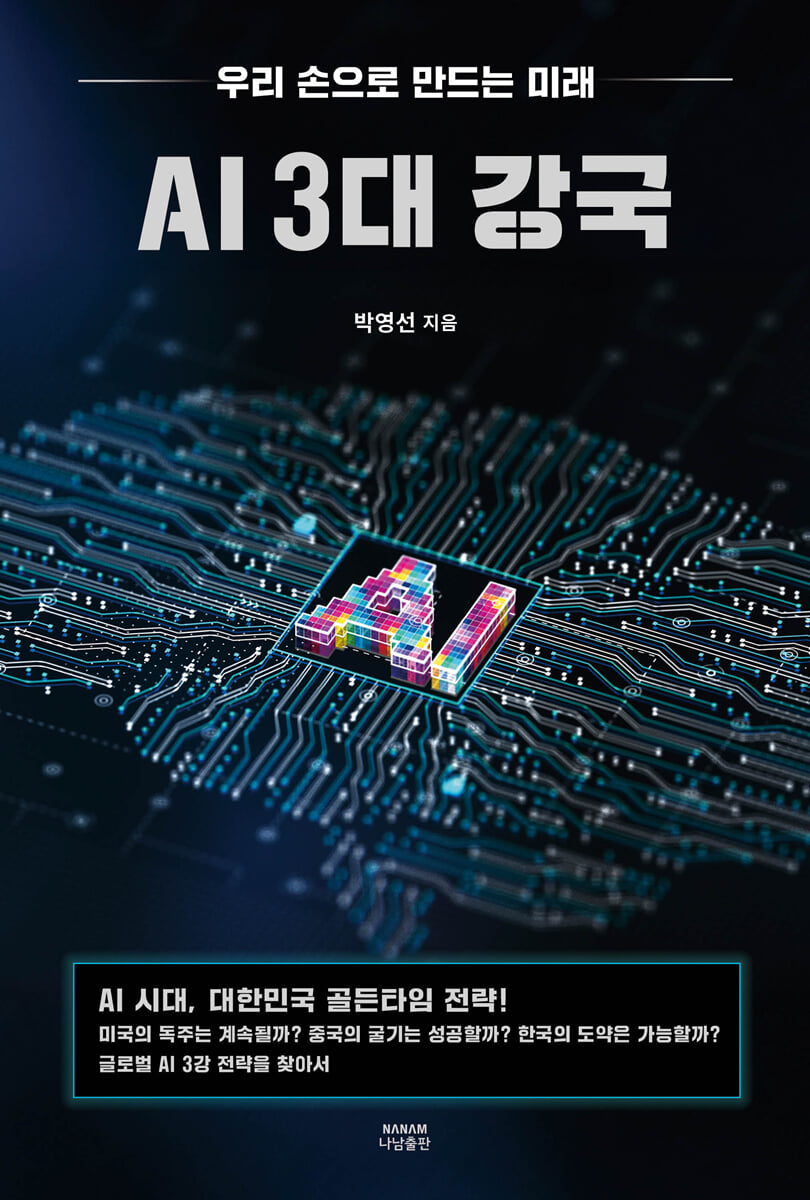
Three major AI powerhouses
 |
Description
Book Introduction
South Korea's golden time is running out!
The Path to Becoming a Global AI Powerhouse: Korea's AI Sovereignty Strategy
As the AI sovereignty battle intensifies, a future strategy book has been published to help South Korea leap forward as one of the "Top 3 AI Powerhouses."
This is "AI's Three Powerhouses: Creating the Future with Our Own Hands," a comprehensive national strategy for South Korea in the AI era presented by former Minister of SMEs and Startups Park Young-sun.
This book is part of the "Technology Hegemony Trilogy," following "Semiconductor Sovereignty" and "AI: War of the Gods," and interprets AI as a language of hegemony that is reorganizing international order and national competitiveness.
The author warns that Korea's golden time is running out and proposes a Korean-style sovereignty strategy centered on the three key elements of AI: computing power, data, and electricity.
The fact that the startups Rebellion, Furiosa AI, and DeepX, which were supported through the 'Detailed (Voluntary Symbiotic) Enterprise Project' during his time as Minister, have grown into Korea's three native fabless companies adds persuasiveness to the book's strategic proposal.
This includes his experience building KAMP, the world's first public-private collaborative AI manufacturing data platform, and his broad understanding of global sites in the United States, China, Taiwan, and Japan.
Above all, the author has translated complex technological discourse into a language accessible to the general public, creating a practical guidebook for the AI era that can be read by policymakers, businesspeople, and even the general public.
The Path to Becoming a Global AI Powerhouse: Korea's AI Sovereignty Strategy
As the AI sovereignty battle intensifies, a future strategy book has been published to help South Korea leap forward as one of the "Top 3 AI Powerhouses."
This is "AI's Three Powerhouses: Creating the Future with Our Own Hands," a comprehensive national strategy for South Korea in the AI era presented by former Minister of SMEs and Startups Park Young-sun.
This book is part of the "Technology Hegemony Trilogy," following "Semiconductor Sovereignty" and "AI: War of the Gods," and interprets AI as a language of hegemony that is reorganizing international order and national competitiveness.
The author warns that Korea's golden time is running out and proposes a Korean-style sovereignty strategy centered on the three key elements of AI: computing power, data, and electricity.
The fact that the startups Rebellion, Furiosa AI, and DeepX, which were supported through the 'Detailed (Voluntary Symbiotic) Enterprise Project' during his time as Minister, have grown into Korea's three native fabless companies adds persuasiveness to the book's strategic proposal.
This includes his experience building KAMP, the world's first public-private collaborative AI manufacturing data platform, and his broad understanding of global sites in the United States, China, Taiwan, and Japan.
Above all, the author has translated complex technological discourse into a language accessible to the general public, creating a practical guidebook for the AI era that can be read by policymakers, businesspeople, and even the general public.
- You can preview some of the book's contents.
Preview
index
Recommendation
prolog
Part 1: Korea's Choice to Become One of the Top 3 AI Powerhouses
1. Conditions for becoming one of the top three AI powerhouses
2. Three major elements of AI and its evolutionary stages
3.
The Birth of K-AI: Korean Sovereign AI
Part 2: AI Semiconductor Sovereignty
4. Key Points to Watch in the AI Semiconductor Era
5. Current Status of K-Semiconductors in the AI Era
6. Korea is one step behind in AI semiconductors.
Part 3: AI Pursuit and Leap Roadmap
7.
Focus on Taiwan: Taiwan's National AI Strategy
8.
Taiwan's 'AI Factory'
9.
Competing on Speed and Scale: Elon Musk's AI Infrastructure Strategy
Part 4: AI Quantum Jump
10.
Quantum Computing Investment Roadmap
11. The Hidden Key to AI Hegemony: Quantum Computers and Cryptography
Part 5: AI G3 Leap and Technological Hegemony
12.
The G3 Project: The Three Global Powers
13.
Nonstop AI Government Plan
Epilogue
prolog
Part 1: Korea's Choice to Become One of the Top 3 AI Powerhouses
1. Conditions for becoming one of the top three AI powerhouses
2. Three major elements of AI and its evolutionary stages
3.
The Birth of K-AI: Korean Sovereign AI
Part 2: AI Semiconductor Sovereignty
4. Key Points to Watch in the AI Semiconductor Era
5. Current Status of K-Semiconductors in the AI Era
6. Korea is one step behind in AI semiconductors.
Part 3: AI Pursuit and Leap Roadmap
7.
Focus on Taiwan: Taiwan's National AI Strategy
8.
Taiwan's 'AI Factory'
9.
Competing on Speed and Scale: Elon Musk's AI Infrastructure Strategy
Part 4: AI Quantum Jump
10.
Quantum Computing Investment Roadmap
11. The Hidden Key to AI Hegemony: Quantum Computers and Cryptography
Part 5: AI G3 Leap and Technological Hegemony
12.
The G3 Project: The Three Global Powers
13.
Nonstop AI Government Plan
Epilogue
Into the book
Technology has always changed the world over time, but AI is coming at the speed of light.
…Where does South Korea stand in the midst of this massive AI transformation? What direction should our AI policy take, and what preparations should we make to become one of the top three AI powerhouses? This book is the result of compiling answers to these questions.
--- p.10-11, from “Prologue”
If the Cold War of the past was an ideological confrontation between the US and Soviet Union, today's Cold War is a new war for hegemony between the US and China, armed with AI technology and computing resources.
--- p.27, from “Conditions for the Three AI Powerhouses”
While the United States has been meticulously implementing its semiconductor strategy, South Korea has continued to argue without any substantive countermeasures.
… Ultimately, the focus of this competition is on ‘who will succeed in commercialization first?’
The difference in response speed between companies and countries will determine future leadership in AI semiconductors.
--- p.109, from “The Current State of K-Semiconductors in the AI Era”
Jensen Huang warned that AI factories will become a new source of future competitiveness, and that companies that fail to do so may be left behind in the industrial ecosystem.
Now, the standard for competitiveness is not production capacity itself, but “how smart a product can be made.”
--- p.154-155, from “Taiwan’s ‘AI Factory’”
According to a July 2024 report, the Ministry of Science and ICT analyzed that when the US' quantum computer technology level is set at 100 points, Korea's score is only about 2.3 points.
This shows that there is a significant gap between us and leading countries such as the United States, China, Germany, and Japan in quantum technology in general.
…Where does South Korea stand in the midst of this massive AI transformation? What direction should our AI policy take, and what preparations should we make to become one of the top three AI powerhouses? This book is the result of compiling answers to these questions.
--- p.10-11, from “Prologue”
If the Cold War of the past was an ideological confrontation between the US and Soviet Union, today's Cold War is a new war for hegemony between the US and China, armed with AI technology and computing resources.
--- p.27, from “Conditions for the Three AI Powerhouses”
While the United States has been meticulously implementing its semiconductor strategy, South Korea has continued to argue without any substantive countermeasures.
… Ultimately, the focus of this competition is on ‘who will succeed in commercialization first?’
The difference in response speed between companies and countries will determine future leadership in AI semiconductors.
--- p.109, from “The Current State of K-Semiconductors in the AI Era”
Jensen Huang warned that AI factories will become a new source of future competitiveness, and that companies that fail to do so may be left behind in the industrial ecosystem.
Now, the standard for competitiveness is not production capacity itself, but “how smart a product can be made.”
--- p.154-155, from “Taiwan’s ‘AI Factory’”
According to a July 2024 report, the Ministry of Science and ICT analyzed that when the US' quantum computer technology level is set at 100 points, Korea's score is only about 2.3 points.
This shows that there is a significant gap between us and leading countries such as the United States, China, Germany, and Japan in quantum technology in general.
--- p.180, from “Quantum Computing Investment Roadmap”
Publisher's Review
Do we have time left?
A winning move found on the front lines of the AI hegemony war.
AI technology is advancing so rapidly that it can change the landscape in just a few months. As the battle for AI supremacy intensifies, a strategy book has been published to help South Korea leap forward as one of the "Top 3 AI Powerhouses."
This is "AI's Three Powerhouses: Creating the Future with Our Own Hands" by former Minister of SMEs and Startups Park Young-sun.
This book, a part of the "Technology Hegemony Trilogy" following "Semiconductor Sovereignty" and "AI: War of the Gods," penetrates the core of the international order surrounding AI and the restructuring of national competitiveness.
In the midst of the massive transition to the AI era, Korea has fallen behind, complacently positioned as a memory semiconductor powerhouse.
The author accurately identifies the reality facing Korea, recognizing that the global AI technology competition is a war for AI sovereignty over technological hegemony.
The United States has secured an overwhelming advantage, while China continues to make secret advances.
Europe, Japan, Taiwan, and other countries are also quickly catching up with the leading countries.
South Korea's declaration to become one of the "Top 3 AI Powers" signifies a challenge to leap forward and surpass all of these competitors, standing shoulder to shoulder with the United States and China.
The author provides a balanced assessment of Korea's strengths and weaknesses to ensure that this declaration does not remain an empty slogan.
The outcome of the technological hegemony war unfolding even at this very moment will determine the future fate of the nation.
Accordingly, the author presents a specific Korean sovereignty strategy that leverages Korea's strengths, focusing on the three key elements of AI (computing power, data, and electricity).
If you hesitate, it's too late, and if you hesitate, the opportunity is lost.
Now is the golden time to start making a leap forward.
A Korean AI sovereignty strategy concretized through policy experience and field experience.
Proof of Possibility: The Native Fabless Trio and KAMP
My experience in policymaking and my research as a senior research fellow at Harvard University's Kennedy School of Government serve as a crucial foundation for this book.
In particular, the case of startups Rebellion, Furiosa AI, and DeepX, which were supported through the 'Detailed (Voluntary Symbiotic) Enterprise Project' during his time as Minister, growing into Korea's three native fabless companies in just a few years, proves the synergy when the private sector's innovation capabilities are combined with government strategies.
KAMP (Korea AI Manufacturing Data Platform), which the author promoted in 2020, will also be recalled.
This was a world-first initiative, with the public and private sectors working together to create a platform that standardizes manufacturing data for AI learning.
Although it was built with difficulty and with difficulties in persuasion at the time, it ultimately did not proceed as originally planned.
The author emphasizes that KAMP must be reorganized now and developed into a Korean-specific manufacturing sovereign AI.
The author's vision is not limited to the domestic region.
Based on a broad understanding of the global scene, it captures movements from around the world and immediately translates them into strategic insights for Korea, vividly conveying the cutting edge of the technological hegemony race.
Taiwan's "AI Factory" and Elon Musk's "Colossus Project" are examples that can help Korea find its own path forward.
Korea must leverage its existing foundation and learn from international precedents to pave the way toward becoming one of the "top three AI powerhouses."
A Practical AI Guidebook in the Language of the People
The author explains complex technological and policy concepts, including AI semiconductor sovereignty, Korean sovereign AI, a quantum computing investment roadmap, and a non-stop AI government, in a way that anyone can understand.
This provides policymakers with design guidelines to concretize national strategies, businesspeople and researchers with strategic insights to apply in the field, and general readers with the language and vision to understand and prepare for the AI era.
That's why "The Three AI Powerhouses" is a practical AI guidebook that everyone can read together and prepare for the future.
As the competition for AI supremacy intensifies, the question of whether Korea can leap forward as one of the world's top three powers is more pressing than ever.
This book answers these pressing questions, presenting the goal of becoming one of the "Top 3 AI Powerhouses" not as an abstract slogan, but as a feasible roadmap.
A winning move found on the front lines of the AI hegemony war.
AI technology is advancing so rapidly that it can change the landscape in just a few months. As the battle for AI supremacy intensifies, a strategy book has been published to help South Korea leap forward as one of the "Top 3 AI Powerhouses."
This is "AI's Three Powerhouses: Creating the Future with Our Own Hands" by former Minister of SMEs and Startups Park Young-sun.
This book, a part of the "Technology Hegemony Trilogy" following "Semiconductor Sovereignty" and "AI: War of the Gods," penetrates the core of the international order surrounding AI and the restructuring of national competitiveness.
In the midst of the massive transition to the AI era, Korea has fallen behind, complacently positioned as a memory semiconductor powerhouse.
The author accurately identifies the reality facing Korea, recognizing that the global AI technology competition is a war for AI sovereignty over technological hegemony.
The United States has secured an overwhelming advantage, while China continues to make secret advances.
Europe, Japan, Taiwan, and other countries are also quickly catching up with the leading countries.
South Korea's declaration to become one of the "Top 3 AI Powers" signifies a challenge to leap forward and surpass all of these competitors, standing shoulder to shoulder with the United States and China.
The author provides a balanced assessment of Korea's strengths and weaknesses to ensure that this declaration does not remain an empty slogan.
The outcome of the technological hegemony war unfolding even at this very moment will determine the future fate of the nation.
Accordingly, the author presents a specific Korean sovereignty strategy that leverages Korea's strengths, focusing on the three key elements of AI (computing power, data, and electricity).
If you hesitate, it's too late, and if you hesitate, the opportunity is lost.
Now is the golden time to start making a leap forward.
A Korean AI sovereignty strategy concretized through policy experience and field experience.
Proof of Possibility: The Native Fabless Trio and KAMP
My experience in policymaking and my research as a senior research fellow at Harvard University's Kennedy School of Government serve as a crucial foundation for this book.
In particular, the case of startups Rebellion, Furiosa AI, and DeepX, which were supported through the 'Detailed (Voluntary Symbiotic) Enterprise Project' during his time as Minister, growing into Korea's three native fabless companies in just a few years, proves the synergy when the private sector's innovation capabilities are combined with government strategies.
KAMP (Korea AI Manufacturing Data Platform), which the author promoted in 2020, will also be recalled.
This was a world-first initiative, with the public and private sectors working together to create a platform that standardizes manufacturing data for AI learning.
Although it was built with difficulty and with difficulties in persuasion at the time, it ultimately did not proceed as originally planned.
The author emphasizes that KAMP must be reorganized now and developed into a Korean-specific manufacturing sovereign AI.
The author's vision is not limited to the domestic region.
Based on a broad understanding of the global scene, it captures movements from around the world and immediately translates them into strategic insights for Korea, vividly conveying the cutting edge of the technological hegemony race.
Taiwan's "AI Factory" and Elon Musk's "Colossus Project" are examples that can help Korea find its own path forward.
Korea must leverage its existing foundation and learn from international precedents to pave the way toward becoming one of the "top three AI powerhouses."
A Practical AI Guidebook in the Language of the People
The author explains complex technological and policy concepts, including AI semiconductor sovereignty, Korean sovereign AI, a quantum computing investment roadmap, and a non-stop AI government, in a way that anyone can understand.
This provides policymakers with design guidelines to concretize national strategies, businesspeople and researchers with strategic insights to apply in the field, and general readers with the language and vision to understand and prepare for the AI era.
That's why "The Three AI Powerhouses" is a practical AI guidebook that everyone can read together and prepare for the future.
As the competition for AI supremacy intensifies, the question of whether Korea can leap forward as one of the world's top three powers is more pressing than ever.
This book answers these pressing questions, presenting the goal of becoming one of the "Top 3 AI Powerhouses" not as an abstract slogan, but as a feasible roadmap.
GOODS SPECIFICS
- Date of issue: September 5, 2025
- Page count, weight, size: 240 pages | 152*225*20mm
- ISBN13: 9791192275307
- ISBN10: 1192275306
You may also like
카테고리
korean


korean

![GQ KOREA Mark (Monthly): December [2025]](http://librairie.coreenne.fr/cdn/shop/files/8ef265dbbfbf186523ed75ba7319009d.jpg?v=1765340328&width=3840)


