

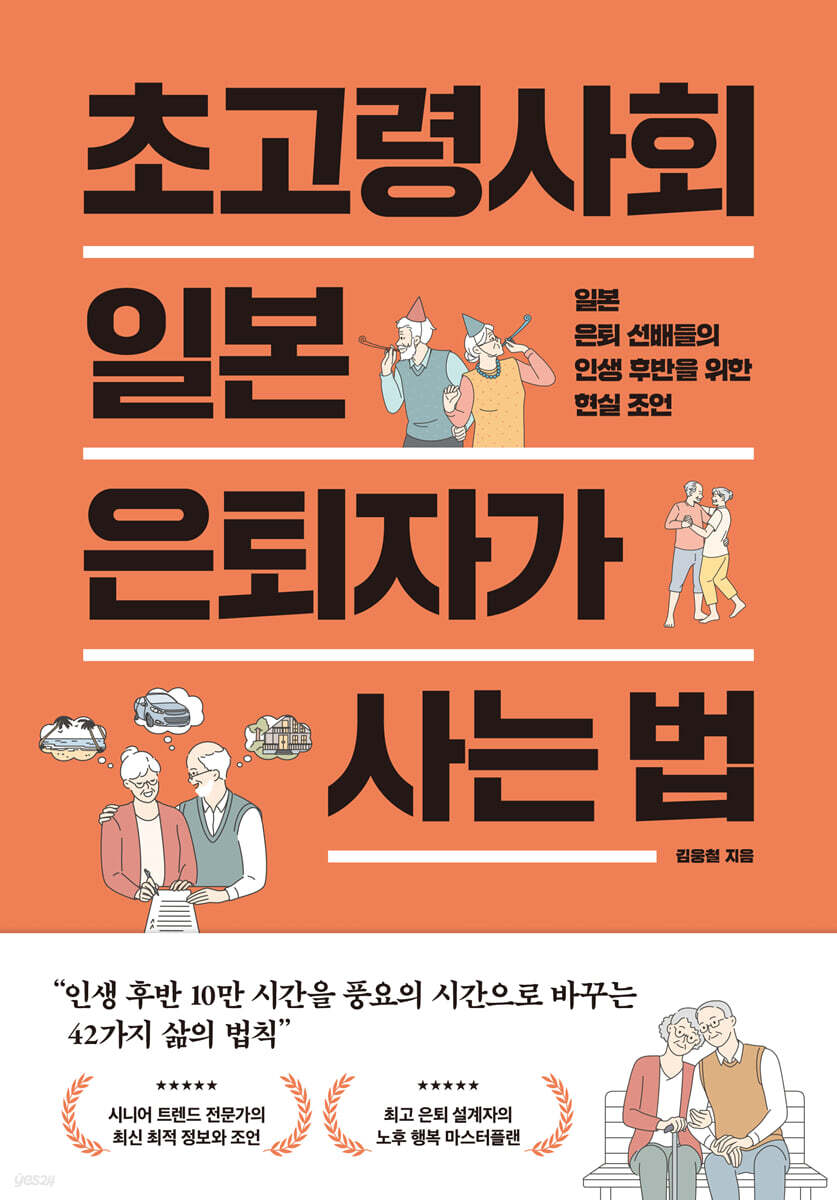
How Retirees Live in Japan's Super-Aging Society
 |
Description
Book Introduction
Japanese Retirement Senior Trends Expert Explains
The Second 100,000 Hours of Life: 42 Life Laws That Will Change Your Future If you subtract the time spent eating, sleeping, and resting from the 24 hours in a day, you are left with 11 hours. According to this calculation, if you retire at age 60 and live to age 100, the amount of free time you will have is well over 100,000 hours. So how should we live during this long retirement? How will we create and maintain the money, work, health, relationships, and daily life we need to live to 100 or beyond? The author took a hint from the case of Japan, which experienced a 'super-aging society', 'mass retirement of 6.8 million people', and 'an era of 35 million senior citizens' before us. We studied what they regretted in similar situations, what they prepared for, and how they responded. To summarize, the first part of the book contains the heartbreaking regrets of retired seniors in Japan, the second part contains the secrets to 'lifelong active life' such as re-employment and starting a business, the third part contains various cases and know-how on retirement funds, the fourth part examines human relationships in retirement, and the final fifth part contains 'daily life skills' for old age. You can check your own preparedness level through the included ‘Retirement Ability Self-Diagnosis Table’, ‘Reemployment Possibility Checklist’, and ‘Emotional Age Diagnosis Table’. By carefully considering each of the author's 42 life rules, even those who are "daunted and anxious" about retirement will be able to envision a "clear future." |
- You can preview some of the book's contents.
Preview
index
Enter: From now on, live for yourself, not for anyone else.
Part 1: The Future | It's Time for "Debut," Not "Retirement"
17 Things I Wish I Knew Before Retiring
23 Things You Shouldn't Do and Shouldn't Do
Create Your Own Life Plan Diary 31
Devote yourself to something you love for 10 years. 36
Throw it away and you will gain 43
Forty: The Perfect Time to Redesign Your Life 47
How to prepare for money, work, social life, and housing 53
[Senior Insight 1] What is your retirement score? 59
Part 2 | In the 100-Year-Old Era, Living "Actively for Life"
From Ignored Seniors to Useful Seniors 73
10 Attitudes to Becoming a Young and Active Senior 79
Get a lucrative qualification in advance 85
90 to enter a popular re-employment occupation
Let's use pensions as a foundation for working again 95
Become a specialist to work long hours 99
3 Essential Conditions for a Lifelong Active Humanoid 104
Find satisfaction and fulfillment through 'slow entrepreneurship' 109
Start a Business or Find a New Job: Which is Your Choice? 113
[Senior Insight 2] 118 Seniors' Dreams Embedded in "Company Play"
Part 3: Money | Are You a "Retirement Rich" or a "Retirement Poor"?
Don't Worry About Money, Be Good with It 125
Fifty: Time to Accelerate Your Retirement Preparations 130
The further you look, the better you live 135
6 Enemies Threatening Aging 141
Dangerous Faith: Escape the Trap of Child Education 150
Change Your Money Sense from Your 50s 154
How much do you want for your retirement expenses? 161
[Senior Insight 3] A Peek into the Household Accounts of a Solo Retiree 167
Part 4: Relationships | A New Connection Brings a New Life
Start a new encounter with something you like 173
Shallow and Simple Relationships Are the Answer 177
10 Principles for Living Well and Happily Alone 182
Get help to keep you safe 189
Rebuilding Relationships and Memories at Senior School 193
Married Life Needs a New Approach 198
[Senior Insight 4] Training to Build the Power to Live Alone 203
Part 5: Daily Life | The Secret to Becoming Happier as You Age
6 Secrets to Becoming a Hobby Master 209
The Power of Volunteering to Find Purpose in Life 215
4 Essential Principles for Successful Farming 218
7 Rules for a Happy Everyday Life 225
Overturning Stereotypes About Money, Work, and Health 233
3 Things You Must Let Go of in Your 50s 238
17 Things You Must Do in Your 60s 242
Five essential accounts: hobbies, culture, health, friends, and money. 255
[Senior Insight 5] How Old Are You at Heart? 260
Reference 265
Part 1: The Future | It's Time for "Debut," Not "Retirement"
17 Things I Wish I Knew Before Retiring
23 Things You Shouldn't Do and Shouldn't Do
Create Your Own Life Plan Diary 31
Devote yourself to something you love for 10 years. 36
Throw it away and you will gain 43
Forty: The Perfect Time to Redesign Your Life 47
How to prepare for money, work, social life, and housing 53
[Senior Insight 1] What is your retirement score? 59
Part 2 | In the 100-Year-Old Era, Living "Actively for Life"
From Ignored Seniors to Useful Seniors 73
10 Attitudes to Becoming a Young and Active Senior 79
Get a lucrative qualification in advance 85
90 to enter a popular re-employment occupation
Let's use pensions as a foundation for working again 95
Become a specialist to work long hours 99
3 Essential Conditions for a Lifelong Active Humanoid 104
Find satisfaction and fulfillment through 'slow entrepreneurship' 109
Start a Business or Find a New Job: Which is Your Choice? 113
[Senior Insight 2] 118 Seniors' Dreams Embedded in "Company Play"
Part 3: Money | Are You a "Retirement Rich" or a "Retirement Poor"?
Don't Worry About Money, Be Good with It 125
Fifty: Time to Accelerate Your Retirement Preparations 130
The further you look, the better you live 135
6 Enemies Threatening Aging 141
Dangerous Faith: Escape the Trap of Child Education 150
Change Your Money Sense from Your 50s 154
How much do you want for your retirement expenses? 161
[Senior Insight 3] A Peek into the Household Accounts of a Solo Retiree 167
Part 4: Relationships | A New Connection Brings a New Life
Start a new encounter with something you like 173
Shallow and Simple Relationships Are the Answer 177
10 Principles for Living Well and Happily Alone 182
Get help to keep you safe 189
Rebuilding Relationships and Memories at Senior School 193
Married Life Needs a New Approach 198
[Senior Insight 4] Training to Build the Power to Live Alone 203
Part 5: Daily Life | The Secret to Becoming Happier as You Age
6 Secrets to Becoming a Hobby Master 209
The Power of Volunteering to Find Purpose in Life 215
4 Essential Principles for Successful Farming 218
7 Rules for a Happy Everyday Life 225
Overturning Stereotypes About Money, Work, and Health 233
3 Things You Must Let Go of in Your 50s 238
17 Things You Must Do in Your 60s 242
Five essential accounts: hobbies, culture, health, friends, and money. 255
[Senior Insight 5] How Old Are You at Heart? 260
Reference 265
Detailed image
.jpg)
Into the book
Entering
Japan is the oldest country in the world.
One in four men and one in three women are aged 65 or older.
In numbers, it's over 35 million people.
This large group of older adults is emerging as the mainstream of today's society.
This situation is unprecedented in human history.
Japan pours a significant portion of its 100 trillion yen government budget into supporting the health and well-being of this mainstream group.
I wonder if this situation can continue.
But on the other hand, there is also ‘hope’ and ‘expectation’.
Of the 35 million seniors, at least half are 'young seniors'.
Also called active senior.
In particular, baby boomer retirees, known as the "Dankai Generation," are making their presence felt in Japan's super-aging society.
They are healthier than younger people, more financially secure than working adults, and are making new connections in diverse communities.
In 2007, this super-elderly 'new human' retired en masse as they turned 60.
At the time, Japanese media gave a big story about the social shock that would result from their mass departure, calling it the "2007 Problem."
Along with the socio-economic debate about the loss of talented human resources, concerns about the "retirement cliff" for young seniors and countermeasures have also been raised.
Retired men who thought their jobs were everything to the point of being called "company people" and so-called "part-time citizens" who knew the inside of their workplaces but were ignorant about where they actually lived, were showered with loving advice by the entire society, including the government, local governments, media, academia, businesses, and civic groups, as if they were consultants.
We have presented various 'retirement debut' ideas that we hope will make a soft landing in the community.
--- pp.7-8
Create your own 'hideaway' in your home.
One thing you should never do after retirement is sit around in the living room all day.
If you do that, your wife will start to abuse you and you may end up being treated like a 'big piece of trash'.
If you don't want to face such days, it's best to disappear from your wife's sight as often as possible.
To disappear from your wife's sight, you need a 'hiding place' where you can hide your body.
But the hideout doesn't necessarily have to be far away.
One way is to create your own space in your home where no one will interfere.
Let's enjoy the feeling of freedom from work life in that space.
In my own hideaway, I can lie down, put on a movie I want to watch, and crunch some snacks.
In Japan, quite a few retirees are actually remodeling their homes to create retreats after retirement, often using the rooms of their independent children.
--- pp.33-34
Break up, throw away, break up
Dansari literally means cutting off (斷) things that are not necessary in daily life, boldly throwing away (捨) unnecessary items, and parting with (離) attachment to things.
This is a concept derived from the yoga philosophy of cessation of activity, abandonment of activity, and separation of activity, which aims to let go of obsessions and achieve a state of mental peace. Author Hideko Yamashita gained great popularity by incorporating this philosophy into the daily life of cleaning and organizing.
Dansari received a lot of social attention as it gained strong sympathy from the Dankai generation, who were facing mass retirement at the time.
The essence of Dansari can be summarized as 'throw away, and you will gain.'
This is not a lifestyle habit of 'subtraction' that organizes personal belongings, but a philosophy of 'addition' that allows you to gain new peace of mind by letting go of your obsession with past belongings.
This philosophy is also being used as a guide for those approaching retirement to create a fulfilling second act in life.
This is because the process of choosing which personal belongings to discard and which to keep allows you to reflect on your current life.
--- p.43
Re-employment: These people won't succeed.
The most common type of senior who is 'neglected' when it comes to re-employment is 'those with strong pride and lack of humility.'
When you get a new job, your position and other things will be lower than before, but people who are too proud have a hard time accepting this reality.
Moreover, with a stubborn personality, it is difficult to respond flexibly in situations where you have to receive instructions from juniors.
Comparing your current situation to your previous job or being obsessed with past positions or connections is a red card in the job market.
In addition, those who ‘lack understanding of roles or duties,’ ‘people whose skills and knowledge are stuck in the past,’ and ‘people in poor health’ are more likely to become seniors who are ignored.
Conversely, the most competitive types in the reemployment market are those with outstanding expertise and practical skills.
Those with extensive knowledge and experience are also considered top priority for senior recruitment.
Along with these abilities, a bright personality, overflowing energy, a sense of balance, and flexibility of thought were found to be the virtues of a 'useful senior.'
Meister 60 emphasizes that being able to quickly grasp one's role and communicate with younger managers are also key success factors in re-employment.
--- pp.76-77
6 Enemies Threatening Retirement: Unsellable Homes
The saying, "If you don't have money in your old age, you can sell your house and make some money" has long been outdated in Japan.
One of the problems that is troubling Japan, a country with an aging population, these days is the increasing number of empty houses.
The proportion of vacant homes among all households in Japan has exceeded the national average of 13%.
The total number of houses is about 60 million, so approximately 7.8 million of them are 'abandoned houses' where no one lives.
Of course, empty houses are concentrated in rural areas rather than in cities, but the problem of empty houses in downtown Tokyo has reached a point where it cannot be ignored.
Some ward offices in Tokyo are even providing subsidies to organizations that manage or demolish empty houses to try to solve the problem.
The vacant home problem is evidence that the era of real estate being used as retirement funds in Japan is over.
Real estate experts are confident that in this situation, the asset value of housing will inevitably continue to decline.
So what should we do?
The correct answer is, 'If you can sell it, it's better to sell it now.'
The explanation is that unless it is a prime piece of land in downtown Tokyo or a special zone with some expected development profits, selling it now is the best way to make a profit, even if it is disappointing.
Some forecast that Japanese housing prices will fall by 2% annually for the next 20 years.
The real estate outlook for Korean society, which is on the verge of entering a super-aging society, must also be considered from a long-term perspective.
--- pp.143-144
Start a new encounter with something you like
The argument put forward by Chizuko Ueno, professor emeritus at the University of Tokyo and sociologist and expert on aging society, is quite interesting.
Just because you have a third-party connection doesn't mean you have to try to get along with your neighbors.
The beauty of urbanization is that you don't have to deal with neighbors you don't like.
It is wise to build 'purpose-specific partnerships' according to the situation.
One thing that stands out in his words is the term "purpose-based partnership," which refers to interpersonal relationships that occur in various areas of daily life after retirement.
Professor Ueno explains that purpose-specific partnerships, or third-party relationships, are “gatherings related to daily life” that he needs, such as “culture partnerships, professional group partnerships, sports partnerships, and dining partnerships.”
For example, in the case of cultural partnerships, segmenting the genre into traditional culture, opera, theater, and film, and having a professional in that field accompany the audience to provide commentary also constitutes a third-party relationship.
Professor Ueno emphasizes that when establishing such purpose-specific partnerships, care must be taken to avoid interfering with the interests of members.
Because interests are not that important in post-retirement gatherings.
The 'Third Human Relationship Theory' is an excellent 'happy retirement strategy' not only for retired men but also for single people, including women living alone.
The importance of developing connections outside of work, a third human relationship, as discussed by Japanese retirement experts, is something Korean retirees should also take note of.
--- p.175
10 Principles for Living Well and Happily Alone
Being able to respond quickly to emergencies is a key element of a successful, single-person retirement.
In the event of an accident or health emergency that occurs in everyday life, the person who can immediately help us is likely a neighbor who lives close to us.
If you get to know the people who live around your house well, you can receive more help from them than from your blood relatives when you are in trouble.
For that reason, the fourth rule to follow is to always greet your neighbors first.
In downtown apartments, even neighbors living on the same floor, let alone in the same building, often do not greet each other.
However, no one would ignore or be offended if the other person greeted them brightly first.
From now on, whenever we meet in the elevator, let's at least give a simple nod first.
A simple greeting can help bridge the gap between neighbors.
Fifth, you should use nearby shopping areas for shopping.
Let's actively use the shopping district near our house and build relationships with the people who work there.
As you shop, chat, and get closer, you can also get the added benefit of getting up-to-date information about the local community.
Sixth, you must actively participate in local events.
It takes a lot of courage to suddenly show up at a local community event one day.
But let's take the courage and jump in.
It will expand your retirement network.
Taking advantage of events like local festivals to get involved in local community activities is also a good way to get started.
--- pp.185-186
Training to build the strength to live alone
If traveling alone isn't an option, going to a cafe in an unfamiliar place you've never been to and spending some time alone, or going to an exhibition or performance alone to fully enjoy some time for yourself are all great ways to cultivate your solitude.
Of course, you can spend time alone at home, but it's not easy to seriously reflect on yourself in a familiar place.
Solitude is created when you spend time in unfamiliar places, as far away from your daily routine as possible.
Professor Hosaka says that writing an autobiography is also effective in developing the ability to live alone.
In fact, in Japan, the number of people writing their own history, that is, their own life stories, is increasing.
According to them, while writing an autobiography, they encounter aspects of themselves that they had never imagined.
This will allow you to immerse yourself in your own life, and as your attitude towards life changes, it will help you develop the ability to tolerate solitude.
Another benefit of writing an autobiography is that it gives you the opportunity to dream again about things you couldn't do or regretted while living.
If you do that, the long second half of your life that will come will turn into a time of opportunity to put it into practice.
Naturally, you will be able to look forward to the old age that will come after retirement.
--- pp.204-205
Things you must do in your 60s so you won't regret it
Don't forget the joy of being a man or a woman: It is said that people who are conscious of their masculinity or femininity and those who are not experience different 'depths' of joy in life.
It is also said that people who consider themselves sensual, whether male or female, live longer.
It is also important to feel the happiness that physical 'touch' brings.
Physical contact, such as being held or hugged, reduces stress and increases feelings of security.
Let's continue to create time to return to being a man and a woman while feeling this.
Invest in the future and spread love: Finally, I encourage you to invest in children and young people.
Passing on wisdom and money to talented young people is a testament to the life you have lived.
It also has the double benefit of making young friends.
Spreading love to those around you is also essential for a happy retirement.
Think of the faces of friends, acquaintances, and coworkers who have supported and helped you throughout your life.
And let us remember that my life has matured in my relationship with them.
It will be a time of gratitude.
Then be sure to express your gratitude to them.
And above all, always love yourself.
Japan is the oldest country in the world.
One in four men and one in three women are aged 65 or older.
In numbers, it's over 35 million people.
This large group of older adults is emerging as the mainstream of today's society.
This situation is unprecedented in human history.
Japan pours a significant portion of its 100 trillion yen government budget into supporting the health and well-being of this mainstream group.
I wonder if this situation can continue.
But on the other hand, there is also ‘hope’ and ‘expectation’.
Of the 35 million seniors, at least half are 'young seniors'.
Also called active senior.
In particular, baby boomer retirees, known as the "Dankai Generation," are making their presence felt in Japan's super-aging society.
They are healthier than younger people, more financially secure than working adults, and are making new connections in diverse communities.
In 2007, this super-elderly 'new human' retired en masse as they turned 60.
At the time, Japanese media gave a big story about the social shock that would result from their mass departure, calling it the "2007 Problem."
Along with the socio-economic debate about the loss of talented human resources, concerns about the "retirement cliff" for young seniors and countermeasures have also been raised.
Retired men who thought their jobs were everything to the point of being called "company people" and so-called "part-time citizens" who knew the inside of their workplaces but were ignorant about where they actually lived, were showered with loving advice by the entire society, including the government, local governments, media, academia, businesses, and civic groups, as if they were consultants.
We have presented various 'retirement debut' ideas that we hope will make a soft landing in the community.
--- pp.7-8
Create your own 'hideaway' in your home.
One thing you should never do after retirement is sit around in the living room all day.
If you do that, your wife will start to abuse you and you may end up being treated like a 'big piece of trash'.
If you don't want to face such days, it's best to disappear from your wife's sight as often as possible.
To disappear from your wife's sight, you need a 'hiding place' where you can hide your body.
But the hideout doesn't necessarily have to be far away.
One way is to create your own space in your home where no one will interfere.
Let's enjoy the feeling of freedom from work life in that space.
In my own hideaway, I can lie down, put on a movie I want to watch, and crunch some snacks.
In Japan, quite a few retirees are actually remodeling their homes to create retreats after retirement, often using the rooms of their independent children.
--- pp.33-34
Break up, throw away, break up
Dansari literally means cutting off (斷) things that are not necessary in daily life, boldly throwing away (捨) unnecessary items, and parting with (離) attachment to things.
This is a concept derived from the yoga philosophy of cessation of activity, abandonment of activity, and separation of activity, which aims to let go of obsessions and achieve a state of mental peace. Author Hideko Yamashita gained great popularity by incorporating this philosophy into the daily life of cleaning and organizing.
Dansari received a lot of social attention as it gained strong sympathy from the Dankai generation, who were facing mass retirement at the time.
The essence of Dansari can be summarized as 'throw away, and you will gain.'
This is not a lifestyle habit of 'subtraction' that organizes personal belongings, but a philosophy of 'addition' that allows you to gain new peace of mind by letting go of your obsession with past belongings.
This philosophy is also being used as a guide for those approaching retirement to create a fulfilling second act in life.
This is because the process of choosing which personal belongings to discard and which to keep allows you to reflect on your current life.
--- p.43
Re-employment: These people won't succeed.
The most common type of senior who is 'neglected' when it comes to re-employment is 'those with strong pride and lack of humility.'
When you get a new job, your position and other things will be lower than before, but people who are too proud have a hard time accepting this reality.
Moreover, with a stubborn personality, it is difficult to respond flexibly in situations where you have to receive instructions from juniors.
Comparing your current situation to your previous job or being obsessed with past positions or connections is a red card in the job market.
In addition, those who ‘lack understanding of roles or duties,’ ‘people whose skills and knowledge are stuck in the past,’ and ‘people in poor health’ are more likely to become seniors who are ignored.
Conversely, the most competitive types in the reemployment market are those with outstanding expertise and practical skills.
Those with extensive knowledge and experience are also considered top priority for senior recruitment.
Along with these abilities, a bright personality, overflowing energy, a sense of balance, and flexibility of thought were found to be the virtues of a 'useful senior.'
Meister 60 emphasizes that being able to quickly grasp one's role and communicate with younger managers are also key success factors in re-employment.
--- pp.76-77
6 Enemies Threatening Retirement: Unsellable Homes
The saying, "If you don't have money in your old age, you can sell your house and make some money" has long been outdated in Japan.
One of the problems that is troubling Japan, a country with an aging population, these days is the increasing number of empty houses.
The proportion of vacant homes among all households in Japan has exceeded the national average of 13%.
The total number of houses is about 60 million, so approximately 7.8 million of them are 'abandoned houses' where no one lives.
Of course, empty houses are concentrated in rural areas rather than in cities, but the problem of empty houses in downtown Tokyo has reached a point where it cannot be ignored.
Some ward offices in Tokyo are even providing subsidies to organizations that manage or demolish empty houses to try to solve the problem.
The vacant home problem is evidence that the era of real estate being used as retirement funds in Japan is over.
Real estate experts are confident that in this situation, the asset value of housing will inevitably continue to decline.
So what should we do?
The correct answer is, 'If you can sell it, it's better to sell it now.'
The explanation is that unless it is a prime piece of land in downtown Tokyo or a special zone with some expected development profits, selling it now is the best way to make a profit, even if it is disappointing.
Some forecast that Japanese housing prices will fall by 2% annually for the next 20 years.
The real estate outlook for Korean society, which is on the verge of entering a super-aging society, must also be considered from a long-term perspective.
--- pp.143-144
Start a new encounter with something you like
The argument put forward by Chizuko Ueno, professor emeritus at the University of Tokyo and sociologist and expert on aging society, is quite interesting.
Just because you have a third-party connection doesn't mean you have to try to get along with your neighbors.
The beauty of urbanization is that you don't have to deal with neighbors you don't like.
It is wise to build 'purpose-specific partnerships' according to the situation.
One thing that stands out in his words is the term "purpose-based partnership," which refers to interpersonal relationships that occur in various areas of daily life after retirement.
Professor Ueno explains that purpose-specific partnerships, or third-party relationships, are “gatherings related to daily life” that he needs, such as “culture partnerships, professional group partnerships, sports partnerships, and dining partnerships.”
For example, in the case of cultural partnerships, segmenting the genre into traditional culture, opera, theater, and film, and having a professional in that field accompany the audience to provide commentary also constitutes a third-party relationship.
Professor Ueno emphasizes that when establishing such purpose-specific partnerships, care must be taken to avoid interfering with the interests of members.
Because interests are not that important in post-retirement gatherings.
The 'Third Human Relationship Theory' is an excellent 'happy retirement strategy' not only for retired men but also for single people, including women living alone.
The importance of developing connections outside of work, a third human relationship, as discussed by Japanese retirement experts, is something Korean retirees should also take note of.
--- p.175
10 Principles for Living Well and Happily Alone
Being able to respond quickly to emergencies is a key element of a successful, single-person retirement.
In the event of an accident or health emergency that occurs in everyday life, the person who can immediately help us is likely a neighbor who lives close to us.
If you get to know the people who live around your house well, you can receive more help from them than from your blood relatives when you are in trouble.
For that reason, the fourth rule to follow is to always greet your neighbors first.
In downtown apartments, even neighbors living on the same floor, let alone in the same building, often do not greet each other.
However, no one would ignore or be offended if the other person greeted them brightly first.
From now on, whenever we meet in the elevator, let's at least give a simple nod first.
A simple greeting can help bridge the gap between neighbors.
Fifth, you should use nearby shopping areas for shopping.
Let's actively use the shopping district near our house and build relationships with the people who work there.
As you shop, chat, and get closer, you can also get the added benefit of getting up-to-date information about the local community.
Sixth, you must actively participate in local events.
It takes a lot of courage to suddenly show up at a local community event one day.
But let's take the courage and jump in.
It will expand your retirement network.
Taking advantage of events like local festivals to get involved in local community activities is also a good way to get started.
--- pp.185-186
Training to build the strength to live alone
If traveling alone isn't an option, going to a cafe in an unfamiliar place you've never been to and spending some time alone, or going to an exhibition or performance alone to fully enjoy some time for yourself are all great ways to cultivate your solitude.
Of course, you can spend time alone at home, but it's not easy to seriously reflect on yourself in a familiar place.
Solitude is created when you spend time in unfamiliar places, as far away from your daily routine as possible.
Professor Hosaka says that writing an autobiography is also effective in developing the ability to live alone.
In fact, in Japan, the number of people writing their own history, that is, their own life stories, is increasing.
According to them, while writing an autobiography, they encounter aspects of themselves that they had never imagined.
This will allow you to immerse yourself in your own life, and as your attitude towards life changes, it will help you develop the ability to tolerate solitude.
Another benefit of writing an autobiography is that it gives you the opportunity to dream again about things you couldn't do or regretted while living.
If you do that, the long second half of your life that will come will turn into a time of opportunity to put it into practice.
Naturally, you will be able to look forward to the old age that will come after retirement.
--- pp.204-205
Things you must do in your 60s so you won't regret it
Don't forget the joy of being a man or a woman: It is said that people who are conscious of their masculinity or femininity and those who are not experience different 'depths' of joy in life.
It is also said that people who consider themselves sensual, whether male or female, live longer.
It is also important to feel the happiness that physical 'touch' brings.
Physical contact, such as being held or hugged, reduces stress and increases feelings of security.
Let's continue to create time to return to being a man and a woman while feeling this.
Invest in the future and spread love: Finally, I encourage you to invest in children and young people.
Passing on wisdom and money to talented young people is a testament to the life you have lived.
It also has the double benefit of making young friends.
Spreading love to those around you is also essential for a happy retirement.
Think of the faces of friends, acquaintances, and coworkers who have supported and helped you throughout your life.
And let us remember that my life has matured in my relationship with them.
It will be a time of gratitude.
Then be sure to express your gratitude to them.
And above all, always love yourself.
--- pp.252-253
Publisher's Review
"Senior Life Future Report in a Super-Aged Society"
The "Technique of Retirement" Discovered in Japan, a Country That Preceded Us
What is retirement?
A first taste of freedom in old age? A reward for a life of hardship? A second chance at life? Yet, as prospective retirees in online communities and news articles tell us,
Suddenly, I felt like a 'refugee' adrift in the vast ocean.
It's called 'Life's Second Act', but it's to the point where I can't sleep because of the hopelessness and anxiety of not having anywhere to turn.
So, what is the 'real life' of people who are already living after retirement?
If we knew in advance what they were worried about and how they responded, wouldn't we be able to prepare in more detail?
Retired seniors in Japan, which entered an aging society 20 to 30 years earlier than us and experienced a super-aged society and mass retirement more than 10 years earlier, say:
The reality of retirement, which came as a surprise, is truly a 'great change in daily life'.
When I open my eyes in the morning, I have nowhere to go, and when I meet people, I have no business cards to hand out.
There is no need to go near the office where you spent most of your day, and the area around your house becomes your living area.
I've lost contact with my old coworkers, with whom I used to talk about getting together for a meal.
The author, a senior trend researcher and retirement columnist, says he wanted to provide "clarity" to these prospective retirees.
I thought that if I presented real-life experiences and data analysis rather than empty success stories, I could dispel the feeling of being lost.
So I thought of Japan.
The author, a "Japan expert" who served as a Tokyo correspondent and international affairs editor for a media outlet, has tracked the reality of Japan's baby boomer retirees through not only newspapers and magazines, but also surveys, statistics, and real-life cases, and included them in this book.
Change your outlook on life to 'retirement mode'!
Looking into the concerns of prospective retirees and the thoughts of retired seniors in Japan, this thought comes to mind.
"Isn't retirement a future of predestined misfortune, no matter how much you prepare?" However, if that's how you think about "life changes after retirement," you need to ask yourself a different question.
Even though our lifestyle has changed to 'lifestyle mode', aren't we still looking at the world through 'office worker mode'?
The insight the author of this book discovered from retired seniors in Japan's super-aging society can be summed up in one word: "Change your outlook on life to retirement mode."
In other words, you can only enjoy a happy retirement if you face reality after retirement and change your perspective accordingly.
So, what specifically do we need to know and from what perspective should we look at it?
The author meticulously analyzed the heartbreaking regrets of retired seniors, the changes they faced in their daily lives, and their unique coping methods that shattered conventional wisdom, and organized them into 42 rules.
It is broadly divided into the following five topics.
First, change your "money sense," which is more important than saving.
When you retire, your regular salary disappears and you have to live on limited funds.
No matter how thoroughly you prepare, unpredictable accidents and incidents can occur, so you can't help but feel anxious.
So experts say that while saving is important, changing your 'feeling' about money is even more important.
To change your sense of money, you first need to 'accurately' figure out how much you have.
The best way is for couples to have a 'retirement household budget meeting' once a year, starting before retirement.
If you identify the problems with your retirement asset planning at this time, you can also prepare countermeasures.
The next step is to lower the family's 'spending level' according to the household budget situation.
If we keep increasing the number of ‘used songs’, ‘old poor’ is an inevitable term.
The third is to ‘downsize’ your lifestyle.
Doing a 'well-down' by getting rid of unnecessary items and furniture can also have the effect of organizing your life.
Other good tips for changing your financial sense include using 'cash' to break the habit of impulse buying, 'reviewing' and changing your insurance every 2-3 years, and not spending 'unnecessary money' on your children and grandchildren (pp. 154-160).
Second, if you want to get re-employed, throw away your business card and take off your rank badge.
Some retirees, when seeking re-employment, write their resumes boasting of their "experience," "former title," and "excellent connections" that are no less than those of young people, promising to contribute to the company.
But did you know that executives at large corporations are at the top of the list of "risky re-employment groups."
Rather, it means that a ‘dazzling past’ is an obstacle in the re-employment market (page 74).
What the actual market demands from 'older job seekers' is a differentiated 'personality' and an 'accepting' attitude.
What exactly does this mean? First, it's "the ability to build interpersonal relationships."
This is because even if you are old, you can easily integrate into the existing organization and avoid clashing with younger superiors.
The second is ‘not using age as an excuse or pretext.’
A common mistake middle-aged job seekers make is complaining, "At my age?" when they don't like the work they're being given or when they don't like the attitude of others.
If you have already lowered your standards, you should not worry about 'face' and just think 'work is work'.
Third, ‘always approach things with a grateful attitude.’
Being able to continue working as we age is ultimately thanks to the support of those around us, including colleagues and family.
If you always show enthusiasm for new tasks with a grateful attitude, your colleagues and superiors will feel a 'human charm' towards you (pp. 104-108).
Third, establish a "third human relationship" beyond direct or blood ties.
Even if you work for one company your entire life, most of your interpersonal relationships within the workplace, known as "job ties," are likely to end upon retirement.
But in old age, more than anything, human relationships become the 'support' of life.
Accordingly, retired seniors recommend creating a ‘third human relationship’ to eliminate the ‘relationship gap’ (p. 175).
The first method I recommend is 'local debut'.
When you commute to work, you rarely have the opportunity to connect with people in your local area.
But after retirement, this 'bed town' turns into a 'life town' where you spend most of your time.
Participating in various community events can provide 'job opportunities' not only through neighborhood friends but also through local information networks (pp. 178-181).
The second recommendation is ‘hobby group’.
However, it is virtually impossible for office workers who only commute between work and home to join a hobby group as soon as they retire.
You should start figuring out your own tastes while you're still working, and find hobbies that will last a lifetime by participating in one-day classes or online communities (pp. 209-214).
There are also things to be careful about when forming these 'retirement-type relationships'.
First, don't take out your old 'company business cards'.
Social status is nothing more than an asset from your current job, a faded past that disappears upon retirement.
Showing off your title by saying things like, 'I used to be like that' only creates a sense of discomfort.
Secondly, surprisingly, ‘being too close or intimate is also prohibited.’
To last, you must maintain a 'shallow and simple relationship' without forming conflicts of interest or extending unnecessary favors (pp. 180-181).
Fourth, develop the "solitude" to navigate the next 100,000 hours after retirement.
"It feels like being left alone on a deserted island." Those who have spent half their lives bustling within organizations, from school to work, often describe their feelings after retirement this way.
But there is really no way out of loneliness in old age.
In a relationship that fades away with each passing year, we must deal with a deep sense of 'loneliness'.
So, could forming more relationships and being more active solve this problem? Experts say no.
Rather, it is said that one can live a more fulfilling life after retirement by developing the 'strength to endure loneliness alone', that is, 'solitude'.
So, what are some practical ways to develop this ability to be alone?
The first is to go on a ‘solo trip’.
Spending time alone while traveling allows you to deeply reflect on your life and discover your true self.
This kind of self-reflection increases solitude and human maturity.
If traveling is difficult, visiting cafes, exhibitions, or performances in unfamiliar places alone is also an option.
The point here is that it should not be a ‘familiar space’ but an ‘unfamiliar space’ far from everyday life.
Only then can you take a 'serious' look at yourself.
The third way is to write an 'autobiography'.
Reflecting on your life story can lead you to encounter aspects of yourself you never imagined possible, and can even provide an opportunity to dream forgotten dreams again (pp. 203-205).
Fifth, find your own way to coexist with your chronic illness and your own way to stay healthy.
When we reach retirement age, the first change we feel in our skin is 'aging'.
Since we only commute between work and home, our physical strength is poor, and most people over 50 end up living with at least one chronic illness.
Of course, maintaining health through exercise and diet control is important, but retired seniors advise that in order to live a long life, it is necessary to look at health in old age from a 'realistic perspective' and respond accordingly.
The first piece of advice is to accept that aging is a natural process as we age.
If you use unnatural 'artificial technology' or 'try to become younger' because your body is aging, it will harm your health.
Rather, there are also research results that show that people who 'actively accept' aging live longer and healthier lives.
The second piece of advice is to 'live your daily life with discomfort.'
As we get older, we tend to seek only comfort.
They choose to move less and think less, saying, 'At this age, why bother?'
Dementia can be prevented by living a life that uses more of the 'head and body', such as finding and doing 'tasks that use the hands' and diversifying the height of door thresholds in the interior design of the house (pp. 236-237).
The third piece of advice is that if you have an incurable illness, learn wise ways to live with it.
Rather than being tied down by illness, if you practice the 'skill of managing illness', your quality of life will change (p. 251).
What are some health guidelines that should be followed until the end of life?
Retired seniors say that maintaining a body that can maintain its final dignity, that is, 'self-defecation', is the most important thing.
Accordingly, the ‘self-esteem’ of the elderly is affected, and there is a large difference in the cost of care (pp. 145-146).
'Little Things' Become Powerful 'Weapons' After Retirement
This book does not cover any 'special' asset management secrets or 'grand' life discourses that will allow you to enjoy a comfortable retirement.
Rather, it is full of 'life skills' derived from the experiences of retired seniors, such as 'get out of the house no matter what', 'decide what you have to do for the day the night before', and 'find out and do the housework yourself' to avoid being treated like 'big trash' by your wife (pp. 226-232).
But people who have lived a little bit of life know.
In the end, happiness is created by accumulating these 'little things'.
In this book, the author calmly shows the 'changes in life after retirement' through the voices of seniors and through clear statistics and figures.
By doing so, you can figure out for yourself what you lack and what you have.
It also helps you establish your own clear outlook on life by providing a new perspective on the second half of life.
It goes without saying that in this process, you can escape from vague anxiety and worry.
The standard for a 'successful retirement' varies from person to person.
Some people incite fear by saying, "You need to have at least a few hundred million won in retirement," and "You need to start preparing from the age of 00 at the latest."
But there are not many people who meet all the conditions.
A 'happy old age' will come when you examine the cards you have and create a new way of life according to them.
The "Technique of Retirement" Discovered in Japan, a Country That Preceded Us
What is retirement?
A first taste of freedom in old age? A reward for a life of hardship? A second chance at life? Yet, as prospective retirees in online communities and news articles tell us,
Suddenly, I felt like a 'refugee' adrift in the vast ocean.
It's called 'Life's Second Act', but it's to the point where I can't sleep because of the hopelessness and anxiety of not having anywhere to turn.
So, what is the 'real life' of people who are already living after retirement?
If we knew in advance what they were worried about and how they responded, wouldn't we be able to prepare in more detail?
Retired seniors in Japan, which entered an aging society 20 to 30 years earlier than us and experienced a super-aged society and mass retirement more than 10 years earlier, say:
The reality of retirement, which came as a surprise, is truly a 'great change in daily life'.
When I open my eyes in the morning, I have nowhere to go, and when I meet people, I have no business cards to hand out.
There is no need to go near the office where you spent most of your day, and the area around your house becomes your living area.
I've lost contact with my old coworkers, with whom I used to talk about getting together for a meal.
The author, a senior trend researcher and retirement columnist, says he wanted to provide "clarity" to these prospective retirees.
I thought that if I presented real-life experiences and data analysis rather than empty success stories, I could dispel the feeling of being lost.
So I thought of Japan.
The author, a "Japan expert" who served as a Tokyo correspondent and international affairs editor for a media outlet, has tracked the reality of Japan's baby boomer retirees through not only newspapers and magazines, but also surveys, statistics, and real-life cases, and included them in this book.
Change your outlook on life to 'retirement mode'!
Looking into the concerns of prospective retirees and the thoughts of retired seniors in Japan, this thought comes to mind.
"Isn't retirement a future of predestined misfortune, no matter how much you prepare?" However, if that's how you think about "life changes after retirement," you need to ask yourself a different question.
Even though our lifestyle has changed to 'lifestyle mode', aren't we still looking at the world through 'office worker mode'?
The insight the author of this book discovered from retired seniors in Japan's super-aging society can be summed up in one word: "Change your outlook on life to retirement mode."
In other words, you can only enjoy a happy retirement if you face reality after retirement and change your perspective accordingly.
So, what specifically do we need to know and from what perspective should we look at it?
The author meticulously analyzed the heartbreaking regrets of retired seniors, the changes they faced in their daily lives, and their unique coping methods that shattered conventional wisdom, and organized them into 42 rules.
It is broadly divided into the following five topics.
First, change your "money sense," which is more important than saving.
When you retire, your regular salary disappears and you have to live on limited funds.
No matter how thoroughly you prepare, unpredictable accidents and incidents can occur, so you can't help but feel anxious.
So experts say that while saving is important, changing your 'feeling' about money is even more important.
To change your sense of money, you first need to 'accurately' figure out how much you have.
The best way is for couples to have a 'retirement household budget meeting' once a year, starting before retirement.
If you identify the problems with your retirement asset planning at this time, you can also prepare countermeasures.
The next step is to lower the family's 'spending level' according to the household budget situation.
If we keep increasing the number of ‘used songs’, ‘old poor’ is an inevitable term.
The third is to ‘downsize’ your lifestyle.
Doing a 'well-down' by getting rid of unnecessary items and furniture can also have the effect of organizing your life.
Other good tips for changing your financial sense include using 'cash' to break the habit of impulse buying, 'reviewing' and changing your insurance every 2-3 years, and not spending 'unnecessary money' on your children and grandchildren (pp. 154-160).
Second, if you want to get re-employed, throw away your business card and take off your rank badge.
Some retirees, when seeking re-employment, write their resumes boasting of their "experience," "former title," and "excellent connections" that are no less than those of young people, promising to contribute to the company.
But did you know that executives at large corporations are at the top of the list of "risky re-employment groups."
Rather, it means that a ‘dazzling past’ is an obstacle in the re-employment market (page 74).
What the actual market demands from 'older job seekers' is a differentiated 'personality' and an 'accepting' attitude.
What exactly does this mean? First, it's "the ability to build interpersonal relationships."
This is because even if you are old, you can easily integrate into the existing organization and avoid clashing with younger superiors.
The second is ‘not using age as an excuse or pretext.’
A common mistake middle-aged job seekers make is complaining, "At my age?" when they don't like the work they're being given or when they don't like the attitude of others.
If you have already lowered your standards, you should not worry about 'face' and just think 'work is work'.
Third, ‘always approach things with a grateful attitude.’
Being able to continue working as we age is ultimately thanks to the support of those around us, including colleagues and family.
If you always show enthusiasm for new tasks with a grateful attitude, your colleagues and superiors will feel a 'human charm' towards you (pp. 104-108).
Third, establish a "third human relationship" beyond direct or blood ties.
Even if you work for one company your entire life, most of your interpersonal relationships within the workplace, known as "job ties," are likely to end upon retirement.
But in old age, more than anything, human relationships become the 'support' of life.
Accordingly, retired seniors recommend creating a ‘third human relationship’ to eliminate the ‘relationship gap’ (p. 175).
The first method I recommend is 'local debut'.
When you commute to work, you rarely have the opportunity to connect with people in your local area.
But after retirement, this 'bed town' turns into a 'life town' where you spend most of your time.
Participating in various community events can provide 'job opportunities' not only through neighborhood friends but also through local information networks (pp. 178-181).
The second recommendation is ‘hobby group’.
However, it is virtually impossible for office workers who only commute between work and home to join a hobby group as soon as they retire.
You should start figuring out your own tastes while you're still working, and find hobbies that will last a lifetime by participating in one-day classes or online communities (pp. 209-214).
There are also things to be careful about when forming these 'retirement-type relationships'.
First, don't take out your old 'company business cards'.
Social status is nothing more than an asset from your current job, a faded past that disappears upon retirement.
Showing off your title by saying things like, 'I used to be like that' only creates a sense of discomfort.
Secondly, surprisingly, ‘being too close or intimate is also prohibited.’
To last, you must maintain a 'shallow and simple relationship' without forming conflicts of interest or extending unnecessary favors (pp. 180-181).
Fourth, develop the "solitude" to navigate the next 100,000 hours after retirement.
"It feels like being left alone on a deserted island." Those who have spent half their lives bustling within organizations, from school to work, often describe their feelings after retirement this way.
But there is really no way out of loneliness in old age.
In a relationship that fades away with each passing year, we must deal with a deep sense of 'loneliness'.
So, could forming more relationships and being more active solve this problem? Experts say no.
Rather, it is said that one can live a more fulfilling life after retirement by developing the 'strength to endure loneliness alone', that is, 'solitude'.
So, what are some practical ways to develop this ability to be alone?
The first is to go on a ‘solo trip’.
Spending time alone while traveling allows you to deeply reflect on your life and discover your true self.
This kind of self-reflection increases solitude and human maturity.
If traveling is difficult, visiting cafes, exhibitions, or performances in unfamiliar places alone is also an option.
The point here is that it should not be a ‘familiar space’ but an ‘unfamiliar space’ far from everyday life.
Only then can you take a 'serious' look at yourself.
The third way is to write an 'autobiography'.
Reflecting on your life story can lead you to encounter aspects of yourself you never imagined possible, and can even provide an opportunity to dream forgotten dreams again (pp. 203-205).
Fifth, find your own way to coexist with your chronic illness and your own way to stay healthy.
When we reach retirement age, the first change we feel in our skin is 'aging'.
Since we only commute between work and home, our physical strength is poor, and most people over 50 end up living with at least one chronic illness.
Of course, maintaining health through exercise and diet control is important, but retired seniors advise that in order to live a long life, it is necessary to look at health in old age from a 'realistic perspective' and respond accordingly.
The first piece of advice is to accept that aging is a natural process as we age.
If you use unnatural 'artificial technology' or 'try to become younger' because your body is aging, it will harm your health.
Rather, there are also research results that show that people who 'actively accept' aging live longer and healthier lives.
The second piece of advice is to 'live your daily life with discomfort.'
As we get older, we tend to seek only comfort.
They choose to move less and think less, saying, 'At this age, why bother?'
Dementia can be prevented by living a life that uses more of the 'head and body', such as finding and doing 'tasks that use the hands' and diversifying the height of door thresholds in the interior design of the house (pp. 236-237).
The third piece of advice is that if you have an incurable illness, learn wise ways to live with it.
Rather than being tied down by illness, if you practice the 'skill of managing illness', your quality of life will change (p. 251).
What are some health guidelines that should be followed until the end of life?
Retired seniors say that maintaining a body that can maintain its final dignity, that is, 'self-defecation', is the most important thing.
Accordingly, the ‘self-esteem’ of the elderly is affected, and there is a large difference in the cost of care (pp. 145-146).
'Little Things' Become Powerful 'Weapons' After Retirement
This book does not cover any 'special' asset management secrets or 'grand' life discourses that will allow you to enjoy a comfortable retirement.
Rather, it is full of 'life skills' derived from the experiences of retired seniors, such as 'get out of the house no matter what', 'decide what you have to do for the day the night before', and 'find out and do the housework yourself' to avoid being treated like 'big trash' by your wife (pp. 226-232).
But people who have lived a little bit of life know.
In the end, happiness is created by accumulating these 'little things'.
In this book, the author calmly shows the 'changes in life after retirement' through the voices of seniors and through clear statistics and figures.
By doing so, you can figure out for yourself what you lack and what you have.
It also helps you establish your own clear outlook on life by providing a new perspective on the second half of life.
It goes without saying that in this process, you can escape from vague anxiety and worry.
The standard for a 'successful retirement' varies from person to person.
Some people incite fear by saying, "You need to have at least a few hundred million won in retirement," and "You need to start preparing from the age of 00 at the latest."
But there are not many people who meet all the conditions.
A 'happy old age' will come when you examine the cards you have and create a new way of life according to them.
GOODS SPECIFICS
- Date of issue: November 20, 2024
- Page count, weight, size: 268 pages | 446g | 150*215*17mm
- ISBN13: 9791193528396
- ISBN10: 1193528399
You may also like
카테고리
korean


korean

![GQ KOREA Mark (Monthly): December [2025]](http://librairie.coreenne.fr/cdn/shop/files/8ef265dbbfbf186523ed75ba7319009d.jpg?v=1765340328&width=3840)


