

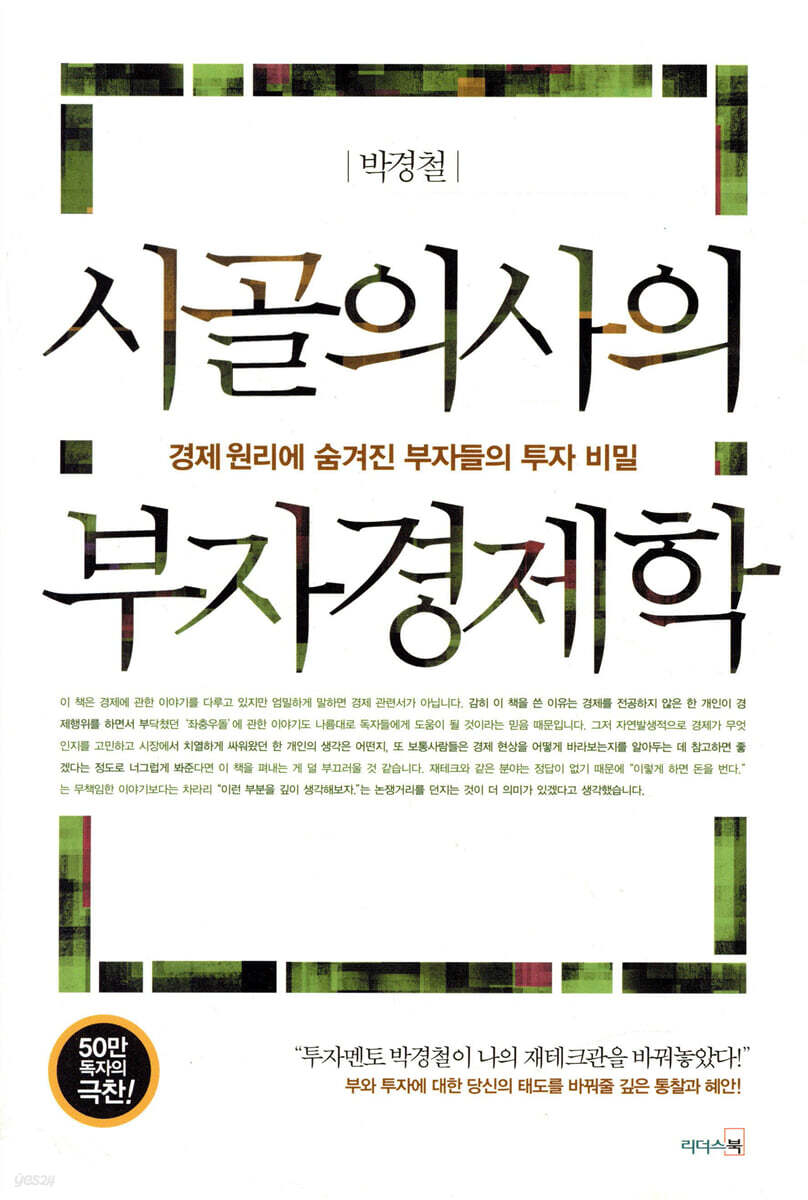
The Country Doctor's Economics of Wealth
 |
Description
Book Introduction
This is a revised edition of “The Country Doctor’s Wealthy Economics,” which was published in 2006 and was greatly loved by readers.
I urge you to abandon shallow investment thinking and adopt a three-dimensional, macroscopic perspective on economics and finance.
From economic structure and phenomena, interest rate philosophy and knowledge, to how to raise seed money, and real estate and securities investment strategies, you can learn the "basics and principles" of financial management that every investor must know.
The first half contains the basic principles that must be observed and understood regardless of any phenomenon, while the second half contains a long-term outlook on what kind of market will open in the long term based on the social structure.
This book, the first investment book published by Dr. Park Kyung-cheol, a surgeon and also famous by his pen name, 'Country Doctor', points out that 'making 1 billion won', which is the goal of ordinary people's financial management, is instilling misunderstandings and prejudices about financial management in us, and says that it is more important to develop an eye for economic phenomena than to develop financial management strategies.
The author also states that “a rich person is someone who views economic phenomena based on interest rates,” and in the book, he reveals the economic laws of the rich that ordinary investors should pay attention to in order to succeed in financial management.
I urge you to abandon shallow investment thinking and adopt a three-dimensional, macroscopic perspective on economics and finance.
From economic structure and phenomena, interest rate philosophy and knowledge, to how to raise seed money, and real estate and securities investment strategies, you can learn the "basics and principles" of financial management that every investor must know.
The first half contains the basic principles that must be observed and understood regardless of any phenomenon, while the second half contains a long-term outlook on what kind of market will open in the long term based on the social structure.
This book, the first investment book published by Dr. Park Kyung-cheol, a surgeon and also famous by his pen name, 'Country Doctor', points out that 'making 1 billion won', which is the goal of ordinary people's financial management, is instilling misunderstandings and prejudices about financial management in us, and says that it is more important to develop an eye for economic phenomena than to develop financial management strategies.
The author also states that “a rich person is someone who views economic phenomena based on interest rates,” and in the book, he reveals the economic laws of the rich that ordinary investors should pay attention to in order to succeed in financial management.
- You can preview some of the book's contents.
Preview
index
Republishing this book
Introduction
Part 1: The Philosophy and Logic of the Rich
-
1.
What is the standard for wealth?
What kind of people are rich? | How to become rich | Three criteria for financial management.
2.
How is wealth formed?
Understanding Added Value | Added Value Is Distributed Based on Financial Knowledge | Knowledge of Interest Rates Makes You Rich
3.
How the Rich Invest
The Logic of the Rich, the Logic of the Poor 1: Greed that Glances Sideways at the World | The Logic of the Rich, the Logic of the Poor 2: A Peaceful Mind That Cannot Be Maintained Until the End | The Logic of the Rich, the Logic of the Poor 3: A Thinking Accustomed to Decline | Act and Judge Contrary to the Rich | The Behavioral Patterns of the Rich
Part 2: Basic Principles of Wealth Economics
-
4.
The Two Axis of Investment: Interest Rates and Inflation
Kostolany's Egg Model: Interest Rates and Investment Decisions | Inflation Threatens Asset Values | You'll Break Even, So Just Stay Still | Is Interest Rate Investing a Never-ending Battle? | Inflation Drives Compound Interest, Interest Rates Drive Simple Interest | Interest Rate Movements | Bonds are a Product Bought and Sold by Predicting Interest Rates and the Economy | Lessons from the Bond Market
5.
Are you an investor or a speculator?
Is investing healthy, and speculation greedy? | Interest rate philosophy separates investors from speculators.
6.
How are 'cheap' and 'expensive' determined?
Fundamentals of Investing: Market Prices | Prices Reflect Psychological Imbalances | Two Criteria for Evaluating Market Prices
7.
Price Logic You Need to Know for Winning Investments
The Core of Investment Decisions: Judging Fair Value | How the Average Changes | Psychology Responds to Price Changes | The Characteristics of Information That Influences Prices
8.
Inflation and asset values
Stocks and real estate: The equilibrium between inflation and asset values | Understand even invisible values | The price of all assets follows the principles of supply and demand | Art prices follow a pattern similar to the inflation rate
9.
Is long-term investing a sure-win game?
The top priority for long-term investing is interest rate investing | Benchmark investment vehicles, interest rates | Are you confident you can generate returns above the interest rate? | Long-term investments that keep pace with the economy's growing pie.
10.
Why Short-Term Investments Fail
The nightmare of trading costs | Beginner's luck can turn into misfortune | Long-term investing requires planning and control
11.
Now it's a battle of returns
How long does it take to accumulate 1 billion won? | Why rates of return are important? | What percentage of returns do you earn per month? | Investing in a stagnant economy is about ratios, not quantities. | Countries that will join the rate of return game. | Short-term opportunities brought about by the rate of return game.
12.
Creating seed money for investing
The Need for Seed Funding | Preparing for Investment: Securing Seed Funding | How to Build Seed Funding | Don't Forget Banks to Build Seed Funding | Banking Products with Low Returns but Protecting Asset Value | Risk-Aware Banking Products | Risk Differences Among Seed Funding Products
Part 3: The Economics of the Rich for Investment
-
13.
How to Invest in Real Estate
Population Structure and Asset Value | How Long Will Baby Boomers' Economic Power and Purchasing Power Last? | Real Estate Investment Outlook | Market Logic in the Seoul Metropolitan Area | The Future of the Seoul Metropolitan Area: Future Development Potential | Real Estate Purchase Strategies in the Seoul Metropolitan Area | Changing Factors Affecting the Real Estate Market | How Long Will Apartment Prices Continue to Soar?
14.
How to Invest in the Changing Stock Market
The 386 Generation Driving Change in the Asset Market | Money Is Flooding the Stock Market | The Undeniable Capital of Retailers | The Fundamental Reasons Behind the US Stock Market's Tenfold Rise | Low Interest Rates Without Inflation | Risk Factors Hindering Stock Market Growth | Bubbles Amid Explosive Growth | Signals of Aggressive Inflows of Large Funds into the Stock Market
15.
How to Invest in Soaring Real Assets
Liquidity-Based Asset Price Surges | The Synchronous Movement of Stock Markets, Interest Rates, Real Estate, and Gold | Real Estate Investment Strategies for Individual Investors
16.
Let go of your prejudices and misconceptions about investing.
The Pitfalls of Long-Term Investment Products | Risks the Unwealthy Must Take | Misconceptions About Investment
17.
How to structure your portfolio
Portfolio for Profitability | Should I Include Foreign Real Estate? | Should I Include Foreign Stocks?
18.
Keep an eye out for new opportunities and first-time products.
Business starts where there's profit potential | Pay attention to new products | Pay attention to new movements in the asset market | Avoid being overwhelmed by information.
Introduction
Part 1: The Philosophy and Logic of the Rich
-
1.
What is the standard for wealth?
What kind of people are rich? | How to become rich | Three criteria for financial management.
2.
How is wealth formed?
Understanding Added Value | Added Value Is Distributed Based on Financial Knowledge | Knowledge of Interest Rates Makes You Rich
3.
How the Rich Invest
The Logic of the Rich, the Logic of the Poor 1: Greed that Glances Sideways at the World | The Logic of the Rich, the Logic of the Poor 2: A Peaceful Mind That Cannot Be Maintained Until the End | The Logic of the Rich, the Logic of the Poor 3: A Thinking Accustomed to Decline | Act and Judge Contrary to the Rich | The Behavioral Patterns of the Rich
Part 2: Basic Principles of Wealth Economics
-
4.
The Two Axis of Investment: Interest Rates and Inflation
Kostolany's Egg Model: Interest Rates and Investment Decisions | Inflation Threatens Asset Values | You'll Break Even, So Just Stay Still | Is Interest Rate Investing a Never-ending Battle? | Inflation Drives Compound Interest, Interest Rates Drive Simple Interest | Interest Rate Movements | Bonds are a Product Bought and Sold by Predicting Interest Rates and the Economy | Lessons from the Bond Market
5.
Are you an investor or a speculator?
Is investing healthy, and speculation greedy? | Interest rate philosophy separates investors from speculators.
6.
How are 'cheap' and 'expensive' determined?
Fundamentals of Investing: Market Prices | Prices Reflect Psychological Imbalances | Two Criteria for Evaluating Market Prices
7.
Price Logic You Need to Know for Winning Investments
The Core of Investment Decisions: Judging Fair Value | How the Average Changes | Psychology Responds to Price Changes | The Characteristics of Information That Influences Prices
8.
Inflation and asset values
Stocks and real estate: The equilibrium between inflation and asset values | Understand even invisible values | The price of all assets follows the principles of supply and demand | Art prices follow a pattern similar to the inflation rate
9.
Is long-term investing a sure-win game?
The top priority for long-term investing is interest rate investing | Benchmark investment vehicles, interest rates | Are you confident you can generate returns above the interest rate? | Long-term investments that keep pace with the economy's growing pie.
10.
Why Short-Term Investments Fail
The nightmare of trading costs | Beginner's luck can turn into misfortune | Long-term investing requires planning and control
11.
Now it's a battle of returns
How long does it take to accumulate 1 billion won? | Why rates of return are important? | What percentage of returns do you earn per month? | Investing in a stagnant economy is about ratios, not quantities. | Countries that will join the rate of return game. | Short-term opportunities brought about by the rate of return game.
12.
Creating seed money for investing
The Need for Seed Funding | Preparing for Investment: Securing Seed Funding | How to Build Seed Funding | Don't Forget Banks to Build Seed Funding | Banking Products with Low Returns but Protecting Asset Value | Risk-Aware Banking Products | Risk Differences Among Seed Funding Products
Part 3: The Economics of the Rich for Investment
-
13.
How to Invest in Real Estate
Population Structure and Asset Value | How Long Will Baby Boomers' Economic Power and Purchasing Power Last? | Real Estate Investment Outlook | Market Logic in the Seoul Metropolitan Area | The Future of the Seoul Metropolitan Area: Future Development Potential | Real Estate Purchase Strategies in the Seoul Metropolitan Area | Changing Factors Affecting the Real Estate Market | How Long Will Apartment Prices Continue to Soar?
14.
How to Invest in the Changing Stock Market
The 386 Generation Driving Change in the Asset Market | Money Is Flooding the Stock Market | The Undeniable Capital of Retailers | The Fundamental Reasons Behind the US Stock Market's Tenfold Rise | Low Interest Rates Without Inflation | Risk Factors Hindering Stock Market Growth | Bubbles Amid Explosive Growth | Signals of Aggressive Inflows of Large Funds into the Stock Market
15.
How to Invest in Soaring Real Assets
Liquidity-Based Asset Price Surges | The Synchronous Movement of Stock Markets, Interest Rates, Real Estate, and Gold | Real Estate Investment Strategies for Individual Investors
16.
Let go of your prejudices and misconceptions about investing.
The Pitfalls of Long-Term Investment Products | Risks the Unwealthy Must Take | Misconceptions About Investment
17.
How to structure your portfolio
Portfolio for Profitability | Should I Include Foreign Real Estate? | Should I Include Foreign Stocks?
18.
Keep an eye out for new opportunities and first-time products.
Business starts where there's profit potential | Pay attention to new products | Pay attention to new movements in the asset market | Avoid being overwhelmed by information.
Into the book
Although this book deals with economics, strictly speaking it is not an economics book.
However, I believe that the story of the 'trials and tribulations' that an individual who did not major in economics encountered while engaging in economic activities will be helpful to readers in its own way.
Having experienced both success and failure in investment for over 20 years, I've naturally pondered the economics of an individual who has fought fiercely in the market. Understanding the perspectives of this individual, as well as how ordinary people view economic phenomena, will be helpful in your investing.
The money-making principles and methods for becoming rich that we commonly encounter these days block the reader's ability to think for themselves, regardless of whether the content is right or wrong.
So, regardless of whether the content in this book is right or wrong, I wanted to make it a bit challenging to read and leave room for reflection.
As with other aspects of life, there are no right answers in fields like financial investment. Therefore, I believe it's meaningful to raise the issue of "Let's think deeply about this" rather than "This is how you make money."
---From the 'Introduction'
A Country Doctor's Investment Notes
The standard for being rich is not 1 billion or 2 billion.
Rich people are those who are not interested in increasing their wealth and have no need for more wealth.
From this perspective, are you wealthy? If you can't answer "yes" to this question, then before seeking ways to become wealthy, you should first consider, "Why do I need to become wealthy?" "What is my desired wealth level?" "What is the basis for that?"
How to become rich and how to maintain it will be something we must consider later. ---p.28, Chapter 1 What are the criteria for being rich?
The best way to make money in our country is real estate, and these days, stocks seem to be the best.
However, when evaluated based on the cumulative returns over 20 years, the results are unexpected.
Borrowing money to invest means taking on a certain amount of risk, and consistently earning 10 percent in profit by borrowing money at an interest rate of 3 percent is not as easy as it sounds.
Therefore, investing in interest rates that slightly exceed the inflation rate is always a safe investment, providing some level of sustained compound interest. ---p.36, Chapter 2: How Wealth Is Formed
Anyone with common sense would normally maintain a calm mind about financial investment.
He rarely listens to what others say, and even if he is tempted, he is not easily moved.
But deep down, I am sensitive to changes in the surrounding circumstances and am constantly stressed.
For example, an ordinary salaryman who has always believed that saving is the best way to manage his finances starts to feel anxious as he starts to see more and more people around him who have made money through real estate investment, and as real estate investment anecdotes start to make the news.
In the end, they lose their composure at the last minute and end up jumping into financial investment.
When they jump into the investment game, they don't realize that the game has already gone through a full cycle: the dominant players who bought at low prices, the talented investors who jumped on the bandwagon early on, and the savvy investors who jumped on the bandwagon late on. ---pp. 43-44, Chapter 3: How the Rich Invest
Selling something when you think it's cheap or buying something when you think it's expensive cannot happen under normal circumstances.
Price is always formed as a result of the conflict between expensive and cheap.
In other words, in the commerce that humans have been engaged in since the beginning of time, the moment a sale takes place is always a conflict between cheap and expensive, and at that moment, one of the two will clearly end up making a loss-making transaction.
A good merchant is one who buys what he thinks is cheap and sells it at a price he thinks is expensive; a bad merchant is one who buys what he thinks is cheap and sells it at a price he thinks is cheap.
Technical analysis is the result of human effort to quantify these intuitive judgments of "expensive" and "cheap." ---p.107, Chapter 6: How Are "Cheap" and "Expensive" Determined?
If you want to open a restaurant, look at Pulmuone. If you want to open a bar, look at Doosan. If you want to open a casino, look at Kangwon Land. If you want to try manufacturing, look at companies that are related to that.
Since you already overestimate yourself enough to want to try that business, it shouldn't be too difficult to look into the potential of a company that already operates in that business.
If the company is not doing well, is not generating returns above its interest rate value, or is not demonstrating leverage, give up without hesitation.
However, if the company meets the criteria you initially considered, stick with it until the end.
That's long-term investing.
In other words, long-term investment in stocks means effectively managing the company on behalf of others and focusing on the operating value and assets of the company in which I am a shareholder. ---p.152, Chapter 9: Is long-term investment a game that guarantees a sure win?
If you can't achieve your goal of 1 billion won in retirement savings through normal, ordinary means, then your next option is to take a risk.
However, when the idea that "if you can't achieve it anyway, take a moderate risk" becomes widespread, what level of "moderate" really means? Paradoxically, this is where the rich and poor begin to diverge in their views on financial management.
The rich don't need to take risks because 1 billion won is not a goal that is 'unreachable anyway', while the poor choose extreme risks with the mindset that 'if I can't reach it anyway, I'll gamble.'
In other words, the lower the feasibility of a goal, the greater the tendency to take risks.
In fact, this is quite paradoxical.
Despite this clear correlation between investment and risk, in actual investment, the rich remain wealthy by avoiding risk, while the poor, by easily taking on risk, often fall into the abyss. ---p.170, Chapter 11: Now, it's a battle for returns.
Currently, policies to increase or decrease the supply of apartments are both factors that disrupt the rise in real estate prices, and neither is the right answer.
Now, if you increase supply, the price will rise, and if you decrease supply, the price will rise.
Contrary to popular belief, increasing the supply of apartments now could actually lead to a plunge in future asset prices. Conversely, if supply is not increased significantly as it is now, it will be difficult to dispel current expectations of rising prices.
Ultimately, policies can be right or wrong depending on the situation, but the market is always right.
Even without the pressure of taxes, our country's real estate market will continue to be strong for a short period of time, but soon, as the asset market changes, prices will peak and return to their original level.
However, I believe that the story of the 'trials and tribulations' that an individual who did not major in economics encountered while engaging in economic activities will be helpful to readers in its own way.
Having experienced both success and failure in investment for over 20 years, I've naturally pondered the economics of an individual who has fought fiercely in the market. Understanding the perspectives of this individual, as well as how ordinary people view economic phenomena, will be helpful in your investing.
The money-making principles and methods for becoming rich that we commonly encounter these days block the reader's ability to think for themselves, regardless of whether the content is right or wrong.
So, regardless of whether the content in this book is right or wrong, I wanted to make it a bit challenging to read and leave room for reflection.
As with other aspects of life, there are no right answers in fields like financial investment. Therefore, I believe it's meaningful to raise the issue of "Let's think deeply about this" rather than "This is how you make money."
---From the 'Introduction'
A Country Doctor's Investment Notes
The standard for being rich is not 1 billion or 2 billion.
Rich people are those who are not interested in increasing their wealth and have no need for more wealth.
From this perspective, are you wealthy? If you can't answer "yes" to this question, then before seeking ways to become wealthy, you should first consider, "Why do I need to become wealthy?" "What is my desired wealth level?" "What is the basis for that?"
How to become rich and how to maintain it will be something we must consider later. ---p.28, Chapter 1 What are the criteria for being rich?
The best way to make money in our country is real estate, and these days, stocks seem to be the best.
However, when evaluated based on the cumulative returns over 20 years, the results are unexpected.
Borrowing money to invest means taking on a certain amount of risk, and consistently earning 10 percent in profit by borrowing money at an interest rate of 3 percent is not as easy as it sounds.
Therefore, investing in interest rates that slightly exceed the inflation rate is always a safe investment, providing some level of sustained compound interest. ---p.36, Chapter 2: How Wealth Is Formed
Anyone with common sense would normally maintain a calm mind about financial investment.
He rarely listens to what others say, and even if he is tempted, he is not easily moved.
But deep down, I am sensitive to changes in the surrounding circumstances and am constantly stressed.
For example, an ordinary salaryman who has always believed that saving is the best way to manage his finances starts to feel anxious as he starts to see more and more people around him who have made money through real estate investment, and as real estate investment anecdotes start to make the news.
In the end, they lose their composure at the last minute and end up jumping into financial investment.
When they jump into the investment game, they don't realize that the game has already gone through a full cycle: the dominant players who bought at low prices, the talented investors who jumped on the bandwagon early on, and the savvy investors who jumped on the bandwagon late on. ---pp. 43-44, Chapter 3: How the Rich Invest
Selling something when you think it's cheap or buying something when you think it's expensive cannot happen under normal circumstances.
Price is always formed as a result of the conflict between expensive and cheap.
In other words, in the commerce that humans have been engaged in since the beginning of time, the moment a sale takes place is always a conflict between cheap and expensive, and at that moment, one of the two will clearly end up making a loss-making transaction.
A good merchant is one who buys what he thinks is cheap and sells it at a price he thinks is expensive; a bad merchant is one who buys what he thinks is cheap and sells it at a price he thinks is cheap.
Technical analysis is the result of human effort to quantify these intuitive judgments of "expensive" and "cheap." ---p.107, Chapter 6: How Are "Cheap" and "Expensive" Determined?
If you want to open a restaurant, look at Pulmuone. If you want to open a bar, look at Doosan. If you want to open a casino, look at Kangwon Land. If you want to try manufacturing, look at companies that are related to that.
Since you already overestimate yourself enough to want to try that business, it shouldn't be too difficult to look into the potential of a company that already operates in that business.
If the company is not doing well, is not generating returns above its interest rate value, or is not demonstrating leverage, give up without hesitation.
However, if the company meets the criteria you initially considered, stick with it until the end.
That's long-term investing.
In other words, long-term investment in stocks means effectively managing the company on behalf of others and focusing on the operating value and assets of the company in which I am a shareholder. ---p.152, Chapter 9: Is long-term investment a game that guarantees a sure win?
If you can't achieve your goal of 1 billion won in retirement savings through normal, ordinary means, then your next option is to take a risk.
However, when the idea that "if you can't achieve it anyway, take a moderate risk" becomes widespread, what level of "moderate" really means? Paradoxically, this is where the rich and poor begin to diverge in their views on financial management.
The rich don't need to take risks because 1 billion won is not a goal that is 'unreachable anyway', while the poor choose extreme risks with the mindset that 'if I can't reach it anyway, I'll gamble.'
In other words, the lower the feasibility of a goal, the greater the tendency to take risks.
In fact, this is quite paradoxical.
Despite this clear correlation between investment and risk, in actual investment, the rich remain wealthy by avoiding risk, while the poor, by easily taking on risk, often fall into the abyss. ---p.170, Chapter 11: Now, it's a battle for returns.
Currently, policies to increase or decrease the supply of apartments are both factors that disrupt the rise in real estate prices, and neither is the right answer.
Now, if you increase supply, the price will rise, and if you decrease supply, the price will rise.
Contrary to popular belief, increasing the supply of apartments now could actually lead to a plunge in future asset prices. Conversely, if supply is not increased significantly as it is now, it will be difficult to dispel current expectations of rising prices.
Ultimately, policies can be right or wrong depending on the situation, but the market is always right.
Even without the pressure of taxes, our country's real estate market will continue to be strong for a short period of time, but soon, as the asset market changes, prices will peak and return to their original level.
---p.215, Chapter 13: How to Invest in Real Estate
Publisher's Review
“Investment mentor Park Kyung-chul changed my perspective on financial management!”
The bible of financial management, “The Country Doctor’s Wealthy Economics,” which has been highly praised by 500,000 readers,
Meet our readers again with a new cover!
How to overcome the global financial crisis?
“Don’t base your decisions on expectations, look at the principles!”
Deep insights and foresight that will change your attitude towards wealth and investing.
Meet "The Country Doctor's Wealthy Economics" in a new form!
Rave reviews from 500,000 readers since its first publication!
"A Country Doctor's Wealthy Economics" reveals the principles of wealth and investment that country doctor Park Kyung-cheol has learned through over 20 years of success and failure.
Since its first publication in July 2006, it has become an exceptionally long-term bestseller, receiving rave reviews from 500,000 readers.
This book urges us to abandon shallow investment theories and adopt a three-dimensional, macroscopic perspective on economics and finance.
From economic structure and phenomena, interest rate philosophy and knowledge, to how to raise seed money, and real estate and securities investment strategies, you can learn the "basics and principles" of financial management that every investor must know.
The first half contains the basic principles that must be observed and understood regardless of any phenomenon, while the second half contains a long-term outlook on what kind of market will open in the long term based on the social structure.
The author states, “The principles in the first half of this book were written with the hope that readers would read it and add their own interpretations and opinions to create their own standards. The second half contains the author’s outlook on social structural change, so I hope you will use it as a negative example or reference.”
New faces, but unchanging principles!
In October 2011, when the book was republished with a new cover, the author added another comment:
That the manuscript of the first edition was not changed.
It is not an idle stubbornness, but a belief that principles do not change with the times.
“If I were to change the outlook for the latter half of the book to something more plausible and keep revising it to keep up with the times, my book would always be perceived as referring to the present, which would be contrary to the original intention of writing this book.
In other words, this book is one that takes into account both unchanging principles and the constant trial and error that we encounter.”
Today, the Earth is rapidly aging, the vitality of Japan and the United States is rapidly declining, and the economies of developed countries and Europe are ailing, with national finances in ruins.
However, this book emphasizes that in situations like this, “don’t base your decisions on forecasts, but on principles.”
In any case, if you look at the principles, you will see the answer, but if you only look at the phenomenon, you will be shaken like a leaf blown by the wind.
Therefore, I believe that "The Country Doctor's Wealthy Economics" will certainly help readers recognize the importance of principles and make the best decisions based on them amid the dark clouds of the global financial crisis. I would like to express my deepest gratitude to the 500,000 readers who have loved this book so far, and to future readers who will encounter it in the future.
The rich view economic phenomena based on interest rates.
Have you ever been told that savings accounts are the trend, so you broke your savings to join a fund, only to see the stock prices plummet? Or have you ever been told that the basics of financial management is to buy a home, so you took out a loan to buy an apartment, only to be miserable because the apartment price never went up?
If you have such experience, let's learn the basics of investing from scratch with "The Country Doctor's Wealthy Economics."
This book is the first investment book published by Dr. Park Kyung-cheol, a surgeon and also famous by the pen name “Country Doctor.”
His insight and writing skills are already renowned, to the point that it is said that no one in the securities industry can so eloquently express his rich humanistic perspective and market insight.
In this book, Park Kyung-chul points out that the goal of ordinary people in their financial management is to "make 1 billion won," which is causing us to misunderstand and prejudice about financial management. He says that it is more important to develop an eye for economic phenomena than to develop financial management strategies.
The author also states that “a rich person is someone who views economic phenomena based on interest rates,” and in the book, he reveals the economic laws of the rich that ordinary investors should pay attention to in order to succeed in financial management.
How to become rich
The greatest wish of ordinary people in our time is to become 'rich'.
That's why books containing the investment methods of the rich always catch the attention of people who want to become rich.
However, the author says that before finding a 'get rich investing method', you must first understand the following three criteria.
First, establish your own standards of wealth that will satisfy you.
The first step in investing is to consider how much of your total wealth you no longer need to increase.
If you don't want to live your whole life as a slave to money, you need to set goals that satisfy you regardless of how much other people have.
Second, strive to improve your abilities and increase your asset value.
It's important to create skills and work that are stable, long-lasting, and will be recognized for their value in the future, if possible.
It is wiser to become rich by increasing your own value than to become rich by investing.
Third, retirement funds should be approached with the concept of increasing the rate of return on investment.
Especially if you think your asset value is weak, you should definitely approach retirement funds with the concept of ratio.
'Rate of return' is more important than 'many a little makes a mickle'
In both the US and Korea, the investment vehicles that have produced the highest returns on a 1 million won investment over the past 100 years are, in order, compound interest deposits, bonds, real estate, and stocks.
In our country, the best way to make money is real estate, and these days, stocks may seem like the best, but even when evaluated based on 20 years of cumulative returns, compound interest deposits were the best.
So, will compound interest deposits continue to be the best investment vehicle? This is precisely why the author wrote this book.
Even though the United States' basic industrial infrastructure has been largely destroyed, it maintains a vast amount of industrial infrastructure through the value of its holdings worldwide.
The author emphasizes that Korea's existing industrial structure, which relies on land and human resources, will shift to the fourth industrial revolution, namely the investment finance industry, and that financial investment should now be approached with the concept of ratio, not quantity.
The concept of ratio is to increase the rate of return.
If you save 1 million won at an annual interest rate of 5%, it will take 70 years to accumulate 1 billion won, but if you entrust your money to an investment vehicle with an annual return of 15%, the period is shortened to 35 years.
The sector with the highest added value going forward will be the investment finance industry.
When competing for profit over land, the profits go to those who work hard to farm or maintain production facilities, but when making money by rolling money, the added value is distributed according to one's understanding of the economy and ability to handle finance.
If you want to get rich, you need to increase your returns, and if you want to make high-yield investments, you need to see through the flow of money.
The rich are those who have mastered this trend, and this is why you need to know 'The Economics of the Rich'.
An in-depth investment book encompassing economic history and philosophy.
Unlike existing investment books that say, “If you do this, you will make money,” the author describes investment principles and strategies in a way that asks, “Let’s think deeply about this.”
Rather than simply pointing out promising stocks or promising development sites, it helps develop an eye for reading the overall market through supply and demand and price logic.
Furthermore, by explaining investment principles while tracing the development of the economy and industry, the book leaves readers with room for self-reflection, and the author's unique interpretation of money and profound insight into wealth stand out.
This book, consisting of three parts, covers the principles of wealth creation and the investment decision-making logic of the wealthy in Part 1, while Part 2 covers nine basic principles that must be remembered before investing.
The final three parts contain investment outlook and strategies.
The bible of financial management, “The Country Doctor’s Wealthy Economics,” which has been highly praised by 500,000 readers,
Meet our readers again with a new cover!
How to overcome the global financial crisis?
“Don’t base your decisions on expectations, look at the principles!”
Deep insights and foresight that will change your attitude towards wealth and investing.
Meet "The Country Doctor's Wealthy Economics" in a new form!
Rave reviews from 500,000 readers since its first publication!
"A Country Doctor's Wealthy Economics" reveals the principles of wealth and investment that country doctor Park Kyung-cheol has learned through over 20 years of success and failure.
Since its first publication in July 2006, it has become an exceptionally long-term bestseller, receiving rave reviews from 500,000 readers.
This book urges us to abandon shallow investment theories and adopt a three-dimensional, macroscopic perspective on economics and finance.
From economic structure and phenomena, interest rate philosophy and knowledge, to how to raise seed money, and real estate and securities investment strategies, you can learn the "basics and principles" of financial management that every investor must know.
The first half contains the basic principles that must be observed and understood regardless of any phenomenon, while the second half contains a long-term outlook on what kind of market will open in the long term based on the social structure.
The author states, “The principles in the first half of this book were written with the hope that readers would read it and add their own interpretations and opinions to create their own standards. The second half contains the author’s outlook on social structural change, so I hope you will use it as a negative example or reference.”
New faces, but unchanging principles!
In October 2011, when the book was republished with a new cover, the author added another comment:
That the manuscript of the first edition was not changed.
It is not an idle stubbornness, but a belief that principles do not change with the times.
“If I were to change the outlook for the latter half of the book to something more plausible and keep revising it to keep up with the times, my book would always be perceived as referring to the present, which would be contrary to the original intention of writing this book.
In other words, this book is one that takes into account both unchanging principles and the constant trial and error that we encounter.”
Today, the Earth is rapidly aging, the vitality of Japan and the United States is rapidly declining, and the economies of developed countries and Europe are ailing, with national finances in ruins.
However, this book emphasizes that in situations like this, “don’t base your decisions on forecasts, but on principles.”
In any case, if you look at the principles, you will see the answer, but if you only look at the phenomenon, you will be shaken like a leaf blown by the wind.
Therefore, I believe that "The Country Doctor's Wealthy Economics" will certainly help readers recognize the importance of principles and make the best decisions based on them amid the dark clouds of the global financial crisis. I would like to express my deepest gratitude to the 500,000 readers who have loved this book so far, and to future readers who will encounter it in the future.
The rich view economic phenomena based on interest rates.
Have you ever been told that savings accounts are the trend, so you broke your savings to join a fund, only to see the stock prices plummet? Or have you ever been told that the basics of financial management is to buy a home, so you took out a loan to buy an apartment, only to be miserable because the apartment price never went up?
If you have such experience, let's learn the basics of investing from scratch with "The Country Doctor's Wealthy Economics."
This book is the first investment book published by Dr. Park Kyung-cheol, a surgeon and also famous by the pen name “Country Doctor.”
His insight and writing skills are already renowned, to the point that it is said that no one in the securities industry can so eloquently express his rich humanistic perspective and market insight.
In this book, Park Kyung-chul points out that the goal of ordinary people in their financial management is to "make 1 billion won," which is causing us to misunderstand and prejudice about financial management. He says that it is more important to develop an eye for economic phenomena than to develop financial management strategies.
The author also states that “a rich person is someone who views economic phenomena based on interest rates,” and in the book, he reveals the economic laws of the rich that ordinary investors should pay attention to in order to succeed in financial management.
How to become rich
The greatest wish of ordinary people in our time is to become 'rich'.
That's why books containing the investment methods of the rich always catch the attention of people who want to become rich.
However, the author says that before finding a 'get rich investing method', you must first understand the following three criteria.
First, establish your own standards of wealth that will satisfy you.
The first step in investing is to consider how much of your total wealth you no longer need to increase.
If you don't want to live your whole life as a slave to money, you need to set goals that satisfy you regardless of how much other people have.
Second, strive to improve your abilities and increase your asset value.
It's important to create skills and work that are stable, long-lasting, and will be recognized for their value in the future, if possible.
It is wiser to become rich by increasing your own value than to become rich by investing.
Third, retirement funds should be approached with the concept of increasing the rate of return on investment.
Especially if you think your asset value is weak, you should definitely approach retirement funds with the concept of ratio.
'Rate of return' is more important than 'many a little makes a mickle'
In both the US and Korea, the investment vehicles that have produced the highest returns on a 1 million won investment over the past 100 years are, in order, compound interest deposits, bonds, real estate, and stocks.
In our country, the best way to make money is real estate, and these days, stocks may seem like the best, but even when evaluated based on 20 years of cumulative returns, compound interest deposits were the best.
So, will compound interest deposits continue to be the best investment vehicle? This is precisely why the author wrote this book.
Even though the United States' basic industrial infrastructure has been largely destroyed, it maintains a vast amount of industrial infrastructure through the value of its holdings worldwide.
The author emphasizes that Korea's existing industrial structure, which relies on land and human resources, will shift to the fourth industrial revolution, namely the investment finance industry, and that financial investment should now be approached with the concept of ratio, not quantity.
The concept of ratio is to increase the rate of return.
If you save 1 million won at an annual interest rate of 5%, it will take 70 years to accumulate 1 billion won, but if you entrust your money to an investment vehicle with an annual return of 15%, the period is shortened to 35 years.
The sector with the highest added value going forward will be the investment finance industry.
When competing for profit over land, the profits go to those who work hard to farm or maintain production facilities, but when making money by rolling money, the added value is distributed according to one's understanding of the economy and ability to handle finance.
If you want to get rich, you need to increase your returns, and if you want to make high-yield investments, you need to see through the flow of money.
The rich are those who have mastered this trend, and this is why you need to know 'The Economics of the Rich'.
An in-depth investment book encompassing economic history and philosophy.
Unlike existing investment books that say, “If you do this, you will make money,” the author describes investment principles and strategies in a way that asks, “Let’s think deeply about this.”
Rather than simply pointing out promising stocks or promising development sites, it helps develop an eye for reading the overall market through supply and demand and price logic.
Furthermore, by explaining investment principles while tracing the development of the economy and industry, the book leaves readers with room for self-reflection, and the author's unique interpretation of money and profound insight into wealth stand out.
This book, consisting of three parts, covers the principles of wealth creation and the investment decision-making logic of the wealthy in Part 1, while Part 2 covers nine basic principles that must be remembered before investing.
The final three parts contain investment outlook and strategies.
GOODS SPECIFICS
- Date of issue: October 10, 2011
- Page count, weight, size: 408 pages | 153*224*30mm
- ISBN13: 9788901131221
- ISBN10: 8901131226
You may also like
카테고리
korean


korean

![GQ KOREA Mark (Monthly): December [2025]](http://librairie.coreenne.fr/cdn/shop/files/8ef265dbbfbf186523ed75ba7319009d.jpg?v=1765340328&width=3840)


