

Storytellers survive
 |
Description
Book Introduction
"Storytellers Survive" scientifically and psychologically analyzes the structure of stories to which humans instinctively respond, and presents a six-step "SUPERB Storytelling Design Method" that can be applied to business and leadership.
The author, who has worked for 25 years as a journalist, critic, and communications director for a global company, reveals that the essence of communication that moves people's hearts beyond data lies in "story," and provides specific guidance on how to create messages that are more persuasive and emotional than logic.
This book is a practical guide that can be widely applied not only to business communication such as meetings, proposals, and pitches, but also to team leadership, organizational persuasion, and story-based branding. It will gift a new language of persuasion to those who live in the age of story, moving beyond the age of logic.
The author, who has worked for 25 years as a journalist, critic, and communications director for a global company, reveals that the essence of communication that moves people's hearts beyond data lies in "story," and provides specific guidance on how to create messages that are more persuasive and emotional than logic.
This book is a practical guide that can be widely applied not only to business communication such as meetings, proposals, and pitches, but also to team leadership, organizational persuasion, and story-based branding. It will gift a new language of persuasion to those who live in the age of story, moving beyond the age of logic.
- You can preview some of the book's contents.
Preview
index
Preface: The Most Powerful Man in the World
Chapter 1.
Why did you fail to persuade?
Chapter 2.
The absolute rules of storytelling that have continued since the mythical age
Chapter 3.
Storytelling classes for working people
Chapter 4.
Why Your Presentation Isn't Engaging
Chapter 5. SUPERB Design: You Can Create a Great Story Too
Chapter 6.
How to Use Data to Add Flavor to Your Story
Chapter 7.
The Storyteller's Way of Thinking
Chapter 8.
Emotional Journey: Captivating Your Audience
Chapter 9.
Writers' Trade Secrets
Chapter 10.
In search of the story called 'me'
Conclusion: The best story always wins.
Chapter 1.
Why did you fail to persuade?
Chapter 2.
The absolute rules of storytelling that have continued since the mythical age
Chapter 3.
Storytelling classes for working people
Chapter 4.
Why Your Presentation Isn't Engaging
Chapter 5. SUPERB Design: You Can Create a Great Story Too
Chapter 6.
How to Use Data to Add Flavor to Your Story
Chapter 7.
The Storyteller's Way of Thinking
Chapter 8.
Emotional Journey: Captivating Your Audience
Chapter 9.
Writers' Trade Secrets
Chapter 10.
In search of the story called 'me'
Conclusion: The best story always wins.
Detailed image
Into the book
The human brain doesn't instinctively like facts and figures.
Of course, the brain is capable of logical reasoning, and is very good at it.
But this takes a lot of effort.
So most of us don't want to put much effort into logical reasoning unless there's a strong motivation (like having to earn money to pay our bills).
On the other hand, the story is easy to approach.
It seeps in naturally and before I know it, it becomes mine.
This process is completely effortless.
--- From Chapter 1, “Why You Fail to Persuade”
If you want to develop your argument using logical reasoning in a PowerPoint presentation, think again.
This approach only serves to trigger a deep-seated instinct in the audience to disagree with whatever you propose.
Because it brings back memories of arguments and fights.
So what approach might be more helpful? The primary reason storytelling is more effective than providing logical arguments is evident in research showing that patients with damage to the brain's emotional centers, which has rendered them unable to feel emotions, are unable to make decisions.
--- From Chapter 1, “Why You Fail to Persuade”
When communicating as a team, we need to shift our focus from asking, "What are we trying to say?" to asking, "What are we trying to achieve?"
Present the quest.
Any communication needs a clear quest and an identifiable purpose.
What do we want our audience to do after listening to our story? What do we want them to think? What do we want them to feel?
--- From Chapter 3, “Storytelling Class for Office Workers”
Research shows that when a new slide appears in a presentation, the audience focuses for about 5 to 6 seconds before shifting their attention and thinking about something else.
This is not because the presenter is boring, but because the human mind likes to wander.
If the presenter is very charismatic, he or she may be able to grab a little more attention, but the audience can only really be held for about 5 or 6 seconds.
--- From Chapter 4, “Why Your Presentation Isn’t Engaging”
Storytelling can be easily applied by following just six simple steps.
I named this step SUPERB.
These six steps can be used to structure a story, but they can also be applied to a wide range of business communications, from presentations and emails to speeches, text messages, and even city council addresses.
--- From Chapter 5, “SUPERB Model”
People make decisions based on emotional reactions rather than logic.
So, to persuade people, influence them, inspire them and change them, you have to create an emotional connection.
Storytelling is a very effective means of doing this.
--- From Chapter 8, “Emotional Journey: Captivating Your Audience”
The SUPERB model has endless benefits if used well.
Like a Swiss Army knife.
It helps you not only structure your stories and edit presentation materials and documents, but also organize meetings, navigate conversations, provide feedback, enhance team-building activities, and maintain a customer- or audience-centric approach to work.
Of course, the brain is capable of logical reasoning, and is very good at it.
But this takes a lot of effort.
So most of us don't want to put much effort into logical reasoning unless there's a strong motivation (like having to earn money to pay our bills).
On the other hand, the story is easy to approach.
It seeps in naturally and before I know it, it becomes mine.
This process is completely effortless.
--- From Chapter 1, “Why You Fail to Persuade”
If you want to develop your argument using logical reasoning in a PowerPoint presentation, think again.
This approach only serves to trigger a deep-seated instinct in the audience to disagree with whatever you propose.
Because it brings back memories of arguments and fights.
So what approach might be more helpful? The primary reason storytelling is more effective than providing logical arguments is evident in research showing that patients with damage to the brain's emotional centers, which has rendered them unable to feel emotions, are unable to make decisions.
--- From Chapter 1, “Why You Fail to Persuade”
When communicating as a team, we need to shift our focus from asking, "What are we trying to say?" to asking, "What are we trying to achieve?"
Present the quest.
Any communication needs a clear quest and an identifiable purpose.
What do we want our audience to do after listening to our story? What do we want them to think? What do we want them to feel?
--- From Chapter 3, “Storytelling Class for Office Workers”
Research shows that when a new slide appears in a presentation, the audience focuses for about 5 to 6 seconds before shifting their attention and thinking about something else.
This is not because the presenter is boring, but because the human mind likes to wander.
If the presenter is very charismatic, he or she may be able to grab a little more attention, but the audience can only really be held for about 5 or 6 seconds.
--- From Chapter 4, “Why Your Presentation Isn’t Engaging”
Storytelling can be easily applied by following just six simple steps.
I named this step SUPERB.
These six steps can be used to structure a story, but they can also be applied to a wide range of business communications, from presentations and emails to speeches, text messages, and even city council addresses.
--- From Chapter 5, “SUPERB Model”
People make decisions based on emotional reactions rather than logic.
So, to persuade people, influence them, inspire them and change them, you have to create an emotional connection.
Storytelling is a very effective means of doing this.
--- From Chapter 8, “Emotional Journey: Captivating Your Audience”
The SUPERB model has endless benefits if used well.
Like a Swiss Army knife.
It helps you not only structure your stories and edit presentation materials and documents, but also organize meetings, navigate conversations, provide feedback, enhance team-building activities, and maintain a customer- or audience-centric approach to work.
--- From the concluding remarks
Publisher's Review
The power of stories: more persuasive than logic and remembered longer than data.
One summer day in 1994, Steve Jobs asked his employees in the NeXT break room:
“Who is the most powerful person in the world?”
When the employees mentioned several names, he spoke firmly.
“You’re all wrong.
“The most powerful people in the world are storytellers.” Jobs, who was kicked out of Apple, the company he founded, for being obsessed with dictatorial communication, realized the power of storytelling to change people’s behavior and move the world while founding the animation company Pixar.
He later chose to move people with stories rather than logic, and as a result, he created the Apple myth, starting with the "Think Different" campaign.
"Storytellers Survive" is a book that explores how the "power of story" persuades people and changes behavior in our workplaces and businesses.
The author of this book, Mark Edwards, is a communications expert who has worked as a journalist and commentator for the Sunday Times for 25 years and has also written for The Economist, The Guardian, GQ, and Esquire.
Currently, he consults on leadership communications, presentation design, and brand story strategy for global corporations and public institutions, including Sony, AstraZeneca, and World Travel Market, helping organizations and leaders persuade the world through the language of story.
His experience and insight are considered the first attempt to organize “story structures that move people’s hearts” into practical language.
6 Steps to Transforming Actions Beyond Thought: The SUPERB Storytelling Design Method
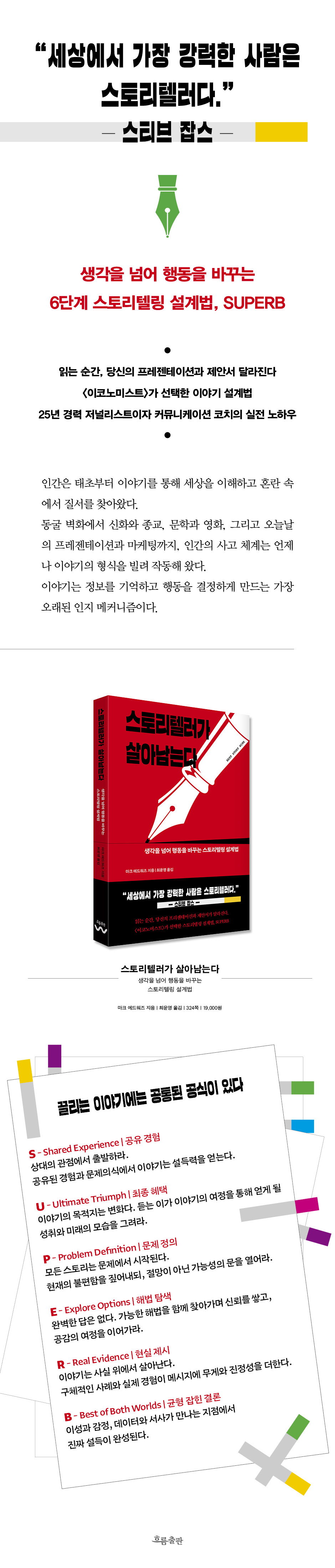
"Storytellers Survive" presents the "SUPERB Storytelling 6-Step Design Method," which reinterprets the structure of stories that humans have been instinctively drawn to since the mythical era into business language.
Since the beginning of time, humans have understood the world through stories and sought order in chaos.
From cave paintings to mythology and religion, literature and film, and even today's presentations and marketing, human thought has always functioned in the form of stories.
Stories are not just entertainment; they are one of the oldest cognitive mechanisms for remembering information and determining behavior.
Our brains respond more strongly to the rhythm and structure of a story than to logic.
Even from a neuroscientific perspective, stories provide special stimulation.
When only information is presented, only the language center is activated, but when listening to a story, the auditory, visual, emotional, and motor areas are activated simultaneously.
That is, we do not ‘hear’ the story, but ‘experience’ it.
As a result, stories are remembered much longer and drive action.
The reason someone's words stick in your mind is not because of their logic, but because they have a 'story structure'.
From ancient myths and epics to movies and commercials, all stories share a remarkably similar skeleton.
This book introduces Joseph Campbell's The Hero's Journey as a representative example.
The protagonist lives an ordinary life, encounters problems and trials, overcomes them, and achieves change and growth.
Humans feel intense empathy and catharsis from the repetition of this journey.
Because it is soon to be ‘our own story’.
Through stories, we constantly ask ourselves who we are, what we want, and how we should live.
The author reimagines this universal narrative structure to fit modern leadership and business practices.
This is the SUPERB 6-step design method.
Shared Experience ─ Start from the other person's perspective.
Humans only feel immersed in stories they can empathize with.
The moment you share the other person's concerns and experiences, the story opens a new door to persuasion.
Ultimate Triumph ─ The story's destination is change.
The listener must envision the future achievements they will achieve through that journey.
Problem Definition ─ The starting point of a story is a ‘problem.’
The discomfort or conflict experienced by the protagonist becomes the starting point of empathy.
Explore Options ─ There is no perfect answer.
The story builds trust through the process of 'finding the way together.'
Real Evidence - Concrete examples and real-world experiences are more important than abstract words.
The story comes to life on top of reality.
Best of Both Worlds (Balanced Conclusion) ─ True persuasion is achieved where reason and emotion, data and narrative meet.
SUPERB is a story design method that fits the instinctive thinking patterns of humans.
We have evolved to respond to the rhythm of crisis and change, conflict and resolution.
Just as heroes in mythology overcome trials and grow, modern audiences find meaning in the process of starting from a problem and moving toward a solution.
That's why the announcements, marketing, and messages from leaders that resonate with us often take the form of stories.
Data persuades, but stories move.
Logic and data reach the brain, but stories reach the heart and lead to action and change.
In fact, when we listen to a story, our brain releases dopamine, which increases attention, and oxytocin, which strengthens trust and bonds.
The art of storytelling: longer than data and more powerful than logic.
"Storytellers Survive" explores the limitations of logic- and data-driven communication and why only stories can move people's hearts through an integrated perspective of science, psychology, language, and brand strategy.
The book shows how to apply the classic story structure to modern business to create “communication that is more persuasive than logic and more memorable than data.”
The age of logic is over.
Now is the era of stories.
The way we understand the world and persuade each other has always been through stories.
In the end, the people who survive in a world where communication is impossible are those who know how to design their own stories.
One summer day in 1994, Steve Jobs asked his employees in the NeXT break room:
“Who is the most powerful person in the world?”
When the employees mentioned several names, he spoke firmly.
“You’re all wrong.
“The most powerful people in the world are storytellers.” Jobs, who was kicked out of Apple, the company he founded, for being obsessed with dictatorial communication, realized the power of storytelling to change people’s behavior and move the world while founding the animation company Pixar.
He later chose to move people with stories rather than logic, and as a result, he created the Apple myth, starting with the "Think Different" campaign.
"Storytellers Survive" is a book that explores how the "power of story" persuades people and changes behavior in our workplaces and businesses.
The author of this book, Mark Edwards, is a communications expert who has worked as a journalist and commentator for the Sunday Times for 25 years and has also written for The Economist, The Guardian, GQ, and Esquire.
Currently, he consults on leadership communications, presentation design, and brand story strategy for global corporations and public institutions, including Sony, AstraZeneca, and World Travel Market, helping organizations and leaders persuade the world through the language of story.
His experience and insight are considered the first attempt to organize “story structures that move people’s hearts” into practical language.
6 Steps to Transforming Actions Beyond Thought: The SUPERB Storytelling Design Method
"Storytellers Survive" presents the "SUPERB Storytelling 6-Step Design Method," which reinterprets the structure of stories that humans have been instinctively drawn to since the mythical era into business language.
Since the beginning of time, humans have understood the world through stories and sought order in chaos.
From cave paintings to mythology and religion, literature and film, and even today's presentations and marketing, human thought has always functioned in the form of stories.
Stories are not just entertainment; they are one of the oldest cognitive mechanisms for remembering information and determining behavior.
Our brains respond more strongly to the rhythm and structure of a story than to logic.
Even from a neuroscientific perspective, stories provide special stimulation.
When only information is presented, only the language center is activated, but when listening to a story, the auditory, visual, emotional, and motor areas are activated simultaneously.
That is, we do not ‘hear’ the story, but ‘experience’ it.
As a result, stories are remembered much longer and drive action.
The reason someone's words stick in your mind is not because of their logic, but because they have a 'story structure'.
From ancient myths and epics to movies and commercials, all stories share a remarkably similar skeleton.
This book introduces Joseph Campbell's The Hero's Journey as a representative example.
The protagonist lives an ordinary life, encounters problems and trials, overcomes them, and achieves change and growth.
Humans feel intense empathy and catharsis from the repetition of this journey.
Because it is soon to be ‘our own story’.
Through stories, we constantly ask ourselves who we are, what we want, and how we should live.
The author reimagines this universal narrative structure to fit modern leadership and business practices.
This is the SUPERB 6-step design method.
Shared Experience ─ Start from the other person's perspective.
Humans only feel immersed in stories they can empathize with.
The moment you share the other person's concerns and experiences, the story opens a new door to persuasion.
Ultimate Triumph ─ The story's destination is change.
The listener must envision the future achievements they will achieve through that journey.
Problem Definition ─ The starting point of a story is a ‘problem.’
The discomfort or conflict experienced by the protagonist becomes the starting point of empathy.
Explore Options ─ There is no perfect answer.
The story builds trust through the process of 'finding the way together.'
Real Evidence - Concrete examples and real-world experiences are more important than abstract words.
The story comes to life on top of reality.
Best of Both Worlds (Balanced Conclusion) ─ True persuasion is achieved where reason and emotion, data and narrative meet.
SUPERB is a story design method that fits the instinctive thinking patterns of humans.
We have evolved to respond to the rhythm of crisis and change, conflict and resolution.
Just as heroes in mythology overcome trials and grow, modern audiences find meaning in the process of starting from a problem and moving toward a solution.
That's why the announcements, marketing, and messages from leaders that resonate with us often take the form of stories.
Data persuades, but stories move.
Logic and data reach the brain, but stories reach the heart and lead to action and change.
In fact, when we listen to a story, our brain releases dopamine, which increases attention, and oxytocin, which strengthens trust and bonds.
The art of storytelling: longer than data and more powerful than logic.
"Storytellers Survive" explores the limitations of logic- and data-driven communication and why only stories can move people's hearts through an integrated perspective of science, psychology, language, and brand strategy.
The book shows how to apply the classic story structure to modern business to create “communication that is more persuasive than logic and more memorable than data.”
The age of logic is over.
Now is the era of stories.
The way we understand the world and persuade each other has always been through stories.
In the end, the people who survive in a world where communication is impossible are those who know how to design their own stories.
GOODS SPECIFICS
- Date of issue: November 3, 2025
- Page count, weight, size: 324 pages | 428g | 140*210*21mm
- ISBN13: 9788965967668
- ISBN10: 896596766X
You may also like
카테고리
korean


korean

![GQ KOREA Mark (Monthly): December [2025]](http://librairie.coreenne.fr/cdn/shop/files/8ef265dbbfbf186523ed75ba7319009d.jpg?v=1765340328&width=3840)


